lower permian abo formation
345new mexico Geological Society Guidebook, 63rd field Conference, warm Springs region, 2012, p. 345-376.
THE LOWER PERMIAN ABO FORMATION IN THE FRA CRISTOBAL AND CABALLO MOUNTAINS, SIERRA COUNTY, NEW MEXICO
SpenCer G. lUCaS1, Karl Krainer2, Dan S. CHaneY3, william a. DimiCHele3, SebaStian VoiGt1, DaViD S berman4and amY C. HenriCi4
1new mexico museum of natural History and Science, 1801 mountain road n. w., albuquerque, nm 87104, [email protected]
2institute of Geology and paleontology, University of innsbruck, innrain 52, innsbruck, a-6020, austria
3Department of paleobiology, nmnH Smithsonian institution, washington, DC 20560
4Carnegie museum of natural History, Section of Vertebrate paleontology, pittsburgh, pennsylvania 15213
Abstract—in the fra Cristobal and Caballo mountains of Sierra County, new mexico, the lower permian (middle-upper wolfcampian) abo formation disconformably overlies the Upper pennsylvanian (newwellian) bursum formation or middle- Upper pennsylvanian (Desmoinesian-Virgilian) bar b formation and is conformably overlain by the lower permian (leon- ardian) arroyo de alamillo formation of the Yeso Group. the abo formation is 278-309 m thick and can be divided into two members: (1) lower, Scholle member, 43-75 m thick, mostly mudstone; and (2) upper, Cañon de espinoso member, 230-250 m thick, characterized by numerous sheet-like beds of sandstone. in the fra Cristobal and Caballo mountains, three complete measured sections of the abo formation exemplify this: red Gap in the fra Cristobal mountains and Saddle tank and mcleod Hills in the Caballo mountains. the abo formation exposed in the fra Cristobal and Caballo mountains is a relatively uniform unit that is almost entirely mudstone (71-80% of the measured sections) and sandstone (19-27% of the measured sections).
minor lithologies are shale, siltstone, calcrete and intraformational conglomerate.
trace fossils from the lower-middle part of the abo formation are a uniform ichnoassemblage of rhizoliths, arthropod loco- motion and feeding traces and tetrapod footprints of the Scoyenia ichnofacies. the ichnoassemblage of the upper part of the Abo Formation, especially in the Caballo Mountains, is dominated by infaunal backfilled burrows. Fossil plants from the Abo Formation are mostly conifers and belong to two paleofloras: (1) red siltstone assemblages that are of low diversity, almost totally conifers; and (2) green shale/siltstone assemblages, more diverse but still dominated by conifers. invertebrate body fossils are only known in the green shale, estuarine facies of the abo formation in the Caballo mountains, and are gastropods and diverse bivalves, including euryhaline pectins and myalinids. tetrapod body fossils are very localized in conglomerates in the Scholle member and can be assigned to Trimerorhachis, Diplocaulus, Diadectes and Dimetrodon. these are fossils of Coyotean age (late Virgilian-late wolfcampian), and regional correlations indicate the abo formation in the fra Cristobal and Caballo mountains is of middle-late wolfcampian age.
the abo formation in the fra Cristobal and Caballo mountains is composed of various conglomerate, sandstone, nodular limestone and mudstone lithofacies that can be combined into three principal architectural elements: sandstone sheets formed by amalgamated channels or by relatively unchannelized flow; sandstone lenses and bodies that represent fluvial channels; and siltstone/mudstone with pedogenic limestone that represents deposits of floodplains. In the Caballo Mountains, localized inter- vals of green shale with interbedded conglomerate, sandstone and limestone yield pectinacean and myalinid bivalves indicative of brackish/marine waters. these are estuarine facies in the abo formation, and in the Derry Hills there is a tongue of Hueco Group marine limestone intercalated in the lower part of the abo formation. abo deposition took place on an extensive alluvial plain in which well-defined, bedload river channels within extensive muddy floodplains were succeeded by sandstone sheets formed by low sinuosity river deposits subject to episodic avulsion and sheetflooding. This change in stratigraphic architecture can be attributed to tectonic changes in which falling base level (relatively rapid subsidence) during deposition of the lower abo was followed by episodically stable base level (slower subsidence) during deposition of the upper abo.
the presence of marine and estuarine beds in the abo formation in the Caballo mountains mandates a redrawing of current paleogeographic maps so that the northwestern shelf of the Hueco seaway is moved to the northwest into the Derry Hills and closer to the current eastern margin of the Caballo mountains.
INTRODUCTION
in the fra Cristobal and Caballo mountains of Sierra County, southern new mexico (fig. 1), siliciclastic red beds of the lower permian abo formation are a conspicuous lithostratigraphic unit in the upper paleozoic section. first recognized in these ranges by lee (1909), the abo formation outcrops have been studied spo- radically, mostly for sedimentological interpretation and descrip- tion of some of their nonmarine ichnofossil assemblages. Here, we present data on the abo formation in the fra Cristobal and Caballo mountains to better elucidate its lithostratigraphy, litho- facies, paleontology, sedimentology and paleogeographic signifi- cance. in this article, Cm = Carnegie museum of natural History,
pittsburgh, pennsylvania; nmmnH = new mexico museum of natural History and Science, albuquerque, new mexico; and USnm = national museum of natural History, Smithsonian institution, washington, D. C.
PREVIOUS STUDIES
lee (1909) named the “abo sandstone” for abo pass at the southern end of the manzano mountains in Valencia County, new mexico. He described the abo section in both the fra Cristobal and the Caballo mountains, correlating the abo interval from near Santa fe to the San andres mountains (fig. 2). at “Saddle peak” near the southern end of the fra Cristobal mountains, lee described the abo as red sandstone that he estimated to be about
in Lucas, S. G., McLemore, V. T., Lueth, V. W., Spielmann, J. A. and Krainer, K., 2012, Geology of the Warm
Springs Region: New Mexico Geological Society 63rd Annual Field Conference Guidebook (Socorro, New
Mexico Geological Society)
122 m thick. in the Caballo mountains at palomas Canyon he described the abo as red, massive sandstone estimated to be about 244 m thick.
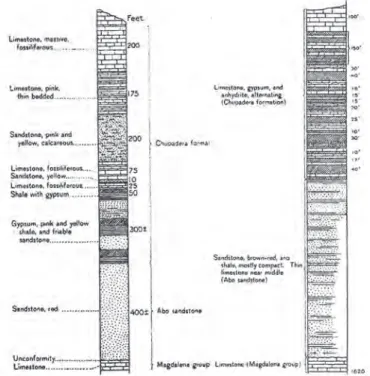
Darton (1928, p. 325) remeasured lee’s sections of the abo formation in the fra Cristobal mountains. He presented a colum- nar section at palomas Gap in the Caballo mountains (fig. 3), where he described the abo as “sandstone, brown-red, and shale, mostly compact. thin limestone near middle….” with a thickness of about 244 m (Darton, 1928, fig. 149). Harley (1934) added nothing to the observations of lee and Darton.
Geologic mapping in the fra Cristobal mountains by masters thesis students from the University of New Mexico briefly char- acterized the abo formation outcrops exposed in the northern portion of that range (thompson, 1955; Jacobs, 1956; mcCleary, 1960). One of these theses presented the first report of tetrapod footprints from the abo formation in the red Gap area of the fra Cristobal mountains (thompson, 1955). Cserna (1956), in
an unpublished doctoral thesis done at Columbia University, also briefly described the Abo Formation in the Fra Cristobal Moun- tains and gave a maximum thickness of about 152 m. nelson (1986), in a review of the geology of the fra Cristobal moun- tains based primarily on student thesis work undertaken at the Colorado School of mines, described the abo formation there as primarily red shale, siltstone and sandstone up to 137 m thick.
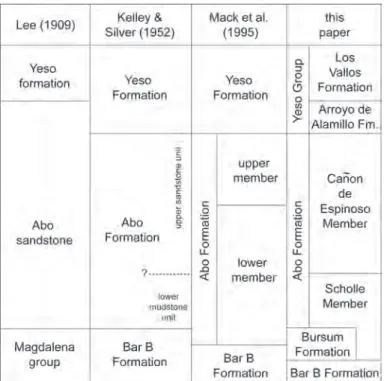
in their classic monograph on the geology of the Caballo mountains, Kelley and Silver (1952) described the abo for- mation as 167-335 m thick and mostly consisting of claystone, abundant siltstone and sandstone and some beds of limestone and conglomerate. Kelley and Silver (1952, p. 99) noted that the abo formation “could be roughly divided into a lower mudstone and an upper sandstone unit” (also see mack et al., 1995). they named the strata beneath the abo formation the bar b forma- tion, and assigned strata immediately overlying the abo to the Yeso formation (fig. 4).
Subsequent work on the abo formation in the fra Cristobal and Caballo mountains was sporadic, mostly focusing on sedi- mentology (mason, 1976; Sherry, 1990; mack et al., 1991, 1995, 2003) and on paleontology (Vaughn, 1969; olson and Vaughn, 1970; berman, 1993; lucas et al., 1995a, b, 2002, 2005b, c). the principal results of this work include: (1) identification of calcic paleosols in the abo formation as a widespread and character- istic lithofacies; (2) recognition of marine and estuarine beds interbedded in the lower part of the abo formation in the south- ern Caballo Mountains; (3) identification of some tetrapod fossil bones in the lower part of the abo formation, near palomas Gap in the Caballo mountains; and 4) description of extensive non- marine ichnofossil assemblages consisting of invertebrate and vertebrate trace fossils.
Seager and mack (2003, p. 26-30) presented a lengthy descrip- tion and analysis of depositional environments of the abo for- mation in the Caballo mountains. they measured a complete,
~ 140-m-thick stratigraphic section of the abo formation near Hidden tank in the southern part of the range. they attempted no subdivision of the formation.
LITHOSTRATIGRAPHY Introduction
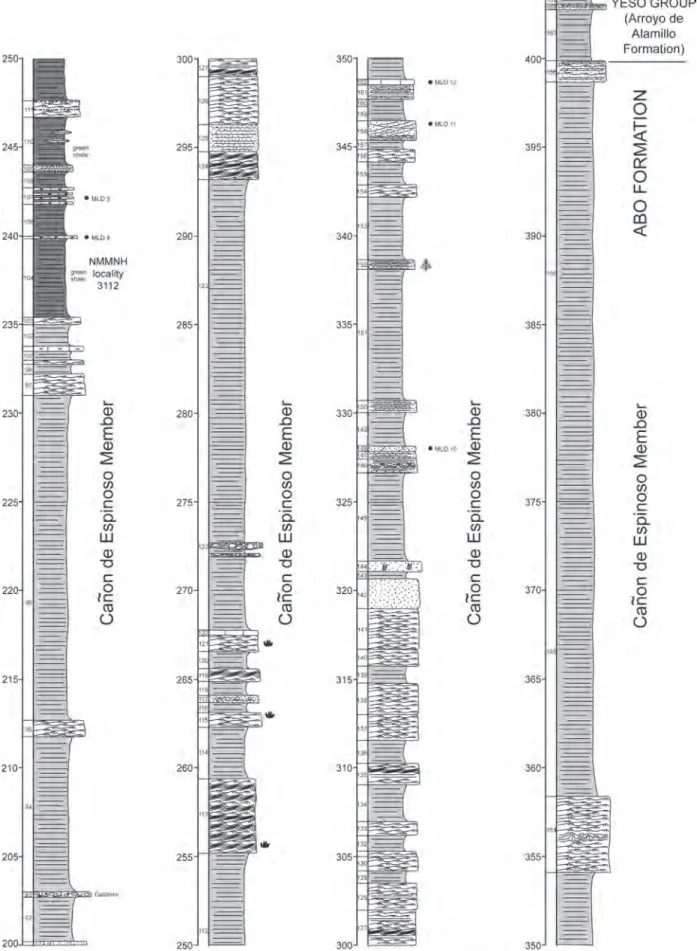
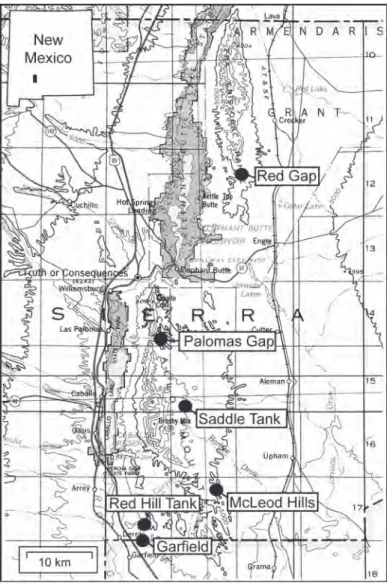
lithostratigraphic nomenclature of the abo formation has been fairly consistent for more than a century, and, in the fra Cristobal and Caballo mountains, the abo formation clearly can be divided into lower (mudstone-dominated) and upper (sandstone-dominated) intervals, as Kelley and Silver (1952) first observed. Here, we base our lithostratigraphy of the abo forma- tion primarily on three complete measured stratigraphic sections of the formation, one at red Gap in the fra Cristobal mountains (figs. 5, 8a), the second at Saddle tank in the central Caballo mountains (figs. 6, 8b) and the third in the mcleod Hills of the southern Caballo mountains (figs. 7, 8C). we also measured other sections of part of the abo formation from the Derry Hills to palomas Gap to document thin, but persistent marine and estu- arine facies (figs. 9-10).
fiGUre 1. map of the fra Cristobal and Caballo mountains in Sierra County, new mexico, showing locations of measured sections of the abo formation discussed in the text.
lower permian abo formation
347fiGUre 2. lee’s (1909) permian stratigraphic sections from north-central new mexico (Galisteo, Sandia) through Socorro County (mesa del Yeso, Carthage) and Sierra County (fra Cristobal, Caballos, San andreas [sic]).
fiGUre 3. Darton’s (1928) stratigraphic sections of the abo sandstone in the fra Cristobal (left) and the Caballo mountains (right).
fiGUre 4. Development of lithostratigraphic nomenclature of the abo formation in the fra Cristobal and Caballo mountains, Sierra County, new mexico.
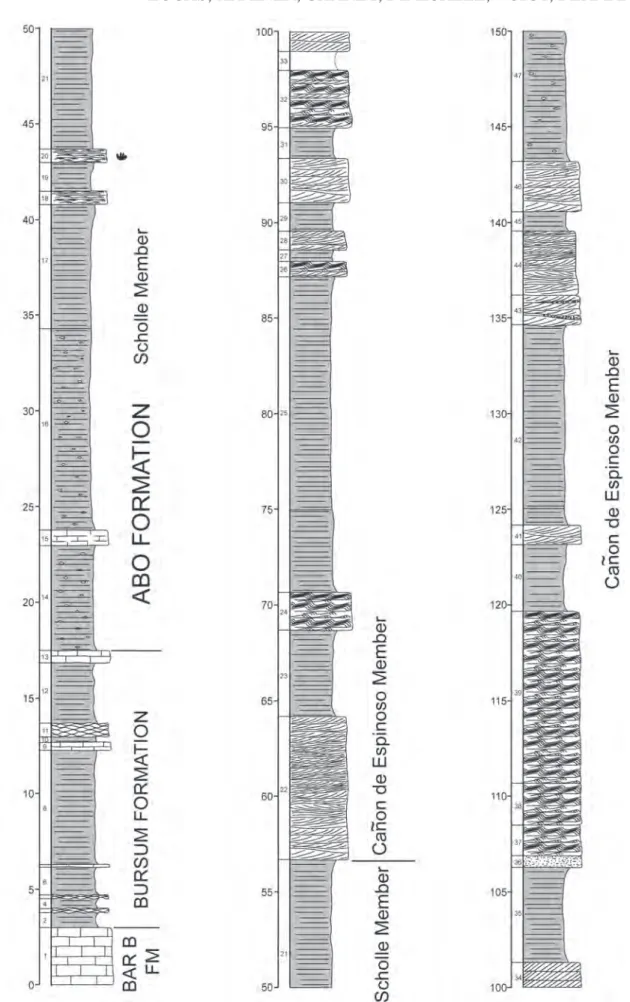
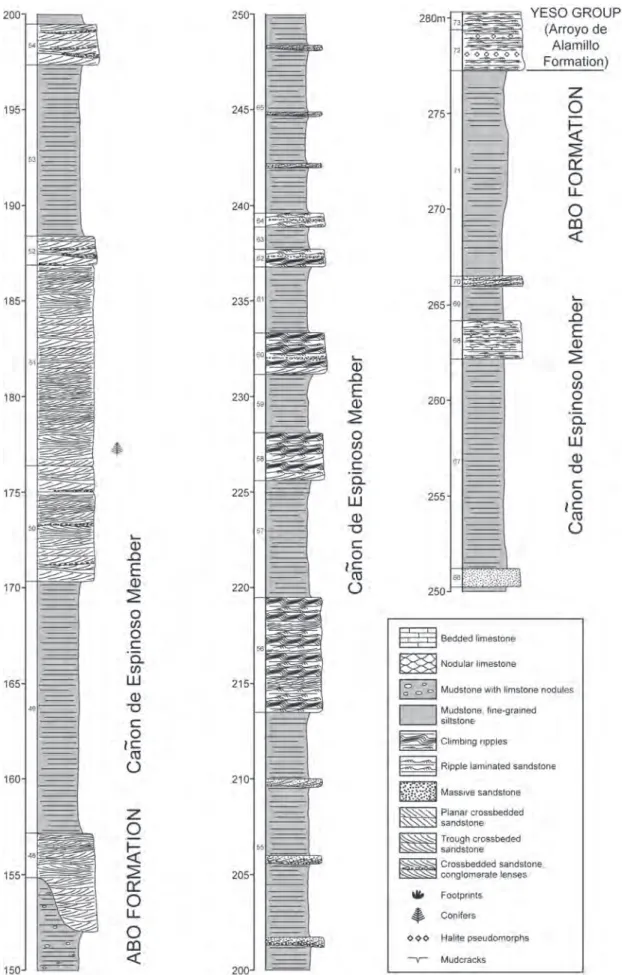
fiGUre 5. measured stratigraphic section of the abo formation at red Gap in the southern fra Cristobal mountains. See appendix for map coordi- nates of location.
lower permian abo formation
349fiGUre 5. Cont.
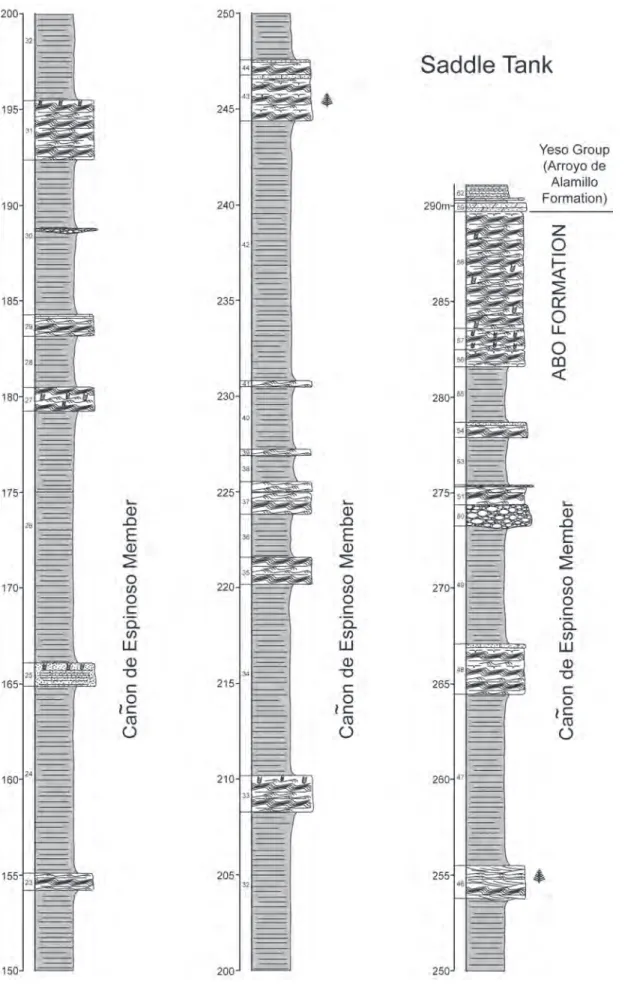
fiGUre 6. measured stratigraphic section of the abo formation at Saddle tank in the southern Caballo mountains. See appendix for map coordinates of location. See figure 5 for lithologic legend.
lower permian abo formation
351fiGUre 6. Cont.
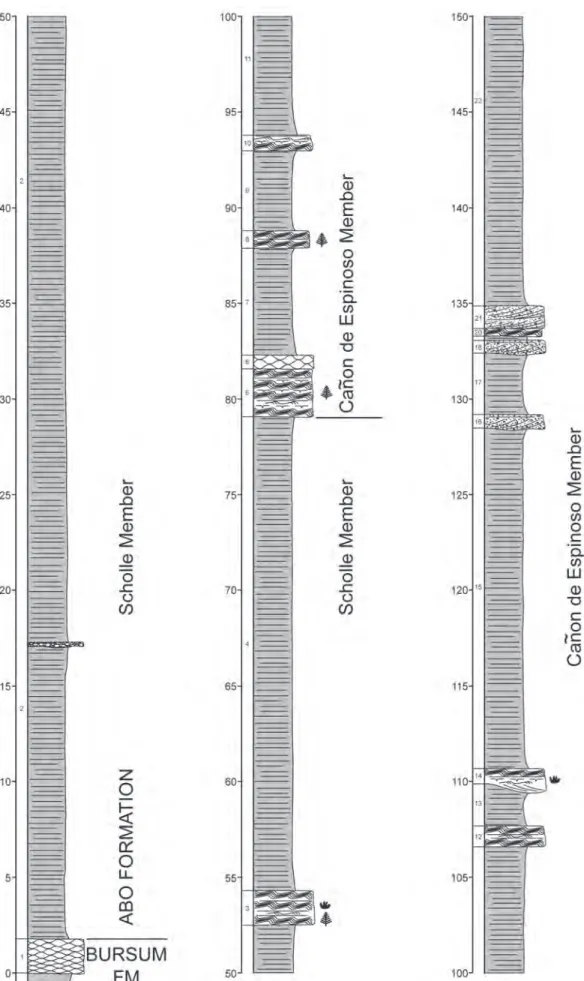
fiGUre 7. measured stratigraphic section of the abo formation in the mcleod Hills in the southern Caballo mountains. See appendix for map coor- dinates of location. See figure 5 for lithologic legend.
lower permian abo formation
353fiGUre 7. Cont.
Abo Members
at the abo type section in Valencia County southward into Socorro County, lucas et al. (2005a) divided the abo formation into two members, a lower mudstone-dominated unit, the Scholle member, and an upper unit with many sandstone sheets, the Cañon
de espinoso member. the same subdivision of the abo formation is evident in the complete sections we measured of the abo for- mation in the fra Cristobal and the Caballo mountains (figs. 5-8).
therefore, we apply the member-level terminology of lucas et al.
(2005a) to the abo formation in this part of Sierra County.
in the fra Cristobal and Caballo mountains, we chose to place the base of the Cañon de Espinoso Member at the first laterally
fiGUre 8. Selected photographs of abo formation outcrops in the fra Cristobal and Caballo mountains. A, red Gap in the fra Cristobal mountains.
B, Saddle tank in the central Caballo mountains. C, mcleod Hills in the southern Caballo mountains.
lower permian abo formation
355extensive sheet of ripple-laminated sandstone. This defines a relatively thin Scholle member (~ 43-75 m thick) overlain by a much thicker Cañon de espinoso member, ~ 230-250 m thick (figs. 5-8). this boundary could have been chosen higher (as did mack et al., 1995, in recognizing lower muddy and upper sandy members of the abo in the mcleod Hills: fig. 4), but the member subdivision we chose is consistent with the stratigraphic archi- tecture and lithological composition of the Scholle and Cañon de espinoso members to the north, in Socorro County (lucas et al., 2005c). we note, though, that the possible differences in choos- ing the member contacts within the abo formation underscores the fact that we view them as member-level units, not mappable formation-rank units.
the abo formation exposed in the fra Cristobal and Caballo mountains is a relatively uniform unit. it is ~278~309 m thick at the complete abo sections we measured (figs. 5-7) and is almost entirely mudstone (71-80% of the measured sections) and sand- stone (19-27% of the measured sections). minor lithologies are shale, siltstone, calcrete and intraformational conglomerate. the most significant stratigraphic difference between the sections is the presence in the Caballo mountains of marine and estuarine facies---mostly shale and limestone---that represent the influence of the nearby Hueco seaway (figs. 9-10). these facies are mostly found in the lower part of the abo formation, though they are also present stratigraphically high in the formation in the mcleod Hills (figs. 7, 9). they are not present in the abo formation in the fra Cristobal mountains.
at almost all of the outcrops in the fra Cristobal and Caballo mountains, the abo formation overlies the bursum formation (upper conglomerate member of the bar-b formation of lawton et al., 2002; see lucas and Krainer, 2004). exceptions are at Caballo Canyon near palomas Gap in the Caballo mountains and in the Derry Hills (fig. 10), where the abo locally rests directly on the bar-b formation (bursum strata are absent). this strati- graphic relationship, and the fact that the base of the abo forma- tion is red-bed mudstone overlying bioclastic marine limestone of the bursum formation (which is often pedogenically modi- fied) supports the conclusion that the Abo-Bursum contact is an unconformity, as is well documented at some other locations (lucas et al., 2009). in the Caballo mountains, fusulinids docu- ment an early wolfcampian (newwellian) age for the bursum formation (thompson, 1991; lawton et al., 2002). However, the age of the base of the abo formation in the fra Cristobal and Caballo mountains cannot be precisely determined within the wolfcampian, though based on regional correlations it is likely middle wolfcampian (e.g., lucas et al., 2011a, b, and see below).
therefore, the duration of a hiatus at the bursum-abo contact appears to be relatively short geologically and below our current level of biostratigraphic resolution. in contrast, in the fra Cris- tobal and Caballo mountains, the contact of the abo formation with the overlying Yeso Group (arroyo de alamillo formation) appears to be gradational and conformable, as it is regionally (lucas et al., 2005c; lucas and Krainer, 2012).
fiGUre 9. measured sections of parts of abo formation at red Hill tank, the mcleod Hills and palomas Gap showing estuarine facies. See appendix for map coordinates of locations of sections.
the measured section) and sandstone (27%). minor lithologies are shale, siltstone, calcrete and intraformational conglomerate.
the stratigraphic interval we assign to the Scholle member at red Gap is relatively thin, ~40 m (fig. 5). the basal mud- stone bed of the abo formation here rests with sharp contact on color-mottled (pedogenically modified?), nodular, bioclastic marine limestone at the top of the bursum formation. abo red mudstones above the contact have dispersed calcrete nodules, whereas bursum red mudstones below the contact do not. about 5.5 m above the base of the abo formation is a prominent ledge of calcrete, overlain by a thick mudstone slope, the lower part of which contains dispersed calcrete nodules. the immediately overlying sandstone beds have climbing ripples (fig. 11b) and yield the extensive ichnofossil assemblage of arthropod and tet- rapod traces documented by lucas et al. (2005b). a mudstone slope follows and, beginning with unit 22, there is noticeably more sandstone in the abo formation, forming sheet-like bodies.
these sandstone bodies are relatively thin and have great lateral extent (fig. 8a). they are either relatively thin, ripple-laminated sheets or multistoried sandstone benches in which trough-cross- bedding is the dominant bedform. all of the abo sandstone sheets have sharp basal contacts on mudstone, some with significant stratigraphic relief, such as bed 48, in which the basal scour is a trough as much as 3 m deep. Some also have intraformational conglomerates at their bases composed of clasts that are mud- stone or calcrete rip-ups.
in the red Gap abo section, the ratio of sandstone to mud- stone increases up section. most of the sandstone bodies in the upper 75 m of the abo section are much less than a maximum of 6 m thick and are full of climbing ripples. a mostly covered (mudstone) slope is the uppermost bed of the abo formation and is overlain by green, thinly laminated and ripple-laminated sandstone with halite pseudomorphs that is the basal bed of the arroyo de alamillo formation of the Yeso Group.
Saddle Tank
at Saddle tank in the northern Caballo mountains, we mea- sured a complete abo formation section that is ~ 278 m thick (figs. 6, 8b). this section is almost entirely mudstone (80% of the measured section) and sandstone (19%). minor lithologies fiGUre 10. measured section of the upper bar b formation, lower abo Formation and the basal limestone of the Hueco Group at the Garfield section in the Derry Hills (fig. 1). Selected thin section photographs are:
A, poorly-sorted, grain-supported sandy conglomerate composed of car- bonate grains, particularly of reworked caliche clasts, and few dark gray micritic lithoclasts (bioclastic wackestone, mudstone and bindstone).
Pore space is filled with coarse, blocky calcite cement. B, poorly sorted, coarse-grained, clast-supported sandstone composed of predominantly reworked caliche clasts, some displaying dark weathering rims. pore space filled with silty carbonate matrix; rarely some calcite cement is present. C, peloidal bioclastic mudstone containing a few mollusc shell fragments and ostracods embedded in dark gray pelmicritic matrix. a few small irregular voids (stromatactis) are filled with calcite cement.
D, peloidal bioclastic mudstone containing a few mollusc shell frag- ments, ostracods and small cyanobacteria colonies, embedded in peloi- dal micritic matrix. Irregular voids are filled with calcite cement.
Red Gap Section
at red Gap in the southern fra Cristobal mountains we mea- sured a complete abo formation section (figs. 5, 8a) that is ~ 294 m thick. this section is almost entirely mudstone (71% of
lower permian abo formation
357fiGUre 11. Selected lithofacies of the abo formation. A-C, ripple-laminated sandstones; note the very distinctive climbing ripples in C. D, pedo- genic calcrete bed. E, Green shale and micritic limestone of estuarine facies. F, extensively bioturbated (Skolithos and Scoyenia) sandstone in upper part of formation. locations: a—palomas Gap, b—red Gap, C—mcleod Hills, D—Saddle tank, e—mcleod Hills, f—Saddle tank.
are shale, siltstone, calcrete and intraformational conglomerate.
Seager and mack (2003) stated that the abo formation section at nearby bob’s tank is ~ 305 m thick, but they described a much thinner abo section (~140 m thick) at Hidden tank in the apache Valley a few km to the south-southwest (Seager and mack, 2003, fig. 24). We assign the lower 57 m of their Hidden Tank section to the Scholle member, which is mudstone with a few thin beds of conglomerate and sandstone. the overlying 83 m of sheet sand- stones and mudstones belong to the Cañon de espinoso member.
the lower 75 m of the abo formation section at Saddle tank is almost entirely red mudstone (fig. 6, units 2-4), and we identify this interval as the Scholle member. at the base of the abo for- mation, red mudstone has a sharp contact on nodular, bioclastic limestone with brachiopods at the top of the bursum formation.
a thin (0.2-m-thick) lens of intraformational conglomerate (clasts are sandstone pebbles) is present about 15 m above the abo base, and a sandstone bed with climbing ripples about 50 m above the abo base contains conifer impressions and tetrapod footprints.
this stratigraphic level yields extensive invertebrate and verte- brate trace fossil assemblages (lucas et al., 2005c).
at Saddle tank, we place the base of the Cañon de espinoso Member at the base of unit 5, because this is the first laterally extensive sandstone sheet, and the percentage of sandstone in the section increases above this unit. most of the sandstone sheets in the lower part of the Cañon de espinoso member have climbing ripples, and some yield conifer impressions and tetrapod foot- prints. Sandstone sheets are thin (no more than about 3 m thick, most much thinner), except at the very top of the abo forma- tion. intraformational conglomerates, such as unit 50, are com- posed of reworked clasts of calcrete and sandstone. at bed 25, ~ 162 m above the abo base, bioturbation exclusively of Skolithos (unornamented tubes) and Scoyenia (meniscate, backfilled tubes) appears and is seen in several succeeding beds of the Cañon de espinoso member. most striking in this regard is bed 57 in which extensive bioturbation creates a densely burrowed ichnofabric (fig. 11f). the base of the overlying arroyo de alamillo forma- tion of the Yeso Group is beds of silty dolomite, green shale and salmon-colored siltstone above bioturbated and ripple-laminated abo sandstone.
McLeod Hills Section
in the mcleod Hills in the southern Caballo mountains, we measured a complete abo formation section that is ~ 309 m thick (figs. 7, 8C). this section is almost entirely mudstone (76% of the measured section) and sandstone (19%). minor lithologies are shale, siltstone, calcrete and intraformational conglomer- ate. lucas et al. (1995a) described this section as ~ 320 m thick, consisting of 84% mudstone, 12% sandstone and the rest shale, siltstone, calcrete and intraformational conglomerate. they chose the same bursum-abo contact as we do and provided brief descriptions of the tetrapod footprint assemblages in bed 86 of our measured section (fig. 7). they considered units 104-110 of our section to be of lacustrine origin.
mack et al. (1995) described the abo formation section in the mcleod Hills and chose a bursum-abo contact lower than we
do, about 12 m below the dolomite we consider to be the top bed of the bursum formation. they determined an abo thickness of only ~ 210 m (minus the 12 m we assign to the bursum), prob- ably because they used a much different dip of the beds than did we. mack et al. (1995) divided the abo formation in the mcleod Hills into two informal members, with the division at the base of our bed 113. However, their statement that “the lower member, 38 to 114 m thick, consists primarily of red and green mudstone interbedded with a few thin (< 2.5 m) beds of carbonate-pebble and granule conglomerate and limestone or dolomite” (mack et al., 1995, p. 181) contradicts their own stratigraphic section (and ours), which shows numerous beds of ripple-laminated sand- stone in their “lower member.” this is why we prefer a different member-level break in the abo, one that puts virtually all of the ripple-laminated sheet sandstone in the upper, Cañon de espinoso member (fig. 7).
the mcleod Hills section is just east of structural deformation of the red House dome (Seager and mack, 2003); dips begin at about 20o and increase to slightly overturned. the lower 53 m of the abo formation (units 25-45) are mostly mudstone slopes with thin, intercalated beds of intraformational conglomerate (clasts are mostly calcrete and some sandstone) and some sandstone beds that are thinly laminated or ripple laminated. red mudstone at the base of the abo formation rests with sharp contact on yellow dolomicrite at the top of the bursum formation. tetrapod foot- prints are abundant in bed 41, ~ 40 m above the base of the abo formation, and this is the same footprint horizon as at Saddle tank, ~ 10 km to the north, and the same horizon that yielded the trace fossil assemblage published by lucas et al. (2005c).
in the mcleod Hills section, we place the base of the Cañon de espinoso member at the base of bed 46. Sandstone beds above that level form laterally extensive sheets, and the percentage of sandstone in the abo section increases up section. from bed 113 up, sandstone approaches half of the thickness of the section, and even more if the covered intervals are not considered to be all mudstone. most of the sandstone sheets in the Cañon de espinoso member have ripple cross-lamination including climbing ripples and are less than 5 m thick. the footprint localities from bed 86 produced most of the tracks documented by lucas et al. (1995a).
a distinctive stratigraphic interval is units 104-110, in which green, thinly laminated shale is intercalated with limestone, marl- stone and siltstone (figs. 7, 9, 11e). lucas et al. (1995a) con- sidered these strata to be of lacustrine origin, but we judge them to be estuarine deposits (see below). the base of the arroyo de alamillo formation of the Yeso Group in the mcleod Hills sec- tion is at an interval of green calcareous shale immediately over- lain by red laminated siltstone and thin-bedded dolomite with gypsum-filled vugs above a covered Abo slope.
Hueco Tongue
at red Hill tank in the Derry Hills, we measured a section that is 65 m thick and includes about 23 m of the bar b for- mation, 37 m of the abo formation and a limestone tongue of the Hueco Group in the lower part of the abo formation (fig.
10, units 63-65). the lower part of the abo formation here is
lower permian abo formation
359composed of poorly exposed red mudstone, locally containing pedogenic limestone nodules and a calcrete horizon. intercalated in these fine-grained red beds are conglomerate, conglomeratic sandstone and sandstone layers. most conglomerates are poorly sorted, massive and clast supported, rarely mud-supported. Some thin conglomerates and sandstones are crossbedded. Conglomer- ates are composed of different types of carbonate clasts; subordi- nate chert clasts are also present. the matrix is red mudstone and siltstone, partly sandy. Clast size is commonly up to 3 cm, rarely up to 10 cm. fine-grained and sandy conglomerates are poorly sorted, clast-supported, and most clasts are subangular-rounded.
locally, we observed pressure solution at grain contacts. most abundant are recrystallized micritic, reddish-brown calcrete clasts with calcite-filled fissures and dark rims of iron hydrox- ides. Subordinate are reworked bindstones, bioclastic mudstones and wackestones (fig. 10). rarely, sedimentary chert clasts with outlines of fossil fragments are present. fossil fragments such as crinoids, shells and fusulinids are rare. the matrix is brownish- gray silty micrite that locally contains small quartz grains. Some beds are well-washed and cemented with blocky calcite. in a few micritic clasts small authigenic minerals (feldspar?) are present.
the top of the section is formed by poorly exposed pink shale, overlain by 2.9 m of bedded gray limestone composed of gray, bioclastic, locally peloidal mudstone containing a few skeletons of marine gastropods and bivalves, ostracods, abundant peloids and small colonies of cyanobacteria similar to Rivularia. the rock contains irregular fenestral fabrics (microfacies lf-bi of flügel, 2004), which may partly represent rhizoliths. locally, cryptalgal fabrics (laminae) are observed. intercalated are thin layers of gray to dark gray micritic lithoclasts (intraclasts), which are poorly sorted, and subangular-subrounded. layers of clast- supported texture alternate with layers of mud-supported texture.
the limestones that form the base of the Hueco Group were depo- sition in a very restricted, very shallow marine (lagoonal) envi- ronment. they demonstrate a more northwesterly location of the shelf of the Hueco seaway than previous paleogeographic recon- structions (see below).
Green/Gray Shale Intervals
in the Derry Hills, and mcleod Hills and palomas Gap areas (fig. 1), greenish shale intervals with intercalated conglomerate, sandstone and limestone are present primarily in the lower and middle abo formation (fig. 9). the outcrops are:
in the Derry Hills, at red Hill tank (sec. 15, t17S, r4w), ~ 40 m above the abo base is a 10-m thick interval of green shale with a few intercalated thin sandstone beds. approximately in the middle of the greenish shale, marine or brackish water bivalves (myalinids and pectinaceans), the scales of palaeoniscoid fish and fossil plants occur.
at mcleod Draw (sec. 22, t17S, r3w), a 3-m-thick inter- val of greenish shale is present in the middle of the abo forma- tion. at the base, two thin, poorly-sorted carbonate-conglomerate beds are developed. approximately in the middle, a gray, micritic limestone bed (0.3 m thick) is present. the limestone bed is bio- turbated and lacks fossils. above the limestone, dark gray shale
is intercalated in the greenish shale. the greenish shale below the limestone bed yields myalinid bivalves and fossil plants; fossil plants are also present in the gray shale above the limestone bed.
in the mcleod Hills, as far north as sec. 3, t17S, r3w, a 10.5-m thick interval of green shale, with intercalated sandstone and conglomerate, is exposed in the middle part of the abo for- mation. Conglomerate beds are poorly sorted, clast supported and trough crossbedded. the conglomerate is composed of various types of carbonate clasts, and subordinately chert and siltstone clasts are present. maximum clast size is approximately 5 cm.
Conglomerate beds lens out laterally. fine-grained, sandy con- glomerate is 0.1-0.2 m thick. the thicker bed displays trough crossbedding. The sandstone occurs as thin, fine-grained beds displaying current ripples. thicker sandstone intervals (0.3-0.8 m thick) display climbing ripples. Greenish shale in the lower part of the succession yields fossil plants and myalinid bivalves. the interval is ~ 87 m above the abo base. another interval of green- ish shale with myalinid bivalves occurs ~112 m above the base of the abo formation.
at palomas Gap we measured two sections of the lower part of the abo formation that contain relatively thin (< 5 m thick) intervals of green shale and limestone that yield fossils of plants and euryhaline bivalves.
PETROGRAPHY
Conglomerate of the abo formation in the fra Cristobal and Caballo mountains is moderately to poorly sorted and clast sup- ported, containing subangular to rounded micritic carbonate grains (mostly pebbles) of various types: (1) gray, homogeneous micritic carbonate grains; (2) gray micritic carbonate grains containing small authigenic minerals; (3) gray micritic carbon- ate grains with calcite-filled fissures; (4) reddish-brown, stained carbonate grains, partly with dark brown weathering rims; and (5) rare reworked red siltstone-mudstone clasts. Siliciclastic grains are absent, and the conglomerate contains small amounts of matrix and is cemented by coarse, blocky calcite cement (fig.
12a-b). rare, thin beds composed of abundant angular to sub- angular, resedimented red siltstone-mudstone clasts and rare car- bonate clasts up to a few cm in diameter embedded in silty to fine-grained sandstone matrix are present (Fig. 12C).
in the abo formation in the fra Cristobal and Caballo moun- tains, sandstone is fine- to very fine-grained with an average grain size rarely exceeding 0.2 mm. the grains are angular to subangu- lar and represented by monocrystalline quartz, rare polycrystal- line quartz, rare detrital feldspars and a few muscovites. a few opaque grains are present. micritic carbonate grains are abun- dant but often difficult to distinguish from the carbonate cement or matrix because of recrystallization (fig. 12D-f). Due to the finer grain size compared to the Abo sections farther north, the sandstones contain higher amounts of monocrystalline quartz, less polycrystalline quartz and chert, less detrital feldspars, and almost no granitic and metamorphic rock fragments. authigenic quartz overgrowths, which are common in the coarser abo sand- stones in northern new mexico (Krainer and lucas, 2010), are rarely observed, probably also due to the fine grain size.
fiGUre 12. thin section photographs of conglomerate and sandstone of the abo formation in the mcleod Hills. A, moderately- to poorly-sorted, fine-grained conglomerate composed of various types of subangular to subrounded micritic carbonate grains that are cemented by coarse, blocky cal- cite cement. Sample mDl 4, plane light, width of photograph is 6.3 mm. B, fine-grained conglomerate containing various types of micritic carbonate grains, small amounts of matrix and calcite cement. Sample mDl 7, plane light, width of photograph is 6.3 mm. C, angular to subangular reddish carbonate clasts embedded in fine-grained matrix. Sample MDL 10, plane light, width of photograph is 6.3 mm. D, fine-grained, mixed siliciclastic- carbonate sandstone displaying small-scale cross-bedding. Sample mDl 11, plane light, width of photograph is 6.3 mm. E, fine-grained sandstone composed of abundant monocrystalline quartz, rare polycrystalline quartz, few detrital feldspars and micas, cemented by carbonate. Sample mDl 10, polarized light, width of photograph is 1.2 mm. F, fine-grained sandstone composed of abundant quartz grains, few detrital feldspars, rare mica and few carbonate grains, cemented by carbonate. Sample mDl 12, polarized light, width of photograph is 1.2 mm.
lower permian abo formation
361PALEONTOLOGY Introduction
trace fossils, fossil plants, invertebrate body fossils (mostly bivalves) and vertebrate bones and teeth have been recovered from the abo formation in the fra Cristobal and Caballo moun- tains. Here, we document the fossil plant, invertebrate body and vertebrate fossils and briefly review the trace fossil record, pend- ing a more detailed published treatment.
Trace Fossils
traces are among the most common fossil remains in the abo formation in the fra Cristobal and Caballo mountains. the nmmnH collection houses 100 catalogued specimens of ichno- fossils from three localities in the abo formation of the fra Cris- tobal mountains (red Gap) and 350 specimens from 23 localities in the abo formation of the Caballo mountains (palomas Gap, apache Gap, Saddle tank, barbee Draw, bob’s tank, mcleod Hills). trace fossils from the abo formation were previously mentioned, illustrated, and/or described by thompson (1955), nelson (1986), Hunt et al. (1990, 1995), lucas et al. (2002, 2005b), and lerner et al. (2004) from the fra Cristobal moun- tains, and by mack et al. (1995) and lucas et al. (1995a, 2005c) from the Caballo mountains. the Caballo mountains are one of the most prolific areas in New Mexico for Lower Permian conti- nental trace fossils.
the lower and middle parts of the abo formation in the fra Cristobal and Caballo mountains contain an essentially uniform ichnoassemblage of rhizoliths, invertebrate traces and tetrapod footprints (fig. 13). these traces occur on clayey mud-drapes within reddish-brown, horizontally-laminated, flaser-bedded or small-scale trough cross-bedded siltstone to very fine-grained sandstone. inorganic sedimentary surface structures include tool marks, raindrop impressions, mud-cracks, and wrinkle marks.
root traces (fig. 13a) are the most common biogenic structures preserved on approximately 30% of the collected specimens. the reddish, mud-filled cylindrical tubes usually measure less than 2 mm in cross section, run parallel to bedding planes or dissect them at various angles. Horizontal segments may exhibit com- plex branching. Characteristic invertebrate traces include Augeri- noichnus helicoidales (fig 13b), Kouphichnium isp. (fig. 13C), Lithographus cf. L. hieroglyphicus (fig. 13D), Stiaria intermedia (fig. 13e), and Tonganoxichnus robledoensis (fig. 13f). they are interpreted as the locomotion and feeding traces of vermi- form animals, xiphosurids, and pterygote and apterygote insects (minter et al., 2008; minter and braddy, 2009). Augerinoichnus, Stiaria, and Tonganoxichnus are ubiquitous trace fossils in the abo formation of the study area.
tetrapod tracks associated with these invertebrate traces are assigned to Batrachichnus salamandroides (fig. 13G), Dimetro- pus leisnerianus (fig. 13H), Hyloidichnus bifurcatus (fig. 13i), and Dromopus lacertoides (Fig. 13J). More than 90% of all finds belong to B. salamandroides and most likely represent tracks of small temnospondyls (lucas et al., 2005b, c; Voigt, 2005).
Dimetropus, Hyloidichnus, and Dromopus, which are supposed tracks of “pelycosaurian-grade” synapsids (Haubold, 2000;
Voigt, 2005), captorhinids (Haubold, 2000; Voigt et al., 2009), and araeoscelids (Haubold and lucas, 2003; Voigt, 2005), respec- tively, are relatively rare.
These kinds of trace fossils are significantly less abundant in the upper third of the abo formation in the fra Cristobal and Caballo mountains. Clayey, mud-draped bedding planes are rare in this part of the section, and the invertebrate ichnofauna instead is dominated by infaunal, backfilled burrows. In the McLeod Hills and nearby at Bob’s Tank, Mack et al. (1995) identified at least some of these burrows as Arenicolites and used them to infer marine influence. Instead, we identify these traces as Skolithos and Scoyenia. indeed, we have seen no Arenicolites in the upper abo formation, and the trace fossil assemblages appear to be a characteristic freshwater fluvial ichnoassemblage of the Scoyenia ichnofacies ( cf. buatois and mángano, 2007). the few tetrapod footprints known from this level are assigned to Amphisauropus kablikae, which are the supposed tracks of seymouriamorph rep- tiliomorphs (Haubold, 2000; lucas et al., 2001; Voigt, 2005), and Dromopus lacertoides.
the ichnoassemblages of the lower and middle part of the abo formation are most similar to those described from the lower permian robledo mountains formation of the robledo moun- tains and Doña ana mountains of south-central new mexico (lucas et al., 1995b, 1998; minter and braddy, 2009) and indicate sparsely to densely vegetated, distal coastal plain environments.
the ichnofauna of this stratigraphic level in the fra Cristobal mountains seems slightly impoverished in comparison to the one in the Caballo Mountains, which might reflect a greater distance to the paleo-shoreline. in the upper part of the abo formation, the known trace fossils are characteristic elements of the freshwater Scoyenia ichnofacies. they suggest relatively inland depositional environments, as were previously described for lower permian strata of central new mexico (lucas et al., 2001, 2004, 2009a).
Fossil Plants
fossil plants were collected from nine sites in the abo forma- tion, stratigraphically from the lower, middle and the upper parts.
Geographically, these come from the area of red Hill tank, in the south, the mcleod Hills in the southeast, and palomas Gap in the center-east portions of the study area (fig. 1). fossil plants (coni- fer impressions) were observed at many other sites, particularly in red sandstones/siltstones, but were not collected because they could not be extracted from the matrix.
the collections can be divided broadly into two groups, based on both facies and floristic content:
1. red sandstones/siltstones, thinly bedded (fig. 14). Such deposits frequently contain both plant debris and trackways of vertebrates and invertebrates. in the Caballo mountains, as elsewhere in the outcrop area of the red sandstones/silt- stone facies of the abo, these fossiliferous beds tend to be sheet sandstones tens to hundreds of meters in areal extent and of varying thickness, from a meter to several meters.
They generally fine upward, with the fossiliferous inter-
fiGUre 13. Selected trace fossils from the abo formation of the Caballo mountains. A, root traces, nmmnH p-42613. B, Augerinoichnus helicoi- dales, nmmnH p-25990. C, Kouphichnium isp., nmmnH p-45757. D, Lithographus cf. hieroglyphicus, nmmnH p- 65086. E, Stiaria intermedia, nmmnH p-45778. F, Tonganoxichnus robledoensis, nmmnH p-65064. G, Batrachichnus salamandroides, nmmnH p-40901. H, Dimetropus leis- nerianus, nmmnH p-65049. I, Hyloidichnus bifurcatus, nmmnH p-65088. J, Dromopus lacertoides, nmmnH p-65114. Scale bars equal 10 mm.
preservation - a, convex epirelief. b, f-G, and J, concave epirelief. C-e and H-i, convex hyporelief. nmmnH localities - a, l-5383. b, l-2938. C, e-H, l-4674. D, l-8706. i, l-8659. J, l-8663. a, fra Cristobal mountains. b-J, Caballo mountains.
lower permian abo formation
363vals in the upper portions, and typically on thin claystone drapes or interbeds between thin layers of siltstone or sand- stone (Lucas et al., 2005b,c). The enclosed paleoflora is parautochthonous to allochthonous.
2. Greenish gray to light gray shales/siltstones (the green/
gray shale facies discussed above) (fig. 15-17), with poorly-developed bedding, and fragmentary, often jum- bled, variably dense plant material that appears allochtho- nous. Such deposits contain occasional evidence of rooting and may be mottled, as if overprinted by pedogenesis. on outcrop, the deposits of these sediments are lenticular and appear to be channel fills. Some have conglomeratic layers at the base.
Red Siltstone Paleoflora
Plant fossils were identified at many sites in the red siltstone facies, often in association with vertebrate and invertebrate track- ways (e.g., lucas et al., 2005b, c). Collections were made from three sites in the mcleod Hills (fig. 1). at all sites from which plants were identified or collected, the paleoflora is of very low diversity and uniformly dominated by the fragmentary remains of conifer branches (fig. 14). this is a pattern typical throughout the abo formation, where mono-dominance by conifers or, less frequently, by the peltaspermous seed fern Supaia D. white, are recurrent patterns (Dimichele et al., 2007).
we attribute the dominant conifer in the mcleod Hills collec- tions to ?Brachyphyllum densum mamay. as noted by mamay (1967), the leaves on this plant are closely adpressed to the axis.
in the low quality molds preserved at the mcleod Hills sites, the leaves are very difficult to identify in most specimens, which appear without magnification and angular lighting to be thin branches or even pinnate compound leaves. Close examination of some specimens, however, reveals small, triangular leaves (fig. 14a2, b2) covering the surfaces. Conifers were the only plants identified at other, uncollected red-bed sites, and include
?Brachyphyllum densum and various morphotypes of Walchia Sternberg.
A single specimen of quite unusual form was identified at one of the red-bed sites (fig. 14C), consisting of small, once-forked appendages, approximately 2 cm in length, slightly wider at the base than after the fork. there may be vein-like central thicken- ings visible. we tentatively identify these specimens as Dicrano- phyllum cf. D. gallicum Grand ‘eury, but this is a real “long- shot” identification, and the leaves, if that is what they are, are rather small. Dicranophyllum is an early coniferopsid, the exact phylogenetic affinities of which are uncertain. See Barthel (1977, 2005) for a description and discussion of the genus.
Green Shale/Siltstone Paleoflora
the green shale/siltstones appear to be quite distinct deposi- tionally from the red sandstones/siltstones, representing shallow channel bodies in coastal plain settings, with fresh to brackish salinities. the plants are intimately associated with invertebrates (see below), including pectinaceans and myalinids, other pelecy-
pods and microchonchids, and also with fragmentary remains of fish. Gray/green beds containing plant fossils have been reported and collected previously from the abo formation. However, for none, as far as we know, has the depositional context been ade- quately described. the illustrations of these plants are organized geographically, to provide a sense of the local composition rather than taxonomically across all localities within this facies-type.
Thus, the green shale paleofloras are from Palomas Gap (Fig. 15), red Hill tank (fig. 16) and the mcleod Hills (fig. 17).
in all of the green shale/siltstone collections, the most common plant remains are those of walchian conifers (figs. 15a-C; fig.
16 A, C, D, Fig. 17 D, E, H). The species affinities of these are not clear, and most of the remains are highly fragmentary. ?Brachy- phyllum densum (Fig. 17C1) was identified at one of the locali- ties as was a specimen similar to Ullmannia bronnii Goeppert (fig. 16b). in the latter instance, this would be one of the earliest reports of Ullmannia Goeppert, and push the voltzialean coni- fer lineage well back in time from its presently earliest known occurrence near the early/middle permian (Kungurian/wordian) boundary (looy, 2007). Consequently, this latter determination must be viewed with considerable caution.
Several other kinds of plants are found in these green/gray deposits, represented mainly by isolated specimens. However, these elements considerably increase the diversity. because speci- mens are small and fragmentary, all identifications must be con- sidered tentative. included are several specimens of possible cal- lipterid foliage. one consists only of tiny pinnules on a partial pinna (fig. 16m), and the others are single pinnules of moderate size (Fig. 17B,G). Callipterid affinities are suggested by the high- angle, very straight veins and the somewhat vaulted nature of the pinnule laminae. additional elements include foliage attributable to the seed fern Odontopteris brongniart ex Sternberg (fig. 17a1- a2), the coniferophyte Cordaites Unger (fig. 15D), and ferns, including a tiny scrap of possible Sphenopteris brongniart ex Sternberg (Fig. 15C), and a very small leaf or leaflet of Taeniop- teris brongniart, that has oval structures regularly ordered along both sides of the mid-vein, possibly sporangia or sori (fig. 16e).
in addition to these vegetative remains, there are a number of different seed types found in these assemblages (figs. 15 e-G, fig. 16f-l, fig. 17f, i). these seeds are all small, and most are bilaterally symmetrical and platyspermic (flattened) with a variably-developed wing. at one site, red Hill tank (fig. 16), seeds are abundant and more diverse than at all the other sites combined. Some of these seeds may pertain to Samaropsis (J.
Schneider, written commun., 2012).
In summary, the Abo paleofloras suggest a conifer-domi- nated landscape, one containing a number of different species and genera of conifers and their sister group, the cordaitaleans.
among these plants, perhaps as understory or fringing disturbed areas, were several other kinds of seed plants, including cal- lipterid peltasperms and odontopterids, and small ground-cover ferns. we expect the latter to be greatly under-represented in the fossil record (Scheihing, 1980), largely because of their low growth habit. larger seed plants with broad leaves may be under- represented because their foliage does not survive particularly well in transport, and the greenish gray shale/siltstone paleofloras
appear to be uniformly allochthonous, though distance of trans- port was likely small. These paleofloras are relatively typical of late paleozoic, seasonally-dry habitats, and emphasize the pecu- liarity of the extremely low diversity found in the much more widely occurring and densely fossiliferous abo formation red- bed floras.
Invertebrate Paleontology
invertebrate body fossils are only present in the abo forma- tion in the Caballo mountains in the greenish-gray shale and silt- stone beds that we have identified as an estuarine facies. These
fossils are the calcareous shells of microconchid gastropods and at least three different kinds of bivalves (fig. 18). pectinacean bivalves, some of which can be assigned to Dunbarella, are par- ticularly common at red Hill tank. myalinid bivalves are pres- ent at red Hill tank and in the mcleod Hills. the third kind of bivalve is not as easily identified as they are “bean-shaped” and lack ornamentation. Some of them are Permophorus.
the importance of these invertebrate fossils is that they indi- cate marine or brackish waters in the estuarine facies. pectin- aceans are marine to brackish water bivalves, as are myalinids.
these bivalve-dominated assemblages merit further study and we briefly present them here for their paleoecological significance.
fiGUre 14. abo formation fossil plants from the Caballo mountains, various red bed localities. all scale bars = 1 cm. A1, Brachyphyllum (USnm 544642, loc. 41904) shaded area is seen in a2; A2, Brachyphyllum (USnm 544642, loc. 41904); B1, cf. Brachyphyllum (USnm 544645, loc. 41882) shaded area is seen in b2; B2, cf. Brachyphyllum (USnm 544645, loc. 41882); C, 544644 Dicranophyllum (USnm 544644, loc. 41904); D, Brachy- phyllum (USnm 544643, loc. 41904); E, 544641 Brachyphyllum (USnm 544641, loc. 41912).
lower permian abo formation
365Fossil Vertebrates
fossil bones and teeth are relatively uncommon in the abo formation in the fra Cristobal and Caballo mountains, much less common than to the north in Socorro and Sandoval Coun- ties or in the correlative strata of the Cutler Group in rio arriba County, new mexico (e.g., berman, 1993; lucas et al., 2010) (Fig. 19). Vaughn (1969) briefly described a small collection of fossil vertebrates from the lower part of the abo formation (Scholle member) at palomas Gap (figs. 20-21). we have relo- cated Vaughn’s localities, which are in intraformational conglom- erates stratigraphically low in the Scholle member, but they no longer yield identifiable fossils. Vaughn (1969) initially identi- fied Dimetrodon aff. D. limbatus from these localities, and later Olson and Vaughn (1970) also identified Trimerorhachis sp. and Diplocaulus sp. from palomas Gap. none of this material was described or illustrated.
we have also found fragmentary bones—mostly amphibian dermal armor and sphenacodontid pelycosaur vertebrate and jaw fragments--at several abo localities in the Caballo mountains and at one locality in the fra Cristobal mountains. in addition,
Greg mack collected a diadectomorph vertebra (fig. 20e-f) and Jerry macDonald a sphenacodontid snout fragment (fig. 21D) from abo conglomerates in the mcleod Hills. the one abo bone locality in the fra Cristobal mountains is from an intraforma- tional conglomerate stratigraphically low in the abo formation and yielded a diagnostic vertebra of a small Dimetrodon (Harris et al., 2011; Cantrell et al., 2011) (fig. 21e-f, H). Here we illus- trate (figs. 20-21) and describe some of the vertebrate fossils from the abo formation in the fra Cristobal and Caballo moun- tains to document their identification and age significance.
in 1969, Vaughn reported on a sparse collection made the same year of vertebrate fossils from the abo formation on the eastern flank of the Caballo Mountains in Sierra County. This was part of a much larger description and discussion of vertebrates also collected by him from the bursum-abo formations near tularosa in otero County. However, the only taxon described by Vaughn at that time was the “pelycosaurian-grade” synapsid Dimetrodon.
Two additional taxa were identified from Vaughn’s original col- lection by olson and Vaughn (1970), the temnospondyl amphib- ian Trimerorhachis and the lepospondyl amphibian Diplocaulus.
the entire Caballo mountains collection made by Vaughn has been permanently transferred to the collections of the Carnegie fiGUre 15. abo formation fossil plants from the northern Caballo mountains, palomas Gap, green clays. all scale bars = 1 cm unless otherwise indi- cated in the figure. A1, Walchia sp. (USnm 544649, loc. 43540) shaded area is see in a2; A2, Walchia sp. (USnm 544649, loc. 43540); B, walchian conifer (USnm 544650, loc. 43540). C, Sphenopteris (USnm 544653, loc. 43539). D, Cordaites sp. (USnm 544652, loc. 43539). E, Conifer seed, vase shaped (USnm 544648, loc. 41905). F, Seed, very small (USnm 544654, loc. 43539). G, Conifer seed (USnm 544651, loc. 43540).
fiGUre 16. abo formation fossil plants from red Hill tank, USnm loc. 41874. all scale bars =1 cm. Scale bar for a, b, C, and D next to the letter C; scale bar for f and G below f; scale bar for i, J, K, and l below K. Scale bars for e, H, and m next to respective specimens. A, Walchia sp. (USnm 544664); B, Ullmannia bronnii (USnm 54468); C, Walchia sp. (USnm 544666); D, Walchia piniformis (USnm 544665); E, Taeniopteris sp. (USnm 544669); F, Seed cluster (USnm 544673); G, pectinoid and seeds (USnm 544678); H, Seed (USnm 544676) bar scale = 0.5cm; I, Seed elongate (USnm 544677); J, Seed, heart shaped (USnm 544675); K, Seed, double winged (USnm 544674); L, Seed, vase shaped (USnm 544672); M, Cal- lipterid (USnm 544671). bar scales = 0.5 cm.
lower permian abo formation
367fiGUre 17. floras from the mcleod Hills. all bar scales = 1 cm unless otherwise indicated. A1, cf. Odontopteris part (USnm 544660, loc. 41903);
A2, cf. Odontopteris counterpart (USnm 544660, loc. 41903); B, cf. Callipterid (USnm 544661, loc. 41903); C1, Brachyphyllum (USnm 544659, loc. 41903); C2, Gravel at base of plant bearing specimen USnm 544659; D, Walchia (USnm 544646, loc. 41905); E, Walchia piniformis (USnm 544662, loc. 41903); F, Samaropsis (USnm 544657, loc. 41903); G, Callipterid (USnm 544647, loc. 41905); H, Walchia piniformis (USnm 544663, loc 41903); I, Conifer seed, vase shaped (USnm 544658, loc. 41903)
museum of natural History.
Vaughn’s collection has been re-examined by us and can be expanded by only one taxon to include:
Elasmobranch fish, xenacanth;
lepospondyl amphibian, Diplocaulus;
temnospondyl amphibian, Trimerorhachis;
“pelycosaurian-grade,” sphenacodontid synapsid, Dime- trodon.
taxa known from the Caballo mountains are also represented in collections from eight sites or areas in the lower perm- ian throughout new mexico (fig. 19). the location of these sites (listed below) and the vertebrates they have yielded were reviewed by berman (1993) and have been revised by Harris et
al. (2005), lucas et al. (2005d, e), Spielmann et al. (2009), and lucas et al. (2012).
with the exception of Trimerorhachis, the Caballo mountains taxa are identified on the basis of isolated or associated isolated elements. a freshwater xenacanth shark (probably Orthacanthus) is represented by two teeth (Cm 87674, 87675) that are easily identified by their unique, unmistakable structure (Fig. 20A-B), which is also the basis of their identification at localities 1, 2, 4-6 (fig. 19). the presence of the lepospondyl amphibian Diplo- caulus is based on a single specimen (Cm 47794) that includes two, narrowly-separated vertebrae exposed in dorsal view that are easily identified by their unique, unmistakable structure (Fig.
20D). five other occurrences of Diplocaulus have been reported fiGUre 18. Selected invertebrate fossils from estuarine facies of the abo formation at nmmnH locality 6776 at red Hill tank. a-C are pectinaceans, cf. Dunbarella, whereas D-e are myalinids. A, nmmnH p-65606. B, nmmnH p-65609. C, nmmnH p-65610. D, nmmnH p-65612. E, nmmnH p-65613.
lower permian abo formation
369from new mexico based on more substantial specimens, includ- ing partial skulls and isolated and articulated vertebrae, from the lower permian abo formation at localities 2-4, 6, 8 (fig.
19), indicating that this genus was geographically wide ranging (berman, 1993; berman and reisz, 1980; Harris et al., 2005).
only one of these specimens has been described, a partial skull from locality 3 (Harris et al., 2005).
in addition to the badly fragmented skull and jaw fragment of Trimerorhachis (Cm 47793: fig. 20C) reported by Vaughn (1969), other records are rare and from widely distributed sites in the Lower Permian Abo Formation. The first specimen to be
recorded from new mexico, the holotype of T. sandovalensis berman and reisz, 1980, was based on a nearly complete skull and a large portion of the postcranial skeleton from Jemez Springs locality 2 (fig. 19). Subsequent discoveries include several par- tial to nearly complete skulls from Socorro (locality 3, Gallina well site: fig. 19), partial skulls from the los pinos mountains locality 7 (fig. 19), and isolated fragments from Sierra lucero locality 8 (fig. 19). However, none of these could be assigned to T. sandovalensis.
the sail-backed “pelycosaurian-grade,” sphenacodontid syn- apsid Dimetrodon is well represented in the Caballo mountains abo formation locality, including an occiput (Cm 87668: fig.
21a-b), two vertebrae, one lacking the neural spine (Cm 47991) and the other with only the base of the spine (Cm 87669: fig.
21C), and numerous neural spine fragments (Cm 47787-47790:
fig. 21G). for two reasons, the occurrence of Dimetrodon is undoubtedly the most interesting of the Caballo mountains local- ity 6 specimens: its rare occurrences in new mexico and much greater size than any previous specimens described from the state (cf. Cantrell et al., 2011). Despite a long and productive history of collecting in the lower permian of the state and the easily rec- ognized remains of Dimetrodon, particularly its neural spines, it went undetected until Vaughn’s (1966, 1969) description of frag- mentary vertebrae with the distinctive figure-8 cross-sectional pattern of the neural spines from the lower permian of Utah, arizona, and new mexico. its presence in new mexico was con- firmed by the discovery of the associated elements of an anterior portion of the left mandible, a short string of loosely articulated mid-dorsal vertebrae, and numerous fragments of neural spines of a small individual from the lower permian from Jemez Springs locality 2 (berman, 1977), which formed the basis of a new spe- cies, D. occidentalis. additional specimens from Jemez Springs were described by madalena et al. (2007) and lucas et al. (2012).
lucas et al. (2009b) described a small specimen of Dimetrodon consisting of four dorsal vertebrae and six incomplete, detached neural spines from the lower permian abo formation in Socorro County, approximately 20 km northeast of Socorro near the flanks of the Joyita uplift and a few km north of Socorro locality 3 (fig. 19). Cantrell et al. (2011) added records of Dimetrodon from abo pass in Valencia County and the Gallina well locality in Socorro County.
the Caballo mountains Dimetrodon specimens consist of two dorsal vertebrae lacking all but the base of the neural spines and associated numerous fragments of the neural spines (Cm 47787- 47791, 87668, 87669). the centra and neural spines possess all the diagnostic features of Dimetrodon: the lateral surfaces of the centra are deeply concave with the ends flaring strongly outward to form an expanded, subcircular rim that surrounds the noto- chordal funnel; a sharp, ventral longitudinal keel of the centrum that extends to the ventral margins of the anterior and poste- rior rims of the centrum; the lateral surfaces of the neural arch just above the transverse processes are deeply excavated; and the neural spines exhibit the distinctive figure-8 cross-sectional pattern. the centra are slightly distorted, yet Cm 87669 is well enough preserved to yield approximate dimensions that are sig- nificantly greater than any of the previously described specimens fiGUre 19. map of principal vertebrate fossil collecting areas in the
abo formation in new mexico. Arroyo del Agua Locality 1.—lower permian exposures of the el Cobre Cañon formation, Cutler Group, in the region of arroyo del agua, rio arriba County. Here the Culter Group includes the permo-pennsylvanian el Cobre Canyon formation and the overlying lower permian arroyo del agua formation (lucas et al., 2005d). Jemez Springs Locality 2.—lower permian exposures of the abo formation near Jemez Springs, Cañon San Diego, Sando- val County (lucas et al., 2012). Socorro Locality 3.—lower permian exposures of the abo formation about 20 km northeast of Socorro in the Joyita uplift, Socorro County (Harris et al., 2005) that is designated as the Gallina well site (berman, 1993). Pecos River Valley Locality 4.—lower permian exposures of the Sangre de Cristo formation of the pecos river Valley, San miguel County. Tularosa Locality 5.—lower permian exposures of the laborcita formation 3.2 km east of tularosa along the western escarpment of the Sacramento mountains, otero County. Caballo Mountains Locality 6.—lower permian exposures of the Abo Formation on the eastern flank of the Caballo Mountains in Sierra County. Los Pinos Mountains Locality 7.—lower permian abo formation exposures along the eastern margin of the los pinos moun- tains in Socorro County. Sierra Lucero Locality 8.—lower permian abo formation about 8 km east of Sierra lucero, Valencia County.
from new mexico, with a greatest length of about 36 mm, width at the posterior end of about 35 mm, and height at the posterior end of about 30 mm. this can be compared to ranges of 24.1 to 28.6 mm, 14.2 to 16.7 mm, 17.8 to 21.2 mm, respectively, for the holotype of D. occidentalis berman, 1977, from Jemez Springs locality 2, and 23 mm, 21 mm, and 22 mm, respectively, for the
specimen described by lucas et al. (2009b) from near locality 3. the vertebrae of the Jemez Springs holotype of D. occiden- talis and the specimen from near the Socorro locality 3 most closely approach the vertebral dimension of the largest-sized specimens of D. milleri, which, using the same dimensions of the dorsal vertebrae given by romer and price (1941), are 21, fiGUre 20. Selected vertebrate fossils from the abo formation in the Caballo mountains. A-B, Xenacanth shark teeth, Cm 87675 (a) and 87674 (b).
C, Jaw fragment of Trimerorhachis sp., Cm 47793. D, Vertebrae of Diplocaulus sp., Cm 47794. E-F, Vertebra of a diadectid, nmmnH p-32543. all specimens are from the Scholle member. a-D are from Vaughn’s (1969) locality at palomas Gap; e-f from nmmnH locality 4518.
lower permian abo formation
371fiGUre 21. Selected vertebrate fossils from the abo formation in the Caballo and fra Cristobal mountains. A-B, occiput of Dimetrodon sp., Cm 87668. C, Vertebra of Dimetrodon sp., Cm 87669-1. D, part of a snout of a sphenacodontid, probably Dimetrodon, nmmnH p-24670. E-F, H, incom- plete vertebra of Dimetrodon sp., nmmnH p-40458. G, Cross section of neural spine of Dimetrodon sp., Cm 47787. all specimens are from the Scholle member. a-C and G are from Vaughn’s (1969) locality at palomas Gap; D is from nmmnH locality 3111; e-f and H from nmmnH locality 5382 in the fra Cristobal mountains.
![fiGUre 2. lee’s (1909) permian stratigraphic sections from north-central new mexico (Galisteo, Sandia) through Socorro County (mesa del Yeso, Carthage) and Sierra County (fra Cristobal, Caballos, San andreas [sic])](https://thumb-ap.123doks.com/thumbv2/123dok/11134041.0/3.972.104.876.136.645/permian-stratigraphic-sections-galisteo-socorro-carthage-cristobal-caballos.webp)