The white of the hind leg is broadly continuous with that of the dorsal surface of the foot. In its whitish belly and in the shape of the skull, the animal corresponds to Mzisvociferans and shows no approach to the characters of M. The skull as a whole is, however, slightly longer than in the continental animal, the difference being the most striking.
The interparietal antero-posterior diameter is usually larger than in the continental form; although this character is not entirely constant, it is sufficient to distinguish series of specimens. The slight cranial peculiarities of the insular form, though hardly sufficient in themselves to distinguish the animals, are undoubtedly important when considered in connection with the external characteristics. It differs noticeably from related species in the width and the plane of the dorsal surface.
Unlike the Tioman rat, JMus siantajiicus retains the external appearance of the mainland form, but differs greatly in its. Skull.— The skull nearly resembles that of Miissiantanlcus, but is much larger, and the rostrum comparatively broader than in A representative of the group occurring on the Anambasthe rostrum is markedly altered in form, though the color is less affected than in the Tioman animal .
Finally, in the Tambelan Islands a race has been developed which carries the peculiarities of the skull even further than in that which inhabits the Anambas; the changes in the shape of the skull accompanied by a marked increase in the general size of the animal, in the quality of the fur and in the color.

214 MILLER
7^CMar/:s.—J/^/s obscurus is likely to be found on the mainland of the Malay Peninsula, where its range is likely to coincide with ^[ks suriferand AIusvocifera7is. Characters. - In color and skull characters similar to Ratufa melanopepla, but size almost equal to Ratufa gigantea. Auditory bullae narrower and more raised above the surface of the basioccipital (when . the skull is held upside down) than in R.melanopepla, the peculiarity of.
Skull.—In size and general shape the skull of Ratufatiomanensis corresponds very closely to that of R. Color.—Side, flanks, and outer surface of legs are translucent chestnut brown, the individual hairs slate-gray at the base, ferruginous at the middle. and black side. Ventral surface of body and inside of legs off-white to base of hairs, inside of hind legs heavily washed with ferruginous.
Skzill.— The type specimen is so new that no exact description of the cranial characters can be given. The auditory bullae, however, are actually larger than in a fully grown specimen of Funatnbulus insignis from Trong. They are so large that when viewed from their side they hide the tips of the pterygoids, which in F.
Characters.— A miniature of Sciurus prevostii (hind foot about . 53 instead of 63, greatest length of skull 51 instead of 58). Underside, feet, inside of hind leg, and entire forelimb light reddish chestnut (lighter than Ridgway's pi. Black on back separated from red on belly by a lateral band of white beginning just behind axilla and extending down front of hind leg.
The fur on the red area is all red to the base except on the sides, close to the white stripe.
220 MILLER
Color.—Entire dorsal surface of head and body a fine gray of black and yellowish wood-brown, the individual hairs black with two or often three brown rings. Underside and inside of legs orange-red brown, brightest posteriorly (where it closely matches Ridgway's figure), considerably lighter on breast, throat, and inside of forelegs.
222 MILLER
Re??iarks.— The peculiarities of the skull characterize Sciuriis temiirostris as a strongly marked local form of S. Underparts orange-red red, but everywhere much paler than in Ridgway's figure, and on the neck and inside of the forelegs fading to ochre-buff. Skull.— The skull of Sciurus anainbe7isis^ except for its slightly smaller size, closely resembles that of S .
The nasals are exactly like those of this species and do not in the least indicate 6". On the other hand, the palate is almost as narrow as that of the Tioman species, while the rostrum, viewed from below, is almost the same shape as the latter. When seen from behind (the skull held upside down), they appear to rise higher and more abruptly above the level of the basioccipital than in the related species.
224 MILLER
Skull.-The skull is very similar to that of Scinriis a)ia}nbensis in o-eneral size and shape. The rostrum is thinner, especially when viewed from below, and the auditory bulla) are distinctly different in shape. The bullae are so flattened that when viewed from behind (the skull held upside down) they appear to rise slightly above the level of the tips of the hamulars. The skull is so close to that of Sciurus anambcnsis in size that it is unnecessary to give detailed cranial measurements.
Samples from Big Tambelan Island and Pulo Bunoa do not differ significantly from each other.
2 26 MILLER
In color it is more yellow than the specimens described by Cuvier, though it does not approach the shades of red. Color.—Upper parts bright tau-red, close to the orange-red Ridgway on back, rump, tail, and outside of thighs, a little paler on cheeks, neck, and outside of forelegs, duller on crown and face. Except on the neck and legs, the hairs in this light brown area are everywhere tipped with black, producing a distinct but irregular shade.
228 MILLER
Skull of same size as in Trong specimens, butaudital bullae slightly less inflated, and paroccipital processes shorter and broader. Characters.—Externally similar to Tupaia tana, but fuller underparts, and especially that of the undertail paler. Color.— Back behind the shoulders glossy-brown, the shorter narrow hairs orange on the subthermals and thus producing an inconspicuous blade, the lights ill-defined better than the others.
On the sides and outside of the legs, the brown gradually gives way to the orange-red brown, but nowhere disappears completely. The entire ventral surface of the body and the inside of the legs is ocher, fading to ocher on the neck and chin and becoming somewhat darker and duller (almost clay-colored) on the inside of the hind legs.
230 MILLER
Characters.— Very similar to Tupaia ferrugbiea, but somewhat smaller, and the color of the flanks and underparts darker and less yellow.
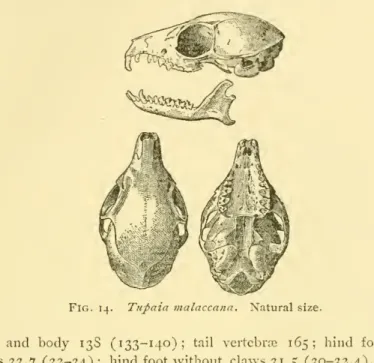
232 MILLER
Tail glossy seal brown above, irregularly lightened and gray, especially through the terminal half, due to the appearance on the surface of the light basal part of the hairs. The basal part of the hairs of the entire tail is bright golden yellow-brown. Skull. – The skull of Tupaia ckrysomalla is so similar to that of specimens of T.ferruginea from Trong, Lower Siam, that I cannot see any features to distinguish them.
The yellow of the tail is occasionally darker than that of the type, almost yellow-brown-occoloured, but never tinged with red. The color is slightly darker than specimens from Trong, Lower Siam; but in size as well as in skull and tooth features the insular bats show no peculiarities.
234 MILLER
In size it corresponds to the dimensions of the Burman specimens; while the margin below the free edge of the nasal leaflet is much more developed than in Rhinolophus affinis, and may easily be described as a supplementary leaflet. Without further material it is impossible to decide whether the island species is identical to that of the peninsula, or whether either is the same as the animal described by Temminck. Skull dimensions: greatest length 15; basal length 13.4; basal length ii.S; cheekbone width 7.8; least interorbital width 2; mastoid width 7.8; largest braincase length 9.6; largest braincase width above roots of zygomata6.8; frontopalatal depth (in the middle of the molar series) 3; braincase depth 5; maxillary dental.
Although this species is closely related to Rhinolophus minor, its legend of different proportions seems to provide sufficient reason for recognizing it as a local form.
236 MILLER
Characters.—Similar to Pteropus condorettsis Peters of Pulo Condor, on the coast of Lower Cochin, China, but of a much different colour; the shiny light gray back contrasted sharply with the dark reddish brown or blackish brown shoulders and neck. The coat on the shoulders, head, neck and underside of the body is loose and somewhat woolly, not compressed at all and therefore appears much longer than the coat on the back, although individual hairs are only about 14mm. It extends on the lower side of the legs to the knees and on the upper arm almost to the elbow, also rarely over the lower side of the propatagium and on the wing membrane along the basal half of the forearm.
238 MILLER
Cranial measurements of the type: greatest length 64; basal length 60; basilar length 58; median pata length 36; palatal width (between anterior molars) 11.4; zygomatic width 33.6; least inter-orbital width in front of postorbital processes 8; least interorbital width behind postorbital processes 7; width between tips of post-orbital processes 21.6; greatest width of braincase above roots of zygomata 22.8; greatest depth of braincase 17.8; occipital depth. 11.8; depth of rostrum at middle of diastema8; mandible 50; maxillary dentition (excluding incisors) 25; mandibular dentition (excluding incisors) 27.6; crown of third upper premolar 4.4 x 3;. That from Tioman Island is smaller, but the peculiar condition of the skull shows that it is a dwarf and abnormal individual.
240 MILLER
The crowns of the molars are more square in outline than those of the mainland animal, and the posterior upper tooth is relatively smaller. Four, from the following localities: Pulo Bunoa, Tambelan Islands,2: Pulo Wai, Tambelan Islands, i; Pulo Siantan, Anambas Islands, i.
242 MILLER
NOTES ON THE FAUNA OF THE ISLANDS VISITED
LINGA ISLAND
PULO TAYA
PULO PENGIKI OR STE. BARBE ISLAND
TAMBELAN ISLANDS
PULO BUNOA
244 MILLER
ANAMBAS ISLANDS
Nycticcbus sp.— "a wretched caged specimen of Nycticebus was brought me, but it was in such bad condition that I would not take it. On each we saw monkeys, squirrels, and tulips." Two specimens of Emballomira ajiambett taken on Pulo Mobur are not mentioned in the field notes. Especially abundant and tame along a small stream (Sungei Maras) much used by canoes."
246 MILLER
TIOMAN ISLAND