Marine Biology!
www2.sunysuffolk.edu/lynchp/ocMB.ppt
Accessed: 14-09-15
Trophic Structure
• Autotroph (Producer)
• Heterotroph (Consumer)
Flow of energy
through a living system;
energy is degraded w/ each step
Generalized trophic pyramid
Simplified food web
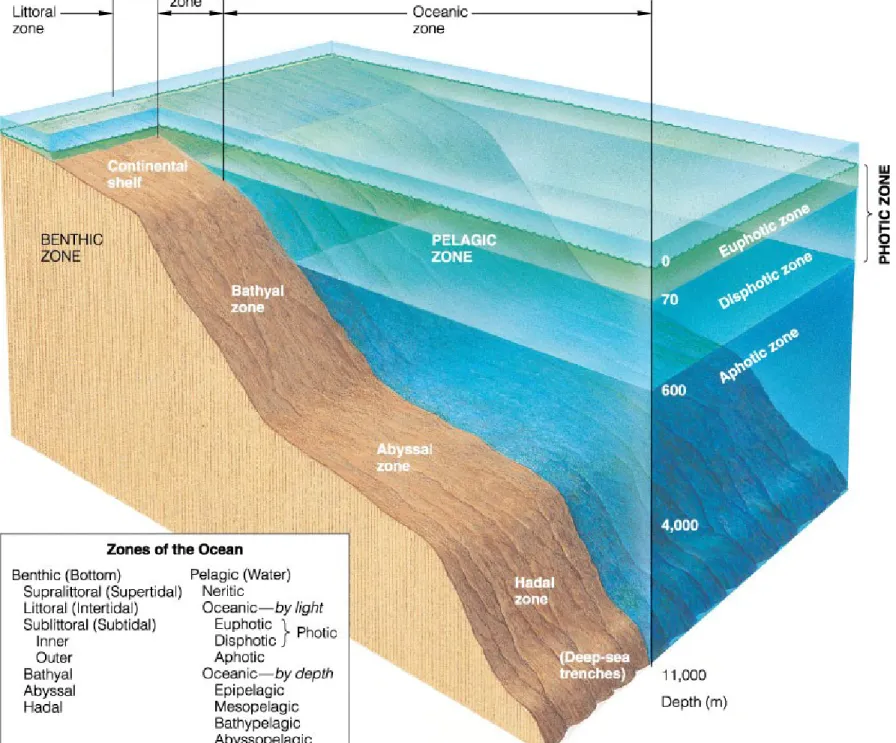
Marine Zones:
Benthic vs. Pelagic
Neritic vs. Oceanic
Fig 12-16, p.285 Garrison
© 2011 Pearson Education, Inc.
Divisions of the Marine Environment
• Pelagic (open sea)
– Neritic (< 200 meters) and oceanic
• Benthic (sea floor)
– Subneritic and suboceanic
© 2011 Pearson Education, Inc.
Pelagic Environment
• Divided into biozones
• Neritic Province – from shore seaward, all water
< 200 meters deep
• Oceanic Province –
depth increases beyond 200 meters
Life in the Ocean
• The PELAGIC community!
• A “Pelagic community” is a community of organisms that live suspended in the water column…they either float (plankton) or swim (nekton).
• This is different than those that live on shore, on the bottom (etc.)
Pelagic
Communitiy, Plankton And
nekton
Marine Mammals that live in the pelagic zone
(Baleen)
Marine Mammals that live in the pelagic zone
(Toothed)
Even “deep” down there are pelagic fish:
Deep sea angler fish
© 2011 Pearson Education, Inc.
Benthos
• Epifauna live on the surface of the sea floor.
• Infauna live buried in sediments.
• Nektobenthos swim or crawl through water above the seafloor.
• Benthos are most abundant in shallower water.
• Many live in perpetual darkness, coldness, and stillness.
© 2011 Pearson Education, Inc.
Benthic Environments
• Supralittoral
• Subneritic
– Littoral – Sublittoral
• Inner
• Outer
• Suboceanic
– Bathyal – Abyssal – Hadal
© 2011 Pearson Education, Inc.
Benthos
© 2011 Pearson Education, Inc.
Intertidal Zonation
• Rocky shore:
• Spray zone – above spring tide zone
• Intertidal zone
– High tide zone – Middle tide zone – Low tide zone
© 2011 Pearson Education, Inc.
Coral Reef Zonation
© 2011 Pearson Education, Inc.
Organisms of the Deep
Pelagic (discussed earlier) & Benthic (Heart Urchin seen here to right)
© 2011 Pearson Education, Inc.
Types of Life!
• Don’t forget PLANKTON (from previous lectures and lab) but now…
NEKTON!
© 2011 Pearson Education, Inc.
Types of Plankton
• Most biomass on Earth consists of plankton.
• Phytoplankton
– Autotrophic
• Zooplankton
– Heterotrophic
© 2011 Pearson Education, Inc.
Nekton
• Independent swimmers
• Most adult fish and squid
• Marine mammals
• Marine reptiles
© 2011 Pearson Education, Inc.
Nekton
Now let’s put everything together – WHO lives there…
Animal Kingdom
• Classify similar animals into Phyla
• 36 Animal Phyla
– Only 1 has vertebrates
These animals are either BENTHIC or PELAGIC;
PLANKTONIC or NEKTONIC…
Invertebrates
• Animals without backbones
• No internal rigid skeleton
• Softbodied
• Many have hard external coverings
Phylum Porifera
Phylum Cnidaria
Phylum
Cnidaria -
CORAL
Phylum Annelida
Phylum Arthropoda - Crustaceans
• Crabs, lobster, shrimp, barnacles, copepods
Phylum
Arthropoda Class
Crustacea
Phylum Mollusca
• 3 Main groups
– Gastropods - snails
– Bivalves- oysters, clams, mussels – Cephalopods – octopuses, squids
Gastropods
• Spiral shells
• Shell-less = sea slugs or nudibranchs
• Project head and muscular foot when moving
Phylum Mollusca
Bivalves
• Twin, hinged shells
• not very mobile
• Suspension feeders
• Gills for gas exchange
Phylum Mollusca
Cephalopods
• Largest of the invertebrates (59 ft squid)
• Foot modified into tentacles
• Active predators
• Highly evolved nervous system
Phylum Mollusca – Class
Cephalopoda- CUTTLEFISH
Phylum Mollusca
Phylum Echinodermata
• Sea stars, sand dollars, brittle stars, sea urchins
Phylum
Echinodermata
PHYLUM CHORDATA
• notochord
• dorsal, hollow nerve tube
• gill slits
• post anal tail
Two Invertebrate Chordates
• Urochordates
– sea squirts or tunicates
• Cephalochordates
– lancelets or amphioxus
VERTEBRATES
• Possess backbones – replaces the notochord
• Subphylum: VERTEBRATA (that’s us…if we were marine mammals!)
Jawless Fish – Class Agnatha
• hagfish
• lamprey
Cartilagenous Fish – Class Chondrichthyes
• skates, rays and sharks
Class
Chondrichthy es
Cartilagenous Fish – Class Chondrichthyes
• skeletons made of tough elastic cartilage
• negatively buoyant
• some of the active sharks must swim to breathe
Bony Fish – Class Osteichthyes
• most numerous and successful of all vertebrates
Bony fish examples
Bony Fish – Class Osteichthyes
• swim bladders
• countercurrent exchange
• operculum
• body shape effects the efficiency of movement
Amphibians
• not found in marine environments
Marine Reptiles
• Sea turtles, sea snakes, marine iguanas, marine crocodiles
Figure 9.05
Marine iguana – 1 of 2 marine reptiles (other = crocodile)
Marine Reptiles
• ectothermic
• covered with scales
• breathe air with lungs,
• have specialized salt glands to excrete excess salt taken in from seawater
Marine Birds Class Aves
• Albatrosses, pelicans, gulls, terns, puffins and penguins
• are endotherms, also have salt secreting glands
© 2011 Pearson Education, Inc.
Marine Mammals
• Land-dwelling ancestors
• Warm-blooded
• Breathe air
• Hair/fur
• Bear live young
• Mammary glands for milk
© 2011 Pearson Education, Inc.
Major Marine Mammal Groups
© 2011 Pearson Education, Inc.
Order Carnivora
• Prominent canine teeth
• Sea otters
• Polar bears
• Pinnipeds
– Walruses – Seals
– Sea lions – Fur seals
© 2011 Pearson Education, Inc.
Carnivora
© 2011 Pearson Education, Inc.
Seals vs. Sea Lions and Fur Seals
• Seals lack prominent ear flaps
• Seals have smaller front flippers
• Seals have fore flipper claws
• Different hip structures
• Different locomotion strategies
Elephant Seals
Figure 9.11
© 2011 Pearson Education, Inc.
Order Sirenia
• Herbivores
• Manatees
– Coastal areas of tropical Atlantic Ocean
• Dugongs
– Coastal areas of Indian and western Pacific Oceans
© 2011 Pearson Education, Inc.
Order Cetacea
• Whales, dolphins, porpoises
• Elongated skull
• Blowholes on top of skull
• Few hairs
• Fluke – horizontal tail fin for vertical propulsion
© 2011 Pearson Education, Inc.
Order Cetacea
© 2011 Pearson Education, Inc.
Order Cetacea
• Suborder Odontoceti (toothed)
– Dolphins, porpoises, killer whale, sperm whale
– Echolocation to
determine distance and direction to objects
– Determine shape, size of objects
Bottlenose
Dolphin
Beluga Whale
© 2011 Pearson Education, Inc.