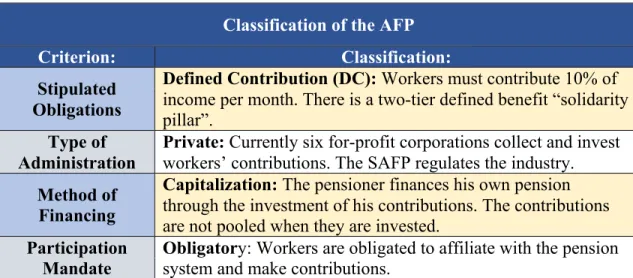
In 2017, pension payments fell short of expectations, and the AFP is one of the most important and contentious issues in Chilean politics. I conclude that the most important contribution of my thesis is to show that the class segmentation of the old Chilean pension system, which the AFP was supposed to eliminate, is still present. In the United States, I am guilty, and our society is guilty of ignorance of the poor.
The article's praise of the Chilean pension system and its details about the possibility of a similar reform in the United States were interesting, so I made research on the AFP part of my studies in Chile. I also looked at the market shares of the companies based on different income tax brackets. Second, Chapter IV specifically considers the effects of the differences in market competitiveness in the AFP for all Chileans, paying most attention to the case of the poorest Chileans.
At the end of IV. the chapter concludes that the most important contribution of my dissertation is to show that the class segmentation of the old Chilean pension system, which the AFP was supposed to eliminate, is still present.
BACKGROUND INFORMATION
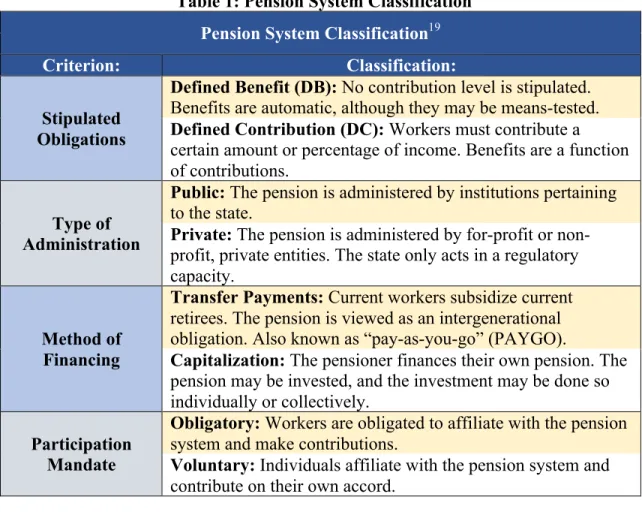
In the UN's International Labor Organization (ILO) Convention on Minimum Standards of Social Security, the ILO defines "social security systems" as a series of programs that protect citizens from "the insecurity of earning a living through work". Because the AFP is primarily designed to cover the old-age portion of Social Security13, I will henceforth use variations of the terms "pension system" and "pension insurance" when referring to the AFP and the subset of Social Security that protects the elderly.14. The first public pension systems were founded at the beginning of the 20th century and adopted two different models.
The 1952 Convention is "the flagship of all ILO social security conventions, as it is the only international instrument, based on basic social security principles, that establishes globally agreed minimum standards for all nine branches of social security". In 1924, Chile was the first country in the Western Hemisphere to establish a national pension system for the elderly, widows and disabled.20 The original Chilean pension system lacked uniformity, with different regimes for different segments of the population. Edwards writes "the original system was not, as has often been argued, a pure pay-as-you-go one", but a system based on the collective capitalization of funds.24 By the 1970s, however, the system relied on the government to fund its obligations and was essentially an insolvent PAYGO system.
The most egregious example of the corruption of the original pension system is the case of the Chilean equestrian industry, as described by Piñera. The structural problems of the former Chilean pension system were exacerbated by the (complicated) economic crisis following the election of Salvador Allende in 1970. On May 1, 1980 ––International Labor Day–– the Ministry of Labor announced that the government would replace the old system of pensions with one based on individual capitalization.
Theoretically, 100% of the Chilean workforce should be enrolled in an AFP—it is required by law.35. At the beginning of the system, self-employed workers were not obliged to affiliate, although they were encouraged to do so. There were three significant periods in terms of the concentration level in the AFP.
VETs that posted profits above 50% of the average across all companies had to invest the excess profits in the same reserve. The purpose of social security systems is to protect workers from "the uncertainties associated with making a living through work".
METHODOLOGY AND LITERATURE REVIEW
49 To obtain the HHI corresponding to a market with a certain number of companies of equal size, multiply the reciprocal of the number of companies by 10,000. As a final aid to understanding the HHI, Figure 5 is a graph by University of Santiago economist Marcela Vera and sociologist Alberto Mayol's 2015 article, “Is the AFP Market Competitive?”, which shows the evolution of the number of AFPs and the HHI from 1982-2007. He cites the behavior of the demand function for the AFP market and economies of scale as factors that reduce competitiveness.
Arenas de Mesa analyzes the 2002 and 2004 Encuesta de Previsión Social (EPS, “Social Provision Survey”), a longitudinal survey of a sample of “approximately 8.1 million current and former members of the Chilean elderly system. Other reasons Valdés Prieto cites as contributing to the inelasticity of the demand function are: 2) Tendency of customers to stick with the first AFP they connect with – there is a lot of customer inertia. This is done to reduce the administrative costs of AFPs, but it also reduces the sensitivity of workers to commission prices.
The second major factor contributing to the decrease in competition that Valdés Prieto discusses is the economies of scale of the VET system. From the average commission fell and the national HHI of AFP in terms of affiliates fell from 2,886 to 2,315.54 Chilean Regional Development Scholarship. One of the few academic analyzes that pointed out regional differences in AFP is Arenas de Mesa 2000, “Temporary Coverage in Chile: Lessons and Challenges of the Privately Administered Pension System”.
Concentration and Growth in Chile: An Ignored Negative Relationship” by Miguel Atienza and Patricio Aroca, professors of economics at the Catholic University of the North. They attribute part of the increase in regional inequality to interregional trade flows and labor mobility. The subsection “Scholarship on the Market Competitiveness of the AFP” included academic research on aspects of the AFP that influence market competitiveness.
ANALYSIS OF MARKET COMPETITION IN THE AFP
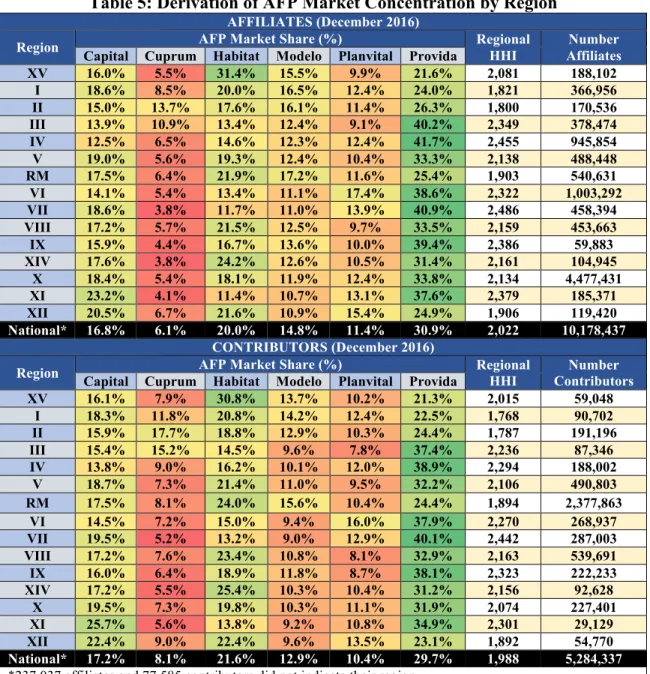
Therefore, market share in terms of contributors is likely to be the most accurate reflection of how companies are positioning themselves in the market. For example, AFP Cuprum's market share in terms of contributors is 132.6% of its market share in terms of subsidiaries. Modelo's market share in terms of contributors is 87.7% of its market share in terms of affiliates.
More simply, AFP Cuprum has a 32.6% larger market share in terms of contributors than in terms of affiliates, while AFP Modelo has a 12.3% smaller market share in terms of contributors than in terms of affiliates. AFP Cuprum also has the smallest market share in every region except Regions II and III, by both. The color scheme helps to visualize the relative equality of market share in regions I and II.
Since RM, the metropolitan area of Santiago, is by far the most populated region, AFP Modelo would see the largest increase in its market share here. Since this reform has resulted in a minimum commission rate for each subsequent implementation period (from 2010 onwards), it can be an effective way to "redistribute" market share. The SAFP only collects data for different income tax brackets in terms of contributors, so no comparison can be made for the market share of affiliated companies.
AFP Cuprum does not have the largest market share in any income tax bracket, except for the highest bracket for which data is available, the bracket greater than or equal to 1,950 thousand pesos per month - more than 6 times more than the average monthly income and more. In contrast, AFP Capital has a much more constant market share across all income tax brackets. AFP Habitat's market share increases with income tax bracket, but it does not have as much of a deficit with lower income tax brackets as AFP Cuprum.
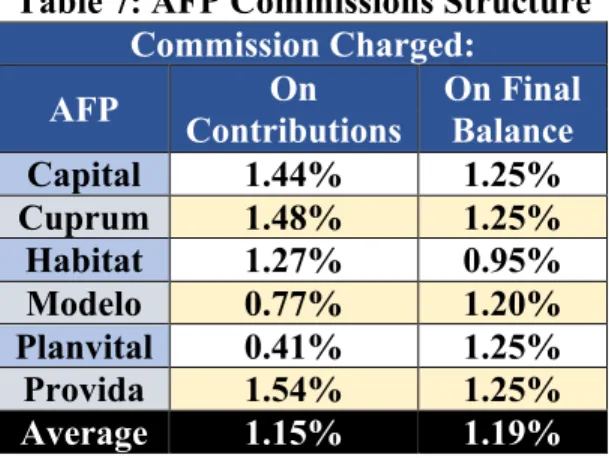
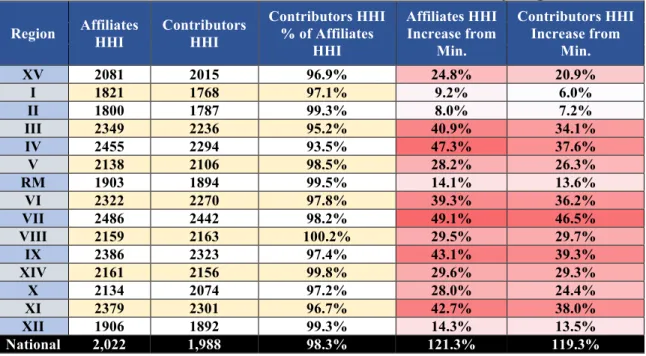
However, Capital's monthly commission of 1.44% is only 0.028 times less than Cuprum's commission of 1.48%, yet it has 4-5 times higher market share in all the lower income tax brackets. In the AFP, the wealthiest regions in Chile have the lowest concentration of market share, and the highest income tax brackets have the lowest concentration of market share.
DISCUSSION
I hope that the prologue of this thesis conveyed to the reader my sense of the inequality of Chile. When market competition in AFP is discussed, it is usually alongside some other aspect of AFP. Of the studies I found that were primarily focused on investigating AFP market competitiveness, all looked exclusively at market competitiveness at the national level.
Thus, a contribution of this thesis is that it goes beyond a national scope in examining the market competitiveness of the AFP and in using the Herfindahl-Hirschman Index to do so. In Chapter III, I find, like other researchers, that the national market of the Chilean pension system shows a high degree of concentration. Similar variations are also evident in the analysis of the HHI according to different income tax brackets.
However, the income tax bracket analysis is worrisome because of the population and wealth distribution. The market for the contributions of the poorest 79.7% of Chileans is less competitive than the market for the contributions of the richest Chileans. First, the Chilean government needs to determine whether the variations in market concentration of the AFP by region and income tax group correspond to similar variations in knowledge of the pension system by region and income tax group.
An area of this thesis that deserves further investigation is to analyze the statistical significance of the differences in market concentration as measured by share of affiliates versus share of contributors, as well as differences in market concentration between regions and between income tax brackets. One aspect of the AFP that has generally been hailed as positive by both its supporters and its detractors is its egalitarianism within the regime. Piñera wrote that the purpose of the AFP was to promote, "freedom and solidarity; a fair but efficient pension system.