• • • •
12
Market positioning
A brand position is the part of the brand identity and value proposition that is to be actively communicated to the target audience and that demonstrates an advantage over competing brands.
Aaker (1996, p. 71)
Aims
The aims of this chapter are to enhance understanding of:
• positioning as the interface between brand identity and brand image
• positioning as a source of competitive advantage
• the challenges involved in developing a narrow positioning
focus for multiattributed destinations
Perspective
PositioningshouldberegardedasmutuallybeneficialfortheDMOand theconsumer,sincetheprocessisunderpinnedbythephilosophyof understandingandmeetinguniqueconsumerneeds.Fortheorgani
sation,thevalueofpositioningliesinthelinkbetweentheanalysesof the internal and external environments. In other words, matching envi
ronment opportunities with organisation resources. Positioning can aid the DMO to cut through to the minds of consumers in markets that arecrowded withthe clutterof promotional messagesof competing destinationsandsubstituteproductsandservices.However,todoso requiresa narrowfocus,andthereforetradeoffsconcerningwhatto leaveout of the proposition. Afterall, a brand is‘a singular idea or conceptthatyouowninsidethemindofaprospect.It’sassimpleand asdifficultasthat’(Ries&Ries,1998,p.172).Onthedemandside, effective positioning of a brand can enable easier decisionmaking fortheconsumer.Consumers don’thavetimeto considerthemerits of all available products in a purchase decision, and will therefore appreciatea memorableandfocusedvaluepropositionthatappeals totheirneeds.
Positioning as a source of competitive advantage
Previously, a model of the destination brand construct was espoused as consisting of the concepts of brand identity, brand image, and brand positioning. This is reproduced in Figure 12.1. Chapter 10 discussed the development a brand identity, which represents the selfimage or desired image, while Chapter 11 discussed brand image as representing the actual image held by consumers. The focus of this chapter is on positioning as a potential means of enhancing congruence between brand identity and brand image.
Figure 12.1 Brand identity, brand positioningandbrand
Brand image Brand identity
Desired brand image
Brand positioning
Name Symbol Slogan
Actual image held by consumers
image
An attractive destination is one that achieves���
���a distinctive ToMA position, which is based on leadership in determinant attributes, in the decision sets of a significant group of travellers, who have an intent to visit within a given time period.
From this perspective it is important to gain an understanding of what decision criteria will be used by the consumer when differentiating destina
tions under consideration. If a destination is perceived to be differentiated on the basis of a determinant attribute, then this is a position that should be exploited by the DMO for mutual benefit. In an ideal world the position
ing campaign will be reinforcing positively held perceptions that will ease decisionmaking by the consumer, rather than attempt to change opinions.
Effective positioning can be a source of competitive advantage for organ
isations in any industry consisting of close substitutes (Porter, 1980). In most tourism markets, particularly those dominated by charter flights and package deals, competing destinations are indeed close substitutes. After all a beach is a beach isn’t it? For example, the beach sunset scene in Figure 12.2 could be almost anywhere in the world.
Therefore, the successful positioning of a destination into a consumer’s evoked decision set represents a source of competitive advantage over the majority of competing places (Pike, 2002b). The chapter is underpinned by Figure 12.3, which presents a proposed model of brand positioning as a potential source of competitive advantage for destinations. The model views positioning as a vehicle for influencing brand image and therefore destination attractiveness.
Figure 12.2 Beachsunsetscene
Sources of comparative advantage
Brand positioning
Competitive Advantage (Destination Attractiveness)
Organic images Induced images
Cognition Affect
Awareness set Evoked set ToMA
- Travel context - Motivation - Previous visitation - Demographics
Attribute determinance
Conation
Figure 12.3 Brandpositioningasasourceofcompetitiveadvantagefordestinations
The positioning concept
Brand positioning describes how a brand can effectively compete against a specified set of competitors in a particular market (Keller, 2003, p. 150).
The concept was first introduced to the advertising community as a mar
keting strategy in 1969 (Trout & Ries, 1979), and has been defined as a process of ‘establishing and maintaining a distinctive place in the mar
ket for an organisation and/or its individual product offerings’ (Lovelock, 1991, p. 110). At the core of this quest for a distinctive place is recognition that marketing is a battle fought inside the consumer’s mind (Ries & Trout, 1986, p. 169):
Marketing battles are not fought in the customer’s office or in the supermarkets or the drugstores of America. Those are only distribution points for the merchandise whose brand selection is decided elsewhere.
Marketing battles are fought in a mean and ugly place. A place that’s dark and damp with much unexplored territory and deep pitfalls to trap the unwary. Marketing battles are fought inside the mind.
Positioning theory is based on three propositions (Ries & Trout, 1986). First, we live in an overcommunicated society, bombarded with information on a daily basis, at levels that are unprecedented in our history. Second, the mind has developed a defence system against the clutter. Third, the only way to cut through the clutter to the mind is through simplified and focused messages. Consequently, not selecting a positioning strategy could lead to headon competition with stronger brands, an unwanted position with little demand, a fuzzy position where distinctive competence is unclear, or no position, where the product is unheard of (Lovelock, 1991).
Porter (1980) warned that being ‘stuck in the middle’, with no distinctive position, was the most dangerous place to be.
Effective positioning offers the customer benefits tailored to solve a problem, in a way that is different to competitors (Chacko, 1997; DiMingo, 1988). The key construct in positioning is brand image. However, posi
tioning requires more than an understanding of what a brand’s image is in the mind of the consumer. While such studies enable an indication of satisfaction with a destination, a weakness of this approach is the inability to determine relative positioning against competing regions. Positioning requires a frame of reference with the competition, particularly in relation to those in consumers’ decision sets. A position is a product’s perceived performance, relative to competitors, on specific attributes (Lovelock, 1991;
Wind & Robinson, 1972). Positioning studies have not been prominent in the tourism literature (Grabler, 1997b). Although positioning had featured in the economics literature as early as the 1920s (Myers, 1992), there was little mention of the construct in the marketing literature until the 1970s.
Destination positioning studies have been particularly rare (Uysal et al., 2000; Heath & Wall, 1992; Yau & Chan, 1990).
Differentness • • •
Ries and Trout (1986) emphasised the need for marketers to think in terms of differentness rather than betterness. This has important tourism implica
tions, given few tourism products are unique. Differentiation is critical for destinations since they will either become places of status or commodities, with the latter leading to increased substitutability (Gilbert, 1990). Plog (2000) lamented the increasing sameness of most destinations around the world, due to the effects of globalisation. Modernity has all but destroyed the opportunity for travellers to experience different attractions (Dann, 2000). This standardisation of facilities enabled mass tourism by providing travellers with necessary familiarity:
As a result, countries become interchangeable in the tourist’s mind.
Whether he is looking for good beaches, restful forests, or old cities, it becomes relatively unimportant to him where these happen to be found (Cohen, 1972, p. 172).
Effective differentiated positioning to stand out from the crowd is possible for any product (DiMingo, 1988; Moutinho, 1994). The fundamental mar
keting challenge faced by DMOs is to somehow match a large and diverse product range with the needs of a number of dynamic and heterogeneous
markets. The desired market position, assuming one has been designed and articulated, must be presented to the market in a way that stands out from other attentionseeking messages of rival destinations and substitute products. If successful, such a position will establish the destination as top of mind in the target audience. If top of mind awareness (ToMA) is an indicator of purchase preference (Axelrod, 1968; Wilson, 1981; Woodside &
Wilson, 1985), it follows that such a position in the mind offers destinations a potential source of competitive advantage (Pike & Ryan, 2004).
As discussed in Chapter 8, strategy should seek to maximise strengths, correct weaknesses, minimise threats, and maximise opportunities. Porter (1980) suggested a competitive strategy was one that positioned a business to make the most of strengths that differentiated the firm from competitors.
A sustainable competitive advantage (SCA) is gained when consumers per
ceive a performance capability gap that endures over time (Coyne, 1986).
To gain an advantage the gap must be through an attribute that represents an important buying criterion. Not all attributes that differentiate a prod
uct from competitors are actually important to the consumer, and not all important attributes are used in decisionmaking.
Attribute importance, salience, and determinance • • •
The ideal for any product is to be perceived favourably on product attributes that are important to the target segment. Different terms have been used in the tourism literature to describe important attributes.
Salience concerns the order in which features are elicited from consumers, where the most pertinent are offered first. Important attributes may be salient but not necessarily determinant (see Research Snapshot 12.1). It is essential then to identify those attributes that determine product choice, to form the basis for any positioning campaign (Lovelock, 1991; Ritchie &
Zins, 1978). Myers and Alpert (1968, p. 13) offered the first definition of determinance in the marketing literature:
Attitudes toward features which are most closely related to prefer
ence or to actual purchase decisions are said to be determinant; the remaining features or attitudes – no matter how favourable – are not determinant.
Research snapshot 12.1 Common determinant attribute themes
From the analysis of over 80 published destination image studies that had used lists of attributesinstructured questionnaires, Isummarised 18themes(seePike, 2003). Ofthese studies, 37concluded withproposed determinantattributes or factors,which I summarised into the following 15 themes:
• Nature/scenery
• Localculture
• Price/value
• Good weather
• Infrastructure
• Friendlylocals
• Safe/relaxingenvironment
• Lotstodo
• Accommodation
• Sportsactivities
• Cafes/restaurants
• Historicalsites
• Nightlife
• Accessibility
• Shopping
Destination market researchers can screen thesethemes, throughfocus groups and/or or personalinterviews,todevelopacontextspecificlistofattributesforuseintailoreddestination imagesurveys.
Source:Pike,S.(2003).Theuseofrepertorygridanalysistoelicitsalientshortbreakholidayattributes.Journalof TravelResearch,41(3),326–330.
To summarise, a large number of attributes may be important in a brand category. Since many competing products are likely to offer many of these features, it will be a reduced set of salient attributes used to differentiate brands. From these, only one or a few determinant attributes will be used in the final brand selection.
Positioning destinations
Few communities have developed a positioning strategy. Instead they yield to the pressure to be all things to all people, and use lookalike promotions and print brochures showing attractions ranging from historic barns to zoos – without any regard to whether these features have any drawing power (Gee & Makens, 1985, p. 29).
The destination positioning process involves seven stages.
1. Identify the target market and travel context.
2. Identify the competitive set of destinations in the target market and travel context.
3. Identify the motivation/benefits sought by previous visitors and non
visitors.
4. Identify perceptions of the strengths and weaknesses of each of the competitive set of destinations.
5. Identify opportunities for differentiated positioning.
6. Select and implement the position.
7. Monitor the performance of the positioning strategy over time.
The value proposition
The development of a proposition is arguably the greatest challenge in branding (Gilmore, 2002). Once the range of potential determinant attributes is known, a key decision must be made about which should be used as the focus of the brand positioning. While focus may be appropriate for singleproduct marketers, the selection of one determinant attribute by a destination marketer is usually problematic. Ries and Trout (1986) used the analogy of postcard images to sum up how a place was positioned in the mind. Another useful example is the ubiquitous roadside billboard, as shown in Figure 12.4. Clearly there is a limit to the amount of information that can be portrayed on a standard size postcard or billboard.
To stand out, and be noticed and remembered, DMOs must design a positioning strategy focused on one or few determinant attributes. Suc
cess is most likely when the range of differentiated features emphasised is small (Aaker & Shansby, 1982; Crompton, et al., 1992) and yet a destina
tion usually comprises a diversity of features. For DMOs, this necessitates making tradeoffs. After all, ‘you can’t stand for something if you chase after everything’ (Ries, 1992, p. 7). The power of focus is due our mind’s dislike of confusion (Trout & Rivkin, 1995). In an age when the infor
mation flood is increasing exponentially, the message should not try to tell the product’s entire story, but rather focus on one powerful attribute, since more brand variations cause confusion. Ries (1992, p. 5) suggested that owning a word in the target’s mind had become the most powerful concept in marketing. Therefore the following question should be asked:
What single idea or concept does my company (or brand) stand for in the mind of the prospect?
In the brand literature it has been suggested that a value proposition is the promise of functional, emotional, and selfexpressive benefits to
Figure 12.4 Roadsidebillboard
influence purchase decisions (Aaker, 1996). These are relevant to the con
cepts of cognitive, affect, and conative images. Functional benefits, or product attributes, by themselves do not differentiate and are easy to copy.
This relates to the cognitive image or knowledge of a destination’s features.
Emotional benefits are the stimulation of a positive feeling. This relates to the affective image component. Selfexpressive benefits strengthen the link between brand and consumer by representing symbols of our selfconcept:
‘A brand can thus provide a selfexpressive benefit by providing a way for a person to communicate his or her self image’ (Aaker, 1996, p. 99).
These may include, for example, ‘adventurous’, ‘hip’, ‘sophisticated’, and
‘successful’, among others. The differences between emotional and self
expressive benefits are that selfexpressive emphasises: the self rather than feelings, a public setting rather than private, future aspirations rather than memory, and the act of using the product rather than the consequence of using it. For example, the benefit of the pre and postbrag value from visit
ing an exotic destination may be different to the benefit of feelings attained from being there. Following Keller (2003), three positioning deliverability criteria should be considered:
• Is the position feasible? For a destination this will relate to the ability of the local tourism industry and host community to deliver the promise.
• Can the position be communicated? In terms of developing strong, favourable, and unique associations, the efficacy of a destination’s com
munications will depend to a large extent on whether the message is reinforcing existing positively held associations of the destination, or whether an attempt is being made to either create awareness or change opinions.
• Is the position sustainable? The ability of the destination to strengthen associations over time will depend on how well the position can be defended against imitating rivals.
Case Study 12.1 is a typical example of a destination faced with the chal
lenge of differentiation in a market crowded with places offering similar attributes and benefits. In this case experiential marketing is offered as a potential opportunity to do so. Pine and Gilmore’s (1989) notion of the experience economy discussed the progression of economic values from commodities to goods, to services, to experiences. Customising a good turns it into a service, and customising a service turns it into an experience.
In a keynote address to the 2004 LeisureFutures conference in Bolzano, Italy, Pine referred to experiential examples such as Japan’s Ocean Dome.
This is the world’s largest indoor swimming pool, but in the form of an indoor beach complete with nonstickable sand. Customers pay over $300 for a family visit to the complex, which is ironically situated only 400 metres from a real beach. Other examples recommended by Pine included:
• Pike Place Fish Market in Seattle, Washington, where the actions and banter of staff is akin to a theatre experience in a fish shop
• Hotel Atlantis in Bermuda
• Othentica (see www.othentica.com), a firm specialising in creating a simulated entertainment experience for elite staff. Based on the psycho
logical profile of participants, the simulation has something in common with the Michael Douglas movie The Game.
Case study 12.1 Long Lake, New York: small destinations and experiential differentiation – what to do?
DrRichard‘Rick’M.Lagiewski,RochesterInstituteofTechnology,USA
LongLakeisasmalltown(852inhabitants)locatedinthecentreoftheAdirondackParkinthe stateofNewYork(seehttp://www.longlakeny.com/).Thetownisappropriatelynamedafter its14milelonglake.Tourismisamajorindustrythere,butalsointheentireAdirondackPark.
This has been the case since the 1950s when destinations in the Adirondack Park became easily accessible for family vacations due to the development of automobiles, a booming postwar economy, increased leisure time and income. This small town inthe Adirondack Parkwasappealing to visitors since it offeredthem somethingdifferent than thelife inthe city:privatecottages,untouchednature,andnumerousopportunitiestoenjoytheoutdoors.
Inevitably,however,thenumberofotherdestinationsdevelopingintheAdirondackParkthat offeredthesameserviceskeptincreasing,andhenceresultedinsaturatedsupply.
Visitors come to Long Lake to enjoy outdoor activities (birdwatching, biking, camping, canoeing,boating, crosscountryskiing, fishing, hiking, hunting,snowmobiling, stargazing) aswell as concerts,craft fairs, and other events. The town’s current marketingefforts are focused essentially on activities that visitors can engage in while in Long Lake. However, all the activities and events found in Long Lake can also be found in many of the other Adirondacktownships.Also,most townsoffer thesametypeof accommodation anddining options,andforthatmatterthesametourisminfrastructureingeneral.
The situation can be summarised as follows: small towns (like Long Lake) in the Adirondack Park that have similar (if not the same) offering of activities, events, accommodation, and dining options (tourism product) as other lake destinations in the Adirondack Park, face the problemofcommoditisationoftheirservices.Hence,thereisaneedtofindawaytodiversify Long Lake from its competitors. Due to limited access to sources of capital, adding new physicalinfrastructureisnotanoption.
PineandGilmore(1999)introducedtheideathatgoodsandservicesarenolongerenough for differentiating and therefore advocated experiences as a form of differentiation. They explainedtheshift from commoditiesto experiences andtheneed to createexperiencesif competitorsaretobedifferentiatedfromtheirrivals.Inaddition,PineandGilmorestatedthat experiences areintrinsically sensory. In other words, it does matter whatone sees,hears, touches, smells, and tastes in shaping of impressions and consequently experiences. As they say (p.59):‘Themoreeffectivelyanexperienceengagesthesenses,themorememorableitwillbe.’
Inworking withLong Lake’sDMO(a onemanoffice)theproposed ideaof differentiating LongLakethroughexperiencesisoftenhindered duetothepersistence towardstraditional marketing such as brochures. Often the concept of experiences is viewed as synonymous with a recreational activity. Again the issue is not seen as focusing on senses and emotions or feelings gained from an experience, but rather on some active participation in an outdoor activity.Also,therewasstillatendencytoidentifyanddefineadifferentphysicalcharacteristic thatdifferentiated Long Lake from other lakes.For example,at 14 miles it wasone of the
longestlakesintheAdirondackPark.However,whatmakesthislakeauniqueexperiencein comparisontoan8milelake?
Discussionquestion
Whatstrategieswouldyousuggestcouldbeusedtogetresidentsandcommunityleaders to focus on senses, feelings, and memories that would represent the marketing vision of a vacation on Long Lake?
Furtherreading
Lagiewski,R.&Zekan,B.(2006).Experientialmarketingoftourismdestinations.International TourismConference(November).Alanya:Turkey.
Pine,J.&Gilmore,J.(1989).TheExperienceEconomy.CambridgeMA:HarvardUniversity Press.
Undertaking the sevenstage destination positioning process on a segment
bysegment basis in all markets, for different travel contexts, would present a significant and no doubt impossible challenge for DMOs. It follows that even with a wide range of attractions, some destinations may not fulfil potential opportunities (Hunt, 1975), where, due to poor decisionmaking, implementation and/or limited budgets, the desired image has not been achieved in the market. The following should be considered to enhance destination positioning effectiveness (Pike & Ryan, 2004, p. 341):
• An understanding of the benefits sought by the target audience, and the relative performances of the competitive set of destinations.
• Tradeoffs for a focused positioning strategy based on determinant attributes.
• Implementation to ‘cutthrough’ and stimulate intent (demand).
• The delivery and monitoring of benefits offered by the position.
• Performance measures to track effectiveness over time.
• Research to stay in touch with target audience needs.
Case Study 12.2 perhaps captures the essence of what Lagewski had in mind in Case Study 9.1.
Case study 12.2 Destination theming: Heidiland region, Switzerland
ProfessorAdyMilman,Ph.D.,RosenCollegeofHospitalityManagement, University of Central Florida
The continuing challenge of destinations to provide tourists with unique and memorable experiences has generated a relatively new trend of adopting theming as a strategy to enhanceanddevelopthetraditionalcomponentsofthedestination.Thisproposedorientation
is not only in response to consumers’ changes in tastes and preferences, but also as a marketingtoolforsustainingdestinationcompetitiveness.
Successfuldevelopmentofa themeddestinationisa combinationof storytelling,creative design,soundfinancialprojections,audienceanalysis,andplanning.Like inmoderntheme parks,destinationtheming strivesto createafantasy atmospherethatisemotionallylinked tothedestination.Thethemeismainlycommunicatedthroughvisualandvocalstatements, butalso through other senses. In many themeddestinations, theming isreflected in archi
tecture,streetfurniture,signage, landscaping,costumedpersonnel,personal storytellingby tourguides andlocalresidents, recreationalactivities, entertainment,music,food services, souvenirshops,andanyotherguestexperiences.
One of the most remarkable examples of destination theming is Heidiland, located in the eastern part of Switzerland where Johanna Spyri wrote her wellknown book Heidi about an unwanted orphan girl who found happiness in the Alps (Spyri, 1996). Most of Heidiland’s resorts and villages areabout 50–75minutes from Zürichairport and approxi
mately 45 minutes from Lake Constance (Swiss National Tourist Office, 2007). In the early 1990s, the Swiss Tourism Board declared the Rhine Valley in the Eastern Canton of Graubun
den as Heidiland, and the region was rededicated in 2001 to commemorate the 100th anniversaryofSpyri’sdeath.
TheHeidi story is communicated to visitors throughout the region,but particularly inthe village of Oberfols, considered Heididorf or Heidi Village. In the village, visitors can visit HeidiHaus,amid19thcenturySwisshutdecoratedwithHeidierafurniture,kitchenutensils, and clothes to give visitors anauthentic feeling for whatlife inHeidi’s era was reallylike.
Thevillagealso offerssouvenir shops,a smallpettingzoo, andapost officewherevisitors cansend letterswiththeHeidi postmark(Schur, 2007).In addition, theHeidithemeisalso communicatedthroughinteractiveexperiences,especiallyhiking.TheHeidiWeg(HeidiPath) isaoneandahalfhourmountainwalkthatfeaturestwelvesignsinseverallanguages,each witha different excerpt from the book and an explanation of someaspect of the scenery.
Ontop of themountain,there isa 200yearoldcowherder’shut wherehikerscan meet a character who plays Heidi’s grandfather (Schur, 2007). The area also developed a brand of mineral water called Heidiland Water.
Tourism operators in Heidiland teamed together to promote the region with emphasis onhealthy vacationinginan Alpineenvironment. Heidiland’s tourismmission stressesthat there is no intention of becoming a Swiss Disneyland or turning Heidiland into a giant themepark. Nevertheless, Heidi’sstory has provided aninspiration to develop a variety of touristfacilities, products, and activities based onthe localexistingnatural and manmade resources.
Discussionquestion
Canyouthinkofanyregionintheworldwherethemingcouldbeappliedthroughpreexisting intellectualproperty?Suggesthowthethemecouldbecommunicatedtovisitors?Brainstorm potentialthemingopportunitiesforyourdestination.
Further reading
Beck, E. (1997). Heidi ho! The Swiss, amid controversy, exploit the orphan. Wall Street Journal(EasternEdition).October21997, p.A1
Schur, Maxine (2007). Following my heart to Heidiland: Inside the landscape of a famous movie. Retrieved on 3/6/07 from: http://www.escapeartist.com/efam/43/In_Search_of_
Heidiland.html
Swiss National Tourist Office (2007). Heidiland home page. Retrieved on 3/6/07 from:
http://www.heidiland.ch/en/accessing_resorts.cfm
The positioning elements
When the proposition focus of the position has been determined, the ele
ments to represent the public face of the brand must be selected. For destinations the most important positioning elements are the place name, a symbol, and a positioning slogan.
Destination names
In this competitive era, the single most important marketing decision you can make is what to name the product. The name is the hook that hangs the consumer brand on the product ladder in the prospect’s mind (Ries & Trout, 1982, p. 28).
At the core of the brand is the product name (Aaker, 1991). A well chosen word can trigger meanings in the mind, and so a good brand name can begin the positioning process by communicating the major benefit of the product (Ries & Trout, 1982). However, there has been little empirical research into the contribution of the brand’s name in the development of favourable brand associations (Keller, 1993), and little, if any, relating to destination names. Unlike new product developments, where an attempt can be made to select a name that enhances the positioning process through either memorability or development of associations, a destination will already have a place name, for which a history of associations has been developed (hopefully!) over time.
Tricky place names • • •
For all manner of political, economical, and practical reasons, it is usu
ally extremely difficult to change a place name for tourism purposes, even though it might make sense to some marketers. For example, in New Zealand during a late1980s crisis meeting that I attended between Rotorua’s civic leaders and Japanese tour wholesalers, convened by the then mayor, John Keaney, to discuss the destination’s ailing image in that market, one of the key outcomes was the suggestion that Rotorua change it’s name to ‘Kingstown’. This was a deliberate reference to Queenstown, which was the preferred New Zealand resort area for Japanese visitors.
In line with Ries and Trout’s (1982) view that brand names need aural qualities, Rotorua, which is an indigenous Maori name that translates as
‘second lake’ in English, did not appeal to the Japanese in the same way as destinations with English names such as Queenstown and Christchurch.
The ‘Kingstown’ suggestion was never pursued seriously beyond the meet
ing, for political and cultural reasons, and, I might add, was never made public. The local reaction to such a proposal does not bear thinking about!
The Rotorua problem is certainly not unique. Ries and Ries (2002) pro
moted the option for Guatemala to change to Guatemaya, in order to link the Mayan people and their heritage to one of a number of countries where Mayan ruins may be found. While well received by the business com
munity in a destination struggling to differentiate, the idea is unlikely to happen. In Turkey, the Ankara Chamber of Trade president put forward a proposal to the country’s Minister of Tourism to revise the destination name (www.eTurbonews.com, 1/3/07):
The name with which our country is known to the world, ‘Turkey,’
needs to be changed. This is the name of a bird in English and is used in a derogatory way to reflect the low intelligence of the bird.
Anyway, there are places that owe much of their renown to a tricky name, such as Titicaca, Timbuktu, Popocateptl, Ouarzazate, and Gstaad (Anholt, 2002). So there are opportunities for places such as:
• Bum Bum Creek (Australia)
• Beer (England)
• Condom (France)
• Fucking (Austria)
• Hell (Norway), to name but a few!
Nevertheless, there are examples of destination name (re)creation around the world, which in some cases has been for branding reasons:
• In the Caribbean, Hog Island was changed to Paradise Island to appeal to the cruise tourism market (Ries & Trout, 1982).
• During the 1930s the Queensland beach town of Elston was renamed Surfers’ Paradise.
• In 1996 the Republic of Cuervo was created by the wellknown tequila brand (see Kotler, 1996) following the purchase of an island off the coast of Tortola in the Caribbean. The company unsuccessfully petitioned for country status at the United Nations, and for the admission of a volley
ball team to the Olympics. Today the island is labelled CuervoNation (see www.cuervo.com).
Adding brand associations • • •
If not able or willing to officially change the name, amendments can be made to the name used to brand the destination. During 2003 the neigh
bouring Queensland beach towns of Bargara, Moore Park, and Woodgate all made moves to add the word beach to the destination name. The names Bargara Beach, Moore Park Beach, and Woodgate Beach clearly signal an important functional attribute for these small emerging destinations. Simi
larly, Florida’s Lee County, home of the USA’s bestknown shellcollectors’
haven Sanibel Island, changed the destination name to Lee Island Coast in promotions. In New Zealand’s central North Island the official place name of Taupo has long been promoted by destination marketers as Lake Taupo to take advantage of the district’s most noticeable natural feature (see, for example, www.laketauponz.com). Likewise, neighbouring district Ruapehu, which features the North Island’s major skiing and climbing mountains, is promoted as Mount Ruapehu.
A further opportunity is that of labelling tourism macroregions with tourismrelated names. One example is Utah’s promotional regions such as Dinasourland and Canyonlands. Another is Queensland’s Gold Coast and Sunshine Coast. Other attempts at establishing emerging macroregions labels within the state include:
• Fraser Coast, in reference to the world heritage listed Fraser Island
• Coral Coast, in reference to the southern starting point of the Great Barrier Reef
• Discovery Coast, in reference to Captain Cook’s 1770 voyage of discov
ery, explicit in the name of the popular beach: The Town of 1770
• Capricorn Coast, in reference to the Tropic of Capricorn
• Tropical North Queensland.
By comparison, the names of England’s macrodestination regions indicate a geographic reference point, such as South East England, and miss an opportunity to promote a travel benefit.
Destination symbols
I experienced an interesting example of how the multiattributed nature of destinations represents a major challenge in the positioning process when as CEO of Tourism Rotorua I was presented with a request by a national television network for a graphic image of one local icon for use in the nightly weather segment. Only one image was permitted, which would be used consistently each night alongside images from other major cen
tres. However, this highprofile opportunity proved a difficult selection due to the vested business interests in different icons by individual repre
sentatives of the RTO’s board. Politics aside, symbols can enhance brand recognition and recall (Aaker, 1996) by serving as a mnemonic devise for the target (Aaker, 1991). A symbol can be a metaphor for the brand’s personality, such as Marlboro’s cowboy and Esso’s tiger (King, 1991).
Since destination names have not usually been designed to reinforce or create associations with a product class, logos and slogans can play important roles as identifiers. A logo and/or slogan can be designed to reflect a desirable functional feature such as nature or an affective bene
fit such as relaxing. Aaker (1996, p. 205) suggested posing the question:
‘What mental image would you like customers to have of your brand in the future?’ A symbol can help to identify the brand with the product class as well as reflect the brand personality. For example, Virgin’s logo, uncon
ventional script, and rakish angle support the Virgin personality, which flaunts the rules (Aaker & Joachimsthaler, 2000). In particular, symbols
that are metaphors for the brand personality are more meaningful. Ries and Ries (1998, p. 132) were critical of many efforts in this regard:
The power of a brand name lies in the meaning of the word in the mind. For most brands, a symbol has little or nothing to do with creating this meaning to the mind.
Symbols can emerge from a diverse array of sources, such as a sound (Harley Davidson), architecture (Spanish adobe construction), the prod
uct’s founder (KFC’s Colonel Sanders), a colour (Hertz’ yellow), packaging (Nivea cosmetics), script style (Cadbury chocolate), a programme (Ronald McDonald House), a character (Energizer bunny), a celebrity (Nike’s Michael Jordan), or a distinctive logo (Adidas’ three stripes). Ownership of such ‘communication equity’ represents a source of competitive advantage (Gilmore, 2002b).
For destinations, a symbol may represent wellestablished icons:
Such symbols as the Eiffel Tower, the Pyramids of Egypt, and the Great Wall of China are the kinds of unique and enduring symbols that DMOs are prepared to die for (Ritchie & Ritchie, 1998, p. 113).
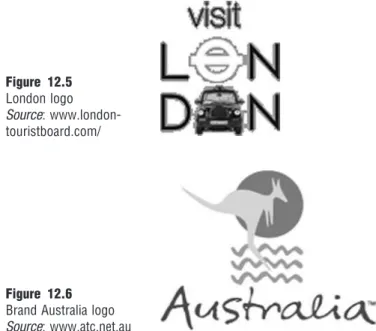
For other destinations the symbol may be a logo. In Figure 12.5 it can be seen that the London logo used in 2004 emphasised the wellknown underground and taxi icons that play a prominent role in most visits to the British capital. Typically, the logo was recently changed again, as was the 2004 logo used for Brand Australia, shown in Figure 12.6, which featured the nation’s favourite icon to provide instant recognition overseas (ATC, 2003). The design was developed through extensive research that identified the kangaroo as Australia’s most recognisable symbol. Similarly, Florida’s
Figure 12.5 London logo Source:www.london
touristboard.com/
Figure 12.6 Brand Australia logo Source:www.atc.net.au
Figure 12.7 Florida logo
Source:www.flausa.com
logo that was in use in 2004 has also been changed. The STO launched the new logo FLA USA in 1997, developed at a cost of US$237,000, including US$100,000 in market testing (Marketing News, 29/9/97). The report sug
gested that sunshine state tourism officials hoped the new logo, shown in Figure 12.7, would ultimately become as recognizable as the Nike swoosh.
The Florida Tourism Industry Marketing Corporation (FTIMC), which changed the organisation name around the same time to Visit Florida, stated that the brand was designed for the long term.
Destination slogans
For most destinations a logo will not be sufficient to communicate a dif
ferentiated position. The addition of a slogan offers an opportunity to add more meaning to that which could be achieved by the brand name or sym
bol (Aaker, 1991). A slogan is a short phrase that communicates descriptive or persuasive information about a brand (Keller, 2003). Interestingly, it has been suggested that the word slogan emanates from the Gaelic term meaning ‘battle cry’ (Boyee & Arens, 1992, in Supphellen & Nygaardsvik, 2002). Slogans are also referred to as tag lines and strap lines.
As Sydney prepared for the 2000 Olympics, Ries and Ries (2002, pp. 153–154) proposed a new positioning slogan based on the following criteria:
• It should be a concept positioning Sydney as a worldclass city alongside London, Paris, Rome, New York, and Hong Kong.
• It should be a concept that has a strong element of believability. People should say, ‘Yes, Sydney is like that’.
• It should be a concept that is alliterative with the name Sydney, to enhance memorability.
• It should be a concept that is consistent with the symbol of the city, the Sydney Opera House.
They suggested only one slogan, ‘Sydney, the world’s most sophisticated city’, which met all four criteria. At the time of writing, Sydney’s actual positioning slogan was There’s no place in the world like Sydney.
Too many destination slogans have been less than memorable (see Dann, 2000; Morgan et al., 2003; Ward & Gold, 1994). Best practice in destination promotion has been limited to a few simple slogans, such as the 1970s development of the ‘I � New York’ campaign (Ward & Gold, 1994, p. 4):
The process of imitation, however, demonstrates a general paucity of creative ideas and effectively ensures that the vast majority of place promotional campaigns rarely manage to cross the threshold of ephemeral indifference.
The slogans used during 2003 by NTOs are presented in Appendix 12.1.
The approach used was to record the slogan used on the home page of each NTO’s consumer website. The rationale was the assumption that since one of the basic tenets of integrated marketing communication is a consistency of message across different media, the slogan used on the DMO home page should represent the destination positioning theme. My content analysis of these slogans identified 14 positioning categories, which are listed below in order of popularity (see Pike, 2004):
• Leadership
• Discovery
• Nature
• Location
• People
• Water
• Selfexpression
• Escape
• Pleasure
• Treasure
• Royal
• Vibrant
• Climate
• Culinary
Some destinations have resorted to public competitions to unearth a slo
gan. For example, during 2001 Tauranga District Council in New Zealand ran a competition inviting the public to design a new slogan for the dis
trict. The competition resulted in over 2500 submitted slogans (Cousins, 2001). Slogan competitions have not been limited to small destinations.
Holcomb (1999), for example, reported a similar initiative by Atlanta in the USA. The obvious danger with competitions is that there may be polit
ical pressure to use the winning slogan, which may not be meaningful to the target market. Research Snapshot 12.2 provides a hierarchy for testing meaningfulness.
Research snapshot 12.2 The USP
Unfortunately, there are few guidelines in the marketing literature for empirically testing brand slogans (Supphellen & Nygaardsvik, 2002). A useful study in the tourism literature concerning differentiation through slogans was reported by Richardson and Cohen (1993). They devel
opedahierarchicaltaxonomyofdestinationslogansfeaturingfourcriteria,basedonReeves’
(1961)conceptofauniquesellingpoint(USP):
• Thefoundationofthehierarchyisthatthesloganmustbeprepositional.
• Suchpropositionsshouldbelimitedto oneoronlyafew.
• Theproposition(s)shouldsellbenefitsofinteresttothemarket.
• Thebenefit(s)mustbeunique.
Richardson and Cohen categorised the slogans of 46 USA state tourism organisations.
Commencingatlevelzeroofthehierarchy,twoofthestateslogansexamined,Yes!Michigan!
and Utah!, were deemed not to be propositional. Ascending to level one of the hierarchy the slogans of six STOs featured propositions, but were no more than a plea to ‘buy our product’. Examples at this level included Discover Idaho and Explore Minnesota. At level two, the proposition is equivalent to stating ‘our product is good’. Of the 14 slogans at this level, examples included Discover the spirit! North Dakota, The spirit of Massachusetts, and Vermont makes it special. Level3a featurednine slogans wherethe proposition promoted anattributethatrepresentedapotentialbenefitbutthatalmosteveryotherstatecouldclaim.
TheseincludedArkansas– thenaturalstate,Maine–thewaylifeshouldbe,andOregon– thingslook different here. Atlevel 3bthe propositionalbenefitattributeused intheslogans of six states could be claimed by many states. These included Ohio the heart of it all!, Oklahoma–nativeAmerica,andTexas,likeawholeothercountry.Atlevel4a,theproposition features a unique attribute, but one that does not represent a benefit. The three states at this level were Delaware – the first state, Pennsylvania – America startshere, and Rhode Island–America’sfirstresort.Atlevel4b,thepinnacleofthehierarchy,theslogans ofonly fivestateswereconsideredtofeatureaUSP:
• Arizona–theGrandCanyonstate
• Florida – coast to coast
• Louisiana – we’re really cookin!
• South Dakota – great faces, great places
• Tennessee–we’replayingyoursong
Source:Richardson,J.&Cohen,J.(1993).Stateslogans:ThecaseofthemissingUSP.JournalofTraveland TourismMarketing,2(2/3),91–109.
Furthermore, a longterm and consistent brand strategy might be subject to tampering, following the appointment of new marketing managers who want to leave their personal stamp on strategies. McKercher and Ritchie (1997) cited the example of an LTA in Australia, which had four man
agers in six years. This led to the development of four different marketing plans, with each having a different positioning statement, resulting in
marketplace confusion. Potential advantages of longterm consistency (see Research Snapshot 12.3) include enhanced consumerbased brand equity through (Pike, 2004):
• ownership of a position, such as ‘Virginia is for lovers’
• ownership of an identity symbol/slogan such as ‘I � New York’
• assurance for local tourism businesses and travel intermediaries who invest resources in developing subbrands that are compatible with the destination umbrella brand.
Research snapshot 12.3 Slogan durability
Analysisof thelongevity of destination slogans requires accessto historical data, whichin thetourismliterature islimited.This paperfocuses onSTOs intheUSAandRTOsinNew Zealand, for which slogans have been documented at previous points in time. USA state slogansusedin2003werecomparedtothosecategorisedbyRichardsonandCohen(1993) andPritchard(1982).Itwasfeltthatthesetimeframesprovideanindicationoftheconsistency of useover theshort to medium term.Of the47slogans used in 1982, only 6were stillin usein1993,andofthe46slogansusedin1993,only13werestillbeingusedin2003.Over a21yearperiod,onlysixofthe1982slogansremainedinusein2003:Arkansas,Delaware, Massachusetts,NewMexico,NewYork,andVirginia.TheNewZealandRTOslogans used in 2003 are compared to those recorded by Pike (1998). Of the 15 slogans listed in 1998, nine of the RTOs had retained the same message over the fiveyear period.
Source:Pike,S.(2004).Destinationbrandpositioningslogans–towardsthedevelopmentofasetofaccountability criteria.ActaTuristica,16(2),102–124.
Key points
1.Positioningastheinterfacebetweenbrandidentityandbrandimage
ThebrandidentitydevelopmentapproachoutlinedinChapter10requirestheeffectiveposi
tioningofthebrandidentitytoachievethedesiredbrandimageinthemarketplace.Positioning isthereforetheinterface between thedesireddestination imageandtheactual imageheld byconsumers.EffectivepositioningismutuallybeneficialforDMOsandconsumertravellers.
2.Positioningasasourceofcompetitiveadvantage
While consumers have an almost limitless number of destinations to choose from, they will only consider the merits of a small number in the actual decision process. A model of positioning as a source of competitive advantage for destinations was proposed; where decision set membershipandtopofmindawarenessarekeyindicatorsofdestinationattractivenessand competitiveness.
3. The challenges involved in developing a narrow positioning focus for multi-attributed destinations
Effective positioning representsa sourceof advantagefor destinations,butrequires asuc
cinct, focused, and consistent message tailored to meet the needs of target segments, to gain ‘cut through’ in crowded, heterogeneous, and dynamic markets. Key components of destinationpositioningarethebrandnameandsymbolssuchaslogosandslogans.
Review questions
• Whyispositioningmutuallybeneficialfordestinationmarketersandconsumers?
• TowhatextentaretheDMOslogansinAppendix12.1likelytobeephemerallyindifferent?
• Towhatextentisyourdestination’ssloganlikelytoappealtoallmarkets?
Appendix 12.1 NTO slogans in 2003
National Theme WWWURL
Tourism Office
Afghanistan No website
Albania No slogan www.albaniatourism.com
Algeria No slogan www.tourisme.dz/
American American Samoa – America’s www.tcsp.com/destinations/
Samoa South Pacific Paradise american_samoa/index.shtml
Andorra No slogan www.turisme.ad/
Angola No slogan www.angola.org/referenc/r_ttips.htm
Anguilla Tranquillity wrapped in blue http://anguillavacation.com/
Antigua The Caribbean you’ve always www.antiguabarbuda.org/
imagined
Argentina Visit Argentina the whole year www.sectur.gov.ar/eng/menu.htm
Armenia No web site
Aruba Aruba is where happiness lives www.aruba.com/
Ascension No slogan www.obsidian.co.ac
Island
Australia No core slogan – differs between www.atc.net.au/brand.asp?sub=
markets 2OVE
Austria Austria – holiday break away www.austriatourism.at/
Azerbaijan No slogan http://azerbaijan.tourism.az/
Bahamas The Islands of the Bahamas – it www.bahamas.com/
just keeps getting better
Bahrain Bahrain – island of golden smiles www.bahraintourism.com/
Bangladesh No website sourced
Barbados Barbados – just beyond your http://barbados.org/
imagination
Belarus No slogan www.touragency.by/ru/
Belgium Welcome to Flanders, Belgium www.visitflanders.co.uk/index.html Belize Belize – mother nature’s best kept http://www.travelbelize.org/
secret
Benin No slogan www.tourisme.gouv.bj/
Bermuda No slogan www.bermudatourism.com
Bhutan No slogan www.kingdomofbhutan.com/
Bolivia No slogan www.mcei.gov.bo
Bonaire No slogan www.infobonaire.com/index.html
Bosnia & Bosnia & Herzegovina – your next www.bhtourism.ba/
Herzegovina adventure
National Theme WWW URL Tourism Office
Botswana Brazil British Virgin Islands Brunei Bulgaria Burkina Faso Burundi Cambodia Cameroon
Canada Cape Verde Cayman Islands CentralAfrican Republic Chad Chile China Colombia Comoros Congo Cook Islands Costa Rica
Croatia Cuba
Curacao Cyprus
Czech Republic
Make your own picture of Botswana
If travelling is your passion, Brazil is your destiny
British Virgin Islands – nature’s little secrets
No slogan
Bulgaria – a treasure to discover Burkina – land of tradition No slogan
No slogan
Cameroon – toute l’Afrique dans un pays (All of Africa in one country)
Canada – discover our true nature Could it be Cayman?
Chile – naturaleza que conmueve Coem say “Nihau”! …and discover the glory of China No slogan
Cook Islands – your recipe for true paradise
Costa Rica – no artificial ingredients
Noslogan
Cuba–peaceful,safeandhealthy tourism
Curacao – in the Southern Caribbean. Real. Different.
Cyprus – irresistible for 9,000 years
No slogan
www.botswana
tourism.gov.bw/tourism/index_f.html http://www.brazil.org.uk/turismo/
brazilbrochure.pdf www.bvitouristboard.com www.visitbrunei.com www.bvitouristboard.com www.mtt.gov.bf
www.burundi.gov.bi/tourisme.htm www.tourismcambodia.com/
www.bcenter.fr/cameroun/index.php
www.travelcanada.ca No website
www.caymanislands.ky Nowebsite
No website www.sernatur.cl/
www.cnto.org.au
www.turismocolombia.com No website
No website
www.tcsp.com/destinations/cooks/
index.shtml
www.visitcostarica.com
www.croatia.hr www.cubatravel.cu/
www.curacaotourism.com
www.cyprustourism.org/cyprus.html www.czechtourism.com
National Theme WWW URL Tourism Office
Democratic No website
Republicof Congo
Denmark No slogan www.visitdenmark.com
Djibouti Djibouti – terre d’echanges et de www.officetourisme.dj rencontres (Land of exchanges
and meetings)
Dominica Dominica–welcometothenature www.dominica.dm/
island
Dominican Dominican Republic – experience http://www.dominicanrepublic.com/
Republic our Caribbean Tourism/index.htm
Dubai Dubai – the Gulf destination www.dubaitourism.co.ae
East Timor No web site
Ecuador Ecuador – nature, culture, www.vivecuador.com/
adventureandtravel
Egypt Egypt–wherehistorybeganand www.egypttourism.org/
continues
El Salvador El Salvador – no hay nada como www.elsalvadorturismo.gob.sv/
lo tuyo! (There is nothing like your own)
England Enjoy England www.visitengland.com
Equatorial Nowebsite
Guinea
Eritrea No website
Estonia Estonia – positively transforming www.visitestonia.com/
Ethiopia Ethiopia – 13 months of sunshine www.tourismethiopia.org/
Falkland Islands No slogan www.tourism.org.fk/
Faroe Islands No slogan www.tourist.fo/
Fiji Fiji–thetrulyrelaxingtropical www.bulafiji.com/
getaway
Finland Finland – naturally www.finlandtourism.com/
France No slogan www.franceguide.com
French Guiana No website
Gabon No slogan www.gabontour.com/
The Gambia The Gambia – welcome to your www.visitthegambia.gm/
haven in Africa
Georgia No slogan www.parliament.ge/tourism/
Germany Germany – a country rich in www.germanytourism.de/
experiences!
National Theme WWW URL TourismOffice
Ghana Noslogan www.africaonline.com.gh/
Tourism/ghana.html
Gibraltar No slogan www.gibraltar.gov.gi/
Greece Greece – beyond words www.gnto.gr/
Greenland Greenland – out of this world www.greenland.com Grenada Grenada – the spice of the www.grenada.org/
Caribbean
Guadelupe No website
Guam No slogan www.visitguam.org/
Guatemala No slogan www.terra.com.gt/turismogt/
Guinea No website
GuineaBassau No website
Guyana Guyana – the land of many www.sdnp.org.gy/mtti/guyana.html waters
Haiti No slogan www.haititourisme.org/
Honduras Honduras – one small country, www.letsgohonduras.com/web/
three worlds apart
Hong Kong Hong Kong – live it, love it! http://webserv2.discoverhongkong.
com/login.html
Hungary No slogan www.hungarytourism.hu
Iceland Iceland–discoveries,thewhole www.icetourist.is year round
India Incredible India www.tourismofindia.com
Indonesia Indonesia – your genuine www.indonesiatourism.com/
experience
Iran No slogan www.irantourism.org/
Iraq No website
Ireland Ireland – live a different life www.ireland.travel.ie
Israel No slogan http://www.tourism.gov.il/english/
default.asp
Italy Pin Italia – che mai! http://www.enit.it/default.asp?Lang=UK Jamaica Jamaica – one love www.visitjamaica.com
Japan Explore Japan www.jnto.go.jp/
Jersey Enjoyment begins with Jersey www.jersey.com
Jordan No slogan www.seejordan.com/
Kazakhstan No slogan www.kazsport.kz/
Kenya Kenya – creation’s most beautiful www.magicalkenya.com destinations, all in one country
National Theme WWW URL Tourism Office
Kiribati No slogan www.tcsp.com/destinations/kiribati/
index.shtml
Kuwait No slogan www.kuwaittourism.com
Kyrgyzstan Nowebsite
Laos Sabbaideeandwelcome! http://visitlaos.com/
Latvia Latvia – the land that sings www.latviatourism.lv
Lebanon No slogan www.lebanontourism.gov.lb
Lesotho Welcome to the mountain www.lesotho.gov.ls/lstourism.htm Kingdom
Liberia No website
Libya Nowebsite
Liechtenstein Liechtenstein–princelymoments www.tourismus.li/
Lithuania No slogan www.tourism.lt/
Luxemburg Grand Duchy of Luxemburg www.ont.lu/
Macau More than ever Macau is a festival www.macautourism.gov.mo
Macedonia No slogan www.economy.gov.mk
Madagascar No slogan www.madagascarcontacts.com
Malawi Malawi – the land of smiles and www.tourismmalawi.com/
laughter
Malaysia Malaysia – truly Asia http://tourism.gov.my/
Maldives Maldives – the sunny side of life www.visitmaldives.com.mv/
Mali No slogan www.tourisme.gov.ml
Malta Malta – welcome to the heart of www.visitmalta.com theMediterranean
MarshallIslands Nowebsite
Martinique Martinique – the French www.martinique.org Caribbean Haven
Mauritania (No slogan) www.mauritania.mr
Mauritius Mauritius – an invitation to www.mauritius.net/
paradise
Mexico The timeless experience – Mexico www.visitmexico.com Micronesia Dive into the heart of exotic www.visitfsm.org/
Micronesia
Moldova No slogan www.turism.md
Monaco Monaco – an exceptional www.monacotourisme.com destination
Mongolia No slogan www.mongoliatourism.gov.mn
National Theme WWW URL Tourism Office
Montenegro Montenegro – art of nature www.visitmontenegro.com Monteserrat Monsteserrat – one hundred www.visitmontserrat.com
thousand welcomes
Morocco No slogan www.tourisminmorocco.com
Mozambique Mozambique–newforyou www.mozambique.mz/
Myanmar No slogan www.myanmar.com/Ministry/Hotel_
Tour/usefullink.htm Namibia Namibia – Africa’s gem www.met.gov.na/
Nepal No slogan www.welcomenepal.com
Netherlands No slogan www.holland.com/global/
Netherlands Nowebsite
Artilles
New Caledonia Discover Caledonia – France’s www.newcaledoniatourism.nc/
best kept secret
New Zealand 100% pure NZ www.purenz.com
Nicaragua Nicaragua – a water paradise www.intur.gob.ni/
Niger No website
Nigeria Nigeria – beauty in diversity www.nigeriatourism.net/
Norfolk Island Norfolk Island – paradise www.norfolkisland.com discovered
Northern Ireland Discover Northern Ireland www.discovernorthernireland.com
Northern My Marianas www.mymarianas.com/
Marianas
North Korea No slogan www.dprknta.com
Norway Norway–apureescape http://www.visitnorway.com/foreign_
offices/great_britain/
Nuie Nuie – rock of Polynesia www.niueisland.com/
Oman No website
Pakistan No slogan www.tourism.gov.pk/
Palestine Palestine – the Holy land www.visitpalestine.com/
Palau ExperiencethewondersofPalau www.visitpalau.com Panama Panama–thepathlesstravelled www.visitpanama.com
Papua New No website
Guinea
Paraguay No slogan www.senatur.gov.py
Peru Pack your six senses – come to www.peru.org.pe/perueng.asp Peru
Philippines Philippines – more than the usual www.tourism.gov.ph/
National Theme WWW URL TourismOffice
PitcairnIslands Noslogan www.government.pn
Poland No slogan www.travelpoland.com/
Portugal
Puerto Rico Go to Puerto Rico www.gotopuertorico.com
Qatar No website
Reunion No website
Romania Romania – come as a tourist, www.romaniatourism.com/
leaveasafriend
Russia No slogan www.russiatourism.ru/
Rwanda No website
Saba Saba – the unspoiled queen…in www.sabatourism.com the Dutch Caribbean
Samoa Samoa – the treasured islands of www.visitsamoa.us the South Pacific
San Marino No slogan www.visitsanmarino.com/
Sao Tome and Sao Tome & Principe – paradise www.saotome.st/
Principe on Earth
Sark No slogan www.sark.info
Saudi Arabia No slogan www.sct.gov.sa/
Scotland Live it – visit Scotland www.visitscotland.com/
Senegal No slogan www.dakarville.sn/tourisme
Serbia Serbia – three times love www.serbiatourism.org/
Seychelles Seychelles – as pure as it gets www.aspureasitgets.com
Sierra Leone No website
Singapore Singapore roars www.visitsingapore.com Slovakia Slovakia – your choice www.slovakiatourism.sk/
Slovenia Slovenia–thegreenplaceof www.sloveniatourism.si/
Europe
Solomon Islands Solomon Islands – the treasured www.tcsp.com/destinations/solomons/
islands of Melanesia index.shtml
Somalia No website
South Africa Discover South Africa www.southafrica.net/
South Korea No slogan www.tour2korea.com
Spain No slogan www.spain.info/Portal/EN
Sri Lanka Sri Lanka – a land like no other www.lanka.net/ctb/
St Barthelemy No slogan www.stbarths.com/homeeng.html
National Theme WWWURL Tourism Office
St Helena Discover St Helena – emerald isle www.sthelenatourism.com of the South Atlantic Ocean
St Kitts and St Kitts and Nevis – two islands, www.interknowledge.com/stkitts
Nevis one paradise nevis/
St Lucia St Lucia – simply beautiful www.stlucia.org/
St Maarten St Maarten – a little European, a www.stmaarten.com/
lot of Caribbean!
St Martin St Martin – French Caribbean www.stmartin.org/
St Vincent and St Vincent and the Grenadines – www.svgtourism.com the Grenadines jewels of the Caribbean
Sudan No website
Surinam Surinam – the drum beat of the www.surinam.net Amazon
Swaziland Swaziland–theroyalexperience www.mintour.gov.sz/
Sweden Noslogan www.visitsweden.com
Switzerland Switzerland – get natural www.myswitzerland.com/
Sudan No website
Syria No slogan www.syriatourism.org
Tahiti Tahiti – islands beyond the www.tahititourisme.com/
ordinary
Taiwan Taiwan–touchyourheart www.taiwan.net.tw/index.jsp Tajikistan Adventureontheroofoftheworld www.traveltajikistan.com
Tanzania No slogan www.tanzaniaweb.com
Thailand No slogan www.tourismthailand.org/
Togo No website
Tokelau Islands No website
Tonga The ancient Kingdom of Tonga www.tongaholiday.com/
Trinidad & No slogan www.visittnt.com/
Tobago
Tunisia No slogan www.tourismtunisia.com
Turkey Go with the rhythm…enjoy Turkey www.turizm.gov.tr/
Turkish Republic No slogan www.trncwashdc.org/c000.html of Northern
Cyprus
Turkmenistan No website
Turks & Caicos Turks & Caicos Islands – get lost www.turksandcaicostourism.com/
Islands
National Theme WWW URL Tourism Office
Tuvalu Tuvalu – timeless! www.tcsp.com/destinations/tuvalu/
index.shtml
Uganda Uganda – the pearl of Africa www.visituganda.com/
Ukraine Noslogan www.tourism.gov.ua/
UnitedArab Noslogan www.uae.org.ae/tourist/index.htm
Emirates
United Kingdom No slogan www.visitbritain.com Uruguay Uruguay – natural www.turismo.gub.uy/
United States of No slogan www.tinet.ita.doc.gov America
US Virgin US Virgin Islands – America’s www.usvitourism.vi/en
Islands Caribbean
Uzbekistan No slogan www.uzbektourism.uz/
Vatican City No slogan www.vatican.va
Vanuatu Vanuatu – another time, another www.vanuatutourism.com place
Venezuela No slogan www.turismoparatodos.org.ve
Vietnam Vietnam–adestinationforthe www.vietnamtourism.com/
new millennium
Wales Be inspired by Wales www.visitwales.com
Wallis and No slogan www.wallis.co.nc/adsupwf/
Futuna
West Sahara No website
Yemen Yemen – be ready to be http://yementourism.com/index.htm astounded
Zambia Zambia – the real Africa www.zambiatourism.com/
Zimbabwe (No slogan) www.zimbabwetourism.co.zw