DO MARKET TIMING INCENTIVES AFFECT THE DEBT- EQUITY CHOICE OF MALAYSIAN
SHARIAH-COMPLIANT IPOs?
Khemaies Bougatef1 andOumaima Kassem2
1 Higher Institute of Computer Science and Management, University of Kairouan, LARIMRAF LR21ES29, Tunisia, [email protected]
2 Higher Institute of Computer Science and Management, University of Kairouan, Tunisia
ABSTRACT
Empirical and theoretical literature points out that market timing could shape financing decisions and persistently affect capital structure. However, prior studies on market timing do not distinguish between Shariah-compliant and non-compliant firms although Shariah compliance considerations may affect market timing incentives. This paper aims to fill this gap in the literature by investigating whether market timing theory is relevant in the case of Shariah-compliant firms. We consider panel data consisting of 40 Malaysian Shariah-compliant companies that went public during the period from 1 January 2015 to 31 December 2018. We report evidence that managers of Malaysia’s Shariah-compliant IPOs tend to time the market by issuing equity when they perceive that their shares are overpriced and market conditions are favorable. However, the impact of the market timing on their capital structure quickly disappears. The findings provide useful implications for investors and portfolio managers interested in investing in Shariah-compliant IPOs. They should identify market timers in order to avoid low subsequent returns of equity issuers.
Keywords: Capital structure, Market timing, Shariah compliance, Malaysia, IPO, Panel data.
JEL classification: G32; G15; C33.
Article history:
Received : May 15, 2023 Revised : November 14, 2023 Accepted : November 30, 2023 Available online : December 1, 2023 https://doi.org/10.21098/jimf.v9i4.1743
I. INTRODUCTION
The debt-equity choice remains one of the main challenging topics for researchers in corporate finance given that theoretical and empirical works have not reached a consensus on its explanatory factors. Modigliani and Miller (1958) defend the neutrality thesis and argue that a firm value is independent of its financial structure.
The trade-off theory (TOT) maintains the efficient market hypothesis (EMH) but relaxes the assumptions of Modigliani and Miller (1958) by introducing market imperfections such as bankruptcy costs, taxes and agency costs. The theory admits the existence of an optimum leverage level resulting from a trade-off between the advantages of debt (such as interest tax shield) and its disadvantages (such as financial distress and agency costs). This optimal level is expected to minimize the overall cost of capital and maximize the firm value. The deviation from this target leverage induces companies to follow an adjustment process. Indeed, the gap between the actual and the target debt level determines the amount and type of securities to be issued. However, the survey carried out by Graham and Harvey (2001) corroborates weakly the existence of an optimal capital structure. They argue that only 10% of firms set a target debt ratio. This is due to the presence of transaction costs impeding them from adjusting their leverage ratios toward their targets (Fisher, Heinkel and Zechner, 1989). Recently, Khoa and Thai (2021) examine the relevance of the TOT in the context of listed real estate firms in Vietnam. Using the generalized method of moments (GMM), they point out that these firms readjust their debt ratios to achieve a target capital structure.
The pecking order theory (POT) introduced by Myers and Majluf (1984) contradicts the predictions of the TOT by rejecting the target leverage hypothesis.
The theory is founded on two key assumptions. First, it is assumed that managers are better informed than investors about the quality of their firms. The costs of this information asymmetry between managers and investors are more important than having an optimal capital structure as posited by the TOT. Given the negative signal that equity issuance conveys to investors, raising capital becomes more expensive than debt issues. And second, managers act on behalf of ongoing shareholders at the expense of entering ones. This adverse selection leads to the underpricing of new issued shares. Myers (1984) shows that the company may pass up some valuable projects if their acceptance obliges it to issue new shares at prices that do not reflect the true value of future investment opportunities. For this reason, companies should maintain liquidity and debt capacity unemployed.
The POT admits that managers should implement a financial strategy that leads to reduce the costs resulting from information asymmetry. Thus, the company gives priority to self-financing, and then relies on debt borrowing, and as a last resort, the issuance of new shares. The prediction of the POT regarding the existence of a hierarchical order in the choice of funding sources have been confirmed by several empirical studies (Jarallah et al. 2019; Rao et al. 2019; Zhang and Zhu, 2021) and rejected by others (Smith and Watts, 1992; Barclay and Smith, 1995a; Fama and French, 2004).
The market timing theory (MTT) of capital structure by Baker and Wurgler (2002) sheds new light on the debt-equity choice. It predicts that past attempts to time the market by issuing overpriced shares and purchasing underpriced ones shape the current capital structure. Numerous empirical studies have tested the
predictions of this theory either for Seasoned Equity Offerings (SEO) or Initial Public Offerings (IPO) (Baker and Wurgler, 2002; Alti, 2006; Hovakimian, 2006;
Gaud, Hoesli, and Bender, 2007; Boubaker and Nguyen, 2009; Huang and Ritter, 2009; Bougatef and Chichti, 2010; Gomes et al., 2019; Zhao, Lee and Yu, 2020; Ratih, 2021; Huang et al., 2021; Vogt, 2023). However, there is no consensus especially regarding the persistence of market timing effects on capital structure.
The review of the existing literature on capital structure shows the scarcity of studies focusing on Shariah-compliant firms despite their growing number and the fast development of Islamic banking and finance (Narayan and Phan, 2019). As far as the authors are aware, no research has been done so far to determine whether the prediction of the MTT is relevant to Shariah-compliant firms. In fact, Shariah compliance considerations may affect market timing incentives since Shariah- compliant firms may take advantage from timing windows to raise capital and keep their debt level below the threshold of 33%. To fill this gap in the literature, this paper aims to investigate whether market timing considerations drive the financing choices of Shariah-compliant firms, using a sample of Malaysian Initial Public Offerings (IPOs). Following Alti (2006), we focus only on IPOs for two reasons. First, an IPO is arguably the most important financial event in the life of a company, and successful timing can potentially result in high gains for the issuer. Second, investors face greater uncertainty and information asymmetry when pricing IPOs compared to public companies, presenting more opportunities for mispricing and the source of timing incentives. Additionally, we chose to study firms operating in Malaysia for two reasons. First, the Shariah Advisory Council of the Securities Commission of Malaysia is the pioneer in introducing a Shariah screening methodology, including both quantitative and qualitative assessments, in 1995 (Bougatef and Nejah, 2022). Second, Malaysia stands uniquely as the sole country to have pioneered Shariah-compliant financial market infrastructures facilitating investors to engage in trade and post-trade activities in accordance with Islamic principles (IFSB, 2020). The investigation of the relevance of market timing predictions on capital structure of Malaysian Shariah-compliant IPOs is thereby very interesting given the attractiveness of these firms for Muslim investors who seek to earn Halal (lawful) income (Adam and Bakar, 2014). Indeed, at the end of 2021, there were 750 Shariah-compliant public limited companies listed in Bursa Malaysia with a total market capitalization reaching 1.2 trillion Malaysian ringgit (Statista Research Department, 2022).
Our empirical results provide overall support for the predictions of the MTT.
Indeed, they indicate that managers of Malaysia Shariah-compliant IPOs tend to time the market by issuing equity when they perceive that their shares are overpriced and market conditions are favorable. However, the impact of these equity market timing attempts on their capital structure vanishes within only one year.
The rest of the paper proceeds as follows. Section 2 presents the Shariah screening methodology. Section 3 reviews the literature on the MTT and the determinants of capital structure of Shariah-compliant companies. Section 4 describes the sample used in the empirical analysis and reports summary statistics on firm characteristics. Section 5 presents the empirical analysis of the relevance of MTT prediction on capital structure of Malaysia Shariah-compliant IPOs. Section 6 concludes.
II. SHARIAH SCREENING METHODOLOGY
Shariah screening is relatively a new practice in Islamic finance. Indeed, until the 1970s, the Muslim community was generally reluctant to invest in stock markets because of the Shariah prohibition, imposed on capital market (Htay, Abedeen and Salman, 2013). Shariah equity Screening is the practice of including or excluding publicly traded securities in investment portfolios or mutual funds based on religious and ethical precepts of Shariah (Zaher and Hassan, 2001). It seeks to identify investments that adhere to Shariah principles and, therefore, be considered eligible for Muslim investors to invest (Asutay and Marzban, 2012).
Mahfooz and Ahmed (2014) differentiate between two sets of Shariah screening criteria: sector screening, known as qualitative or extra-financial screening, and financial screening also referred to as quantitative screening. Meeting both these criteria is essential for a business to qualify as Shariah-compliant. The standard screening process typically utilizes two main criteria: business activities and financial ratios. Evaluating business activities aims to uncover the core nature of the company’s operations, while the financial screening ensures compliance with issued financial standards.
2.1. Qualitative Screening
The extra-financial screening consists of selecting companies on the basis of the nature of their activities. Islamic investment must first be in accordance with the rules of Islamic law which prohibit certain activities. Nevertheless, it’s important to note that Islam generally permits the majority trade types, with prohibition being the notable exception (El-Gamal, 2000). Peillex and Ureche-Rangau (2012) suggest that extra-financial screening consists of excluding companies based on their industry nature. Islamic principles explicitly forbid specific activities labelled as haram (illicit) such as pork, alcohol, conventional finance (non-Islamic banking and insurance), hospitality, pornography, gambling and similar activities.
Conventional banking is excluded due to its natural tendency to operate with Riba (usury). The prohibition of conventional insurance is due to the al-gharar or uncertainty involved in contracts. Although not explicitly mentioned by Islamic law, other activities are excluded by the Shariah. These activities include tobacco, arms production, advertising and the media, with the exception of sports and news channels. From a religious and ethical perspective, Shariah forbids investments in companies whose products can harm human health without providing utility (such as tobacco), or involves consumption that contradicts the principles of Islamic law. Accordingly, this prohibition encompasses all activities deemed “haram” (El Hajjaji and Moutahaddib, 2019).
Overall, the sector screening process seeks to examine whether the company is engaged in non-Shariah compliant activities. Thus, we can categorize qualitative screening in primary and secondary activities.
2.1.1. Primary Activities
The firms, products and activities prohibited by Islam include (i) conventional banks, financial institutions and insurance companies, (ii) alcoholic beverages and
products, (iii) pork and pork-related products, (iv) gambling, casinos, lotteries and related games, (v) entertainment production like movies and cinemas, (vi) weaponry, (vii) harmful environmental pollutants, (viii) tobacco and related items, and (ix) trading of gold and silver as cash on the deferred basis.
2.1.2. Secondary Activities
Muslims are not unanimously prohibited to buy shares issued by companies that do not comply with the Shariah standards. If a company has exceptional income from non-Shariah compliant activities, including investing excess cash in interest- bearing instruments, some Shariah scholars consider investment in the shares of these companies to be Haram. Meanwhile, others have issued a legal opinion (i.e., a fatwa) which allows such investment under two conditions: (i) the income deemed illicit must not exceed a certain threshold of overall income which is generally ranges from 4% to 5%, and (ii) the obligation to purify the dividends.
2.2. Quantitative Screening
Once the company meets the criteria of the qualitative screening, the quantitative screening should to be completed (Nasiri and Drissi-Bakhkhat, 2021). The quantitative screening is based on financial ratios and it seeks to check whether their values are below the 33% tolerance threshold. The primary objective of the financial screening criteria is to exclude companies that exhibit unacceptable levels of conventional debt, liquidity, and interest-based investment or impermissible income. According to Islamic principles, companies should not borrow on the basis of a predetermined interest rate, nor invest in debt-bearing instruments, nor should they generate income through other activities prohibited by the Shariah (Mahfooz and Ahmed, 2014).
2.2.1. Debt Level
The Leverage level is one of the key elements used to check whether the company is Shariah-compliant since a lower debt level may indicate a positive investment signal (Derigs and Marzban, 2008). The debt screening aims to ensure that the company is moderately leveraged (or ideally debt-free). Indeed, one of the pillars that differentiate Islamic finance is the prohibition of remunerated loans, since receiving and payment of interest are both banned by Islam (El Hajjaji and Moutahaddib, 2019). A company would be considered as Shariah–compliant if the portion of total debt (non-Shariah compliant) does not exceed 33% of the equity.
2.2.2. Liquidity Ratio
There is no single liquidity threshold. According to the Shariah board of the Dow Jones index, the liquidity level of companies defined as the portion of liquid assets from total assets should be less than 33 percent. For the other indexes such as FTSE, S&P and HSBC, the investment in a company is considered permissible if its illiquid assets are larger than 50 percent of the total assets (or market capitalization value)
(Derigs and Marzban, 2008). The reason behind liquidity screens is twofold. First, it permits to exclude companies whose core activity involves holding cash in bank deposits or financial instruments, generating income through interest. Indeed, a high level of cash and interest-bearing securities may increase the likelihood that excess cash will be placed in conventional banks. The second reason is to avoid investing in companies whose assets are mainly made up of cash, which would lead to investing directly in cash.
2.2.3. Interest Ratio and Impure Income
The investment is considered halal if the level of non-compliant income or interest income is less than the 5 percent threshold. However, this threshold has no real foundation in the holy Quran or Hadith and is mainly founded on pure Ijtihad of the Shariah scholars (Derigs and Marzban, 2008).
III. LITERATURE REVIEW 3.1. The Market Timing Theory
3.1.1. General Presentation of the Market Timing Theory
In efficient and integrated capital markets, there are no benefits from switching between equity and debt as demonstrated by Modigliani and Miller (1958).
However, if the capital markets are inefficient or not perfectly integrated, there is therefore an opportunity of market timing. The MTT described by Baker and Wurgler (2002) predicts that capital structure evolves as the cumulative outcome of past ability to sell overpriced shares. According to the MTT, managers issue securities depending on their relative costs and these timing attempts persistently affect capital structure. This theory posits that for external financing decisions firms may prefer external equity when the cost of equity is low, and prefer debt otherwise. In the MTT, there is no optimal capital structure but a debt-equity ratio that results from past attempts to time the market. Equity market timing would have long lasting effects on leverage if the costs of deviation from an optimal capital structure are lower compared to those resulting from adjustment process.
Therefore, managers will not rebalance away market timing effects toward target leverage. If there is no optimal capital structure, managers need not to reverse these decisions when the firm’s stocks are perceived as correctly valued and its stock returns appear to be normal, allowing market timing to have persistent effects on leverage (Baker and Wurgler, 2002).
3.1.2. Testable Predictions of the MTT
Many predictions of the MTT can be investigated empirically. Among them include:
- Firms tend to issue equity instead of debt when their market values are high relative to their current book values and past market values.
- Repurchasing equity coincides with low market valuations.
- Managers draw advantage from temporary overpricing by relying on equity financing. The firm is overvalued if the revelation of the private information
owned by managers will cause the share price to decrease, and is undervalued if revelation will cause the price to rise.
- Firms are more likely to issue new shares when they perceive that equity capital is relatively cheaper.
- Equity issues are preceded by high profitability and followed by dramatically underperformance.
- Market timers become underleveraged after the hot issue periods.
- Market timing activities exhibit a long-lasting effect on capital structure.
3.1.3. Empirical Literature on Market Timing
The market timing hypothesis states that, when external equity is really cheap, issuing new shares is the first choice because firms want to take advantage from the issuing opportunity before stock prices fall. A large body of literature makes evidence of this timing behavior. Studies on market valuations around equity issues are completed by other findings such as post-issue underperformance, or survey result. Starting with Taggart (1977), a great number of studies point out the tendency of managers to issue equity when market valuations are high and to coincide repurchasing with low valuations. The majority of empirical studies have confirmed the significant impact of market timing attempts on capital structure (Baker and Wurgler, 2002; Huang and Ritter, 2009; Alti, 2006; Hovakimian, 2006;
Gaud, Hoesli, and Bender, 2007; Bougatef and Chichti, 2010). However, there is no consensus on the persistence of this impact. Indeed, some authors emphasize on the persistence of the market timing attempts on firms’ capital structure while others argue that this impact quickly disappears.
Using a sample of U.S. IPOs, Baker and Wurgler (2002) find that weighted average market-to-book ratios are negatively related to current debt levels suggesting that low leverage firms are those that have issued shares when their market valuations are relatively higher than their book values while high leverage firms are those that have issued shares when their stock prices were low. They point out that market timing is the key factor that shapes financing decisions.
Moreover, they claim that the impact of market timing attempts on capital structure is very persistent. Elliot, Koëter-Kant and Warr (2007) separate out between the mispricing and growth option components of market-to-book in order to avoid the dual interpretation problem of this market timing proxy as employed by Baker and Wurgler (2002). Using a sample of non-financial U.S. firms that issued public seasoned equity, over the period 1980–1999, they provide robust evidence that mispricing has significant incremental explanatory power in the security choice decision. Their findings suggest that market timing explains a significant portion of the variation in the type of security used to fund the financing deficit. Similarly, Gaud, Hoesli, and Bender (2007) demonstrate that, in the case of European firms, market timing plays a preponderant role in choosing the financing source and that equity issuance is often preferred to other financing forms, especially in case of existence of windows of opportunities.
Huang and Ritter (2009) examine time-series patterns of external financing decisions for a sample of publicly traded U.S. firms over the period 1964-2001.
Using several alternative measures for the cost of equity capital, they find that U.S.
firms fund a large proportion of their financing deficit with more external equity when the cost of equity is low. They also claim that companies slowly adjust toward target leverage which allows market timing effects to persist. Bougatef and Chichti (2010) investigate the relevance of market timing considerations on the debt-equity choice for a sample of Tunisian and French publicly traded firms over the period 2000-2008. Consistent with the MTT, their findings reveal that firms tend to issue equity when their market valuations are relatively higher than their book values and during favorable equity market conditions. Consequently, market timers become underleveraged in the short-run as well as in the long-run.
Recently Zhao, Lee and Yu (2020) test the persistent timing effect on capital structure using a sample of Chinese companies over the period from 2003 to 2013.They find that the effect of equity market timing on firm capital structure persists for more than 7 years. Their findings also indicate that corporate financing decisions depend on the conditions of the equity market.
Unlike aforementioned studies that highlight the persistent effect of the equity market timing, some others argue that this effect quickly vanishes. Alti (2006) explores market timing attempts for IPOs by identifying market timers as firms that go public in hot issue market. He finds that the timing behavior significantly depreciates the debt ratio in the short term but this negative impact quickly disappears. After the IPO, companies entering the market during hot phase have a tendency to rebalance their capital structure by relying more on indebtedness than equity compared to those entering during cold market state. Therefore, the impact of market timing on leverage completely disappears by the end of the second year.
This result confirms the hypothesis of adjustment towards target leverage and contradicts that of Baker and Wurgler (2002).
Similarly, Hovakimian (2006) finds that equity issues are positively correlated with market-to-book ratios but their impact quickly disappears. By contrast, debt issues have persistent effects on capital structure. Kayhan and Titman (2007) investigate how cash flows, capital expenditures, and historical stock prices affect debt ratios. They point out that these variables significantly determine changes in capital structures. Specifically, changes in stock prices and financial deficits have strong influences on changes in capital structures. However, their impact is reversed. This result indicates that although capital structures are affected by historical stock prices, firms tend to adjust towards target ratios. This evidence is consistent with the TOT but goes against the predictions of the MTT.
3.2. Literature Review on the Determinants of Shariah-compliant Companies’
Capital Structures
There is a growing literature which has attempted to assess the impact of Shariah compliant considerations on the corporate capital structure choice. However, almost studies have, so far, focused on testing the predictions of the trade-off and the pecking order theories and have not included variables that capture market timing attempts. Yildirim et al. (2018) compare the main determinants of capital structure between Shariah-compliant and non-Shariah-compliant firms pertaining to seven countries and seven industries over the period from 2004 to 2014. Their findings robustly indicate that book debt levels of both types of firms align more
with the POT’s predictions, while for market leverage, they tend to adhere more to the TOT. Rehan and Abdul Hadi (2019) conduct a comparative study of Shariah compliant and non-Shariah compliant companies in order to assess the relevance of the TOT predictions on the choice of the capital structure. Using a sample of 558 non-financial companies listed on Bursa Malaysia main market over the period from 2005 to 2016, they emphasize the relevance of the TOT and the adjustment process in explaining changes in capital structure of public listed companies in Malaysia. However, findings in Sahudin et al. (2019) reveal that the POT and the agency theory are the dominant theories governing the corporate financing decisions of Shariah-compliant firms in Malaysia. The managers of Malaysian Shariah-compliant companies follow a specified financing hierarchy, i.e., they would prefer firstly internal financing, then debt financing in the form of Ijarah or Murabaha and as last resort Mudaraba-based or Musharaka-based equities. Sahudin et al. (2019) also find that, consistent with the agency theory, those firms tend to prefer short-term debt as a controlling mechanism to mitigate the agency problem.
This order seems to be not respected by the managers of Islamic firms in Saudi Arabia. Indeed, Guizani and Ajmi (2021) explore whether the principles of the POT can explain the capital structure choice for a sample of Shariah-compliant companies listed on the Kingdom of Saudi Arabia stock market over the period 2006-2016. They also examine the extent to which Islamic financial instruments are adopted by these companies during crisis periods. They provide evidence that sale-based instruments (Murabaha, Ijara) are used as the first alternative, because they are cheaper. In case the company needs more funds, it does not use the debt- based instruments due to the constraint of the debt ratio, it switches to equity financing as a second alternative and finally the issuance of the Sukuk seems to be the last alternative to finance its deficit, due to the underdevelopment of the Sukuk market in Saudi Arabia. In addition, findings in Guizani and Ajmi (2021) reveal a strong violation of the POT in crisis periods suggesting that companies seem to follow a modified hierarchical order, in which they first rely on equity, then
“Murabaha, Ijara” instruments, and finally Sukuk as a last resort. Meanwhile, Alnori and Alqahtani (2019) argue that capital structure of Saudi Arabia companies could be explained by the TOT. Specifically, they find that sharia-compliant firms have significantly lower levels of leverage and slower speeds of adjustment towards the TOT target leverage ratio compared to non- Shariah-compliant firms. Akbar et al (2023) compare the effect of factors determining the capital structure on debt levels of Shariah-compliant and non-compliant companies in Pakistan. Using a sample of 185 companies from 14 sectors, including 117 compliant and 68 non-compliant companies, they find that the effects of these determinants differ between book and market leverage. They also point out that compliant companies move towards target leverage ratios slower compared to non-compliant ones. Furthermore, they conclude that the choice capital structure in compliant and non-compliant companies in Pakistan cannot be explained by a single theory. Indeed, both the POT and the TOT are applicable, with a predominance of the POT for compliant firms.
The review of the empirical literature on the determinants of capital structure choices for Shariah-compliant firms reveal the absence of studies that focus on the importance of market timing considerations in financing decisions. Thus, this
paper attempts to fill this research gap through the exploration of relevance of MTT predictions on the debt-equity mix among Shariah-compliant IPO firms listed on Bursa Malaysia.
IV. DATA AND SUMMARY STATISTICS
Our main sample consists of all Shariah-compliant firms that have gone public between 1 January 2015 and 31 December 2018. IPO dates are provided by Bursa Malaysia in the IPO Summary published from 2015.This document provides several information on newly listed companies such as the issue price, the number of shares, the issuing house and the date of listing. We exclude financial firms due to their capital structure specificity (Thabet et al. 2017). Data are hand collected from annual reports published by firms on their web sites.
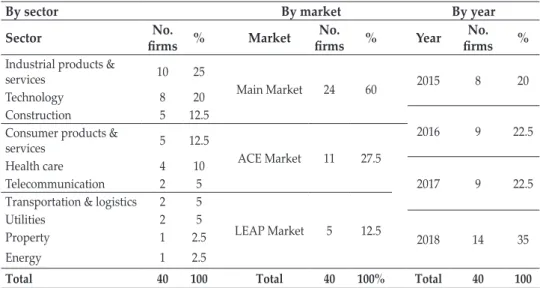
Table 1 shows that 25% of our sample belongs to the sector of industrial products and services. This evidence may be due to the fact that manufacturing companies are generally larger size and consequently they have easier access to capital markets. Indeed, 60% of the firms of our sample are listed on the Main market which is reserved to large companies.
Table 1.
Sample Composition
By sector By market By year
Sector No.
firms % Market No.
firms % Year No.
firms % Industrial products &
services 10 25
Main Market 24 60 2015 8 20
Technology 8 20
Construction 5 12.5
2016 9 22.5
Consumer products &
services 5 12.5
ACE Market 11 27.5
Health care 4 10
2017 9 22.5
Telecommunication 2 5
Transportation & logistics 2 5
LEAP Market 5 12.5
Utilities 2 5
2018 14 35
Property 1 2.5
Energy 1 2.5
Total 40 100 Total 40 100% Total 40 100
Table 2 presents summary statistics of firm characteristics since the year prior to the IPO. As can be seen, the leverage level as measured by book value fall from 49.89% in Pre-IPO to 34.94% in IPO year which indicates that firms tend to reduce their indebtedness after going public. We also point out that book leverage is always higher than market leverage suggesting that on average the market value of the firm is always higher than its book value. This evidence is confirmed by the values of the market-to-book ratios that are all greater than 1.
The net equity issues take their high value in the IPO year which indicates that
IPO proceeds from the sale of primary shares exceed proceeds from subsequent sale of secondary shares. Meanwhile, this evidence is consistent with the market theory predictions that market timers sell substantially more equity when they go public (Alti, 2006). Table 2 also reveals that profitability deteriorates after IPO. This evidence is in line with previous findings that IPOs and seasoned equity issues underperform their benchmarks in the long run (Ritter, 1991; Loughran and Ritter, 1995) and this underperformance is more pronounced for hot-market IPOs (Ritter, 1991). Meanwhile, this evidence corroborates with the market timing hypothesis suggesting that companies prefer going public following an increase of their profitability in order to sell overvalued shares.
Table 2.
Firm Characteristics
N BLEV(%) MLEV(%) TANG(%) PROF(%) SIZE MTB
Pre-IPO 37 49.89 - - 28.37 14.86 17.08 -
IPO 40 34.94 28.17 22.80 27.95 10.58 17.29 1.61
IPO+1 40 33.53 25.60 8.63 27.70 8.34 17.38 1.84
IPO+2 40 37.93 29.34 3.79 27.06 4.93 17.37 1.87
IPO+3 26 39.04 36.63 -1.76 26.96 4.23 16.72 1.46
IPO+4 17 38.75 34.97 2.31 28.44 1.56 16.94 1.46
IPO+5 8 60.14 35.27 21.99 31.26 -37.33 16.43 1.73
Notes: Book leverage (BLEV) is defined as book debt scaled by total assets. Market leverage (MLEV) is defined as book debt divided by market value of the firm. Market value is measured as total assets minus book equity plus market capitalization. Market capitalization is calculated by multiplying outstanding shares by their close prices.
Net equity issuance equals the change in book equity minus the change in retained earnings reported to total assets. Asset tangibility (TANG) is defined as property, plant, and equipment reported to total assets. Profitability (PROF) is measured as earnings before interests and tax (EBIT) reported to total assets. Firm size (SIZE) is the natural logarithm of net sales. The market-to-book ratio (MTB) is defined as book debt plus market value of equity divided by total assets.
V. EMPIRICAL ANALYSIS
5.1. Impact of Market Timing on Equity Issuance
The POT states that companies do not prioritize equity issuance since underpricing due to information asymmetry between managers and investors discourages them to raise their capital. Conversely, the MTT argues that firms should take advantages from the presence of windows of opportunities by issuing equity when market conditions are favorable which allow them to reduce their overall cost of capital. Numerous prior studies provide evidence on the tendency of firms to follow an equity market timing strategy leading to issue new shares at lower costs (Baker and Wurgler, 2002; Alti, 2006; Zhao, Lee and Yu, 2020). To investigate whether Shariah-compliant companies adopt such equity market timing strategy, we connect equity issuance to two variables that reflect market conditions (MTB and Market) and two control variables (Profitability and Size):
(1)
Following Baker and Wurgler (2002), net equity issuance is defined as the change in book equity minus the change in retained earnings reported to total assets. Market-to-book ratio (MTB) is defined as book debt plus market value of equity divided by total assets. Book debt is defined as total liabilities. High values of this ratio are interpreted as an indicator of overvaluation and therefore firms tend to issue more shares to take advantage of this market timing window (Fama and French, 2002; Baker and Wurgler, 2002).
Market value is measured as total assets minus book equity plus market capitalization. Market capitalization is obtained by multiplying outstanding shares by their close prices. The variable Market reflects the performance of stock market and is defined as the return of the FTSE which represents the main index of the Bursa Malaysia. Market is measured as the natural logarithm of . This variable is used to assess the impact of stock market performance on net equity issuance (Frank and Goyal, 2003; Alti, 2006; Hovakimian, 2006; Chen et al, 2013;
Belkhir et al., 2016; Allini et al., 2018). According to the MTT, the improvement of stock market performance induces equity issuance.
The variable Profitability (PROF) is measured as earnings before interests and tax (EBIT) reported to total assets. The market timing predicts that companies should wait for the release of profitable results before issuing stocks, in order to capitalize on investors’ increased optimism about the future of the company.
Indeed, when profitable results are announced, investors tend to be more confident about the company’s prospects, which can lead to an increase in the stock price.
By issuing stocks at that time, companies can take advantage of this increased demand and obtain financing at a potentially lower cost (Bougatef and Chichti, 2010).
The firm size (SIZE) is defined as the natural logarithm of net sales. The MTT suggests that there is a negative relationship between stock issuance and the firm size since small companies are often characterized by higher information asymmetry. Therefore, small companies may choose to issue stocks only when their securities are overvalued (Lee, 2021).
The estimation results reported in Table 2 are consistent with the market timing hypothesis. Indeed, they suggest that market conditions play a primordial role in equity issuance decisions. The market-to-book ratio turns out to have a significant and positive impact on equity issues suggesting that Shariah-compliant firms tend to raise their capital when their market values are relatively higher than their book values. This result is consistent with the hypothesis that the increase of the market- to-book ratio makes firms to perceive their shares as overpriced and consequently they attempt to take advantage from this mispricing (Baker and Wurgler, 2002;
Chang et al., 2007).
The variable Market measuring the performance of the Malaysian stock market exhibits a strong positive effect on equity issuance. This result aligns with the market timing prediction that an improvement of market conditions is followed by an increase of net equity issues (Alti, 2006).
The variable profitability (PROF) is found to be negatively and significantly related to equity issuance. This finding suggests that companies do not adopt a market timing strategy by issuing stocks after earning announcement to
take advantage of investor optimism. Instead, their financing behaviors can be explained by the POT, which advocates for prioritizing internal funding sources and using stock issuance as a last resort. There are two plausible explanations for this evidence. First, companies may be concerned about preserving their reputation with investors and maintaining their credibility by avoiding exploiting investor optimism. Second, companies may prefer to avoid transaction costs and fees associated with stock issuance.
The variable size turns out to have a negative and significant effect on equity issuance. This result indicates that small companies generally issue more shares than large companies. Indeed, small companies tend to grow and invest more quickly than large companies (Karabarbounis et al., 2014). The negative relationship between company size and equity issuance can be explained by the MTT, which assumes that small companies seek to take advantage of periods of investor optimism to issue equity, unlike large companies that have sufficient internal resources to finance their projects. Moreover, small companies often face higher levels of information asymmetry, meaning that investors have less information about their activities and prospects. This can lead to equity mispricing, which persuades small companies to raise capital when they perceive their shares are overvalued (Lee, 2021). In contrast, this result contradicts the POT, which assumes that large companies prefer equity financing because they are less sensitive to information asymmetry problems than small companies.
Table 3.
Determinants of Equity Issues
Variables MTB MARKET PROF SIZE INTERCEPT
Coefficients 0. 7453**
(0.3281) 0.3742***
(0.1114) -0.6411***
(0.1292) -0.7426**
(0.3455) 26.2673***
(6.0813)
Adj. R-squared 0.4189*** Prob. Hausman 0.0826
Prob.(F-statistic) 0.0000 No. of observations 111
Prob.(Cross-section F) 0.0187 No. of firms 40
Prob.(Cross-section Chi-
square) 0.0488
Notes: The dependent variable is net equity issuance defined as the change in book equity minus the change in retained earnings reported to total assets. The independent variables are market-to-book ratio (MTB), profitability (Prof), size, and tangibility (Tang). The market-to-book ratio (MTB) is defined as book debt plus market value of equity divided by total assets. Market is measured as the natural logarithm of . Profitability (PROF) is measured as earnings before interests and tax (EBIT) reported to total assets. Firm size (SIZE) is the natural logarithm of net sales. The probability of Fisher and Chi-square tests indicate the presence of individual effects. The test of Hausman indicates that the random effects model is appropriate for net equity issues. The Panel Estimated Generalized Least Squares (EGLS) method is used to deal with heteroskedasticity or auto-correlation problems. ** and *** indicate the significance level at 5 and 1%, respectively. Robust standard errors are in parentheses.
Overall, our findings strongly support the MTT predictions especially regarding the existence of “windows of opportunity” to issue equity. These equity market timing attempts could have a significant impact on firm’s capital structure.
5.2. Impact of Equity Market Timing on Capital Structure
Using an international sample of the G-7 countries, Rajan and Zingales (1995) provide evidence that leverage is positively related to size and tangibility and negatively associated with profitability and market-to-book ratio. In this paper, we maintain the first three determinants and we compute a weighted market-to- book ratio in order to assess the impact of equity timing attempts on capital structure.
Indeed, the coincidence between higher values of the market-to-book ratios and the issuance of new equity is interpreted by some researchers as an attempt of market timing that affects negatively leverage (Baker and Wurgler, 2002; Huang and Ritter, 2009; Mahajan and Tartaroglu, 2008).
To compute the weighted market-to-book ratio, we use two methods. The first method is proposed by Baker and Wurgler (2002) and it consists of using total external finance as a weight. The external finance weighted average market-to-book is computed as follows:
Where (e) represents net equity issues defined as the change in book equity minus the change in retained earnings reported to total assets. (d) represents net debt issues defined as the change in book debts reported to total assets. This variable takes high values for firms that raised external finance when the market-to-book ratio was high and vice-versa.
The second method described by Mahajan and Tartaroglu (2008) consists of replacing external finance by net equity issues. The equity issue weighted average market-to-book is computed as follows:
(2)
This variable takes high values for firms that have a history of issuing new equity when their market valuations are higher than their book values and past market values.
Besides the weighted market-to- book ratio, we introduce three other firm characteristics assumed by previous theories as determinants of capital structure namely profitability, tangibility and firm size. Thus, we propose the following model:
(3)
We use two measures of the dependent variable “leverage” (LEV). Indeed, we believe that it is important to employ both book and market measures of leverage in order to understand the managers’ preferences in terms of leverage ratios and control potentially spurious correlations that may result from a discrepancy between measures included in the regressions and those used by managers. Book (4)
leverage (BLEV) is defined as total debts reported to total assts. Market leverage (MLEV) is defined as total assets minus market value divided by total asests.
Table 4 reports regression results. Both tests of Fisher and Chi-square suggest the significance of the cross-section effects. The test of Hausman indicates that we should choose the fixed effects model for market leverage and the random effects model for book leverage. The explanatory power of our regression varies between 22.08% and 96.75% as we focus on book leverage or market leverage.
The examination of the coefficients of variables shows that market timing proxies (MTBefwa.it and MTBewa.it) are more relevant if we focus on market leverage.
The weighted market-to-book ratio is negatively correlated with leverage. This result suggests that Shariah-compliant firms tend to reduce their leverage when their market valuations are relatively higher than their book values. This result is consistent with the MTT predictions that firms tend to issue more new stocks when their market values are significantly higher than their book values by considering a high market-to-book ratio as an indicator of overvaluation. Companies should therefore take advantage from this mispricing opportunity to improve their capital structures by issuing more equity and use proceeds to repay their debts.
This negative association between weighted average market-to-book ratio and leverage has been previously documented by Baker and Wurgler (2002) for U.S firms, Hogfeldt and Oberonko (2004) for Sweden firms, Bie and Haan (2007) for Dutch firms and Mahajan and Tartaroglu (2008) for firms in all G-7 countries, except Japan. In the Islamic context, our results corroborate those of Hussain et al. (2020), who point out that during periods of overvaluation, managers of Shariah-compliant firms in Malaysia that are above their target levels tend to take advantage of mispricing by issuing more equity. They then return to their target levels more quickly. The managers of Shariah compliant firms are likely to reduce reliance on debt during periods of overvaluation in order to create financial leeway, preserve financial flexibility and protect potential future growth. In addition, the restrictions related to Sharia compliance, such as keeping their debt level below the threshold of 33%, create an additional incentive for over-leveraged firms to rely on equity during periods of overvaluation.
The other explanatory factors of leverage present generally the expected signs.
The variable “Tangibility” exhibits a positively significant impact on leverage. This result corroborates with the predictions of the TOT suggesting the existence of a positive association between tangibility and leverage since real assets may be considered by creditors as a guarantee that attenuates the default risk. This result is also in line with the principles of Islamic finance suggesting that debt should be asset-backed which means that Shariah-compliant companies cannot have more debt than tangible assets. This also means that companies with more tangible assets will therefore have a higher level of indebtedness, and conversely, companies with lower tangible assets will therefore have a lower level of indebtedness (Ahmed, 2007). This result corroborates with findings in Haron and Ibrahim (2012) and Yildirim et al. (2018) for Shariah-compliant firms in Malaysia and Guizani and Ajmi (2021) for a sample of 66 Islamic-compliant firms listed on Saudi Stock Market.
Profitability plays a negative and significant role regardless of the measure chosen for leverage. This result confirms the existence of a financing hierarchy prioritizing internal funds over external sources. Profitable Shariah-compliant
companies tend to avoid debt if their financing needs can be met by the cash flow generated by their activities. The plausible explanation of this financing hierarchy is that profitable compliant firms are not allowed to invest their excess cash (internal funds) in interest-bearing investments (riba). Our finding contradicts the TOT which postulates the existence of a positive relationship between leverage and profitability since the default risk is negligible for profitable firms. This negative relationship between leverage and profitability has been previously documented by Haron and Ibrahim (2012) and Yildirim et al. (2018) for Shariah-compliant firms in Malaysia and Guizani and Ajmi (2021) for Shariah-compliant firms in Saudi Arabia.
The variable SIZE turns out to have a positive and significant impact only on market leverage. This positive relationship is consistent with TOT, which predicts that large firms rely more on leverage compared to small companies. Indeed, large firms are well diversified, have a better understanding of the market, a better ability to adapt and a better reputation in the debt markets, which leads to a lower risk of bankruptcy. In this case, the access of large companies to the credit market will be easier, which increases their debt capacity. In contrast, the ownership structure of small firms is generally characterized by capital concentration. Managers of these firms who hold a large share of the capital tend to be reluctant to issue new debt in order to avoid its disciplinary role.
The inverse association between the firm size and leverage confirms our prior result on the tendency of small firms to issue more equity than larger firms. Our result corroborates with previous findings in Rajan and Zingales (1995) for firms in major industrialized (G-7) countries, Antoniou et al. (2008) for firms in UK, US, Germany, France and Japan, Yildirim et al (2018) for a sample of Shariah-compliant and non-compliant firms from 7 countries and 7 industries, and Hussain et al.
(2020) for Shariah-compliant and non-compliant firms in Malaysia.
The variable “Size” has no significant impact on book leverage. This result is consistent with previous findings in Frank and Goyal (2009), who point out that when focusing on book leverage, the firm size loses the reliable impact that they have when studying market-based leverage. Lose the reliable impact that they have when studying market-based leverage.
Table 4.
Determinants of Leverage
Book leverage (BLEV) Market leverage (MLEV) Random effects Fixed effects
MTBefwa -1.8321***
(0.4655) - -0.15091***
(0.0549) -
MTBewa - -2.4874***
(0.5174) - -0.3062**
(0.1581)
PROF -0.0844***
(0.0196) -0.1412***
(0.0184) -0.1125***
(0.0427) -0.1492***
(0.0535)
TANG 0.0954***
(0.0283) 0.0981***
(0.0319) 0.0443***
(0.0171) 0.0688**
(0.0334)
SIZE 0.2179
(0.6449) 0.4556
(0.6538) 1.6818*
(0.9379) 1.6312* (0.9321)
Intercept 6.4722***
(1.6043) 4.3410***
(1.8185) 3.8194
(5.9143) 5.0353 (6.0644)
Adj. R-squared 0.2208 0.2427 0.9675 0.9409
Prob.(F-statistic) 0.0000 0.0000 0.0000 0.0000
Prob. (Cross-section F) 0.0000 0.0000 0.0000 0.0000
Prob. (Cross-section Chi-square) 0.0000 0.0000 0.0000 0.0000
Prob. Haussman 0.9533 0.5031 0.0497 0.0013
No. of observations 199 192 171 169
No. of firms 40 40 40 40
Notes: The dependent variable is leverage, whereas the independent variables are weighted market-to-book ratio (MTBefwa or MTBewa), profitability (Prof), size, and tangibility (Tang). Leverage is measured by book value (book leverage) and market value (market leverage). Book leverage (BLEV) is defined as book debt scaled by total assets.
Market leverage (MLEV) is defined as book debt divided by market value of the firm. Market value is measured as total assets minus book equity plus market capitalization. Market capitalization is calculated by multiplying outstanding shares by their close prices. Profitability (PROF) is measured as earnings before interests and tax (EBIT) reported to total assets. Asset tangibility (TANG) is defined as property, plant, and equipment reported to total assets.
Firm size (SIZE) is the natural logarithm of net sales. The market-to-book ratio (MTB) is either weighted by total external finance (MTBefwa) or by only net equity issuance (MTBewa). The probability of Fisher and Chi-square tests indicate the presence of individual effects. The test of Hausman indicates that the fixed effects model is appropriate for market leverage and the random effects model for book leverage. The Panel Estimated with Generalized Least Squares (EGLS) method for random effects and least square dummy variable (LSDV) for fixed effects. *, ** and ***
indicate the significance level at 10, 5 and 1%, respectively. Robust standard errors are in parentheses.
5.3. Persistence of Equity Market Timing Effects on Capital Structure
The persistence of equity market timing impact on capital structure is the key testable prediction of MTT since prior studies on this topic document controversial results (Baker and Wurgler, 2002; Alti, 2006; Zhao, Lee and Yu, 2020). To test the persistence of equity market timing attempts on capital structure of Shariah-compliant IPOs operating in Malaysia, we run the following regression:
(5) The empirical findings reported in Table 5 suggest that the effect of equity market timing disappears within one year suggesting that Shariah-compliant IPOs quickly rebalance their capital structures to catch up with their target leverage. This evidence contradicts the MTT predictions that capital structure is the outcome of
past abilities to time equity issues. This result is consistent with previous finding in Haron and Ibrahim (2012) who argue the existence of target capital structure for Shariah compliant firms in Malaysia.
Table 5.
Persistence of Market Timing Attempts on Capital Structure
Year Book leverage (BLEV) Market leverage (MLEV)
MTBefwa MTBewa MTBefwa MTBewa
t + 1 -0.9604**
(0.4613) -0.9182*
(0.4861) -0.9141***
(0.3901) -0.4519***
(0.1041)
t + 2 -0.1097
(0.5125) -0.45013
(0.7513) -0.2048
(0.8661) -0.4216 (0.3486) Notes: This table displays the results regarding the persistence of equity market timing on leverage. The dependent variable is leverage, whereas the independent variables are weighted market-to-book ratio (MTBefwa or MTBewa), profitability (Prof), size, and tangibility (Tang). We report only the results of the variable of interest, namely the weighted market-to-book ratio. *, ** and *** indicate the significance level at 10, 5 and 1%, respectively. Robust standard errors are in parentheses.
VI. CONCLUSION
Previous empirical studies on market timing behavior are mainly focused on the non-Shariah compliant firms. In this paper, we extend the test of market timing to Shariah-compliant firms. We use a sample of Malaysia Shariah-compliant firms that went public between 2015 and 2018. Our empirical findings indicate the existence of positive association between market-to-book ratios and equity issues. This evidence indicates that managers of Malaysia Shariah-compliant IPOs interpret high values of market-to-book ratios as an indicator of overvaluation and tend to take advantage from this opportunity by issuing overpriced equity shares. Indeed, Shariah-compliant firms possess certain financial characteristics that make their information environment worse than information environment of Shariah non- compliant firms (Farooq and Pashayev, 2020) which could increase the likelihood of misevaluation that is at the root of timing incentives.
We also document that equity market timing attempts affect significantly and negatively the leverage ratio. However, Malaysia Shariah-compliant IPOs become underleveraged only in the short-term since the effect of market timing quickly vanishes. This evidence is consistent with the dynamic TOT suggesting that firms quickly rebalance their capital structures to move toward their target leverage.
Our findings imply that investors and portfolio managers interested in investing in Shariah-compliant IPOs should identify market timers since they exhibit subsequent lower returns.
The market timing hypothesis posits that managers are able to time the market not only by issuing equity when valuations are high (equity market timing) but also by issuing debt when the borrowing cost is occasionally low (debt market timing). Therefore, in future research, it is suggested to examine the impact of debt market timing on the issuance of Shariah-compliant bonds (Sukuk).
REFERENCES
Adam, N. L., & Bakar, N. A. (2014). Shariah screening process in Malaysia. Procedia - Social and Behavioral Sciences, 121, 113-123.
Ahmed, H. (2007). Issues in Islamic corporate finance: Capital structure in firms’.
(Research Paper 70). Islamic Research and Training Institute, Islamic Development Bank Group.
Akbar, S., Khan, S., Haq, Z. U., & Khan, M. I. (2023). Capital structure dynamics of Shariah-compliant vs noncompliant firms: Evidence from Pakistan.
International Journal of Islamic and Middle Eastern Finance and Management, 16(2), 366-383.
Allini, A., Rakha, S., McMillan, D. G., & Caldarelli, A. (2018). Pecking order and market timing theory in emerging markets: The case of Egyptian firms. Research in International Business and Finance, 44, 297-308.
Alnori, F., & Alqahtani, F. (2019). Capital structure and speed of adjustment in non-financial firms: Does sharia compliance matter? Evidence from Saudi Arabia. Emerging Markets Review, 39, 50-67.
Alti A. (2006). How persistent is the impact of market timing on capital structure?.
Journal of Finance, 61(4), 1681-1710.
Antoniou, A., Guney, Y., & Paudyal, K. (2008). The determinants of capital structure: Capital market-oriented versus bank-oriented institutions. Journal of Financial and Quantitative Analysis, 43(1), 59-92.
Asutay, M., & Marzban, S. (2012). The impact of asset-based versus market capitalization- based Shari’ah screening on US and Japanese equities: An empirical analysis. Journal of Asian and African Studies, 11(2), 151–165.
Baker, M., & Wurgler J. (2002). Market timing and capital structure. Journal of Finance, 57(1), 1-32.
Barclay M. J., & Smith C. W. (1995). The maturity structure of corporate debt.
Journal of Finance, 50(2), 609-631.
Belkhir, M., Maghyereh, A., & Awartani, B. (2016). Institutions and corporate capital structure in the MENA region. Emerging Markets Review, 26, 99-129.
Bie, T. och, & Haan, L. (2007). Does market timing drive capital structure? A panel data study of Dutch firms. Working Paper, De Nederlandsche Bank. Netherlands.
Boubaker A., & Nguyen D. K. (2009). Does financing behavior of Tunisian firms follow the predictions of the market timing theory of capital structure?”. Economics Bulletin, 29(1), 169-181.
Bougatef K., & Chichti J. E. (2010). Equity market timing and capital structure:
Evidence from Tunisia and France. International Journal of Business and Management, 5(10), 167-177.
Bougatef, K., & Nejah, I. (2022). The COVID-19 pandemic and herding behaviour among investors in Shariah-compliant stocks. Journal of Islamic Accounting and Business Research, 13(5), 832-844.
Chang, X., Tam, L. H., Tan, T. J., & Wong, G. (2007). The real impact of stock market mispricing—Evidence from Australia. Pacific-Basin Finance Journal, 15(4), 388- 408.
Chen, D. H., Chen, C. D., Chen, J., & Huang, Y. F. (2013). Panel data analyses of the pecking order theory and the market timing theory of capital structure in Taiwan. International Review of Economics & Finance, 27, 1-13.
Derigs, U., & Marzban, S. (2008). Review and analysis of current Shariah-compliant equity screening practices. International Journal of Islamic and Middle Eastern Finance and Management, 1(4), 285-303.
El-Gamal, M. A. (2000). A basic guide to contemporary Islamic banking and finance.
Houston: Rice University.
El Hajjaji, H., & Moutahaddib, A. (2019). Création d’un indice boursier islamique sur la place de Casablanca [Creation of an Islamic stock market index on the Casablanca market]. Researches and Applications in Islamic Finance, 3(1), 88-110.
Elliott, W. B., Koëter-Kant, J., & Warr, R. S. (2007). A valuation-based test of market timing. Journal of Corporate Finance, 13(1), 112–128.
Fama, E. F., & French, K. R. (2002). Testing trade-off and pecking order predictions about dividends and debt. The Review of Financial Studies, 15(1), 1-33.
Fama E. F., & French K. R. (2004). Financing decisions: Who issue stock. Journal of Financial Economics, 76(3), 549-582.
Farooq, O., & Pashayev, Z. (2020). Shariah compliance and information transmission: Evidence from an emerging market. Journal of Islamic Accounting and Business Research, 11(8), 1583-1597.
Fisher E. O., Heinkel R., & Zechner J. (1989). Dynamic capital structure choice:
Theory and tests. Journal of Finance, 44, 19-40.
Frank, M, Z., & Goyal, V. K. (2003). Testing the pecking order theory of capital structure, Journal of Financial Economics, 67(2), 217-248.
Frank, M. Z., & Goyal, V. K. (2009). Capital structure decisions: Which factors are reliably important?. Financial Management, 38(1), 1-37.
Gaud P., Hoesli M., & Bender A. (2007). Debt-equity choice in Europe. International Review of Financial Analysis, 16(3), 201-222.
Gomes, M. C., Magnani, V. M., Albanez, T., & Valle, M. R. (2019). Effects of market timing on primary share issues in the Brazilian capital market. The North American Journal of Economics and Finance, 49, 361-377.
Graham, J. R., & Harvey, C. R. (2001). The theory and practice of corporate finance:
Evidence from the field. Journal of Financial Economics, 60(2-3), 187-243.
Guizani, M., & Ajmi, A. N. (2021). Testing the pecking order theory of capital structure in an Islamic legal system: The case of Saudi Arabia. International Journal of Islamic and Middle Eastern Finance and Management, 14(4), 732-752.
Haron, R., & Ibrahim, K. (2012). Target capital structure and speed of adjustment:
Panel data evidence on Malaysia Shariah compliant securities. International Journal of Economics, Management and Accounting, 2(2), 87–107.
Hogfeldt, P. och., & Oberonko, A. (2004). Does market timing or past profitability determine capital structure. Working Paper, Stockholm School of Economics, Sweden.
Hovakimian A. (2006). Are observed capital structure determined by equity market timing?. Journal of Financial and Quantitative Analysis, 41(1), 221-243.
Huang R., & Ritter J. R. (2009). Testing theories of capital structure and estimating the speed of adjustment. The Journal of Financial and Quantitative Analysis, 44(2), 237-271.
Huang, Y., Uchida, K., Yu, X., & Zha, D. (2021). Market timing in private equity placements: Empirical evidence from China. Pacific-Basin Finance Journal, 69, 101642.
Hussain, H. I., Ali, M., Hassan, M. K., & El-Khatib, R. (2020). Asymmetric capital structure speed of adjustment, equity mispricing and Shari’ah compliance of Malaysian firms. International Review of Economics & Finance, 86, 965-975.
Htay, S. N. N. H., Abedeen, Z., & Salman, A. S. (2013). Towards standardization of Shari’ah screening norms and practices. International Journal of Humanities and Social Science Invention, 2(11), 23–30.
Islamic Financial Services Board (IFSB). (2020, July). Islamic financial services industry stability report 2020.
Jarallah, S., Saleh, A. S., & Salim, R. (2019). Examining pecking order versus trade-off theories of capital structure: New evidence from Japanese firms.
International Journal of Finance & Economics, 24(1), 204-211.
Karabarbounis, M., Macnamara, P., & McCord, R. (2014). A business cycle analysis of debt and equity financing. Economic Quarterly, 100(1), 51–85.
Kayhan, A., & Titman S. (2007). Firms’ histories and their capital structures. Journal of Financial Economics, 83(1), 1-32.
Khoa, B, T., & Thai, D. T. (2021). Capital structure and trade-off theory: Evidence from Vietnam. The Journal of Asian Finance, Economics and Business, 8(1), 45-52.
Lee, J. (2021). Information asymmetry, mispricing, and security issuance. Journal of Finance, 76(6), 3401-3446.
Loughran, T., & Ritter, J. R. (1995). The new issues puzzle. The Journal of Finance, 50(1), 23-51.
Mahajan, A., & Tartaroglu, S. (2008). Equity market timing and capital structure:
International evidence. Journal of Banking & Finance, 32(5), 754-766.
Mahfooz, S., & Ahmed, B. (2014). Shariah investment screening criteria: A critical review. Journal of King Abdulaziz University, Islamic Economics, 27(1), 111–145.
Modigliani F., & Miller M. H. (1958). The cost of capital, corporation finance and the theory of investment. American Economic Review, 48(3), 261-297.
Myers S. C. (1984). The capital structure puzzle. Journal of Finance, 39(3), 575-592.
Myers S. C., & Majluf N. S. (1984). Corporate financing and investment decisions when firms have information that investors do not have. Journal of Financial Economics, 13(2), 187-221.
Narayan, P. K., & Phan, D. H. B. (2019). A survey of Islamic banking and finance literature: Issues, challenges and future directions. Pacific-Basin Finance Journal, 53, 484-496.
Nasiri, I., & Drissi-Bakhkhat, M. (2021). The creation of an Islamic stock market index on the Moroccan financial place according to the S&P method. Researches and Applications in Islamic Finance, 5(1), 107-123.
Peillex, J., & Ureche-Rangau, L. (2012). Création d’un indice boursier islamique sur la place financière de Paris: méthodologie et performance [Creation of an Islamic stock market index on the Paris financial center: methodology and performance] Revue d’économie financière [Financial Economics Review], 107(3), 289-314.
Rajan R. G., & Zingales L. (1995). What do we know about capital structure? Some evidence from international data. Journal of Finance, 50(5), 1421-1460.
Rao, P., Kumar, S., & Madhavan, V. (2019). A study on factors driving the capital structure decisions of small and medium enterprises (SMEs) in India. IIMB Management Review, 31(1), 37-50.