12 Measuring the effectiveness of marketing plans for service
businesses
A three-level marketing accountability framework
The ultimate test of marketing investment, and indeed any invest- ment, is whether it creates value for shareholders. But few marketing investments are evaluated from this perspective, and many would argue that it is almost impossible to link financial results to any specific marketing activity.
But increasingly, boards of directors and city analysts the world over are dissatisfied with this lack of accountability for what are, very often, huge budgets. Cranfield School of Management has been addressing this problem through its Marketing Value Added Research Club and Marketing Accountability Research Club, formed with a number of blue-chip companies. The club set out to create and test a new framework which shows how marketing systematically contributes to shareholder value, and how its contribution can be measured in an objective and comparable way.
There is an urgent need for such a framework. Not only does marketing need it, to answer the widespread accusations of poor performance,1 but corporate and financial strategists need it too, to understand how to link marketing activities to the wider corporate agenda. All too often marketing objec- tives and strategies are not aligned with the organization’s overall plans to increase shareholder value.
The purpose of this chapter is to set out the logic of this framework, which is underpinned by two Cranfield University PhD theses by Wilson2and Smith.3
The chapter starts with a brief justification of the need for a wholly new approach to measuring the effectiveness of marketing.
It then proceeds to set out another accountability framework also developed in the Cranfield Research Clubs.
What counts as marketing expenditure?
Historically, marketing expenditure has tended to escape rigorous per- formance appraisal for a number of reasons. First, there has been real confusion as to the true scope and nature of marketing investments.
Too often, marketing expenditure has been assumed to be only the bud- gets put together by the marketing function, and as such a (major) cost to be controlled rather than a potential driver of value. Second, the causal relationship between expenditure and results has been regarded as too difficult to pin down to any useful level of precision.
Now, because of the demands of increasingly discerning customers and greater competition, marketing investments and marketing pro- cesses are under scrutiny as never before. From the process point of view, as a result of insights from management concepts such as the quality movement and re-engineering, marketing is now much more commonly seen as a cross-functional responsibility of the entire orga- nization rather than just the marketing department’s problem.
Howard Morganis, past chairman of Procter and Gamble, said,
‘There is no such thing as a marketing skill by itself. For a com- pany to be good at marketing, it must be good at everything else from R&D to manufacturing, from quality controls to financial controls.’ Hugh Davidson in Offensive Marketing4 comments, ‘Marketing is an approach to business rather than a specialist discipline. It is no more the exclusive responsibility of the marketing department than profitability is the sole charge of the finance department.’
But there is also a growing awareness that, because of this wider inter- pretation of marketing, nearly all budgets within the company could be regarded as marketing investments in one way or another. This is especially the case with IT budgets. The exponential increase in com- puting power has made it possible to track customer perceptions and behaviours on a far greater scale, and with far greater precision than previously. When used correctly, these databases and analytical tools can shed a much greater light on what really happens inside the ‘black box’. However, the sums involved in acquiring such technologies are forcing even the most slapdash of companies to apply more rigorous appraisal techniques to their investments in this area.
This wider understanding of what ‘marketing’ is really all about has had a number of consequences. First, the classic textbook treatment of strategic issues in marketing has finally caught up with reality. Topics
such as market and customer segmentation, product and brand devel- opment, databases and customer service and support are now regu- larly discussed at board level, instead of being left to operational managers or obscure research specialists.
CEOs and MDs are increasingly accepting that they must take on the role of chief marketing officer if they want to create truly customer-led organizations. Sir Clive Thompson commented, ‘I am convinced that corporate and marketing strategy are more or less the same things.
The chief executive has to be the chief marketer. If you delegate that responsibility, you are not doing your job.’
Second, because of their ‘new’ mission-critical status, marketing invest- ments are attracting the serious attention of finance professionals. As part of a wider revolution in thinking about what kind of corporate assets are important in today’s business environment, intangibles such as knowledge about customers and markets, or the power of brands, have assumed a new importance. The race is on to find robust methods of quantifying and evaluating such assets for the benefit of corporate managements and the wider investment community.
Unfortunately, this new focus on the importance of market- ing has not improved the profile of marketing professionals.
Instead, the spotlight has merely highlighted their weak- nesses and shortcomings. After one 1997 survey on the per- ceived status of the profession, John Stubbs, CEO of the UK Marketing Council, was forced to comment, ‘I was taken aback by just how little reputation marketing actually has among other functions . . . marketing and marketers are not respected by the people in their organisations for their contri- butions to business strategy, results or internal communica- tion. We often do not know what or who is good or bad at marketing; our measurements are not seen as credible; our highest qualifications are not seen to have compatible status with other professions.‘
A survey at Cranfield during a two-year period has revealed that marketers are seen as ‘slippery, expensive, unreliable and unaccountable’.5
What does ‘value added’ really mean?
The term ‘value added’ is fast becoming the new mantra for the early 21st century business literature, and is often used quite loosely to
indicate a business concept that is intended to exceed either customer or investor expectations, or both. However, from the point of view of this chapter, it is important to realize that the term has its origin in a number of different management ideas, and is used in very specific ways by different sets of authors. Most of the ideas come from the US, and have originated in business school and consultancy research in the mid-1980s.
Value chain analysis
First, there is Michael Porter’s well-known concept of value-chain analysis.6Porter’s concept of value added is an incremental one; he focuses on how successive activities change the value of goods and services as they pass through various stages of a value chain. The analysis disaggregates a firm into its major activities in order to under- stand the behaviour of costs and the existing and potential sources of differentiation. It determines how the firm’s own value chain interacts with the value chains of suppliers, customers and competitors. Com- panies gain competitive advantage by performing some or all of these activities at lower cost or with greater differentiation than competitors.
Shareholder value added (SVA)
Second, there is Alfred Rappaport’s equally well-known research on shareholder value added.7Rappaport’s concept of value added focuses less on processes than Porter’s, and acts more as a final gateway in decision-making, although it can be used at multiple levels within a firm. The analysis measures a company’s ability to earn more than its total cost of capital . . . Within business units, SVA measures the value the unit has created by analysing cash flows over time.
At the corporate level, SVA provides a framework for evaluating options for improving shareholder value by determining the tradeoffs between reinvesting in existing businesses, investing in new businesses and returning cash to stockholders.
There are a number of different ways of measuring shareholder value added, one of which,market value added(MVA), needs further explan- ation.Marketvalue added is a measure first proposed by consultants Sterne Stewart in 1991, which compares the total shareholder capital of a company (including retained earnings) with the current market value of the company (capitalization and debt). When one is deducted from the other, a positive result means value has been added, and a negative result means investors have lost out. Within the literature, there is much discussion of the merits of this measure, Value chain analysis
is used to identify potential sources of economic advantage
SVA is described as
‘The process of analysing how decisions affect the net present value of cash to
shareholders’
versus another approach proposed by Sterne Stewart – EVA (eco- nomic value added).
However, from the point of view ofmarketing value added, Walters and Halliday8 usefully sum up the discussion thus: ‘As aggregate measures and as relative performance indicators they have much to offer . . . [but] how can the manager responsible for developing and/
or implementing growth objectives [use them] to identify and select from alternative [strategic] options?’
Market value addedis one of a number of tools that analysts and the capital markets use to assess the value of a company.Marketing value addedas a research topic focuses more directly on the processes of cre- ating that value through effective marketing investments.
Customer value
A third way of looking at value added is the customer’s perception of value. Unfortunately, despite exhaustive research by academics and practitioners around the world, this elusive concept has proved almost impossible to pin down: ‘What constitutes [customer] value – even in a single product category – appears to be highly personal and idiosyn- cratic’, concludes Zeithaml, for instance.9Nevertheless, the individual customer’s perception of the extra value represented by different products and services cannot be easily dismissed: in the guise of mea- sures such as customer satisfaction and customer loyalty, it is known to be the essence of brand success, and what became known during the late 1990s as relationship marketing.
Accounting value
Effectively, this is a snapshot picture from the annual accounts of how the revenue from a sales period has been distributed, and how much is left over for reinvestment after meeting all costs, including share- holder dividends. Although this figure will say something about the past viability of a business, in itself it does not provide a guide to future prospects.
One reason that the term ‘value added’ has come to be used rather carelessly is that all these concepts of value, although different, are not mutually exclusive. Porter’s value chain analysis is one of several extremely useful techniques for identifying potential new competitive market strategies. Rappaport’s SVA approach can be seen as a power- ful tool which enables managers to cost out the long-term financial implications of pursuing one or other of the competitive strategies which have been identified. Customer perceptions are clearly a major driver (or destroyer) of annual audited accounting value in all compa- nies, whatever strategy is pursued.
Finally, there is the accountant’s definition of value added: ‘value added¼sales revenue – purchases and services’.
However, most companies today accept that value added, as defined by their annual accounts, is really only a record of what they achieved in the past, and that financial targets in themselves are insufficient as business objectives. Many com- panies are now convinced that focusing on more intangible measures of value added such as brand equity, customer loy- alty, or customer satisfaction are the new route to achieving financial results.
Unfortunately, research has found that there is no neat, causal link between offering additional customer value and achieving value added on a balance sheet. That is, good ratings from customers about perceived value do not necessarily lead to financial success. Nor do financially successful companies necessarily offer products and services which customers perceive as offering better value than competitors.
In order to explain the link that does exist between customer-oriented strategies and financial results, a far more rigorous approach to fore- casting costs and revenues is required than is usual in marketing plan- ning, coupled with a longer-term perspective on the payback period than is possible on an annual balance sheet. This cash-driven perspec- tive is the basis of the SVA approach, and can be used in conjunction with any marketing-strategy formulation process.
However, despite its apparent compatibility with existing plan- ning systems, it is important to stress that adherents of the SVA approach believe that, after all the calculations have been made about the impact of different strategic choices, the final decision about which strategy to pursue should be the one which generates the most value (cash) for shareholders.
This point of view adds a further dimension to the strategic debate, and is by no means universally accepted: there is a vigorous and ongoing debate in the literature as to whether increasing shareholder value should be the ultimate objective of a corporation.
Despite these arguments, there is no denying that during the last 15 years, SVA (or variants on the technique) has become the single most dominating corporate valuation perspective in developed western economies. Its popularity tends to be limited to the boardroom and the stock exchanges, however. Several surveys (e.g. CSF Consulting in 2000, KPMG in 1999) have found that less than 30% of companies were pushing SVA-based management techniques down to an operational level, because of difficulties in translating cash targets into practical, day-to-day management objectives.
This is a pity because, apart from its widespread use at corporate level, the SVA approach particularly merits extensive attention of research- ers interested in putting a value on marketing, as it allows marketing investments (or indeed any investments) to be valued over a much longer period of time than the usual one-year budget cycle.
Although common sense might argue that developing strong product or service offerings, and building up a loyal, satisfied customer base, will usually require a series of 1–2 year investment plans in any business, such is the universal distrust of marketing strategies and forecasts that it is common practice in most companies to write off marketing as a cost within each year’s budget. It is rare for such expen- diture to be treated as an investment which will deliver results over a number of years, but research shows that companies who are able to do this create a lasting competitive edge.
Meanwhile, over the past 15 years, research into marketing account- ability continues apace at Cranfield, particularly into the application of the SVA concept. This was followed by research into the effective- ness of marketing strategies. As a result, a three-level model has been developed and tested and it is to this model that we now turn.
Three distinct levels for measuring marketing effectiveness
When one of the authors was marketing director of a fast moving con- sumer goods company 30 years ago, there were many well tried-and- tested models for measuring the effectiveness of marketing promo- tional expenditure. Indeed, some of these were quite sophisticated and included mathematical models for promotional campaigns, for advertising threshold and wear-out levels and the like.
Indeed, it would be surprising if marketing as a discipline did not have its own quantitative models for the massive expenditure of FMCG com- panies. Over time, these models have been transferred to business-to- business and service companies, with the result that, today, any organi- zation spending substantial sums of shareholders’ money on promotion should be ashamed of themselves if those responsible could not account for the effectiveness of such expenditure.
Nonetheless, with the advent of different promotional methods and channels, combined with an empowered and more sophis- ticated consumer, the problems of measuring promotional effectiveness have increased considerably.
Consequently, this remains one of the major challenges facing the mar- keting community today and, as mentioned above, the research and practice of specialists at Cranfield School of Management continue apace.
But, at this level, accountability can only be measured in terms of the kinds of effects that promotional expenditure can achieve, such as awareness, or attitude change, both of which can be measured quantitatively.
But to assert that such expenditure can be measured directly in terms of sales or profits is intellectually indefensible, when there are so many other variables that affect sales, such as product efficacy, packaging, price, the sales force, competitors and countless other vari- ables that, like advertising, have an intermediate impact on sales and profits. Again, however, there clearly is a cause and effect link, other- wise such expenditure would be pointless. This issue is addressed later in this chapter.
So, the problem with marketing accountability has never been how to measure the effectiveness of promotional expenditure, for this we have had for many years. No, the problem occurs because marketing isn’t just a promotional activity. As explained in detail in Chapter 1, in world class organizations where the customer is at the centre of the business model, marketing as a discipline is responsible for defining and under- standing markets, for segmenting these markets, for develop- ing value propositions to meet the researched needs of the customers in the segments, for getting buy-in from all those in the organization responsible for delivering this value, for play- ing their own part in delivering this value and for monitoring whether the promised value is being delivered.
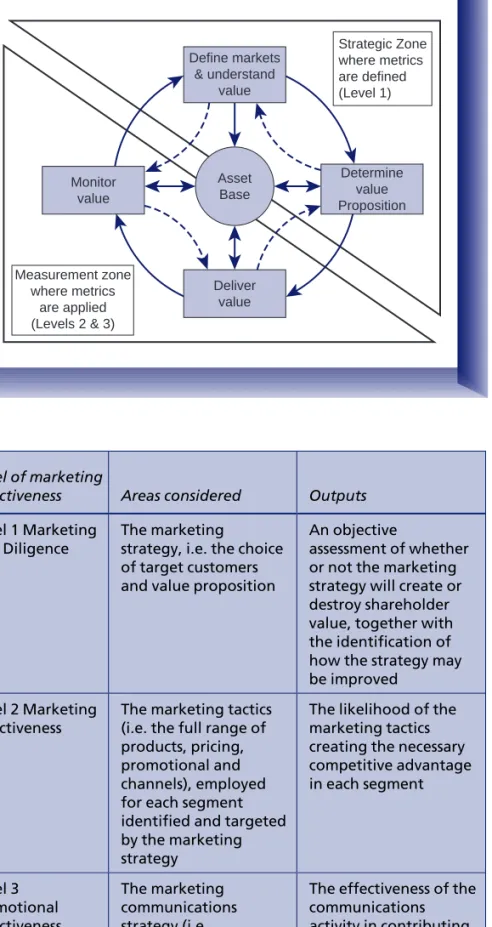
Indeed, this definition of marketing as a function for strategy develop- ment as well as for tactical sales delivery, when represented as a map (see Figure 12.1), can be used to clarify the whole problem of how to measure marketing effectiveness. This is expanded on in Table 12.1.
Level 1: Shareholder value added (SVA)
SVA is profit after tax, minus net capital employed multiplied by the cost of capital. There are only three things you can do to affect SVA:
increase revenue decrease costs decrease the amount of capital tied up in the business.All of these are highly influenced by the strategic marketing plan. A very simple example of how SVA can be calculated follows: A has
£15,000 invested in the company. The cost of capital is 10%. The com- pany makes a net profit of £2,000. Therefore, the company has created
£500 SVA (£15,00010%£2000¼ þ£500).
Level of marketing
effectiveness Areas considered Outputs Level 1 Marketing
Due Diligence
The marketing
strategy, i.e. the choice of target customers and value proposition
An objective
assessment of whether or not the marketing strategy will create or destroy shareholder value, together with the identification of how the strategy may be improved
Level 2 Marketing Effectiveness
The marketing tactics (i.e. the full range of products, pricing, promotional and channels), employed for each segment identified and targeted by the marketing strategy
The likelihood of the marketing tactics creating the necessary competitive advantage in each segment
Level 3 Promotional Effectiveness
The marketing communications strategy (i.e.
advertising, sales team, etc.), employed to communicate with each segment
The effectiveness of the communications activity in contributing to marketing objectives
Table 12.1 Three levels of marketing measurements Asset
Base Define markets
& understand value
Determine value Proposition
Deliver value Monitor
value
Strategic Zone where metrics are defined (Level 1)
Measurement zone where metrics
are applied
(Levels 2 & 3) Figure 12.1
Map of the marketing domain and the three- level accountability framework
Level 1 is the most vital of all three, because this is what determines whether or not the marketing strategies for the longer term (usually three to five years) destroy or create shareholder value added. It is jus- tified to use the strategic marketing plan for assessing whether share- holder value is being created or destroyed because, as Sean Kelly10 agrees:
The customer is simply the fulcrum of the business and every- thing from production to supply chain, to finance, risk manage- ment, personnel management and product development, all adapt to and converge on the business value proposition that is projected to the customer.
Thus, corporate assets and their associated competences are only rele- vant if customer markets value them sufficiently highly that they lead to sustainable competitive advantage, or shareholder value added. This is our justification for evaluating the strategic plan for what is to be sold, to whom and with what projected effect on profits as a route to establishing whether shareholder value will be created or destroyed.
A company’s share price, the shareholder value created and the cost of capital are all heavily influenced by one factor:
risk. Investors constantly seek to estimate the likelihood of a business plan delivering its promises, while the boards try to demonstrate the strength of their strategy.
How much is a company really worth? In most companies there is a huge discrepancy between the tangible assets and the share price;
there are innumerable tools that try to estimate the true value of intan- gibles and goodwill. However, these mostly come from a cost-account- ing perspective. They try to estimate the cost of re-creating the brand, intellectual property or whatever is the basis of intangible assets. Our research into companies that succeed and fail suggests that approach is flawed, because what matters is not the assets owned, but how they are used. We need to get back to the basics of what determines com- pany value.
We should never be too simplistic about business, but some things are fundamentally simple. We believe that a company’s job is to create shareholder value, and the share price reflects how well the invest- ment community thinks that is being done. Whether or not share- holder value is created depends on creating profits greater than investors might get elsewhere at the same level of risk. The business plan makes promises about profits, which investors then discount against their estimate of the chance a company will deliver it. So it all comes down to that. A company says it will achieve $1bn; investors and analysts think it is more likely to be $0.8bn. The capital markets
revolve around perceptions of risk. What boards and investors both need therefore is a strategic management process that gives a rigorous assessment of risk and uses that to assess and improve shareholder value creation. Just such a process has emerged from many years of research at Cranfield, a process we have called, appropriately, Market- ing due diligence.
There is a whole book dedicated to explaining this process,11 so we will provide only a brief summary here.
Where does risk come from?
Marketing due diligence begins by looking for the risk associated with a company’s strategy. Evaluation of thousands of marketing plans and business plans suggests that the many different ways that companies fail to keep their promises can be grouped into three categories:
The market wasn’t as big as they thought They didn’t get the market share they hoped for They didn’t get the profit they hoped for.Of course, a business can fail by any of these routes or a combination of them. The risk inherent in a plan is the aggregate of these three cate- gories, which we have called, respectively, market risk, strategy risk and implementation risk. The challenge is to accurately assess these risks and their implications for shareholder value creation.
Our research found that most estimates of business risk were unreliable because they grouped lots of different sources of risk under one heading. Since each source of risk is influenced by many different factors, this high-level approach to assessing business risk is too sim- plistic and inherently inaccurate. A better approach is to subdivide business risk into as many sources as practically possible, estimate those separately and then recombine them. This has two advantages.
First, each risk factor is ‘cleaner’, in that its causes can be assessed more accurately. Second, minor errors in each of the estimations cancel each other out. The result is a much better estimate of overall risk.
How risky is a business?
Marketing due diligence makes an initial improvement over high-level risk estimates by assessing market, strategy and implementation risk separately. However, even those three categories are not sufficiently detailed. We need to understand the components of each, which have to be teased out by careful comparison of successful and unsuccessful strategies. Our research indicated that each of the three risk sources could be subdivided further into five risk factors, making 15 in all.
These are summarized in Table 12.2.
Armed with this understanding of the components and subcompo- nents of business risk, we are now half-way to a genuine assessment
Table 12.2
Factors contributing to risk
Overall risk associated with the business plan
Market risk Strategy risk Implementation risk Product category
risk, which is lower if the product category is well established and higher for a new product category.
Target market risk, which is lower if the target market is defined in terms of homogeneous segments and higher if it is not.
Profit pool risk, which is lower if the targeted profit pool is high and growing and higher if it is static or shrinking.
Segment existence risk, which is lower if the target segment is well established and higher if it is a new segment.
Proposition risk, which is lower if the proposition
delivered to each segment is segment specific and higher if all segments are offered the same thing.
Competitor impact risk, which is lower if the profit impact on competitors is small and distributed and higher if it threatens a competitor’s survival.
Sales volumes risk, which is lower if the sales volumes are well supported by evidence and higher if they are guessed.
SWOT risk, which is lower if the strengths and weaknesses of the organization are correctly assessed and leveraged by the strategy and higher if the strategy ignores the firm’s strengths and weaknesses.
Internal gross margin risk, which is lower if the internal gross margin assumptions are conservative relative to current products and higher if they are optimistic.
Forecast risk, which is lower if the forecast growth is in line with historical trends and higher if it exceeds them significantly.
Uniqueness risk, which is lower if the target segments and propositions are different from that of the major competitors and higher if the strategy goes ‘head on’.
Profit sources risk, which is lower if the source profit is growth in the existing profit pool and higher if the profit is planned to come from the market leader.
Pricing risk, which is lower if the pricing assumptions are conservative relative to current pricing levels and higher if they are optimistic.
Future risk, which is lower if the strategy allows for any trends in the market and higher if it fails to address them.
Other costs risk, which is lower if assumptions regarding other costs, including marketing support, are higher than existing costs and higher if they are lower than current costs.
of our value creation potential. The next step is to accurately assess our own business against each of the 15 criteria and use them to evaluate the probability that our plan will deliver its promises.
This gradation of risk level is not straightforward. It is too simplistic to reduce risk assessment to a tick-box exercise. However, a comparison of a strategy against a large sample of other company’s strategies does provide a relative scale.
By comparing, for instance, the evidence of market size, or the homogeneity of target markets, or the intended sources of profit against this scale, a valid, objective, assessment of the risk associated with business plan can be made.
What use is this knowledge?
Marketing due diligence involves the careful assessment of a business plan and the supporting information behind it. In doing so, it dis- counts subjective opinions and side-steps the spin of investor rela- tions. At the end of the process the output is a number, a tangible measure of the risk associated with a chosen strategy. This number is then applied in the tried and trusted calculations that are used to work out shareholder value. Now, in place of a subjective guess, we have a research based and objective answer to the all-important question:
Does this plan create shareholder value?
Too often, the answer is no. When risk is allowed for, many business plans create less value than putting the same money in a bank account or index-linked investment. Such plans, of course, actually destroy shareholder value because their return is less than the opportunity cost of the investment. An accurate assessment of value creation would make a huge difference to the valuation of the company. The result of carrying out marketing due diligence is, therefore, of great interest and value to both sides of the capital market.
For the investment community, marketing due diligence allows a much more informed and substantiated investment decision. Portfolio management is made more rational and more transparent. Marketing due diligence provides a standard by which to judge potential invest- ments and a means to see through the vagaries of business plans.
For those seeking to satisfy investors, the value of marketing due dili- gence lies in two areas. First, it allows a rigorous assessment of the business plan in terms of its potential to create shareholder value. A positive assessment then becomes a substantive piece of evidence in negotiations with investors and other sources of finance. If, on the other hand, a strategy is shown to have weaknesses, the process not only pinpoints them but also indicates what corrective action is needed.
For both sides, the growth potential of a company is made more explicit, easier to measure and harder to disguise.
For anyone involved in running a company or investing in one, marketing due diligence has three messages. First, busi- ness needs a process that assesses shareholder value creation, and hence the value of a company, in terms of risk rather than the cost of replacing intangible assets. Second, business risk can be dissected, measured and aggregated in a way that is much more accurate than a high-level judgement. Finally, marketing due diligence is a necessary process for both inves- tors and companies.
Eventually, we anticipate that a process of marketing due diligence will become as de rigueur for assessing intangible value as financial due dil- igence is for its tangible counterpart. Until then, early adopters will be able to use it as a source of competitive advantage in the capital market.
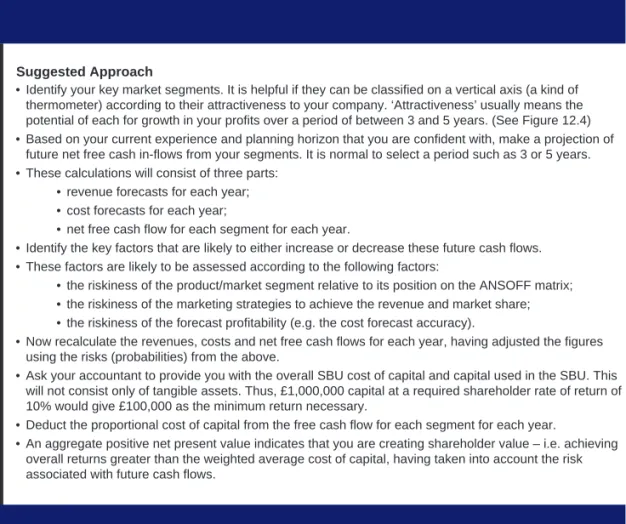
The following is a summary of how SVA should be calculated using the marketing due diligence process (see Figures 12.2 and 12.3).
Valuing Key Market Segments
Background/Facts
© Professor Malcolm McDonald
• Risk and return are positively correlated, i.e. as risk increases, investors require a higher return.
• Risk is measured by the volatility in returns, i.e. high risk is the likelihood of either making a very good return or losing all your money. This can be described as the quality of returns.
• All assets are defined as having future value to the organization. Hence assets to be valued include not only tangible assets like plant and machinery, but intangible assets, such as Key Market Segments.
• The present value of future cash flows is the most acceptable method to value assets including key market segments.
• The present value is increased by:
- increasing the future cash flows
- making the future cash flows ‘happen’ earlier
- reducing the risk in these cash flows, i.e. improving the certainty of these cash flows, and, hence, reducing the required rate of return.
Figure 12.2 Valuing key market segments (sheet 1 of 2)
This high-level process for marketing accountability, however, still does not answer the dilemma of finding an approach which is better than the plethora of metrics with which today’s marketing directors are bombarded, so Cranfield’s Research Club took this issue on board in an attempt to answer the following questions:
What needs to be measured Why it needs to be measured How frequently it needs to be measured To whom it should be reported And the relative importance of each.This leads to a discussion of Level 2.
Suggested Approach
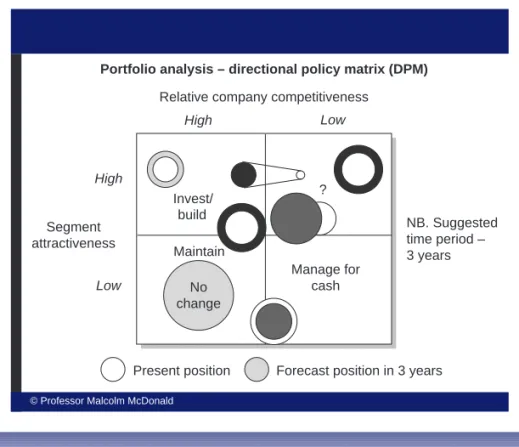
• Identify your key market segments. It is helpful if they can be classified on a vertical axis (a kind of thermometer) according to their attractiveness to your company. ‘Attractiveness’ usually means the potential of each for growth in your profits over a period of between 3 and 5 years. (See Figure 12.4)
• Based on your current experience and planning horizon that you are confident with, make a projection of future net free cash in-flows from your segments. It is normal to select a period such as 3 or 5 years.
• These calculations will consist of three parts:
• revenue forecasts for each year;
• cost forecasts for each year;
• net free cash flow for each segment for each year.
• Identify the key factors that are likely to either increase or decrease these future cash flows.
• These factors are likely to be assessed according to the following factors:
• the riskiness of the product/market segment relative to its position on the ANSOFF matrix;
• the riskiness of the marketing strategies to achieve the revenue and market share;
• the riskiness of the forecast profitability (e.g. the cost forecast accuracy).
• Now recalculate the revenues, costs and net free cash flows for each year, having adjusted the figures using the risks (probabilities) from the above.
• Ask your accountant to provide you with the overall SBU cost of capital and capital used in the SBU. This will not consist only of tangible assets. Thus, £1,000,000 capital at a required shareholder rate of return of 10% would give £100,000 as the minimum return necessary.
• Deduct the proportional cost of capital from the free cash flow for each segment for each year.
• An aggregate positive net present value indicates that you are creating shareholder value – i.e. achieving overall returns greater than the weighted average cost of capital, having taken into account the risk associated with future cash flows.
Figure 12.3 Suggested approach (sheet 2 of 2)
Level 2: Measuring marketing effectiveness
The approach we took to answering these questions was to drive metrics from a company’s strategy and the following model, shown as Figure 12.5, was developed. This clearly shows the link between Lead Indicators and Lag Indicators. There are other factors, of course, that influence what is sold and to whom. The ‘Hygiene Factors’ (HF),
‘Productivity Factors’ (PF) and ‘Critical Success Factors’ (CSF) shown under the strategy element of the lead indicators are explained shortly.
This process model is explained in much greater detail inMarketing Accountability,12so here we will provide a brief summary only.
To date, few academics or practitioners have addressed this second level, which links marketing actions to outcomes in a more holistic way.
We shall describe it briefly here, although it must be stressed that it is central to the issue of marketing metrics and marketing effectiveness.
First, however, let us destroy once and for all one of the great myths of measurement – marketing return on investment. This implies ‘return’
divided by ‘investment’ and, for marketing expenditure such as pro- motional spend, it is an intellectually puerile notion. It’s a bit like demanding a financial justification for the wings of an aircraft! Also, as McGovernet al. say,
Invest/
build
?
Maintain
Manage for cash Relative company competitiveness
Portfolio analysis – directional policy matrix (DPM)
High
Low
High Low
Segment attractiveness
No change
Present position Forecast position in 3 years
NB. Suggested time period – 3 years
© Professor Malcolm McDonald
Figure 12.4 Portfolio analysis – directional policy matrix (DPM)
Measuring marketing performance isn’t like measuring factory output – a fact that many non-marketing executives don’t grasp.
In the controlled environment of a manufacturing plant, it’s simple to account for what goes in one end and what comes out the other and then determine productivity.
But the output of marketing can be measured only long after it has left the plant.13
Neither is the budget and all the energy employed in measuring it a proxy for measuring marketing effectiveness.
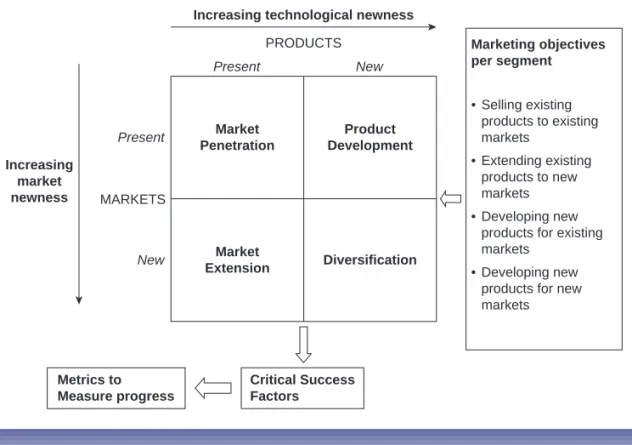
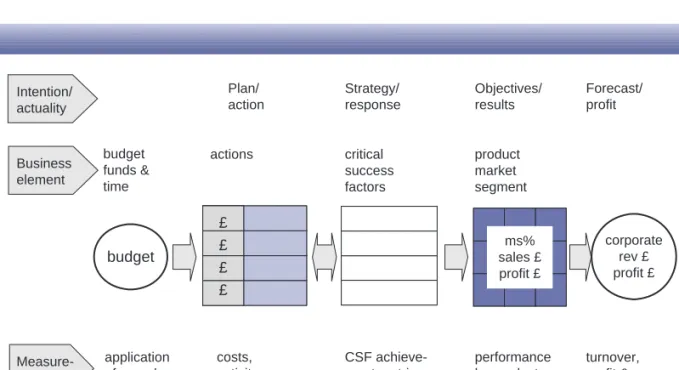
In Figure 12.5, reading from right to left, it can be seen that the corpo- rate financial objectives can only be met by selling something to some- one – represented in the figure as the Ansoff matrix (shaded box).
So how do we set about linking our marketing activities to our overall objectives? We will start with the Ansoff matrix shown in Figure 12.6.
Each of the cells in each box (cells will consist of products/services for segments) is a planning unit, in the sense that objectives will be set for each for volume, value and profit for the first year of the strategic plan.
For each of the products for segment cells, having set objectives, the task is then to determine strategies for achieving them. The starting
product market segment
ms%
sales £ profit £
corporate rev £ profit £ actions, esp.
marketing
metrics on achievement of factor to required level costs,
activity milestones
& outputs
Strategy/
achievement
Objectives/
results Plan/
action
performance by product market segment application
of spend budget funds &
time Resource allocation/
spend
Forecast/
profit
corporate performance
turnover, profit &
shareholder value budget
£
£
£
£ Intention/
actuality
Business element
Measure- ment
Lead indicators Lag indicators
Required by customers.
Relative to competitors
Market growth Customer acquisition/ retention/
uptrading/ X-selling/ regained Product/customer mix Channel performance Cost to achieve
Responsibilities who who who who what what what what
Positioning of issues in the model
PFs
HFs
CSFs
Figure 12.5 Overall marketing metrics model
point for these strategies is Critical Success Factors (CSFs), the factors critical to success in each product/service for segment, which will be weighted according to their relative importance to the customers in the segment. See Figure 12.7.
In these terms, a strategy will involve improving one or more CSF scores in one or more product-for-segment cells. It is unlikely though that the marketing function will be directly responsible for what needs to be done to improve a CSF. For example, issues like product/service efficacy, after sales service, channel management and sometimes even price and the sales force are often controlled by other functions, so marketing needs to get buy-in from these functions to the need to improve the CSF scores.
It is very rare for this information to be perfectly available to the mar- keter. While models such as price sensitivity, advertising response or even marketing mix or econometric approaches may help to populate the CSF form, there are generally several other factors where informa- tion is less easy to gather. Nevertheless, a CSF analysis indicates where metrics are most needed which can steer the organization towards measuring the right things.
Market Penetration
Product Development
Market
Extension Diversification
Present New
Increasing technological newness
Increasing market newness
Present
New
PRODUCTS
MARKETS
• Selling existing products to existing markets
• Extending existing products to new markets
• Developing new products for existing markets
• Developing new products for new markets
Marketing objectives per segment
Critical Success Factors Metrics to
Measure progress
Figure 12.6 Ansoff matrix
Figure 12.8 shows the actions that have to be taken, by whom and at what cost in order to improve the CSFs.
100 Total weighted
score
(score x weight) CSF 4
CSF 3 CSF 2 CSF 1
Competitor C Competitor B
Competitor A Your
organization Weighting
factor Critical Success
Factors
• Strategies to improve
competitive position/achieve objectives over time (4Ps)
• Metrics (each CSF) to measure performance over time in achieving goals
Figure 12.7 Critical success factors: in each segment, defined by the segment
product market segment
ms%
sales £ profit £
corporate rev £ profit £ critical
success factors actions
CSF achieve- ment metrics costs,
activity milestones &
outputs
Strategy/
response
Objectives/
results Plan/
action
performance by product market segment application
of spend budget funds &
time
Forecast/
profit
turnover, profit &
shareholder value budget
£
£
£
£ Intention/
actuality
Business element
Measure- ment
Figure 12.8 Marketing metrics model
Figure 12.9 shows how these actions multiply for each box of the Ans- off matrix.
There are other factors, of course, that influence what is sold and to whom. These may be referred to as ‘Hygiene Factors’ (HF) – i.e. those standards that must be achieved by any competitor in the market.
Other factors may be referred to as ‘Productivity Factors’ (PF) – i.e.
those issues which may impact on an organization’s performance unless the required productivity is achieved in its relevant activities.
Thus, it can be seen how the expenditure on marketing and other func- tional actions to improve CSFs can be linked to marketing objectives and, ultimately, to profitability, and it becomes clear exactly what must be measured and why. It also obviates the absurd assumption that a particular marketing action can be linked directly to profitability. It can only be linked to other weighted CSFs which, if improved, should lead to the achievement of volumes, value and, ultimately, profits.
Figure 12.3 is reintroduced here in Figure 12.10, as it summarizes all of this in one flow chart, which clearly spells out the difference between
‘Lag Indicators’ and ‘Lead Indicators’. Lead indicators are the actions taken and the associated expenditure that is incurred. These include, of course, promotional expenditure, which will be addressed later in this chapter. Lag indicators are the outcomes of these actions and expenditures and need to be carefully monitored and measured. Thus, retention by segment, loss by segment, new customers, new product sales, channel performance and the like areoutcomes, but these need to
product market segments
action
£ action
£ action
£ action
£
CSF1 CSF2 CSF3 CSF4
corporate rev £ profit £
budget budget
budget
critical success factors
marketing actions
budget funds &
time
corporate performance
ms%
sales £ profit £
Figure 12.9 Cascading actions from the Ansoff matrix
be linked back to the appropriateinputs, an issue which is addressed later in this chapter.
There is one other crucial implication to be drawn from this model.
Most operating boards on scrutinizing profit and loss accounts typically see only one line for revenue, while costs are covered in considerable detail, and it is around costs that most of the discussion takes place. In the view of the authors, there should be at least two sets of figures – one to detail where the sales revenue has come from, another to detail costs. A key task of marketers, rarely carried out, is to link the two documents together. Figure 12.10 goes some way towards this.
We stress, however, that the corporate revenue and profits shown in the right of Figure 12.10 are not the same as shareholder value added, which takes account of the risks involved in the strategies, the time value of money and the cost of capital. This brings us to Level 3.
Level 3: Promotional Effectiveness
Level 3 is the fundamental and crucial level of promotional measurement.
product market segment
ms%
sales £ profit £ actions, esp.
marketing
metrics on achievement of factor to required level costs,
activity milestones
& outputs
Strategy/
achievement
Objectives/
results Plan/
action
performance by product market segment application
of spend budget funds &
time Resource allocation/
spend
Forecast/
profit
corporate performance
turnover, profit &
shareholder value budget
£
£
£
£ Intention/
actuality
Business element
Measure- ment
Lead indicators Lag indicators
Required by customers.
Relative to competitors
Market growth Customer acquisition/ retention/
uptrading/ X-selling/ regained Product/customer mix Channel performance Cost to achieve
Responsibilities who who who who what what what what
Positioning of issues in the model
PFs
HFs
CSFs
corporate rev £ profit £
Figure 12.10 Overall marketing metrics model
It would be surprising if marketing as a discipline did not have its own quantitative models for the massive expenditure of FMCG companies. Over time, these models have been trans- ferred to business-to-business and service companies, with the result that, today, any organization spending substantial sums of shareholders’ money on promotion should be ashamed of themselves if those responsible could not account for the effectiveness of such expenditure.
Nonetheless, with the advent of different promotional methods and channels, combined with an empowered and more sophisticated con- sumer, the problems of measuring promotional effectiveness have increased considerably. Consequently, this remains one of the major challenges facing the marketing community today.
For example, in fast moving consumer goods, supermarket buyers expect and demand a threshold level of promotional expenditure in order to be considered for listing. Indeed, in most commercial situa- tions, there is a threshold level of expenditure that has to be made in order just to maintain the status quo – i.e. keep up the product or ser- vice in consumer consciousness to encourage them to continue buying.
The author refers to this as ‘maintenance’ expenditure.
In most situations, however, not to maintain existing levels of promo- tion over time results in volume, price and margin pressure, market share losses and a subsequent declining share price.
There is some evidence from the IPA’s analysis of almost 900 promo- tional campaigns, presented in a report.14The graph in Figure 12.11 shows that, in one experimental scenario, the promotional budget was cut to zero for a year, then returned to normal, while in another, the budget was cut by 50%. Sales recovery to pre-cut levels took five years and three years, respectively, with cumulative negative impacts on net profits of £1.7 million and £0.8 million.
It is important to make one final point about measuring the effective- ness of promotional expenditure in taking account of ‘maintenance’
expenditure. This point relates to the tried and tested method of meas- uring the financial impact of promotional expenditure – net present value.
As can be seen from the following, by not taking account of the expen- diture to maintain current sales and by including total promotional expenditure in the NPV calculations, a totally false result ensues.
However, by taking account of maintenance expenditure, a much better result emerges.
Present values
Discounting a future stream of revenue into a ‘Present Value’ assumes that a rational investor would be indifferent to having a dollar today, or to receiving in some future year a dollar plus the interest that could have been earned by investing that dollar for those years.
Thus it makes sense to assess investments by dividing the money to be received in future years by (1þr), where r is the discount rate (the annual return from investing that money) andnis the number of years during which the investment could be earning that return.
PV or NPV or DCF is denoted as:
PV¼ PCt ð1þrÞn
Sis the sum of the cash flows in yearst(1, 2, 3, 4, etc.).
This summation of the cash flows is then divided by (1þr)nwhereris the discount rate andnis the number of years the investment could be earning that return.
Budget maintained every year
ROI defined as the incremental revenue generated from advertising per unit of spend Time
Long-term case history
Sales
Zero advertising year 1 then back to usual weights Half budget in year 1 then back to usual weights
Zero budget year 1
Budget saved
Sales forgone
Profit on forgone sales
Impact on bottom line
Time to recover
Half budget year 1
£1.8m
£0.9m
£8.6m
£4.3m
£3.5m
£1.7m
£1.7m
£0.8m
5 years 3 years
Figure 12.11 ROI. Long-term case history
Hence, for a net free cash flow of $2 million a year over 4 years and a cost of capital of 10%, the net present value is:
2
ð1:1Þþ 2
ð1:1Þ2þ 2
ð1:1Þ3þ 2
ð1:1Þ4¼$6:4million
Minus an initial investment of, say, $5 million, the NPV of this invest- ment is $1.4 million.
However:
A promotional investment of, say, $7 million, using the above figure, would produce a loss of $0.6 million.
If, however, a company needs to spend say $6 million just to maintain current sales, the investment is only $1 million and the NPV would then be:
$1millionþ 2
ð1:1Þþ 2
ð1:1Þ2þ 2
ð1:1Þ3þ 2
ð1:1Þ4¼$5:4million The research issue facing our community is how to estimate what might be classified as ‘maintenance’ promotion and what as ‘invest- ment’ promotion. This is complicated by the different forms of promo- tion and the many different channels available today, but it is not impossible.
Conclusion
Having provided some insights into marketing accountability, it should make it slightly easier to answer the following questions:
What needs measuring? Why? When? How? How frequently? By whom? Reported to whom? At what cost? Etc.It is suggested that the following questions also need to be explored:
1. What counts as marketing expenditure?
2. What does ‘added value’ really mean?
value chain analysis
shareholder value added (SVA) customer value
brand value accounting value value-based marketing
3. What are the major ‘Schools of Thought’? What are the strengths and weaknesses of each?
4. Preliminary conclusions from the above with our own recommen- dations/hypotheses.
5. Some small-scale field work to test findings on world class companies.
The metrics below show a summary of some of the more common met- rics in use in companies today:
Brand awareness Channel efficiency Cost per lead Customer satisfaction Growth in customers Lead conversion rate Orders: number average, total value Repurchase rate Share of customer Total marketing cost per order.Whatever models emerge from the above, it is highly unlikely that any organization will be using them all. There will be examples of excel- lence along a number of dimensions which will help us to refine and develop the models.
The authors are indebted to Professor Robert Shaw of Cass Business School, who worked with them in running Cranfield University School of Management’s Value Added Research Club. They are also indebted to Peter Mouncy, who worked with the authors in Cranfield’s Market- ing Accountability Research Club.
Summary
The chapter outlined a number of marketing investment appraisal techniques which form an important part of marketing strategy and marketing planning, starting with a discussion of what counts as marketing expenditure. It continued by describing three lev- els of marketing measurement:
Level 1: Marketing Due Diligence (MDD). MDD assesses the risks associated with the three main components of strategic marketing plans: the market; the marketing strategy; and the profit pool. The forecast net free cash flows for the planning period are reduced if appropriate by the probability that they can be archived. The accountant will then take account of the cost of capital to assess whether these risk-adjusted net free cash flows will create or destroy shareholder value.
Level 2: Marketing Spend Evaluation. The model provided a framework for linking princi- pal products for market (the Ansoff matrix) to critical success factors, productivity factors and to hygiene factors. These are then translated into actions, with costs and responsibil- ities associated with each action.
Level 3: Promotional Spend Evaluation. Here, the difference between maintenance and investment expenditure was explained and examples provided which illustrated the very different net present value outcomes based on maintenance and investment expenditure.
We have now covered each of the major phases of marketing planning, examined related organizational issues in detail and, in this chapter, reviewed measurement of the effectiveness of marketing plans. In the final chapter, which follows, we provide an over- view and summary of the key issues we have covered and a detailed step-by-step approach for developing a services marketing planning system. This chapter will provide a detailed structure, with accompanying pro-formas, for creating:
A three-year strategic marketing plan A one-year detailed tactical marketing plan A headquarters consolidated plan of several strategic business unit (SBU) stra- tegic marketing plans.