ISSN 977-0125-9989-1-9
9 770125 998919 LIPI Press
STT
NO.1052/SK/DITJEN/PPG/STT/1986
MASYARAKAT INDONESIA
MAJALAH ILMU-ILMU SOSIAL INDONESIA
NOMOR 2, DESEMBER 2018 VOLUME 44
DAFTAR ISI
MASY ARAKA T INDONESIA, V ol. 44, No. 2, DESEMBER 2018
NO. AKREDITASI: 640/AU3/P2MI-LIPI/07/2015
ISSN 0125-9989 E-ISSN 2502-5694
TARA MITI TOMI NUKU: MERAWAT TOLERANSI DALAM TRADISI DI ALOR, NUSA TENGGARA TIMUR
Katubi ...1-16 ETHICAL CULTURE STRENGTHENING MODEL AT RESORT POLICE AS PART OF
POLICE REFORM: A BOURDIE U’S HABITUS BASED APPROACH
Ahrie Sonta ...17-35 WARISAN KOLONIAL DAN MARGINALISASI ORANG LOLODA DI PANTAI BARAT
HALMAHERA
Abd. Rahman ...36-47 SENI UNTUK DAMAI: UPAYA REKONSILIASI AKAR RUMPUT PASCA TRAGEDI 1965
Ganesh Cintika Putri ...48-59 LAPISAN MARGINALISASI DAN KONSTRUKSI ILEGALITAS DALAM MASYARAKAT
PERBATASAN DI PERBATASAN INDONESIA FILIPINA
Dhimas Langgeng Gumelar, Natasha Devanand Dhanwani ...60-75 BERDAMPINGAN DENGAN LELUHUR DI MASA DEPAN: HISTORISITAS, LANSKAP,
DAN ARTIKULASI IDENTITAS MASYARAKAT TENGGER SENDURO
Nabilla Nailur Rohmah ...76-87 RITUAL BEDEKEH SUKU AKIT DI PULAU RUPAT KABUPATEN BENGKALIS PROVINSI RIAU PADA ERA GLOBAL
Suroyo ...88-97 TINJAUAN BUKU
EKOLOGI MANUSIA DAN PEMBANGUNAN BERKELANJUTAN
Puji Hastuti ...98-102 TINJAUAN BUKU
MELIHAT PERKEMBANGAN SAINS DI INDONESIA, REVIEW BUKU STS DI INDONESIA KEBIJAKAN DAN IMPLEMENTASINYA: QUO VADIS?
Muhammad Luthf ...103-118
i
MASYARAKAT INDONESIA
MAJALAH ILMU-ILMU SOSIAL INDONESIA
NO. AKREDITASI: 640/AU3/P2MI-LIPI/07/2015
VOLUME 44
ISSN 0125-9989 E-ISSN 2502-5694
NOMOR 2, DESEMBER 2019
DAFTAR ISI
TARA MITI TOMI NUKU: MERAWAT TOLERANSI DALAM TRADISI DI ALOR, NUSA TENGGARA TIMUR
Katubi ...1-16 ETHICAL CULTURE STRENGTHENING MODEL AT RESORT POLICE AS PART OF
POLICE REFORM: A BOURDIEU’S HABITUS BASED APPROACH
Ahrie Sonta ...17-35 WARISAN KOLONIAL DAN MARGINALISASI ORANG LOLODA DI PANTAI BARAT
HALMAHERA
Abd. Rahman ...36-47 SENI UNTUK DAMAI: UPAYA REKONSILIASI AKAR RUMPUT PASCA TRAGEDI 1965
Ganesh Cintika Putri ...48-59 LAPISAN MARGINALISASI DAN KONSTRUKSI ILEGALITAS DALAM MASYARAKAT
PERBATASAN DI PERBATASAN INDONESIA FILIPINA
Dhimas Langgeng Gumelar, Natasha Devanand Dhanwani ...60-75 BERDAMPINGAN DENGAN LELUHUR DI MASA DEPAN: HISTORISITAS, LANSKAP,
DAN ARTIKULASI IDENTITAS MASYARAKAT TENGGER SENDURO
Nabilla Nailur Rohmah ...76-87 RITUAL BEDEKEH SUKU AKIT DI PULAU RUPAT KABUPATEN BENGKALIS PROVINSI RIAU PADA ERA GLOBAL
Suroyo ...88-97 TINJAUAN BUKU
EKOLOGI MANUSIA DAN PEMBANGUNAN BERKELANJUTAN
Puji Hastuti ...98-102 TINJAUAN BUKU
MELIHAT PERKEMBANGAN SAINS DI INDONESIA, REVIEW BUKU STS DI INDONESIA KEBIJAKAN DAN IMPLEMENTASINYA: QUO VADIS?
Muhammad Luthfi ...103-118
iii
MASYARAKAT INDONESIA
MAJALAH ILMU-ILMU SOSIAL INDONESIA
NO. AKREDITASI: 640/AU3/P2MI-LIPI/07/2015
VOLUME 44
ISSN 0125-9989 E-ISSN 2502-5694
NOMOR 2, DESEMBER 2019
DDC:
Katubi
TARA MITI TOMI NUKU: MERAWAT TOLERANSI DALAM TRADISI DI ALOR, NUSA TENGGARA TIMUR
Masyarakat Indonesia, Vol. 44 (2) Desember 2019: 1–16 ABSTRAK
Meningkatnya intoleransi beragama di Indonesia akhir-akhir ini menjadi masalah serius dalam konstruksi kehidupan multikultur. Akan tetapi, ada beberapa wilayah di Indonesia yang dianggap berhasil dalam menjaga toleransi, misalnya di Provinsi Nusa Tenggara Timur, terutama di Pulau Alor-Pantar. Bahkan, ketika konfl ik dahsyat dengan isu agama melanda sebagian wilayah Indonesia bagian timur pasca-runtuhnya Orde Baru, solidaritas komunitas lokal orang Alor-Pantar mampu membuat mereka terhindar dari konfl ik dahsyat tersebut. Hal itu karena sejak dulu orang-orang di tiap kampung di Pulau Alor-Pantar mengembangkan cara untuk menghindari konfl ik, termasuk konfl ik yang bernuansa agama, berbasis tradisi. Oleh karena itu, kehidupan beragama masyarakat di Kepulauan Alor-Pantar dan hubungannya dengan adat banyak mengundang minat para akademisi untuk membahasnya.
Berbeda dengan berbagai tulisan para akademisi sebelumnya, tulisan ini membahas tradisi komunitas Muslim dan Kristiani di Alor dalam menata kehidupan mereka bersama melalui nilai kebudayaan dengan memberikan penghormatan khusus pada tradisi lokal, yakni semboyan Tara miti Tomi nuku, yang artinya ’berbeda-beda tetapi satu bersaudara.’ Untuk membahas persoalan itu, tradisi lisan lego-lego menjadi titik tekan pembahasan. Tulisan ini berdasar penelitian lapangan dengan metode etnografi . Berdasar analisis pelaksanaan tradisi lisan lego-lego dan lirik lego-lego, tulisan ini memaparkan dua hal, yaitu 1) praktik sosial-budaya yang telah dilakukan antarkelompok beragama yang berbeda dalam menjaga toleransi, 2) cara berbagai kelompok etnis di Alor mengajarkan pentingnya saling menghargai antarumat beragama melalui tradisi lisan lego-lego, terutama melalui lirik lagunya.
Kata kunci: toleransi beragama, tara miti tomi nuku, lego-lego, tradisi lisan, Alor, multikulturalisme DDC:
Ahrie Sonta
ETHICAL CULTURE STRENGTHENING MODEL AT RESORT POLICE AS PART OF POLICE REFORM: A BOURDIEU’S HABITUS BASED APPROACH
Masyarakat Indonesia, Vol. 44 (2) Desember 2019: 17–35 ABSTRACT
This research emerged from concerns over cultural reform within the Indonesian Police, which has yet to show expected results, compared to successfully materialized structural and instrumental changes within the frame of Police Reform in the past two decades. Ethical culture, in this research, is believed as ‘organizational capital’
that is needed by the Police to facilitate cultural change. Inquiry into police habitus at the Sidoarjo Resort Police as this research’s object, revealed some problems hindering institutional integrity, i.e.: reminders of paramilitary culture, police doxa as crime-fi ghter, insuff uctient and partial development of internal oversight system, absence of public participatory ethical infrastructure, and deonthologic or rule-based defi nition of ethical approach. In
iv | Masyarakat Indonesia, Vol. 44 (2), Juni 2018
the time being, on personel integrity aspect, there found the following problems: limited comprehension of ethics as a philosophy and of public ethics as public offi cial’s code of conduct, absence of training on ethics in police education, absence of supporting symbolic capitals, and weaknesses within recruitment and socialization system for newly recruited offi cers. A model of ethical culture strengthening is thus developed to overcome the problems on institutional and personel integrity, particularly at the resort level police organization.
Keywords: Public Ethics, Ethical Culture, Sidoarjo City Resort Police, Structure-Agent
DDC:
Abd. Rahman
WARISAN KOLONIAL DAN MARGINALISASI ORANG LOLODA DI PANTAI BARAT HALMAHERA
Masyarakat Indonesia, Vol. 44 (2) Desember 2019: 36–47 ABSTRAK
Paper ini bertujuan membahas secara singkat mengenai situasi keterpinggiran Loloda di Pesisir Pantai Barat Halmahera dalam segala sektor pembangunan dibandingkan daerah-daerah lainnya di Maluku Utara. Berbicara mengenai Maluku Utara, tidaklah lengkap apabila tidak membicarakan Loloda, sebagai bagian integral dari dunia Maluku. Informasi sezaman menyatakan bahwa Loloda merupakan bekas kerajaan tertua Maluku (Moloku Loloda) di pesisir pantai barat laut Halmahera, Kawasan Laut dan Kepulauan Maluku. Loloda merupakan bagian utama dari sejarah dan kebudayaan “dunia Maluku” sejak berdirinya pada abad ke-13 Masehi. Upaya mempertahankan dan melestarikan adat dan tradisi Kerajaan Loloda terus berlagsung hingga kini, meskipun sejak periode orde lama (1950-1969) seluruh daerah di Indonesia yang dahulunya berbasis kerajaan atau Kesultanan telah dihapuskan.
Daeran-daerah itu diintegrasikan ke dalam nomenklatur sistem administrasi pemerintahan daerah Negara Kesatuan Republik Indonesia. Pengintegrasian itu merupakan restrukturisasi Pemerintahan Republik Indonesia ke dalam bentuknya yang baru dan resmi, selama lebih dari dua dekade masa kemerdekaan Indonesia. Pertanyaannya adalah apakah masih ada kekuatan hegemonik Ternate sebagai Warisan Kolonial Hindia Belanda atas Loloda, sehingga daerah bekas kerajaan Maluku tertua ini masih terpinggirkan dari pembangunan daerah dan nasional? Penulisan ini menggunakan metode dan metodologi sejarah, melalui studi-studi kepustakaan, kearsipan, dan pengamatan di lapangan, serta wawancara lisan dengan informan-informan terpilih.
Kata Kunci: Loloda, Halmahera, Warisan, Kolonial, Marginalisasi.
DDC:
Ganesh Cintika Putri
SENI UNTUK DAMAI: UPAYA REKONSILIASI AKAR RUMPUT PASCA TRAGEDI 1965
Masyarakat Indonesia, Vol. 44 (2) Desember 2019: 48–59
ABSTRAK
Pembunuhan massal dan penghilangan paksa yang terjadi pasca tragedi 1965 menyisakan konfl ik berkepanjangan hingga kini. Narasi sejarah yang dibentuk pemerintah menempatkan sekelompok orang yang diduga berkaitan dengan PKI mengalami stigmatisasi dan ketidakadilan hingga 40 tahun setelahnya. Tulisan ini bermaksud menganalisis strategi yang dilakukan masyarakat akar rumput untuk menciptakan narasi alternatif sebagai bagian dari upaya rekonsiliasi. Secara khusus, tulisan ini akan menganalisis narasi sejarah alternatif yang disuguhkan lewat pementasan teater Gejolak Makam Keramat pada 13 Juli 2017 di Yogyakarta. Pementasan ini dipilih karena proses pembuatan naskah, latihan, pemilihan metode bertutur, serta pelibatan penonton yang mampu menarasikan sejarah alternatif di tengah narasi dominan yang menghambat upaya rekonsiliasi. Tulisan ini ingin mengatakan bahwa Teater Gejolak Makam Keramat memberikan ruang bagi narasi sejarah alternatif sebagai bagian dari upaya rekonsiliasi akar rumput. Paling tidak terdapat tiga strategi yang dilakukan untuk mencapai tujuan tersebut yaitu:
pengemasan narasi alternatif dalam objek seni yang lebih aman dari persekusi; partisipasi penyintas sebagai subjek dari narasi, serta; pelibatan audience dalam proses penyajian narasi.
Kata kunci: seni, teater, rekonsiliasi, narasi alternatif
v DDC:
Dhimas Langgeng Gumelar, Natasha Devanand Dhanwani
LAPISAN MARGINALISASI DAN KONSTRUKSI ILEGALITAS DALAM MASYARAKAT PERBATASAN DI PERBATASAN INDONESIA FILIPINA Masyarakat Indonesia, Vol. 44 (2) Desember 2019: 60–75
ABSTRAK
Studi marginal mendekatkan fokus kajian sering pada identitas suatu komunitas tempatan, tanpa di sadari, pandangan tersebut mengkonstruksi dimensi marginal yang anakronistik. Studi tersebut menjerumuskan masyarakat di perbatasan Indonesia-Filipina, dan memunculkan romantisme. Studi yang dilakukan di Kepulauan Sangihe, berdasar pada fakta-fakta etnografi s dan historis, serta observasi yang dilakukan selama bulan Juli-Agustus 2018.
Kami menggunkan hubungan relasional untuk menangkap plot transformasi pada catatan Eropa serta kajian historis yang sudah diterbitkan. Hubungan tersebut pada dasarnya mendeskripsikan kelompok pejuang yaitu buruh paksa yang dijadikan budak. Transformasi tidak meninggalkan dimensi tradisional, khususnya adalah bagaimana penguasaan selama ini dilakukan oleh sistem ekonomi Feodalisme hingga Kapitalisme. Di wilayah perbatasan, Orang Sangir yang tinggal dekat dengan laut melakukan mobilisasi sebelum orang-orang Eropa datang, dan dimensi tradisional tersebut masih dilakukan, tetapi dibawah kuasa baru, yaitu negara modern. Mendasarkan diri pada isu transnasionalisme dan sekuritas, Indonesia dan Filipina membuat regulasi yang mengatur mobilitas migran.
Pada akhirnya, Orang Sangir tersebut merasa selalu menjadi kriminal, disematkan stigma ilegal, tereksklusi dari kepulauannya sendiri di mana masyarakat yang tidak tinggal di Sangihe Besar mengklaim dirinya sebagai Orang Pulo. Kami melihat bahwa wilayah perbatasan Indonesia-Filipina sebagai wilayah abu-abu, cair, dan laboratorium kreatif.
Keywords: Marginal, Hubungan Relasional, Legal-Ilegal, Orang Sangir
DDC:
Nabilla Nailur Rohmah
BERDAMPINGAN DENGAN LELUHUR DI MASA DEPAN : HISTORISITAS, LANSKAP, DAN ARTIKULASI IDENTITAS MASYARAKAT TENGGER SENDURO Masyarakat Indonesia, Vol. 44 (2) Desember 2019: 76–87
ABSTRAK
Artikel ini mengkaji signifi kasi historis ajaran leluhur dan lanskap Puncak Songolikur bagi masyarakat Tengger di Senduro dan bagaimana historisitas tersebut dimaknai, direpresentasikan, dan direkonstruksi dalam konteks sejarah masa kini. Dalam tulisan ini, cerita rakyat Tengger tentang “Joko Seger dan Roro Anteng” tidak dikaji sebagai legenda ataupun mitos, melainkan sebagai sejarah publik yang memiliki relevansi dengan realita sosial masa kini. Bagi orang Tengger, cerita mengenai asal-usul leluhurnya menyangkut keseluruhan kerangka teologis yang mendasari tatanan sosial dan praktik kultural dalam kehidupan kesehariaanya. Kebijakan Lima Agama Mayoritas rezim Orde Baru telah menyebabkan Hinduisasi dan Islamisasi besar-besaran, yang juga berpengaruh besar terhadap tatanan sosial dan kultural masyarakat Tengger. Terlebih lagi, penerapan kebijakan Taman Nasional dan Pariwisata di ruang hidup mereka telah melahirkan tantangan yang lebih besar, yang memanifestasikan tatanan kehidupan yang semakin kapitalistik dan profan. Dalam kondisi ini, Puncak Songolikur mengahadirkan dan merawat narasi historis mengenai leluhur masyarakat Tengger di Senduro, sebagaimana pula merawat nilai-nilai spiritual, tatanan sosial, praktik budaya, dan keseluruhan cara hidup yang menyertainya. Namun, pengembangan destinasi wisata “Puncak B29” di lanskap Puncak Songolikur sejak 2013 menjadi tantangan sekaligus peluang bagi narasi sejarah masyarakat Tengger Senduro. Dalam tulisan ini akan ditunjukkan bagaimana pengembangan pariwisata dapat berpeluang menjaga sekaligus mengkontestasikan historisitas Puncak Songolikur. Pembahasan tersebut menyangkut bagaimana masyarakat Tengger di Senduro menegaskan, menegosiasikan, dan mengartikulasikan kembali identitasnya dalam konteks sejarah hari ini.
Kata kunci: Tengger Senduro, Puncak B29, Puncak Songolikur, Historisitas, Artikulasi
vi | Masyarakat Indonesia, Vol. 44 (2), Juni 2018 DDC:
Suroyo
RINGKASAN DISERTASI:
RITUAL BEDEKEH SUKU AKIT DI PULAU RUPAT
KABUPATEN BENGKALIS PROVINSI RIAU PADA ERA GLOBAL Masyarakat Indonesia, Vol. 44 (2) Desember 2019: 88–97
ABSTRAK
Ritual bedekeh sangat erat kaitannya dengan tradisi dan adat istiadat masyarakat suku Akit. Suku Akit menggunakan sistem pengetahuan, kepercayan presepsi sebagai bagian dari kebudayaan dan tradisi mereka terhadap konsep sehat dan sakit serta penyebab sakit tersebut. Suku Akit dan masyarakat pendukungnya telah memiliki pengetahuan lokal (local knowlegde) dan kearifan lokal (local wisdom) dalam mengatasi masalah kesehatan dan cara mengobatinya apabila masyarakat mengalami gangguan kesehatan. Penelitian ini membahas tradisi ritual bedekeh suku Akit di Pulau Rupat Kabupaten Bengkalis, Provinsi Riau. Tradisi ini masih tetap dipraktikkan oleh masyarakat suku Akit, tetapi keberadaan sekarang semakin terpinggirkan oleh faktor intern dan ekstern. Pelaksanaan ritual bedikie banyak mengandung kearifan lokal, simbol, nilai, dan dampak bagi kehidupan masyarakat pendukungnya.
Penelitian ritual bedekeh oleh bomoh pada suku Akit di Pulau Rupat Kabupaten Bengkalis, Provinsi Riau dirancang sesuai dengan paradigma keilmuan kajian budaya (cultural studies). Sebagai landasan analisis, digunakan teori hegemoni, teori praktik, dan teori wacana relasi kuasa dan pengetahuan. Data dalam penelitian ini dikumpulkan melalui teknik observasi, wawancara mendalam, studi pustaka, dan dokumentasi.
Berdasarkan telaah dan metode analisis pelaksanaan upacara ritual mempunyai tahap-tahap yang harus dilakukan sebagai berikut Pertama, pemeriksaan, yaitu pemeriksaan perlengkapan upacara ritual dipimpin oleh Batin dan Bomoh menentukan waktu untuk mengadakan ritual. Kedua, penyerahan, yaitu Bomoh menyerahkan peralatan dan bahan yang dibutuhkan dalam upacara pelaksanaan ritual, Ketiga, tegak bomoh, yaitu berlangsungnya upacara ritual pengobatan oleh bomoh. Faktor yang memengaruhi semakin terpinggirnya ritual bedekeh suku Akit di Desa Hutan Panjang, Kecamatan Rupat, Kabupaten Bengkalis, Provinsi Riau adalah relasi kuasa dalam konversi agama, stigma negatif bahwa orang Akit terkenal dengan ilmu sihir, perkembangan ilmu pengetahuan dan teknologi dalam sistem pengobatan modern dan pengaruh pendidikan formal dan nonformal dalam berbagai jenjang dan cara berpikir manusia. Implikasi dari keterpinggiran ritual bedekeh adalah sikap terbuka suku Akit melalui kontak budaya (akulturasi) dengan kebudayaan lain, penyederhanaan praktik ritual oleh bomoh dalam dimensi waktu, dan semakin menguatnya identitas suku Akit. Upaya yang dilakukan sebagai langkah strategis pewarisan ritual bedekeh secara intern dan ekstern. Profesi bomoh dianggap sangat membantu dan masih dibutuhkan untuk pengobatan, pemerintah diharapkan memberikan bantuan kepada profesi bomoh dari segi pendanaan (tunjangan) agar lebih fokus terhadap profesi sebagai pengobat tradisional.
Kata kunci: bedikie, bomoh, suku Akit, keterpinggiran, pewarisan
DDC:
Puji Hastuti
TINJAUAN BUKU:
EKOLOGI MANUSIA DAN PEMBANGUNAN BERKELANJUTAN
Prof. Oekan S. Abdoellah, Ph.D., PT Gramedia Pustaka Utama, 2017. 256 hlm.
Masyarakat Indonesia, Vol. 44 (2) Desember 2019: 98–102
vii DDC:
Muhammad Luthfi TINJAUAN BUKU:
MELIHAT PERKEMBANGAN SAINS DI INDONESIA,
REVIEW BUKU STS DI INDONESIA KEBIJAKAN DAN IMPLEMENTASINYA:
QUO VADIS?
Soewarsono, Thung Ju Lan, & Dundin Zaenuddin. STS di Indonesia Kebijakan dan
Implementasinya: Quo Vadis? PT Gading Inti Prima (Anggota IKAPI): 186 hlm, 16 x 21 cm.
Masyarakat Indonesia, Vol. 44 (2) Desember 2019: 103–118
viii | Masyarakat Indonesia, Vol. 44 (2), Juni 2018
MASYARAKAT INDONESIA
MAJALAH ILMU-ILMU SOSIAL INDONESIA
NO. AKREDITASI: 640/AU3/P2MI-LIPI/07/2015
VOLUME 44
ISSN 0125-9989 E-ISSN 2502-5694
NOMOR 2, DESEMBER 2019
DDC:
Katubi
TARA MITI TOMI NUKU: NURTURING TOLERANCE OF TRADITION IN ALOR, EAST NUSA TENGGARA
Masyarakat Indonesia, Vol. 44 (2) Desember 2019: 1–16
ABSTRACT
The increase of religious intolerance in Indonesia has recently become a serious problem in the construction of multicultural life. However, some areas in Indonesia are considered successful in maintaining tolerance, for instance, in the Province of East Nusa Tenggara, particularly in Alor-Pantar Island. When a great confl ict in the context of religious issues occurred in parts of Eastern Indonesia after the collapse of the New Order, the Alor-Pantar local community could avoid this terrible confl ict due to their solidarity. It is because people from each village in Alor- Pantar Island have developed means to avoid confl icts based on tradition, including confl icts in religious terms.
Therefore, academics are encouraged to discuss about the religious life of the people in the Alor-Pantar Island and its relationship with customs. Diff erent from prior writings, this article discusses the traditions of the Muslim and Christian communities in Alor in undergoing their lives through cultural values by giving special respect to a local tradition, Tara miti Tomi nuku, which means ‘brotherhood in diversity’. To disclose this issue, the oral tradition of lego-lego will be the center of discussion. This paper is based on fi eld research using ethnographic methods.
Based on the analysis of the implementation of the lego-lego’s oral tradition and the lego-lego’s lyrics, this paper describes two things, which are 1) socio-cultural practices that have been carried out by diff erent religious groups in maintaining tolerance; 2) means that various ethnic groups in Alor have been undertaken to teach the importance of interfaith mutual respect through the oral tradition of lego-lego, especially through the lyrics of the song.
Keywords: religious tolerance, tara miti tomi nuku, lego-lego, oral tradition, Alor, multiculturalism
DDC:
Ahrie Sonta
ETHICAL CULTURE’S STRENGTHENING MODEL AT RESORT POLICE AS PART OF POLICE REFORM: A BOURDIEU’S HABITUS BASED APPROACH
Masyarakat Indonesia, Vol. 44 (2) Desember 2019: 17–35 ABSTRACT
This research emerged from concerns over cultural reform within the Indonesian Police, which has yet to show expected results, compared to successfully materialized structural and instrumental changes within the frame of Police Reform in the past two decades. Ethical culture, in this research, is believed as ‘organizational capital’
that is needed by the Police to facilitate cultural change. Inquiry into police habitus at the Sidoarjo Resort Police as this research’s object, revealed some problems hindering institutional integrity, i.e.: reminders of paramilitary culture, police doxa as crime-fi ghter, insuff uctient and partial development of internal oversight system, absence
ix
of public participatory ethical infrastructure, and deonthologic or rule-based defi nition of ethical approach. In the time being, on personel integrity aspect, there found the following problems: limited comprehension of ethics as a philosophy and of public ethics as public offi cial’s code of conduct, absence of training on ethics in police education, absence of supporting symbolic capitals, and weaknesses within recruitment and socialization system for newly recruited offi cers. A model of ethical culture strengthening is thus developed to overcome the problems on institutional and personel integrity, particularly at the resort level police organization.
Keywords: Public Ethics, Ethical Culture, Sidoarjo City Resort Police, Structure-Agent DDC:
Abd. Rahman
COLONIAL HERITAGE AND MARGINALIZATION OF THE LOLODA PEOPLE ON THE WEST COAST OF HALMAHERA
Masyarakat Indonesia, Vol. 44 (2) Desember 2019: 36–47 ABSTRACT
This paper aims to briefl y discuss the marginalized situation of the Loloda people on the west coast of Halmahera in all development sectors compared to other regions in North Maluku. Discussing North Maluku, it is not complete without talking about Loloda as an integral part of the Moluccas’ world. Contemporary information states that Loloda is the oldest kingdom of Moluccas (Moloku Loloda) on the northwest coast of Halmahera, the Molucca Sea Region and Islands. Loloda is the main part of the history and culture of the “Moluccan world” since its foundation in the 13th Century. Attempts to maintain and preserve customs and traditions of the Kingdom of Loloda are still ongoing until today, although since the Old Order period (1950-1969), all regions in Indonesia dominated by the Kingdom and Sultanate systems were abolished. Those regions are integrated into the nomenclature of the regional administration system of the Unitary State of the Republic of Indonesia. This integration is the realization of restructuring the Republic of Indonesia to the new and offi cial form for more than two decades of independence.
The question is whether or not the hegemonic power of Ternate as the Dutch East Indies’ colonial heritage of Loloda remains in existence, so the former area of the oldest kingdom of Moluccas is still marginalized from regional and national development. This article utilizes historical methods and methodologies throughout a study of literature, archives, and fi eld observations, as well as interviews with selected resource persons.
Keywords: Loloda, Halmahera, Heritage, Colonial, Marginalization
DDC:
Ganesh Cintika Putri
ART FOR PEACE: GRASSROOTS’ RECONCILIATION EFFORTS AFTER THE 1965 TRAGEDY
Masyarakat Indonesia, Vol. 44 (2) Desember 2019: 48–59 ABSTRACT
Mass killings and enforced disappearances which occurred after the 1965 tragedy have been becoming a prolonged confl ict until today. The historical narrative shaped by the government puts a group of people who were allegedly involved in the Communist Party of Indonesia (PKI) experiencing stigmatization and injustice for up to 40 years. This paper intends to analyze the strategies undertaken by grassroots communities to create alternative narratives as a part of the reconciliation eff orts. Particularly, this paper will examine the alternative historical narratives presented in the Gejolak Makam Keramat Theatrical Performance on July 13, 2017, in Yogyakarta.
This performance was chosen due to the arts of scripts making, practices, choices of speaking methods, and the involvement of audiences which were able to narrate alternative history amidst the dominance of narratives that hindered the reconciliation attempts. This paper would like to say that the Gejolak Makam Keramat Theatrical Performance has contributed a space to historical narratives as a part of grassroots reconciliation eff orts. There are, at least, three strategies implemented to achieve those objectives, which are: the packaging of alternative narratives in an art object which is safer than persecution; the participation of survivors as the subject of the narrative, and;
the involvement of audiences in the process of presenting the narration.
Keywords: art, theater, reconciliation, alternative narratives
x | Masyarakat Indonesia, Vol. 44 (2), Juni 2018 DDC:
Dhimas Langgeng Gumelar, Natasha Devanand Dhanwani
MARGINALIZATION LEVELS AND ILLEGAL CONSTRUCTION IN BORDER COM- MUNITIES ON THE INDONESIA-THE PHILIPPINES BORDER
Masyarakat Indonesia, Vol. 44 (2) Desember 2019: 60–75
ABSTRACT
Marginal studies often focus on the identity of a local community which unconsciously construct an anachronistic marginal dimension. That study also plunged the people of the Indonesia-the Philippines border and showed up romanticism. The research was conducted on Sangihe Islands, based on ethnographic and historical facts and observations undertaken in July-August, 2018. We use relational relations to capture the plot of transformation in European records and historical studies that have been published. The relationship describes a group of fi ghters which consisted of forced laborers who became slaves. Transformation cannot be disengaged from the traditional dimension, particularly on how control has been ruled out by the dominance of the economic system of Feudalism to Capitalism. In the border area, the Sangir people, who resided nearby the sea, mobilized before the Europeans arrived. The traditional dimension was still carried out, but under the new authority, which is the modern state.
Based on the issues of transnationalism and security, Indonesia and the Philippines made a regulation that regulated the mobility of migrants. The Sangir people, eventually, found themselves as criminals, which were identic with illegal stigma, and were excluded from their own islands where people who did not live in Sangihe Besar claimed themselves as Orang Pulo. We perceive the Indonesia-the Philippines border as a gray, liquid, and creative laboratory area.
Keywords: Marginal, Relational Relations, Legal-Illegal, Sangir People
DDC:
Nabilla Nailur Rohmah
SIDE BY SIDE WITH ANCESTORS IN THE FUTURE: HISTORICAL, LANDSCAPE, AND ARTICULATION OF THE IDENTITY OF THE TENGGER SENDURO PEOPLE Masyarakat Indonesia, Vol. 44 (2) Desember 2019: 76–87
ABSTRACT
This article studies the historical signifi cance of the ancestral tenet and the landscape of Puncak Songolikur for Tengger people in Senduro and how they are being performed, represented, and reconstructed in the present historical context. In this paper, the Folklore of Tengger about “Joko Seger and Roro Anteng” is studied neither as legend nor myth, but as public history which has relevance to the present social realities. For them, the story of the origin of their ancestor encompasses the overall theological framework that underlies the social order and cultural practices in their everyday life. The fi ve religions policy during the authoritarian New Order regime has led to a massive Hinduization and Islamization which has a great infl uence on the social and cultural order of Tengger people. Moreover, the enforcement of national park and tourism policy in their living space has raised greater challenge which manifests an increasingly capitalistic and profane life order. Under this condition, Puncak Songolikur presents and preserves the historical narrative about their ancestors as well as spiritual values, social order, cultural practice, and life. However, the development of tourist destination “Puncak B29” in the landscape of Puncak Songolikur since 2013 has become both a challenge and opportunity for their historical narratives. This paper explores how tourism development maintains and simultaneously contests the historicity of Puncak Songolikur.
It includes how people assert, negotiate, and rearticulate their identity in current cosmopolite historical horizon.
Keywords: Tengger Senduro, Puncak B29, Puncak Songolikur, Historicity, Articulation
xi DDC:
Suroyo
DISSERTATION SUMMARY: THE BEDEKEH RITUAL OF THE AKIT PEOPLE IN RUPAT ISLAND, BENGKALIS REGENCY, RIAU PROVINCE, IN THE GLOBAL ERA
Masyarakat Indonesia, Vol. 44 (2) Desember 2019: 88–97
ABSTRACT
The bedekeh ritual is closely linked to the customs and traditions of the Akit people. The Akit people use the system of knowledge in which the belief in perception as a part of their culture and tradition towards health and sick concepts as well as the causes of diseases. The Akit people and their relatives utilize local knowledge and local wisdom in overcoming health problems as well as a means to cure the diseases. This research discusses the ritual tradition of bedekeh traditionally held by the Akit people in Rupat Island, Bengkalis Regency, Riau Province. The Akit people remain practicing this tradition, but its existence is now slowly marginalized by internal and external factors. Bedekie rituals encompass a lot of local wisdom, symbols, values, and impacts for the lives of the Akit People. Research on bedekeh rituals by the bomoh of the Akit people in Rupat Island, Bangkalis Regency, Riau Province was designed based on the scientifi c paradigm of cultural studies. As an analysis framework, hegemony, practical, and power and knowledge relations theories are used to sharpen the research result. The data collection was undertaken through observations, in-depth interviews, a study of literature, and documentation.
Based on research and analysis methods, the implementation of rituals has several steps to be done. First, an investigation in which the inspection of ritual equipment is done and led by Batin, and Bomoh determines the time to hold the rituals. Secondly, a handover in which Bomoh gives the necessary equipment and materials for the implementation of rituals. Thirdly, tegak bomoh in which bomoh conducts the rituals for treating sick people.
Some factors aff ecting the marginalized condition of bedekeh rituals of the Akit people in Hutan Panjang Village, Rupat District, Bengkalis Regency, Riau Province are power relations in religious conversion. It is seen that there is a negative perspective towards the Akit People who are famous for witchcraft, the development of science and technology in the modern medical system, and the infl uence of formal and non-formal education on various levels and the changing of ways of thinking in human beings. The impacts of the marginalized condition of bedekeh ritual are: the Akit people are more open in which cultural contacts (acculturation) occurred with other cultures, the ritual practices are simplifi ed by bomoh, and the identity of the Akit people is getting stronger. These attempts are done as strategic steps to inherit bedekeh rituals internally and externally. Bomoh is considered very helpful and is still necessary for medication. The government is expected to provide assistance to bomoh in the context of funding (allowances) in order to be more focus on their job as a traditional healer.
Keywords: bedikie, bomoh, Akit, marginalization, inheritance
DDC:
Puji Hastuti
TINJAUAN BUKU: EKOLOGI MANUSIA DAN PEMBANGUNAN BERKELANJUTAN
Prof. Oekan S. Abdoellah, Ph.D., PT Gramedia Pustaka Utama, 2017. 256 hlm.
Masyarakat Indonesia, Vol. 44 (2) Desember 2019: 98–102
DDC:
Muhammad Luthfi
TINJAUAN BUKU: MELIHAT PERKEMBANGAN SAINS DI INDONESIA, REVIEW BUKU STS DI INDONESIA KEBIJAKAN DAN IMPLEMENTASINYA:
QUO VADIS?
Soewarsono, Thung Ju Lan, & Dundin Zaenuddin. STS di Indonesia Kebijakan dan
Implementasinya: Quo Vadis? PT Gading Inti Prima (Anggota IKAPI): 186 hlm, 16 x 21 cm.
Masyarakat Indonesia, Vol. 44 (2) Desember 2019: 103–118
17
ETHICAL CULTURE STRENGTHENING MODEL AT RESORT POLICE AS PART OF POLICE REFORM:
A BOURDIEU’S HABITUS BASED APPROACH
Ahrie Sonta
ABSTRACT
This research emerged from concerns over cultural reform within the Indonesian Police, which has yet to show expected results, compared to successfully materialized structural and instrumental changes within the frame of Police Reform in the past two decades. Ethical culture, in this research, is believed as ‘organizational capital’
that is needed by the Police to facilitate cultural change. Inquiry into police habitus at the Sidoarjo Resort Police as this research’s object, revealed some problems hindering institutional integrity, i.e.: reminders of paramilitary culture, police doxa as crime-fi ghter, insuff uctient and partial development of internal oversight system, absence of public participatory ethical infrastructure, and deonthologic or rule-based defi nition of ethical approach. In the time being, on personel integrity aspect, there found the following problems: limited comprehension of ethics as a philosophy and of public ethics as public offi cial’s code of conduct, absence of training on ethics in police education, absence of supporting symbolic capitals, and weaknesses within recruitment and socialization system for newly recruited offi cers. A model of ethical culture strengthening is thus developed to overcome the problems on institutional and personel integrity, particularly at the resort level police organization.
Keywords: Public Ethics, Ethical Culture, Sidoarjo City Resort Police, Structure-Agent
ABSTRACT
This research emerged from concerns over cultural reform within the Indonesian Police, which has yet to show expected results, compared to successfully materialized structural and instrumental changes within the frame of Police Reform in the past two decades. Ethical culture, in this research, is believed as ‘organizational capital’
that is needed by the Police to facilitate cultural change. Inquiry into police habitus at the Sidoarjo Resort Police as this research’s object, revealed some problems hindering institutional integrity, i.e.: remainders of paramilitary culture, police doxa as crime-fi ghter, insuff uctient and partial development of internal oversight system, absence of public participatory ethical infrastructure, and deonthologic or rule-based defi nition of ethical approach. In the time being, on personel integrity aspect, there found the following problems: limited comprehension of ethics as a philosophy and of public ethics as public offi cial’s code of conduct, absence of training on ethics in police education, absence of supporting symbolic capitals, and weaknesses within recruitment and socialization system for newly recruited offi cers. A model of ethical culture strengthening is thus developed to overcome the problems on institutional and personel integrity, particularly at the resort level police organization.
Keywords: Public Ethics, Ethical Culture, Sidoarjo City Resort Police, Structure-Agent
INTRODUCTION
Ethical approach in police organization is a new fi eld of study which is still scarcely examined.
Nevertheless, ethical analysis is considered important for police studies presently, due to a number of reasons. First, police’s position as law enforcement agency calls for pre- eminent integrity in carrying out its tasks.
Every abberation commited by police offi cer has serious consequence on declining public support, vanishing trust against law, and growing
scepticism towards police as a whole (Jenks, Jhonson, and Matthews, 2012: 14). Second, police’s position as public institution requires appropriate implementation of public ethics principles. In line with public institution reforms currently undertaken in various countries, police organizations are nowadays urged to increase accountability and transparency in the utilization of their authority (Chan, 2004; 331). Third, the relation between abuse of police authority and the lack of public ethics is a problem that is yet
18 | Masyarakat Indonesia, Vol. 44 (2), Juni 2018 to be apprehended so far (Juntunen and Käyhkö, 2008: 3). The earlier mentioned reasons show the importance of ethical analysis for police organization to observe how the principles of ethics can be applied to strengthen institutional and offi cers’ individual integrity.
Abuse of authority in police organization comprises several deviant behaviours possibly committed by police offi cers. As law enforcer, police exercise its mandate within the corridor stipulated by the constitution, acts, as well as internal organization regulations. If an offi cer commits act beyond the borders of stipulated rules, the offi cer is regarded as committing deviant behaviour (Jenks, Jhonson, and Matthews, 2012:
14). However, rules-based defi nition alone is insuffi cient to explain how police integrity can be developed (Juntunen and Käyhkö, 2008: 16).
As a concrete example, police organization in Indonesia has so far developed a set of rules defi ning the limits of police offi cers’ authority in carrying out their tasks. Among the rules is the Government Regulation No. 2 of 2003 concerning Discipline Code of the Indonesian State Police Members, which regulates allowed and non-allowed behaviours. Another example is an internal police policy on code of ethics based on the Indonesian Police Chief Regulation No.14 of 2011 concerning Indonesian State Police Ethical and Professional Code which further regulates the values and norms within the police profession. Various internal as well as external supervisory bodies have been formed at the national and regional level to oversee compliance before the said rules. Notwithstanding the fact, various abuse of authority by police offi cers in reality are still widely spreading and hard to eradicate (see for instance, Dwilaksana, 2001;
Reksodiputro, 2009; and Muradi, 2014).
Ethical approach is relied on value-based defi nition. When applied as public ethics, it has to defi ne a value frame that must be adhered institutionally (institutional values) as well as individually (individual values). The combination of rule-based defi nition and value-based defi nition is considered important to measure the success of integrity development in public institutions, included here is the Police (Juntunen and Käyhkö, 2008: 16).
This research focuses on ethic strengthening at the resort level police (Kepolisian Resor, abbreviated as Polres) organization, as the basic police unit at the forefront of police service in Indonesia. Selection of Sidoarjo City Resort Police (Kepolisian Resor Kota, abbreviated as Polresta) in East Java as the research locust is based on two main reasons. First, due to its strategic position as a big city (Surabaya, the capital of East Java Province) buff er zone, with heterogene operational area comprising urban and rural societies, refl ecting diverse policing mode that need to be carried by its police offi cers in the fi eld. The increasing policing tasks complexity faced by the Sidoarjo Polres had raised its status from Polres to Polresta in 2016. Second, due to the low achievement in its performance measured nationally through the 2015 Police Governance Index (Indeks Tata Kelola Kepolisian, abbreviated as ITK). The East Java Regional Police (Kepolisian Daerah, abbreviated as Polda) scored 5.159 and stood at the 26th position among 31 Polda throughout Indonesia. ITK score is an important indicator to ensure a sustainable Police Reform, that the low achievement of the East Java Polda hence considered among reasons to conduct this research at Sidoarjo Polres as part of the East Java Polda. Numbers of service problems and deviant behaviours of police offi cers in Sidoarjo raised by media add up the reasons to focus this research at Sidoarjo City Resort Police.
This research employs Bourdieu habitus theoretical approach to overcome the structure- agent (as in Bourdieu’s term, italicized to diff er it from “agent” as police rank) contradiction in explaining the causes of police offi cers’ deviant behaviour. The “agent perspective” utilizes individual point of view, as for example through the “rotten apples” theory, that the root of the problems is located on the existence of mentally weak offi cers, or those who have the tendencies to commit normative abberations and abuse of authority. These rotten apples are individuals who managed to go through strict screening process in police recruitment, yet were then enticed by abuse of authority inherent in police works, or deviant individuals who retain their deviant practices in an environment which provide vast opportunities to commit such practices (Yildiz, 2001). The
Ahrie Sonta | Ethical Culture Strengthening Model ... | 19
“structure perspective”, in contrary, views system and organizational culture factor as the root of cause, where there is no possibility that corrupt polices were natural born corruptors or criminals, or morally evil which make them constitutively diff erent from their fellows. Thus, through the structure perspective, eff orts to control abuse of authority should be done by checking on the barrels, not merely on the apples, that is to check on the organization, not only on the personnel individuals (Murphy, 1973 in Baker and Carter, 1994: 46).
Bourdieu’s habitus approach is considered appropriate to understand this contradiction.
First, employment of habitus concept is seen as resolutive on the dichotomy of individual- society, social agent-structure, and of freedom- determinism. Second, Bourdieu attempts to dissolve the domination mechanism and strategy, where as domination is no longer observed from external tangible impacts, but also intangible impacts. By revealing this mechanism towards social actors, Bourdieuian sociology provides arguments that can induce political actions. Third, Bourdieu explains the praxis logic of social actors in confl ictual and of diff erent-level social scope, where he built a perspective of social scope with pluralistic dimension, that is constructed out of various autonomous spaces which defi ne specifi c models of domination (culture, politics, gender, arts, and not only economy) (Haryatmoko,
2010). Bourdieu social praxis theory has since then compacted through the formula: (habitus x capital) + arena = praxis. This formula can be described as ha bitus-arena-capital integral relation, where praxis of agents are actually strategies, to increase or maintain their capital.
It is worth noting however, that according to Bourdieu (1998), agents do not carry out nor presume these strategies as purely utilitarian, they regard these strategies instead as feel for the game which last from moment to moment in short terms. Hence, in the relation between capital and arena, habitus illuminates the variegated logics of social action taken by humans (Wacquant, 2011:
82).
HABITUS AND PUBLIC ETHICS
Bordieu social action theory can be understood as an attempt to fi nd the relation between individual and social structure, or more specifi cally as “a correspondence between social structure and mental structure” (Juntunen and Käyhkö, 2008:
18). Accordingly, Bourdieu habitus approach is considered as the right approach to investigate the origins of police offi cers’ deviant behaviour, be they rooted in individuals or in structure.
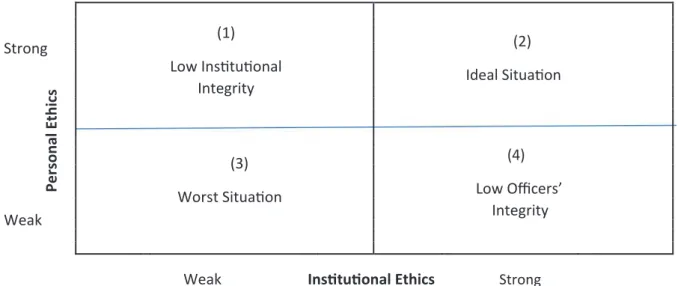
Theoretically, the situation of ethics in police organization can be diff erentiated into four possibilities, as depicted through diagram 1.
At quadrant 1, individuals have high personal
Strong
Personal Ethics
Weak
(1)
(2)
Integrity
(3) (4)
Integrity
Weak Strong
Diagram 1. Agent-Structure Encounter in Public Ethics
20 | Masyarakat Indonesia, Vol. 44 (2), Juni 2018 integrity, but lacking of strong institutional integrity, resulting in those individuals are forced to face obstacle or coalesce into deviant organizational norms. This situation resembles to what has been foreseen by organizational structure and culture approach. At quadrant 4, the institutional integrity is strong, but individuals there are lacking in personal integrity, and therefore striving to fi nd loopholes where they can break the rules. This situation is as described by the “rotten apple” theory, that the institution has basically built strong regulations, but are not observed by individuals, be it due to weaknesses in supervision or other possible causes. The worst situation is at quadrant 3, when individuals as well as institutional do not have strong ethical base altogether, hence making the improvement of police organization a very diffi cult task.
Conversely, the ideal situation is at quadrant 2, when both individuals and institution have the same strong ethical foundation to achieve high police integrity. This is the ideal condition that is to be achieved through ethical culture strengthening.
Bour dieu’s approach is basically a structuralism-genetic approach (Haryatmoko, 2016: 37). Analysis on objective structure of human behaviour in this approach can not be separated from analysis on the origins of mental structures in biological individuals, which are partially a product of unifi ed social structure and analysis on the origins of those social structures themselves. Therefore, the logics of human action according to habitus theory, can not one one hand be solely put back on the individuals, or on the othe other hand solely isolated on structure and culture; they instead are dialectics and combinations of the two aspects. In the case of social behaviours, habitus takes the role of
“opus operatum” and “modus operandi” at the same time; that points to the mode as well as the result of praxis itself (Bourdieu, 1977: 36).
As “structuring structure”, habitus encompasses the entire “schemes of perception, thought, feeling, evaluation, conversation, and action that structure all manifestations of expressive, verbal, and practical statements from a person” (Bourdieu, 1984: 82). In habitus,
there is doxa, the unquestionable basic and fundamental assumptions. Included in this case, the police doxa as a point of perspective towards Police as a profession with specifi c mission (Chan, 2004: 333). Apart from that, there are behavioural schemes absorbed by agents as part of their personality and practiced automatically (ilusio). In the context of cultural change, doxa and ilusio are the elements which can hardly be altered. However, individuals are not passively absorbing organizational and environmental infl uences which surround them.
As a “structured structure”, habitus refl ects behavioural formation which is conditioned by social structure, institutional organization system, and disposition of its members’ attitudes. In other words, individuals do have roles in forming social structure, through repetitive actions reproduction aligned with their strategy and interests in an arena. On this basis, behavioural change at individual level corresponds to habitus change at the organizational level. Here is where the concept of habitus helps to comprehend in more detailed way on how ethical culture strengthening can be carried out in an organization, including Police organization. The real situation in Police organization generally lies at quadrant 1 and quadrant 4, or at the mixture of both.
Public ethics approach off ers a solution through modality concept, by creating instruments of ethics in an organization, to abridge moral norms and factual actions (Haryatmoko, 2015:
6). The objective of this approach is to prevent norms from being merely normative guidance, but really materialized instead in actions.
Public ethics covers three main dimensions: (1) Objective, aimed towards public welfare through quality and relevant public service; (2) means or modality, the development of ethic infrastructure through creation of regulation, law, and rules to guarantee accountability, transparency, and neutrality of public service; and (3) actions, regarded as “public integrity” to guarantee that quality and relevant public service is carried out.
The objective-means-actions triangle is a unifi ed entity in building public ethics, where the three shall face hard challenges from confl ict of interests and ellite-cartel corruption (Haryatmoko, 2011).
Ahrie Sonta | Ethical Culture Strengthening Model ... | 21 SIDOARJO CITY RESORT POLICE:
A CHANGING POLICE UNIT
Police organization in Indonesia is a national police with fragmented yet unifi ed system (Dahniel, 2008: 14). It is regarded as fragmented, due to the fact that authority to carry out police functions have been dispersed through administrative deconcentration and decentralization, i.e. to regional levels police units paralleled with autonomous local governments. Hierarchically, Indonesia recognizes Polda as police structure at regional/provincial level, Polresta as subregional police structure at city district or municipal level which is at the same level with Polres as subregional police structure at district/regency level , and Sectoral Police (Kepolisian Sektor abbreviated as Polsek) as police structure at sub- regency/sub-district/precinct level. Inline with the focus of local autonomy at the municipal/
regency level, the units which are regarded as the most strategic within the Indonesian Police structure are then Polres and Polresta units, which are called as Basic Police Units (Satuan Dasar Kepolisian, abbreviated as SDK).
Polres/Polresta are expected to be spearhead of police services and functions in Indonesia.
The same pattern can be seen as well in several countries, for example the District Police in the United States, Sub Division Police in the United Kingdom, Police Stations in Japan, and District Politie in the Netherlands which are all functioning as the forefront of police public service. Bayley (1998) explained that Basic Police Unit is the unit closest to the public which serve nearly all essential police functions and services, and in Indonesia, these units are the Polres/Polresta.
Sidoarjo Polresta is currently supported by 1.501 personnel, with 1.401 of which are police offi cers, and the rest 100 personnel are civil servants. Nearly half of the numbers (640 police offi cers and 62 civil servants), which account for 46.76% of total Sidoarjo Polresta personnel, are stationed at the Polresta Head Quarter, while the remaining 761 police offi cers and 38 civil servants, which account for 53.32% personnel, are stationed at Polsek levels. Exactly match with the number of sub-districts in Sidoarjo Municipality, the Sidoarjo Polresta commands 18 Polsek units
which comprises of 10 urban Polsek, and 8 rural Polsek. Nevertheless, when compared to the 2.126.052 population of Sidoarjo, the police- people ratio is 1:1416, or 87 police for every 100.0000 people, a quantitatively clear disparity between the number of police offi cers and the number of public which need to be served. The increased status of Sidoarjo Polres to Polresta in 2016 was among other aimed to reduce the disparity through incremental increase in the number of police offi cers serving in Sidoarjo.
Related to ethical culture, breach of disciplinary and ethical code among police offi cers in Sidoarjo Polresta shows statistically similar tendency compared to other Polres/
Polresta in Indonesia; year on year hikes and slumps without any certain predictable pattern (see for instance, Ramadhan, 2015; Iriady, 2013;
Tahir, Karim, and Sampurno, 2013). Throughout 2012-2015 period, Sidoarjo Polresta managed to unveil 65 breach of discipline cases, involving 122 personnel. Apart from that, recorded as well 14 trials on breach of police professional code of ethics, with three of which fell within severe/
gross violation category that should be dealt with penal code. Two of the three severe violation cases have resulted in discharging of the involved personnel (SPPP), while personnel involved in the other case was not discharged from service with consideration that the involved personnel was sentenced with 3 months imprisonment as probation period.
Nothwithstanding the fact, it is worth noting that the offi cial data on breach of disciplinary and ethical code does not cover unveiled/unsettled indications of breaches possibly commited by the rest of Sidoarjo Polresta members. As stated by Bayley (2002: 134), “Although the public is most concerned about dramatic infringements of the rule-of-law, such as brutality, planting false evidence, and lying in courts most of the liberties taken by police are more mundane, routinized, and diffi cult to detect.” This, however, should be understood as agent’s strategy to familiarize the police arena, and manipulate the rule of the game to avoid punishments and sanctions. Observations in the fi eld have shown various forms of unveiled violations and breaches, that will be explained further in the next part of this research.
22 | Masyarakat Indonesia, Vol. 44 (2), Juni 2018
PARAMILITARY CULTURE:
THE ENDURING OLD DOXA OF THE POLICE
Infl uence of paramilitary culture as a yardstick for police doxa in Indonesia took shape during the New Order era when Police was still under the same roof of ABRI (Armed Forces of the Republic of Indonesia) with the military, and the remains are still found in this research. Reforms toward a better course has been done since the separation of Police from ABRI, for example through the 3-S slogan; Smile, Salute,“Salam”
(The Indonesian word for greeting), to put forward a friendlier face of the police before public. Nevertheless, ruins of paramilitary behaviours still exist among others in the form of violent behaviours in handling mass rally and suspects during interrogation process, as well as misuse of fi re arms, extortion, and many others.
These forms of paramilitary ruins are found in the breach of discipline records collected by the Police Provost Section in Sidoarjo Polresta from 2012 to 2015.
A traffic police officer who joined the police in 1983/84 and spent most of his career as crime intelligence offi cer raised an example of such paramilitary behaviours during suspect interrogation process in the past, which was full of violence and pressures to have suspect/s sign the interrogation report form, despite the lack of evidence.
“In the past, various methods were carried, [untill the suspect/s profess/es that he/she committed crime] for he/she could not stand the pressure.
Now it is not allowed, interrogation is a heart to heart process. Everything should be directed with evidence. In the past, we would be angry when interrogation did not go as we want. Now everything has to be based on evidence. Now no one may go beyond what has been stipulated” (SP Interview, March 10, 2017).
Police violent behaviours towards public still remain as well within police’s point of view as crime-fi ghter, identically related to physical and verbal violence. Police Reform however has pledged for a new doxa: civic (minded) police to serve the public. The Police strives to change
the symbols closely related to military world, for example by changing its rank nomenclature, its organizational structure, and by improving its education system. Police education system nowadays have reduced its military style education, and put more emphasize on police professional and functional education. Soldier style physical and discipline trainings are now gradually replaced with education pattern that gives more space for critical thinking and decision making capacity to handle various operational problems in the society.
Nonetheless, this old doxa is a die-hard matter in reality. Some offi cers who experienced military style education and trainings in the past, half-heartedly accept the new educational system.
Revealed in this research’s interview, they consider the junior offi cers resulting from this new educational system as not as good as those who went through the military style education in the past. Most of them are complaining about the lack of discipline, respect, hierarchical awareness, and strictness towards public from the junior offi cers. Some of them even suggested to have the old educational system back.
The earlier mentioned facts, bring up suggestion that in the case of Sidoarjo Polresta as well as other Polres/Polresta, fundamental changes from paramilitary doxa to civic-minded police are still needed. Prevention measures are particularly needed against attempts from military educated police offi cers to re-implant violent behaviours on their junior or sub-ordinate offi cers under the cover of disciplinary strengthening, hierarchical respect, and/or strictness as police offi cer. A bold boundary between strictness and violence need to be drawn even clearer than ever. As researched by Yildiz (2001) on police organization in Turkey, police violence is culturally implanted within its operational code spread allover factions of offi cers, allowing violence in certain situations, regarded as logical behaviour, understandable, or at least forgiven. Violent acts in suspect interrogation, or even brutal acts in handling mass rally, were raised as examples in this research.
According to Jenks, Jhonson, and Matthews, (2012: 7), there are three types of violence possibly committed by police offi cers in its
Ahrie Sonta | Ethical Culture Strengthening Model ... | 23 relation with public, i.e.: physical violence (to
include ranges of excessive physical measures up to brutal acts),psychol ogical violence (including harrasment), and legal abuse against the rights of citizen/s. This problem gets more complicated as some of these violent behaviours are not carried under certain (personal) benefi t, but are regarded as for the sake of the public where law bending or even breaking is considered necessary to fi ght crimes. Martinelli (2006) labels this kind of behaviour as “noble cause” which is too often used to legitimate such act.
Other facts revealed from this research interview were the motivations behind these violent acts. A faction of police offi cers were those who failed in military recruitment test and put the police as their next option. Another faction consists of offi cers joined the police for they had experience of violence in the society, and intend to utilize the police status to avenge and cover up the trauma. These military and violence related motives are the ones which makes police offi cers more receptive towards various violent behaviour patterns, be they absorbed through education or socialization in their duty as police.
Being a Police as Social Mobility Vehicle Majority of personnel at Polres/Polresta level are of low rank offi cers, i.e. brigadier and agent rank offi cers which in Sidoarjo Polresta consist of 562 personnel that account to 87,8% of the total personnel. These brigadier and agent rank offi cers have various motivations behind their profession as police. However, a signifi cant portion of these brigadier and agent rank offi cers perceive the police profession as having a plus value, as a settled and well respected profession before the public, even when compared to civil servants, private employees, or entrepreneurs who tend to receive better remuneration. All of these perceptions contribute to “applicants fl ooding” whenever vacancy for brigadier and agent rank offi cers is announced, and some of those applicants even prepared signifi cant amount of money to lubricate the tight selection process.
Throughout interview phase in this research, it was revealed that getting a settled job was
the most prevalent motive of being a police, especially for brigadier level. Nonetheless, there are some variations in this “settled job” motive.
First, being a police was their last resort after failing to get the job/s they want. Some of the interviewed police offi cers in this research stated they initially did not want to be policeman. Some of them wanted to be teacher, soldier, aircraft mechanics, etc. Only after they could not be any of the aforementioned profession whatever the causes were, they applied to the Police. Second, the motivation of being a police is also infl uenced by people in their surroundings. Having family member/s or friend/s in school who already joined the police. Third, being a police is a socio- economic boost for family status. A brigadier serving as traffi c police stated he joined the police to ease his parents economic burden. A detective at the drugs unit stated he wanted to have a better life for his parents were only peasants, and he really hopes that one of his children will follow his path to be a police.
Short discussion in previous paragraphs have described on one hand how the society views the profession of police; and on the other hand show certain expectations underlying people’s motivations to choose this profession.
The implication, particularly on the ethical culture, is emergence of agent/s to align himself to the institutional settings within the police organization, to mention as well, the deviant practices. For the remuneration is relatively lower, these offi cers need to strive for extras (income), forcing them to compromize money making practices, despite being deviant or even illegal.
In other words, police offi cers tend to open their arms for corrptive practices, although not entirely can be regarded as overt corruption. A staff offi cer stated that every month he receives from his commandant what he calls as “incentives”, amounting nearly half of his offi cial sallary. In return for the incentives, he has to ensure loyalty to his commandant.
Loyalty to commandants can be defi ned in two ways. First, sub-ordinate has to be observant and ready to carry out whatever the commandant orders, even beyond the offi cial job description (Interview CS, March 13, 2017). The orders
24 | Masyarakat Indonesia, Vol. 44 (2), Juni 2018 often came out of plan, and too often resulting from commandant’s spontaneous ide, that is to say out of the blue. It can be an order to escort commandant ouside offi ce, delivering stuff s, and buying things wanted by the commandant. All these orders make him and his fellow offi cers suff er from rest defi ciency, for all of them need to promptly respond anaytime in the day from morning to afternoon, till late in the evening, whenever their commandant gives order.
Second, this relation of loyalty is actually personal in nature between superiors and subordinates. The transactional side of this relation is never brought up openly to surface, and even no specifi c rules on how much is this incentive should be, and how the commandant’s should give this to his subordinate/s. Based on the interview, the amount of this incentive diff ers nominally from one subordinate to another, and it even diff ers from one function (division) to another. Hence, this loyalty relation can be seen as patron-client relation, a relation personally built by two parties. And such patron-client relations, with its transactionally corruptive facts, become fertile medium for the development of deviant practices in the Police which will surely hinder the development of transparent, accountable, and neutral public service.
Riding on Police Discretion
Then a question shall be addressed on how the commandant can fund the monthly incentives for his sub-ordinates. Police sallary is based on rank combined with service duration, called as incremental sallary increase system, ranging from only 3% to 5% annually. Thus, offi cers of the same rank, with slight diff erence in service duration, will have nearly the same amount of sallary. But, a brigadier who have served for 32 years can earn more than a commissioner adjutant who have only served for ten years. The question again is, how the commandant can fund the monthly incentives for his sub-ordinates.
The answer lies in what is called as police discretion, and integral aspect of police profession habitus. The loyalty relation explained earlier have described how deviant practices have been
dispersed, absorbed, and socialized to eventually become habitus for junior offi cers. This is not an instant process, it took years instead throughout the duty as a police, to understand the nitty-gritty of these deviant practices within an offi cer’s scope of duty. Theoretically, it can explain how a police offi cer gain the opportunity to commit corruption, through a simple mathematical formula by Klitgaard (1998), which defi nes C = P + D – A;
where, C = corruption, P = power, D = discretion, and A = accountability. Corruption emerges from provision of certain authority (power) added with an opportunity to subjectively interpret rules of law (discretion), minus control and supervision (accountability).
Discretion is not a police specifi c matter, it does in fact apply to any government and bureaucratic institution. Existence of authority and space for subjective interpretation at the same time, will in turn generate opportunities for personal or group own benefi t/s. In the case of police organization, police discretion can be explained as follows: police discretion maybe defi ned as the capacity of police offi cers to select from among a number of legal and illegal courses of action or inaction while performing their duties (Bailey (ed), 1995: 206). Thus it is clear that police discretion capacitates to carry out both legal and illegal measures in handling or halting cases, up to release and discharge.
Various types and modes of operation of the “deviant discretion” within Polres/Polresta level have been collected by Dwilaksana (2001), particulary at the traffi c incidents unit.
T hrough an interview with FT, a businessman from Sidoarjo, a further explanation of this
“deviant discretion” was revealed. According to his (FT) experience, any case related to business permits, waste, up to software copyright infringment can be source of income for deviant offi cers. He once had a café selling alcoholic drinks, and for this he had to provide some amount of “incentives” to be distributed monthly to diff erent police units.
“Each month we gave the detectives, intelligence, sabhara (alert unit), drugs unit, and municipal police at district government. Sabhara is in charge for minor penal off ences, to handle alcohol related