Introduction
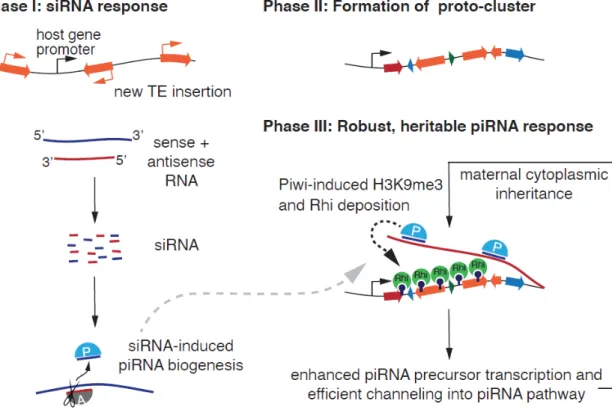
Maternally inherited siRNAs initiate piRNA cluster formation
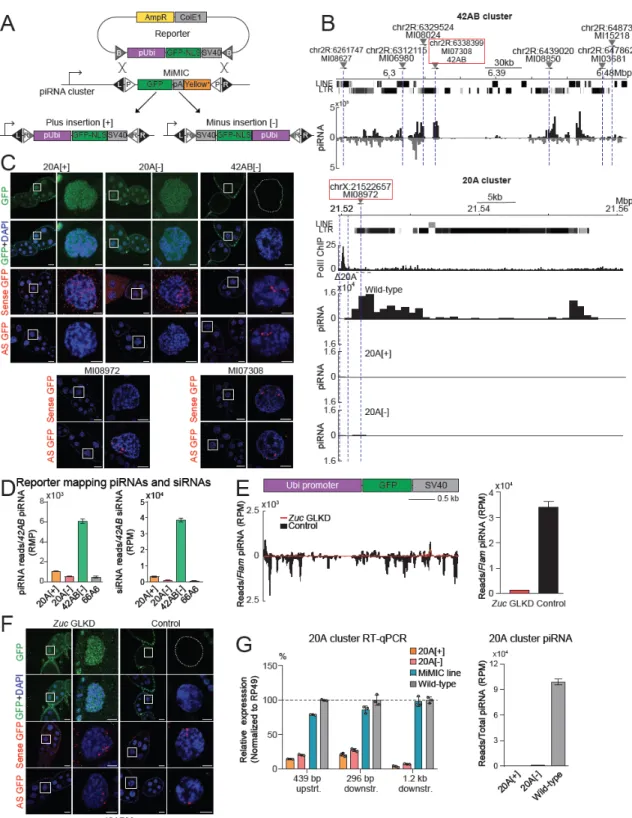
An unusual reporter behaves like a bona fide dual-strand piRNA cluster
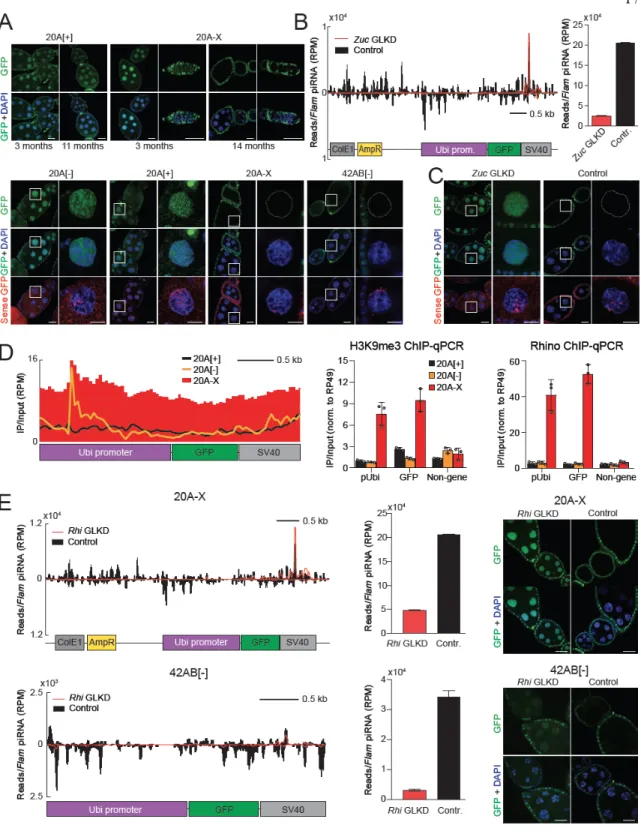
Unexpectedly, we found that one of the lines of insertion in the 20A cluster has distinct properties. The somatic GFP expression, which we also confirmed by detecting abundant cytoplasmic GFP mRNA in follicular cells by in situ hybridization, argues against genetic damage of . Thus, in contrast to other 20A insertion lines and similar to insertions in 42AB, 20A-X shows normal GFP expression in follicular cells and strong GFP suppression in the germline.
To test the involvement of piRNAs in the repression of the 20A-X reporter in the germline, we cloned and analyzed small RNA libraries from the ovaries of 20A-X flies. Zuc GLKD also led to the release of repression of the germline reporter as shown by the expression of GFP protein and the detection of sense RNA in the cytoplasm (Fig. 2.2C) indicating that, similar to the 42AB insertions, repression of 20A-X is piRNA-dependent. Double-stranded clusters, such as 42AB, are exclusively active in banding, and their transcription, nuclear processing, and export require the Rhino-Deadlock-Cutoff complex (RDC), which is.
In contrast, unistranded clusters, such as flamenco and 20A, do not depend on the RDC complex and the H3K9me3 mark and can be active in the soma. Shown are profiles of piRNAs mapped to the 20A-X reporter in control (white GLKD) and to Zuc GLKD driven by nos-GAL4. Note that although GFP protein is not expressed in control flies, sense RNA is present in the nucleus.
Zuc GLKD causes accumulation of RNA in the cytoplasm and leads to expression of GFP protein.
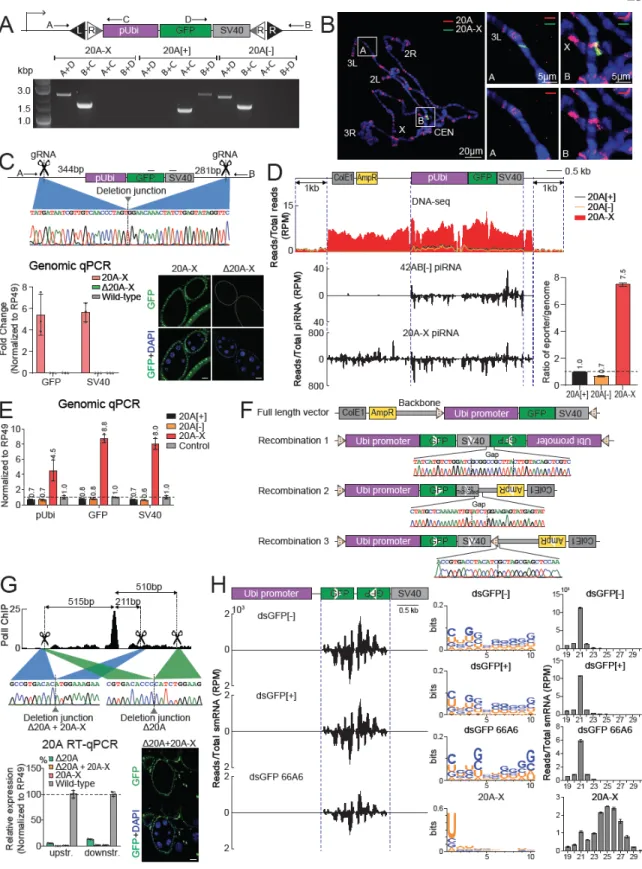
The repetitive organization of the 20A-X locus correlates with its
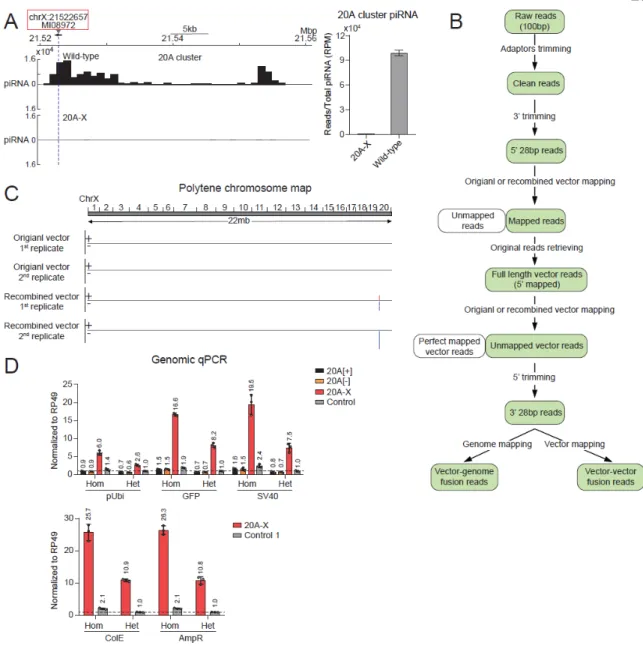
Taken together, our results indicate that the 20A-X line contains multiple, rearranged copies of the reporter sequence at a single site within the 20A cluster. To investigate whether the "host" 20A cluster is required for 20A-X to function as a double-stranded piRNA cluster, we used CRISPR/Cas9 to delete the 20A cluster promoter (Figure 2.3G). In wild-type flies, deletion of the putative promoter abolished the expression of a long RNA (piRNA precursor) from the 20A cluster, indicating that the deletion interferes with its function.
However, deletion of the 20A cluster promoter in 20A-X flies did not release reporter silencing (Fig. 2.3G), indicating that piRNA-dependent repression of the 20A-X locus does not require activity of the "host" 20A cluster. We obtained flies with insertion of the dsGFP reporter at the same site as other 20A reporters as well as in a control (non-piRNA cluster) region of the . Probes against the reporter detected two locations: one co-localizes with the 20A cluster signal on the X chromosome, the other signal is localized on chromosome 3L, where the native ubiquitin gene (Ubi-p63E) is found (chr3L dm6). C) Verification of the 20A-X insertion site by CRISPR deletion.
The region of the 20A cluster encompassing the reporter insertion site was deleted in the 20A-X line using CRISPR/Cas9. Different portions of the reporter sequence were measured by genomic qPCR in flies with 20A reporters as well as a control line in which the reporter was integrated into non-cluster region (chr 3L dm6). qPCR values were normalized to the rp49 gene region. The putative promoter of the 20A cluster (determined by a prominent Pol II ChIP-following peak) was deleted using CRISPR/Cas9 in wild-type and 20A-X flies.
-qPCR primers were positioned 2030 and 3769 bp downstream of the putative promoter (upstream and downstream of the reporter insert, respectively).
Thus, suppression of the 20A-X reporter in both the male and female germ lines requires maternal inheritance of the reporter. Next, we determined enrichment of the H3K9me3 mark and the Rhino protein on chromatin of the 20A-X reporter in the offspring following paternal or maternal inheritance of the locus. Loss of piRNA by paternal transmission thus correlates with loss of H3K9me3 and Rhino from the 20A-X locus.
Therefore, it is important to distinguish whether the parent-of-origin effects of 20A-X depend on inheritance of the genomic locus or cytoplasmic transmission of piRNAs to the next generation. To distinguish between these possibilities, we designed two different crosses: in both crosses the offspring inherited 20A-X paternally, but in one cross the mothers also carried a copy of the 20A-X locus, which, however, was not transmitted to the offspring. (Fig. 2.4E). The presence of the 20A-X locus in mothers caused GFP repression and piRNA generation in the offspring, even though the locus itself was not transmitted to the offspring.
Scheme of crosses to test effects of maternal and paternal transmission of 20A-X. Note that the genotype of the offspring of the two crosses is identical. Shown are GFP protein and sense and antisense GFP RNA expression in ovaries and GFP protein expression in testes of the offspring. H3K9me3 and Rhino levels decrease after paternal transmission to levels similar to those of the control region.
The only difference is cytoplasmic inheritance of small 20A-X-derived RNAs from their mothers, which is sufficient to restore both GFP repression and piRNA generation in the offspring germline.
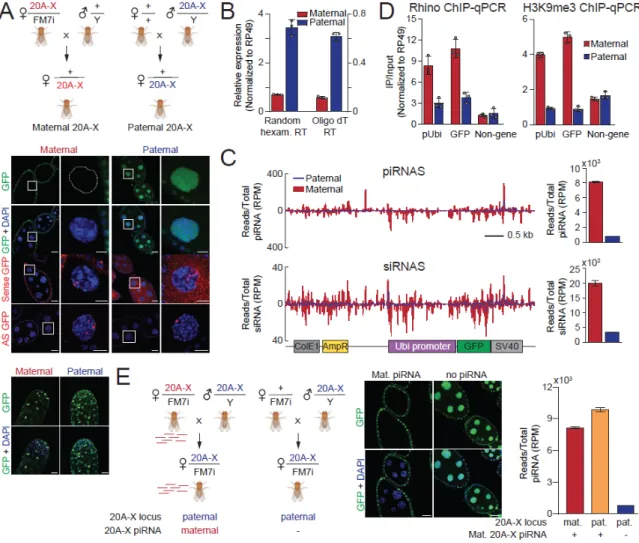
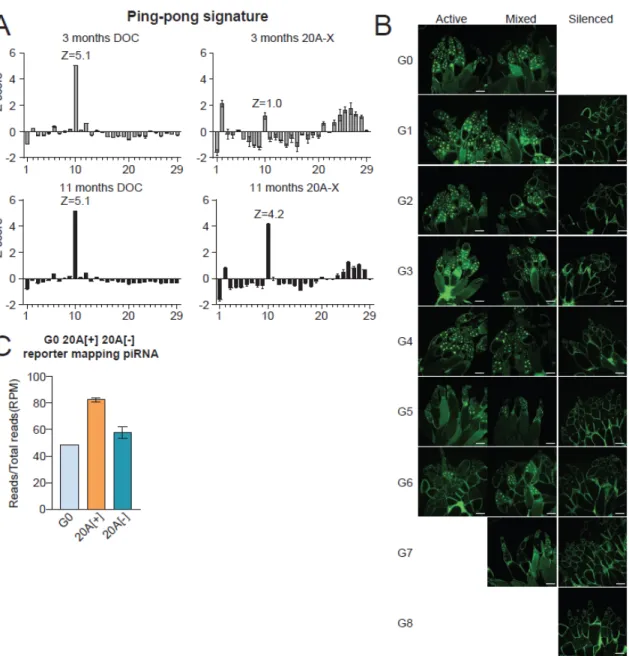
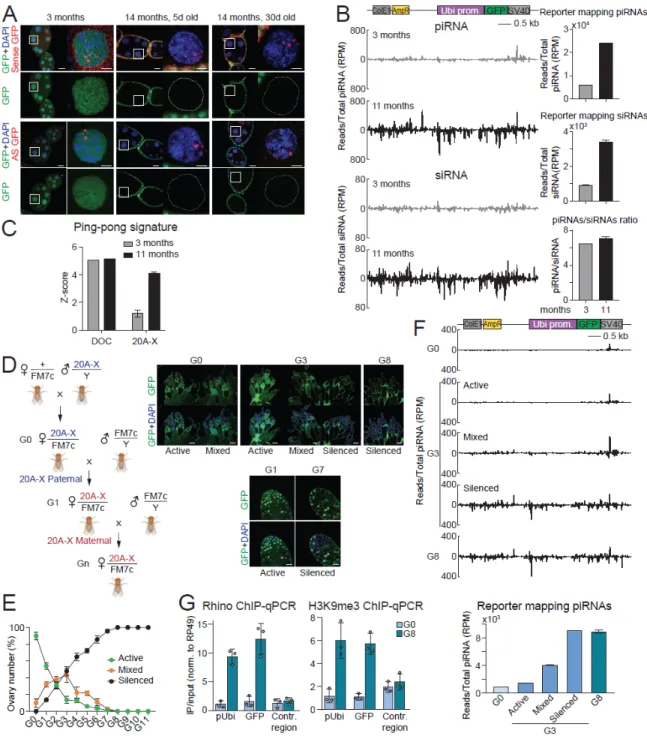
Shown are piRNA and siRNA profiles along the reporter sequence in ovaries of progeny from the two crosses shown in (A). Next, we analyzed small RNA profiles in ovaries of 20A-X flies 3, 11, and 21 months after establishment of the population. No further increase in abundance of 20A-X piRNAs and ping-pong treatment was observed when comparing 11- and 21-month-old stocks.
The loss of 20A-X's ability to generate piRNAs after paternal inheritance provides a unique opportunity to explore de novo establishment of a piRNA cluster. Interestingly, ovaries from flies of intermediate generations (G2-G5) showed great variation in the degree of repression between individual egg chambers (Fig. 2.5D, 2.5E, S2.5B). Finally, we determined the enrichment of H3K9me3 mark and Rhino protein on chromatin of the 20A-X reporter in ovaries of G0 and G8 progeny.
Shown are GFP protein and RNA expression in ovaries of 20A-X flies 3 and 14 months after establishment of this line by RMCE. The bar graph shows the levels of 20A-X piRNAs and siRNAs, normalized by the total number of piRNA and siRNA reads in each library. Shown are Z-scores indicating the ping-pong signature (10 nt distance between 5' ends of complementary piRNAs) of 20A-X piRNAs.
Rhino and H3K9me3 levels on chromatin were measured by ChIP-qPCR in ovaries of G0 and G8 generation using primers against the pUbi and GFP regions as well as a control, non-clustered region (chr 2L dm6) and normalized to rp49 - the locus.
Maternal siRNA triggers activation of piRNA cluster in the progeny 38
To further explore the role of siRNA, we abrogated the siRNA pathway either in the mothers or in the offspring using Ago2 mutation (Fig. 2.6C). GFP repression was strongly disrupted in the offspring of Ago2-deficient mothers, confirming that it requires trans-generational cytoplasmic transmission of siRNA (Fig. 2.6D). Taken together, these results indicate that initiation of 20A-X repression in the offspring requires trans-generational inheritance of cytoplasmic siRNAs, while the siRNA pathway is dispensable for maintenance of repression.
These abundant siRNAs were restricted to the GFP sequence that forms the inverted repeats in the dsGFP construct. This means that maternally contributed GFP siRNAs targeting part of the 20A-X locus were sufficient to induce piRNA generation from the entire 20A-X locus in the offspring. Maternal siRNA induced 20A-X repression in the offspring independently of the inheritance of the siRNA-generating locus or the genomic position of the siRNA-generating locus.
Analysis of GFP expression in progeny of crosses shown in (C). E) Cytoplasmic inheritance of siRNAs activates piRNA production in the progeny. These inherited piRNAs direct deposition of the RDC chromatin complex onto clusters, which is required for efficient piRNA expression in the progeny. Indeed, cytoplasmically-inherited siRNAs are sufficient to activate piRNA biogenesis in the progeny, while the zygotic siRNA pathway is completely dispensable for this process (Fig. 2.6).
On the other hand, increase in the level of antisense transcripts was suggested to be associated with spontaneous activation of BX2 (Casier et al., 2019), suggesting a general role of antisense.
Genomic requirements for piRNA cluster function
Specifically, the expanded repeat organization may be required for maintenance of the RDC complex chromatin compartment, which is essential for transcription and post-transcriptional processing of piRNA precursors (Andersen et al., 2017; Chen et al., 2016; ElMaghraby et al., 2019 ; Hur et al., 2016; Klattenhoff et al., 2009; Mohn et al., 2014; Zhang et al., 2014). Rhi is a paralog of HP1 that forms 'classical' heterochromatin domains that depend on cooperative interactions between multiple HP1 molecules and associated proteins (through interactions between HP1 dimers bound to adjacent nucleosomes) (Le Thomas et al., 2014b; Yu et al., 2015a; Yu et al., 2018). Similar to HP1, Rhi is capable of self-interactions through its chromo- and chromo-shadow domains, and these interactions are required for the formation of RDC complex compartments and the function of piRNA clusters (Le Thomas et al. , 2014b; Yu et al., 2015a).
All ChIP experiments were performed based on previous description (Chen et al., 2016) with some modifications. Polytene chromosomes DNA FISH was performed as previously described (Cai et al., 2010; Lavrov et al., 2004) with the following modifications. Once the mitochondrial reads were removed, aligned reads were then used to generate stacked RPM signals and enrichment profiles by our custom scripts and deepTools (Ramirez et al., 2016).
Read counts over bins of equal size were calculated using deepTools2 and BEDOPS (Neph et al., 2012), and figures were made using Matlab. To map the fusion read, the first 20 nt and the full length of the reads were mapped to vector sequences using the aforementioned bow tie settings. Paramutation in Drosophila Requires Nuclear and Cytoplasmic Actors of the PiRNA Pathway and Induces Cis-Spreading of PiRNA Production.
Splicing-independent loading of TREX on nascent RNA is required for efficient expression of double-stranded piRNA clusters in Drosophila. The rhino deadlock cutoff complex licenses noncanonical transcription of double-stranded piRNA clusters in Drosophila. The recruitment of Armitage and Yb to a transcript triggers its phasic processing into primary piRNAs in the Drosophila ovaries.
Materials and methods