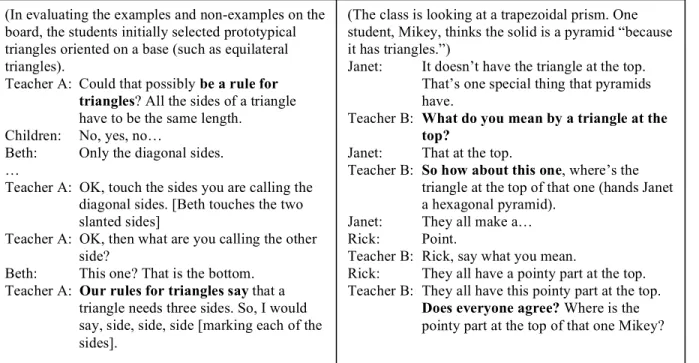
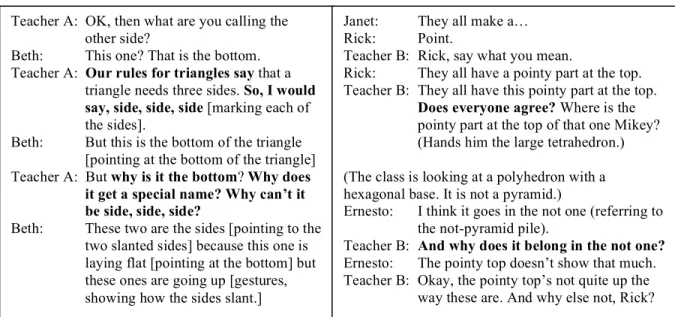
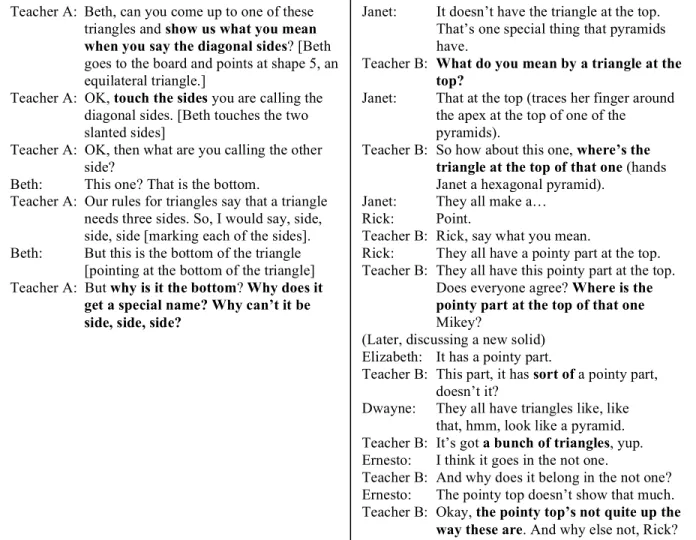
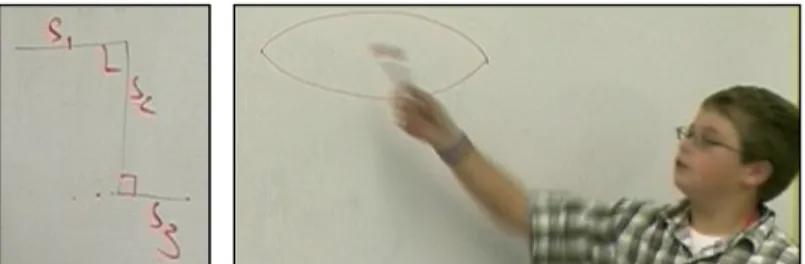
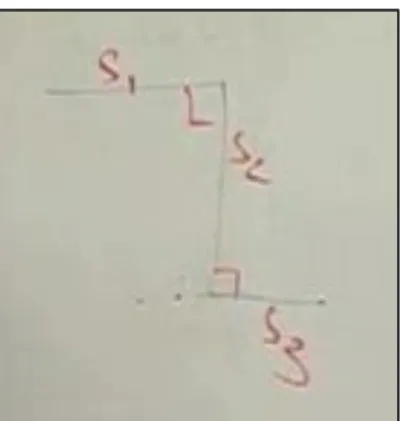
First, as illustrated in the previous section, the activities provided students with opportunities to engage in aspects of the practice of defining. But this is the bottom of the triangle [points to the bottom of the triangle]. Beth: But this is the bottom of the triangle [points to the bottom of the triangle].
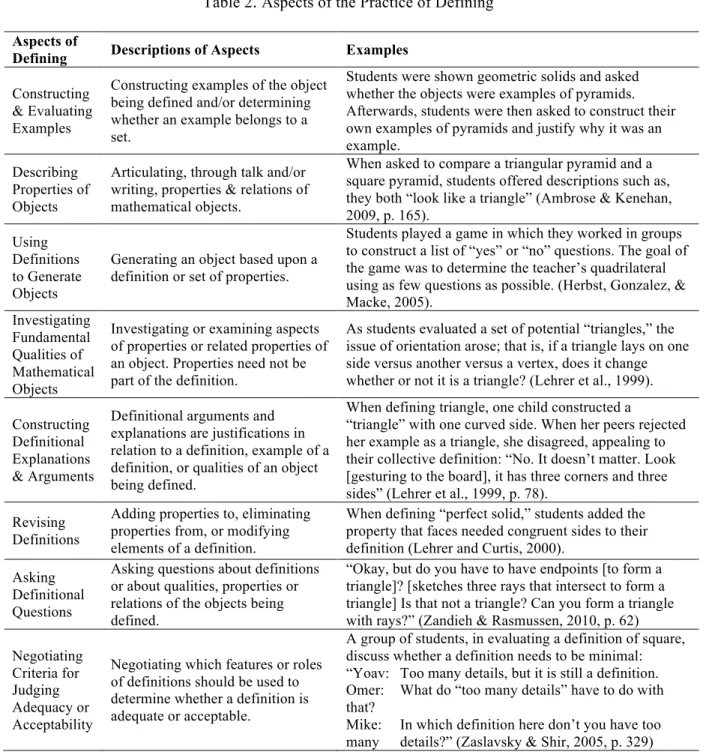
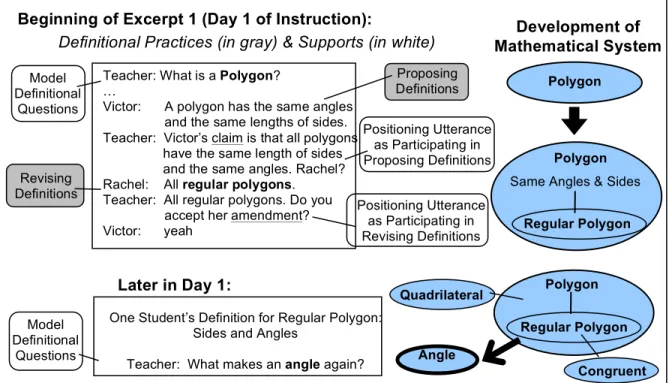
A mathematical definition is a description of the properties of a mathematical object (such as a geometric shape) and the relationships between those properties (Polya, 1957). That is, when a new object was introduced, the teacher asked the students for the definition of the new object. Initially, as mentioned above, the teacher modeled the asking of definitional questions that supported the development of the mathematical system.
Each of these examples therefore illustrates the role of the teacher in supporting student participation. In the process, I found that seven of the initial 11 aspects of definitional practice are common and describable at the level of talk. In the following sections, I describe each of the eight categories that make up my coding scheme for Involvement in Aspects of Definitional Practice.
In this example, the teacher asks students to participate in following the definition.]. At the same time, by participating in this and similar aspects of the practice, the teacher supported the students' participation in aspects of the determination practice.
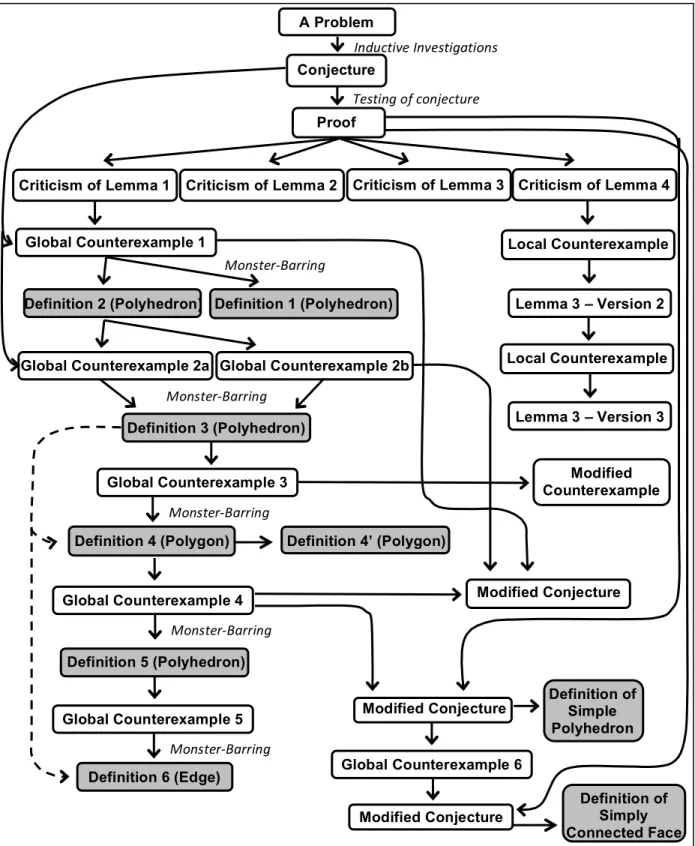
Initial Forms of Practice and Knowledge
In this example, the teacher asked a definition question about the properties that made up the object, leading to the development of system components. Although in this case the student provided the rebuttal voluntarily, the teacher sometimes encouraged students to do so (e.g., “Does anyone have a counterargument?”). After hearing her classmates suggest relationships, one student, Lavona, proposed a new definition: "I think all shapes are polygons except... a quadrilateral." Once the teacher.
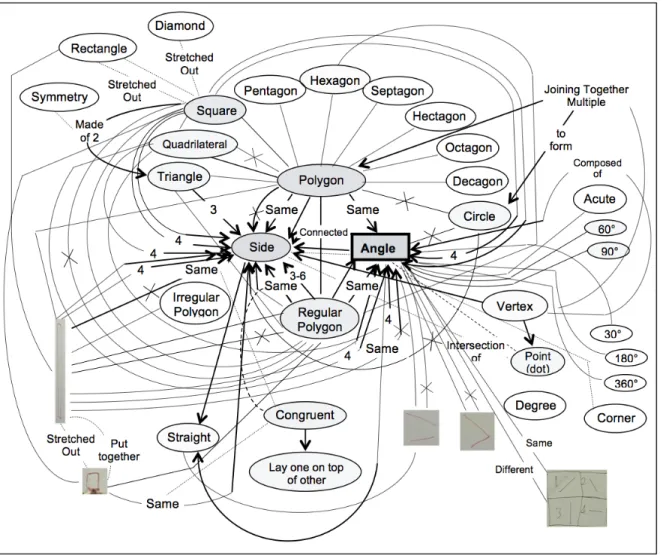
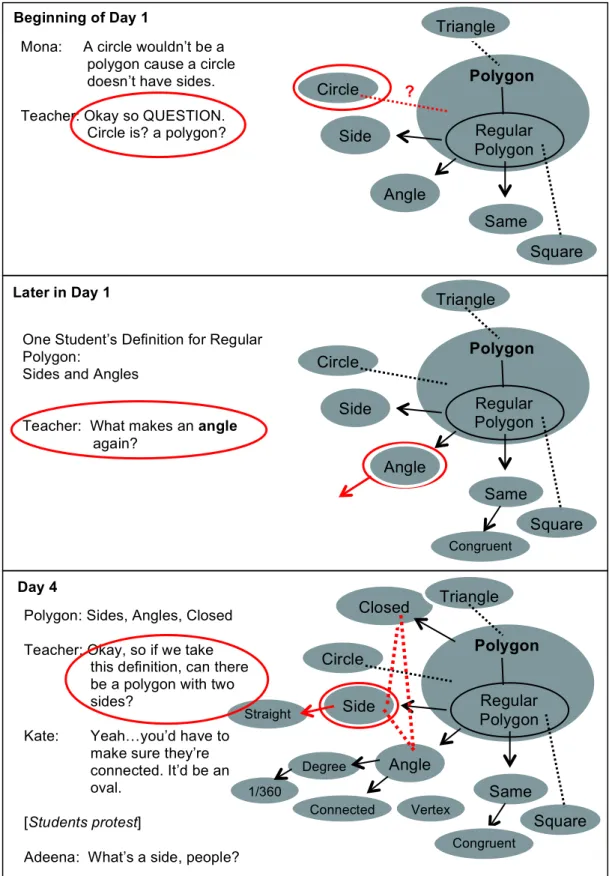
As he did so, he noted that he was writing "so I can keep track." The teacher then once again took the opportunity to request that students suggest definitions in a way that, similar to his previous question, served to expand on system. Rather than accepting the girls' suggestion, the teacher dismissed their comment as a question, thus positioning their contribution as participating in the Aspect of Practice to ask definitional questions: "Ok, so QUESTION. The teacher then added ' asked a definition question to request that students participate in the Practice Aspect of the construction of a.
The teacher calmed the students down and brought the discussion back to their original goal of understanding what makes something a polygon. To consider regularity, students considered whether a square and rectangle drawn by the teacher were regular and why. After they had established that regular was defined as "same sides" and "same angles," the teacher prompted the students to remember another word for "same" that they had learned last year.
Throughout the class period, the teacher continued to encourage this agreed term whenever they returned to the definition of regular. Many of the definitional questions posed or reproduced by the teacher investigated the properties that make up an object or specific class relationships. Within the first class period, the teacher asked or articulated such questions about "polygon", "quadrilateral", "circle".
The teacher often further emphasized the importance of new objects by writing the names of the objects on the board, emphasizing agreed terms.
Students Take on Authority for Expanding the Mathematical System
The teacher then opened the floor for other contributions: "Okay then:: Is that it? The teacher then rejected Kate's suggestion and repeated "regular" several times, as if to emphasize its importance. Another student, Jomerd, then called out two different contributions which the teacher again called out as questions.
Jomerd proposed an alternative definition that "nothing is equal, like angles are not equal, sides are not equal." Before the class could expand on the concept of irregularity, Lavona asked a definitional question similar to the teacher's questions. She asked "why is it regular?" Her question indicates that she was beginning to understand the range of questions the teacher was asking. Finally, one student, Owen, stated that "CO::n should be connected." The teacher added this revision to their definition on the board and then suggested alternative language they could use to express the same idea: “sometimes we say it's closed.
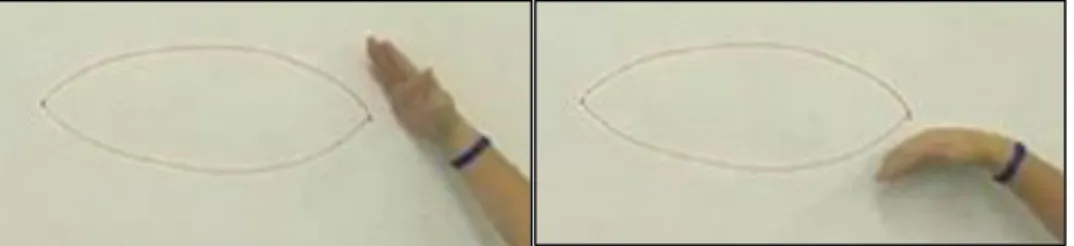
In this, Kate's definitional argument was similar to the teacher's in justifying the validity of his zigzag example. Another student pointed to an oval to illustrate what she thought Kate meant, and the teacher drew her explanation on the board so that it was accessible to others in the class (see Figure 5). What's the page, folks?” This definitional question was similar to the teacher's modeling in that it asked about the properties of the object and served as an explanation.
When they reached an impasse, the teacher remarked, “But I don't yet know what I mean by next.” The teacher continued to help the class make connections between practice and knowledge by asking definitional questions that elaborated on system components and modeling participation in that kind of practice.The students, in turn, began to acquire the teacher's traits by asking similar questions and thus also got in touch with knowledge development.
During the first day and the beginning of the fourth day, the teacher's questions motivated the introduction of new ideas and characteristics.
Student Positioning of Definition at the Fore
At the beginning of the sixth day of teaching, the teacher returned again to the question of defining polygon. The teacher opened again by asking the definition question of "what is a polygon?" This time, however, they did. His appeal to the definition resembled how the teacher had earlier modeled this aspect of practice.
Ned's soccer construction was also similar to the teacher's previous constructions in that it contrasted with what the students thought the training ground looked like. The teacher then pointed out that the point of difference in Kate's and Ned's thinking was what they considered "the side." The teacher pointed out that what Ned drew could be considered consistent if the sides were folded over.
The teacher pointed out that they were talking about two-dimensional objects and suggested that they add that property to their definition. In this continuation of the excerpt, the teacher turned his attention back to the original question of whether "closed" and "sides" guaranteed "corners." He asked one student, Shaunee, to reason about the relationship, first encouraging her to talk about their definition of "polygon." When things say things can't come out...like a back door.” The teacher added: “sometimes we call this the interior, the inside and the outside, the outside.
Whereas before, the teacher's examples had been primarily a source of contestation and revision of definitions, here, student-constructed examples motivated reexamination of the ideas they had explored. Furthermore, Kate and Ned's contributions illustrated an awareness of the importance of keeping definition at the fore, something the teacher had consistently modeled and emphasized through meta-talk and writing. When one group claimed that their instructions were easy to follow, the teacher followed their instructions in some way.
In this way, the knowledge the class developed informed the teacher's next move in teaching.
Student Agents in Orchestrating Defining
After the students had worked in their table groups, the teacher asked each group to write their definition on the board. The teacher started by reading the definition of Kate, Mona and Adeena: “three sides, only three corners and it is closed.” Several students raised their hands and the teacher called out Vern who suggested “straight sides.”
In that case, Kate had been the student who suggested that their definition of "polygon" should include "straight," and the teacher had then noted that once they determined that a "side" meant "straight," they no longer needed. to specify this. The teacher then asked for the definition of straight, “so we're all on the same page.” They returned to Kate, Mona and Adeena's definition of 'triangle' and the teacher asked if there was 'anything this doesn't cover?' Kira noted that it had not taken into account that the angles of rotation are 360 degrees.
They then moved on to the next definition: "three sides, three angles, can be regular or irregular polygons, and it is closed." The teacher once again asked a definition question to push the students to think about the economic relations: “do they need to say closed if they say. When they arrived at Diego's definition, "three straight lines and must be connected," the teacher remarked, "NOW, that's a really sparse definition. What do you think?" A student agreed, "yes" and Diego followed by arguing, "but doesn't it come with angles?" The teacher observed “as soon as Diego says, three pages and.
One group included that triangles have "three points," and when the teacher asked them for another word "we've been using," the class chanted, "vertex." In contrast, on Day 1, the teacher had to remind students of their goal to create a definition of "polygon" and later "regular." When asked to define polygon, students listed many examples of polygons (eg "octagon", "quadrilateral"), but without directly contributing to the creation of a definition. Here, a few students seem to have taken on the role of the teacher in orchestrating discussions.
In the interaction between the boys, Diyari, taking on the role the teacher had previously modeled, prompting Cordell to revise his definition.