We hope that this book will assist health care providers in managing infectious diseases and selecting appropriate antimicrobial therapy in a timely manner. This book is not intended to serve as a comprehensive overview of all infectious disease topics.
5 mg/kg every 24 hours 5 mg/kg every 24 hours; on dialysis days after HD administer Varicella-zoster virus (immunocompromised patients). Dose according to ClCr <10; on dialysis days, schedule dose after HD; adjust based on serum levels of PCP or Nocardia sp (IV) 15-20 mg/kg/24h tmp component in 3-4 divided doses.

MedicationaCRRT empiric dosingb,c,d
Maintenance dose: 15-20 mg/kg based on actual body weight for most patients (adjusted weight may be appropriate for very obese patients). ClCr, ml/min. Vancomycin Dosing Interval ≥65 q12h (q8h may be needed in younger patients with good renal function) 35-64 q24h (for severe infections consider q12h starting dose for ClCr>50a and adjust based on levels) 21-34 Approximately q48h (in severe infections infections consider starting dose q24ha and adjust based on levels) ≤20 Re-dose based on HD serum levels Give 25 mg/kg and monitor serum levels to determine when to re-dose (see Intermittent Hemodialysis Patients) . Dosing of antimicrobials Patients receiving CRRT • Loading dose: A starting dose of 25 mg/kg actual body weight can be used.
An empiric dosage of approximately 15-25 mg/kg every 24-48 hours is reasonable initially, and serum levels can be used for adjustments. Dose for gentamicin and tobramycin, mg/kg (see Table 14 for frequency) Desired concentration of amikacin, mcg/mL.
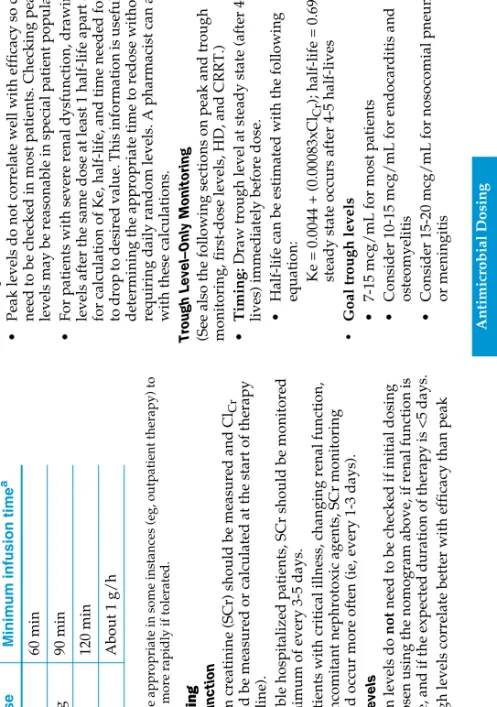
Dose for gentamicin and tobramycin, mg/kg (see Table 14 for frequency)Desired amikacin concentration, mcg/mL
Pediatric Antibacterial Dosing Guidelines Antimicrobial Usual Daily DoseMaximum Daily Dose Dose Adjustment for Renal Impairment ClCr >50 ml/minClCr >50 ml/minClCr 10-49 ml/minClCr <10 ml/minClCr <10 ml/min or anuric levels divided q2 mg/h/min q2 mg/h/h2 h2h/mg. (see recommendations in Table 21 and Table 22). 100 mg/24 hours 200 mg/dose Unchanged Information needed but insufficient available to recommend daptomycin Little or no information on dosing in children; consult a pediatric infectious disease specialist dicloxacillin 25-50 mg/kg/24 hr divided q6 hr Bone or joint infection: 100 mg/kg/24 hr divided q6 hr 2 g/24 hr Unchanged Doxycycline unchanged IV or oral (children > 7 years): 2-4 mg/kg 24h divided every 12-24h. 2 g/24 hours erythromycin 10 mg/kg/dose erythromycin q8-12h10 mg/kg/dose erythromycin q12-24 hours gemifloxacin There is little or no information on dosing in children; consult a pediatric infectious disease specialist Gentamicin 5-7.5 mg/kg/24 h divided q8 h CF: 7.5-10 mg/kg/24 h divided q8 h in some children May be considered a single daily dose in some children; monitor serum levels (see Table 21 and Table 22).
600 mg/24h Unchanged 2.5-10 mg/kg/dose q12- 24h (gives 50% of usual daily dose) telithromycin Little or no information exists on dosing in children; consult a pediatric infectious disease specialist. Antimicrobial Dosage vancomycinIV: 40 mg/kg/24h divided q6h CNS infection: 60 mg/kg/ 24h divided q6h; monitor serum levels (see Table 23 and Table 24) Oral: C difficile-associated diarrhea (metronidazole is drug of first choice): 40 mg/kg/24 hours divided every 6 hours.

Antimicrobial Dosing Table 19. Pediatric Antimycobacterial Dosing Guidelines Antimycobacterial agents
Antimycobacterial agents Usual daily dose Maximum daily dose Dose adjustment for renal impairment ClCr >50 ml/min ClCr >50 ml/min ClCr 10-49 ml/min ClCr <10 ml/min or anuria. 5 mg/kg/dose (or 250 mg/m2/dose) q24h HSV encephalitis (neonate): Consult a pediatric infectious disease specialist; 60 mg/kg/24h divided into 8 hours. Antiviral drugs Usual daily dose Maximum daily dose Dose adjustment for renal impairment ClCr >50 ml/min ClCr >50 ml/min ClCr 10-49 ml/min ClCr <10 ml/min or anuria.
Antimicrobial dosing of cidofovir is accompanied by concomitant oral probenecid and IV normal saline (0.9 normal saline) hydration Adenovirus: 1 mg/kg/dose 3 x/week CMV induction: 5 mg/kg/dose once Maintenance: 3 mg/kg/ dose 1x/ wk If SCr increases by 0.3-0.4 mg/dL above baseline, reduce cidofovir dose by 40%; discontinue treatment due to increase in SCr ≥0.5 mg/dl above baseline or development of ≥3+ proteinuria. No information available ribavirin See product labeling valacyclovir Little or no information on dosing in children (adolescents only): Genital HSV: 1,000 mg q12h (7-10 days) Recurrent genital HSV: 500 mg q12h Genital HSV suppression mg q24h.
Disease stategentamicin or tobramycin NF (mg/kg/dose)
Maintenance Dosing of Aminoglycosides a Individualization of dosage and dosing interval is crucial because of the narrow therapeutic index. Vancomycin Maintenance Dosing a The same total daily dose can be administered to older children and adolescents with normal renal function at q8h or q12h intervals. Recommendations for measuring vancomycin serum levels • Measure vancomycin serum concentrations (trough) in cases of 1) unstable or altered renal function 2) administration of other nephrotoxic drugs 3) positive blood cultures or other cultures • Measure vancomycin serum concentrations (peak and trough) in cases of 1) meningitis infection (to document penetration) 2) osteomyelitis infection (to document penetration).
Specific treatment of bacterial organisms Organisms First-line treatment Alternative treatment Acinetobacter sp meropenem, imipenem (not ertapenem) tigecycline, piperacillin/tazobactam, ampicillin/sulbactam, ceftazidime, cefepime, fluoroquinolone, aminoglycoside, colistin, minocycline, doxycycline, tmp /smx, sulbactam Actinomyces sp penicillin ampicillin, amoxicillin, doxycycline, cephalosporin, clindamycin, erythromycin Aeromonas sp tmp/smx, fluoroquinolone carbapenem,b aminoglycoside, 3rd generation cephalosporin Bacillus sp vancomycin clindamycin, carbapenem,b fluoroquinolone B anthracis (anthrax) ciprofloxacin, doxycycline, amoxicillin, penicillin, levofloxacin, imipenem Bacteroides fragilis metronidazole carbapenem, bβ-lactam/β-lactamase inhibitor, c clindamycin, moxifloxacin, cefotetan, cefoxitin, tigecycline Bartonella sp B henselae macrolide, d doxycycline fluoroquinolone B quintana macrolide, d doxycycline Bordetella pertus sis macrolidedtmp/smx Borrelia burgdorferi (Lyme disease) doxycycline, amoxicillin, penicillin, cefuroxime, cefotaxime, ceftriaxone, azithromycin, clarithromycin.
OrganismsFirst-line treatmentaAlternate treatmenta
Fluoroquinolones should generally not be used as first-line treatment for outpatient therapy in previously healthy patients without risk factors for drug-resistant S-pneumonia because of concerns about possible overuse leading to increased resistance. Use an enterococcal endocarditis regimen for patients with endocarditis caused by penicillin-resistant strains (MIC >0.5 mcg/ml). Use of penicillin with gentamicin or ceftriaxone with gentamicin has shown superior cure rates compared to monotherapy with penicillin or ceftriaxone for patients with a highly susceptible strain. Do not use gentamicin in patients with ClCr <30 ml/min.
Therapy for prosthetic valve endocarditis caused by staphylococci a. Recommended doses are for adult patients with normal renal function. Patients with ClCr <50 mL/min should be treated in consultation with an infectious disease specialist.

Respiratory Procedures For the above prophylaxis candidates: • It may be appropriate to administer one of the above prophylactic regimens recommended for dental procedures (Table 42) prior to an invasive procedure (eg, tonsillectomy, adenoidectomy) involving the airway that requires an incision or biopsy of the respiratory mucosa. In patients who are scheduled for elective manipulation of the urinary tract and also have an enterococcal urinary tract infection or colonization, it may be reasonable to give antibiotic therapy to eradicate enterococci from the urine before the procedure. If the urinary tract procedure is not elective, it may be reasonable to put the patient on an antimicrobial regimen containing an agent active against enterococci.
Amoxicillin or ampicillin is the preferred agent for enterococcal coverage; vancomycin can be administered to patients who are unable to tolerate ampicillin. Neisseria meningitidis penicillin MIC <0.1 mcg/ml 0.1-1.0 mcg/ml penicillin, or ampicillin, or ceftriaxone, or cefotaxime ceftriaxone or cefotaxime meropenem or a fluoroquinoloneb.
Infectious Syndromes Table 45. Recommended Doses of Select Antimicrobial Agents for Treatment of Meningitis in Children and Adults With Normal Renal and Hepatic Function Antimicrobial agents
Empiric therapy for acute uncomplicated cystitis Host considerations Empiric antimicrobial selection Healthy women 3-day regimens • tmp/smx 160/800 mg bida • tmp 100 mg bida • ciprofloxacin 250 mg bid • ciprofloxacin XR 500 mg daily • levofloxacin XR 500 mg daily day regimens • amoxicillin 250 mg tid or 500 mg bidb (amoxicillin/clavulanate can be used empirically if amoxicillin resistance is suspected) • nitrofurantoin monohydrate macrocrystals 100 mg bidc • nitrofurantoin macrocrystals 50-100 mg 1- qidc, 3rd cephalosporin (oral). Men; symptoms >1 week; recent use of antimicrobials; diabetes; age >65 y Consider 7-day treatment • tmp/smx 160/800 mg bida • tmp 100 mg bida • ciprofloxacin 250 mg bid • ciprofloxacin XR 500 mg daily • levofloxacin 250 mg daily • amoxicillin 2500 mg bida /clavulanate can be used empirically if amoxicillin resistance is suspected). If Enterococcus sp is suspected by Gram stain, options include: • ampicillin 1-2 g IV q6h • ampicillin/sulbactam 1.5-3 g IV q6h • piperacillin/tazobactam 3.375 g IV q6h • vancomycin (after recent penicillin use 15 mg /kg IV). q12h.
Inpatients (complicated): Uroseptic or hemodynamically unstable Empiric coverage against more common organisms, including Enterobacteriaceae and Enterococcus sp and S saprophyticus Community-acquired UTI ampicillin 1-2 g IV q6h plus ciprofloxacin 400 mg q 5002xh 7 mg q 500 2h cin or ; ampicillin/sulbactam 1.5-3 g IV q6h; piperacillin/tazobactam 3.375 g IV q6h; For penicillin allergy: vancomycin 15 mg/kg IV q12h plus ceftriaxone 1-2 g IV q24h or cefotaxime 1-2 g IV q8h or ciprofloxacin 400 mg q8-12h or levofloxacin 500-750 mg q2y4h Catheter-associated. UTI (also includes activity against Pseudomonas aeruginosa) ampicillin 1-2 g q6h IV plus ciprofloxacin 400 mg q8-12h or levofloxacin 500-750 mg q24h; piperacillin/tazobactam g q6h; cefepime 1-2 g q12h plus ampicillin 1-2 g q6h; meropenem 1 g IV q8h; imipenem 500 mg IV q6h; Consider adding vancomycin if penicillin- or ampicillin-resistant Enterococcus sp is a problem. Syndrome Empiric antimicrobial selectiona Acute bacterial prostatitis ciprofloxacin 500 mg twice daily for 4 weeks; levofloxacin 500 mg daily for 4 weeks; tmp/smx DS bite for 4 weeksb Chronic bacterial prostatitis ciprofloxacin 500 mg bite for 6-12 weeks; levofloxacin 500 mg daily for 6-12 weeks; tmp/smx DS bid for 6-12 weeks; Relapse: Treat for 12 weeks Failure: Consider suppression with tmp/smx SS daily or nitrofurantoin 50 mg daily Candiduria Removal of Foley catheter resolves infection in 40% of cases; treat only with fluconazole 200-400 mg daily for 7-14 days if patient is symptomatic or neutropenic, or has renal allograft or urological instrumentation Candida pyelonephritis fluconazole 400 mg (6 mg/kg) daily for 14 days; fluconazole-resistant Candida sp: Consider amphotericin with or without 5-flucytosine.
Common pathogensPreferred antimicrobial therapya First-line treatmentAlternate treatment
Infectious syndromes a Urine or prostatic fluid cultures recommended to guide effective therapy; urine Gram stain can aid in the initial selection of an antimicrobial agent. For lower urinary tract infections, the 7-day course of nitrofurantoin may help to counteract fluoroquinolone resistance and overuse. Treatment of non-toxic soft tissue infections Syndrome and common pathogens First-line treatment Alternative treatment CELLULITIS OR ERYSIPELAS Uncomplicated cellulitis, no exposure problems (β-hemolytic streptococci and Staphylococcus aureus.
Infectious syndromes Erysipelas (β-hemolytic streptococci, usually group A) penicillin cefazolin, cephalexin, cefadroxil, nafcillin, oxacillin, dicloxacillin, clindamycin, vancomycin Immunocompromised (β-hemolytic bacteria and other Pseudogram streptococci, other streptococci, fungi, viruses). Empiric therapy depends on the clinical presentation; modified based on determined etiology and cultures and sensitivity IMPETIGO S aureus, group A streptococci cefazolin, nafcillin, oxacillin, dicloxacillin, cephalexin, cefadroxil, mupirocin topical.