Page ii
Series in Economics
ESSENTIALS OF ECONOMICS Brue, McConnell, and Flynn Essentials of Economics Third Edition
Mandel
Economics: The Basics Second Edition
Schiller
Essentials of Economics Ninth Edition
PRINCIPLES OF ECONOMICS Colander
Economics, Microeconomics, and Macroeconomics Ninth Edition
Frank and Bernanke
Principles of Economics, Principles of Microeconomics, Principles of Macroeconomics Fifth Edition
Frank and Bernanke
Brief Editions: Principles of Economics, Principles of Microeconomics, Principles of Macroeconomics
Second Edition Karlan and Morduch
Economics, Microeconomics, and Macroeconomics First Edition
McConnell, Brue, and Flynn
Economics, Microeconomics, and Macroeconomics Nineteenth Edition
McConnell, Brue, and Flynn
Brief Editions: Microeconomics and Second Edition Miller
Principles of Microeconomics First Edition
Schiller
The Economy Today, The Micro Economy Today, and The Macro Economy Today Thirteenth Edition
Slavin
Economics, Microeconomics, and Macroeconomics Eleventh Edition
ECONOMICS OF SOCIAL ISSUES Guell
Issues in Economics Today Sixth Edition
Sharp, Register, and Grimes Economics of Social Issues Twentieth Edition
ECONOMETRICS Gujarati and Porter Basic Econometrics Fifth Edition
Gujarati and Porter
Essentials of Econometrics Fourth Edition
MANAGERIAL ECONOMICS Baye and Prince
Managerial Economics and Business Strategy Eighth Edition
Brickley, Smith, and Zimmerman
Managerial Economics and Organizational Architecture Fifth Edition
Thomas and Maurice Managerial Economics Eleventh Edition
INTERMEDIATE ECONOMICS Bernheim and Whinston
Microeconomics
Microeconomics and Behavior Ninth Edition
ADVANCED ECONOMICS Romer
Advanced Macroeconomics Fourth Edition
MONEY AND BANKING Cecchetti and Schoenholtz
Money, Banking, and Financial Markets Third Edition
URBAN ECONOMICS O'Sullivan
Urban Economics Eighth Edition
LABOR ECONOMICS Borjas
Labor Economics Sixth Edition
McConnell, Brue, and Macpherson Contemporary Labor Economics Tenth Edition
PUBLIC FINANCE Rosen and Gayer Public Finance Tenth Edition Seidman Public Finance First Edition
Environmental Economics: An Introduction Sixth Edition
INTERNATIONAL ECONOMICS Appleyard and Field
International Economics Eighth Edition
King and King
International Economics, Globalization, and Policy: A Reader Fifth Edition
Pugel
International Economics Fifteenth Edition
Page iv
PUBLIC FINANCE, TENTH EDITION
Published by McGraw-Hill Education, 2 Penn Plaza, New York, NY 10121.
Copyright © 2014 by McGraw-Hill Education. All rights reserved. Printed in the United States of America. Previous editions © 2010, 2008, and 2005. No part of this publication may be reproduced or distributed in any form or by any means, or stored in a database or retrieval system, without the prior written consent of McGraw-Hill Education, including, but not limited to, in any network or other electronic storage or transmission, or broadcast for distance learning.
Some ancillaries, including electronic and print components, may not be available to customers outside the United States.
This book is printed on acid-free paper.
1 2 3 4 5 6 7 8 9 0 QVR/QVR 1 0 9 8 7 6 5 4 3 ISBN 978–0–07–802168–8
MHID 0–07–802168–5
Senior Vice President, Products & Markets: Kurt L. Strand
Vice President, Content Production & Technology Services: Kimberly Meriwether David
Managing Director: Douglas Reiner
Executive Brand Manager: Michele Janicek Marketing Manager: Katie Hoenicke
Managing Development Editor: Christina Kouvelis Marketing Coordinator: Jennifer M. Jelinski Director, Content Production: Terri Schiesl Senior Project Manager: Lisa A. Bruflodt Buyer: Nicole Baumgartner
Cover Designer: Studio Montage, St. Louis, MO.
Cover Image: © Photodisc/PunchStock Compositor: S4Carlisle Publishing Services Typeface: 10.5/12 Times Lt STD Roman Printer: Quad/Graphics
All credits appearing on page or at the end of the book are considered to be an extension of the copyright page.
ISBN-10: 0-07-802168-5 (alk. paper)
1. Finance, Public—United States. I. Gayer, Ted, 1970- II. Title.
HJ257.2.R67 2014 336.73—dc23
2013019748 The Internet addresses listed in the text were accurate at the time of publication. The inclusion of a website does not indicate an endorsement by the authors or McGraw- Hill Education, and McGraw-Hill Education does not guarantee the accuracy of the information presented at these sites.
www.mhhe.com
Page v
To our children
Page vii
HARVEY S. ROSEN
Harvey S. Rosen is the John L. Weinberg Professor of Economics and Business Policy at Princeton University. Professor Rosen, a Fellow of the Econometric Society and a Research Associate of the National Bureau of Economic Research, is well known for his contributions to the fields of Public Finance, Labor Economics, and Applied Microeconomics. From 1989 to 1991, he served as Deputy Assistant Secretary (Tax Analysis) at the US Treasury. During a second stint in Washington from 2003 to 2005, he served on the President's Council of Economic Advisers, first as a Member and then as Chairman. In this capacity, he provided advice to the White House on a wide variety of policy issues, including tax reform, Social Security, health care, energy, the federal budget, and financial market regulation. In 2007 he received from the National Tax Association its most prestigious award, the Daniel M. Holland medal for distinguished lifetime contributions to the study and practice of public finance.
TED GAYER
Ted Gayer is the co-director of the Economic Studies program and the Joseph E. Pecham Senior Fellow at the Brookings Institution. He was formerly on the faculty of Georgetown University's Public Policy Institute.
Professor Gayer has published research in environmental economics, housing, regulation, and education policy. From 2003 to 2004, he served as a Senior Economist on the President's Council of Economic Advisers, where he worked primarily on environmental and regulatory policy. From 2007 to 2008, he served as Deputy Assistant Secretary (Microeconomic Analysis) at the US Treasury. In this capacity, he helped develop policies relating to a wide variety of issues, including housing, credit markets, agriculture, health care, energy, insurance, and the environment. He was also responsible for guiding the Treasury's participation in the Social Security and Medicare Trustees working groups.
Preface
The British philosopher and mathematician Bertrand Russell wrote,
“Change is one thing, progress is another.” In this Tenth edition, we continue to make substantive changes that reflect progress made in the field of public finance. Yet we have been careful to stay focused on the central mission of the book, which is to explain as clearly as possible how the tools of economics can be used to analyze government expenditure and tax policies.
The field of public finance is constantly developing. New applications of experimental and quasi-experimental techniques measure the impact of public policies, and new insights provided by economic theory into the roles of government spending and taxation.
This book incorporates recent developments and along the way takes its readers to the frontiers of current research and policy. While the information presented is cutting edge and reflects the work of economists currently active in the field, our approach makes it accessible to undergraduates whose only prior exposure to economics is at the introductory level.
Each chapter of this Tenth edition has something new. Rather than provide a long list of changes, we will instead highlight some of the key innovations.
NEW WORLDS TO EXPLORE
Changes to Tax Law
On January 1, 2013, Congress passed the American Taxpayer Relief Act of 2012. Although most of the public discussion of this contentious piece of
Page ix
17, 19, and 21 have been updated to reflect these changes.
Taxation of Multinational Corporations
As the pace of globalization accelerates, the question of how to tax multinational corporations becomes a more pressing policy question. In particular, there has been a vigorous debate about how the United States should tax corporate profits earned abroad by domestic firms. The chapter on corporation tax (Chapter 19) now includes an expanded discussion of this issue, with an evaluation of two alternative systems: global taxation and territorial taxation of corporate profits.
Health Care
In 2010, President Obama signed into law the Affordable Care Act (ACA), which significantly overhauled the government's role in the health care market. The chapter on government and the market for health care (Chapter 10) now includes a discussion of the ACA, with a particular focus on the mandate that everyone purchase health insurance.
Federal Debt
Recent years have seen a considerable increase in the size of US government debt as a proportion of the Gross Domestic Product. This has raised the question of whether high levels of debt can lead to a fiscal crisis.
This issue is now taken up in Chapter 20 on deficit finance.
Improved Graphical Analysis
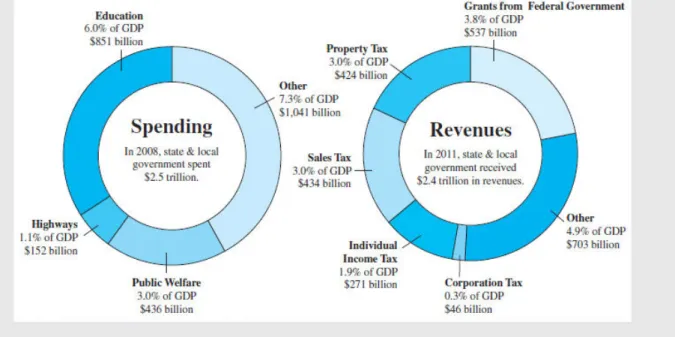
Recent years have seen a considerable increase in federal government spending. Understanding the scope of government activity is therefore becoming ever more important. New graphics in Chapter 1 provide a succinct and convenient overview.
All of the changes in this Tenth edition were made to further our goal of
Page x
that modern public finance provides a practical and invaluable framework for thinking about policy issues. In this textbook, we have tried to do just what we did when we worked in Washington—to emphasize the links between sound economics and the analysis of real-world policy problems.
Harvey S. Rosen and Ted Gayer
UP-TO-DATE TOOLS AND SUPPLEMENTS
Animated PowerPoint Slides
Thoroughly updated and comprehensive PowerPoint presentations, prepared by Donna Anderson of University of Wisconsin La Crosse, feature animated graphs and figures to help clarify difficult concepts for students.
Test Bank
Public Finance has been known for its strong, rigorous test bank questions, and the Tenth edition continues this tradition. The test bank has been expertly updated to reflect the cutting-edge changes in the text. New questions in every chapter provide additional opportunities to test student knowledge.
Instructor's Manual
Revised by Tori Knight of Carson-Newmann University, the instructor's manual provides a number of instructor resources along with detailed solutions to the end-of-chapter questions.
Online Learning Center
interesting Web links, while instructors can also access the password- protected ancillaries to access downloadable versions of the instructor resources.
CourseSmart is a new way for faculty to find and review eTextbooks. It's also a great option for students who are interested in accessing their course materials digitally. CourseSmart offers thousands of the most commonly adopted textbooks across hundreds of courses from a wide variety of higher education publishers. It is the only place for faculty to review and compare the full text of a textbook online. At CourseSmart, students can save up to 50 percent off the cost of a print book, reduce their impact on the environment, and gain access to powerful Web tools for learning including full text search, notes and highlighting, and e-mail tools for sharing notes between classmates. Complete tech support is also available for each title.
Finding your eBook is easy. Visit www.CourseSmart.com and search by title, author, or ISBN.
Page xi
It is a pleasure to acknowledge the people who have helped in the preparation of Public Finance. Across all the editions of this book, nearly 400 academic colleagues who teach public finance have responded to surveys that provided useful material on how they focus their courses. The input afforded insights about their needs and those of their students.
We have been the beneficiaries of numerous suggestions for improvements over the previous edition. We are very thankful to Jean Marie Callan for her research support. In addition, a number of people helped with particular issues in this edition. They include:
Henry Aaron
Brookings Institution Gary Burtless
Brookings Institution Amanda Kowalski Yale University Jonathan Meer
Texas A&M University Clifford Winston
Brookings Institution
We also appreciate the people who reviewed and made useful suggestions to earlier editions of this text. They include:
Roy D. Adams
Iowa State University
Donna Anderson
University of Wisconsin, La Crosse Gary M. Anderson
California State University, Northridge Gerald Auten
US Treasury
Charles L. Ballard
Michigan State University Kevin Balsam
Hunter College Thomas Barthold
Joint Committee on Taxation Marco Bassetto
University of Minnesota, Minneapolis Anne Louise Berry
Stanford University Douglas Blair
Rutgers University Rebecca Blank
University of Michigan Serguey Braguinsky SUNY Buffalo
Genevieve Briand
Eastern Washington University Alex M. Brill
House Ways and Means Committee Eleanor Brown
Pomona College
Page xii
Queens University Lawrence P. Brunner
Central Michigan University Leonard Burman
Urban Institute Rachel Burton
Georgetown University Stuart Butler
Heritage Foundation Donald E. Campbell
College of William and Mary Adam Carasso
The Urban Institute Kai Chan
Princeton University Sewin Chan
New York University Howard Chernick Hunter College Ron Cheung
Florida State University Bradley Childs
Belmont University Robert Chirinko Emory University John A. Christianson University of San Diego
Steven Craig
University of Houston Steven G. Craig
University of Houston Susan Dadres
Southern Methodist University Bev Dahlby
University of Alberta John Deskins
Creighton University, Omaha Robert A. Dickler
Bowie State University Avinash Dixit
Princeton University Kevin T. Duffy-Deno
Southeastern Massachusetts University Alejandra Edwards
California State University, Long Beach Wayne Edwards
University of Alaska, Anchorage Nada Eissa
Georgetown University Eric Engen
Federal Reserve Board O. Homer Erekson Miami University, Ohio Judy Feder
Georgetown University
University of Texas John Fitzgerald Bowdoin College Fred E. Foldvary Virginia Tech Jane G. Fortson Princeton University Ken Fortson
Princeton University Don Fullerton
University of Texas William Gale
Brookings Institution Gary Galles
Pepperdine University Malcolm Getz
Vanderbilt University J. Fred Giertz
University of Illinois Gregory Gilpin
Indiana University, Bloomington Robert Gitter
Ohio Wesleyan University Amihai Glazer
University of California, Irvine Roy T. Gobin
Loyola University of Chicago
William T. Gormley Georgetown University Jane Gravelle
Congressional Research Service Gordon Gray
American Enterprise Institute Michael Greenstone
Massachusetts Institute of Technology Timothy J. Gronberg
Texas A & M University Simon Hakim
Temple University Jonathan H. Hamilton University of Florida Rich Hanson
University of California, Irvine Winston Harrington
Resources for the Future Kevin Hassett
American Enterprise Institute Eric Helland
Claremont McKenna College L. Jay Helms
University of California, Davis Roger S. Hewett
Drake University James Hines
University of Michigan
Page xiii
American Action Forum Janet Holtzblatt
US Treasury Gary A. Hoover
University of Alabama John K. Horowitz
University of Maryland Hilary Hoynes
University of California, Davis Paul Hughes-Cromwick
Henry Ford Health System Robert Inman
University of Pennsylvania Micah Jensen
Georgetown University Rebecca Kalmus
Harvard University Robert Kelly
Fairfield University Valerie Kepner King's College Edward Kienzle Boston College Bruce R. Kingman SUNY, Albany Jeffrey Kling
Congressional Budget Office
Helen Ladd Duke University Charles G. Leathers University of Alabama Gary D. Lemon
De Pauw University Al Lerman
US Treasury Peng Li
Huazhong University of Science and Technology Steve Lile
Western Kentucky University Alessandro Lizzeri
New York University Alan Lockard
Binghamton University Bradley S. Loomis
Rochester Institute of Technology Edward Lopez
University of North Texas Jens Ludwig
Georgetown University Robin Lumsdaine American University Pirudas Lwamugira Fitchburg State College Molly K. Macauley Resources for the Future
Harvard University Randall Mariger
University of Washington Jim Marton
University of Kentucky Simon Medcalfe
Brenau University Jonathan Meer Stanford University Philip Meguire
University of Canterbury Roger P. Mendels
University of Windsor van der Merwe Fanus
Potchefstroom University for Christian Higher Education, South Africa David Mitchell
Missouri State University Olivia Mitchell
University of Pennsylvania Farshid Mojaver
University of California, Davis Robert Moore
Occidental College Adele Morris
Brookings Institution James J. Murphy
University of Massachusetts
Page xiv
Noelwah Netusil Reed College Eric Nilsson
California State University, San Bernardino Louise Nordstrom
Nichols College Peter Norman
University of North Carolina, Chapel Hill Pia M. Orrenius
Federal Reserve Bank of Dallas Susan Parks
University of Wisconsin, Whitewater Anthony Pellechio
World Bank
Anita Alves Pena
Colorado State University Alfredo M. Pereira
University of California, San Diego Wade Pfau
National Graduate Institute of Policy Studies Florenz Plassmann
Binghamton University (SUNY) Joseph Pomykala
Towson University Paul Portney
University of Arizona James Poterba
Massachusetts Institute of Technology
Princeton University Christopher J. Rempel Reed College
Mark Rider US Treasury Robert Rider
University of Southern California Jose Daniel Rodriguez-Delgado University of Minnesota
Carol Rosenberg Urban Institute Stephen Rubb Bentley College Steven R. Sachs
University of Connecticut Efraim Sadka
Tel-Aviv University Gian S. Sahota
Vanderbilt University Robert C. Sahr
Oregon State University Andrew Samwick
Dartmouth College Benjamin Scafidi
Georgia State University Helen Schneider
University of Texas at Austin
James K. Self Indiana University Albert J. Shamash Trenton State College Daniel Shaviro
New York University Eytan Sheshinski Hebrew University Mark Showalter
Brigham Young University Jonathan Skinner
Dartmouth College Kenneth Small
University of California, Irvine John L. Solow
University of Iowa John Sondey
South Dakota State University Richard Steinberg
Virginia Polytechnic Institute and State University C. Eugene Steuerle
The Urban Institute Thomas F. Stinson University of Minnesota John Straub
Tufts University Paul Styger
Potchefstroom University for Christian Higher Education, South Africa
Page xv
United States Naval Academy Amy Taylor
US Center for Health Services Research Nicolaus Tideman
Virginia Tech University Kiertisak Toh
Radford University Mehmet Tosun
University of Nevada, Reno Gregory A. Trandel
University of Georgia Alan Viard
American Enterprise Institute Marianne Vigneault
Bishop's University Lennard van Vuren
Potchefstroom University for Christian Higher Education, South Africa Michael Wasylenko
Syracuse University Kristen Willard Columbia University Mark L. Wilson
West Virginia University-Tech Clifford Winston
Brookings Institution Pavel Yakovlev Duquesne University
Chiou-Nan Yeh
Alabama State University Aaron Yelowitz
University of Kentucky James Young
Northern Illinois University Sajid Zaidi
Princeton University Joshua Graff Zivin Columbia University George Zodrow Rice University
Finally, we both would like to thank our families for their support.
Longtime readers of this book might recall that the first edition was written when Lynne Rosen and Jonathan Rosen were babies. Now they are college graduates, and have been delighted to welcome Zachary Gayer, Jacob Gayer, and Nathan Gayer into the Public Finance family.
Harvey S. Rosen and Ted Gayer
Brief Table of Contents
Part I
GETTING STARTED 1 Introduction
2 Tools of Positive Analysis 3 Tools of Normative Analysis
Part II
PUBLIC EXPENDITURE: PUBLIC GOODS AND EXTERNALITIES 4 Public Goods
5 Externalities
6 Political Economy 7 Education
8 Cost-Benefit Analysis
Part III
PUBLIC EXPENDITURE: SOCIAL INSURANCE AND INCOME MAINTENANCE
9 The Health Care Market
10 Government and the Market for Health Care 11 Social Security
FRAMEWORK FOR TAX ANALYSIS 14 Taxation and Income Distribution 15 Taxation and Efficiency
16 Efficient and Equitable Taxation
Part V
THE UNITED STATES REVENUE SYSTEM 17 The Personal Income Tax
18 Personal Taxation and Behavior 19 The Corporation Tax
20 Deficit Finance
21 Fundamental Tax Reform: Taxes on Consumption and Wealth
Part VI
MULTIGOVERNMENT PUBLIC FINANCE 22 Public Finance in a Federal System
Appendix Glossary References Name Index Subject Index
Table of Contents
About the Authors Preface
Acknowledgments
Part I: GETTING STARTED
CHAPTER 1: INTRODUCTION Public Finance and Ideology
Organic View of Government Mechanistic View of Government Viewpoint of This Book
Government at a Glance The Legal Framework The Size of Government Expenditures
Revenues Our Agenda Summary
Discussion Questions
Appendix: Doing Research in Public Finance CHAPTER 2: TOOLS OF POSITIVE ANALYSIS
The Role of Theory
Causation versus Correlation Experimental Studies
Conducting an Experimental Study Pitfalls of Experimental Studies Observational Studies
Conducting an Observational Study Pitfalls of Observational Studies Quasi-Experimental Studies
Conducting a Quasi-Experimental Study
Discussion Questions
CHAPTER 3: TOOLS OF NORMATIVE ANALYSIS Welfare Economics
Pure Economy Exchange Production Economy
The First Fundamental Theorem of Welfare Economics Fairness and the Second Fundamental Theorem of Welfare Economics
Market Failure Market Power
Nonexistence of Markets Overview
Buying into Welfare Economics Summary
Discussion Questions
Part II: PUBLIC EXPENDITURE: PUBLIC GOODS AND EXTERNALITIES
CHAPTER 4: PUBLIC GOODS Public Goods Defined
Efficient Provision of Public Goods Deriving the Efficiency Condition Problems in Achieving Efficiency The Free Rider Problem
Privatization
Public versus Private Provision Public versus Private Production Public Goods and Public Choice Summary
Discussion Questions
CHAPTER 5: EXTERNALITIES The Nature of Externalities Graphical Analysis
Implications Conclusion
Mergers
Social Conventions
Public Responses to Externalities: Taxes and Subsidies Taxes
Subsidies
Public Responses to Externalities: Emissions Fees and Cap-and-Trade Programs
Emissions Fee Cap-and-Trade
Emissions Fee versus Cap-and-Trade Command-and-Control Regulation The Us Response
Progress with Incentive-Based Approaches Implications for Income Distribution
Who Benefits?
Who Bears the Cost?
Positive Externalities A Cautionary Note Summary
Discussion Questions
CHAPTER 6: POLITICAL ECONOMY Direct Democracy
Unanimity Rules Majority Voting Rules Logrolling
Arrow's Impossibility Theorem Representative Democracy
Elected Politicians Public Employees Special Interests Other Actors
Explaining Government Growth Conclusion
Summary
Discussion Questions
Does Education Generate Positive Externalities?
Is the Education Market Inequitable?
What Can Government Intervention in Education Accomplish?
Does Government Intervention Crowd Out Private Education?
Does Government Spending Improve Educational Outcomes?
Public Spending and the Quality of Education Does Education Increase Earnings?
New Directions for Public Education Charter Schools
Vouchers
School Accountability Summary
Discussion Questions
CHAPTER 8: COST-BENEFIT ANALYSIS Present Value
Projecting Present Dollars into the Future Projecting Future Dollars into the Present Inflation
Private Sector Project Evaluation Internal Rate of Return
Benefit-Cost Ratio
Discount Rate for Government Projects
Rates Based on Returns in the Private Sector Social Discount Rate
Discounting and the Economics of Climate Change Government Discounting in Practice
Valuing Public Benefits And Costs Market Prices
Adjusted Market Prices Consumer Surplus
Inferences from Economic Behavior
The Chain-Reaction Game The Labor Game
The Double-Counting Game Distributional Considerations Uncertainty
An Application: Are Reductions in Class Size Worth It?
Discount Rate Costs
Benefits
The Bottom Line and Evaluation Use (and Nonuse) by Government Summary
Discussion Questions
Appendix: Calculating the Certainty Equivalent Value Part III: PUBLIC EXPENDITURE: SOCIAL INSURANCE AND INCOME MAINTENANCE
CHAPTER 9: THE HEALTH CARE MARKET What's Special about Health Care?
The Role of Insurance The Role of Risk Pooling
Adverse Selection in the Health Insurance Market Insurance and Moral Hazard
Other Information Problems in the Health Care Market Externalities of Health Care
Do We Want Efficient Provision of Health Care?
Paternalism
The Problem of the Uninsured High Health Care Costs
Summary
Discussion Questions
CHAPTER 10: GOVERNMENT AND THE MARKET FOR HEALTH CARE
Private Health Insurance
The Implicit Subsidy for Employer-Provided Insurance The Advantages of Employer-Provided Health
Government Provision of Health Insurance: Medicare and Medicaid
Medicare: Overview
Cost Control under Medicare
Medicare: Impacts on Spending and Health Medicaid: Overview
Medicaid: Impacts on Health Affordable Care Act of 2010
Alternative Paths to Health Care Reform Single-Payer Approach
Market-Oriented Approach Final Thoughts
Summary
Discussion Questions
CHAPTER 11: SOCIAL SECURITY Why Have Social Security?
Consumption Smoothing and the Annuity Market Adverse Selection and the Annuity Market
Other Justifications Structure of Social Security
Basic Components Distributional Issues The Trust Fund
Effects of Social Security on Economic Behavior Saving Behavior
Retirement Decisions Implications
Long-Term Stresses on Social Security Social Security Reform
Maintain the Current System Privatize the System
Conclusions Summary
Discussion Questions
Distribution of Income
Interpreting the Distributional Data Rationales for Income Redistribution
Simple Utilitarianism The Maximin Criterion
Pareto Efficient Income Redistribution Nonindividualistic Views
Other Considerations Expenditure Incidence
Relative Price Effects Public Goods
Valuing In-Kind Transfers Reasons for In-Kind Transfers Conclusion
Summary
Discussion Questions
CHAPTER 13: EXPENDITURE PROGRAMS FOR THE POOR
A Quick Look at Welfare Spending TANF
Income Maintenance and Work Incentives The Basic Trade-Offs
Analysis of Work Incentives Work Requirements
Time Limits Family Structure
National versus State Administration The Earned Income Tax Credit
Supplemental Security Income Medicaid
Unemployment Insurance Benefits
Financing
Effects on Unemployment
Supplemental Nutrition Assistance Program (SNAP)
Employment and Job Training Overview
Summary
Discussion Questions
Part IV: FRAMEWORK FOR TAX ANALYSIS
CHAPTER 14: TAXATION AND INCOME DISTRIBUTION Tax Incidence: General Remarks
Only People Can Bear Taxes
Both Sources and Uses of Income Should Be Considered
Incidence Depends on How Prices Are Determined Incidence Depends on the Disposition of Tax Revenues Tax Progressiveness Can Be Measured in Several Ways Partial Equilibrium Models
Unit Taxes on Commodities Ad Valorem Taxes
Taxes on Factors
Commodity Taxation without Competition Profits Taxes
Tax Incidence and Capitalization General Equilibrium Models
Tax Equivalence Relations The Harberger Model Analysis of Various Taxes Some Qualifications
An Applied Incidence Study Conclusions
Summary
Discussion Questions
CHAPTER 15: TAXATION AND EFFICIENCY Excess Burden Defined
Questions and Answers
Excess Burden Measurement with Demand Curves Preexisting Distortions
Differential Taxation of Inputs Does Efficient Taxation Matter?
Summary
Discussion Questions
CHAPTER 16: EFFICIENT AND EQUITABLE TAXATION Optimal Commodity Taxation
The Ramsey Rule Equity Considerations Summary
Application: Taxation of the Family Optimal User Fees
Overview
Optimal Income Taxation Edgeworth's Model Modern Studies
Politics and the Time Inconsistency Problem Other Criteria for Tax Design
Horizontal Equity
Costs of Running the Tax System Tax Evasion
Overview Summary
Discussion Questions
Part V: THE UNITED STATES REVENUE SYSTEM CHAPTER 17: THE PERSONAL INCOME TAX
Basic Structure Defining Income
Items Included in H-S Income
Some Practical and Conceptual Problems Evaluating the H-S Criterion
Excluded Forms of Money Income Interest on State and Local Bonds Some Dividends
Capital Gains
Employer Contributions to Benefit Plans
Exemptions Deductions
Impact on the Tax Base Tax Expenditures
The Simplicity Issue Rate Structure
Effective versus Statutory Rates Taxes and Inflation
How Inflation Affects Taxes Tax Indexing
The Alternative Minimum Tax
Choice of Unit and the Marriage Tax Background
Analyzing the Marriage Tax Treatment of International Income State Income Taxes
Summary
Discussion Questions
CHAPTER 18: PERSONAL TAXATION AND BEHAVIOR Labor Supply
Theoretical Considerations Some Caveats
Labor Supply and Tax Revenues Saving
Empirical Evidence
Tax-Preferred Savings Accounts Taxes and the Capital Shortage Housing Decisions
Proposals for Change Portfolio Composition
A Note on Politics and Elasticities Summary
Discussion Questions
CHAPTER 19: THE CORPORATION TAX
Employee Compensation Deducted Interest, but Not Dividends, Deducted Depreciation Deducted
Investment Tax Credit
Treatment of Dividends versus Retained Earnings Effective Tax Rate on Corporate Capital
Incidence and Excess Burden A Tax on Corporate Capital A Tax on Economic Profits Effects on Behavior
Total Physical Investment Types of Assets
Corporate Finance State Corporation Taxes
Taxation of Multinational Corporations Global versus Territorial Taxation Corporation Tax Reform
Full Integration Dividend Relief Summary
Discussion Questions
CHAPTER 20: DEFICIT FINANCE How Big Is the Debt?
Interpreting Deficit and Debt Numbers Summing Up
The Burden of the Debt
One Hand Borrows from the Other An Overlapping Generations Model Neoclassical Model
Ricardian Model Overview
To Tax or to Borrow?
Benefits-Received Principle Intergenerational Equity Efficiency Considerations
Controlling the Deficit Overview
Summary
Discussion Questions
CHAPTER 21: FUNDAMENTAL TAX REFORM: TAXES ON CONSUMPTION AND WEALTH
Efficiency and Equity of Personal Consumption Taxes Efficiency Issues
Equity Issues Retail Sales Tax
Rationalizations
Efficiency and Distributional Implications of State Sales Taxes
A National Retail Sales Tax?
Value-Added Tax
Implementation Issues
A VAT for the United States?
Hall-Rabushka Flat Tax Cash-Flow Tax
Income versus Consumption Taxation Advantages of a Consumption Tax Disadvantages of a Consumption Tax Problems with Both Systems
Wealth Taxes
Estate and Gift Taxes Rationales
Provisions
Reforming Estate and Gift Taxes Prospects for Fundamental Tax Reform Summary
Discussion Questions
Part VI: MULTIGOVERNMENT PUBLIC FINANCE CHAPTER 22: PUBLIC FINANCE IN A FEDERAL SYSTEM
The Tiebout Model
Tiebout's Assumptions Tiebout and the Real World Optimal Federalism
Disadvantages of a Decentralized System Advantages of a Decentralized System Implications
Public Education in a Federal System Property Tax
Incidence and Efficiency Effects
Why Do People Hate the Property Tax So Much?
Intergovernmental Grants Types of Grants
The Flypaper Effect Overview
Summary
Discussion Questions
APPENDIX: SOME BASIC MICROECONOMICS GLOSSARY
REFERENCES NAME INDEX SUBJECT INDEX i
ii iii iv v vii viii ix x xi xii xiii
1 2 3 4 5 6 7 8 9 10 11 12 13 14 15 16 17 18 19 20 21 22 23 24 25 26 27 28 29 30 31 32 33 34
37 38 39 40 41 42 43 44 45 46 47 48 49 50 51 52 53 54 55 56 57 58 59 60 61 62 63 64 65 66 67 68 69 70 71
75 76 77 78 79 80 81 82 83 84 85 86 87 88 89 90 91 92 93 94 95 96 97 98 99 100 101 102 103 104 105 106 107 108
111 112 113 114 115 116 117 118 119 120 121 122 123 124 125 126 127 128 129 130 131 132 133 134 135 136 137 138 139 140 141 142 143 144 145
149 150 151 152 153 154 155 156 157 158 159 160 161 162 163 164 165 166 167 168 169 170 171 172 173 174 175 176 177 178 179 180 181 182
185 186 187 188 189 190 191 192 193 194 195 196 197 198 199 200 201 202 203 204 205 206 207 208 209 210 211 212 213 214 215 216 217 218 219
223 224 225 226 227 228 229 230 231 232 233 234 235 236 237 238 239 240 241 242 243 244 245 246 247 248 249 250 251 252 253 254 255 256
259 260 261 262 263 264 265 266 267 268 269 270 271 272 273 274 275 276 277 278 279 280 281 282 283 284 285 286 287 288 289 290 291 292 293
297 298 299 300 301 302 303 304 305 306 307 308 309 310 311 312 313 314 315 316 317 318 319 320 321 322 323 324 325 326 327 328 329 330
333 334 335 336 337 338 339 340 341 342 343 344 345 346 347 348 349 350 351 352 353 354 355 356 357 358 359 360 361 362 363 364 365 366 367
371 373 374 375 376 377 378 379 380 381 382 383 384 385 386 387 388 389 390 391 392 393 394 395 396 397 398 399 400 401 402 403 404 405
408 409 410 411 412 413 414 415 416 417 418 419 420 421 422 423 424 425 426 427 428 429 430 431 432 433 434 435 436 437 438 439 440 441 442
446 447 448 449 450 451 452 453 454 455 456 457 458 459 460 461 462 463 464 465 466 467 468 469 470 471 472 473 474 475 476 477 478 479
482 483 484 485 486 487 488 489 490 491 492 493 494 495 496 497 498 499 500 501 502 503 504 505 506 507 508 509 510 511 512 513 514 515 516
520 521 522 523 524 525 526 527 528 529 530 531 532 533 534 535 536 537 538 539 540 541 542 543 544 545 546 547 548 549 550 551 552 553
556 557 558 559 560 561 562 563 564 565 566 567 568 569 570 571 572 573 574 575 576 577 578 579 580 581 582 583 584 585 586
Part One
GETTING STARTED
People's political philosophies influence their views on the role of government. Some people hold individual freedom as a top priority;
others place more emphasis on promoting the well-being of society as a whole. Philosophical differences can and do lead to disagreements on the appropriate scope for government economic activity.
However, forming intelligent opinions about public policy requires not only a political philosophy but also an understanding of what government actually does. Who has the legal power to conduct economic policy?
What does government spend money on, and how does it raise revenue?
Chapter 1 discusses how political views affect attitudes toward public finance, and outlines the operation of the US system of public finance. It provides a broad framework for thinking about the details of the public finance system that are discussed in subsequent chapters.
Chapters 2 and 3 present the analytical tools used by public finance economists. Chapter 2 focuses on the tools of positive analysis, which deals with statements of cause and effect. The question here is how economists try to assess the impacts of various government policies.
However, we want to determine not only the effects of government policies, but whether or not they produce results that are in some sense good. This is the role of normative analysis, which requires an explicit ethical framework, because without one, it is impossible to say what is good. Chapter 3 covers this ethical framework.
Chapter One I NTRODUCTION
Public Finance is nothing else than a sophisticated discussion of the relationship between the individual and the state. There is no better school of training than public finance.
—FORMER CZECH PRIME MINISTER VACLAV KLAUS
The year is 1030 BC. For decades, the Israelite tribes have been living without a central government. The Bible records that the people have asked the prophet Samuel to “make us a king to judge us like all the nations” [1 Samuel 8:5]. Samuel tries to discourage the Israelites by describing what life will be like under a monarchy:
This will be the manner of the king that shall reign over you; he will take your sons, and appoint them unto him, for his chariots, and to be his horsemen; and they shall run before his chariots … And he will take your daughters to be perfumers, and to be cooks, and to be bakers. And he will take your fields, and your vineyards, and your oliveyards, even the best of them, and give them to his servants … He will take the tenth of your flocks; and ye shall be his servants. And ye shall cry out in that day because of your king whom ye shall have chosen [1 Samuel 8:11–18].
The Israelites are undeterred by this depressing scenario: “The people refused to hearken unto the voice of Samuel; and they said: ‘Nay; but there shall be a king over us; that we also may be like all the nations; and that our king may judge us, and go out before us, and fight our battles’” [1 Samuel 8:19–20].
This biblical episode illustrates an age-old ambivalence about government.
Government is a necessity—“all the nations” have it, after all—but at the same time it has undesirable aspects. These mixed feelings toward government are inextricably bound up with its taxing and spending activities. The king will provide things that the people want (in this case, an army), but only at a cost. The resources for all government expenditures ultimately must come from the private sector. As Samuel so graphically explains, taxes can be burdensome.
Page 3
taxing and spending activities of government, a subject usually called public finance.
public sector economics See public finance.
public economics See public finance.
This term is something of a misnomer because the fundamental issues are not financial (that is, relating to money). Rather, the key problems relate to the use of real resources. For this reason, some authors prefer the label public sector economics or simply public economics.
We focus on the microeconomic functions of government—the way government affects the allocation of resources and the distribution of income. Nowadays, the macroeconomic roles of government—the use of taxing, spending, and monetary policies to affect the overall level of unemployment and the price level—are usually taught in separate courses.
The boundaries of public finance are sometimes unclear. Some policy goals that might be achieved by government spending or taxation can also be achieved by regulations. For example, if the government wishes to limit the size of
corporations, one possible policy is to impose large taxes on big corporations. Another is to issue regulations making firms that exceed
a particular size illegal. While corporate taxation is a subject of intense study in public finance, antitrust issues receive only tangential treatment in public finance texts and are covered instead in courses on industrial organization. While this practice seems arbitrary, it is necessary to limit the scope of the field. This book follows tradition by focusing on government spending and taxation, only occasionally touching on regulatory policies.
Page 4
PUBLIC FINANCE AND IDEOLOGY
Public finance economists analyze not only the effects of actual government taxing and spending activities but also what these activities ought to be. Opinions on how government should function in the economic sphere are influenced by ideological views concerning the relationship between the individual and the state. Political philosophers have distinguished two major approaches.
Organic View of Government
This view conceives of society as a natural organism. Each individual is a part of this organism, and the government can be thought of as its heart. Yang Chang-chi, Mao Tse-tung's ethics teacher in Beijing, held that “a country is an organic whole, just as the human body is an organic whole. It is not like a machine which can be taken apart and put together again” (quoted in Johnson [1983, p. 197]). The individual has significance only as part of the community, and the good of the individual is defined with respect to the good of the whole. Thus, the community is stressed above the individual. For example, in the Republic of Plato, an activity of a citizen is desirable only if it leads to a just society. Perhaps the most infamous instance of an organic conception of government is provided by Nazism: “National Socialism does not recognize a separate individual sphere which, apart from the community, is to be painstakingly protected from any interference by the State….
Every activity of daily life has meaning and value only as a service to the whole.”1 The goals of the society are set by the state, which attempts to lead society toward their realization. Of course, the choice of goals differs considerably. Plato conceived of a state whose goal was the achievement of a golden age in which human activities would be guided by perfect rationality. On the other hand, Adolf Hitler [1971/1925, p. 393] viewed the state's purpose as the achievement of racial purity: “The state is a means to an end. Its end lies in the preservation and advancement of a community of physically and psychically homogeneous creatures.” More recently, the Iranian Ayatollah Khomeini argued that “only a good society can create good believers.” He wrote that “Man is half-angel, half-devil,”
and the goal of government should be to “combat [the devil part] through laws and suitable punishments” (quoted in Taheri [2003]).
A crucial question is how societal goals are to be selected.
Proponents of the organic view usually argue that certain goals are
Mechanistic View of Government
In this view, government is not an organic part of society. Rather, it is a contrivance created by individuals to better achieve their individual goals. As the American statesman Henry Clay said in 1829, “Government is a trust, and the officers of the government are trustees; and both the trust and the trustees are created for the benefit of the people.” The individual rather than the group is at center stage.
Accepting that government exists for the good of the people, we are still left with the problem of defining just what good is and how the government should promote it. Virtually everyone agrees that it is good for individuals when government protects them from violence. To do so government must have a monopoly on coercive power. Otherwise, anarchy develops, and as the 17th-century philosopher Thomas Hobbes [1963/1651, p. 143] noted, “The life of man [becomes] solitary, poor, nasty, brutish and short.” Hobbes's observation was confirmed in Tunisia in early 2011, when revolution forced the president and other political leaders to flee the country. In the absence of government and police, chaos ensued. Similarly, in The Wealth of Nations, Adam Smith argued that government should protect “the society from the violence and invasion of other independent societies,” and protect
“as far as possible every member of the society from the injustice or oppression of every other member of it” [1977/1776, Book V, pp. 182, 198].
The most limited government, then, has but one function—to protect its members from physical coercion. Beyond that, Smith argued that government should have responsibility for “creating and maintaining certain public works and certain public institutions, which it can never be for the interest of any individual, or small number of individuals, to erect and maintain” [1977/1776, Book V, pp. 210–211]. Here one thinks of items like roads, bridges, and sewers—the infrastructure required for society to function.2
At this point, opinions within the mechanistic tradition diverge. Libertarians, who believe in a very limited government, argue against any further economic role for the government. In Smith's words, “Every man, as long as he does not violate the laws of justice, is left perfectly free to pursue his own interest his own way”
[1977/1776, Book V, p. 180]. Libertarians are extremely skeptical about the ability of governments to improve social welfare. As Thomas Jefferson pungently put it in his first inaugural address,
Page 5
In contrast, those whom we might call social democrats believe that substantial government intervention is required for the good of individuals. These interventions can take such diverse forms as safety regulations for the workplace, laws banning racial and sexual discrimination in housing, or public provision of health care.
Social democrats tend to believe that individual freedom is more than the absence of physical coercion. An impoverished individual may be free to spend
his income as he pleases, but the scope of that freedom is quite limited.
Between the libertarian and social democratic positions there is a
continuum of views with respect to the appropriate amount of government intervention.
Viewpoint of This Book
The notion that the individual rather than the group is paramount is relatively new.
Historian Lawrence Stone [1977, pp. 4–5] notes that before the modern period,
It was generally agreed that the interests of the group, whether that of kin, the village, or later the state, took priority over the wishes of the individual and the achievement of his particular ends. “Life, liberty and the pursuit of happiness” were personal ideals which the average, educated 16th-century man would certainly have rejected as the prime goals of a good society.
Since then, however, the mechanistic view of government has come to exert a major influence on Anglo-American political thought. However, it is by no means totally dominant. People on both the left and the right regularly voice objections to the individualistic view. For example, in 2011 Democratic senatorial candidate Elizabeth Warren said, “There is nobody in this country who got rich on his own … [P]art of the underlying social contract is you take a hunk of that and pay forward for the next kid who comes along.” And in 2012 Rick Santorum, who was seeking the Republican presidential nomination, stated, “Just as original sin is man's inclination to try to walk alone without God, individualism is man's inclination to try to walk alone among his fellows.” Indeed, anyone who claims that something must be done in the “national interest,” without reference to the welfare of some individual or group of individuals, is implicitly taking an organic point of view.
More generally, even in highly individualistic societies, people sometimes feel it necessary to act on behalf of, or even sacrifice their lives for, the nation.
Anglo-American economic thought has also developed along individualistic lines. Individuals and their wants are the main focus in mainstream economics, a view reflected in this text. However, as stressed earlier, within the individualistic tradition there is much controversy with respect to how active government should be. Thus, adopting a mechanistic point of view does not by itself provide us with an
inevitably depends in part on ethical and political judgments. As this country's ongoing debate over public finance illustrates, reasonable people can disagree on these matters. We attempt to reflect different points of view as fairly as possible.
Page 6
GOVERNMENT AT A GLANCE
We have shown how ideology can affect one's views of the appropriate role of government. However, to form sensible views about public policy requires more than ideology. One also needs information about how the government actually functions. What legal constraints are imposed on the public sector? What does the government spend money on, and how are these expenditures
financed? Before delving into the details of the US system of public finance, we provide a brief overview of these issues.
The Legal Framework
The Constitution reflects the Founding Fathers’ concerns about government intervention in the economy. We first discuss constitutional provisions relating to the spending and taxing activities of the federal government and then turn to the states.
Federal Government Article 1, Section 8, of the Constitution empowers Congress “to pay the Debts and provide for the common Defense and general Welfare of the United States.” Over the years, the notion of “general welfare” has been interpreted very broadly by Congress and the courts, and now this clause effectively puts no constraints on government spending.4 The Constitution does not limit the size of federal expenditure, either absolutely or relative to the size of the economy. Bills to appropriate expenditures (like practically all other laws) can originate in either house of Congress. An appropriations bill becomes law when it receives a majority vote in both houses and the president signs it. If the president vetoes an expenditure bill, it can still become law if it subsequently receives a two- thirds majority vote in each house.
How does Congress finance these expenditures? Federal taxing powers are authorized in Article 1, Section 8: “The Congress shall have Power to lay and collect Taxes, Duties, Imposts and Excises.” Unlike expenditure bills, “All Bills for raising Revenue shall originate in the House of Representatives” [Article 1, Section 7].
In light of the enormous dissatisfaction with British tax policy during the colonial period, it is no surprise that considerable care was taken to constrain governmental taxing power, as described in the following paragraphs:
Page 7
collected will be the same in each state. Presumably, states in which individuals drive more than average will have higher tax liabilities. Thus, it is still possible (and indeed likely) that various taxes make some states worse off than others.5
2. “No … direct Tax shall be laid, unless in Proportion to the Census or Enumeration herein before directed to be taken” [Article 1, Section 9]. A direct tax is a tax levied on a person as opposed to a commodity. Essentially, this provision says that if State A has twice the population of State B, then any direct tax levied by Congress must yield twice as much revenue from State A as from State B.
In the late 19th century, attempts to introduce a federal tax on income were declared unconstitutional by the Supreme Court because income taxation leads to state tax burdens that are not proportional to population. Given this decision, the only way to introduce an income tax was via a constitutional amendment. The 16th Amendment, ratified in 1913, states, “Congress shall have power to levy and collect taxes on incomes, from whatever source derived, without
apportionment among the several states, and without regard to census or enumeration.” Today the individual income tax is one of the mainstays of the federal revenue system.
3. “No person shall be … deprived of life, liberty, or property, without due process of law; nor shall private property be taken for public use, without just compensation” [Fifth Amendment]. From the point of view of tax policy, this clause means distinctions created by the tax law must be reasonable. However, it is not always simple to determine which distinctions are “reasonable” and doing so is an ongoing part of the legislative and judicial processes.
4. “No Tax or Duty shall be laid on Articles exported from any State” [Article 1, Section 9]. This provision was included to assure the southern states that their exports of tobacco and other commodities would not be jeopardized by the central government.
The federal government is not required to finance all its expenditures by taxation.
If expenditures exceed revenues, it is empowered “to borrow Money on the credit of the United States” [Article 1, Section 8]. At various times over the past few decades, a constitutional amendment to require a balanced federal budget has received some support, but so far it has not passed.
State and Local Governments According to the 10th Amendment, “The powers not delegated to the United States by the Constitution, nor prohibited by it to the States, are reserved to the States respectively, or to the people.” Thus, the
Page 8
Imports or Exports.” Thus, the federal government controls international economic policy. In addition, various constitutional provisions have been interpreted as requiring that the states not levy taxes arbitrarily, discriminate against outside residents, or levy taxes on imports from other states. For example, in 2005, the Supreme Court declared unconstitutional laws in Michigan and New York that granted in-state wineries a competitive advantage over out-of-state wineries.
States can impose spending and taxing restrictions on themselves in their own constitutions. State constitutions differ substantially with respect to the types of economic issues with which they deal. In recent years, one of the most interesting developments in public finance has been the movement of some states to amend their constitutions to limit the size of public sector spending.
From a legal standpoint, the power of local governments to tax and spend is granted by the states. As a 19th-century judge put it:
Municipal corporations owe their origin to, and derive their powers and rights wholly from, the [state]
legislature. It breathes into them the breath of life, without which they cannot exist. As it creates, so it may destroy. If it may destroy, it may abridge and control [City of Clinton v. Cedar Rapids, 1868].
It would be a mistake, however, to view localities as lacking in fiscal autonomy.
Many towns and cities have substantial political power and do not respond passively to the wishes of state and federal governments. For example, the state of California recently discarded plans to take gasoline tax revenues from local governments, due to forceful objections from local leaders [Steinhauer, 2009]. An interesting development in recent years has been the competition of states and cities for federal funds. The cities often are more successful in their lobbying activities than the states!
The Size of Government
In a famous line from his State of the Union address in 1996, President Bill Clinton declared: “The era of big government is over.” Such a statement presupposes that there is some way to determine whether or not the government is “big.” Just how does one measure the size of government?
One measure often used by politicians and journalists is the number of workers in the public sector. However, this can be misleading. Imagine a country where a few public servants operate a powerful computer that guides all economic decisions. In this country, the number of government employees certainly underestimates the importance of government. Similarly, it would be easy to construct a scenario in which a large number of workers is associated with a relatively weak public sector.
1. Purchases of goods and services. The government buys a wide variety of items, everything from missiles to services provided by ecologists.
2. Transfers of income to people, businesses, or other governments. The
government takes income from some individuals or organizations and gives it
to others. Examples are welfare programs such as food stamps and subsidies