Mechanistic Study of Cu-Mediated, Photoinduced C–S Bond Formation and Demonstration of Electrochemical
Ammonia Production by a Surface- Attached Iron Complex
Thesis by
Kareem Imad Hannoun
In Partial Fulfillment of the Requirements for the degree of
Doctor of Philosophy
CALIFORNIA INSTITUTE OF TECHNOLOGY Pasadena, California
2019
(Defended May 6, 2019)
ii
2019
Kareem Imad Hannoun ORCID: 0000-0003-3176-1104
All rights reserved
ACKNOWLEDGEMENTS
My time at Caltech has been both fulfilling and frustrating. I have been privileged to work with an incredible group of scientists, from whom I have learned and grown immensely. As an advisor, Jonas has given me this opportunity and challenged me to grow as a scientist and person. The other members of my committee have also encouraged me to achieve more and provided support and guidance along the way. I especially have to thank the members of the Peters lab I’ve had the honor of overlapping, who have helped me in more ways than I could possibly list here. I especially have to thank Yichen Tan, Jon Rittle, and John Anderson, who all helped me get on my feet in a new environment. Miles Johnson was a great colleague who really pushed me to do thorough and careful science and had a lasting influence on the way I approach my work self-critically.
I would also like to thank the training and mentorship I received as an undergraduate.
Richard Jordan took me in as a clueless undergraduate and showed great patience with me as I acquired the skills and knowledge necessary to succeed. His fastidiousness and kind feedback encouraged me to continue in chemistry and develop a keen eye for data analysis.
The camaraderie I experienced in the Jordan group gave me an opportunity to learn from many scientists with disparate backgrounds.
I need to thank all the friends who’ve helped me through graduate school. Nik Thompson and Blake Daniels were instrumental in my happiness and adjustment to Caltech.
Paul Walton, Trevor Del Castillo, Ben Matson, and Mark Nesbit have all provided great experiences, from hiking and camping together to roasting coffee. Nina Gu has supported me over the past couple of years and provided constant friendship and willingness to have
iv new experiences outside of lab. Michael McGovern has been a consistent source of support and encouragement. Although we don’t get to talk or see each other as often as we would like, I know he’s always there for me.
Last, but not least, I need to thank my family for their unwavering support and belief.
My parents and my sister Deena have always been encouraging during difficult stretches and I’m lucky to have such a loving family who support me unwaveringly.
ABSTRACT
The worldwide reliance on fossil fuels for energy and petrochemicals poses a massive environmental hazard. Furthermore, many chemical processes rely on precious metals that have low abundance on Earth and are threatened. As the world population grows rapidly, these factors pose an increasing threat to our planet and new chemical processes are needed that employ earth-abundant catalysts and alternative chemical currencies such as light and electricity derived from renewable sources.
Chapter 2 discusses an in-depth mechanistic study of the photoinduced, copper- mediated cross-coupling of aryl thiols with aryl halides. This reaction employs light energy and an earth-abundant metal to achieve bond formation through a pathway distinct from that of thermal reactions. In particular, I focus on the stoichiometric photochemistry and subsequent reactivity of a [CuI(SAr)2] – complex (Ar = 2,6-dimethylphenyl). A broad array of experimental techniques furnish data consistent with a pathway in which a photoexcited [CuI(SAr)2]-* complex undergoes SET to generate a CuII species and an aryl radical, which then couple through an in-cage radical recombination.
Chapter 3 discusses the surface attachment of a P3BFe complex to a carbon electrode, and the electrochemical generation of ammonia from N2 by the surface-appended species (P3BFe = tris-phosphinoborane). Ammonia production is achieved industrially by the combination of N2 and H2, the latter of which is derived from methane with concomitant production of CO2. Alternative chemical processes, such as the use of energy derived from electricity, are vital for the decreasing the carbon footprint of ammonia production. Synthetic modification of a previously-reported P3BFe complex by addition of three pyrene substituents onto the catalyst backbone allows non-covalent attachment onto a graphite surface. The
vi resulting functionalized electrode shows good stability towards iron desorption under highly reducing conditions, and produces 1.4 equiv NH3 per iron site. The data presented provide the first demonstration of electrochemical nitrogen fixation by a molecular complex appended to an electrode.
PUBLISHED CONTENT AND CONTRIBUTIONS
(1) Johnson, M. W.†; Hannoun, K. I.†; Tan, Y.; Fu, G. C.; Peters, J. C. A Mechanistic Investigation of the Photoinduced, Copper-Mediated Cross-Coupling of an Aryl Thiol with an Aryl Halide. Chem. Sci. 2016, 7 (7), 4091–4100.
https://doi.org/10.1039/C5SC04709A. K.I.H. participated in running experiments, data analysis, DFT calculations, and manuscript preparation.
†These authors contributed equally.
viii
TABLE OF CONTENTS
Acknowledgements ...iii
Abstract ...v
Published Content and Contributions ...vii
Table of Contents ...viii
List of Illustrations and/or Tables ...x
Nomenclature ...xiii
Chapter I: Introduction ...1
1.1 Motivation ...1
1.2 Copper-Mediated Cross Coupling and Photochemistry ...2
1.3 Mechanism of Copper-mediated Coupling Reactions ...3
1.4 Reduction of N2 to NH3 by Molecular Catalysts ...6
1.5 Surface Attachment of Molecular Electrocatalysts ...10
1.6 Chapter Summaries ...12
1.7 References ...13
Chapter II: A Mechanistic Investigation of Photoinduced, Copper-Catalyzed Cross-Couplings of Aryl Thiols with Aryl Halides ...21
2.1 Introduction ...21
2.2 Results and Discussion ...23
2.3 Conclusions ...43
2.4 References ...45
Chapter III: Electrochemical Ammonia Production by a Surface-Attached Iron Complex ... 55
3.1 Introduction ...55
3.2 Results and Discussion ...56
3.3 Conclusion ...62
3.4 References ...62
Appendix A: Supplementary Information for Chapter II ...66
A.1 General Considerations ...66
A.2 Synthesis and Characterization ...70
A.3 Molar Conductivity Measurements ...76
A.4 Spectroscopic Identification of Copper(II) Species ...76
A.5 Identification of 2.1 by ESI-MS ...77
A.6 Radical Clock Experiments ...78
A.7 Stoichiometric of [CuI(SAr)2]Na with Phenyl Halides ...81
A.8 Stern-Volmer Quenching Experiment ...81
A.9 Steady-State Fluorimetry Experiment ...82
A.10 Reactivity of 1-(but-3-en-1-yloxy)-2-iodobenzene with [CuI(SAr)2]Na ...82
A.11 VT-NMR Study of 2.1 ...83
A.12 DOSY Experiment ...83
A.13 Actinometric Studies ...84
A.14 Emission Spectrum of 100-W Hg Lamp ...86
A.15 Absorption Spectra of 2.1 in the Presence of 2.2 ...88
A.16 DFT Calculations ...89
A.17 Probe of Direct Coupling between [CuI(SAr)2]Na (2.1) and Aryl Radical ...92
A.18 X-Ray Crystallographic Data ...96
A.19 1H and 13C NMR Data ...97
A.20 References...110
Appendix B: Supplementary Information for Chapter III ...113
B.1 General Considerations...113
B.2 Synthesis and Characterization ...115
B.3 Chemical Ammonia Generation Experiments ...119
B.4 Electrochemistry ...119
B.5 Electrochemical Ammonia Generation Experiments. ...123
B.6 Electrode Desorption Experiment ...124
B.7 Supplementary XPS data ...125
B.8 NMR Spectra ...125
B.9 References ...129
x
LIST OF ILLUSTRATIONS AND TABLES
Chapter I:
Scheme 1.1: Copper-mediated Ullmann coupling ...2
Scheme 1.2: Copper-catalyzed, ligand-accelerated Ullmann coupling ...3
Figure 1.1 Photoexcitation of a CuI–amide to access a highly reducing excited state and photoinduced C–N cross-coupling catalyzed by a CuI–amide ...3
Figure 1.2: Possible pathways for ligand-accelerated Ullmann coupling reactions ...4
Figure 1.3: Radical clock experiments disfavoring the intermediacy of an aryl radical in the copper-catalyzed C–N and C–S coupling reactions ...5
Scheme 1.3: Model chemistry demonstrating the viability of a CuI/CuIII cycle based on oxidative addition and reductive elimination for C–N coupling ...5
Figure 1.4: Early mechanistic studies of photoinduced, Cu-catalyzed cross-coupling ...6
Figure 1.5: First examples of N2 activation and catalytic reduction ...8
Figure 1.6: Electrochemical reduction of N2 ...9
Figure 1.7: Overview of common strategies for surface attachment of molecular electrocatalysts ...11
Chapter II: Equation 2.1 ...21
Equation 2.2 ...22
Figure 2.1: Outline of a possible catalytic cycle for photoinduced, copper-catalyzed cross-coupling ...22
Equation 2.3 ...23
Figure 2.2: An alternative mechanism: coupling of an aryl radical with a copper(I)–thiolate as a key step ...24
Figure 2.3: An alternative mechanism: SRN1 ...25
Figure 2.4: An alternative mechanism: concerted oxidative addition ...25
Equation 2.4 ...26
Equation 2.5 ...27
Equation 2.6 ...27
Figure 2.5: X-ray crystal structure of [CuI(SAr)2][Na(12-crown-4)2] (2.1) ... 28
Equation 2.7 ...29
Figure 2.6: Cyclic voltammograms of [CuI(SAr)2]Na (2.1) and of NaSAr ... 30
Figure 2.7: Optical spectrum and time-resolved luminescence of 2.1 ...32
Figure 2.8: Difference density plot for the lowest energy absorption band of [CuI(SAr)2]Na (2.1) ...33
Figure 2.9: Stern–Volmer plot for the luminescence quenching of [CuI(SAr)2]Na* in the presence of Ph–I ... 34
Equation 2.8 ... 35
Table 2.1: Reactions of a copper–thiolate with an aryldiazonium salt ...36
Equation 2.9 ...36
Table 2.2: Reaction of an aryl radical: Cyclization versus capture by a copper–thiolate ...38
Equation 2.10 ...39
Figure 2.10: X-band EPR spectrum (77 K) of a coupling reaction following irradiation for 5 min ... 40
Figure 2.11: Optical spectrum of a coupling reaction prior to photolysis and after photolysis in propionitrile at −78 °C ... 41
Equation 2.11 ... 41
Equation 2.12 ... 42
Figure 2.12: Spin density plots of [CuII(SAr)3]− and CuII(SAr)2 ... 43
Chapter III: Scheme 3.1 ...57
Scheme 3.2 ...57
Figure 3.1: UV-vis spectra of authentic sample of 3.3 and sample of 3.3 recovered from functionalized electrode ...59
Figure 3.2: Cyclic voltammograms of functionalized and unfunctionalized electrodes ...60
Table 3.1: Yields of NH3 from CPE experiments with pyP3BFeMe-functionalized electrodes ...61
Figure 3.3: XPS spectra ...62
Appendix A: Figure A.1: Representative example of reaction setup using a 100-W Hg lamp ...69
Table A.1: Molar conductivities of measured compounds ...76
Figure A.2: ESI-MS of 2.1 ...78
Table A.2: Reactivity of 2.1 with 1-(allyloxy)-2-iodobenzene ...79
Table A.3: Reactivity of 2.1 with 1-(but-3-en-1-yloxy)-2-iodobenzene ...80
Table A.4: Reactivity of 2.1 with 2-iodobenzophenone ...80
Table A.5: Stability of radical clocks...80
Table A.6: Reactivity of 2.1 with iodobenzene and control experiments ...81
Table A.7: Excited-state lifetime as a function of quencher concentration ...82
Table A.8: Product distribution in the reaction of 2.1 with 1-(but-3-en-1-yloxy)-2-iodobenzene ...82
Figure A.3: Low temperature and ambient temperature 1H NMR of 2.1 ...83
Table A.9: Measured hydrodynamic radii ...84
Table A.10: DFT-calculated radii ...84
Figure A.4: Emission spectrum of 100-W Blak-Ray Long Wave Ultraviolet Lamp (Hg) ...87
Figure A.5: Absorbance spectra of [CuI(SAr)2]Na in acetonitrile at various concentrations ...87
Figure A.6: Absorbance spectra of sodium 2,6-dimethylthiophenolate in acetonitrile at various concentrations ...88
Figure A.7: Optical spectra of 2.1 in the presence of increasing concentrations of sodium 2,6-dimethylthiophenolate ...88 Figure A.8: Optical spectra of 2.1 in the presence of
xii
sodium 2,6-dimethylthiophenolate at variable temperature ...89
Figure A.9: Calculated free energies of two possible Cu(I) speciations ...90
Figure A.10: Calculated free energies of three possible Cu(II) speciations ...90
Table A.11: Free energies of computed molecules ...90
Figure A.11: Spin density plots of Cu(2,6-dimethylthiophenolate)2 and [Cu(2,6-dimethylthiophenolate)3] – ...91
Figure A.12: DFT structures of Cu(2,6-dimethylthiophenolate)2 and [Cu(2,6-dimethylthiophenolate)3] – showing the orientation of the g tensor ...92
Table A.12: Crystal Data and Structure Refinement for 2.1 ...96
Figure A.13: 1H NMR of [CuI(SAr)2]Na ...97
Figure A.14: 1H NMR of Sodium 2,6-dimethylthiophenolate ...98
Figure A.15: 1H NMR of 4-Methoxyphenyl 2,6-dimethylphenyl sulfide ...99
Figure A.16: 13C NMR of 4-Methoxyphenyl 2,6-dimethylphenyl sulfide ...100
Figure A.17: 1H NMR of 2-(Allyloxy) 2,6-dimethylphenyl sulfide ...101
Figure A.18: 13C NMR of 2-(Allyloxy) 2,6-dimethylphenyl sulfide ...102
Figure A.19: 1H NMR of 3-(2,6-dimethylphenylthiomethyl)-2,3-dihydrobenzo-furan ...103
Figure A.20: 13C NMR of 3-(2,6-dimethylphenylthiomethyl)-2,3-dihydrobenzo-furan ...104
Figure A.21: 1H NMR of 2-(2,6-dimethylphenylthio)-benzophenone ...105
Figure A.22: 13C NMR of 2-(2,6-dimethylphenylthio)-benzophenone ...106
Figure A.23: 1H NMR of 2-(but-3-en-yloxy) 2,6-dimethylphenyl sulfide ...107
Figure A.24: 13C NMR of 2-(but-3-en-yloxy) 2,6-dimethylphenyl sulfide ...108
Figure A.25: 1H NMR of 4-(methylchromane) 2,6-dimethylphenyl sulfide ...109
Figure A.26: 13C NMR of 4-(methylchromane) 2,6-dimethylphenyl sulfide ...110
Appendix B: Figure B.1: Cyclic voltammogram of pyP3B (3.1) ...121
Figure B.2: Cyclic voltammogram of pyP3BFeMe (3.3) ...121
Figure B.3: Cyclic voltammogram of[pyP3BFeN2][Na(THF)n] (3.4) ...122
Figure B.4: Cyclic voltammograms of surface-attached pyP3B (3.1) ...123
Figure B.5: Overview XPS spectra ...125
Figure B.6: 1H NMR of 3-Iodo-4-Bromo-O-(1-pyrenyl-butyl)phenol ...125
Figure B.7: 13C{1H} NMR of 3-Iodo-4-Bromo-O-(1-pyrenyl-butyl)phenol ...126
Figure B.8: 1H NMR of 3-diisopropylphosphino-4-Bromo-O-(1-pyrenyl-butyl)phenol ...126
Figure B.9: 31P{1H} NMR of 3-diisopropylphosphino-4-Bromo-O-(1-pyrenyl-butyl)phenol ...126
Figure B.10: 1H NMR of pyP3B (3.1) ...127
Figure B.11: 31P{1H} NMR of pyP3B (3.1) ...127
Figure B.12: 1H NMR of pyP3BFeBr (3.2) ...127
Figure B.13: 1H NMR of pyP3BFeMe (3.3) ...128
Figure B.14: 1H NMR of [pyP3BFeN2][Na(THF)n] (3.4) ...128
NOMENCLATURE
A. Absorbance.
Å. Angstrom.
Ar. Aryl group.
ATR. Attenuated Total Reflectance.
A(X).Hyperfine coupling constant due to nucleus X BArF4.[B(3,5-C6H3(CF3)2)4] –
Carb. Carbazolide.
Cat. Catalyst.
CO2RR. CO2 Reduction Reaction.
CPE. Controlled Potential Electrolysis.
CV. Cyclic Voltammetry or Cyclic Voltammogram.
D. Doublet or deuterium.
DCM. Dichloromethane
DFT. Density Functional Theory.
DMF. Dimethylformamide.
DMPHEN. 2,8-dimethyl-1,10-phenanthroline.
DOSY. Diffusion Ordered Spectroscopy Dx. Compound with x deuterium atoms.
E. Electron.
E°. Thermodynamic reduction or oxidation potential.
Ep. Peak reduction or oxidation potential.
EPR. Electron Paramagnetic Resonance.
EPR. Electron Paramagnetic Resonance.
Eqn. Equation.
Equiv. Equivalent(s).
ESI-MS. Electrospray Ionization-Mass Spectrometry.
FT. Fourier Transform.
g. Electron g-factor.
GC. Gas Chromatography.
HER. Hydrogen Evolution Reaction.
HOPG. Highly Ordered Pyrolytic Graphite.
HPLC. High-Performance Liquid Chromatography.
I. Nuclear spin quantum number.
iPr. Isopropyl.
IR. Infrared.
J. NMR coupling constant.
L. Generic ligand or liter.
LTQ. Linear Trap Quadrupole.
Lut. 2,6-lutidine.
M. Multiplet or metal.
NMR. Nuclear Magnetic Resonance. xiv Nuc. Nucleophile.
OTf. Trifluoromethanesulfonate anion.
P3B. Tris(o-diisopropylphosphinophenyl)borane.
Phen. 1,10-phenanthroline.
pyP3B. (o-iPr2P-p-O(CH2)4pyrene-(C6H4))3B.
Pyrr. Pyrrolidinone.
Q. Stern-Volmer quenching fraction, quality factor, or quartet.
R. Alkyl or aryl group.
S. Siemen (Ω−1).
S. Spin quantum number.
SCE. Saturated Calomel Electrode.
SET. Single Electron Transfer.
SN2. Bimolecular nucleophilic substitution.
SNAr. Nucleophilic aromatic substitution.
SRN1. Unimolecular radical nucleophilic substitution.
T. Triplet.
t-Bu. Tertial-butyl.
TD-DFT. Time-Dependent Density Functional Theory.
TEMPO. 1-hydroxyl-2,2,6,6-tetramethylpiperidine anion.
TEMPOH. 1-hydroxyl-2,2,6,6-tetramethylpiperidine.
TMS. Tetramethylsilane.
UV-vis. Ultraviolet-visible.
X-band. Radio frequency range from 8.0 to 12.0 GHz (typically ~9.5 GHz for EPR).
XPS. X-ray Photoelectron Spectroscopy.
δ. NMR chemical shift.
ε. Extinction coefficient.
Λm. Molar conductivity.
μB. Bohr Magneton.
μeff. Effective magnetic moment.
Φ. Quantum Yield.
C h a p t e r 1
INTRODUCTION
1.1 Motivation
Over the current century, rapidly growing world population and increased energy usage in the developing world is projected to lead to at least a three-fold increase of worldwide energy usage.1 The majority of energy currently comes from non-renewable sources that produce CO2 emissions, contributing to climate change.2 While renewable energy alternatives exist for providing electricity with a low carbon footprint, many chemical processes are reliant on fossil-fuel feedstocks such as natural gas.3
Furthermore, many important chemical processes rely on precious metals such as Pd, Rh, and Ir.4, 5 These metals have low abundance on earth and their continued usage is not sustainable based on projected worldwide growth. Due to the use of precious metals and fossil-fuel based chemical feedstocks in many vital chemical processes, there is an urgent need to develop new chemical methods that use earth-abundant metals and incorporate alternative sources of energy such as sunlight and electricity.6
The use of alternative chemical processes opens up new methods for bond formation based on divergent reactivity.7 The development on new strategies for difficult bond formation reactions also opens up the possibility of discovering new transformations unachievable with previous methods. To better apply these new chemical methods to broader classes of reactions, we seek to understand the mechanism of these transformations and identify key reaction steps that we can alter through reaction design. The design and study
2 of photochemical and electrochemical reactions mediated by earth-abundant metals will lead to a greater understanding of reaction pathways operative in these classes of reactions.
However, many barriers exist to elucidating pathways of photochemical and electrochemical reactions. Photochemical reactions are often complex, and common spectroscopic methods that are suitable for thermally-driven reactions are not always applicable to their study. Electrochemical transformations can be difficult to control due to the interfacial and heterogeneous nature of electron transfer. Multi-electron, multi-proton redox processes are also complex due to the vast number of possible reaction pathways that can be spanned. Despite these difficulties, improvement and study of electrochemical and photochemical reactions is necessary to better employ renewable energy sources for chemical reactions. This thesis will discuss the study of photochemical bond formation reactions and development of an electrochemical N2 reduction system.
1.2 Copper-Mediated Cross Coupling and Photochemistry
Scheme 1.1: Copper-mediated Ullmann coupling.
The coupling of nucleophiles and electrophiles catalyzed by copper dates back to the early 20th century, making it the first example of metal-catalyzed cross-coupling (Scheme 1.1).8, 9 These early coupling reactions required harsh reaction conditions and showed limited functional group tolerance, leading to these methods being superseded by catalytic reactions based on precious metals such as palladium.10 In the early 21st century, it was discovered that the addition of chelating ligands, typically bidentate nitrogen donors, led to enhanced reactivity at lower temperatures with broader functional group tolerance relative to ligand-
free conditions (Scheme 1.2).11 Over the last 15 years, there has been a significant growth in the use and number of reports of copper-catalyzed reactions.12
Scheme 1.2: Copper-catalyzed, ligand-accelerated Ullmann coupling.
Copper complexes have also been noted for their desirable photophysical properties, such as long excited-state lifetimes and highly reducing excited states.13 Our group has studied a number of P- and N-coordinated CuI complexes that access highly-reducing excited states, and we sought to employ these complexes to achieve copper-mediated bond formation reactions through single-electron redox processes.14–17 In 2012, we reported the copper- catalyzed coupling of carbazole with aryl halides through a radical pathway (Figure 1.1).18 This approach has been successfully expanded to a number of nucleophiles and electrophiles, yet many mechanistic questions remained (and still remain) unanswered.
Figure 1.1: (A) Photoexcitation of a CuI–amide to access a highly reducing excited state.
(B) Photoinduced C–N cross-coupling catalyzed by a CuI–amide.
1.3 Mechanism of Copper-mediated Coupling Reactions
Despite the long history of copper-catalyzed coupling reactions, very little was understood about the pathways operative in these reactions until recently. This lack of
4 understanding provided an obstacle to reaction discovery and optimization, as chemists were not able to make rational choices in testing substrates and ligands.
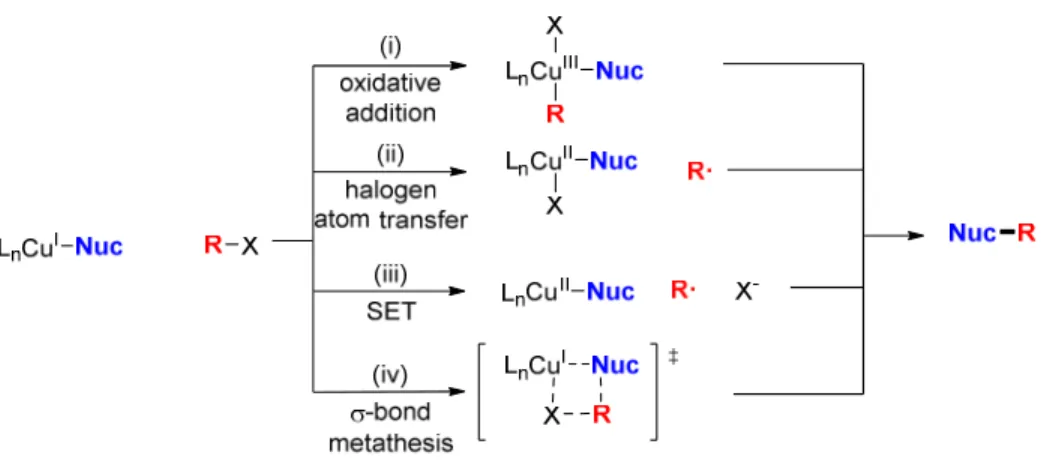
Early mechanistic work on thermal copper-catalyzed coupling reactions demonstrated that CuI–nucleophile complexes are key reaction intermediates, and that these intermediates can react with electrophiles.19 Several mechanisms have been proposed for this step, including (i) oxidative addition to generate a CuIII intermediate, (ii) halogen atom transfer to generate a CuII–halide and electrophile radical, (iii) single-electron transfer (SET) to generate a CuII complex and electrophile radical, and (iv) σ-bond metathesis through a 4- centered transition state (Figure 1.2).
Figure 1.2: Possible pathways for ligand-accelerated Ullmann coupling reactions.
A number of radical clock and radical trapping experiments have disfavored mechanisms involving the formation of a free electrophile radical (Figure 1.3).19, 20 However, these studies do not exclude the possibility of short-lived radical intermediates that undergo rapid recombination. Mechanistic studies on the reaction of iodobenzene and both methanol and methylamine concluded that both iodine atom transfer and single electron transfer mechanisms were accessible, with the preferred pathway depending on the nature of the nucleophile and ancillary ligand.21 While evidence exists for all pathways mentioned, most
proposals favor oxidative addition to generate a CuIII species.22 The Ribas and Stahl groups demonstrated the viability of this oxidative addition mechanism by stoichiometrically demonstrating the synthesis of a macrocyclic CuIII complex that undergoes reductive elimination to form a C–N bond (Scheme 1.3).23 It is likely that different mechanisms may be operative in thermal Ullmann coupling reactions depending on the reaction conditions, or that multiple pathways may be accessible even in a single reaction.
Figure 1.3: Radical clock experiments disfavoring the intermediacy of an aryl radical in the copper-catalyzed C–N (left) and C–S (right) coupling reactions.
Scheme 1.3: Model chemistry demonstrating the viability of a CuI/CuIII cycle based on
oxidative addition and reductive elimination for C–N coupling.
In the photoinduced arylation of carbazole by a copper phosphine complex, early evidence supports a mechanism involving photoexcitation of a bis-phosphine copper carbazolide species as the first step.18 Complexes of this type can be quenched by iodobenzene, and EPR data of a frozen reaction mixture revealed the presence of a CuII species, consistent with photoinduced single-electron transfer (SET) from CuI to iodobenzene to form a CuII species and an aryl radical (Figure 1.4). Radical cyclization
6 experiments supported the intermediacy of an aryl radical, but the mechanism of the bond formation step was not determined.
Figure 1.4: Early mechanistic studies of photoinduced, Cu-catalyzed cross-coupling. (A)
Radical clock experiments demonstrating the intermediacy of an aryl radical. (B) Observation of a CuII species under catalytic conditions, which is proposed to be involved in C–N bond formation.
Following this report, a number of photoinduced copper-catalyzed cross coupling reactions were reported by our group, including N-alkylation,24, 25 S-arylation,26 O- arylation,27 and C-alkylation reactions.28 These reactions did not require traditional ligands such as phosphines, and proceeded under varying conditions. We then sought to investigate the mechanism of these reactions to determine the factors affecting these ligand-free reactions and to characterize the mechanistic diversity of these reactions. In particular, we sought to determine the active species in these reactions, understand their photochemical properties, and better understand the nature of the coupling step.
1.4 Reduction of N2 to NH3 by Molecular Catalysts
The splitting of dinitrogen into ammonia is an essential process for worldwide agriculture, and is performed on a scale of 413 Tg N annually.29 Nitrogen is fixed naturally primarily by nitrogenase enzymes that reside in root nodules of plants such as soybeans and
other legumes.30 However, the amount of nitrogen fixed enzymatically falls significantly short of current worldwide demand.29, 31
As a supplement to natural sources of fixed nitrogen, industrial ammonia production represents a significant cost for the efficient growth of various crops. Industrially, N2 is fixed by the Haber-Bosch process on a scale of 120 Tg N annually.31 The Haber-Bosch process employs an iron-based catalyst to convert H2 and N2 to ammonia at high temperature and pressure. While efficient, the Haber-Bosch process uses 2% of the global energy output and requires significant infrastructure. The majority of this energy input is employed for H2
production through steam reforming and the water-gas shift reaction, which leads to CO2
formation.29, 32 The low volumetric energy density of H2 also requires its on-site production and limits Haber-Bosch plants to areas that have large amounts of hydrocarbon fuels.33 Development of scalable alternatives to the Haber-Bosch process that can be coupled to solar light or energy is important to the decentralized production of ammonia in the developing world, as well as to meeting the growing demand for ammonia-based fertilizer throughout the developed world.
As an alternative to the Haber-Bosch process, the fixation of N2 with protons and electrons has been proposed as a scalable and energy-efficient method.33 In particular, the reduction of dinitrogen with electricity derived from renewable sources is of particular interest. Significant progress has been made in the reduction of dinitrogen by transition metal
8 complexes over the past 50 years, although efficient catalytic reduction of N2 remains difficult.
Figure 1.5: (A) The first example of N2 binding to a transition metal. (B) Protonation of a
metal-bound N2 fragment to give N–H bond formation. (C) Catalytic reduction of N2 to ammonia by a molybdenum complex.
The binding of N2 to a transition metal center was first observed by Allen and Senoff at a RuII center in 1965.34 In 1972, protonation of a metal-bound N2 fragment was first reported by Chatt,35 to give a M=NNH2 species (Figures 1.5A, 1.5B). Catalytic reduction of N2 to ammonia was then first reported by Schrock in 2003 at a Mo center (Figure 1.5C).36 This report was followed by a number of other reports of catalytic N2 reduction, including the reduction of N2 to NH3 by P3BFe by our group.37, 38 Despite the rapidly growing number
of reports of N2 reduction by molecular complexes, chemical reductants and large driving forces are required in nearly every case.
1.4.1 Viability of Electrochemical Reduction
Figure 1.6: (A) Stoichiometric reduction of N2 to ammonia by a tungsten complex at a Hg
pool electrode by Pickett. (B) Electrocatalytic reduction of N2 to ammonia by a molecular iron complex and a cocatalytic redox mediator by our group.
While most examples of molecular N2 fixation have utilized relatively strong chemical reductants as the electron source, there has been long-standing interest in using alternative electron sources in N2 fixation. Reduction of dinitrogen to ammonia without stoichiometric chemical reductants is necessary for coupling ammonia production to sunlight or electricity. In 1985, Pickett and coworkers demonstrated the stoichiometric reduction of N2 to NH3 at an electrode mediated by a tungsten phosphine complex (Figure 1.6A).39–41 Recently, our group has demonstrated the electrocatalytic reduction of N2 at low temperature by a tris-phosphinoborane iron catalyst (P3BFe, Figure 1.6B).42, 43 This was followed by the Berben group’s report of stoichiometric N2 electroreduction by an aluminum complex at
10 lower overpotential.44 These electroreductions demonstrate the viability of a molecular electrochemical strategy to reduce N2 to ammonia.
1.5 Surface Attachment of Molecular Electrocatalysts
Electrocatalysis is fundamentally important for securing our energy future and producing chemical fuels from renewable energy.45 Catalysis by synthetic transition metal complexes offer significant advantages over heterogeneous materials, including the ability to control interactions in their coordination sphere and the multitude of spectroscopic techniques available to study mechanism. These mechanistic understandings can allow rational alteration of catalysts to increase activity and stability.
A number of difficulties arise when soluble molecular complexes are employed as electrocatalysts in solution:46 only a small portion of the added catalyst is electrochemically active at a given time, deleterious bimolecular pathways can occur, catalyst can diffuse into both chambers of the electrochemical cell, and mechanistic study of molecular electrocatalysts presents numerous challenges. To avoid these difficulties, molecular catalysts can be immobilized on an electrode surface. While appealing, catalyst immobilization presents its own challenges. Most immobilization techniques require significant modification to the original catalyst synthesis, and may not be broadly applicable.
It is then difficult to determine the nature of the metal sites on the electrode, and the resulting catalyst activity may differ from that of the freely diffusing catalyst.
Figure 1.7: Overview of common strategies for surface attachment of molecular
electrocatalysts.
Surface immobilization can be achieved by a number of approaches by using various types of catalyst-surface interactions, including both covalent and non-covalent attachment (Figure 1.7). Common covalent strategies include reduction of an aryl diazonium, Cu- catalyzed alkyne-azide click reaction, and alkyne oxidation. Common non-covalent strategies include adsorption of phosphonates on metal oxide layers and adsorption of pyrene moieties onto graphitic carbon surfaces. Covalent attachment methods generally require the incorporation of reactive functional groups and harsh redox processes that may interfere with catalyst synthesis, while adsorption on metal oxide layers allow limited electrode materials to be used.
A number of electrocatalytic reactions relevant to the generation of chemical fuels from electricity have been demonstrated by surface-attached molecular catalysts. The hydrogen evolution reaction (HER) has been heavily studied, as it is the simplest fuel-
12 forming reaction. A broad number of attachment strategies have been demonstrated for HER by an immobilized catalyst.46 The CO2 reduction reaction (CO2RR) has also been explored; the harsher and more reducing conditions required for CO2RR have however limited the applicability of many strategies. Adsorption of pyrene-containing catalysts has been most broadly successful,47–50 although other strategies have been successfully demonstrated.51–57
1.6 Chapter Summaries
Chapter 2 discusses an in-depth mechanistic study of the photoinduced, copper- mediated cross-coupling of aryl thiols with aryl halides. In particular, I focus on the stoichiometric photochemistry and subsequent reactivity of a [CuI(SAr)2] – complex (Ar = 2,6-dimethylphenyl). A broad array of experimental techniques furnish data consistent with a pathway in which a photoexcited [CuI(SAr)2]-* complex undergoes SET to generate a CuII species and an aryl radical, which then couple through an in-cage radical recombination.
Chapter 3 discusses the surface attachment of a P3BFe complex to a carbon electrode, and the electrochemical generation of ammonia from N2 by the surface-appended species.
Synthetic modification of a previously-reported P3BFe complex by addition of three pyrene substituents onto the catalyst backbone allows non-covalent attachment onto a graphite surface. The resulting functionalized electrode shows good stability towards desorption under highly reducing conditions, and produces 1.4 equiv NH3 per iron site. The data
presented provide the first demonstration of electrochemical nitrogen fixation by a molecular complex appended to an electrode.
1.7 References
(1) Lewis, N. S.; Nocera, D. G. Powering the Planet: Chemical Challenges in Solar Energy Utilization. Proc. Natl. Acad. Sci. 2006, 103 (43), 15729–15735.
(2) Balzani, V.; Credi, A.; Venturi, M. Photochemical Conversion of Solar Energy.
ChemSusChem 2008, 1 (1–2), 26–58.
(3) Olah, G. A. Beyond Oil and Gas: The Methanol Economy. Angew. Chem. Int. Ed.
2005, 44 (18), 2636–2639.
(4) J. Dunn, P. The Importance of Green Chemistry in Process Research and Development. Chem. Soc. Rev. 2012, 41 (4), 1452–1461.
(5) Torborg, C.; Beller, M. Recent Applications of Palladium-Catalyzed Coupling Reactions in the Pharmaceutical, Agrochemical, and Fine Chemical Industries. Adv.
Synth. Catal. 2009, 351 (18), 3027–3043.
(6) Chirik, P.; Morris, R. Getting Down to Earth: The Renaissance of Catalysis with Abundant Metals. Acc. Chem. Res. 2015, 48 (9), 2495–2495.
(7) Holland, P. L. Distinctive Reaction Pathways at Base Metals in High-Spin Organometallic Catalysts. Acc. Chem. Res. 2015, 48 (6), 1696–1702.
(8) Ullmann, F.; Bielecki, J. Ueber Synthesen in Der Biphenylreihe. Berichte Dtsch.
Chem. Ges. 1901, 34 (2), 2174–2185.
14 (9) Hassan, J.; Sévignon, M.; Gozzi, C.; Schulz, E.; Lemaire, M. Aryl−Aryl Bond
Formation One Century after the Discovery of the Ullmann Reaction. Chem. Rev.
2002, 102 (5), 1359–1470.
(10) Johansson Seechurn, C. C. C.; Kitching, M. O.; Colacot, T. J.; Snieckus, V.
Palladium-Catalyzed Cross-Coupling: A Historical Contextual Perspective to the 2010 Nobel Prize. Angew. Chem. Int. Ed. 2012, 51 (21), 5062–5085.
(11) Beletskaya, I. P.; Cheprakov, A. V. The Complementary Competitors: Palladium and Copper in C–N Cross-Coupling Reactions. Organometallics 2012, 31 (22), 7753–
7808.
(12) Thapa, S.; Shrestha, B.; K. Gurung, S.; Giri, R. Copper-Catalysed Cross-Coupling:
An Untapped Potential. Org. Biomol. Chem. 2015, 13 (17), 4816–4827.
(13) Horváth, O. Photochemistry of Copper(I) Complexes. Coord. Chem. Rev. 1994, 135–
136, 303–324.
(14) Harkins, S. B.; Peters, J. C. A Highly Emissive Cu2N2 Diamond Core Complex Supported by a [PNP]– Ligand. J. Am. Chem. Soc. 2005, 127 (7), 2030–2031.
(15) Miller, A. J. M.; Dempsey, J. L.; Peters, J. C. Long-Lived and Efficient Emission from Mononuclear Amidophosphine Complexes of Copper. Inorg. Chem. 2007, 46 (18), 7244–7246.
(16) Lotito, K. J.; Peters, J. C. Efficient Luminescence from Easily Prepared Three- Coordinate Copper(I) Arylamidophosphines. Chem. Commun. 2010, 46 (21), 3690–
3692.
(17) Deaton, J. C.; Switalski, S. C.; Kondakov, D. Y.; Young, R. H.; Pawlik, T. D.;
Giesen, D. J.; Harkins, S. B.; Miller, A. J. M.; Mickenberg, S. F.; Peters, J. C. E-Type Delayed Fluorescence of a Phosphine-Supported Cu2(μ-NAr2)2 Diamond Core:
Harvesting Singlet and Triplet Excitons in OLEDs. J. Am. Chem. Soc. 2010, 132 (27),
9499–9508.
(18) Creutz, S. E.; Lotito, K. J.; Fu, G. C.; Peters, J. C. Photoinduced Ullmann C–N Coupling: Demonstrating the Viability of a Radical Pathway. Science 2012, 338 (6107), 647–651.
(19) Tye, J. W.; Weng, Z.; Johns, A. M.; Incarvito, C. D.; Hartwig, J. F. Copper Complexes of Anionic Nitrogen Ligands in the Amidation and Imidation of Aryl Halides. J. Am.
Chem. Soc. 2008, 130 (30), 9971–9983.
(20) Chen, C.; Weng, Z.; Hartwig, J. F. Synthesis of Copper(I) Thiolate Complexes in the Thioetherification of Aryl Halides. Organometallics 2012, 31 (22), 8031–8037.
(21) Jones, G. O.; Liu, P.; Houk, K. N.; Buchwald, S. L. Computational Explorations of Mechanisms and Ligand-Directed Selectivities of Copper-Catalyzed Ullmann-Type Reactions. J. Am. Chem. Soc. 2010, 132 (17), 6205–6213.
(22) Monnier, F.; Taillefer, M. Catalytic C–C, C–N, and C–O Ullmann-Type Coupling Reactions. Angew. Chem. Int. Ed. 2009, 48 (38), 6954–6971.
(23) Casitas, A.; King, A. E.; Parella, T.; Costas, M.; Stahl, S. S.; Ribas, X. Direct Observation of CuI/CuIII Redox Steps Relevant to Ullmann-Type Coupling Reactions.
Chem. Sci. 2010, 1 (3), 326–330.
16 (24) Bissember, A. C.; Lundgren, R. J.; Creutz, S. E.; Peters, J. C.; Fu, G. C. Transition-
Metal-Catalyzed Alkylations of Amines with Alkyl Halides: Photoinduced, Copper- Catalyzed Couplings of Carbazoles. Angew. Chem. Int. Ed. 2013, 52 (19), 5129–5133.
(25) Ziegler, D. T.; Choi, J.; Muñoz-Molina, J. M.; Bissember, A. C.; Peters, J. C.; Fu, G.
C. A Versatile Approach to Ullmann C–N Couplings at Room Temperature: New Families of Nucleophiles and Electrophiles for Photoinduced, Copper-Catalyzed Processes. J. Am. Chem. Soc. 2013, 135 (35), 13107–13112.
(26) Uyeda, C.; Tan, Y.; Fu, G. C.; Peters, J. C. A New Family of Nucleophiles for Photoinduced, Copper-Catalyzed Cross-Couplings via Single-Electron Transfer:
Reactions of Thiols with Aryl Halides Under Mild Conditions (0 °C). J. Am. Chem.
Soc. 2013, 135 (25), 9548–9552.
(27) Tan, Y.; Muñoz-Molina, J. M.; Fu, G. C.; Peters, J. C. Oxygen Nucleophiles as Reaction Partners in Photoinduced, Copper-Catalyzed Cross-Couplings: O-Arylations of Phenols at Room Temperature. Chem. Sci. 2014, 5 (7), 2831–2835.
(28) Ratani, T. S.; Bachman, S.; Fu, G. C.; Peters, J. C. Photoinduced, Copper-Catalyzed Carbon–Carbon Bond Formation with Alkyl Electrophiles: Cyanation of Unactivated Secondary Alkyl Chlorides at Room Temperature. J. Am. Chem. Soc. 2015, 137 (43), 13902–13907.
(29) Fowler, David; Coyle, Mhairi; Skiba, Ute; Sutton, Mark A.; Cape, J. Neil; Reis, Stefan; Sheppard, Lucy J.; Jenkins, Alan; Grizzetti, Bruna; Galloway, James N.; et al.
The Global Nitrogen Cycle in the Twenty-First Century. Philos. Trans. R. Soc. B Biol.
Sci. 2013, 368 (1621), 20130164.
(30) Mus, F.; Crook, M. B.; Garcia, K.; Costas, A. G.; Geddes, B. A.; Kouri, E. D.;
Paramasivan, P.; Ryu, M.-H.; Oldroyd, G. E. D.; Poole, P. S.; et al. Symbiotic Nitrogen Fixation and the Challenges to Its Extension to Nonlegumes. Appl Env.
Microbiol 2016, 82 (13), 3698–3710.
(31) Erisman, J. W.; Sutton, M. A.; Galloway, J.; Klimont, Z.; Winiwarter, W. How a Century of Ammonia Synthesis Changed the World. Nat. Geosci. 2008, 1, 636–639.
(32) Recently, the possibility of producing ammonia from dihydrogen derived from water electrolysis has also been explored as a low-carbon alternative to steam reforming.
However, this process Is extremely energy intensive and relies on a non-abundant platinum catalyst.
(33) Singh, V.; Dincer, I.; Rosen, M. A. Chapter 4.2 - Life Cycle Assessment of Ammonia Production Methods. In Exergetic, Energetic and Environmental Dimensions; Dincer, I., Colpan, C. O., Kizilkan, O., Eds.; Academic Press, 2018; pp 935–959.
(34) Allen, A. D.; Senoff, C. V. Nitrogenopentammineruthenium(II) Complexes. Chem.
Commun. Lond. 1965, 0 (24), 621–622.
(35) Chatt, J.; Heath, G. A.; Richards, R. L. The Reduction of Ligating Dinitrogen to Yield a Ligating N2H2 Moiety. J. Chem. Soc. Chem. Commun. 1972, 0 (18), 1010–1011.
(36) Yandulov, D. V.; Schrock, R. R. Catalytic Reduction of Dinitrogen to Ammonia at a Single Molybdenum Center. Science 2003, 301 (5629), 76–78.
(37) Anderson, J. S.; Rittle, J.; Peters, J. C. Catalytic Conversion of Nitrogen to Ammonia by an Iron Model Complex. Nature 2013, 501 (7465), 84–87.
(38) Roux, Y.; Duboc, C.; Gennari, M. Molecular Catalysts for N2 Reduction: State of the Art, Mechanism, and Challenges. ChemPhysChem 2017, 18 (19), 2606–2617.
(39) Pickett, C. J.; Talarmin, J. Electrosynthesis of Ammonia. Nature 1985, 317 (6038), 18
652.
(40) Al-Salih, T. I.; Pickett, C. J. Electron-Transfer Reactions in Nitrogen Fixation. Part 1.
The Electrosynthesis of Dinitrogen, Hydride, Isocyanide, and Carbonyl Complexes of Molybdenum: Intermediates, Mechanisms, and Energetics. J. Chem. Soc. Dalton Trans. 1985, 6, 1255–1264.
(41) Pickett, C. J.; Ryder, K. S.; Talarmin, J. Electron-Transfer Reactions in Nitrogen Fixation. Part 2. The Electrosynthesis of Ammonia: Identification and Estimation of Products. J. Chem. Soc. Dalton Trans. 1986, 7, 1453–1457.
(42) Chalkley, M. J.; Del Castillo, T. J.; Matson, B. D.; Roddy, J. P.; Peters, J. C. Catalytic N2-to-NH3 Conversion by Fe at Lower Driving Force: A Proposed Role for Metallocene-Mediated PCET. ACS Cent. Sci. 2017, 3 (3), 217–223.
(43) Chalkley, M. J.; Del Castillo, T. J.; Matson, B. D.; Peters, J. C. Fe-Mediated Nitrogen Fixation with a Metallocene Mediator: Exploring pKa Effects and Demonstrating Electrocatalysis. J. Am. Chem. Soc. 2018, 140 (19), 6122–6129.
(44) Sherbow, T. J.; Thompson, E. J.; Arnold, A.; Sayler, R. I.; Britt, R. D.; Berben, L. A.
Electrochemical Reduction of N2 to NH3 at Low Potential by a Molecular Aluminum Complex. Chem. – Eur. J. 2019, 25 (2), 454–458.
(45) Markovic, N. M. Electrocatalysis: Interfacing Electrochemistry. Nat. Mater. 2013, 12
(2), 101–102.
(46) Bullock, R. M.; Das, A. K.; Appel, A. M. Surface Immobilization of Molecular Electrocatalysts for Energy Conversion. Chem. – Eur. J. 2017, 23 (32), 7626–7641.
(47) Axet, M. R.; Dechy-Cabaret, O.; Durand, J.; Gouygou, M.; Serp, P. Coordination Chemistry on Carbon Surfaces. Coord. Chem. Rev. 2016, 308, 236–345..
(48) Kang, P.; Zhang, S.; Meyer, T. J.; Brookhart, M. Rapid Selective Electrocatalytic Reduction of Carbon Dioxide to Formate by an Iridium Pincer Catalyst Immobilized on Carbon Nanotube Electrodes. Angew. Chem. Int. Ed. 2014, 53 (33), 8709–8713.
(49) Maurin, A.; Robert, M. Noncovalent Immobilization of a Molecular Iron-Based Electrocatalyst on Carbon Electrodes for Selective, Efficient CO2-to-CO Conversion in Water. J. Am. Chem. Soc. 2016, 138 (8), 2492–2495.
(50) Blakemore, J. D.; Gupta, A.; Warren, J. J.; Brunschwig, B. S.; Gray, H. B.
Noncovalent Immobilization of Electrocatalysts on Carbon Electrodes for Fuel Production. J. Am. Chem. Soc. 2013, 135 (49), 18288–18291.
(51) Rosser, T. E.; Windle, C. D.; Reisner, E. Electrocatalytic and Solar-Driven CO2
Reduction to CO with a Molecular Manganese Catalyst Immobilized on Mesoporous TiO2. Angew. Chem. Int. Ed. 2016, 55 (26), 7388–7392.
(52) Yao, S. A.; Ruther, R. E.; Zhang, L.; Franking, R. A.; Hamers, R. J.; Berry, J. F.
Covalent Attachment of Catalyst Molecules to Conductive Diamond: CO2 Reduction Using “Smart” Electrodes. J. Am. Chem. Soc. 2012, 134 (38), 15632–15635.
(53) Kramer, W. W.; McCrory, C. C. L. Polymer Coordination Promotes Selective CO2
Reduction by Cobalt Phthalocyanine. Chem. Sci. 2016, 7 (4), 2506–2515.
(54) Goff, A. L.; Artero, V.; Jousselme, B.; Tran, P. D.; Guillet, N.; Métayé, R.; Fihri, A.;
Palacin, S.; Fontecave, M. From Hydrogenases to Noble Metal–Free Catalytic Nanomaterials for H2 Production and Uptake. Science 2009, 326 (5958), 1384–1387.
20 (55) Rodriguez‐Maciá, P.; Dutta, A.; Lubitz, W.; Shaw, W. J.; Rüdiger, O. Direct
Comparison of the Performance of a Bio-Inspired Synthetic Nickel Catalyst and a [NiFe]-Hydrogenase, Both Covalently Attached to Electrodes. Angew. Chem. Int. Ed.
2015, 54 (42), 12303–12307.
(56) Zhanaidarova, A.; Moore, C. E.; Gembicky, M.; Kubiak, C. P. Covalent Attachment of [Ni(Alkynyl-Cyclam)]2+ Catalysts to Glassy Carbon Electrodes. Chem. Commun.
2018, 54 (33), 4116–4119.
(57) Zhanaidarova, A.; Ostericher, A. L.; Miller, C. J.; Jones, S. C.; Kubiak, C. P. Selective Reduction of CO2 to CO by a Molecular Re(Ethynyl-Bpy)(CO)3Cl Catalyst and Attachment to Carbon Electrode Surfaces. Organometallics 2019, 38 (6), 1204–1207.