Environmental Science & Technology Letters is published by the American Chemical
in Surface Waters and Wastewaters during Chloramination
David Hanigan, E. Michael Thurman, Imma Ferrer, Yang Zhao, Susan Andrews, Jinwei Zhang, Pierre Herckes, and Paul Westerhoff
Environ. Sci. Technol. Lett., Just Accepted Manuscript • DOI: 10.1021/acs.estlett.5b00096 • Publication Date (Web): 08 May 2015 Downloaded from http://pubs.acs.org on May 15, 2015
Just Accepted
“Just Accepted” manuscripts have been peer-reviewed and accepted for publication. They are posted online prior to technical editing, formatting for publication and author proofing. The American Chemical Society provides “Just Accepted” as a free service to the research community to expedite the dissemination of scientific material as soon as possible after acceptance. “Just Accepted” manuscripts appear in full in PDF format accompanied by an HTML abstract. “Just Accepted” manuscripts have been fully peer reviewed, but should not be considered the official version of record. They are accessible to all readers and citable by the Digital Object Identifier (DOI®). “Just Accepted” is an optional service offered to authors. Therefore, the “Just Accepted” Web site may not include all articles that will be published in the journal. After a manuscript is technically edited and formatted, it will be removed from the “Just Accepted” Web site and published as an ASAP article. Note that technical editing may introduce minor changes to the manuscript text and/or graphics which could affect content, and all legal disclaimers and ethical guidelines that apply to the journal pertain. ACS cannot be held responsible for errors or consequences arising from the use of information contained in these “Just Accepted” manuscripts.
Methadone Contributes to N-nitrosodimethylamine Formation in Surface Waters and 1
Wastewaters during Chloramination 2
3
David Hanigan1*, E. Michael Thurman2, Imma Ferrer2, Yang Zhao3, Susan Andrews3, Jinwei 4
Zhang4, Pierre Herckes4, Paul Westerhoff1 5
6
1School of Sustainable Engineering and the Built Environment, Arizona State University, Box 7
3005, Tempe, AZ 85287-3005 8
2Center for Environmental Mass Spectrometry, Department of Environmental Engineering, 9
University of Colorado at Boulder, Boulder, CO 80309 10
3Department of Civil Engineering, University of Toronto, 35 St. George Street, Toronto, ON, 11
Canada M5S 1A4 12
4Department of Chemistry and Biochemistry, Arizona State University, Tempe, AZ 85287- 13
1604 14
15
*Corresponding author: email: [email protected]; phone: 480-727-2911 ex. 72911 16
17
Keywords: Disinfection by-product, Precursor, N-nitrosodimethylamine, NDMA, Methadone, 18
dimethylisopropylamine.
19 20 21
TOC Art 22
23 24
1 Abstract
25
N-nitrosodimethylamine (NDMA) is a probable human carcinogen that forms in drinking 26
water as a disinfection by-product. Several specific precursor chemicals present during 27
chloramination are known but cannot account for the total observed NDMA formation potential 28
(FP) in drinking waters. We discovered a pharmaceutical precursor of NDMA with high FP 29
using a liquid chromatography/quadrupole/time-of-flight mass spectrometry (LC/QTOF-MS) 30
screening procedure. The pharmaceutical methadone, which is used to mitigate heroin 31
withdrawal symptoms and is also prescribed for chronic pain, contains a dimethylisopropylamine 32
functional group that reacts to form high amounts of NDMA upon chloramination. In this study, 33
methadone had a molar NDMA yield ranging from 23% to 70% dependent upon chloramine 34
dose (1 to 150 mgCl2/L) and was responsible for between 1 and 10% of NDMA FP in most raw 35
surface waters in which it was detected and up to 62% of NDMA FP in wastewater. Samples 36
with higher methadone concentrations had greater NDMA FP. We measured a median 37
methadone concentration of 23 ng/L with a range of 1 to 2,256 ng/L among detections, which 38
was consistent with high occurrence rates and environmental persistence for methadone in the 39
published literature for surface waters and wastewaters. A literature review of methadone use, 40
metabolism, and fate in the U.S. resulted in a prediction of low ng/L levels of methadone- 41
associated NDMA FP at drinking water treatment plants (DWTPs) downstream of communities 42
using methadone. Medicinal use of methadone potentially displaces and transforms the health 43
risks associated with heroin use by individuals to possible cancer risk for populations served by 44
downstream DWTPs. This work is among the first to contrast known public health benefits of 45
pharmaceutical-taking patients against the potential exposure of millions of people to 46
physiologically-relevant levels of carcinogenic NDMA in chloraminated drinking water.
47
2 Introduction
48
N-nitrosodimethylamine (NDMA) is a disinfection by-product (DBP) of regulatory concern 49
due to its carcinogenic potential and occurrence.1,2 Health Canada, Massachusetts, and California 50
have set regulatory limits, guidance limits, or notification levels in the 10 to 40 ng/L range.3-5 51
NDMA forms in drinking water from a reaction between chloramines and predominantly 52
unidentified organic nitrogen precursors, and these precursors appear to be strongly linked with 53
the presence of treated wastewater.6,7 While several model compounds produce NDMA upon 54
chloramination,8-12 either their NDMA yields are low or the occurrence is too low at the point of 55
chloramination to account for NDMA formation.7,13 The only current options to remove NDMA 56
precursors in drinking water treatment plants (DWTPs) are nonselective control strategies (e.g., 57
activated carbon or pre-oxidation), which are potentially cost prohibitive or confounded by 58
unintended consequences such as formation of other DBPs.14 Without knowledge of precursor 59
chemical structures and characteristics, mitigation strategies for NDMA formation in DWTPs are 60
difficult to optimize.
61
Current research regarding NDMA precursors is limited to applying chloramines to model 62
compounds that contain organic nitrogen. Wastewater is well known to contain higher amounts 63
of NDMA precursors,6 and thus there has been a significant effort to identify pharmaceutical and 64
personal care products present in wastewater that are NDMA precursors.11 Other research has 65
focused on agricultural runoff and led to the discovery that diuron, a herbicide, produces NDMA 66
upon chloramination.15 This approach has led to discovery of multiple NDMA precursors with a 67
range of molar NDMA yields but the occurrence of such compounds in DWTP intakes is either 68
unknown or not great enough to account for a significant fraction of the total NDMA formation 69
potential (FP) of the water.13 For example, ranitidine has high NDMA yield upon chloramination 70
but no occurrence, and dimethylamine has high occurrence but is only responsible for low ng/L 71
levels of NDMA due to low NDMA yield. However, both the occurrence of anthropogenic 72
chemicals in the environment16 and the wastewater content in U.S. surface water are increasing,17 73
and therefore it is likely that NDMA precursor loadings will consequently increase. In addition, 74
22% of the U.S. population was served with chloraminated drinking water in 2010, an increased 75
from 19% in 2007.18 Thus, discovering NDMA precursors with moderate to high yield that are 76
likely to occur in surface water could lead to targeted treatment strategies that reduce NDMA 77
formation and thus cancer risk to end users of chloraminated drinking water.
78
Methadone is a pharmaceutical that contains organic nitrogen (tertiary amine) and is typically 79
used to treat heroin addiction but is becoming more commonly prescribed for chronic non-cancer 80
pain and to mitigate withdrawal symptoms associated with prescription opiates (e.g., 81
morphine).19 In the U.S. in 2009, 4.4 million methadone prescriptions (approximately 1.5/100 82
U.S. persons) were issued, which includes only methadone distributed for pain relief and not to 83
substance abuse treatment centers.19,20 In 2013, there were 330,308 persons (approximately 84
1/1,000 U.S. persons) being treated with methadone for substance abuse, which was 26% of all 85
U.S. substance abuse clients.21 The 2014 production quota of methadone in the U.S. was 31,875 86
kg, or approximately 274 mg day-1 1000 U.S. persons-1.22 Methadone use is marginally lower in 87
Europe, where use was reported as 0.3–232,23 138,24 14825 (estimated from concentrations in 88
WWTPs), and 9726 (National Health Service data) mg day-1 1000 people-1, in Spain, Belgium, 89
Croatia, and the United Kingdom, respectively. Approximately 28% of ingested methadone is 90
excreted in the urine as unmetabolized drug (although this varies from 10-60% based on patient 91
sex and urine pH).27-32 EPISuite modeling and occurrence data predict methadone removal in 92
wastewater treatment plants (WWTPs) to be low (27%33 and 0 to 44%,23,25,34-37
respectively).
93
Methadone removal in the environment is also predicted to be slow, having a predicted lifetime 94
of several months.33 Estimated NDMA FP from methadone in DWTPs downstream of WWTP 95
effluents results in one to tens of ng/L NDMA, which is typical for DWTPs of this nature (See 96
Health Implications). Pre-oxidation and granular activated carbon (GAC) remove methadone 97
well in DWTPs,34 which is similar to what has been seen previously for NDMA FP 98
reduction.38,39 Methadone therefore likely has the characteristics (occurrence and environmental 99
persistence) to be a precursor of importance to NDMA formation.
100
The goal of this research was to identify NDMA precursors in surface water and wastewater 101
that have both high occurrence and high NDMA molar yield. Our approach was to use liquid 102
chromatography/quadrupole/time-of-flight mass spectrometry (LC/QTOF-MS) with accurate 103
mass to identify NDMA precursors via neutral loss fragmentation of the dimethylamine 104
structure, which may form NDMA upon chlorination. If successful, this approach will be useful 105
to identify new NDMA precursors to suggest new treatment techniques or DWTP source water 106
protection strategies. This paper details the approach and identifies methadone, a pharmaceutical 107
that has not been previously reported as a precursor of NDMA in surface water and wastewater.
108
3 Materials and Methods
109
A list of reagent chemicals and a description of the analytical methods can be found in the 110
supporting information (SI). Surface waters (n=10) and the secondary effluent of a wastewater 111
treatment plant were collected from across the U.S. and Canada between August 2014 and 112
February 2015. The wastewater plant treated 45,000 m3/d (roughly 120,000 people at 378 L/d) 113
and was selected because we have conducted research at this facility located near our 114
laboratories for over a decade.40,41 Samples ranged in organic matter characteristics (dissolved 115
organic carbon from 2.5 to 6 mgC/L and total dissolved nitrogen from 0.4 to 5.4 mgN/L) and in 116
the potential contribution from upstream wastewater and agricultural sources. The sample 117
locations are known to have relatively high NDMA FP (20 to 600 ng/L) and thus were expected 118
to have high concentrations of NDMA precursors.
119
Samples were shipped overnight in coolers with ice packs within 24 hours of collection.
120
Immediately upon arrival, samples were filtered with pre-combusted Whatman GF/D filters (2.7 121
µm nominal pore size, GE Healthcare, Piscataway, NJ) to remove colloids and particles that may 122
impede solid phase extraction. The filtered samples were stored in a refrigerated (4°C) chamber 123
for a maximum of one week before extraction/isolation.
124
NDMA FP tests for methadone yield and kinetics (details contained in the SI) were conducted 125
on the filtered water or Milli-Q™ water. A method to capture and elute NDMA precursors was 126
developed, and recovery of precursors into cation exchange (Oasis MCX) isolates ranged from 127
41 to 168% (coefficient of variance from 0.01 to 1.04). The details of this method are given in 128
the SI and will be the subject of a future publication. One fraction of the isolate was reconstituted 129
into Milli-Q™ water and chloraminated under FP conditions to determine recovery of bulk 130
NDMA precursors (reconstituted NDMA FP / raw water NDMA FP = bulk precursor recovery).
131
A second fraction was used for NDMA precursor identification by LC/QTOF-MS and 132
methadone quantification by gas chromatography/mass spectrometry (GC/MS) and liquid 133
chromatography/mass spectrometry (LC/MS). Further details regarding NDMA and methadone 134
quantification as well as a description of the LC/QTOF-MS system can be found in the SI. A 135
blank (Milli-Q™ water) was also isolated to confirm that methadone was not a contaminant 136
leaching from the cation exchange resin, and none was found.
137
4 Results and Discussion
138
4.1 Discovery of a new pharmaceutical NDMA precursor: methadone 139
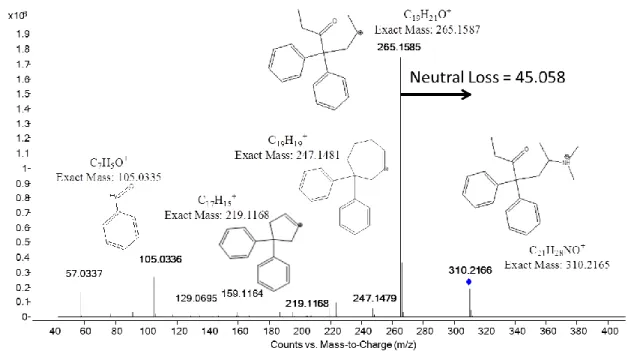
Methadone, as an NDMA precursor, was discovered in wastewater using a LC/QTOF-MS 140
screening procedure for the presence of dimethylamine, with a diagnostic loss of 45.058 mass 141
units corresponding to the loss of a dimethylamine structure from the molecule (Figure 1). Using 142
data files from the instrument software that were modified with MATLAB®, it was possible to 143
extract ions with the correct diagnostic ion loss of 45.058 from the sample. Using this procedure, 144
an ion with mass of 310.2165 m/z was found in the water sample that had a dimethylamine loss 145
(45.058). The ion gave a formula of C21H28NO (Figure 1), which corresponds to over 800 146
possible structures in ChemSpider for the neutral molecule.42 Several accurate mass tools were 147
applied to help determine the structure and identify the unknown, including extraction of 148
diagnostic ions,43 MS/MS analysis,43 isotope pattern mass spacing,44 fragment structural 149
analysis,45 and database extractions.46 Figure 1 shows the results of the MS-MS analysis and 150
structural fragments consistent with a putative methadone identification, which was later 151
confirmed with a pure methadone standard by retention time and MS-MS analysis (Figure SI-1) 152
with accurate mass. A more detailed explanation of the screening and MATLAB® procedure will 153
be discussed in a later publication that presents instrumental analytical techniques for unknown 154
NDMA precursors. Next was to confirm that the dimethylamine loss was consistent with a high 155
NDMA formation potential.
156 157
158
Figure 1 – MS/MS analysis of wastewater sample with putative structures for methadone 159
fragments, which matches MS/MS analysis of a pure standard with less than 1-ppm mass 160
accuracy. Note the loss of a dimethylamine with a neutral loss of 45.058 mass units.
161 162
4.2 NDMA formation yield and kinetics from methadone 163
After confirmation of methadone by the LC/QTOF-MS screening procedure, a methadone 164
standard was purchased, added to Milli-Q™ water, and dosed with monochloramine for varying 165
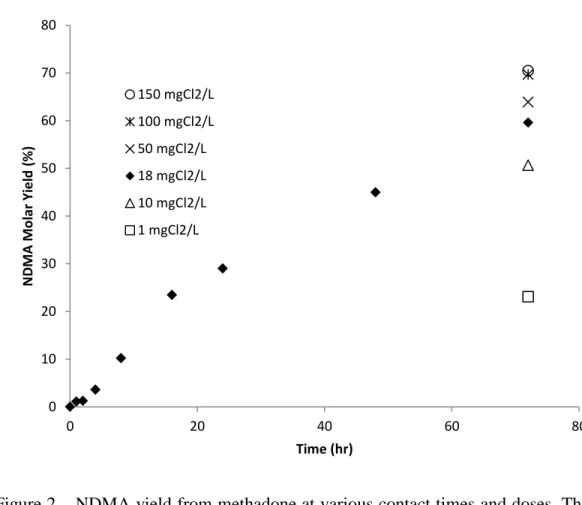
contact times to determine NDMA formation yield and kinetics (Figure 2). Methadone forms 166
NDMA at low monochloramine doses (1 to 10 mgCl2/L) and at doses typically used in NDMA 167
FP tests (>10 mgCl2/L). At a dose and contact time commonly used in NDMA FP studies (18 168
mgCl2/L for 72 hours), methadone had a molar yield of 60%. At this monochloramine dose, 169
NDMA formation from methadone was moderately slow (Figure 2; Kapp = 0.035 M-1 s-1 modeled 170
using previously published methods47,48) and within the range of previously observed rates for 171
NDMA formation in a wastewater-impacted surface water.47,48 As the monochloramine contact 172
time increased from 0 to 72 hr, NDMA formation from methadone increased but did not plateau 173
at longer contact times, meaning that our estimate of 60% yield at 72 hours is potentially a 174
conservative estimate with longer contact times.
175
In addition to the yield under FP conditions, we investigated whether monochloramine dose 176
would impact the total NDMA formed. In Figure 2, we show that increasing monochloramine 177
dose increased the NDMA yield of methadone (from 23 to 70% at doses of 1 to 150 mgCl2/L), a 178
phenomenon that has been similarly observed in other natural and engineered (wastewater) water 179
sources recently by our team.47,48 180
Methadone is one of only six compounds known to have a molar yield of NDMA in excess of 181
50% under 72 hr formation potential conditions; the five others are ranitidine,11 182
dimethylisopropylamine,8 5-((Dimethylamino)methyl)furan-2-methanol,9 183
dimethylbenzylamine,8,10,49 and N,N-Dimethyl-1-(2-thienyl)methanamine).8 The other five 184
compounds have not been detected or have not been looked for in wastewater effluents, however 185
published literature reports methadone occurs in both wastewater and surface water.23,25,34-37,50-53
186 187
188
Figure 2 – NDMA yield from methadone at various contact times and doses. The matrix was 189
Milli-Q™ water borate buffered at pH 8. The data points shown are averages of duplicates with 190
relative deviation <8%.
191 192
4.3 Occurrence of methadone and contribution to NDMA formation 193
Organic matter from a secondary wastewater effluent sample was isolated using cation 194
exchange (Oasis MCX) in triplicate to search for the DMA structure. After discovering 195
methadone in extracts from a WWTP sample by LC/QTOF-MS (Section 4.1), we quantified 196
methadone in the extracts by GC/MS and found that concentrations ranged from 32 to 2,256 197
ng/mL (Figure 3). Because methadone can degrade in the inlet of a GC,54 we used LC/MS to 198
confirm our quantification and the results agreed well. Furthermore, although our extraction 199
0 10 20 30 40 50 60 70 80
0 20 40 60 80
NDMA Molar Yield (%)
Time (hr) 150 mgCl2/L
100 mgCl2/L 50 mgCl2/L 18 mgCl2/L 10 mgCl2/L 1 mgCl2/L
method was similar to published methadone extraction procedures,36,50 our goal during method 200
development was to screen samples for dimethylamine structures. Therefore, an isotopically- 201
labeled methadone was not used to quantify losses during solid phase extraction. Consequently, 202
our estimations are likely conservative and inherently variable. When exposed to 18 mgCl2/L 203
monochloramine (the same as that used in our FP tests on the raw water), methadone had a 60%
204
molar yield to NDMA at 72 hr. Using this yield, methadone contributed up to 323 ng/L 205
(assuming 100% recovery across SPE) to the NDMA FP of this water, or up to 62% of the total 206
NDMA formation potential of the non-methadone spiked reconstituted wastewater isolates 207
(reconstituted NDMA FP of 525 ng/L for this extract). We note that two of the methadone 208
extracts contributed 1 to 13% of NDMA formation with one extract contributing 62%.
209
We also isolated 10 surface water samples for DMA structure searches by LC/QTOF-MS, and 210
methadone was quantifiable in five of these sample isolates (SW 3, 5, 6, 7, and 9 in Table SI-1).
211
The contribution to NDMA FP ranged from <1 to 3% of the reconstituted isolates (Figure 3). In 212
general, isolates with greater methadone concentrations formed more NDMA when reconstituted 213
into Milli-Q™ water. One sample had unusually high NDMA FP in the raw water (>500 ng/L);
214
this sample is known to be heavily impacted by wastewater and had the greatest contribution of 215
NDMA FP from methadone, albeit still relatively low (1 to 3%). Five surface water samples had 216
no detectable methadone.
217
218
219
Figure 3 – Percent contribution of methadone to NDMA FP in six water sources. Methadone 220
recovery across SPE was unknown. Squares and Xs show a wastewater and a surface water, 221
respectively, with triplicate extractions and quantification (GC/MS). Other symbols represent 222
four surface waters that were extracted in triplicate, but only a single sample was used for 223
quantification (LC/MS).
224 225
Because our sampling campaign and methods were not initially developed to specifically 226
identify and quantify methadone, we searched the literature for methadone occurrence data 227
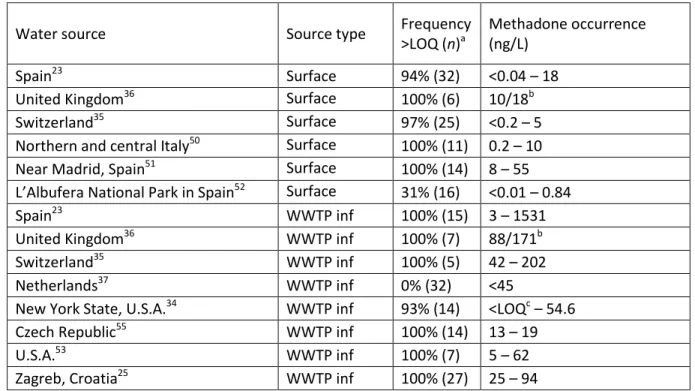
(Table 1). Available data regarding methadone occurrence is primarily from Europe with only 228
two studies in the U.S. reporting concentrations. Methadone occurred in all WWTP influents 229
except when the limit of quantification (LOQ) was insufficiently low (LOQ = 45 ng/L in one 230
study for WWTP influent samples), and methadone was poorly removed through conventional 231
WWTPs (37%,23 42%,35 44%,36 0%,37 0-16%,34 and 26%25). The finding that methadone is 232
poorly removed in WWTPs agrees well with the predicted removal by EPISuite (27%).33 It 233
0 100 200 300 400 500 600 700 800 900
0.1 1 10 100 1000 10000
NDMA FP in Reconstituted Sample (ng/L)
Methadone in Isolate (ng/mL)
1% 13%
0.2-0.3%
1-3%
62%
diphenylpyrrolidine (EDDP). This metabolite has been reported as two to three times more 235
abundant in wastewater than the parent compound,23,34-36 and the NDMA FP of the metabolite 236
EDDP is unknown, although it is likely to be low based on demethylation and cyclisation of the 237
N. Methadone is generally ubiquitous in surface waters, occurring in all European samples 238
except those of a state controlled park, and ranged in concentration from non-detectable to 55 239
ng/L. Only two studies published concentrations in the U.S.; both studies were from WWTPs 240
and reported lower concentrations than Europe. Based on this literature review and a molar yield 241
of 60%, the contribution to NDMA formation in surface and wastewater from methadone could 242
be in the low ng/L and the hundreds of ng/L, respectively. We conclude that methadone is a 243
potentially important precursor as NDMA typically forms at roughly the same order of 244
magnitudes as these preliminarily calculated values.
245 246
Table 1 – Summary of methadone occurrence in surface water and WWTP influents (inf).
247
an: number of samples 248
bMean/max are shown as no range was given.
249
cLOQ between 1 and 10 ng/L 250
251
4.4 Health implications 252
Methadone has clear benefits as a medicinal tool. However, it is poorly removed in WWTP 253
(<50%), relatively persistent in the environment (months),33 and has the potential to contribute to 254
the increased cancer risk associated with nitrosamines in chloraminated drinking water. For 255
example, a community of 100,000 people could contain 1,500 chronic pain treatment and 100 256
substance abuse treatment methadone users.19-21 Notably, the number of prescriptions of 257
methadone to treat chronic pain is 1.5 orders of magnitude greater than for substance abuse 258
treatment in the U.S. and potentially avoidable using other prescription drugs. At the minimum 259
recommended dose of 7.5 mg/d,19 the community will consume 12 g/d of methadone, of which 260
approximately 28% is excreted as the parent drug in urine.27-32 These are conservative estimates 261
of doses and excretion, and if applied to the total number of methadone users in the U.S. given in 262
Water source Source type Frequency
>LOQ (n)a
Methadone occurrence (ng/L)
Spain23 Surface 94% (32) <0.04 – 18
United Kingdom36 Surface 100% (6) 10/18b
Switzerland35 Surface 97% (25) <0.2 – 5
Northern and central Italy50 Surface 100% (11) 0.2 – 10
Near Madrid, Spain51 Surface 100% (14) 8 – 55
L’Albufera National Park in Spain52 Surface 31% (16) <0.01 – 0.84
Spain23 WWTP inf 100% (15) 3 – 1531
United Kingdom36 WWTP inf 100% (7) 88/171b
Switzerland35 WWTP inf 100% (5) 42 – 202
Netherlands37 WWTP inf 0% (32) <45
New York State, U.S.A.34 WWTP inf 93% (14) <LOQc – 54.6
Czech Republic55 WWTP inf 100% (14) 13 – 19
U.S.A.53 WWTP inf 100% (7) 5 – 62
Zagreb, Croatia25 WWTP inf 100% (27) 25 – 94
the introduction, only half of the U.S. production of methadone is accounted for. A typical 263
wastewater production rate is 378 L day-1 person-1, resulting in 90 ng/L methadone entering this 264
theoretical WWTP, where it is partially removed (27%).33 If <10% is removed in the receiving 265
stream with 40% dilution56 (non-WW origin), a downstream DWTP practicing chloramination 266
could produce roughly 5 ng/L NDMA FP from methadone in the river (60% molar NDMA FP 267
yield). Notably, this theoretical potable water treatment plant would form NDMA in 268
concentrations that are typical of chloraminating DWTPs using wastewater impacted surface 269
water as the water source (median of 35 ng/L in one study).57 270
This is among the few examples showing a direct relationship between a pharmaceutical that 271
improves human welfare and the formation of a carcinogen during drinking water disinfection.
272
The closest example is a personal care product (triclosan) that has the potential to form 273
trihalomethanes during chlorination, but the relative formation of trihalomethanes was concluded 274
to be minor.58 The medicinal use of methadone potentially displaces and transforms the health 275
risks for individuals associated with heroin use and chronic pain to cancer risk for entire 276
populations served by downstream DWTPs. The health risk associated with heroin use is high, 277
and the risk associated with consumption of low levels of NDMA is relatively low but is spread 278
across a greater population.
279
5 Acknowledgements
280
The authors gratefully acknowledge the support received from participating utilities and from 281
the funding sources: The Water Research Foundation (Project #4499 managed by Djanette 282
Khiari), the American Water Works Association Abel Wolman Fellowship, the Water 283
Environment Federation Canham Graduate Studies Scholarship, and the Arizona State 284
University Ira A. Fulton School of Engineering Dean’s Fellowship. The Center for 285
Environmental Mass Spectrometry acknowledges Agilent Technologies, Inc., for instrument 286
support, especially Jerry Zweigenbaum and Craig Marvin.
287
6 Supporting Information Available
288
The supporting information contains a table of NDMA data for reconstituted and raw water 289
samples, a MS/MS spectra of pure methadone and methadone in the wastewater sample, and 290
additional materials and methods. This information is available free of charge via the Internet at 291
http://pubs.acs.org/journal/estlcu.
292 293
8 References
294 295
1. USEPA, Unregulated Contaminant Monitoring Rule 2. 2006.
296
2. Peto, R., Gray, R., Brantom, P., and Grasso, P., Effects on 4080 rats of chronic ingestion 297
of N-nitrosodiethylamine or N-nitrosodimethylamine: a detailed dose-response study.
298
Cancer research, 1991. 51(23 Part 2): p. 6415.
299
3. Massachusetts Department of Energy and Environmental Affairs. Current Regulatory 300
Limit: n-Nitrosodimethylamine (NDMA). 2004 [cited 2014; Available from:
301
http://www.mass.gov/dep/water/drinking/standards/ndma.htm.
302
4. California Department of Public Health, NDMA and other nitrosamines - drinking water 303
issues. http://www.cdph.ca.gov/certlic/drinkingwater/Pages/NDMA.aspx, 2013.
304
5. Health Canada, Guidelines for Candian Drinking Water Quality: Guideline Technical 305
Document - N-Nitrosodimethylamine. Water, Air and Climate Change Bureau, Healthy 306
Environments and Consumer Safety Branch, Health Canada, Ottawa, Ontario, 2011.
307
Catalogue No H128-1/11-662E.
308
6. Krasner, S. W., Westerhoff, P., Chen, B., Amy, G., Nam, S., Chowdhury, Z., Sinha, S., 309
and Rittmann, B., Contribution of Wastewater to DBP Formation. AwwaRF Final Report, 310
2008.
311
7. Krasner, S. W., Mitch, W. A., McCurry, D. L., Hanigan, D., and Westerhoff, P., 312
Formation, Precursors, Control, and Occurrence of Nitrosamines in Drinking Water: A 313
Review. Water Research, 2013. 47(13): p. 4433-4450.
314
8. Selbes, M., Kim, D., Ates, N., and Karanfil, T., The Roles Of Tertiary Amine Structure, 315
Background Organic Matter And Chloramine Species On NDMA Formation. Water 316
Research, 2013. 47(2): p. 945-953.
317
9. Le Roux, J., Gallard, H., and Croue, J. P., Formation of NDMA and halogenated DBPs 318
by chloramination of tertiary amines: the influence of bromide ion. Environmental 319
science & technology, 2012.
320
10. Kemper, J. M., Walse, S. S., and Mitch, W. A., Quaternary Amines As Nitrosamine 321
Precursors: A Role for Consumer Products? Environmental science & technology, 2010.
322
44(4): p. 1224-1231.
323
11. Shen, R. and Andrews, S. A., Demonstration of 20 pharmaceuticals and personal care 324
products (PPCPs) as nitrosamine precursors during chloramine disinfection. Water 325
Research, 2011. 45(2): p. 944-952.
326
12. Chang, H., Chen, C., and Wang, G., Identification of potential nitrogenous organic 327
precursors for C-, N-DBPs and characterization of their DBPs formation. Water 328
Research, 2011. 45(12): p. 3753-3764.
329
13. Mitch, W. A. and Sedlak, D. L., Characterization and Fate of N-Nitrosodimethylamine 330
Precursors in Municipal Wastewater Treatment Plants. Environmental Science &
331
Technology, 2004. 38(5): p. 1445-1454.
332
14. Sedlak, D. L. and von Gunten, U., The Chlorine Dilemma. Science, 2011. 331(6013): p.
333
42-43.
334
15. Chen, W. H. and Young, T. M., NDMA formation during chlorination and 335
chloramination of aqueous diuron solutions. Environmental Science & Technology, 2008.
336
42(4): p. 1072-1077.
337
16. Kolpin, D. W., Furlong, E. T., Meyer, M. T., Thurman, E. M., Zaugg, S. D., Barber, L.
338
B., and Buxton, H. T., Pharmaceuticals, hormones, and other organic wastewater 339
contaminants in US streams, 1999-2000: a national reconnaissance. Environmental 340
science & technology, 2002. 36(6): p. 1202-1211.
341
17. Rice, J., Wutich, A., and Westerhoff, P., Assessment of De Facto Wastewater Reuse 342
across the U.S.: Trends between 1980 and 2008. Environmental Science & Technology, 343
2013. 47(19): p. 11099-11105.
344
18. Li, C., Trends and Effects of Chloramine in Drinking Water. Water Conditioning &
345
Purification, 2011. 53(10): p. 52-56.
346
19. Paulozzi, L. J., Mack, K. A., and Jones, C. M., Vital Signs: Risk for Overdose from 347
Methadone Used for Pain Relief -- United States, 1999-2010. MMWR: Morbidity &
348
Mortality Weekly Report, 2012. 61(26): p. 493-497.
349
20. Kenan, K., Mack, K., and Paulozzi, L., Trends in prescriptions for oxycodone and other 350
commonly used opioids in the United States, 2000–2010. Open Medicine, 2012. 6(2): p.
351
e41-e47.
352
21. Substance Abuse and Mental Health Services Administration, National Survey of 353
Substance Abuse Treatment Services (N-SSATS): 2013. Data on Substance Abuse 354
Treatment Facilities. BHSIS Series S-73, HHS Publication No. (SMA) 14-489. Rockville, 355
MD: Substance Abuse and Mental Health Services Administration, 2014.
356
22. Drug Enforcement Administration Office of Diversion Control. Methadone. 2014 [cited 357
2015 March 24]; Available from:
358
http://www.deadiversion.usdoj.gov/drug_chem_info/methadone/index.html.
359
23. Boleda, M. R., Galceran, M. T., and Ventura, F., Monitoring of opiates, cannabinoids and 360
their metabolites in wastewater, surface water and finished water in Catalonia, Spain.
361
Water Research, 2009. 43(4): p. 1126-1136.
362
24. van Nuijs, A. L. N., Mougel, J.-F., Tarcomnicu, I., Bervoets, L., Blust, R., Jorens, P. G., 363
Neels, H., and Covaci, A., Sewage epidemiology — A real-time approach to estimate the 364
consumption of illicit drugs in Brussels, Belgium. Environment International, 2011.
365
37(3): p. 612-621.
366
25. Terzic, S., Senta, I., and Ahel, M., Illicit drugs in wastewater of the city of Zagreb 367
(Croatia) – Estimation of drug abuse in a transition country. Environmental Pollution, 368
2010. 158(8): p. 2686-2693.
369
26. Baker, D. R., Barron, L., and Kasprzyk-Hordern, B., Illicit and pharmaceutical drug 370
consumption estimated via wastewater analysis. Part A: Chemical analysis and drug use 371
estimates. Science of The Total Environment, 2014. 487(0): p. 629-641.
372
27. Baselt, R. and Casarett, L., Urinary excretion of methadone in man. Clinical 373
pharmacology and therapeutics, 1971. 13(1): p. 64-70.
374
28. Ferrari, A., Coccia, C. P. R., Bertolini, A., and Sternieri, E., Methadone—metabolism, 375
pharmacokinetics and interactions. Pharmacological Research, 2004. 50(6): p. 551-559.
376
29. Bellward, G. D., Warren, P. M., Howald, W., Axelson, J. E., and Abbott, F. S., 377
METHADONE-MAINTENANCE - EFFECT OF URINARY PH ON RENAL 378
CLEARANCE IN CHRONIC HIGH AND LOW-DOSES. Clinical Pharmacology &
379
Therapeutics, 1977. 22(1): p. 92-99.
380
30. Nilsson, M. I., Widerlöv, E., Meresaar, U., and Änggård, E., Effect of urinary pH on the 381
disposition of methadone in man. European Journal of Clinical Pharmacology, 1982.
382
22(4): p. 337-342.
383
31. Inturrisi, C. E., Colburn, W. A., Kaiko, R. F., Houde, R. W., and Foley, K. M., 384
Pharmacokinetics and pharmacodynamics of methadone in patients with chronic pain.
385
Clinical Pharmacology & Therapeutics, 1987. 41(4): p. 392-401.
386
32. Leimanis, E., Best, B. M., Atayee, R. S., and Pesce, A. J., Evaluating the Relationship of 387
Methadone Concentrations and EDDP Formation in Chronic Pain Patients. Journal of 388
Analytical Toxicology, 2012. 36(4): p. 239-249.
389
33. US EPA, Esitmation Programs Interface Suite™ for Microsoft® Windows, v 4.11.
390
United States Environmental Protection Agency, Washington, DC, USA. 2015.
391
34. Subedi, B. and Kannan, K., Mass Loading and Removal of Select Illicit Drugs in Two 392
Wastewater Treatment Plants in New York State and Estimation of Illicit Drug Usage in 393
Communities through Wastewater Analysis. Environmental Science & Technology, 2014.
394
48(12): p. 6661-6670.
395
35. Berset, J.-D., Brenneisen, R., and Mathieu, C., Analysis of llicit and illicit drugs in waste, 396
surface and lake water samples using large volume direct injection high performance 397
liquid chromatography – Electrospray tandem mass spectrometry (HPLC–MS/MS).
398
Chemosphere, 2010. 81(7): p. 859-866.
399
36. Baker, D. R. and Kasprzyk-Hordern, B., Multi-residue analysis of drugs of abuse in 400
wastewater and surface water by solid-phase extraction and liquid chromatography–
401
positive electrospray ionisation tandem mass spectrometry. Journal of Chromatography 402
A, 2011. 1218(12): p. 1620-1631.
403
37. Bijlsma, L., Emke, E., Hernández, F., and de Voogt, P., Investigation of drugs of abuse 404
and relevant metabolites in Dutch sewage water by liquid chromatography coupled to 405
high resolution mass spectrometry. Chemosphere, 2012. 89(11): p. 1399-1406.
406
38. Hanigan, D., Zhang, J., Herckes, P., Krasner, S. W., Chen, C., and Westerhoff, P., 407
Adsorption of N-Nitrosodimethylamine Precursors by Powdered and Granular Activated 408
Carbon. Environmental Science & Technology, 2012. 46(22): p. 12630-12639.
409
39. Krasner, S. W., Shirkhani, R., Westerhoff, P., Hanigan, D., Mitch, W. A., McCurry, D.
410
L., Chen, C., Skadsen, J., and von Gunten, U., Controlling the Formation of Nitrosamines 411
During Water Treatment. Water Research Foundation Final Report, 2015. Water 412
Research Foundation: Denver, CO.
413
40. Upadhyay, N., Sun, Q., Allen, J. O., Westerhoff, P., and Herckes, P., Synthetic musk 414
emissions from wastewater aeration basins. Water Research, 2011. 45(3): p. 1071-1078.
415
41. Chen, W., Westerhoff, P., Leenheer, J. A., and Booksh, K., Fluorescence excitation- 416
emission matrix regional integration to quantify spectra for dissolved organic matter.
417
Environmental science & technology, 2003. 37(24): p. 5701-5710.
418
42. ChemSpider, www.chemspider.com.
419
43. Ferrer, I. and Thurman, E. M., Analysis of 100 pharmaceuticals and their degradates in 420
water samples by liquid chromatography/quadrupole time-of-flight mass spectrometry.
421
Journal of Chromatography A, 2012. 1259(0): p. 148-157.
422
44. Thurman, E. M. and Ferrer, I., The isotopic mass defect: a tool for limiting molecular 423
formulas by accurate mass. Analytical and Bioanalytical Chemistry, 2010. 397(7): p.
424
2807-2816.
425
45. Thurman, E. M., Ferrer, I., and Fernández-Alba, A. R., Matching unknown empirical 426
formulas to chemical structure using LC/MS TOF accurate mass and database searching:
427
example of unknown pesticides on tomato skins. Journal of Chromatography A, 2005.
428
1067(1–2): p. 127-134.
429
46. Ferrer, I., Fernandez-Alba, A., Zweigenbaum, J. A., and Thurman, E. M., Exact-mass 430
library for pesticides using a molecular-feature database. Rapid Communications in Mass 431
Spectrometry, 2006. 20(24): p. 3659-3668.
432
47. Zhang, J., Hanigan, D., Shen, E., Andrews, S., Herckes, P., and Westerhoff, P., Modeling 433
NDMA Formation Kinetics During Chloramination of Model Compounds and Surface 434
Waters Impacted by Wastewater Discharges, in Occurrence, Formation, Health Effects, 435
and Control of Disinfection By-Products. 2015, ACS Books.
436
48. Zhang, J., Hanigan, D., Herckes, P., and Westerhoff, P., N-Nitrosamine Formation 437
Kinetics in Wastewater Effluents and Surface Waters. Water Research, 2015. In Review.
438
49. Mitch, W., Krasner, S., Westerhoff, P., and Dotson, A., Occurence and Formation of 439
Nitrogenous Disinfection By-products. Water Research Foundation Report, 2009.
440
50. Zuccato, E., Castiglioni, S., Bagnati, R., Chiabrando, C., Grassi, P., and Fanelli, R., Illicit 441
drugs, a novel group of environmental contaminants. Water Research, 2008. 42(4–5): p.
442
961-968.
443
51. Mendoza, A., López de Alda, M., González-Alonso, S., Mastroianni, N., Barceló, D., and 444
Valcárcel, Y., Occurrence of drugs of abuse and benzodiazepines in river waters from the 445
Madrid Region (Central Spain). Chemosphere, 2014. 95(0): p. 247-255.
446
52. Vazquez-Roig, P., Andreu, V., Blasco, C., and Picó, Y., SPE and LC-MS/MS 447
determination of 14 illicit drugs in surface waters from the Natural Park of L’Albufera 448
(València, Spain). Analytical and Bioanalytical Chemistry, 2010. 397(7): p. 2851-2864.
449
53. Chiaia, A. C., Banta-Green, C., and Field, J., Eliminating Solid Phase Extraction with 450
Large-Volume Injection LC/MS/MS: Analysis of Illicit and Legal Drugs and Human 451
Urine Indicators in US Wastewaters. Environmental Science & Technology, 2008.
452
42(23): p. 8841-8848.
453
54. Galloway, F. R. and Bellet, N. F., Methadone Conversion to EDDP during GC-MS 454
Analysis of Urine Samples. Journal of Analytical Toxicology, 1999. 23(7): p. 615-619.
455
55. Baker, D. R., Očenášková, V., Kvicalova, M., and Kasprzyk-Hordern, B., Drugs of abuse 456
in wastewater and suspended particulate matter — Further developments in sewage 457
epidemiology. Environment International, 2012. 48(0): p. 28-38.
458
56. Rice, J. and Westerhoff, P., Spatial and Temporal Variation in De Facto Wastewater 459
Reuse in Drinking Water Systems across the U.S.A. Environmental Science &
460
Technology, 2015. 49(2): p. 982-989.
461
57. Guo, Y. C. and Krasner, S. W., Occurrence of Primidone, Carbamazepine, Caffeine, and 462
Precursors for N-Nitrosodimethylamine in Drinking Water Sources Impacted by 463
Wastewater1. JAWRA Journal of the American Water Resources Association, 2009.
464
45(1): p. 58-67.
465
58. Rule, K. L., Ebbett, V. R., and Vikesland, P. J., Formation of Chloroform and 466
Chlorinated Organics by Free-Chlorine-Mediated Oxidation of Triclosan. Environmental 467
Science & Technology, 2005. 39(9): p. 3176-3185.
468 469 470