Smithsonian
Miscellaneous Collections.1037
Ibobo^ins jfunb.
METHODS FOR THE DETERMINATION
OF
ORGANIC MATTER IN AIR,
BY
DAYID HENDRICKS BERGIEY,
B.S., M.D.,HolderoftheThomasA. Scott FellowshipinHygiene,1894-'95,LaboratoryofHygiene, University ofPennsylvania, Philadelphia, Pa.
CITY OF WASHINGTON
:PUBLISHED BY THE SMITHSONIAN
INSTITUTION.1896.
Ube"Rnicftcirbocfeetpress,"fflewgorfe
METHODS FOR THE DETERMINATIOK OF ORaANIC MATTER IN AIR.
By Dayid Hendricks Bergey,
B.S., M.D.A nnmber
of methods have been devised for the estimation of organic matter in air.The
results that have been obtainedby
these different methods are, however, quite variable even under thesame
atmospheric conditions.The
dijfficulties that were encountered in estimating the quantity of organic matter in expired air, while con- ducting the research onThe
Composition of Expired Air and its effectsupon Animal
Life,' demonstrated the fact thatsome
of the methods in use were unsatisfactory.At
the suggestion of Dr. Bil- lingssome
of these methods have been tested andcompared
as to their reliabilityand
adaptability for hygienic investigations.The
methods thatarenow
in use fall intotwo
gro^ips. In the firstgroup ofmethods the organic matter is convertedinto
ammonia
eitherby
theWanklyn, Chapman,
andSmith
^ processand
estimated with Nessler's reagent; orby
direct nesslerization of the absorbent usedto abstractthe organic matterfrom theair; or, as in one of themethods, the distillate is carried into dilute sulphuric acid and theamount
of free acid estimatedby
titrationwith deci-normalammonia.Inthe second group of methods the organic matter is oxidized
by
boiling witha dilute solution of permanganate of potash,
and
titrating withoxalic acid solution, asin the estimationof organicmatterinwater.Allthese different methods are colorimetric in their nature.
They
are also only indirect methods inasmuch as theyafford no clue as to the nature or quantity of organic matter
—
as such—
that is presentinthe air; the end-products in allof the methods being of an entirely different naturefrom the organic matter itself.
The
modifications ofthe methodsof bothgroupsby
differentexperi- menters consist principally in variations as to the form of absorbent used and themodes
of absorption, or in themanner
of applying the reducingagents. In mostinstances the modifications of theapparatusemployed
are ofminor importance.The
methods of thefirst group havemuch
incommon. Chapman
^2
METHODS FOR THE DETERMINATION
OFtook advantage of the process devised
by Wankljn, Chapman,
andSmith
^ for the estimation oforganic matterin waterby
its conversion into freeand
albuminoid ammonia,and
adaptedit to the estimationof organicmatter inair.He
aspirated the air through cotton-wool, or through gun-cotton, asbestos, or pumice-stone,and
then subjected the absorbentto distillation, thereby converting the organic matter derived from the airinto ammonia.He
foundthat aspirationthroughasbestos gave the mostreliableresults.Moss
* passed a measured quantity of airthrough fourwash
bottles of 100 C.C. capacity, each containing 50 c.c. of puredistilledwater, ex- cept the first, which contained also 50 c.c. of pure hydrochloric acid.The
absorbent solutions are then subjected to distillation and theammonia
evolved from the organic matter estimated with Nessler's reagent.R.
Angus Smith
^aspirated measured volumes of air throughpuredistilled water contained in an absorption tube.
The
water is then subjected to distillationand
theammonia
estimatedby means
of Nessler's reagent.The method employed
at theMontsouris^ Observatory, near Paris, consists in drawing aknown volume
of air through bent tubes or through a "rose," laid in a cooling mixture.The
suspended particles inthe airare condensed andretained,and
are then takenup
with puredistilled water; or in addition to the cooling mixturethe air is con- ducted through pure distilled water.
The
distilled water containing the suspendedmatterfromthe air isthen subjected to distillationand
theammonia
estimatedby means
of Nessler's reagent.In the laboratoryof theMedical Officer of Health,^ in Glasgow, the apparatus
employed
at the Montsouris Observatory is slightly modi-fied.
The
air isdrawn
through a "rose" which isplaced ina small vessel containing a quantity of small glassbeads lyingin dilutesul- phuric acid.The
sulphuric acid and beadsare then transferred to a cleanretort,the acid is neutralized with solution ofsodium
carbonate,when
the estimation ofammonia
is conductedinthe usualmanner.Fodor^ uses
two
U-shaped tubes containing pure distilled water acidulatedwith sulphuric acid.The
airis filtered throughglass-wooland
theamount
of organic matterinthe dust isdeterminedby
distilla-tion, as wellas the
amount
contained in the acidulatedwater.The two
absorbents are subjected to distillation separately, thus showing theamount
of organicmatter in each ofthem.Lehmann
'recommends
Uffelmann'smethod
inwhich the airisaspi- rated through two small flasks, the onecontaininga dilute solution of sulphuric acid andthe other a dilute solution of caustic potash, each of about onepercent, strength. These solutions are thenmixed and
ORGANIC MATTER
IK AIR. 6 the oxidizable matter determinedby
distillationand
testing with^N'essler's reagent.
A
modificationof Chapman'smethod
which hasmet
with consider- able favorconsists in the aspiration ofaknown volume
of airthrough freshly ignited finelygranular pumice-stone contained ina narrow ab- sorption tube.The
subsequenttreatmentof thepumice-stoneis similar to that firstemployed by Chapman.
Thismethod
was devisedby
ProfessorKemsen
^° and has since been usedby
Miss Talbot^' andby
Dr. Abbott.'"Smee
" employs a large glass funnel, sealed at the neck, and filledwithcracked ice.
The
moisture and suspendedparticles in the air are<3ondensed onthe exterior surface of thefunnel
and
are collected in a small beakerplaced underneath the funnel.The
condensations are then subjected to distillation andtheammonia
estimatedby means
of^essler's reagent.
Fox'" prefers
what
he calls the "pulverization of water method."It consists in bringing consecutive portions of freshairinto intimate contact with asmallquantityof very purewaterwhichis beingreduced to a minute state of subdivision
by
pulverizationin aglass cylinder abouteight inchesinlengthand
two inches in diameter, and which isiurnished with a large india-rubber stopper. This stopper has
two
perforations, into one of which the air pipe of a Bergson's spray pro- duceris fitted; the other is intended for thepassage of astraight glass tubeabout twelve inches longand one-fourthinchindiameter. Thirty cubic centimetres of puredistilled waterare placedin thecylinder, and this serves to
wash
the airof all its impurities as itpasses through the fine sprayformed in the cylinderby
the spray-producer.The
thirty•cubiccentimetres of water used are thendiluted to 100 c. c. with dis- tilledwater, and the whole subjected to distillation in a small retort, the distillates beingtested for
ammonia
with Nessler's reagent.Miss Talbot" concluded, as the result of
some
determinationsmade
with Remsen's method, that all of the organicmatter fails to becon- vertedintoammonia
during the first distillation.She
found that the second andthirdre-distillation of the distillates uniformly give higher results. She sought to overcome this difiicultyby
aspirating the air directlythroughthe boilingpermanganate in theretort.• Dr.
Abbott
''' found, as the result of his investigations, that in^'31estimates
made upon
the outside air, the air of the laboratory, airfrom
over decomposing meat infusions, and theair from over sewage,we
have failed to obtain evidenceof the existenceofmore
than a trace of gaseous, nitrogenous, organic matters, other thanammonia
; theamounts
being constantly so small as tofall farbelow the permissible limits ofexperimental error."4 METHODS FOR THE DETERMINATION
OFFor the direct estimation of
ammonia
in air Uffelmann" employs the followingmethod
:Twenty
to thirty litres of air are aspirated through 10 c. c. of dilate sulphuric acid; this is then tested with Nessler's reagent and the color producedcompared
with that of a solution ofammonium
chloride ofknown
strength.He
uses 0.8147g.NH4-C1
in 1 litre of water, which is equal to 0.100 g.NHg
to thelitre. This solution is dilutedwith water (for the comparison) until its coloris similar to that produced
by
the sample of air.A
yellow color indicates 0.005 mg.NHg
in 100 c. c. of water.A method
which Iemployed
inan earlier series of experiments^ consists in conductingmeasuredvolumes of airthrough a coilof glass tubinglaidinice so as tocondense the atmospheric moistureand dust.The
fluidcollected in thismanner
isthen subjectedtodistillation.The
chief difficulty in this
method
is the slowness withwhich
the con- densation of moisture takes place. It is only on dayswhen
the atmosphere is nearly or completely saturated with moisture that an appreciableamount
of fluid is collected.On
clear days the evapora- tion ofthe moisture often exceeds the condensation,andinconsequence the fluid alreadycollectedmay
be lostthrough evaporation.A method employed by
Grray,'® of l^ew Zealand, consists in collect- ing the rain wateras it fallsand subjectingitto distillation.The
methods of the second group also have acommon
object, the determination of theamoimt
ofoxygen
requiredtooxidize theorganic matter in aknown volume
of air. These methods differ, however, very greatly as to the forms of apparatusemployed by
the different experimenters.E.
Angus
Smith' used a flask of about 100 cu. in. (1175 c. c.) capacity.The
air ispumped
out of the flaskby means
of ahand
bellows, so that the airof the place
may
passin to takeits place.The
flask isthen closed with arubberstopper perforated
by
two holes, the onecontaining a glass tubethrough which aweak
solution of perman- ganate ofpotashis introducedfrom a small burette ; the otheropening allows the airthatis displacedby
the permanganatesolution to escape.A
small quantity of the permanganate solutionis used at first and agitated withthe sample ofair.More
ofthe permanganatesolutionisadded
as fast as it is being decolorized, a permanent color indicating that the " air contained nomore
material capable of decomposing permanganate."The
solution of permanganate which Smith usedwas
of such strength that 1 c. c. tested with proto salt of iron equalled 0.00225 g. of metallic iron, or, 0.00032 g. of oxygen. Alka-line saltsseemed to
him
to bemore
sensitive than pure permanganate.A
secondmethod
devisedby
Smith is as follows: Thirty cubic centimetres of water containinga smallamount
of aweak
solution ofORGANIC MATTER
IN AIR.permanganateof potashof
known
strength, are shakenwith the airin a flask ofknown
capacity.The
flask is refilled with air and again shaken—
" airwashing,"—
andthisprocessiscontinueduntilalltheper-manganate is decolorized.
The volume
of air required to decolorize thepermanganatewill indicatethe quantityof organic matter contained init.Uffelmann"
determines the quantity of organic matter in airby means
ofa solution of permanganateof potash, ofwhich 1 c. c. equals 0.395 mg. ofKMnO^,
or 0.1 mg. of oxygen, and requires 0.7875 mg. of oxalic acid to neutralizeit.The
permanganate solution is placedin a smallflask, thestopperof whichcarries two glass tubes.One
of these tubesisof sufficient size to serve as a dust-filter and contains freshly ignited asbestos orglass-wool; the othertubeserves toconnect the appa- ratuswithasmallaspirator,about onelitrein capacity.The
apparatusiscleansedwith hotpermanganatesolution.
One
cubic centimetreofthe permanganatesolution is then placed in theflask with 9 c. c. of puredistilledwater, and acidulatedwith severaldropsof dilute hydrochloric acid.
Ten
to twentylitres of air are aspirated through the apparatus.The
asbestos orglass-wool absorbentis transferred to a clean casserole with 60 c. c.of distilledwater; 2 c. c. ofKMnO^
solutionand 1 c. c. of dilute sulphuric acid areadded and boiled for fiveminutes.The
un- reduced permanganate remaininginsolutionisthentitratedwithoxalic acid solution.The
permanganatesolution inthe flaskistreated in thesame
manner.The two
results willshow
the quantity of gaseous and of dust-form of organic matter in the air aspirated through the apparatus.A
secondmethod
devisedby Ufielmann
is as follows:Two
flat-bottomed test-tubes, each closed with a double-bored rubber stopper, are attached to each other.
A
dust-filter of asbestos or of glass-woolisattachedtotheentrance-tubeofthe firsttest-tube.
The
firstofthese test-tubes contains a.dilute solution of caustic potash and the second a dilutesolution of sulphuric acid; each solutionbeingof about 1 per cent, strength.By means
of a rubber syringe of 50 c. c. capacity, 10 to 20 litres of air arepumped
throu.ghthe apparatus.The two
solu- tions are thenmixed
and theamount
of organic oxidizable matter determinedin the usualmanner.Carnelley and Mackie^^
employ
a solution of permanganate of potash of Y^^-Q strength, 1 c. c. of which equals 0.008 mg. of oxygen, or0.0000056 litres ofoxygen
at 0° C. and 760mm. The
solution isusuallykept of-^ strength and diluted as required; about 50 c. c. of dilutesulphuric acid (1 : 6) being added to each litreofthe
weak
solu- tion. Forthe collection ofsamples of airlarge, well-stoppered jars, of about 8.5 litres capacity, are used.The
jars are first rinsed with a6
METHODS FOR THE DETERMINATION
OFlittle of the standard permanganate, and
when
not in usesome
of the solution is always kept inthem
so as to assure complete cleanliness fromany
reducing substance. Before using the jarsare drained.The
sampleof airis collectedby pumping
out the air contained inthejarswith a small
hand
bellows and allowing the air tobeexamined
to flowin. Fifty cubic centimetres of the standard solution of permanganate arerun into each jar,
when
itistightly stoppedand
well shakenfor at least five minutes.Twenty
-fivecubic centimetresofthepermanganate solution are then withdrawnby means
of a pipetteand
placed in a glass cylinder holding about 200 c. c.Twenty
-fivecubic centimetres of the fresh standard solution are placedinto asimilar glass cylinder for comparison.Both
of these solutions are then dilutedup
to 150c. c. with distilled water
and
allowed to stand for ten minutes, afterwhich
the tints of the two solutions are compared. Standardsolution ofpermanganateisnow
runinto the first cylinderfrom a burette, until the tints of both solutions are of thesame
intensity; usually from^
to 6 c. c. of the standard solution are required.
The amount
ofstand- ard solution addedto the solution in the first cylinderis a measure of the bleaching effectedby
the organic matter in theknown volume
ofairon one-haK of the permanganate employed.
The
resultsmay
be expressed either in terms of thenumber
of cubic centimetres of thexcroQ- solution bleached
by
1 litre of air, or, as they prefer,by
thenumber
of volumes ofoxygen
required to oxidize the organic matterin, say, 1,000,000 volumes of air, i e., the 25 c. c. of solution from a 8.5 litres flask, inwhich 50c. c. of standard solution
had
been used, required 3 c. c. tobring its tintup
to that of the cylinder containing the fresh standard, or the entire 50 c. c.would
have required 6 c. c.Thisrepresents the
number
of cubic centimetres of standard perman- ganate bleachedby
3,500—
50=
3,450c. c. of air; consequently-g-.f^-=
1.74c. c. is the bleaching effectedby
1 litre of air, or 0.0000097litre of oxygen, or 9.7 volumes of
oxygen
arerequired to oxidize the organic matter in 1,000,000 volumes of air. Correction for tempera- ture is considered unnecessary, as its effect falls within the limits of experimental error.Nekam
'^ repeated Uffelmann's experiments, giving particular attention tothe question whether all ofthe organic matter isabsorbedby
the permanganate; and also whether the permanganate suffers reduction from other reducing agents in the air.He
found the permanganate to undergo spontaneous reduction whileit oxidizesthe organicmatter veryslowly.Archarow
^^ alsoemployed
Uffelmann's method, but so modified the apparatus as toconduct the airthrough thepermanganateinafine stream.The
permanganatewas
also keptat asomewhat
higher tem-OEGANIC MATTER
IN AIR.7
perature than the surrounding air, about 43°C,
asthiswas
found to facilitatethe oxidation of the organicmatter.The
best results were obtained with acid permanganate solution.The
accuracy of themethod
diminishes with the concentration of the permanganate solutions—
a solutioncontaining 0.026mg.K M n
"^ tothe litre beingmost satisfactory.
Some
of the methods which have been here reviewed have been tested inthis laboratory anumber
of timesin order to determinetheir reliability. In most instances thesame method
of absorptionwas
resorted to for the estimation of either the
ammonia
or thereducingpower
of the organic matter in the air. Itwas
possible therefore to estimate the quantity of organic matterinthe air interms of both the end-productswhich
have served thus far for the estimation of organic matterby
the various experimenters.In thosemethodsin which the organic matter is convertedinto free and albuminoid
ammonia
the retort and condenser used for the distil^lationprocess arepreviously rendered freefrom
ammonia by
the pro*longed distillation of distilled water that contains but very small proportions ofammonia.
The
absorbent material, whatever theform
thathas been used, is transferred tothe cleanretort and diluted with a
sufficientquantity of twice distilled water to bring the whole
amount up
to500 c. c.The
preparationofsufficientquantities oftwicedistilled water having a low ammonia-content is not always an easy matter..This is especially the case with the laboratory water-supply.
The
sewage contamination of the water supplyis so
marked
as tomake
it.impossibleto
remove
all theammonia
inthe second distillation, owing- to the presence of considerable quantities of urea in it.By
using- springwater this difficultywas
largely obviated. In each determina- tion itisnecessaryto deducttheammonia-contentof thedistilledwater thatwas
usedtodilutetheabsorbent material fromthe resultsobtained for the determination.Inthose methodsinwhich the reducing
power
of the organicmatterupon
permanganatewas
determined the processwas
carried out in a porcelain casserolewhich had
previouslybeencleansedby
boilingwithsome
of thepermanganate solution.The
strength of the solution of permanganate of potashemployed was
0.4g. to thelitre of water,and
was titrated before each experiment against a solution of oxalic acid containing 0.7875 g. to the litre of water, and 10 c. c. ofwhich
equalled 1 mg. of oxygen. In these methods it is also necessary tomake
deductionsfrom the resultsobtained for each determination for theamount
ofoxygen consumed by
the organic matterinthetwice distilledwater that had been usedto dilute the absorbent material to100 c. c. In each determination 6 to 8 c. c. of permanganate solu-
8
METHODS FOE THE
DETERMIXATIOIs^ OFtion are added to the diluted absorbentmaterial, and also 5c. c. of 25 per cent sulphuric acid,
and
the boiling continued for fiveminutes.Method
I.A. Total oxidizable matter. In this
method
the total oxidizable matter in air is determinedhj
aspii-ating aknown volume
of airthrough 100c. c. of twice distilledwater, contained ina Pettenkofer absorptiontube, andthen determining the
amount
ofoxygen consumed bj
this absorbent ascompared
with thesame amount
of the water before the experiment, the difference between thetwo
results repre- senting theamount
of reductionproducedby
the organic matterin thevolume
of air aspu-ated.The
results obtainedby
thismethod
are given inTableII; theformof apparatusemployed
isshown
in Fig. 1.B. Free and albuminoid ammonia.
The
free and albuminoid am-monia
is determined in the 100 c. c. of twice distilledwater, used as the absorbent material in this method,and
through whichaknown Tolume
of air has been aspirated,and
theamount
ofammonia
found in thesame
quantity of the water before usingis deductedfrom the results of each of the determinations.The
results obtainedby
thismethod
areshown
inTable I; theformof theapparatus is thesame
as thatshown
in Fig. 1.Method
II.A. Determination of the gaseous and dust-formof organic matter
*in air, according to the
method
of Uffelmann.A
small Erlenmeyer£ask, of 100 c. c. capacity, and closed with a rubber stopper having two openings, contained the absorbent material
which
in thismethod
is 25 c. c. of^
solution of permanganate of potash acidulated with sulphuric acid.The
openings inthe rubber stopper of theflaskcarry twoshort pieces of glass tubing; the one isconnected.atits upper extremitywith a smallglobe-shaped glasstube containing freshly ignited'asbestos or glass-wool, andthe lower extremity ofthe tubeextends nearly to the bottom ofthe flask.
The
other glass tubeis bentat right angles just above the stopper,
and
terminates justbelow
the inner edge of the stopper.The
other end of this tube isconnected with the aspirator.The
gaseous form of organic matteris retained in25 c. c. ofperman- ganate solution in the flask. Itsamount
is determinedby
diluting the permanganate solutionwith 75 c. c. of twice distilled water and boiling in the ordinarymanner, deducting theamount
ofoxygen
con-sumed by
the 75 c. c. of water fromthe end-resultORGANIC MATTER
IN AIR. 9The
dust-form of organic matteris determinedby
transferring the asbestos orglass-wool absorbent to a clean casserole, adding 100 c. c.of twice distilled water,.6 to 8 c. c. of permanganate solution, and 5
c. c. of 25 per cent, sulphuric acid, and then boiling for fiveminutes
and
titrating with oxalic acid solution inthe usual manner. In each determination it is necessary to deduct theamount
ofoxygen
con-sumed by
the 100 c. c. of water from the end-result.The
results obtainedfor the gaseous and dust-form oforganic matter in airby
thismethod
are given in Table III; the form of apparatusemployed
isshown
in Fig. 2.Method
III.A. Total oxidizable matter. This
method
is a modification of thatemployed by
Remsen.The
air is aspirated through freshly ignited and finely granular pumice-stone contained inaglass absorp- tion tube, 18 c. m. in length and 1 c. m. in diameter.The
pumice- stone is thenwashed
into a clean casserole with 100 c. c. of twice distilled water, and the oxidizable matter determined in the usual manner.From
the results soobtained it is necessary to deduct theamount
ofoxygen consumed by
the 100 c. c. of water,and by
a simi- laramount
of the pumice-stone before it is exposed to the air. Insome
of the experiments adust-filter of freshly ignited asbestoswas
prefixedto the absorption apparatusto exclude all dust.The
results obtainedby
thismethod
are given in TableYI
; the apparatus em- ployedinthismethod
isshown
in Fig. 8.B. Free and albuminoid ammonia. Remsen's method.
By
thismethod
the free and albuminoidammonia
are determinedby
transfer- ring thefinely granular pumice-stone, through which aknown volume
of ail'has been aspirated, to a clean retortwith 500c. c. of twice dis- tilledwater. Before beginning theaspiration of airthe pumice-stone
is moistened with
some
twice distilled water.From
the results ob- tained ineach determination it is necessary to deduct theamount
ofammonia
given offby
thesame amount
of water, as well asby
thesame amount
of the pumice-stone.The
results obtainedby
thismethod
areshown
in TablesIV and Y
; the apparatusemployed
isshown
in Fig. 3.Method
IY.A. Carnelleyand Mackie's method. In this
method
theair con- tained in afour- to six-litre flaskis agitatedwith 50 c. c. of yirW solu- tion of permanganate of potashfor about fiveminutes.Then
25 c. c.of the permanganate solution are placed into a flat-bottomed glass cylinder of such size that it isfilled to within about5 c. m. of the top
10
METHODS FOR THE DETERMINATION
OFwhen
the permanganate solntion is diluted with 125 c. c. of twice dis- tilled water.Another
glass cylinderof similar size contains 25 c. c.of fresh permanganate solution diluted with 125 c. c. of water.
The
tintsof the solutions inthese cylinders are compared afterabout ten minutes,
and
the tint of the solution in the first cylinder isdeepened so as to compare with that in thesecond cylinderby
the addition of a few drops of the i-qVo"solution of permanganate from aburette.The amount
of permanganate solution required for this purpose indicates the bleaching effected on one-half of thepermanganate solution inthe flaskby
theorganic matter intheair whichit contained. Since 1 c. c.ofthe TTToirpermanganate solution isequal to 0,008 mg. of oxygen, it is easy to calculate the
number
of milligrammes ofoxygen
required for the entire sample of airused.The
resultsobtained in thismethod
are givenin Table YII.
B. Carnelley and Mackie's
method
modified. Thismethod
dif- fers from the foregoing in that the permanganate solution is run into the flask froma burette untilno furtherbleaching effectisnoted.The
flask contains 50 c. c. of pure distilled water, and the bleaching effected isshown by
thetint of the water after it has been agitated withthe sample of airfor several minutes.The
permanganate solu- tion is added untila very faint rose tint is perceptible in the water and remains permanent for fiveminutes.The
permanganatesolution usedinthismethod
is -g-oVo"strength;Ice.
equals 0.004 mg. of oxy- gen.The number
of cubic centimetres of the permanganate solution required to produce the faint rose tint in the 50 c. c. of water will indicate theamount
of organic matterinthe sample ofair used.The
results obtained
by
thismethod
aregiven in TableYIII.Method
Y.A. Inthis
method
theammonia
in the airis estimated directly,by
aspirating the air through a y^ solution of sulphuric acid (100 c. c.)
which
is contained in a Pettenkofer absorption tube and afterward titratingthe acid with a y-g- solution ofammonium
hydroxid, 1 c. c.of the
ammonium
hydroxidsolution being equal to 1.7 mg. ofNHg.
The
results obtained with thismethod
are given in TableIX
; the apparatusemployed
isshown
in Fig. 1.B.
By
aspirating the air through 100 c. c. of pure distilled water contained in a Pettenkofer absorption tube and nesslerizing; the depthof thecolorproduced being comparedwith standardammonium
chloride solution.
The
results obtained with thismethod
are given inTable X.C. Uffelmann's method,
by
aspirating the air through 10 c. c. of diluted sulphuricacid andtitratingwith Nessler's reagent.organic matter
in air. 11Method YL
Bj
thismethod
the sulphurettedhydrogen andthe sulphurous acid gasin the air aredetermineddirectlyby
aspiratingairthroughaPetten- kofer absorption tube containing 100 c. c. of a-f^ solution of iodine.The
quantity of iodine remaining unchanged in thesolution is deter-mined by
titrating with a yw solution ofsodium
hyposulphite, using starch paste as anindicator.One
c.c.ofthesodium
hyposulphite solu- tion is equal to 1.7 mgs. ofHgS,
or 3.2 mgs. of SOg.The
results obtainedby
thismethod
aregiven inTable XI.The
resultsobtainedby
these methodsshow
quite variableamounts
of organic matterin theair. This is
what
onewould
expecttofind,butthe greatdifficultyinsuch aninvestigationis thatit isnotpossible to
make
satisfactorycontrol experiments. There is no possibility of establishing a standard for comparison, yetby making
simultaneous determinations with thedifferent methods on thesame
au*some
idea as to theirreliabilitymay
beobtained.The
experimentalerror ineach of the methods is necessarily very large,and
insome
of the methodsis so great as to render
them
almostentirely useless.The more cum-
bersometheapparatusandthemore
complicatedthemethod
thegreater will bethe experimental error. Sincethere isno way known
asyetof determining the organic matter directly, it becomes necessary to select the method,which
gives the most closely concordant results in air of approximately thesame
degree of purity, or in several duplicate determinations on thesame
air.The method which
con- stantly gives the lowest results in simultaneous determinations is also probably the one to be preferred as being the most reliable. Thismethod
will naturallybethe one inwhichthedanger of contamination can be reducedto aminimum,
and requires the simplest form of ap- paratus, and yet affords reasonable certainty that all of the organic matter isabsorbed.Judging fromthe results obtainedin the several seriesof simultane- ousdeterminations(seeTables
XII
toXY),
itisnoeasy mattertodecidewhich
of the different methods is to be preferred as being the mostreliable. Takingall thepoints into consideration, however, it appears to
me
that theEemsen
absorption tubeand
the absorbent materialrecommended by Eemsen —
freshly ignited granular pumice-stone—
affords the most trustworthy results.
The
absorption tube is smalland
easily cleansed, and the pumice-stone can be freedfrom organic matterby
prolonged incineration in a platinum crucible.The
pro- cess of distillationemployed
inthisand
several of the othermethodsis, however, liable to lead to considerable error, especially in inex- perienced hands.
The
amounts ofammonia
to be derived from the organic matterin severalhundred
litres of airare extremely small, so12
METHODS FOE THE DETEEMINATION
OFthatwithout the utmost caution inthe entire manipulation the experi- mental error
may
exceed several times theamount
ofammonia
really present. Aside from these difficulties there is also the difficulty of securing absolute freedom of allammonia
inthe retort, condenser, and in the receivers, as well as the great difficulty generally experienced inpreparing distilled watersufficiently free fromammonia
tomake
itsuse safe forthe purposes requiredin these methods.
The
pumice-stone also affords the most reliable results in the methods dependingupon
the oxidation of the organic matter in the airby means
of permanganate solution. Since, however, the results obtainedinthismanner
areinfluencedby
the presence of other redu- cing bodiesin the air, this cannotbe lookedupon
as being an ideal method.Itis evidentthat the quantity of organic matter in the airvaries from hour to hour and from day to day.
As
to thesource of this organic matter,itmay
bestated thatthis willvary constantly withthe locality and the nature of its surroundings.The
dust of the air isundoubtedlyarich source of
ammonia
and is also anactive reducing agentupon
permanganate.The
relative proportion of the organic matterinthe airthat is of a nitrogenous natureseems to bequitelarge, yet it is evident from the results of analyses that a portion of the organic matteris non-nitrogenous in character. Itisprobable that a large proportion of the nitrogenous organic matter inthe air exists in the form of dustparticles arising from vegetable and animal debris, and thatthe proportionofgaseous, nitrogenous organic mattersismuch
smaller than is
commonly
supposed, at leastin ordinary air; and such asdo exist are presumablyoftheformof aminesfrom putrefactive pro- cesses.Such
gaseous bodies could occurinlarge amountsonlyin the vicinity of excessive quantities of putrefying materials, or of certain manufacturing establishments, as, for instance, soapfactories or bone- boiling establishments.In the opinion of Grray,^^ "the organized nitrogen existsinthe air in the form of germs and minute organisms and possibly of minute particles of disintegrated organic matter.
The
combined nitrogen con- tained in rain isderivedfrom three sources : theammonia compounds
derived from the decayof animal and vegetable substances and from the combustion of fuel; the organic matter existing inthe air; and, lastly, the nitric acid resulting eitherfrom theoxidation of ammonia, and probablysome
ofthe organic matter, or, from the direct union of atmosphericoxygen
and nitrogenimdertheinfluence of electrical dis- charges taking place inthe atmosphere."From
thefact, therefore, thatthe greaterportionof the organic mat- ter inthe airisin theform of dustparticles, and thatbut a relativelyORGANIC MATTER
IN AIR.1^
small proportion of it is "asnallj present in the gaseous form, the
method
of analysis which will be most likely to present resultsthat possessany
degree of accuracywill bethe one which abstracts the dust particles most efficientlyfrom the sample of air analyzed. In the second place, the most reliablemethod
will be the one in whichthe organic matter is converted intoammonia
with the least possibility ofany
considerable experimental error arising from the manipulation.The method which
has seemed tome
to meet all these indications most satisfactorily is that of Kemsen.Here
the absorbent material consists of finely granular pumice-stone that has been freshly ignited for twelve totwenty-four hours. This is filledinto a smallglass ab- sorption tube, twenty centimetres in length, consisting of a narrow portion four centimetres longandthreemillimetresin internaldiameter, andof awider portion sixteen centimetres long and twelve millimetres in internal diameter.The mouth
ofthistubeisclosedby means
of per- foratedrubber cork bearinga shortpieceofglasstubingthroughwhich
the air enters. Thistubeis cleansedby
placing itforsome
hoursina
mixtureof bichromate of potash,sulphuric acid,andwater. Itisthor- oughlyrinsed with twicedistilled water, until free of all trace of the cleansing mixture, and wiped on the outsidewith aclean towel. It is.now
ready to be filledwith the freshly ignited pumice-stone. This is.transferredfrom the plantinum cruciblewith a clean, porcelain, spoon- shaped spatula.
As
soon as thepumice
has cooledsomewhat
itiswell moistened withtwice distilledwater,the rubberstopperis put in place, and the narrow portion attached to a gas-meter or aspiratorby means
of rubber tubing.
The
moistened granular pumice-stone thus affords,an excellent absorbent for the dust particles in the air aspirated throughit.
None
of the absorbents used in the other methods seem to afford such favorable opportunities for the abstraction ofthe dust particles in the air. Thisisespeciallythecasewithliquidabsorbentmaterials.The
airpassesthrough these inthe formof finebubbles,but under suchcir-
cumstances the dustparticles
may
also pass with theseair bubbles, be- cause theyare moistened withconsiderable difficulty. Neither can the absorbentmaterials used in the other methods be subjected to such purifying processes as the piimice-stone, which can be heated to red- nesswithoutinjuringits absorbent powers.Those methods inwhich theorganicmatterisdetermined
by
estimat- ing the quantity of permanganate reducedby
it seem to be lesssatis- factory inmany
respects than those in which the organic matter isconvertedinto ammonia. In the first place,suchresults arealwaysin- fluenced
by
thereducing action ofother bodiesin theair besidesthose of organic nature. In the second place the rateatwhichmany
organic14 METHODS FOR THE DETERMINATION
OFbodies
become
oxydizedby
the permanganate is sufficiently slowto•escape detection
by
thisprocess as ordinarily conducted. Finally, the process of determinationby
boilingwithacidulatedsolution ofperman-;ganate of potash
and
titrationwith oxalic acid solution is avery deli- cateone,requiring considerablecareandexperiencetoobtainconcordant results.Those methods in which the determination is
made
withcold per-manganate
solution, and where theamount
of organic matter isestimated colorimetrically, are open to several objections.
The
permanganate acts quite slowlyin cold solution and withoutany
de- greeof regularity.The
estimation colorimetrically, as in themethod
'of Carnelly and Mackie," is a most uncertain process because of the difficulty ofdetectingslightvariations inthe tintsofpermanganatesolu- tions of the strength
employed by
them, or even of solutions ofbut half that strength. It appeared tome
thatthe operationwas
renderedsomewhat
easierby
using a permanganate solution of onlyone-halfthe strengthrecommended by
them.The same
objectionsapply to those methods inwhich
cold solutions of permanganate are shaken with successiveportions of asampleofairuntiltheyare decolorized, as inE.Angus
Smith's "air-washing"; and in methods already described inwhich
the permanganate is added slowly toa sample ofair in a flask as longasit is beingdecolorized.Under
suchconditions theperman- ganate acts slowlyand
u.nsatisfactorily; and there isgreat difficultyin recognizing the exact point ofneutralization since the end-reaction isnot sharply defined, and as yet there appears to be no
way
inwhich it€an be
made more
definite.THE RESULTS OBTAINED IN AIR ANALYSES BY THE DIFFERENT METHODS.
Method
I.Absorbent
material: twice distilled water.Absorption apparatus: a Pettenkofer absorption tube.
table
I.:no. of Date, experi- 1895 ments.
1 20-VI
2 20-VI
3 21-VI
4 21-VI
5 22-VI
« 22-VI
7 24-VI
Time Amount Sourceofthe taken of air
airaspirated.
m
aspi- aspi- Window.rating. rated.
Room
7hours 36.0L. Closed Sewerpipe 7 " 73.6 "Room
6i " 33.0 " Closed Sewerpipe 6i " 109.0"Room
6 " 26.0 " Closed Sewerpipe 6 ^' 84.9 "Room
7i " 122.0" ClosedMgs.ofNH3in1cbm.ofair.
Free NH,
69.444 47.554 75.757 27.523 0.000 0.000 0.000
mgs.
Alb.NHs.
458.333mgs.
33.967 "
181.818 "
22.935 "
250.000 "
88.339 "
0.000 "
OKGANIC MATTER
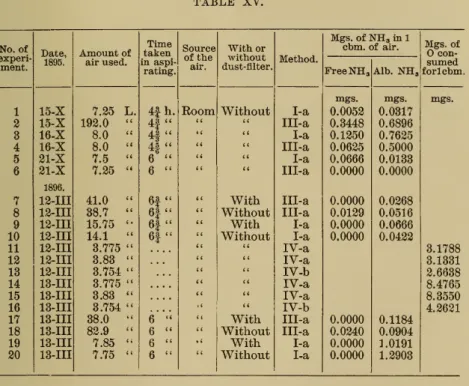
IN AIR. 15 This table shows analysesmade
of the air ofone of therooms of the laboratory,and
of theair of oneof the soil pipes at thesame
time on several successive days, the organic matter being converted into am- monia.The windows
of theroom
were closed on each day.The
results obtained from the room-air are uniformly higher than those obtained from theair of the soil pipe.
With
one exception, the pro- portion of albuminoidammonia
in the air of the soil pipe is smaller than that of thefree ammonia, while in the room-air, with the excep- tion of thelast analysis where noammonia
was found, thealbuminoidammonia
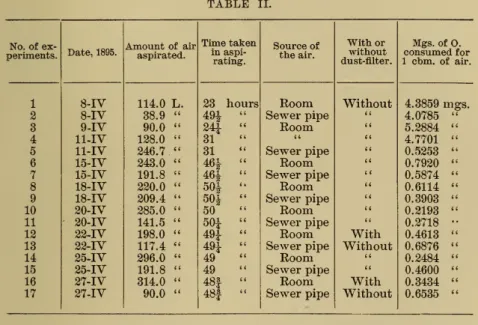
is farinexcessof the free ammonia.TABLE
II.This tableshows analyses
made
of air taken from thesame
sources asthose recorded in Table I, but in this instance the quantity of or- ganicmatterisestimatedby
itsreducingactionon permanganateinstead of being convertedinto ammonia. In two of theanalyses ofthe room-aira dust-filter
had
been placed before the absorption apparatus, but since no analyses weremade
on thesame day
without the use of a dust-filterthe results obtainedafford no informationas tothe effectsof sucha dust-filteron theresults obtained.The
resultsobtained with- out the useof a dust-filter, on succeeding days, are insome
instances evenmore
variantthan those with, and without, the use of the dustfilter.
No
suggestion can beoffered to explain the very highresults obtained inthe firstfour analyses.No
uniform relationcanbe deter-mined
between the relativeamounts of organic matterin theroom-airand
that of the soil pipe in the results obtainedby
this method, asseemed
to be the case in the results recorded in Table I.16
methods foe the
deteemin-atio^^ ofMethod
11.Absorbentmaterials: (a) purified glass-wool, (b) acidulated perman- ganate solution.
Absorption apparatus:
two
small Erlenmejer flasks, connectedby
rubber tubing; modification of Uffelmann's apparatus.TABLE
III.No.of Date, experi- 1895.
ment.
1 7-VI
2 7-VI
3 8-VI
4 10-VI
5 20-VI
6 21-VI 7 22-VI
8 24-VI
9 24-VI
10 26-VI
11 26-VI 12 26-VI
13 2-VII
14 2-VII
15 2-VII
16 3-VII
17 3-VII 18 3-VII 19 8-VII 20 8-VII 21 8-VII
Time
Amountof taken Sourceof airaspirated. in aspi-
rating.
the air.
30.0 L. 1 hour
Room
Closed 25.0 " 1 " ((30.0 " 1 " '•'
27.0 " 1 " a
7.3 " 2ihrs. a
8.8 " 5 " a
6.7 " 3^ " li
7.5 " 5^ " Open
8.3 '' 5f " "
5.5 '' 44- " u
8.0 " 3| " ((
10.0 "
3f " ((
8.4 ''
U
" Closed8.25" 5i " a 12.1 "
5i " (I
17.3 "
5i"
Open8.0 "
H
" a8.4 "
5i " "
7.6 " 64 " <(
8.05" 64 " ((
10.2 " 6 " i(
Mgs.of Oconsumedfor1
cbm.of air.
Gaseousform. Dust-form,
0.31746 13.33333 0.63492 0.35273 19.56947 54.11255 0.00000 19.04761 5.73723 17.65224 8.82612 19.41747 5.75109 5.75109 5.75109 19.64195 33.90776 43.05748 25.42588 6.00114 4.73619
mgs 80952
mg&
09523 63492 17637 56947 23376 32196 39420 42340
81553 50218 50654 67989 11812 45307 49529 00912 94476
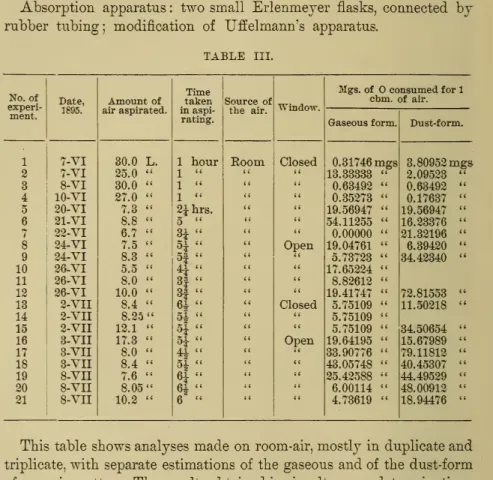
This table showsanalyses
made
on room-air,mostly induplicateand
triplicate,withseparate estimations of the gaseous andofthe dust-form of organicmatter.
The
resultsobtainedinsimultaneous determinations onthesame
airshow
amarked
variation. This variation intheresults seems to be intimately connected with the quantity of airthatwas
aspiratedthrough each apparatu.s; thegreater the quantity of air aspi- rated the smaller the relativeproportion of organic matter found, both as tothe gaseous