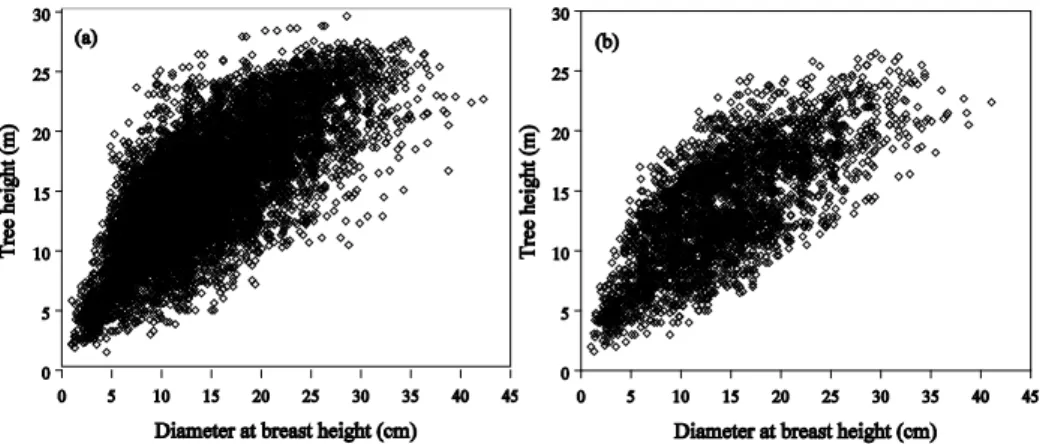
The aim of this study was to develop a general height-diameter model for predicting tree height of Acacia mangium plantations in South Sumatra that can account for the variation in terrain and stand conditions. Therefore, the aim of this study is to develop a general height-diameter model for predicting tree height of A.
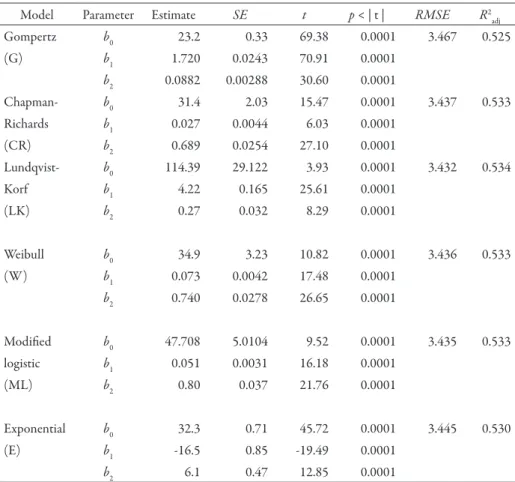
Parameter Estimation and Model Comparison of the Base Models
Inclusion of Stand Variables
RESULTS AND DISCUSSION
Performance and Comparison of the Candidate Base Models
Parameter estimates, standard errors, and related fit statistics of the generalized height-diameter models tested. All parameters of the seven generalized height-diameter models were significantly different from zero (p-value <0.01).
Selected Generalized Height-Diameter Model
CONCLUSION
Developing and validating nonlinear height-diameter models for major tree species in Ontario's boreal forests. Comparisons of height diameter for sixteen tree species in the central western Willamette Valley of Oregon.
SCRUTINY ON PHYSICAL PROPERTIES OF SAWDUST FROM TROPICAL COMMERCIAL WOOD SPECIES
EFFECTS OF DIFFERENT MILLS AND SAWDUST’S PARTICLE SIZE
- INTRODUCTION
- MATERIALS AND METHODS A. Raw Materials
- Sawdust Preparations
- Sieve Analysis for the Particle Size Distribution
- Particle Density
- Porosity
- Water Retention
- Statistical Analysis
- RESULTS AND DISCUSSION A. Particle Size Distribution
- Particle Density
- Porosity
- Water Retention
- Influential Factors on Porosity and Water Retention
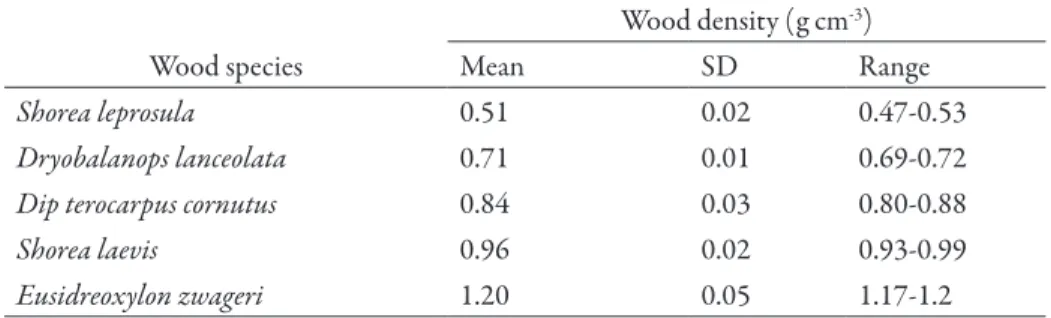
It can be concluded that the grinding types influenced the particle size distribution (OS, CPS and FPS). Thus, it is logical that the particle size distribution of sawdust samples (OS, CPS and FPS) processed by different plants and blade sizes appears to be more consistent with the input for the OS, CPS and FPS ratio between different wood species. with their varying density (Figure 1 and Table 1). Particle size distribution (OS, CPS and FPS) of sawdust samples produced from five tropical wood species using different mill types: i.e.
This study also showed the strong effect of wood density and particle size classes on particle density of sawdust. Particle density (g cm-3) of sawdust samples from five tropical wood species using different mill types and prepared by particle size classes: CPS (a) and FPS (b).
EFFECTIVENESS OF A SUPERFICIAL TREATMENT USING BIFENTHRIN TO PROTECT RADIATA PINE FRAMING
FROM DAMAGE BY SUBTERRANEAN AND DRYWOOD TERMITES IN INDONESIA
- MATERIALS AND METHODS
- Semi-laboratory Trial Using Subterranean Termite M. gilvus
- Semi-laboratory Trial Using the Subterranean Termite Coptotermes curvignathus
- Laboratory Trial Using Coptotermes curvignathus
- Laboratory Trial Using the Drywood Termite Cryptotermes cynocephalus
- RESULTS AND DISCUSSION A. Field and Semi-laboratory Trials
- Laboratory Trials
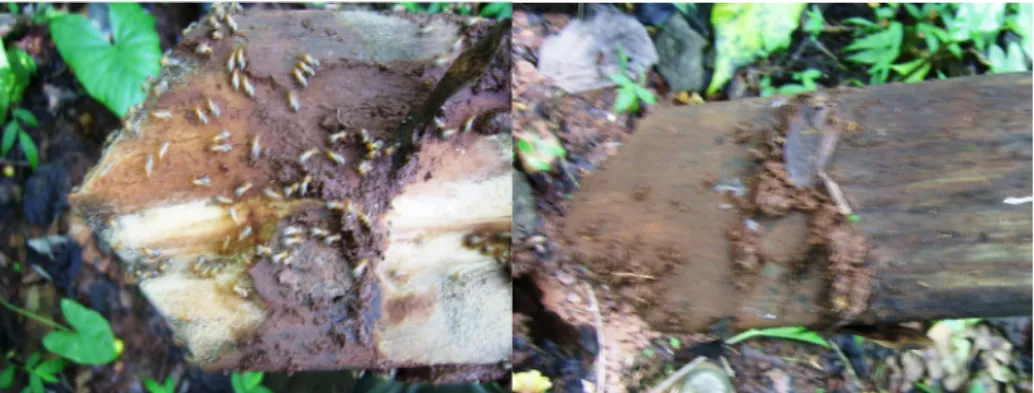
No additional treatment was given to the exposed cut edges of the treated specimens. At the end of the test, the test specimens were cleaned and evaluated for termite damage using the ASTM D 1758 grading system. At the end of the test, the test specimens were cleaned and evaluated for damage caused by M.
At the conclusion of the trial, test specimens were cleaned and evaluated for damage caused by C. Average damage score, termite survival, and termite contact with treated and untreated control test specimens at the conclusion of field and semi-laboratory trials against M.
DISTRIBUTION OF Hoya multiflora Blume AT GUNUNG GEDE PANGRANGO NATIONAL PARK, INDONESIA
METHODS
The process of data collection was carried out by observing herbarium sheets, field observations and plot sampling. Inventory was done by observing belt transects (Cox, 2002) vertically from the bottom to the top of mountain at different altitudes, from 700 to 1500 m a.s.l. The field observations were carried out at the four selected hilly areas with different sides/directions.
Two of those four hills faced east and west directions, while the other two hills facing north and south sides/directions were selected, and the physiographic condition of those hills is characterized by different forest and vegetation types.
RESULTS AND DISCUSSION A. Results
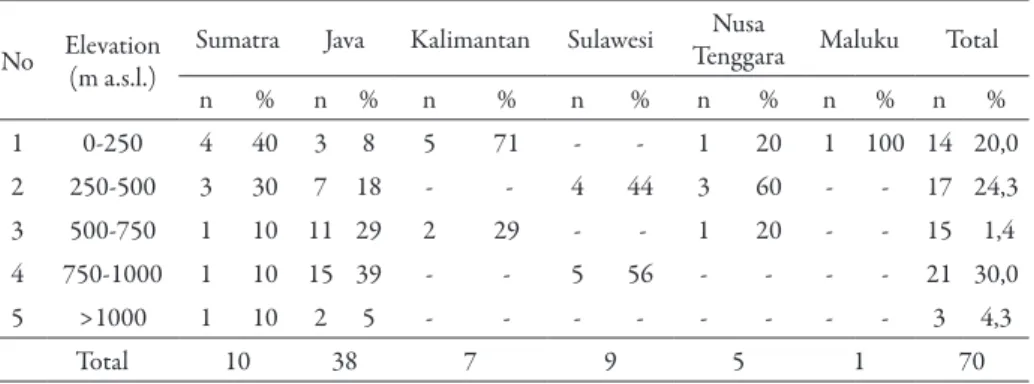
The results in Table 1 indicate that the species tolerates a wide range of habitats and has a high adaptability to the ecological diversity of the region. After 2003, the area was extended to the lower level, from 650 m above sea level at Bodogol (Balai Taman Nasional Gunung Gede Pangrango official, personal communication). This fact therefore contradicts the evidence from the herbarium sheets of the Herbarium Bogoriense, which assumes that this species has a physiographic distribution with an altitude range of 20 to 1500 m above sea level.
DISCUSSION
This property enables the seeds to travel the current of wind and the gentle breeze of the earth. According to data from the Indonesian Meteorology, Climatology and Geophysics Agency (BMKG) 2008 (personal communication), the wind direction over the GGPNP (3000 feet) is southwest (January–March), south (April–May and November–December), and southeast (June– October). In areas where there is rugged topography that significantly interrupts the environmental wind flow, wind circulation between mountains and valleys is the most important contributor to the prevailing winds.
The main factor affecting spatial distribution is seed dispersal, which mainly depends on wind as the primary means of dispersal, rather than habitat factors. Wind speed and direction also affect the long- and short-distance dispersal of this species.
ANATOMICAL PROPERTIES AND FIBER QUALITY OF FIVE POTENTIAL COMMERCIAL WOOD SPECIES FROM
CIANJUR, WEST JAVA
RESULTS AND DISCUSSION A. Anatomical Properties
Stock jet pits with greatly reduced borders to apparently simple, pits horizontal (scalariform, slit-shaped) to vertical (palisade). Mineral inclusions: prismatic crystal present in radial alligment in anterior ray cells and axial parenchyma cells in chamber. Prismatic crystals present in radial alignment in procumbent ray cells and in chambered axial parenchyma cells.
Three characteristics of vascular rays (vascular pits with distinct margins, similar in size and shape to intervascular pits in ray cells; with greatly reduced borders to apparently simple, rounded or angular pits; and vascular pits, unilaterally compound and coarse ). Four features of vascular ray pits (vascular rays with prominent margins similar to intervascular pits in size and shape through ray cells; with greatly reduced margins to apparently simple, pits rounded or angular and horizontal pits (scalariform, wound-like). ) to vertical (palisade ); and receptacle pits of two different sizes or types in the same ray cells).

Fiber Quality
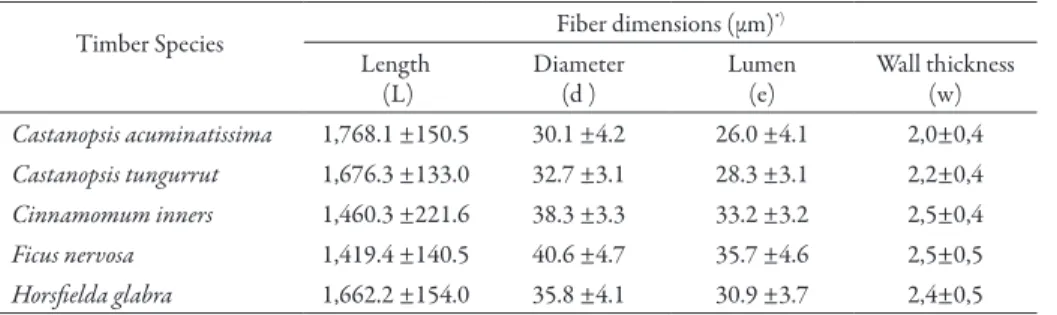
Calculation of fiber dimension derived value and determination of class quality for pulp and paper is based on the procedure and criteria of Nurachman and Siagian (1976) presented in Table 3. Rolliness Based on the calculation results in Table 4, the fiber quality of the five types of wood as proposed materials for pulp and paper can be assessed as class I. Fibers completely collapse during pulp skin formation; flattening and felting properties are high, resulting in high tear, burst and tensile strength of the corresponding pulp.
A possible explanation is that the woods investigated by Oey (1964) had a significantly lower density and strength class compared to woods of similar species. In addition, future research should also examine wood chemical components such as cellulose, lignin, pentosan, extractive and ash content to obtain more reliable results to support the basic classification in determining pulp and paper processing quality.
Evaluation of Possible Uses
However, the regular parenchyma bands in Ficus nervosa and Horsfieldia glabra make it possible to use them as pencil materials. This study has deeply investigated the anatomical properties and diagnostic features of five wood species native (native) to Cianjur (West Java). That is, the data and information obtained regarding these anatomical properties and diagnostic features can be expected to be beneficial for completing Xylarium Bogoriense 1915. key of wood identification.
Judging from the fiber quality preliminary study, all five woods could be categorized as Class I for pulp and paper processing. However, these five types of wood have their own specific characteristics that deserve careful consideration for special processing, not only for pulp and paper, but also for other wood products.
NON TIMBER FOREST PRODUCT UTILIZATIONS AND AWARENESS OF SMALL-SCALE INDUSTRY
DEVELOPMENT IN FOREST COMMUNITIES- A CASE STUDY IN EAST KALIMANTAN
METHODS A. Study Site
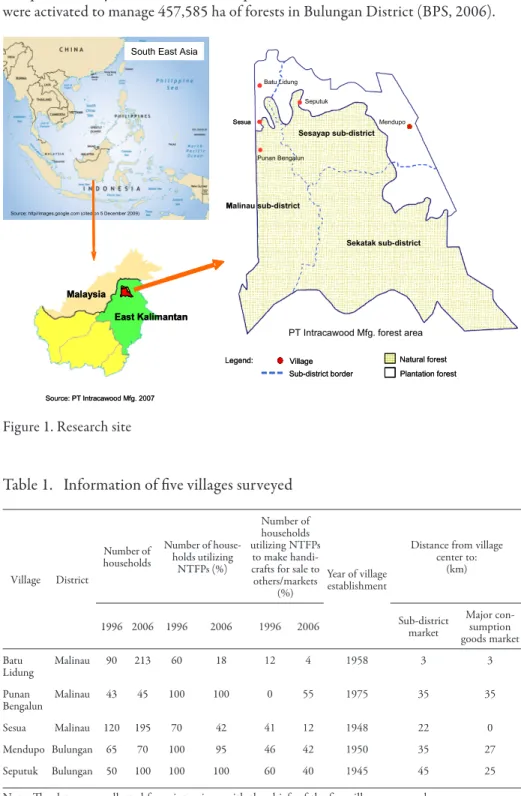
Five villages were selected for the effective nature of community-based gathering; and this seems to affect activities related to their dependence on forests. Most of the communities in these five villages were farmers and used the rivers for drinking, washing and bathing. They represent one of the fifteen hotspots of tropical rainforests in the world (Mittermeier and Bowles, 1993).
Bulungan District is in the northern part of East Kalimantan Province, and covers an area of 1,801,050 ha. After the establishment of the concessionaires in this area in the 1970s, communities living in or near the forest faced restrictions on the use of forest products as stated in a policy established by the HPH.
Data Collection and Analysis
Potential of NTFPs and their Utilization by Forest Communities
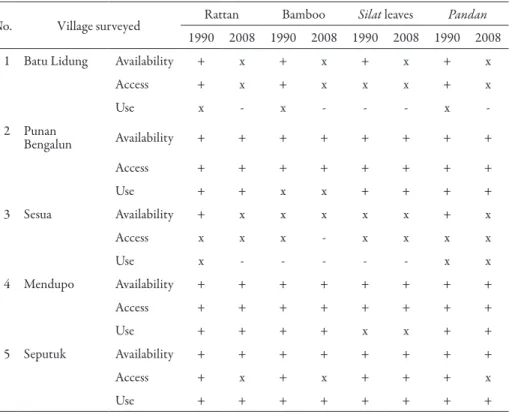
In the five villages surveyed, residents reported that they had more difficulty finding sources of NTFPs since the establishment of forest concessionaires. In the surveyed villages, the majority of handicraft NTFPs used by the forest communities were rattan (Calamus spp.), bamboo (Bambusoideae), pandan (Pandanus spp.) and silat leaves (Palmae). Not all the forest communities in the villages could produce handicrafts – it is a skill passed down from previous generations.
The availability, access and use of NTFPs in the five surveyed villages are shown in Table 2. Handicraft making of NTFPs by forest communities in the five surveyed villages (n = 65): production by gender and material resources.
Forest-related Activities of Forest Communities
The villagers in Batu Lidung were unaware of the potential of utilizing natural resources or NTFPs in economic support activities. villages within the forest, reducing villagers' forest dependence; and 2) although an abundant supply of NTFPs was available, the variety of employment opportunities meant that villagers had little interest in utilizing the forest. These environmental differences between villagers in remote areas and those living near the capital affected their outlook.
Activities Related to Handicraft Making in Seputuk Village
The leader had to make sure that all members carried out all activities based on the agreements made, such as those involving mutual cooperation and working hours. The members of the group made a uniform (medium) size of winning baskets and sold them to the market at IDR 20,000 per unit (as of 2007). Small and large sizes could also be made, but since the medium size was the most common and sold well, the group decided to make only one size.
The Custom of NTFP Utilization: Why Are Females More Active?
Awareness in Forest Communities Regarding the Benefits of NTFP Utilization In the villages-surveyed, “fulfillment of life requirements” was ranked first among
Awareness Regarding Opportunities for the Development of Small-Scale NTFPs Industry
- CONCLUSIONS
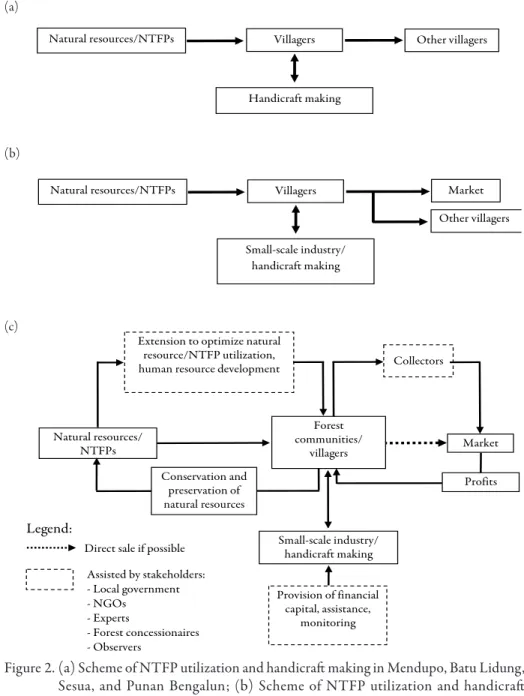
Scheme of NTFP use and handicrafts in Seputuk c. Recommended scheme for NTFP utilization and small scale industry a. Statistics describing households' perceptions towards NTFP utilization, handicrafts and small-scale industrial opportunities (results from interviews of 65 households in the five villages surveyed). Do you want to develop your small scale industry (for households that have started small scale industry).
2 Provision of financial capital for To provide financial support to Local government, small scale industrial communities to optimize the forest concessionaires. Forest communities in Seputuk village have since 2000 started small-scale industries involving handicraft manufacturing using NTFPs.