The role of First Lady of the United States has a very broad and somewhat vague definition. Such overprotective nature extends to the actions of the First Lady in her ascribed position. Fashion and social etiquette have changed dramatically as the United States and its governing body developed.
Rosebush, the exact origin of the term "First Lady" is unknown, but many scholars point to journalist Mary Clemmer Amme's printed phrase ""First Lady of the Land"" while referring to Lucy Webb Hayes (r during her husband's inauguration) as the source . Yet Martha Washington's smart use of coarse household fabrics in a color reminiscent of the original West Indian costume linked the role of First Lady with the New World and subsequently a new nation. Yet the majority of the American population chose cheap and readily available domestic white fabric (muslin), thus continuing Martha Washington's dress style of sheer functionality.
Patterson said, "In the television era of the 1960s, style and image often counted as much as substance." Patterson, James T. 39 Diana Vreeland interpreted Jackie's success as a trend for her, “.. to put some style into the White House and to be the First Lady of the country.”40. Calvin Coolidge often bought clothes for his wife and even encouraged her to spend lavishly on her own clothing.49 Grace's style before she became First Lady was "understated" and did not follow most of the fashion trends of the 1920s. .50 However, through her husband's guidance, “she was modern without being vulgar.
Fashion History, 1870- 1925
Many of the technical developments of the early nineteenth century contributed directly to accessible extravagant fashion by the end of the century. Crinoline rings fell out of fashion in the late 1860s, but became quite popular in the 1870s and 1880s. 60 The term "Victorian" refers to the era indicated by the reign of the British monarch, Queen Victoria (r and, "...the ideals and standards of morality and taste which prevailed during [the Queen's] reign" (Webster's Dictionary, 1084).
Among such changes in fashion, the re-emergence of the eighteenth-century polonaise as a fashionable trend topped the fray. Women of the lower classes were forced to endure physical labor and needed less restrictive clothing. The two-piece walking suit, derived from early equestrian costumes that copied men's suits into a female garment, also embodied aspects of the reform movement for women's dress that actually began in 1851 with the rise of bloomers.
Styles from the 1890s continued to adhere to Victorian standards of prescribed outfits for both times of day and certain events. In addition, the "S" curve corset transformed the shape of the bust into a single protruding mass, also known as "mono-bust". Fashion during the First World War was not dictated by the courts of France or the productions of the Ballet Russe.
But in 1914 and the outbreak of World War I, women like Edith eschewed the bright exotic clothing of the early part of the decade for simpler garments that, for the first time in hundreds of years, allowed them to move freely and allowed them to join the war effort and subsequently the workforce. Even so, evening wear remained formal and glamorous with opulent textiles, beading and fur; by the end of the decade, however, it also began to experience reforms for the benefit of the movement.95. In general, fashion for women changed drastically during the last years of the nineteenth century and the early years of the twentieth century.
With the signing of the Treaty of Versailles in 1919, fashion was once again dictated by European designers, but not limited to French courtiers. With Chanel's influence, the flapper style emerged and the restrictive garments of the nineteenth century were eliminated.

Edith Bolling Galt Wilson’s Image
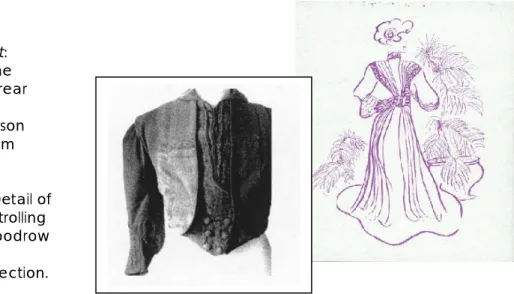
The dress of "green plaid cloth" that Edith wore to the theater in 1890 is in the collection of the Woodrow Wilson House Museum and is an example of late 1880s styles for women in America. Overall, the simple jacket is an example of the types of clothing Edith wore before her first marriage. The inner upper part of the jacket has small pleats and hooks to close the garment.
Worth's fashion of the period was characterized by the Edwardian preference for all-over decoration and asymmetrical lines. While repainting the portrait, Stone failed to repaint the back of the chair in which she posed. Jewelers were in a terrible state when Edith took ownership, with the help of the store's employees and Edith's lawyer.
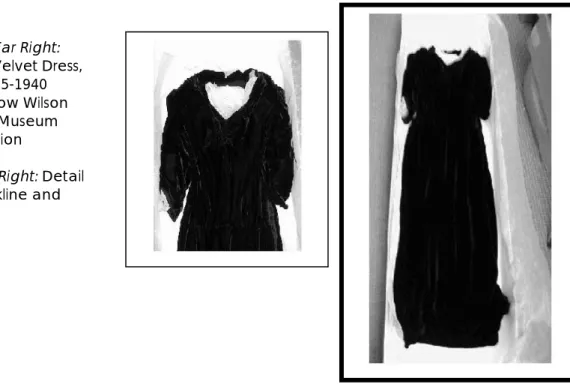
One dress from the Woodrow Wilson House collection represents her style in deep mourning: a dress made of black silk taffeta and black net from the first decade of the twentieth century. But even more damning was an article in the Washington Post that stated, “The President Spent Much of the Evening Entering Mrs. Galt.”146 Rittenhouse, Anne, “The Trousseau of the White House Bride,” New York Times , May 3, 1914, http://proquest.umi.com/login. . hallmark of Worth's designs) and is white in color with embroidered flowers and a net running from the shoulders.
156 The Washington Post, “Refuses Paris Gowns,” The Washington Post, November 24, 1915, http://proquest.umi.com/login. Geometric embroidery was a hallmark of Worth's designs in the first decade of the twentieth century and something that Edith favored. Thus, she tore the lining from the upper part of the dress, split the hem of the skirt and made the lining into an asymmetric frill.
A ball gown from the 1930s (made by a local seamstress from fabric most likely purchased during her travels in Asia) shows similar. handwork – the track from the hull was crudely cut and used as a custom patch. From her Virginia upbringing during the Reconstruction of the South, she developed a sense of practicality that she often used to save money when. The jacket is lined with black crepe which is also used to line the matching A-line skirt.
The added measurement of the top of the dress visually slims the straight-cut skirt.

Comparisons between Edith’s Dresses, designs by Worth, and her contemporaries
Women, like Edith, were aware of the European aristocracy's preference for Worth's designs during the last quarter of the nineteenth century. The couturier was most often associated with the Empress Eugénie, wife of Napoleon III, and their court—he made all the "state and evening dresses, court dresses, elaborate street clothes, and masquerade costumes."165 The Empress was so popular and with influence. that other royal members quickly followed her example, including the Queen of Hungary and the Queen of Sweden.166 By the end of the c. Virginian Nancy Witcher Langhorne Astor, the first woman to serve as a member of the British Parliament, is credited with helping to create another fashion trend adopted by Edith through her association with the House of Value.
171 Conversation between Harold Koda, Director of the Costume Institute at the Metropolitan Museum of Art, and the author, October 17, 2008. Because of his ties to politics and the monarchy, it is understandable that Edith Wilson turned to Worth before and during her years. in the White House. The dress, which was another piece from her trousers, had a deep V-neckline made of white lace and lavender brocade.176 In addition, the dress had a large corsage of artificial flowers attached to the center of the bust.
Baltimore-based Alice Warder Garrett was a follower of Léon Bakst and the Ballet Russe. Garrett is shown wearing a blue, white, and black dress.179 The top of the dress is white while the bottom is blue with a black belt wrapped around the hips.180 The dress has a high neckline, long sleeves of full , and blue cuffs with buttons that almost reach the elbow.181 The skirt starts below the hips (dropped waist) and is asymmetrical in tiers.182 In addition, the dress has a matching white turban, which Alice proudly displays with the bow of the head. 183 The entire dress appears to have small pleats, similar to Mariano Fortuny's Delphos dresses, which were popular during her teens, and were also considered avant-garde along with some of the Asian-inspired designs by Paul Poiret and the textile designs of Weiner. Werkstätte (ca. But during her tenure as First Lady, her love of suits took on a new role - she was immersed in a male universe where most everyone in her immediate surroundings wore suits every day, regardless of event or time.
Power was something that Edith eventually achieved within herself-. declared a caretaker presidency, where she alone spoke and took orders from a very ill Woodrow Wilson. Edith's use of the Worth suit was so successful that by 1921 women across America could and did buy similar ones. 194 Conversation between Harold Koda, Director of the Costume Institute at the Metropolitan Museum of Art, and the author, October 17, 2008.
Coolidge was dressed by her husband and Lou Hoover's clothing was influenced by the onset of the Great Depression. Edith's subtle use of gender-specific styles and colors, which were similar to mourning clothing and the somber atmosphere of World War I, changed the dress standards for First Ladies while maintaining a sense of dignity and commonality.

Bibliography
Jewels: The Closing of a Historic Shop is a Triumph of Meaning over Means,” Reasononline, juli 2001, http://www.reason.com/news/show/28092.html. Marconi Transatlantic Wireless Telegraph, "Fashion Buyers Organize," The New York Times, 5. marts 1913, http://proquest.umi.com/login. The New York Times, "Ambassador Davis Home for Vacation," The New York Times, 26. august 1920, http://proquest.umi.com/login.
Rittenhouse, Anne, “The Trousseau of the White House Bride,” The New York Times, May 3, 1914, http://proquest.umi.com/login. First Lady, Public Wife A behind-the-scenes history of the evolving role of First Ladies in American political life. Special Cable Dispatch, “Jazz Bath Shocks French Dowagers,” The Washington Post, July 17, 1921, http://proquest.umi.com/login.
Galt All Her Dresses But Stops All Sales From German Agent," The Washington Post, November 20, 1915, http://proquest.umi.com/login. Costume from House of Worth, Photographs from Seyoung House Museum Collection Thomas Woodrow Wilson, NT 61.17.