I believe that most physicians dealing with Asian schistosomiasis and in particular the control problem associated with it are irritated, to say the least, by the inconsistency of the names used in the writings of the intermediate host students. It seems to me that we now have enough adequately preserved material in the collections of the United States National. Unfortunately, the characters of the shells are not as clearly defined as those of the radula and opercula, and their placement in a key signature would rather be involved.
The species belonging to this genus form a small compact group, the distribution of which is confined to northern Japan, north of the schistosomo])horousKatayamas. Here again, he erroneously assigns Blanfordia japonica as the type of the genus Blanfordi-a, which was established by Xevill in 1878 as Blanfordia hensoni A. In the same year Annandale (31) published his paper on "The Molluscan Hosts of the Human Blood Fluke in China and Japan, and species which may be confused with them." Here he gives a description of the animal, which I copy below the general definition.
Two years after this, in 1934, Bequaert(44) discusses the intermediate host of the Asiatic blood sugar in the Philippines and reviews the field as a hole based on what has been said before. There is considerable variation in the strength of these characters, not only in the different species of the genus, but in the shells of the individual species themselves; in Blanfordia intcgra the thickenings are only indicated.
8 SMITHSONIAN MISCELLANEOUS COLLECTIONS VOL. 95 KEY TO THE SPECIES OF THE GENUS BLANFORDIA
Shell of medium size, oblong-ovoid, rather firm, horn-colored, with the outer edge of the peristome bordered by a narrow zone of dark chocolate brown.
10 SMITHSONIAN MISCELLANEOUS COLLECTIONS VOL. 95 Imdly worn that no remarks about their sculpture can be made
NO, 5 INTERMEDIATE
12 SMITHSONIAN MISCELLANEOUS COLLECTIONS VOL. 95
14 SMITHSONIAN MISCELLANEOUS COLLECTIONS VOL. 95 BLANFORDIA SIMPLEX Pilsbry
A study of the merged historical chapter of this genus, in which only the malacological side of the problems of naming was cited, will explain past problems. The first intermediate host of Schistosoma japonicum to be described comes from Ronoin in the middle of the southern part of the Island of Formosa. The following year, 1914, Miyairi and Suzuki (20) published their paper on "Der Zwischenwirt des Schistosomum japonicum Katsurada.".
The following year, 1920, Cort (26) published a paper "On the Desiccation Resistance of the Intermediate Host of Schistosoma japonicum Katsurada." The mollusks he says were obtained by Sado Yoshida of the Osaka Medical College, and it is very likely that my subspecies Katayama nosophora yoshidai was obtained from the same source. In 1932 Tubangui (40) published "The intermediate host of molluscs in the Philippines of the oriental blood fluke, Schistosoma japonicum Katsurada," in which he refers to Blanfordia japonica and Blanfordia formosana.
Shell.-Shell elongate-conical or very elongate-ovate, thin, translucent, horn-colored with a dark line marking the edge of the peristome. 95 humus-and-moss numerous samples of vanasnael, recognized as a Katayama, were humus and moss numerous samples of vanasnael, recognized as a Katayama, were found.* * *The samples collected were all taken from moss banks or under the moss in the porous humus or loosely wet.
KEY TO THE SHELLS OF THE SPECIES OF THE GENUS KATAYAMA
SYNOPSIS OF THE NUMBER OF DENTICULATIONS ON THE MARGINAL TEETH OF THE SPECIES OF KATAYAMA
Base moderately long, narrowly umbilicate, well rounded and marked by a continuation of the incremental sculpture mentioned above.
SMITHSONIAN MISCELLANEOUS COLLECTIONS VOL. 95 This subspecies differs from Katayama nosophora yoshidai in being
The shell is similar in all respects to Katayama nosophora nosophora, from which it differs in having each v^^aya a little larger and in having a different denticulation on the inner marginal teeth.

24 SMITHSONIAN MISCELLANEOUS COLLECTIONS VOL. 95
26 SMITHSONIAN MISCELLANEOUS COLLECTIONS VOL. 95
The postnuclear whorls are well-rounded, marked by low, obsolescent, thread-like lines, which are quite thick and of varying size and spacing.
28 SMITHSONIAN MISCELLANEOUS COLLECTIONS VOL. 95
The base well rounded, narrowly umbilical and characterized by the same sculpture that characterizes the spire. Aperture ovoid; outer lip slightly expanded and reflexed and added to the preceding whorl at the parietal wall. This species, which we first considered a subspecies of fausti, is far from the species by reducing the denticles of the inner marginal tooth to 7.
Tubangui discovered the intermediate host of the Asiatic bloodworm in the southern Philippines, which made it desirable to investigate its relationship to other schistosomophore mousca, making it, although related to Katayama and Oncomelania. 95the molluscs in question nevertheless differ from each of these molluscs in question, and nevertheless differ from each of these as much as they differ from each other. Hence we find little more than an American list of species in mollusc catalogs until Tubangui (40) established the intermediate host status in his paper on "The Philippine intermediate host of the molluscs for the Oriental blood broom Schistosoiiiajaponicum Katsurada."
After Tubangui, Rensch (41), to whom some of these molluscs were sent for determination, named them Oncomelania hydrohiopsis in 1932. Shell. - Shell small, oblong-oval, thin, horn colored or darker with a slender dark line bordering the peristome. Radida.- The radula is small and has a rachidian tooth with 5 denticles, the middle one being the largest and the other two tapering.
It was rarely encountered under water, but more often under dead leaves and other wet objects above the water's edge. Aperture broadly oval and rather broadly dilated and reflected, associated with the anterior curve in the parietal vi^. This species differs from Schistosomophora hydrobiopsisin in having a more inflated horn sculpture, a more inflated and narrower axial sculpture and indications of stronger spiral sculpture, and in having 7 teeth on the outer marginal tooth of the radula.
The shell is small, oblong-oval, thin, light horn-colored, with the core whorls transparent; a slender maroon line edges the peristome. In addition to this, there are faint indications of spiral sculpture - so faint that it becomes apparent only under certain angles of light, primarily around the periphery and upper part of the base. NO.5 INTERMEDIATES OF ASIATIC BLOODFEUKE BARTSCH 33 behind the peristome by a very heavy callus which extends down to the base.
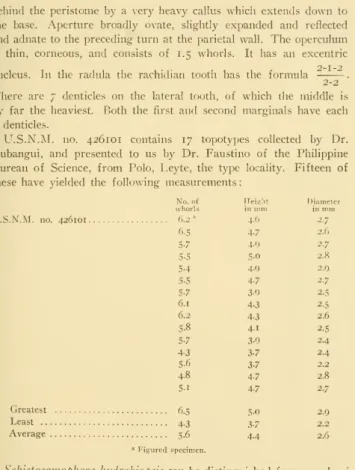
34 SMITHSONIAN MISCELLANEOUS COLLECTIONS VOL. 95 marked by retractively curved lines of growth, which on the last
In the first case we would have nothing but varieties of the earHer Oncomelania hupensis Gredler** *which would mean that the province of Hupeh is the motherland of the prototype. He states that in their museum they have had this label Hemibia for a long time, and therefore call it Hemibia because of the amphibious habits of the animal. Heude (8), who in the same year, 1890, published six additional species in his memorable work on the terrestrial and freshwater molluscs of the valley of the Fleuve Bleu.
His next species, Hemibiacarcctorum, is figured on plate 33, figiu-e 16, and is said to come from the left bank of the Yangtze opposite Nanking; I also think this is just a form of Oncomelania schmackeri. His next species, Hemihia luteola, we also feel is nothing more than a variety of Oncomelania schmackeri; it is this Figure 17. In 1923 Mcleney and Faust (29) demonstrated that Oncomclania served in the Soochow area as an intermediate host for Schistosoma japonicnm.
In 1924, Faust (34) published "Schistosomiasis in China", stating that he and Meleney also found what they called. The same year saw the publication of Faust's article (33), “Notes on Larval Flukes from China,” in which he cites all the places where they have been shown to be intermediate hosts. They are also found in the rice nursery beds. ** * The snails do not live in clayey soil, but can usually be located near freshly dumped human manure.
His studies (31) are recorded in 1924 in his paper on "The MoUuscan Hosts of Human Blood Fluke in China and Japan, and Species Liable to Confused with them," where he concludes that Katayamaof Robsonis is not generally distinguished from Oncouielania . . Tubangui (40), in his paper The Molluscan Intermediate Host in the Philippines of Oriental Blood Fluke, Schistosoma japonicum. The most important paper, from the mollusk point of view, was contributed by Dr.Fu-ching Li (46), "Anatomic, Entwicklungs-geschichte, Oecologie und Rassenbestimmung von Oncomelania, des Zwischenwirtes von Schistosoma japonicum (Katsurada) in China1." A very careful anatomical and embryological as well as ecological study of Oncomelania is given here.
Moreover, in some species these incremental lines are bent at more or less regular intervals, giving them the effect of a spiral sculpture. Radula.— The radula of the various species of Oncoinclania show no deviations in the rachidial or lateral teeth. In the laboratory, if placed in a deep glass container in shallow water, it usually crawls out of the water to the window side of the box within a few minutes, and after crawling* to free itself from the water, sticks its shell to the glass with slime at the opening and withdraws into its shell, where it remains for hours or days.
KEY TO THE SPECIES OF ONCOMELANIA '
It is not found in large canals where there is a lot of traffic and therefore a lot of water movement, but can be found no more than four or five meters from such a canal, in a small terminal branch. It can be found singly or in groups. It is occasionally found on stones or grass roots a few inches below the surface of the water, but dredged material of deep-water grass has not been found to contain it, nor has it been found at the bottom of any canal on whose bank it lies. The base is slightly elongated, well rounded, narrowly umbilical and marked by the continuation of the axial ribs and incremental lines extending into the umbilicus.
Specimens described and figured, U.S.N.M. no. 420953, as well as other specimens entered under this catalog number, were collected by Dr.H. Meleneyon on the shore of Tung Ting Lake, near Yochow City, Hunan Province, China.
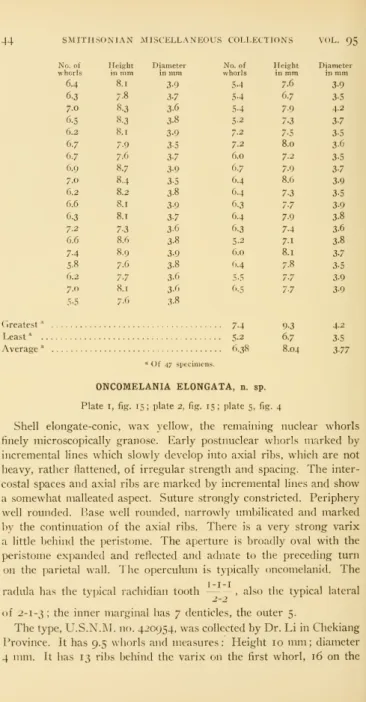
44 SMITHSONIAN MISCELLANEOUS COLLECTIONS VOL. 95
NO. 5 INTERMEDIATE HOSTS OF ASIAN BLOODFLUKE BARTSCH 45 penultimate, 14 on third from last, 15 on fourth from.
46 SMITHSONIAN MISCELLANEOUS COLLECTIONS VOL. 95 marked by incremental lines which gradually develop into ribs on the
48 SMITHSONIAN MISCELLANEOUS COLLECTIONS VOL. 95
50 SMITHSONIAN MISCELLANEOUS COLLECTIONS VOL. 95
52 SMITHSONIAN MISCELLANEOUS COLLECTIONS VOL. 95
54 SMITHSONIAN MISCELLANEOUS COLLECTIONS VOL. 95 ONCOMELANIA CRASSA (Heude)
REMEDIAL MEASURES
Neue Materialien zu den Eigenschaften und der geografischen Verbreitung chinesischer und japanischer Binnenmollusken L. Diagnoza specierum novarum ex insulis Philippinis. Mollusken jagen menschliches Blut in China und Japan und Arten, die mit ihnen verwechselt werden können. Der Mollusken-Zwischenwirt der orientalischen Blutbahn auf den Philippinen, Schistosoma japonicum Katsurada.
Anatomie, Evolutionsgeschichte, Ökologie und Rassenidentifikation von Oncomelania, dem Zwischenwirt von Schistosoma japonicum (Katsurada 1904) in China.

58 SMITHSONIAN MISCELLANEOUS COLLECTIONS VOL. 95
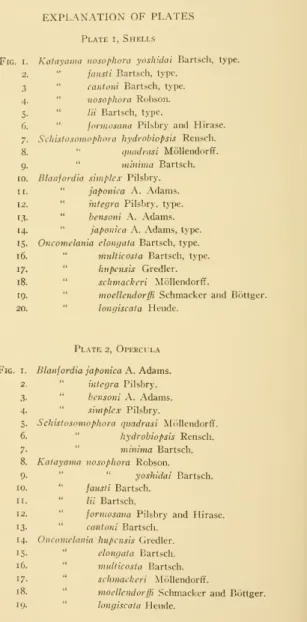
EXPLANATION OF PLATES
RADULAE
ANIMAL AND EGGS