The second lay southeast of the deer stone, with its head pointing east. Burial material related to the history of the Bronze Age in the territory of Mongolia.
Joint Mongolian-Smithsonian Deer Stone Project Hovsgol Aimag, Mongolia
CONSERVATION REPORT 2005 Field Season
The 2005 field season was the first year of conservationist involvement in the field activities of the Joint Mongolian-Smithsonian Deer Stone Project [DSP], expanding a collaboration that began in June 2004, with Beaubien's participation as workshop organizer/presenter. at the first annual DSP symposium, held in Ulaanbaatar. Field participation in 2005 was organized through the SCMRE Archaeological Conservation Program [ACP].1 The ACP group consisted of Basiliki Vicky Karas (SCMRE/ACP co-author and co-author of the report) and Carolyn Thome (model maker from the Central Exhibitions Office of Smithsonian [ OEC]), except Beaubien (Fig.1). The entire DSP team arrived in Mongolia on June 16, 2005 and began the field season by co-hosting the 2nd Annual Mongolia-Smithsonian Deer Stone Joint Project Symposium in Ulaanbaatar (June 17-18).
In addition, Beaubien co-presented (with NMNH Conservator Natalie Firnhaber) a workshop at the Symposium on Exhibitions and Storage: Preservation Issues. The session included a presentation of tests to select good materials for making plinths and practical practice in making protective storage and exhibition supports for various objects. Its portability and compactness were ideal for field use, but its light sensitivity and inability to use near metal objects presented a challenge in creating a suitable scanning environment for each deer stone. Once the logistics of operating the instrument in the field were worked out, the ACP team was able to produce complete raw data files for ten deer stones from Efd and three Erkhel sites.3 Data post-processing steps are currently underway at SCMRE, and further collaboration with OEC and other providers is planned in graphic modeling and.
Fitzhugh (te verschijnen), Documenting Mongolia’s Deer Stones: application of digital imaging technology to conservering, Third Forbes Symposium on Scientifi e Research in the Field of Asian Art (Washington, DC: Freer Gallery of Art, Smithsonian Institution); En.
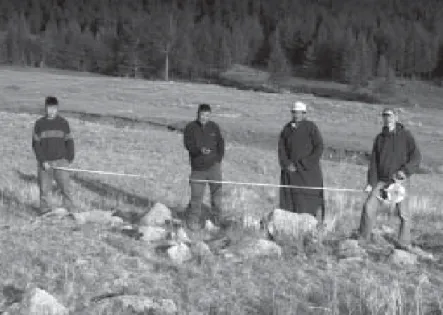
![Figure 1: The scan team: Karas, Thome and Beaubien [vii06, PTD]](https://thumb-ap.123doks.com/thumbv2/123dok/11208735.0/69.918.489.808.77.362/figure-scan-team-karas-thome-beaubien-vii06-ptd.webp)
2005 Burial Mound Survey in Hovsgol Aimag, Mongolia
The 2005 survey team included members of the Institute of Archeology at the Mongolian Academy of. The reported presence of more than 400 mounds west and north of the Ushkiin Uuver deer stone complex and the known number of 118 mounds west of the Ulaan Tolgoi deer stone complex strongly suggested that this particular area may include a large number of mounds (Frohlich and Bazarsad 2005). Five hundred and three mounds were located on the southern hillsides of the large mound complex north and west of the Ushkiin Uuver boxwood complex (Figure 3).
Twenty-four pits were tested in 12 mounds located between 6 km and 12 km west and northwest of the Ushkiin Uuver deer stone complex. Two metric variables were recorded: the vertical distance between the lowest location of the stone and the present surface (variable B) and the vertical distance from the present surface to the top of the stone (variable A). The total vertical height of the stone (variable AB was calculated by summing the two recorded variables.
Based on these preliminary pilot tests, we can say that the khirigsuur at Ushkiin Uuver is younger than the comparable hills west and northwest of the deer rock complex.
Appendix A
Buddhist Enclosure Site
Deer Stone Site
Rock art carved into lava blocks at outcrops on the level terrace north of the terrace edge overlooking the Shishig River. We found this deer stone site on a terrace on the northern shore of Lake Erkhel, just south of the motorway. One deer stone stood and had faint but unmistakable deer stone markings; the other stone was north of the standing stone and fell.
Returning from inspection of the East Erkhel deer stone site up in the hills east of the ger camp, we found a small pavement mound that had been looted on a small hill overlooking the Hatgal road. A local shepherd told us about this deer stone site, located in the middle of a shepherd's winter camp in the hills east of Lake Erkhel tourist camp. Deer Stone 1 – Circular feature, two pieces of charcoal (AMS charcoal sample) - Deer Stone 2 – South Circular feature, chert end scraper.
Hjortesten 2, a fallen hjortesten at Evdei 3. Close-up of Evd Klostersted Functions A, B, C, E, F and I:.
Appendix D
After excavating one of the horse head graves at Erkhel Ulaan Tolgoi Deer Stone (DS) No. Excavation of the northeast corner mound should provide a date for the construction of the large khirigsuur that is almost as accurate as the dating of the interior of the large mound itself. There was a small pit 4 inches deeper than the rest of the gravelly silt level where we ended the excavation.
Most of the bone was cracked for marrow extraction or cooking, and only fragments of probably one animal were present, at different depths, so the upper level bone may also postdate the mound construction. Very large surface rocks covering the center of the hill, more than in the corner piles, which are more or less the same size (4 × 4 meters). There are 5 of these "super" horse heads, 3 on the north side of the 'East Gate' and 2 on the south side.
The smaller fragment of the left mandible lacked the proximal and distal parts and included only the main molar.
Appendix F
Summary: Anthropologists have argued for years about the first people of the Americas and how many waves of migration occurred. Professor William Laughlin, a single migration proponent, proposed to test his theory through joint research with the Russian academician A. Okladnikov, first in 1974 in the Aleutian Islands and in 1975 on Olkhon Island in Lake Baikal. Stephen Zegura proposed a two-wave migration based on Y-chromosome haplotypes which demonstrated that the Asians most closely related to American Indians originated from the Lake Baikal region and northern Mongolia.
Summary: Reindeer herding has been a way of life and livelihood for North Eurasian peoples for more than 2,000 years. Despite its importance, the date and place where reindeer herding originated are not known, but it is believed to have first occurred in Tuva and northern Mongolia. This article discusses the biology and ecology of reindeer; practices used by the Tsaatan and other reindeer herding peoples, and theories about its history and origins.
Digital Scanning in an Archaeological Setting: Creative Applications in Mesoamerica and Mongolia Harriet F. Rae) Beaubien (presentation) and Basiliki Vicky Karas (demonstration).
Appendix G
Conservation Report 2005
In the afternoon, Paul and I held workshops - he at the Museum of Natural History, and I stayed at the Museum of Mongolian History, using the same room as for the presentations. On Sunday morning, June 19, Paul and I went to the Mongolian History Museum to meet Odbaater. Odbaater was clearly dedicated to his work and wanted to do it to the best of his ability, which he mostly already was.
In the afternoon we went back to the Mongolian History Museum and met with Twl, the person in charge of storage. She asked if I would suggest changes in the display, and I said the UV light inside the containers should be covered with UV absorbing plastic and I would look for sources on the internet for her. I suggested covering the windows to prevent fading, especially of the red in the intricately embroidered hangings.
I also suggested an internship in the US for one of the conservators from the Cultural Heritage Center.
Appendix H
ONGOLIA
A COMPLETELY DIFFERENT PERSPECTIVE LOOKING AT NORTHERN CONNECTIONS (ES ALSO WORKS IN A BROAD ANTHROPOLOGICAL TRADITION LOOKING AT ARCHEOLOGY IN THE CONTEXT OF NOGRAPHIC CONNECTION SERV! NCED %SKIMO DEATH MASKS AND IVORY SPRAYS WITH SHAMANISTIC AND ANIMAL MOTIFS &ITZHUGHS. E RIEST TO THE GOVERNOR'S OFFICE IN THE CENTER OF THEIR URON REGISTERS PROJECT PROCESS CARRIED OUT BY RESIDUAL 3OVIET OFFICIALS IT IS IMPORTANT AND PEACEFUL A THEORY PROPOSED BY ART HISTORIAN %STHER .. ACOBSON4EPFEROFTHE5NIVERSITYOF/REGON AT- ONGOLIANDEERSTONEARTISANEARLYFORM.
ON THE AGENDA IS A VISIT TO THE 4SAATAN RAIN KEEPERS IN THE MOUNTAINS ABOVE THE CAMP &ITZHUGH SOME OF THE ARCHAEOLOGY START RUNNING AROUND A CURI OUS-DECORATED LEGCLONE TO DIGGING A CURI OUR DECORATED LEGCLONE, NOT OF WHICH THE EXPEDITION MAIN LAW4THE 4. SAATAN.UMBERING JUST CALLS FOR HUNDRED VEIL OF THE 4SAATA-WP THEIR SUMMER CAMP SINANALPINE MEADOW NEAR THE HEADWATER OF A STREAM CALLED -ENDEBULUG. MOST OF THE APPROXIMATE DEER STONES IN NORTHERN ONGOLIA ARE ISOLATED AND EXPOSED TO SEVERE ENVIRONMENTAL CONDITIONS THREATENING THE WEATHER THROUGH THE MINES EMBARRASSMENT% ALL HERE RELATION ISOLATION DOES NOT CONTROL VANDALIZATION OF ALL AND THE UNDERTAKING OF ALL MAINTENANCE. NIGHTMARES MERWORKINGWITH3#-2%FELLOW 6ICKY +ARAS AND #AROLYN 4HOME AN EXPERT MODEL PROCESSOR FROM THE 3MITHSONIANS /OFFICE OF %XHIBITS .. 34;EAUBIEN USED A LASER SCANNER TO DIGITALLY RECORD BRICKS.
TO MAKE DESIGNS FROM DEER STONE, WE USED THE SHABROTE KIT. h4HE SCANNING ENABLES YOU TO WRITE THESE DESIGNS VERY VERY ACCURATEvWRITE»EAUBIEN h3OJE FOOD FOR HISTORIANS AND PEOPLE INTERESTED IN TECHNOLOGYv.
EER3TONESIN$
4THE BUILDING IS SIMPLE 4THE SCANNER PROJECTS LASER LIGHT ONTO AN OBJECT, CREATING A DETAILED PROFILE OF THE SURFACE OF THE OBJECT WHICH CAN THEN BE PROCESSED INTO A VERY ACCURATE THREE-DIMENSIONAL IMAGE AN EOLOGICAL PROJECT CAN USE 'UTIT'SGOGRE POTENTIAL FOR RESEARCH OOK, PRESERVATION AND CONSERVATION OP LONG-TERM'. A LONG VISIT TO THE BORDER GUARD OFFICE IN 4SAGANHOURTHEEXPEDITIERENDEZVOUSWITHTHE4SAATANAT THE HEAD OF AN ARROW VALLEY LEADING TO-ENDEBULUGto-ENDEBULUG4HE 4SAATANTREATALLOFTHETAMESPECIAL$E0RIESTASOLD FRIENDS/EXPLAINED WITH HORSESWE CAME UP THE VALLEY AND THE MOUNTAINS IN!FT REAL HOURS OF FAST HARD CLIMBING ON HORSE BACK, WHICH IS PARTIALLY ILLUMINATED BY A CLEAR VIEWS OF THE EXTENSIVE $ARKHAT6 ALLEG AND THE ALMOST BORING 3AYAN MOUNTAINS WERE BEHIND THE 4SAATCAMP. TRIPTO ENDEBULUGMEAANS VISITING DETENTS OF3UYAN A WOMAN WHO HAS BEEN SOLD FOR MORE THAN YEARS AND THE GROUPS MOST SELLINGHAMAN3HEISTHE ONLY SOURCE OF 4SAA TANT TRADITIONAND FOLKLORE(HERITAL BODY AND OLD FACE GIVE US A GIVE US OF HOW HE IS CONNECTED TO METAMYSTIC TRADITION THAT HAS BEEN THOUSANDS OF YEARS DATES)TSTH ISSTRADITIONWHICH &ITZHUGH THINKS TO BE RESPONSIBLE FOR COMMON RITUALITY ARTIFACTS USED BY PEOPLE IN THE!RCTIC WORLD, PEOPLE ARE DIFFERENT AS THE 4SAAT AND THE!LASKAN%SKIMO.
34; BACK AT CAMP WE FIND THE CUP THAT HAD BEEN DEEP AROUND THE UNMARKED STONE AND ITZHUGH HAD SELECTED FOR EXCAVATION 4 HE HAS A CURIOUSLY USED ASTWEST STONE ALIGNMENT UNDER THE SURFACE AS WELL AS BONES THAT SHOULD DATE THE MONUMENT. 4THE NEXT DAY THE AMBASSADOR LEAVES AND WHILE THE EDITORS CONTINUE WITH TWO!MERICAN VOLUNTEERS$ENIS2YDJESKIAND"ETSY%LDREDGE AND)GUIDANCE/DBAATARONASRESEARCHOFTHE VALLEISKHIRIGSUURS&ORTWODAYSWERECORDDOZ ANDVANDESTENHEUVEN BEFORE WE DO ANYTHING REAL SP ANNEND PASSING AMAZING UNKNOWN GRANITE ROCK THAT LOOKS ON ITS SIDE INTO THE FLOOD PLANE) APPEARS SIMPLE STONE, BUT %LDREDGE HAS SHARP EYES AND TRACSES THE STONE JOINT COUNTER BELT WITH HER FINGERS 3 HEALS THE FAINT IMPRESSIONS OF AN EARRING CARVING/THE PROPERTIES REVEAL THEMSELVES IN THE LIGHT CHANGES “EAUBIEN. THE LAST DAY WITH THE ARCHAEOLOGIST SPENT BACK FILLING IN THE GLOVES AROUND THE CENTURY STONE 4HEY FEEL THAT THIS IS PROBABLY BASED ON THE ALIGNMENTS OF THE STONE THEY FOUND UNDER THE MONUMENT THAT ACCOMPANIES 4URKI CRITUAL SITES. ARCHAEOLOGISTSAFETYAFTERAFEASTOF-ONGOLIAN PREPARED BYTHEEXPEDITIONSEXPEDITIONERS)HITCHARIDEBACK TO -URONWITH"EAUBIENENHERTEAMWHORENBACKTO,AKE%RKHELTOSCANMOREDERSSTONES-YLAST DAY IS SPENT WITH THEM IN THE EXTENDED MARKET OF THE CITY WHERE "EAUBIELARGE BOLTS OF BLACKCLOTH PURCHASES(ERTEAM HAS DISCOVERED NEEDS A RELIABLE TENT TO EQUIP THEIR EQUIPMENT PROTECTING SUN WHICH THROWS THE SCANNER) LEAVES SHE DISCUSSED WAYS OF ASHION CROSSING WITH 4 SOGOUR DRIVERS A LOW-TECH CONVERSATION THAT MUST BE HAD BEFORE THEY CAN USE THEIR CUTTING EDGE LASER.
PREVIOUS EXCAVATIONS AND FURTHER STUDY OF DEERSTONE ICONOGRAPHY WILL BE NEEDED TO DETERMINE IF-ONGOLIAG BIRTH IN THE 3CYTHIAN VET STYLE, ALTHOUGH NEW RADIO CARBOND DATATION THIS SUMMER EXCAVATIONS OF EVEN MORE HORSE HEAD BURIALS FROM, AKE%RKHEL CONFIRMS THAT THE DEER STONE FROM THE 3C IS SPREAD YTHIANS &ITZHUGH ALSO NEED MORE TIME TO STUDY WHETHER "RONZE!GE-ON GOLIA INDEED HAS ANY INFLUENCE ON THE CULTURE BEYOND DE!LASKAN.
Radiocarbon Dates List