Month 2: Social Media Channels
You’ve reviewed your current marketing plan and identified the specific points in your current cam- paign where post-purchase feedback and word-of- mouth generated on the Social Web might benefit you. Now, it’s time to get a firm handle on the various forms of social media that are available to you. Part III covers each of the social media chan- nels. It opens with a general approach for build- ing your plan and then works through each of the channel groups — social platforms (e.g., Face- book), social channels, including both multimedia (e.g., YouTube) and ratings and reviews, and social interactions (e.g., social activity and status updates) — in turn. This is a long month — five weeks. You don’t actually have to wait for one of this year’s long calendar months to do these exer- cises. If you need an extra week, just roll the last exercise into next month.
Chapter 8: Week 1: Build a Social Media Campaign Chapter 9: Week 2: Social Platforms
Chapter 10: Week 3: Social Content: Multimedia
III
153■Week 1: Build a Social Media caMpaign
Chapter Contents How Is Social Media Different?
Quantifying the Social Feedback Cycle Social Media Channels
Social Media and the Purchase Funnel The Main Points
Week 1: Build a Social Media Campaign
You’ve worked through the issues that drive social media and its acceptance by the people you want to reach. You’ve seen how you can use it to com- plement traditional and online channels. You’ve looked at the tools available to help you get ready to use it. Chapter 8 provides a quick dive into your emerging social media plan: Chapters 9 through 12 back it up with detail and channel specifics.
In this chapter, you’ll develop a framework for your social media marketing strategy. You’ll work through exercises designed to show you how to properly participate and influence the con- versations that others use when evaluating your marketing claims and messages. Note that while traditional and online media are planned and controlled by you, your agency, or PR firm, social media is generated and controlled by participants.
8
154
chapter 8:Week 1: Build a Social Media caMpaign■
How Is Social Media Different?
does the receipt of your message depend on an interruption? if so, consider the follow- ing question:
If you couldn’t interrupt people, how would you reach them?
For many marketers, interruptive advertising is very likely the basis of the mar- keting toolbox. i’d go as far as to say that most marketers don’t even think of advertis- ing as being an interruption: it is just advertising. interruptions are so engrained across current marketing channels that a lot of marketers don’t stop to think about the con- sequences of not being able to interrupt. it’s a lot like air: it’s just assumed to be there.
now, looking out across the Social Web, it feels like marketing on the moon. There is no air.
The question i’ve posed — asking what you would do if you couldn’t interrupt — is indicative of where marketing is heading. as ad avoidance moves from an activity limited to those willing to install a pop-up blocker, email filter, or similar software into an expected condition that is adopted without further thought by everyone — the phrase
“all the kids are doing it” definitely comes to mind — the way in which you reach and engage your audience will surely change. presently, people not wishing to be exposed to marketing and advertising messages have to take an explicit action to avoid it: They have to place their name on a list to avoid calls or install a pop-up blocker to prevent intrusive ads. The shift from active to passive avoidance is happening now: pop-up blockers are increasingly being built into browsers and browser add-ons (the little soft- ware applications that help people manage some aspect of Web use). pop-ups as a result are routinely blocked unless specifically permitted. it’s pretty easy to imagine the day when, as a marketer, you will have to get explicit permission to contact someone by phone, mail, in person, or through any other channel. Think about living in a whitelist world — where the only communication you actually receive arrives after having been accepted from a trusted source — instead of the current blacklist world where every- thing except what’s blocked gets delivered. Think back to gary Ruskin’s quote:
“It is better for the industry to act voluntarily. Otherwise, after a long court battle, angry citizens will get rid of the commercial speech doc- trine and replace it with the right to be left alone.”
if you doubt gary’s prescience, look at San Francisco and the naming rights for the city’s baseball park at candlestick point. Following a set of corporate naming deals — first 3com and then Monster — people became frustrated by the fact that the name of this and other similar landmarks was being sold. To start, it was a hassle:
Try giving directions when the names of important landmarks keep changing. as well,
155■HoW iS Social Media diFFeRenT?
many citizens who were proud of the roots of the original name outright resented this form of advertising, and simply refused to go along at all. instead, they continued to refer to the park by its original name in print and especially conversation. ironically, the latter — conversational use of the corporate name — was one of the prime benefits of buying the naming rights in the first place. Having had enough, the citizens of San Francisco voted in a mayor friendly to their cause. in 2004, a resolution was passed that returns the original name — officially — to the stadium after the 2008 season for evermore. on matters of intrusive advertising, if you push your audience hard enough, it will push back.
all of this is not to suggest that you stop doing what’s working in your current programs. There are many formats — TV, radio, print — where interruptive advertising is largely accepted, particularly if something like gSd&M ideacity’s “uninvited guest”
credo is followed. The “uninvited guest,” written by agency co-founder Tim Mcclure, holds that ads are interruptions: ads are an uninvited guests. Therefore, a debt is owed to the person interrupted, and it is through the repayment of this debt — through humor, emotion, or similar — that your ad becomes an invited guest. With regard to social media, your message is an invited guest from the get-go. This is both an opportunity — your audience is picking up your message on its own — and a challenge — you have to have that invitation to get in! This chapter is all about earning your invitation, the right way.
i again want to stress that the use of social media is intended to complement and extend your current efforts, not replace them. as you consider the role of the par- ticipants who are talking about your brand, product, or service currently, think about techniques like spam and pop-ups. While most marketers have stayed away from spam, many have embraced pop-ups. are pop-ups really any less offensive than spam? Mar- keters make extensive use of double opt-in email. While double opt-in is a very good practice, the further subscription option (often checked by default) that says something to the effect of “as well as our various and unnamed marketing partners now and in the future…” undoes about 99 percent of the benefit of double opt-in. Why not require that each marketing partner be separately approved? Why not offer a double opt-in for pop-ups, too? all of these interruptive and intrusive practices are viewed dimly by the majority of those online. consider this as your chance to move forward. offensive practices — attempted instead with social media — are unlikely to win friends in pre- cisely the forum where you really want to win them: the Social Web.
on the Social Web, you have to take a different approach when creating your plan. When you first establish a presence on the Social Web, you’re like any other new- comer. The fact that you’ve been marketing for 10 or 20 years doesn’t mean nearly as much as your online social reputation. if you’re new to social media, then by definition you don’t have a social reputation beyond the carry-over from whatever you have built
156
chapter 8:Week 1: Build a Social Media caMpaign■
outside the Social Web. Building a solid online reputation is essential: ultimately, it is your online — not offline — reputation that drives your results on the Social Web.
“If someone is mentioned by name and described as a non-Internet user, then that could be the sum of their online reputation.”
— Nathan Gilliatt, Social media analyst/consultant Your online social reputation is something that you build as you go — just as it was in the market square in your great-great-grandparents’ day. Metrics like the ratio of blog comments to your blog post, unique visitors, dwell times, and quantitative assessments of social commentary about the content you create or the conversations that reference your brand, product, or service can provide an indication of your online reputation from a social viewpoint. Based on those measures, you can get an idea of what needs to be done to strengthen or improve your reputation, regardless of your starting point. if you think that some of the criticism and outrage levied on brands that trample the Social Web is severe, take a look at Figure 8.1. When it came to social trans- gressions, your great-great-grandparents had it worse. Much worse. This, incidentally, is exactly why disclosure and similar best practices are so important: once caught, always a suspect. Tough love, that last one. But better learnt here than in public.
Villagersinstocks, caption “When Marketsturn ugly” - public DoMain, iMagefroM WikipeDia, http://en.wikipedia.org/ wiki/Image:John_Waller_in_pillory.JPG
Figure 8.1 Bad behavior is not tolerated on the Social Web
This week’s exercises focus on building your social media plan. You’ll pull your social feedback cycle and touchpoint map together, and at the same time add the data that you looked at in chapter 7, “influence and Measurement.” This includes your net promoter score as well and the sources of discrete data — page views, dwell times, comment-to-post ratios — and any other measures you may have found.
By the end of the week, you’ll have a complete framework for your social media program. Just in time, too. The next four weeks are going to be spent on the Social
157■QuanTiFYing THe Social FeedBack cYcle
Web, looking at both social applications and social media as applied by marketers for the purpose of business. By building your framework first, you’ll be better able to read- ily spot the applications that are best suited to addressing the marketing challenges that you face. Think of what’s coming up as walking into a grocery store: What you’re writ- ing out this week is a list of what you love, what you don’t care for, and what you’re allergic to.
Quantifying the Social Feedback Cycle
You’re going to start this week by combining the metrics you’ve been gathering with the social feedback cycle and touchpoint map you created. in the section that follows, you’re going to extend the metrics you looked at last week and tie them to the specific objectives that drive your social media campaign.
Tip:
A set of worksheets covering this week’s exercises can be found in the appendix. In addition to these printed worksheets, you can also download electronic copies and access related resources at the website accompa- nying this book. Complete information regarding these resources and the website is included in the appendix.Combining Touchpoints and Feedback
Your social feedback cycle shows you the “path” that potential customers take and the media and messages that they currently encounter as they learn about and evaluate your product or service. That much isn’t exactly new: it’s what marketers have been working through, in one way or another and across a range of media, for years. What is new is the consideration phase, and the way in which the conversations occurring on the Social Web enter the purchase funnel. This is what your social feedback cycle is showing you. consumers routinely state that on the internet, they can validate what they learn through TV, radio, or print. Recognize that it is here — the consideration phase, where the social feedback cycle connects to the purchase funnel — that this vali- dation happens. Someone comes in contact with your awareness message and then turns to the Web for more information. This invariably includes asking others with whom they may be only loosely connected — or not connected with at all until this moment — but who themselves may have had direct experience with your product or that of a competitor. This is the Social Web at work in the consideration phase of the purchase process.
Turn next to your touchpoint map. Recall that this provides a very visual way of “seeing” the effectiveness of your various marketing efforts and the experiential points where customers come into direct contact with your brand, product, or service.
using your touchpoint map, you can see the relative importance of each of these as
158
chapter 8:Week 1: Build a Social Media caMpaign■
“talk-generators.” if this seems a bit of a leap, consider that the intensity and polarity of consumer-generated content — positive (helpful) references versus negative (damag- ing) — is driven by the experience you create. in the case of “viral” advertising, the experience talked about is typically that of the advertisement: it is the ad (but not necessarily the product) that gets passed around. of more interest to social marketers is the experience associated with the product or service itself. on the Social Web, people are looking for information, not promotion. When this experience is delightful, the service gets recommended. When the product delivers an experience that meets or exceeds expectations, it gets favorably presented to others on the Social Web. When it doesn’t, it doesn’t.
Taken together, between the social feedback cycle and the touchpoint map, you get a clear indication of the trigger-points for the important conversations that matter to you — as a marketer — and the way in which they are likely to play out through social media. as you review your social feedback cycle and touchpoint maps, think about and then answer each of the following questions. You’ll be using these answers later this week when you develop the framework for your first social media campaign.
Monday’s One-Hour Exercise
Today you’re going to spend an hour looking at the social feedback cycle you created in chapter 5, “The Social Feedback cycle,” and the touchpoint map you created in chapter 6, “Touchpoint analysis.” consider each of the following questions:
W
• hat are you doing to generate awareness? Which specific awareness channels or media are you using?
W
• hat channel is your top performer in terms of Roi? How did you measure this?
W
• hat are you doing at the point of sale? Which specific channels or media are you using to ensure (or derail) competitive sales closures?
W
• hich of your identified touchpoints are working? Which are not?
W
• hich touchpoints represent your “top three” (or two or even one), the ones you absolutely count on to generate a talk-worthy experience?
a
• re your strongest touchpoint experiences driven by marketing (the expectation you set) or operations (the product or service you deliver)?
W
• hich three could you do without? Which are the touchpoints that your cus- tomers don’t really seem to talk about?
o
• f the three that don’t seem to matter, why do they exist? are these left over from a prior selling paradigm, or just weeds that need to be pulled? or, are they
“neglected stars,” the kinds of things that could be powerful talk generators if only ___ (and do be sure to fill in that blank!)?
159■QuanTiFYing THe Social FeedBack cYcle
Monday’s Wrap-Up
Today you connected the social feedback cycle elements with your touchpoints. By understanding the contribution (or challenge) being introduced in the consideration phase of the purchase process, you can get an indication of the types of social channels that will most likely provide a beneficial effect and/or provide real insight. Social media is as much a forum for market study as social endorsement. By connecting your touch- points, specifically ranking them, and then differentiating between the important ver- sus optional touchpoints, you can pinpoint the places where social media is most likely to help you. after all, half of winning is knowing which fights to pick.
Applying Social Media Metrics
Yesterday you connected your social feedback cycle and touchpoint map. Today you’re going to add your most robust metrics and hold the results up to your current market- ing plan. each day this week you’ll build more: By Friday you’ll have identified some very specific opportunities for social media and integrated these ideas into your emerg- ing marketing plan. in the chapters that follow, you’ll review each channel in detail to see which make the final cut.
in the first part of your working session today, you’ll want to gather the met- rics presented in chapter 7. if you haven’t yet completed your measurement exercises, you’ll need to pause here and do that. The remaining sections of this chapter, and indeed most of the actual work that you’ll be doing in subsequent chapters, depend on these metrics and the way in which they define the state of your current business. on this point one thing should be clear: Social media is as quantitative a discipline as any.
Without “the numbers,” you are flying by trial and error. one of my neighbors, now retired, was a commercial pilot. i was talking with him about the way that a lot of the
“new marketing” seems to happen: He pointed out that from his perspective, trial and error is generally not the recommended way to fly.
in chapter 7, you first encountered the metrics shown in Table 8.1. Table 8.1 repeats these metrics, this time connecting them with the social feedback cycle. This table shows you how to connect your available metrics to the activities of participants on the Social Web. This table links together metrics that you very likely already have — or could have relatively easily — with the kinds of questions that are of particular inter- est to you as a marketer.
For example, looking at page views, blog references, and click stream analysis, you can draw conclusions about who is participating and what they are reading and then look for ways to make that content more useful to them. This is important as a social feedback cycle best practice: By continuously reviewing and tuning your content based on its use you are continuously enhancing your relevance to specific audiences and thereby building your social reputation. For more on metrics and web analytics, refer to the sidebar “Web analytics: an Hour a day.”
160
chapter 8:Week 1: Build a Social Media caMpaign■
PTable 8.1 Selected Metrics and the Questions They Address
These Metrics… Interpreted As… Answer These Questions:
Page views, visitor info, blog mentions, click analysis, traffic patterns, referrers
Who’s reading, and what (Unique) audience and habits
Audience: Who is reading and what is being read?
Time on site, blog context, review polarity
Memes and their intensity over time
Influence: What are people saying about your offer?
Time on site, pass-alongs, comment-to-post ratio, blog mentions, reviews, bounce rates
Items clicked on Length of stay Conversational qualities
Engagement: How involved is your audience; how likely is your mes- sage to spread quickly as a result?
Pass-alongs, conversions, reviews
Conversions, actions taken in support of your objectives
Action Taken: What happened as a result of participation?
Pass-alongs, blog mentions, time on site, bounce rate
Trends: subscribers, repeat visitors, referrals
Loyalty: How likely are people to return and to refer what you offer to others?
Take a look at the fundamental metrics and how they relate to the elements of influence, engagement, and more. Starting with the most basic measures — page views, click patterns, and referrers, for example — you can track and create a trend for unique visitors to your social content in the same way that you would do with any web asset.
This gives you the ability to refine and improve the experience that you offer.
Featured Case: Product Pulse — Measuring Success
Product Pulse is a social marketing application, currently available on Facebook and MySpace.
It gets brands, products, and services into the conversation on social networks and invites com- ments — both positive and negative — from members.
Recent campaigns have featured The North Face, Timbuk2, and Mountain Hardwear. These appli- cations yielded very granular data and importantly data that are independent of the other exist- ing metrics available for in-campaign and post-campaign analysis.
Beyond the reach-related numbers collected during the campaigns, detailed comments are generated by participants. The comment content is measurable. For example, the Mountain Hardwear program ran five weeks, engaged about 20,000 people in the campaign, and gener- ated about 8,000 comments and 5 million social impressions across Facebook. According to Chris Strasser, Mountain Hardwear promotions project manager, “ProductPulse got people talking about Mountain Hardwear products on Facebook…something we couldn‘t do with banners.”
This type of marketing/social integration is readily accepted by social network members, too:
Product Pulse is in the top 3 percent of all Facebook applications.
161■QuanTiFYing THe Social FeedBack cYcle
Tracking additional metrics — for example, time spent across different social media assets, or the post-to-comment ratio if you are offering or tracking a blog or forum — will give you an idea of the robustness of the conversation. These are the met- rics that relate directly to influence — the degree to which what is said in one forum will influence an action in another — as well as engagement. You may or may not have access to the data i’ve suggested: if not, ask around. Someone in your organization prob- ably does. if you are working through these exercises without any data, for example, as a student or as someone interested in social media but not directly involved at the moment, then go and look at some popular blogs: Tally the posts and comments and create your own table of data so that you can see how this would be actually done, and why it is useful. if you maintain a personal blog, look at the data for that as you work through these exercises.
Web Analytics: An Hour a Day
If you are interested in digging deeper into web analytics, you may want to purchase Web Analytics: An Hour a Day by Avinash Kaushik (Sybex, 2007). Writing in the same style as this book, Avinash covers in detail many of the metrics that are referenced here along with the best practices relating to collecting and reporting on them.
Finally, add the number of content “pass-alongs” (e.g., “send to a friend”) and more detailed information about the actual conversions. You can develop a very defen- sible position on how social media is being used with regard to your brand, product, or service using a handful of these measures along with a good deal of the intuitive exper- tise that you bring as a seasoned marketer. With this data, you can make a reasoned choice — based on quantitative and well-understood metrics — as to what social media components are likely to yield the most benefit in terms of augmenting your current efforts. By understanding which type of content or which social media channels are in play, you can define your influencers with regard to their role in the social feedback cycle. are people sharing photos or videos of your product in action? or, are they writ- ing about an experience that they had? are they creating and sharing positive or nega- tive stories, or, are they creating content that shows new or novel uses of your product?
These are things you want to capture and build on.
Tuesday’s One-Hour Exercise
Today you’re going to pull together a list of the metrics that you identified in your exercises last week (chapter 7) and develop a basic framework for your dashboard
162
chapter 8:Week 1: Build a Social Media caMpaign■
and report card. later, in chapter 13, “objectives, Metrics, and Roi,” you’ll come back to this and build on it. For now, focus on the basics and get the core data in place.
if you haven’t worked with dashboards and report cards, here’s a quick distinction:
The detail-oriented “dashboard” will organize and present the metrics you are collect- ing: page views, time spent, etc. The “report card” distills it all down into the smaller set of derived metrics that you track and use as a quick and ready performance guide.
as an easy place to start, consider making the net promoter score, a core social media metric that you worked with in chapter 7, the centerpiece of your report card.
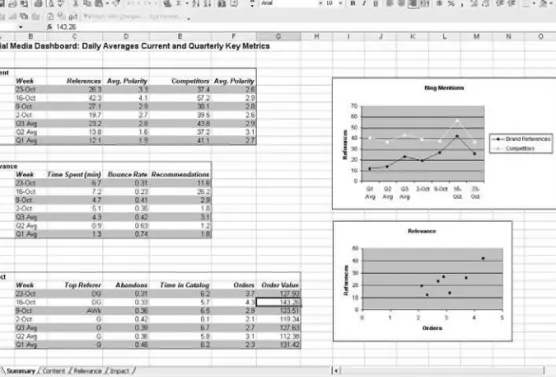
You can back it up with the dashboard data that you’ll begin collecting. The underly- ing dashboard measures provide a more granular view that is important to individuals and the departments they lead. providing this data makes it easier for you to build an internal constituency.
To build your dashboard and report card, you can use just about anything, including pen and paper. My suggestion is that you use a spreadsheet or even a report card reporting package of some type. as you gain experience, you’ll want to modify the design: if you’ve built your dashboard or report card in a text-based format, it won’t easily scale or adapt. as a result, you’re likely to quit using it, which of course defeats the purpose of creating it.
if possible, have the underlying reports you need that contain the metrics you want delivered in a format that you can import directly into your spreadsheet for quick and easy analysis. Your information Technology (iT) department can help you with this — it’s surprisingly easy and can make a big difference in the sustainability of your measurement efforts. it’s social media after all: get everyone involved! To create your data worksheet:
u
• sing Table 8.1 as a reference, identify the metrics that you have or can get.
There may be others as well that are specific to your business. Add those too.
c
• reate a spreadsheet following the example shown in Figure 8.2, adapted to hold the data you identified. create a list of the data you want: You aren’t collecting it yet, but rather identifying it.
F
• or each item listed in your spreadsheet, identify the source of the data and work out a plan to either collect it or have it provided to you by someone in your organization.
Tip:
If you choose to utilize the Net Promoter score as a core element — and I highly recommend that you do — purchase a copy of The Ultimate Question and either retain an experienced consultant or per- sonally develop any additional expertise required to implement this program fully.163■Social Media cHannelS
Figure 8.2 A Very Simple Dashboard
Tuesday’s Wrap-Up
You now have two big pieces of your emerging social media plan in front of you. You have an analysis based on the social feedback cycle along with your touchpoint map, and you’ve added to that a reporting tool that will allow you to quantitatively track tactical results over time. in addition, you have a new metric, the net promoter score.
it will help you over time by providing strategic guidance that effectively links your marketing efforts to operations. additionally, the net promoter score will give you a solid starting point from which to plan your opening moves on the Social Web.
Social Media Channels
To make sense of the Social Web, i’ve found it useful to split social media channels into functional groups: platforms, content, and interactions, as shown in Figure 8.3.
it helps me, as a marketer, to make sense of the dozen or so arms that Robert Scoble lists in his starfish model of social media. it also provides the nice side benefit of having ready buckets to catch new social media channels and content formats as they emerge.
Finally, from a purely practical standpoint, it makes it much easier to plan a social media program.
164
chapter 8:Week 1: Build a Social Media caMpaign■
CONVERSION (PURCHASE)
Social Interactions
EVENTS and CALENDARS
SMS and TEXT
EMAIL (BACN)
STATUS UPDATES
VIDEO
AUDIO
(PODCAST) Social Content
PHOTOS MICROBLOGS BLOGS WHITE-LABEL SOCIAL NETWORKS PERSONAL
SOCIAL NETWORKS
WIKIS Social Platforms
Figure 8.3 Social Media Channels and Groupings
Making Sense of the Channels
There is an underlying perspective shift when you move from participant to marketer on the Social Web. looking at the starfish model and the groupings i have applied, for example, there are a number social media types spread around the central act of “con- version.” From a participant’s perspective, this makes complete sense: The participant (at the center) undergoes some sort of conversion — a persuasion or movement toward an action or a decision — as a result of interaction with or exposure to the surrounding social media ecosystem in which the participant spends time. From a marketer’s per- spective, however, what is of interest is how various channels can be used to increase the likelihood of a conversion on the part of a Social Web participant. The partici- pant’s question is “What do i need to know?” The marketer’s question is “Through which channel or media type should i provide the answer?” From this perspective, it’s a nightmare to try and plan a dozen or more channels, hoping to catch the right one in what is merely one element of a larger integrated marketing program. it is much easier to look at the integrated whole, find an opening or other indication of a need for social media, and then look for a tool within a specific group of social media channels that can be effectively applied given this need. Through the combination of your social feed- back cycle and touchpoint map, this is exactly the approach you will be using.
Social Platforms
Social platforms, the first of the big groupings within social media, include social networks — MySpace, Facebook, linkedin, plaxo, and more — as well as white-label
165■Social Media cHannelS
platforms that can be used to provide community and support services. also included in this group are wikis (collaborative platforms that drive consensus around ideas, externally with customers or internally with employees and partners). Wikipedia is the prime example, although there are lots of others. Social platforms will be covered next week in detail in chapter 9, “Social platforms.”
Real-world examples — in this case from the publishing industry — of white-label platforms in use include comcast’s use of lithium’s community platform, Meredith publishing group’s use of the pluck Sitelife platform, and Jive Software’s work with condé nast. Meredith publishing also uses a wiki — served by wiki platform provider Wet paint — in its WOOD magazine community. The wiki powers a “dictionary” of woodworking terms. Rather than tasking editors with maintaining the definition for a long (and growing) list of terms, the WOOD magazine editors seeded the wiki with the most important terms and provided a “starting” definition. after that, community members were invited to update, add to, and improve the definitions. Who better to maintain the dictionary of woodworking terms than the community that relies on it?
This is a great example of the benefits of participation (on the part of the marketer or publisher) and simultaneous involvement of constituents made possible via social media. in this case, by applying a wiki, both marketer and consumer work together to do something great. Both participate, both benefit.
How can you do even more with these tools in marketing? consider the personal or professional social networks (for example, Facebook). While you can always pur- chase banner ads or section pages on social networks, that’s not really “social media.”
compared with what is emerging on the Social Web, that’s old-school, more akin to traditional interruptive online advertising. it’s no different than buying 10 million impressions on eSpn or Yahoo. in the same way that targeting ads by itself doesn’t makes them compelling, the fact that these ads are appearing on a social network does not make them social media. Make no mistake, those types of ad buys may well be an important part of your overall marketing program. They can work for building aware- ness, for example, and used correctly they have a proven return. But again, they aren’t social, so used alone you are missing a big part of what the Social Web has to offer.
ok, that sounds great…but if not banners, then what? Take a look at the embedded marketing applications on Facebook. Beyond Vampire Bites and Sheep Throwing, there are some solid marketing applications that leverage the Facebook platform. american airlines launched Travel Bag in March of 2008, and product pulse has been running contests featuring branded merchandise since 2007. Social Vibe — running in Facebook and MySpace — links marketers and social network members interested in the causes of charity. These applications directly involve the members of these networks and simultaneously promote the brands, products, and services of par- ticipating companies. The members are in complete control. The result has measurable marketing value: See for example the product pulse tip for more details.
166
chapter 8:Week 1: Build a Social Media caMpaign■
There are a lot of working, integrated marketing tools that live inside of social networks. Take a look at these applications, or better yet, add them to your profile on these sites. You do have profiles on these sites, right? if you don’t, take a few minutes and create them. if you’d rather, you can wait, and do this in chapter 9 as an exercise.
either way — and quite seriously — even though it may seem at first a bit a of time waster, do participate in the online networks and content sites that i am presenting (or sites that are similar). Through participation you’ll learn more about social media than by sitting on the sidelines. Social media is not a spectator sport.
White-Label Social Platforms
Beyond the personal and professional social networks, white-label platforms are available so that you can create your own social network. While this sort of undertaking is beyond the scope of what you can do in an hour, it is nonetheless an important channel for you to consider. Not recommended is creating yet another social network simply so that potential customers can come and hang out at your house. They probably won’t.
When offering an online community, there needs to be an activity, a purpose, something to participate in or build together. One of the biggest differences in Web 2.0 (a.k.a., the Social Web) and Web 1.0 is the impact and importance of collaboration. Collaboration occurs visibly at the interpersonal level: Think about Wikipedia, or a discussion on Facebook, or your “friends list”
on MySpace. Deeper than that, collaboration also occurs invisibly on the Social Web through the component parts that people use to create rich applications.
Social Content
The next big group is social content, the things that people make and share — photos, videos, comments, blog posts — that then circulate on the Social Web. This content is often consumer generated but just as easily can be marketer generated. Social content will be covered in detail in chapter 10, “Social content: Multimedia,” and chapter 11,
“Reviews, Ratings, and Recommendations.”
This type of content is already in widespread use. even if you subtract the post- ings of “The daily Show” (one of my favorites — aside from the internet, where else would one even consider watching the news?) and other professionally generated con- tent repurposed for the Web, there is still a lot of plain-old-made-at-home content that is being shared. according to Silicon.com and BBc news, estimates are that 8 hours
Tip:
Vampire Bites? Sheep Throwing? If you’re wondering what these are, grab a friend who’s active on Facebook and request a quick tour. There really is no better way to learn to use social tools than by being social.167■Social Media cHannelS
of content is now uploaded to YouTube every minute, up from 6 hours every minute in 2007. You may be tempted to say “Yeah, sure, 8 hours of cats on skateboards!” Stop and consider, though, that a good chunk of the consumer-generated content is actually quite good — photos of national parks, snowboarding videos, and very useful hotel reviews to name a few. even at its worst, a phone-recorded video of a baby eating spa- ghetti is still great content when it’s your baby. More importantly, that content is tak- ing away viewing time that just a few years ago would have been spent in front of a TV or reading a newspaper, potentially viewing your ad.
Social content is an area where you can play in several ways. You can use exist- ing social content to gauge your reception and reputation as it currently stands. What are others saying about your company and what you offer? You can look for new ways to extend your products that tap the ideas and the applications being advanced through social content.
Enjoy the Lites
A great example of the idea of tapping existing social media ideas to power your marketing is found in the work of Carson Williams, an electrical engineer from Mason, Ohio, who in 2004 syn- chronized his residential holiday lights to music. Miller Brewing picked up on the idea, and cre- ated a 2005 holiday campaign around the concept, in the process providing a nod to the power of social media as a communications channel. You can experience Carson’s most excellent work — as well as the Miller campaign it inspired, here: http://www.snopes.com/photos/arts/
xmaslights.asp.
instructional content, contests, and responses to customer issues are all ripe for your contribution of social content. The Social Web is yours to use as much as anyone else’s. The big caveat is, of course, disclosure. if you’re putting out a piece of video that shows the correct way to use your product, chances are it’s “self-disclosing.” after all, disclosure actually helps you in these cases. By making it clear that you are the product Manager for the product being shown, for example, and that you’d like people to know about this specific safety aspect of your product or service, you not only build credibil- ity for the social content you’ve created but you establish yourself as an expert.
Where disclosure is easy enough in instructional content like Home depot’s
“Basics of paint” video from YouTube shown in Figure 8.4, it is essential in promo- tional content as well. do be sure to take the same care when putting out content that is intended to show why someone should purchase your product. When this sort of content is undisclosed, once discovered (and note, not if discovered but when) you will most certainly wish you had rethought that decision to market “under the radar.” Fail- ing to disclose is the number one reason for blow-ups on the Social Web.
168
chapter 8:Week 1: Build a Social Media caMpaign■
Figure 8.4 Home Depot Painting Demonstration
Social Interactions
if social platforms are the containers for social content — the photos, posts, videos, and other content that people share — then how do Social Web participants keep track of what’s going on? That’s where the final group of channels — social interactions — fit.
Think of these as the little pieces of content that fly around based on something that you or someone else just did, messages that notify you of what just happened or what is just now available to you. “Follow” notices on Twitter, status updates on MySpace, and google alerts are all examples of these links. Social interactions will be covered in detail in chapter 12, “Social interactions.”
Making Sense of Social Information
How do people keep track of all that goes on across the Social Web? More importantly, how do you as a marketer know where to look or what to follow? It turns out that the answer to both questions is the same: by tracking the feeds comprised of social interactions.
Ten or twenty years ago the typical marketing program was a self-contained thing: a set of chan- nels, planned and operated together to deliver a single message. Media fragmentation, along with the Web, made the planning process more complex but still left marketers more or less in control of the primary information channels — online media, direct mail, TV, radio, print, and similar. Now comes the Social Web: a dozen big social networks, private label communities, doz- ens of content sharing sites, and more. How do you keep track of it all as a participant? Do people really go out and check 100 different sites each day to see what happened? Or do they forsake all
169■Social Media cHannelS
Making Sense of Social Information (continued)
The answer is “neither.” Instead, people are increasingly turning to “feeds” to manage their par- ticipation on the Social Web. Examples include subscribing to a friend’s status updates, using a service like Friendfeed or a browser toolbar such as Minggl. Just as blog readers use feeds to keep tabs on a diverse collection of authors, social media participants use tools that aggregate the interactions of friends to keep track of what’s happening on the Social Web. As a marketer, you can use these same services to help you make sense of the goings-on on the Social Web.
Social interactions range from quick notices — a new friend request, for example — to notices or requests for upcoming events that you and your friends are planning to see or would like to participate in. as a marketer, you can use social applications in this group to build your business. if you have a club, museum, or similar venue, make sure it’s listed with or available through dodgeball and Brightkite, for example. utilize calen- dar and event listing services too, and especially the socially enabled tools that encourage rating and sharing. Where citySearch and similar were the early leaders, eventful, shown in Figure 8.5, is now one of my current favorites. eventful is representative of the new- est social calendars. While the newer sites include naturally social elements like ratings and reviews, they also include consumer-driven applications that draw events to specific locations. eventful — through its “demand it” service — gives local participants a direct line to event planners and organizers. eventful includes tools that help performers plan tours based on local demand. Where the static or paid listings in typical local or online newspaper “weekend” calendars provide undeniable utility, the newer social event ser- vices help people choose based on the collective knowledge that drives the Social Web.
170
chapter 8:Week 1: Build a Social Media caMpaign■
Wednesday’s One-Hour Exercise
Today you’re going to spend an hour looking at your social feedback cycle, your touch- point map, and your net promoter score so that you can select from the larger social media groups the specific channels through which you will want to engage your audi- ence. You’ll be doing the actual selection in the upcoming chapters: at this point, you are uncovering the opportunities that will inform your selection options.
Think about and answer the following questions:
W
• hat are the top three objectives of your social campaign? What other forms of media are you using, and how will social media benefit you?
d
• oes your net promoter score suggest that you should start with an outreach campaign or a learning campaign? are you looking to build on a positive reputa- tion or to better understand how to go about improving one? Starbucks, follow- ing its “three-hour closing” in early 2008, rolled out a very social effort built around a blog and the simple question “How can We improve?”
T
• hink about social platforms, social content, and social interactions: Which is most likely to provide the support you need, and, fits into the marketing pro- gram you already have in place?
With your objectives identified, you can think about the kinds of applications that may be useful. perhaps you’re thinking about setting up a blog or launching a pod- casting effort. if so, tentatively place these on your social feedback cycle and touchpoint map. Think through how these new marketing efforts will complement (or change or replace) what you are doing now. Tie back to the metrics you’ve identified as well: You may not be able to measure everything on day 1, but do take the time now to note the measures you’d like to have. Then, locate the sources of as much of that data as you can and build it into your dashboard and report card. importantly, don’t worry about getting all of the channels identified at this point: You’ll be working through each in detail in the upcoming chapters and then coming back to this exercise. The point for today is simply to make an informed choice now about what is starting to appear as a likely way to tap social media.
Wednesday’s Wrap-Up
Today you identified the core social media channels that you’ll be considering for your existing marketing program, based on the dynamics of your current customers and their interaction with potential customers at the point of consideration in the purchase funnel.
You should now have a social feedback cycle that includes active listening or participa- tive components: in addition to the awareness and purchase activities you are already engaged in, you should now have social elements that connect and amplify your mes- sages if you are planning an outreach effort. if you are starting with a listening/learning
171■Social Media and THe puRcHaSe Funnel
effort, you should have a solid set of metrics identified that support tracking what you will learn over time so that you can use it to drive change within your organization, set- ting yourself up for success when you choose to add socially based outreach efforts to your marketing program.
Social Media and the Purchase Funnel
You’re making good progress this week. You’ve identified some specific actions involv- ing social media–based marketing that you can combine with your current efforts.
Yesterday you identified one or more focus areas within the social media landscape that include the specific social media components. in the next section you’ll look at how social media components can be applied to the purchase funnel in the consider- ation phase and then by extension to the tactical point-of-purchase efforts within your marketing plan.
The consideration phase of the purchase funnel is the focal point of your social media program. The consideration phase is the point in the purchase funnel where potential buyers make the most intensive use of social media in the context of a trans- action. Word-of-mouth is the currency of the consideration phase: in the predigital marketplaces, word-of-mouth exchanges between people powered the referral and recommendation process. in the digital age — on the Social Web — word-of-mouth, in some form and especially social media, is part of almost every information exchange that takes place. To understand why — and to again underscore the importance of the combination of the social feedback cycle and touchpoint processes, consider two typi- cal scenarios and the likely conversations that follow.
The first scenario, involving a hybrid automobile, is the classic expectation ver- sus realization dilemma. This one centers on environmental protection agency (epa) mileage estimates. To be sure, instead of miles per gallon, the epa really should have used either ratings stars or oil barrels — something that made it clear that these esti- mates were relative measures of fuel economy, not indicators of “your actual mileage,”
which in most case will definitely vary and, generally speaking, will vary unfavorably.
no one on the planet believes that epa mileage estimates have anything to do with what you will actually experience as a motorist. no one, evidently, except hybrid own- ers. For hybrid owners, the entire purchase motivation is based on the expected mile- age! This is not a knock on hybrid buyers: instead, i am emphasizing that what for many buyers is considered a relative guideline, used at best in passing, is in fact a fun- damentally important touchpoint (a performance claim in this case) for hybrid buyers.
in this case, variance matters, and a long, technically complex disclaimer does little to change that. in the “Hybrid” sidebar you’ll see a relatively common post as the expec- tation of stopping for gas less often gives way to reality, as realizing fuel mileage that is
172
chapter 8:Week 1: Build a Social Media caMpaign■
only marginally better than many other vehicles sinks in. The shame here is that there are so many good reasons to buy a hybrid other than pure fuel economy. Yet, by assert- ing claims that no one — including the manufacturers — believes, consumers are left frustrated. as a result, they vent that frustration through social media and otherwise solid brands pay the price.
Marketer Introduces Hybrid, Claims 49/51 MPG
Consider the following excerpt from a typical conversation in a hybrid forum: “Civic Hybrid driver averaging 32 mpg city/highway files class-action suit; Honda claims 49/51. Frustration w/ actual mileage of hybrid versus advertised mileage; echoes that of other owners.” What kind of market- ing effort could be used to overcome this? While there is not an easy answer, this is the type of challenge that marketers face now on the Social Web.
The second scenario is reflective of a different issue: purchase envy. in the next sidebar, you’ll see a comment from someone intrigued by the nike+ running shoe with a built-in ipod transponder. unfortunately, this person doesn’t own nikes. Hold that thought.
in the hybrid mileage and nike+ examples, the social conversation is essentially word-of-mouth. The conversation flows around expectations, experience, frustrations, and joys — all elements of the basic conversation that you’d expect between two people discussing actual or potential purchases in real life. Word-of-mouth carries very natu- rally into social media. Whenever someone is posting or creating content that relates to a product or service experience, you can bet that an opinion or similar commentary will be present in that content.
173■Social Media and THe puRcHaSe Funnel
Marketer Introduces New Running Shoe
Consider the following excerpt from a conversation in a health forum: “Looks way cool but it’s missing a few things…you have to buy the special Nike shoes with the hole in the sole for the little accelerometer. Don’t know that I want to cut apart my other shoes.” What might Nike or Apple do in response? How could they capitalize on this?
Tip:
Tip: All of the rules that apply to word-of-mouth apply to social media. For a complete treatment of word- of-mouth, and to learn more about its proper and effective use, consider joining the Word of Mouth Marketing Association (http://www.womma.org).The following sections provide specific guidance on how social media can be applied and used as a part of your marketing program.
Blogs
Blogs are one of the primary places where thoughts are collected and commented on.
These are conversations that you can listen to, or jump into provided you disclose your affiliation. You are always able to create your own blog — a “corporate” blog — and to use it to talk about the things that are of interest to you. For maximum effec- tiveness as a marketing channel, be sure that what you talk about is also of interest to your customers.
174
chapter 8:Week 1: Build a Social Media caMpaign■
Microblogs
one of the more recent tools on the Social Web is the microblog. Services like Twit- ter (text) and Seesmic (video) have become important components of social media.
Microblogs facilitate short bursts of thought and communication, in particular in a context of people who are interested in the thoughts of specific others. You can create a profile and use these tools to tell others what’s up, what you’re working on, or to ask questions. disclosure is essential. in particular, take care to understand the rules that apply in any specific forum, especially as regards spam. Spam in this context refers to using these channels as if they were your own corporate megaphone, creating post after post about what you are doing with relatively few if any that relate to what others are doing or talking about. on services like Twitter and Seesmic, others choose to follow you. if you spam them, they’ll simply stop following your updates (they no longer hear anything you say) or in extreme cases will also block you, preventing you from seeing what they are saying as well. it’s a lot like being told to sit in the corner, and as some- one who got plenty of practice in grade school, i can tell you it is no fun at all.
Reviews, Ratings, and Recommendations
The Social Web is often characterized by terms like the “wisdom of crowds.” Reviews, ratings, and recommendations are all tacit forms of the voting process through which the collective conscious arrives at consensus. These same tools can be used in a market- ing context, both in a learning mode — for example, to see why your customers like or dislike something — or in an outreach mode where ratings, reviews, and recommenda- tions play a direct role in affirming or derailing an impending purchase.
Video and Audio Podcasts
podcasting can be an important part of your marketing program. The typical podcast episode is 15 to 30 minutes: What could you do if you had someone’s attention for that amount of time? Because podcasts are episodic, you have the ability to build on more advanced or nuanced themes over time. You can use a podcast as an extension of a current program to deliver in-depth material about the use or application of a product, very much like the way the prostatenet.org uses HearThis.com. alternatively, look at shows like “Beach Walks with Rox” (http://beachwalks.tv/), shown in Figure 8.6, or gary Vaynerchuk’s “Wine library TV” (http://tv.winelibrary.com/). Both have used podcasting to build the reputations of their respective businesses as their podcast sub- scriber base grows.
Tip:
Reviews and ratings are first and foremost a method of improving the purchase experience. Track them, pay attention, and use them to improve the current experience or to identify new features. Look back at the Nike+sidebar and note the comment about adding the heart monitor to the system.
175■Social Media and THe puRcHaSe Funnel
Figure 8.6 Beach Walks with Rox
Tip:
Want to make managing your podcast and collecting the basic metrics really easy? Use Feedburner’s online toolset. It takes a few minutes to set up, but it will provide the tracking and user data that you need. You’ll find more information at the Feedburner website (http://www.feedburner.com).The Point of Sale and Beyond
Thinking back to the role of social media in the consideration phase of the purchase process, it isn’t surprising that social media can be applied at the point of purchase and even more so, after the purchase. What happens in the consideration phase almost always carries though to the point of purchase: The social conversations themselves likely begin post-purchase. This is because the conversations that are relevant to a potential buyer and, therefore, useful at the point of purchase are in general based on the experiences of those who have already purchased the product or otherwise had a direct experience with it and then talked about it. What goes around comes around, for better or for worse.
common in marketing plans aimed at the point of purchase are keyword buys and search efforts, the use of case studies as “proof points,” and post-purchase surveys. in addition, the social media components discussed in the following sections can be used.
176
chapter 8:Week 1: Build a Social Media caMpaign■
Search Engine Optimization: An Hour a Day
If you are interested in digging deeper into consideration and pur- chase phase search engine optimization, you may want to purchase Search Engine Optimization: An Hour a Day by Jennifer Grappone and Gradiva Couzin (Sybex, 2006). Writing in the same style as this book, Jennifer and Gradiva cover in detail the optimization techniques that will additionally help drive these portions of your social media program.
Online Reviews and Best Purchased With . . .
amazon pioneered the online review and turned it into a marketing staple by extend- ing the concept to the reviewer. By including the ratings of reviewers along with the reviews themselves, potential buyers are able to more fully evaluate the applicability of the review.
like reviews, “best purchased with” is a form of social media applied to com- merce that can drive overall satisfaction higher by making sure that customers have everything they need to fully enjoy a purchase. When someone has a new dog bowl in the checkout line at petco, it’s only natural for the sales associate to say, “do you need dog food, as well? i can get that for you right now.” When i was buying spark plugs recently at auto Zone, the associate asked if i needed anti-seize or dielectric grease. i started to say, “no, i have them in the shop at home,” but i went ahead and purchased those items as well. guess what? i did not have either one of them at home. He saved me an hour in traffic by avoiding a trip back to the store. He also increased his ticket sales, which was fine with me.
The same principle applies online: if you offer e-commerce, use the knowledge you have at hand — the items in the basket — and compare those with the last hundred or last thousand baskets that had one or more of the same items. What else was in those baskets? as a marketer, you can track and tap this knowledge, developing product bun- dles or competing offers based on what your customers are already doing. Think of this as free collective knowledge. Firms like Bazaarvoice can help you with this.
Tell-a-Friend
This social feature, perhaps more than any other, ought to be a “best practice” for every marketer. ask yourself this question: if you, through efforts that cost you both time and money, brought someone all the way to your website where they happened upon something that you sold…but that was perfect not for them but for someone else that they knew…wouldn’t you want that person to tell the other about it? of course