Multilingual bibliographies: The babelbib package
Harald Harders [email protected]
Version v1.29, 2009/10/10, printed October 10, 2009
Abstract
This package enables to generate multilingual bibliographies in cooperation withbabel. Two approaches are possible: Each citation may be written in another language, or the whole bibliography can be typeset in a language chosen by the user.
In addition, the package supports commands to change the typography of the bibliographies.
The current version supports Afrikaans, Bahasa, Catalan, Danish, Dutch, English, Esperanto, Finnish, French,1 Galician, German, Greek, Italian, Norwegian, Portuguese, Russian, Spanish, and Swedish. Please help me to add more languages.
Many of the standard and extended bibliography styles are available.
Please read section 4.
If you have used version 0.1 of this package: The mechanism to change fonts have changed, please read section 5.
Have a look totugboat-babelbib.pdfwhich includes detailed descrip- tions how to use and extend the babelbib bundle.
Contents
1 Introduction 3
2 Usage 3
3 Preparing the bibfiles 4
4 Available bibliography styles 5
1Babelbib does not work withfrenchleprior V5,987. Please update the frenchle package or use the native babel support for French, instead.
5 Customisation of the bibliography’s typography 6
5.1 Names . . . 7
5.2 URL’s . . . 7
5.3 ISBN and ISSN . . . 7
5.4 Spaces between forenames . . . 8
5.5 Edition numbers . . . 8
5.6 Printing of month and year . . . 9
6 How to add new languages 11 7 Problems and Incompatibilities 11 8 To Do 11 9 The implementation 12 9.1 Headings of the files . . . 12
9.2 The package itself . . . 13
9.3 The language definitions . . . 25
9.3.1 German . . . 25
9.3.2 Galician . . . 29
9.3.3 English . . . 32
9.3.4 Italian . . . 36
9.3.5 Greek . . . 39
9.3.6 Norwegian . . . 42
9.3.7 French . . . 45
9.3.8 Russian . . . 49
9.3.9 Spanish . . . 56
9.3.10 Danish . . . 59
9.3.11 Finnish . . . 62
9.3.12 Esperanto . . . 65
9.3.13 Portuguese . . . 69
9.3.14 Dutch . . . 72
9.3.15 Swedish . . . 75
9.3.16 Afrikaans . . . 79
9.3.17 Bahasa . . . 82
9.3.18 Catalan . . . 85
10 BibTEX style files 88 10.1 “Normal” BibTEX style files . . . 88
10.1.1 Generic code . . . 88
10.1.2 Sorted bibliographies . . . 118
10.1.3 Generic code . . . 125
10.2 AMS styles . . . 126
Copyright
Copyright 2003–2008 Harald Harders.
This program can be redistributed and/or modified under the terms of the LaTeX Project Public License Distributed from CTAN archives in directory macros/latex/base/lppl.txt; either version 1 of the License, or any later version.
1 Introduction
This package is a replacement forbibgerm.sty[2] with the aim to be extendable to other languages more easily. In addition, babelbib provides a more flexible typography of bibliographies without the need to changebstfiles. But there are two shortcomings: This package needsbabel.sty[1] (thus, it does not work with german.sty or ngerman.sty), and it is written for LATEX 2ε and does not work with plain TEX.
The current version supports Afrikaans, Bahasa, Catalan, Danish, Dutch, En- glish, Esperanto, Finnish, French,2 Galician, German, Greek, Italian, Norwegian, Portuguese, Russian, Spanish, and Swedish.
If you have used version 0.1 of this package: The mechanism to change fonts have changed, please read section 5.
2 Usage
To use this package place
\usepackage{babelbib}
into the preamble of your document. The package loads all necessary language definitions for all files it knows that are loaded bybabel.
By default, the language of the bibliographic keywords (“editor”, “page”, etc.) switches for each item to the language of the cited document.3 If all citations shall be written in the same language, add the optionfixlanguageto the package call. Then, all bibliographies are typeset in the document’s main language. To change the bibliography’s language, use\selectbiblanguage{hlanguagei}. This
\selectbiblanguage
command only has an effect, iffixlanguageis set.
babelbibsupports the BibTEX stylesbabplain,babplai3,babalpha,babunsrt, bababbrv, and bababbr3that correspond to the standard bstfiles, but include international support as well as flexible typography.4 As usual, you select the style using\bibliographystyle{hfilenamei}. In addition, the package supports
\bibliographystyle
the BibTEX stylebabamsplwhich corresponds toamsplainby theAMS. If you
2Babelbib does not work withfrenchleprior V5,987. Please update the frenchle package or use the native babel support for French, instead.
3This is equivalent to using the package optionvarlanguage.
4The versions with the3 in the filenames replace the second and later authors byet al., if more than three authors are given.
want to use this style, you have to add the optionlanguagenames to the call of the package. Default isnolanguagenames.
If you don’t like some of the keywords provided bybabelbib, or if you want to
\declarebtxcommands
use new ones, you are able to get these using the command\declarebtxcommands.
It takes two arguments, where the first is the language for which you want to add or change keywords, and the second is the list of command definitions. It seems to be best to show that for an example. You may want to change the definitions for Ph.D. theses for English and German with new orthography (the defaults are
“PhD thesis” resp. „Dissertation“). You can reach a change by the following code:
\declarebtxcommands{english}{%
\def\btxphdthesis#1{\protect\foreignlanguage{english}{Ph.D.\ thesis}}%
}
\declarebtxcommands{ngerman}{%
\def\btxphdthesis#1{\protect\foreignlanguage{ngerman}{Doktorarbeit}}%
}
You may change more than one command in one\setbtxcommandcommand. You just have to add more of the\def. . . lines. But please don’t forget the percent sign at the end of the lines in order to avoid unwanted spaces in the output. TheAMS BibTEX styleamsplainuses “Ph.D. thesis” instead of the default “PhD thesis” for babamspl. If you want the same keyword as in theAMSoriginal, you can use the
\declarebtxcommandsline shown above.
3 Preparing the bib files
In order to use the feature of multilingual bibliographies, add the fieldlanguageto every entry in yourbibfiles. This field gives the language of the cited document, e. g.
@InBook{dieter1997a,
editor = {Dieter, George~E. and others}, title = {Materials Selection and Design},
chapter = {Effects of Composition, Processing, and Structure on Properties of Engineering Plastics},
publisher = {ASM International},
year = 1997,
volume = 20,
series = {ASM Handbook}, pages = {434--456}, language = {english}, isbn = {0-87170-386-6}
}
Then, the output of the document data (title, authors, series, etc.) is typeset with correct hyphenation patterns. Wheather also the keywords (“edition”, “pages”, etc.) are switched to the citation language, depends on wheather fixlanguage has been used. All languages that appear in the bibliography have to be loaded bybabel.
If the fieldlanguage is missing, the citation is typeset using a fall-back lan-
\setbtxfallbacklanguage
guage. By default, the document’s main language (that one that is active at
\begin{document}) is used. You can change the fall-back language by using
\setbtxfallbacklanguage{hlanguagei}, e. g.,
\setbtxfallbacklanguage{ngerman}
babelbibsupports a couple of additional fields: ISBN,ISSN,URL,URLDATE, and ANNOTE.ISBN andISSN take the ISBN or ISSN respectively. URLis the address of a WWW page whileURLDATEis the date when the WWW page has been visited.
The fieldURLis typeset using the command\urlif available, e. g., if the user has loaded url.sty. Otherwise, babelbibdefines a \url command which just calls
\texttt. ANNOTE typesets annotations after each entry in the bibliography. By default, aquotationenvironment (starting with\noindent) is used. If the field ANNOTELANGUAGEis also given, the language is switched to the specified language.
Otherwise the language of the keywords is used.
You can change the behaviour by redefining\btxannotation{hannotationsi}.
The annotations are only printed when the package optionannoteis used.
If you want to use language-dependent commands as\alsonamein a bibliogra-
\biblanguage
phy that was produced withfixlanguageyou will be surprised that the commands change the output depending on the language of the citation. If you want to write a field with the keyword language, you can use the command\biblanguage, e.g.,
@Article{abinger1988a,
author = {Abinger, R. and Hammer, F. and Leopold, J. and others}, title = {Gro"sschaden an einem 300"=MW"=Dampfturbosatz},
journal = {Der Maschinenschaden},
year = 1988,
volume = 61, number = 2, pages = {58--60}, language = {ngerman},
note = {\biblanguage{\alsoname~\cite{abinger1990a}}}
}
This will give the note “see also [. . . ]” instead of “siehe auch [. . . ]” when the bibliography uses English keywords.
4 Available bibliography styles
The babelbib bundle contains adapted versions of the standard bibliography styles plain, unsrt, abbrv, and alpha. They are called babplain, babunsrt, bababbrv, andbabalpha, respectively. All variants write names in a special man- ner when more than one author is given. The first author ist written “Lastname, Forename” while all other authors are written “Forename Lastname”. This is done to emphesize the ordering by the lastname.
If you don’t want this behaviour you can use additional variants that use the same notation for all names. By appending -fl to the style name, e. g.,
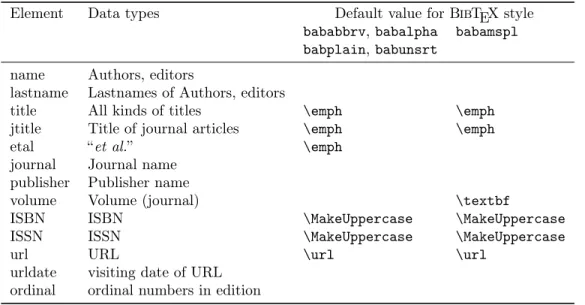
Table 1: Default values for the fonts in bibliographies. If no value is given, the standard font (normally upright roman) is used.
Element Data types Default value for BibTEX style bababbrv,babalpha babamspl babplain,babunsrt
name Authors, editors
lastname Lastnames of Authors, editors
title All kinds of titles \emph \emph
jtitle Title of journal articles \emph \emph
etal “et al.” \emph
journal Journal name publisher Publisher name
volume Volume (journal) \textbf
ISBN ISBN \MakeUppercase \MakeUppercase
ISSN ISSN \MakeUppercase \MakeUppercase
url URL \url \url
urldate visiting date of URL ordinal ordinal numbers in edition
babalpha-fl, all names are written “Forename Lastname”. By appending -lf, e. g.,babalpha-lf, all names are written “Lastname, Forename”.
The stylebabamsplis thebabelbibequivalent toamsplain.
5 Customisation of the bibliography’s typography
In constrast to the standard andgermbib bstfiles, the appearance of the different data types is not fixed forbab*.bst. There are commands for some data fields that determine the used font.
You can change some font specifications in the bibliography using the com-
\setbibliographyfont
mand\setbibliographyfont{helementi}{hfont commandi}, wherehelementiis a typographic element, listed in table 1. hfont commandiis a command that takes one argument, e. g.\textbf,\emph, or\textsc. If no suitable command is avail- able, you have to define one, first. For example, you can get a bold italic font as follows:
\newcommand\textitbf[1]{{\bfseries\itshape #1\/}}%
\setbibliographyfont{title}{\textitbf}%
As it can be seen in this example, the argument of the used font command mustn’t be specified in\setbibliographyfont.
5.1 Names
Thehelementi name changes the whole name of the author, including forename and lastname. Iflastname is also specified, it changes the lastname within the font for the name. For example,
\setbibliographyfont{name}{\emph}
\setbibliographyfont{lastname}{\MakeUppercase}
leads to\emph{Harald \MakeUppercase{Harders}}resp. “Harald HARDERS”.
By default, a colon is printed after the author names. If you want another sign, just redefine the command\btxauthorcolon:
\renewcommand\btxauthorcolon{,}
Unfortunately, it cannot detect if the name ends on a fullstop. Thus, things like
“Harders, H.. Title of document” may appear.
5.2 URL’s
The font definition for urldate can also be used not to change the font but to provide a command that writes the date in the correct language, e. g., using the isodatepackage:
\usepackage[short]{isodate}
\setbibliographyfont{urldate}{\printdate}
When using urldate, normally a string is printed between the url itself and the the date, e.g., in English “http://www.dante.de, visited on 2005-11-11”. The string is “, visited on ”. This is reached by the definition of the internal com- mand\btxurldatecomment, e.g., for English
\def\btxurldatecomment#1{%
\protect\foreignlanguage{english}{, visited on #1}%
}
You can change this command, for example, to typeset the date in brackets:
\declarebtxcommands{english}{%
\def\btxurldatecomment#1{ [#1]}%
}
Be sure not to forget the leading space. It is necessary to be able to begin with a comma which does not have a space before it.
5.3 ISBN and ISSN
There are two additional commands,\btxISBNand\btxISSN. They generate the
\btxISBN
\btxISSN strings “ISBN” and “ISSN” in bibliographies. By default, they do it without a change of the font. For example, if using oldstyle digits, it could be worth to change them e. g. to
\renewcommand\btxISBN{\textsc{isbn}}
\renewcommand\btxISSN{\textsc{issn}}
By default, the ISBN resp. ISSN is printed if present in the data base. You can
\btxprintISBN
\btxprintISSN switch this behaviour off by using\btxprintISBN{false}resp.\btxprintISSN{false}.
Similarly, printing is switched on by\btxprintISBN{true}resp.\btxprintISSN{true}.
Alternatively, you can switch on or off the ISBN and ISSN when loading the pack- age by using the package optionsisbn,noisbn,issn, ornoissn.
This, however, only works for the “standard” styles, i. e., not for theAMSstyle babamspl.
If you are usingbabamspl, the language names of the citations are printed by default, as the originalAMSstyle does it. You can avoid this by adding following line to your preamble:
\newcommand\btxprintamslanguage[1]{}
5.4 Spaces between forenames
The spaces between multiple forenames are written by\btxfnamespacelongand
\btxfnamespaceshort
\btxfnamespacelong \btxfnamespaceshort for full and abbreviated forenames, respectively. By de- fault, a normal space is used between full forenames, and a thin space (\,) is used between abbreviated forenames (with the exception English where no space is printed). These defaults can be changed language-dependent:
\declarebtxcommands{english}{%
\def\btxfnamespaceshort{\,}%
\def\btxfnamespacelong{~}%
}
5.5 Edition numbers
Ordinal numbers for editions are handled by LATEX when typesetting the biblio- graphy. You just have to give the number itself in thebib file and it is typeset correctly in the bibliography, e.g.,
edition = 3
is typeset as "‘3."’ in German and “3rd” in English. Unfortunately, I do not know about other languages than these two how to write ordinal numbers. Thus, in all other languages, a warning is produced and the given number is printed without a change (“3” in the example). If not a pure number is given, it also is typeset without a change. You can add or change the output of edition numbers on a language basis, e.g.,
\declarebtxcommands{english}{%
\def\btxnumeralshort#1{%
\btxnumeralenglish{english}{#1}}%
\def\btxnumerallong#1{%
\ifnumber{#1}{%
\ifcase#1 0th\or first\or second\or third\or forth\or fifth\or sixth\or seventh\or eighth\or nineth\or tenth\else
\btxnumeralenglish{english}{#1}%
\fi}{#1}}%
}
This example typesets the ordinals between 1st and 10th as words and switches to the short form for larger numbers in English language for the long version and uses the default function for the short version.
Three output formats are predefined: \btxnumeraldotprints the number with a dot followed, as it is common in German. \btxnumeralenglishadds “st”, “nd”,
“rd”, or “th”, depending on the number. And\btxnumeralfallbackgenerates a warning and prints the number as given.
If you, for instance, want to switch the Danish behaviour to be as the German is, use these commands:
\declarebtxcommands{danish}{%
\def\btxnumeralshort#1{\btxnumeraldot{danish}{#1}}%
\def\btxnumerallong#1{\btxnumeraldot{danish}{#1}}%
}
For the English variant, a font numeral is predefined that typesets the ap- pended characters. If you, for example, want to print the superscripted, use
\setbibliographyfont{numeral}{\textsuperscript}
If you know how numerals are handled in a language, please send me an eMail.
5.6 Printing of month and year
Starting with version 1.29, babelbib prints dates in the format “MMM YYYY’
datename
with the name of the month in case the month is specified in an bibliography entry by default (or by using the package optiondatename). For example,
@Manual{baeker1998a,
title = {Automatische Neuvernetzung mit ABAQUS/Standard -- Technik und Anwendungen},
author = {B\"aker, M.},
organization = {Institut f\"ur Werkstoffe, Technische Universit\"at Braunschweig},
address = {Braunschweig}, month = oct,
year = 1998,
language = {ngerman}
}
@TechReport{aurenhammer1996a,
author = {Aurenhammer, F. and Klein, R.}, title = {Voronoi Diagrams},
institution = {FernUniversit\"at Gesamthochschule in Hagen}, year = 1996,
number = 198, month = 5,
language = {english}
}
results in
[1] Bäker, M.: Automatische Neuvernetzung mit ABAQUS/Standard – Technik und Anwendungen. Institut für Werkstoffe, Technische Universität Braun- schweig, Braunschweig, October 1998.
[2] Aurenhammer, F. and R. Klein: Voronoi Diagrams. Technical Report 198, FernUniversität Gesamthochschule in Hagen, May 1996.
Note that this conversion only works if you specify the month using the prede- fined macro namesjan,feb, etc. or if you specify the month numerically (1,2,3, etc.). If you use strings (e. g., “January”), the handling of months does not work so that month and year are printed as given in any case.
Whether the full name (e. g., “October”) or an abbreviation (e. g., “Oct.”) is printed, is determined by the bibliography style (.bst).
By loadingbabelbibwith the package optiondatenumeric, the month is con- datenumeric
verted to a number. Currently, the output format is “MM/YYYY” in all languages.
The result looks as follows:
[1] Bäker, M.: Automatische Neuvernetzung mit ABAQUS/Standard – Technik und Anwendungen. Institut für Werkstoffe, Technische Universität Braun- schweig, Braunschweig, 10/1998.
[2] Aurenhammer, F. and R. Klein: Voronoi Diagrams. Technical Report 198, FernUniversität Gesamthochschule in Hagen, 5/1996.
If you don’t like the used format, you might change it by redefining the macro
\btxprintmonthyearnum
\btxprintmonthyearnumfor your language as follows:
\declarebtxcommands{danish}{%
\def\btxprintmonthyearnum#1#2{#1-#2}%
}
Here, the first argument is the month, the second the year.
By loadingbabelbibwith the package optiondateasis, the month is printed dateasis
as specified in thebibfile in the format “MMM YYYY”. Beware that the internal macro namesjan, feb, etc. are handled as numbers so that following output is gained:
[1] Bäker, M.: Automatische Neuvernetzung mit ABAQUS/Standard – Technik und Anwendungen. Institut für Werkstoffe, Technische Universität Braun- schweig, Braunschweig, 10 1998.
[2] Aurenhammer, F. and R. Klein: Voronoi Diagrams. Technical Report 198, FernUniversität Gesamthochschule in Hagen, 5 1996.
6 How to add new languages
The language definitions are placed in special files with the extension.bdf. If you want to add a new language to thebabelbibsystem, you should copy one of the existingbdffiles and change the new file.
Since babelbib.sty contains a list of known languages, it will not find the new language definition file, automatically. Then, you can give the name of the new file without extension as an option when loadingbabelbib. For example, to loadmylang.bdf, you have to load the package as follows:
\usepackage[mylang]{babelbib}
If you have developed a newbdffile, please send it to [email protected].
Then, I will add it to thebabelbibsystem.
7 Problems and Incompatibilities
• Babelbib does not work together with old versions of thefrenchlepackage prior V5,987. Please update the frenchle package or use the native babel support for the French language, instead.
• If babelbib is used together with one of the classes of the KOMA-Script bundle, some additional spaces are added when numerical edition numbers are used. This is a KOMA-Script bug and will be fixed in the next KOMA- Script release.
8 To Do
• Add more languages.
• Complete Dutch.
• Add the possibility to switch off ISBN and ISSN tobabasmpl.
Acknowledgements
Danie Els, [email protected] (Afrikaans); Taneli Huuskonen, huuskone@cc.
helsinki.fi(Esperanto, Finnish); Víctor Luaña,[email protected].
es(Spanish); Hans Fredrik Nordhaug,[email protected](Norwegian, Swedish);
Robert Fuster, [email protected] (Catalan); Markus Kohm, komascript@
gmx.info(Different schemes for writing names); Matthias D. Eisner,matthias.
[email protected](protect\foreignlanguagecalls); Daniel Winkelmann,daniel.
[email protected](idea for different formatting of forenames and lastnames); Jan Steffan,[email protected](\setbtxfallbacklanguage); Philip Ratcliffe,[email protected](corrections for Italian); Angel Tsankov,
[email protected] (bugfix with \bbbbh\CurrentOptioniloaded); Prokopis Proko- pidis, [email protected] (Greek); Daniel Flipo, daniel.flipo@univ-lille1.
fr (French numerals); Ignacio Fernández Galván, [email protected] (Span- ish numerals); Peter Bartke, [email protected] (idea of annote field);
Yanti Yulianti,[email protected](Bahasa); Miguel Rodríguez Pen- [email protected](Galician); José Carlos Santos [email protected] (Por- tuguese).
Furthermore, I thank the person who provided Russian. Unfortunately, I can- not find the name anymore.
References
[1] Braams, Johannes: Babel, a multilingual package for use with LATEX’s standard document classes, 2002. CTAN:macros/latex/required/babel/.
[2] Wallmeier, M., A. Scherer, and H. Harders: Macros for german BibTEXing, 2000. CTAN:biblio/bibtex/contrib/germbib/.
9 The implementation
Source lines that look like h*...i or h/...iwhere ... is arbitrary text are not written into the output files. If a source line starts withh...i, this part of the line is omitted.
9.1 Headings of the files
Heading of the package and the other files:
1h∗packagei
2\NeedsTeXFormat{LaTeX2e}[1998/06/01]
3\ProvidesPackage{babelbib}
4h/packagei
File heads of thebdffiles:
5hafrikaansi%% Language definitions for Afrikaans by
6hafrikaansi%% Danie Els <[email protected]>
7hafrikaansi\ProvidesFile{afrikaans.bdf}
8hbahasai%% Language definitions for Bahasa by
9hbahasai%% Yanti Yulianti <[email protected]>
10hbahasai\ProvidesFile{bahasa.bdf}
11hcatalani%% Language definitions for Catalan by
12hcatalani%% Robert Fuster <[email protected]>
13hcatalani\ProvidesFile{catalan.bdf}
14hdanishi\ProvidesFile{danish.bdf}
15hdutchi\ProvidesFile{dutch.bdf}
16henglishi\ProvidesFile{english.bdf}
17hesperantoi%% Language definitions for Esperanto by
18hesperantoi%% Taneli Huuskonen <[email protected]>
19hesperantoi\ProvidesFile{esperanto.bdf}
20hfinnishi%% Language definitions for Finnish by
21hfinnishi%% Taneli Huuskonen <[email protected]>
22hfinnishi\ProvidesFile{finnish.bdf}
23hfrenchi\ProvidesFile{french.bdf}
24hgaliciani%% Language definitions for Galician by
25hgaliciani%% Miguel Rodr{\’\i}guez Penabad <[email protected]>
26hgaliciani\ProvidesFile{galician.bdf}
27hgermani\ProvidesFile{german.bdf}
28hgreeki\ProvidesFile{greek.bdf}
29hgreeki%% Language definitions for Greek by
30hgreeki%% Prokopis Prokopidis <[email protected]>
31hitaliani\ProvidesFile{italian.bdf}
32hnorski%% Language definitions for Norwegian by
33hnorski%% Hans Fredrik Nordhaug <[email protected]>
34hnorski\ProvidesFile{norsk.bdf}
35hportuguesei%% Language definitions for Portuguese by
36hportuguesei%% Jos\’e Carlos Santos <[email protected]>
37hportuguesei\ProvidesFile{portuguese.bdf}
38hrussiani%% Language definitions for Russian by
39hrussiani%% ... (can’t find the information. If it was you please tell me!)
40hrussiani\ProvidesFile{russian.bdf}
41hspanishi%% Language definitions for Spanish by
42hspanishi%% V{\’\i}ctor Lua{\~n}a <[email protected]>
43hspanishi\ProvidesFile{spanish.bdf}
44hswedishi%% Language definitions for Swedish by
45hswedishi%% Hans Fredrik Nordhaug <[email protected]>
46hswedishi\ProvidesFile{swedish.bdf}
Version information unique for all generated files:
47hlatexi [2009/10/10 v1.29 babelbib: multilingual bibliographies (HH)]
48hbsti%% 2009/10/10 v1.29 babelbib: multilingual bibliographies (HH)
9.2 The package itself
Define an option which fixes the language in the bibliography to the main language of the document.
49h∗packagei
50\newif\ifbbbbfixlanguage
51\DeclareOption{fixlanguage}{\bbbbfixlanguagetrue}
52\DeclareOption{varlanguage}{\bbbbfixlanguagefalse}
If this option is used, generate the commands\btxlanguagenamehlanguageithat save how languages are called in other languages, e. g. in German, French is called
„französisch“.
53\newif\ifbbbblanguagenames
54\DeclareOption{nolanguagenames}{\bbbblanguagenamesfalse}
55\DeclareOption{languagenames}{\bbbblanguagenamestrue}
56\newif\ifbbbbannotations
57\DeclareOption{annote}{\bbbbannotationstrue}
58\DeclareOption{noannote}{\bbbbannotationsfalse}
\ifbtx@printISBN
\ifbtx@printISSN
The booleans that store the necessary information if ISBN and ISSN shall be printed.
59\newif\ifbtx@printISBN
60\newif\ifbtx@printISSN
61\DeclareOption{isbn}{\btx@printISBNtrue}
62\DeclareOption{noisbn}{\btx@printISBNfalse}
63\DeclareOption{issn}{\btx@printISSNtrue}
64\DeclareOption{noissn}{\btx@printISSNfalse}
\bbbbifundefined
65\newcommand\btxprintmonthyear[4]{}
66\newcommand*\btx@dateasis{%
67 \def\btxprintmonthyear##1##2##3##4{##2\ ##3}%
68}
69\newcommand*\btx@datenumeric{%
70 \def\btxprintmonthyear##1##2##3##4{%
71 \ifnumber{##2}{\btxprintmonthyearnum{##2}{##3}}{##2\ ##3}}%
72}
73\newcommand*\btx@datename{%
74 \def\btxprintmonthyear##1##2##3##4{%
75 \ifnumber{##2}{%
76 \ifcase ##2 \or
77 \csname btxmonjan##4\endcsname{##1}\or
78 \csname btxmonfeb##4\endcsname{##1}\or
79 \csname btxmonmar##4\endcsname{##1}\or
80 \csname btxmonapr##4\endcsname{##1}\or
81 \csname btxmonmay##4\endcsname{##1}\or
82 \csname btxmonjun##4\endcsname{##1}\or
83 \csname btxmonjul##4\endcsname{##1}\or
84 \csname btxmonaug##4\endcsname{##1}\or
85 \csname btxmonsep##4\endcsname{##1}\or
86 \csname btxmonoct##4\endcsname{##1}\or
87 \csname btxmonnov##4\endcsname{##1}\or
88 \csname btxmondec##4\endcsname{##1}\or
89 \PackageError{babelbib}{%
90 Month outside range 1 to 12 used}{%
91 Better use the BibTeX names jan, feb, mar, etc.}%
92 \fi
93 \ ##3%
94 }{%
95 ##2\ ##3}%
96 }%
97}
98\DeclareOption{dateasis}{\btx@dateasis}
99\DeclareOption{datenumeric}{\btx@datenumeric}
100\DeclareOption{datename}{\btx@datename}
If additional options are given, try to load these as languages. This is implemented in order to be able to use a new language that is not yet supported by the official babelbib.
101\DeclareOption*{%
102 \InputIfFileExists{\CurrentOption.bdf}{%
103 \expandafter\def\csname bbbb\CurrentOption loaded\endcsname{\@empty}%
104 }{%
105 \PackageError{babelbib}{%
106 Language definition file \CurrentOption.bdf not found}{%
107 Maybe you misspelled the language option?}%
108 }%
109}
Default options.
110\ExecuteOptions{varlanguage,nolanguagenames,noannote,isbn,issn,datename}
Process the given options.
111\ProcessOptions*
\bbbbifundefined Define a replacement for\@ifundefinedthat does not define the command it is tested for as side effect. This command has been taken from a news posting by Markus Kohm ([email protected]).
112\newcommand*{\bbbbifundefined}[1]{%
113 \begingroup\expandafter\expandafter\expandafter\endgroup
114 \expandafter\ifx\csname #1\endcsname\relax
115 \expandafter\@firstoftwo
116 \else
117 \expandafter\@secondoftwo
118 \fi
119}
\bbbbaddto Adds the command named\bibs#2to the command\extras#1, if this command is defined before, where#1and#2are the arguments of\bbbbaddto. For internal use only.
120\newcommand\bbbbaddto[2]{%
Test wheather\extras#1is defined.
121 \expandafter\bbbbifundefined{extras#1}{}{%
Callbabel’s command to append\bibs#1to\extras#1.
122 \expandafter\addto\expandafter{\csname extras#1\endcsname}{%
123 \csname #2\endcsname}%
124 \typeout{babelbib extension \@backslashchar #2 added to
125 \string\extras #1}%
126 }%
127}
\inputbdf Input the file#2.bdfif babel has loaded the language#1. For internal use only.
128\newcommand\inputbdf[2]{%
Test wheather\date#1 is defined which is the case if the language #1has been loaded.
129 \bbbbifundefined{date#1}{}{%
Input#2.bdf.
130 \@ifundefined{bbbb#2loaded}{%
131 \expandafter\def\csname bbbb#2loaded\endcsname{\@empty}%
132 \input{#2.bdf}%
133 }{}%
134 }%
135}
\selectbiblanguage Define\selectbiblanguage which explicitly selects the language for the biblio- graphy. This is only useful when the optionfixlanguage is used. Otherwise the command produces a warning and does nothing else.
Since all the language dependent macros are not know before\begin{document}, the command \selectbiblanguage has to wait until there, before doing any action. Because after \begin{document}, it can do the action immediately,
\selectbiblangugehas to be redefined there.
136\ifbbbbfixlanguage
Define the\selectlanguagecommand for usage before\begin{document}.
137 \newcommand\selectbiblanguage[1]{%
138 \AtBeginDocument{\@selectbiblanguage{#1}}%
139 }
Redefine it at\begin{document}.
140 \AtBeginDocument{%
141 \renewcommand\selectbiblanguage[1]{\@selectbiblanguage{#1}}%
142 }
Define the “real” command that does the action. It tests wheather \bibs#1and
\extras#1are known and produces error messages if not. If everything is okay, change the bibliography language.
143 \newcommand\@selectbiblanguage[1]{%
144 \bbbbifundefined{bibs#1}{%
145 \bbbbifundefined{date#1}{%
146 \PackageError{babelbib}{Language #1 in bibliography not loaded
147 by babel}{%
148 The language #1 hasn’t been loaded by babel.
149 Add it to the\MessageBreak
150 options of the \string\usepackage{babel} command or to the
151 global options.}%
152 }{%
153 \PackageError{babelbib}{Language #1 in bibliography unknown by
154 babelbib}{%
155 There are no definitions for #1 available in the
156 current\MessageBreak
157 version of babelbib. Please contact [email protected].}%
158 }%
159 }{%
160 \typeout{babelbib: Set language for keywords in the bibliography fixed to #1}%
161 \csname bibs#1\endcsname
162 }%
163 }
164\else
165 \newcommand\selectbiblanguage[1]{%
166 \PackageWarning{babelbib}{Command \string\selectbiblanguage\space
167 used without package\MessageBreak
168 option fixlanguage. Ignored}%
169 }
170 \AtBeginDocument{%
171 \typeout{babelbib: Use citation-dependent languages in bibliography}%
172 }
173\fi
\btxselectlanguage Define\selectbiblanguage which selects a language and complains if babelbib does not know about this language. For internal use, only.
174\newcommand\btxselectlanguage[1]{%
175 \bbbbifundefined{bibs#1}{%
176 \bbbbifundefined{date#1}{%
177 \PackageError{babelbib}{Language #1 in bibliography not loaded
178 by babel}{%
179 The language #1 hasn’t been loaded by babel.
180 Add it to the\MessageBreak
181 options of the \string\usepackage{babel} command or to the
182 global options.}%
183 }{%
184 \ifbbbbfixlanguage
185 \PackageWarning{babelbib}{Language #1 in bibliography
186 unknown\MessageBreak
187 by babelbib. Hyphenation will be\MessageBreak
188 incorrect}%
189 \else
190 \PackageError{babelbib}{Language #1 in bibliography unknown by
191 babelbib}{%
192 There are no definitions for #1 available in the
193 current\MessageBreak
194 version of babelbib. Please contact [email protected].}%
195 \fi
196 }%
197 }{%
198 \csname extras#1\endcsname
199 \selectlanguage{#1}%
200 }%
201}
\biblanguage Define\biblanguagewhich switches to the keyword language within a field.
202\newcommand\biblanguage[1]{{%
203 \expandafter\selectlanguage\expandafter{\biblanguagename}#1}}
\btxlanguagename Define\btxlanguagenamewhich typesets the name of the language given in the argument, spoken in the current active language.
204\newcommand\btxlanguagename[1]{%
205 \bbbbifundefined{btxlanguagename#1}{%
206 \PackageError{babelbib}{Languagename for #1 not
207 defined\MessageBreak
208 in \languagename\space language}{%
209 Either you have forgotten to specify the option ‘languagenames’
210 when loading\MessageBreak
211 babelbib, or the command \string\bibs\languagename\space does
212 not contain a definition\MessageBreak
213 for the command \string\btxlanguagename#1.
214 In the latter case, please\MessageBreak
215 contact [email protected].}%
216 #1%
217 }{%
218 \@nameuse{btxlanguagename#1}%
219 }%
220}
\setbtxfallbacklanguage
221\newcommand*\setbtxfallbacklanguage[1]{%
222 \edef\btxfallbacklanguage{#1}%
223 \typeout{babelbib: Set bibliography fall-back language to
224 \btxfallbacklanguage}%
225}
\btxfallbacklanguage
226\AtBeginDocument{%
227 \@ifundefined{btxfallbacklanguage}{%
228 \edef\btxfallbacklanguage{\languagename}%
229 \typeout{babelbib: Set bibliography fall-back language to
230 \btxfallbacklanguage}%
231 }{%
232 \typeout{babelbib: Bibliography fall-back language unchanged
233 (\btxfallbacklanguage)}%
234 }%
235}
\declarebtxcommands Declare \declarebtxcommands which adds or replaces one or more of the \Btx or \btx commands defined in a \bibshlanguagei command. The first argument gives the language for which the commands shall be added or changed. The second argument includes the definitions of the commands. For an example, see section 2.
236\newcommand*\declarebtxcommands[2]{%
237 \AtBeginDocument{%
238 \typeout{babelbib: Add a command to \string\bibs#1}%
239 \expandafter\g@addto@macro\csname bibs#1\endcsname{#2}%
240 \ifbbbbfixlanguage
241 \selectbiblanguage{\biblanguagename}%
242 \fi
243 }%
244}
This command may only be used in the preamble.
245\@onlypreamble\declarebtxcommands
\btxifchangecaseon
\btxifchangecaseoff
The bst files write titles twice, first with changed case and second with pre- served case. The macros\btxifchangecaseon and\btxifchangecaseofftype- set one of these versions. The languages append one of these commands to the
\extrashlanguageicommands.
246\newcommand*\btxifchangecaseon{%
247 \def\btxifchangecase{\@firstoftwo}%
248}%
249\newcommand*\btxifchangecaseoff{%
250 \def\btxifchangecase{\@secondoftwo}%
251}%
\setbibliographyfont Define \setbibliographyfont and \setbibliographyfont* that set the font declared by the first argument#1to the second argument#2. The second argument has to be a macro with one argument, like\textbf, \emph, \textsc, etc. The normal version generates an error, if the internal command \btx#1font is not defined. The star version doesn’t. error.
252\newcommand\setbibliographyfont{%
253 \@ifnextchar*{\@@setbibliographyfont}{\@setbibliographyfont}%
254}
\@setbibliographyfont
255\newcommand\@setbibliographyfont[2]{%
256 \bbbbifundefined{btx#1font}{%
257 \PackageError{babelbib}{Bibliography font ‘#1’ can’t be set}{%
258 You have tried to define a font for the bibliographic element
259 \MessageBreak
260 ‘#1’, which is unknown to babelbib}%
261 }{%
262 \expandafter\renewcommand\csname btx#1font\endcsname{#2}%
263 \typeout{babelbib: Bibliography font for ‘#1’ changed.}%
264 }%
265}
\@@setbibliographyfont The first argument is the*and ignored.
266\newcommand\@@setbibliographyfont[3]{%
267 \bbbbifundefined{btx#2font}{%
268 \expandafter\newcommand\csname btx#2font\endcsname{#3}%
269 \typeout{babelbib: Bibliography font for ‘#2’ newly defined.}%
270 }{%
271 \expandafter\renewcommand\csname btx#2font\endcsname{#3}%
272 \typeout{babelbib: Bibliography font for ‘#2’ changed.}%
273 }%
274}
\providebibliographyfont Define \providebibliographyfont and \providebibliographyfont* that do the same as \setbibliographyfont and \setbibliographyfont*, but only, if \setbibliographyfont has not been used for #1, before. It is similar to
\providecommmandwhich only defines that command if it is undefined, before.
This command is intended to be used by the BibTEX style, but can also be used by the user.
275\newcommand\providebibliographyfont{%
276 \@ifnextchar*{\@@providebibliographyfont}{\@providebibliographyfont}%
277}
\@providebibliographyfont
278\newcommand\@providebibliographyfont[2]{%
279 \bbbbifundefined{btx#1font}{%
280 \PackageError{babelbib}{Bibliography font ‘#1’ can’t be set}{%
281 You have tried to define a font for the bibliographic element
282 \MessageBreak
283 ‘#1’, which is unknown to babelbib}%
284 }{%
285 \expandafter\ifx\csname btx#1font\endcsname\@empty
286 \expandafter\renewcommand\csname btx#1font\endcsname{#2}%
287 \typeout{babelbib: Using the BibTeX style’s default font for ‘#1’.}%
288 \else
289 \typeout{babelbib: Using user changed font for ‘#1’.}%
290 \fi
291 }%
292}
\@@setbibliographyfont The first argument is the*and ignored.
293\newcommand\@@providebibliographyfont[3]{%
294 \bbbbifundefined{btx#2font}{%
295 \expandafter\newcommand\csname btx#2font\endcsname{#3}%
296 \typeout{babelbib: Using the BibTeX style’s default font for ‘#2’.}%
297 }{%
298 \expandafter\ifx\csname btx#2font\endcsname\@empty
299 \expandafter\renewcommand\csname btx#2font\endcsname{#3}%
300 \typeout{babelbib: Using the BibTeX style’s default font for ‘#2’.}%
301 \else
302 \typeout{babelbib: Using user changed font for ‘#2’.}%
303 \fi
304 }%
305}
\btxnamefont Define the dummy commands for available fonts
306\newcommand*\btxnamefont{}
307\let\btxnamefont=\@empty
308\newcommand*\btxlastnamefont{}
309\let\btxlastnamefont=\@empty
310\newcommand\btxtitlefont{}
311\let\btxtitlefont=\@empty
312\newcommand\btxjtitlefont{}
313\let\btxjtitlefont=\@empty
314\newcommand\btxetalfont{}
315\let\btxetalfont=\@empty
316\newcommand\btxjournalfont{}
317\let\btxjournalfont=\@empty
318\newcommand\btxpublisherfont{}
319\let\btxpublisherfont=\@empty
320\newcommand\btxvolumefont{}
321\let\btxvolumefont=\@empty
322\newcommand\btxISBNfont{}
323\let\btxISBNfont=\@empty
324\newcommand\btxISSNfont{}
325\let\btxISSNfont=\@empty
326\newcommand\btxurlfont{}
327\let\btxurlfont=\@empty
328\newcommand\btxurldatefont{}
329\let\btxurldatefont=\@empty
330\newcommand\btxnumeralfont{}
331\let\btxnumeralfont=\@empty
\btxauthorcolon Define \btxauthorcolonwhich defines the characters typeset after the authors, if they are written before the title. By default, it is a “:”.
332\newcommand\btxauthorcolon{:}
\btxISBN Define\btxISBNwhich outputs "‘ISBN"’ in a bibliography. For example, it could be defined to\textsc{isbn}when old style digits are used.
333\newcommand\btxISBN{ISBN}
\btxISSN Define\btxISSNwhich outputs "‘ISSN"’ in a bibliography. For example, it could be defined to\textsc{issn}when old style digits are used.
334\newcommand\btxISSN{ISSN}
\ifbtxprintISBN
\ifbtxprintISSN
These commands are used by the bibliography styles to typeset the ISBN or ISSN only if wanted.
335\DeclareRobustCommand\ifbtxprintISBN[1]{\ifbtx@printISBN #1\fi}
336\DeclareRobustCommand\ifbtxprintISSN[1]{\ifbtx@printISSN #1\fi}
\btxprintISBN
\btxprintISSN
These macros are used to switch on or off printing of ISBN resp. ISSN. Valid arguments aretrue andfalse.
337\newcommand*\btxprintISBN[1]{\csname btx@printISBN#1\endcsname}
338\newcommand*\btxprintISSN[1]{\csname btx@printISSN#1\endcsname}
\btxannotation A command that typesets annotations.
339\ifbbbbannotations
340 \DeclareRobustCommand\btxannotation[1]{%
341 \begin{quotation}%
342 \noindent
343 #1%
344 \end{quotation}%
345 }
346\else
347 \DeclareRobustCommand\btxannotation[1]{}%
348\fi
\btx@ifnumerical Test wheather argument 1 is a number (from KOMA script)
349\providecommand\ifnumber[3]{%
350 \begingroup\@tempswafalse\let\scr@next\test@number
351 \expandafter\scr@next#1\scr@next
352 \if@tempswa\endgroup#2\else\endgroup#3\fi
353}
354\providecommand*\test@number[1]{%
355 \ifx \scr@next#1%
356 \let\scr@next\relax
357 \else
358 \@tempcnta=\expandafter\expandafter\expandafter\number
359 \expandafter‘#1\relax
360 \ifnum \@tempcnta>47\relax
361 \ifnum \@tempcnta<58\relax
362 \@tempswatrue
363 \else\@tempswafalse\fi
364 \else\@tempswafalse\fi
365 \if@tempswa\else\let\scr@next\gobble@till@next\fi\fi
366 \scr@next
367}
368\def\gobble@till@next#1\scr@next{}
\btx@parsenum Parses the number given by\btx@parsenumhnumberi\@emptyprints it and returns the last two digits in\btx@digitaand\btx@digitb.
369\def\btx@parsenum#1#2#3\@empty{%
370 #1%
371 \edef\btx@digitb{#3}%
372 \ifx\@empty\btx@digitb
373 #2%
374 \edef\btx@digita{#1}%
375 \edef\btx@digitb{#2}%
376 \else
377 \expandafter\btx@parsenum#2#3\@empty
378 \fi
379}
\btxnumeralfallback
380\DeclareRobustCommand\btxnumeralfallback[2]{%
381 \foreignlanguage{#1}{%
382 \ifnumber{#2}{%
383 \PackageWarning{babelbib}{Handling of numerical editions not
384 handled\MessageBreak by language #1 for edition ‘#2’}%
385 }{}%
386 #2%
387 }%
388}%
\btxnumeraldot
389\DeclareRobustCommand\btxnumeraldot[2]{%
390 \foreignlanguage{#1}{\ifnumber{#2}{#2.}{#2}}%
391}
\btxnumeralenglish
392\DeclareRobustCommand\btxnumeralenglish[2]{%
393 \foreignlanguage{#1}{%
394 \ifnumber{#2}{%
395 \expandafter\btx@parsenum#2\@empty\@empty\@empty
396 \btxnumeralfont{%
397 \ifx\btx@digitb\@empty
398 \ifcase\btx@digita th\or st\or nd\or rd\else th\fi
399 \else
400 \ifnum\btx@digita=1
401 th%
402 \else
403 \ifcase\btx@digitb th\or st\or nd\or rd\else th\fi
404 \fi
405 \fi
406 }%
407 }{#2}%
408 }%
409}
\url Define\url which, by default, is used for URLs. Only necessary if not provided by another package, e. g.url.sty.
410\AtBeginDocument{%
411 \providecommand\url[1]{%
412 \PackageError{babelbib}{No \string\url\space command defined but
413 field URL used\MessageBreak
414 in bibliography}{%
415 Please define a \string\url\space command for printing URLs
416 before \string\begin{document}, e.\,g.\MessageBreak
417 by loading the package ‘url.sty’.}%
418 \texttt{#1}%
419 }%
420}
Perform the following commands at\begin{document}in order to be sure to do that after loadingbabel.
421\AtBeginDocument{%
Loadbabelif that has not been done, yet.
422 \RequirePackage{babel}
Input all know languages that babel has also loaded, before.
423 \inputbdf{afrikaans}{afrikaans}
424 \inputbdf{american}{english}
425 \inputbdf{austrian}{german}
426 \inputbdf{bahasa}{bahasa}
427 \inputbdf{brazil}{portuguese}
428 \inputbdf{brazilian}{portuguese}
429 \inputbdf{british}{english}
430 \inputbdf{canadian}{english}
431 \inputbdf{canadien}{french}
432 \inputbdf{catalan}{catalan}
433 \inputbdf{danish}{danish}
434 \inputbdf{dutch}{dutch}
435 \inputbdf{english}{english}
436 \inputbdf{esperanto}{esperanto}
437 \inputbdf{finnish}{finnish}
438 \inputbdf{francais}{french}
439 \inputbdf{french}{french}
440 \inputbdf{frenchb}{french}
441 \inputbdf{galician}{galician}
442 \inputbdf{german}{german}
443 \inputbdf{germanb}{german}
444 \inputbdf{greek}{greek}
445 \inputbdf{italian}{italian}
446 \inputbdf{norsk}{norsk}
447 \inputbdf{mexican}{spanish}
448 \inputbdf{naustrian}{german}
449 \inputbdf{ngerman}{german}
450 \inputbdf{portuges}{portuguese}
451 \inputbdf{portuguese}{portuguese}
452 \inputbdf{russian}{russian}
453 \inputbdf{russianb}{russian}
454 \inputbdf{spanish}{spanish}
455 \inputbdf{swedish}{swedish}
456 \inputbdf{UKenglish}{english}
457 \inputbdf{USenglish}{english}
Call\bibs#1, where#1stands for the main language of the document, to activate the additional bibliographic commands.
458 \ifbbbbfixlanguage
459 \typeout{babelbib: Load BibTeX extensions
460 \string\bibs\bbl@main@language\space for \bbl@main@language}%
461 \selectbiblanguage{\bbl@main@language}%
462 \else
463 \expandafter\selectlanguage\expandafter{\bbl@main@language}%
464 \fi
465}
466h/packagei
9.3 The language definitions
9.3.1 German
467h∗germani
\bibsgerman Define \bibsgerman which itself defines all necessary expressions used in bibli- ographies that differ in different languages. This command is used for all German dialects.
Since the language of the keywords may differ from the language of the biblio- graphy item, the keyword language is set for each keyword. Because this command is also used for dialects, it has an optional argument which is set to the dialect.
468\newcommand\bibsgerman[1][german]{%
Define the command \biblanguagename that always returns the name of the current language for bibliographies.
469 \def\biblanguagename{#1}%
First, define all commands for usage within a sentence (which normally start with a lowercase letter, if they aren’t a noun). These commands start with a lowercase letter.
Many commands have an argument. This may be used by the bibTEX styles to append a dot after abbreviations, e. g.\btxetalshort{.}.
470 \def\btxetalshort##1{\protect\foreignlanguage{#1}{et~al##1{}}}%
471 \def\btxetallong##1{\protect\foreignlanguage{#1}{et~alii}}%
472 \def\btxandshort##1{\protect\foreignlanguage{#1}{und}}%
473 \def\btxandlong##1{\protect\foreignlanguage{#1}{und}}%
The command\btxandcommacontains a “,” if a comma is added before the “and”
in a list of more than two items. For German, this is not the case.
474 \def\btxandcomma##1{}%
475 \def\btxinlong##1{\protect\foreignlanguage{#1}{in:}}%
476 \def\btxinshort##1{\protect\foreignlanguage{#1}{in:}}%
477 \def\btxofseriesshort##1{\protect\foreignlanguage{#1}{d.\ Reihe}}%
478 \def\btxinseriesshort##1{\protect\foreignlanguage{#1}{in}}%
479 \def\btxofserieslong##1{\protect\foreignlanguage{#1}{der Reihe}}%
480 \def\btxinserieslong##1{\protect\foreignlanguage{#1}{in}}%
481 \def\btxeditorshort##1{\protect\foreignlanguage{#1}{Hrsg##1{}}}%
482 \def\btxeditorlong##1{\protect\foreignlanguage{#1}{Herausgeber}}%
483 \def\btxeditorsshort##1{\protect\foreignlanguage{#1}{Hrsg##1{}}}%
484 \def\btxeditorslong##1{\protect\foreignlanguage{#1}{Herausgeber}}%
485 \def\btxvolumeshort##1{\protect\foreignlanguage{#1}{Bd##1{}}}%
486 \def\btxvolumelong##1{\protect\foreignlanguage{#1}{Band}}%
487 \def\btxnumbershort##1{\protect\foreignlanguage{#1}{Nr##1{}}}%
488 \def\btxnumberlong##1{\protect\foreignlanguage{#1}{Nummer}}%
Avoid the ligature in „Auflage“ in the same way,babeldoes it. This is a change in the behaviour to thegermbibpackage. In „Aufl“ the ligature is still used since this is done in abbreviations.
489 \def\btxeditionshort##1{\protect\foreignlanguage{#1}{Aufl##1{}}}%
490 \def\btxeditionlong##1{\protect\foreignlanguage{#1}{%
491 Auf\penalty10000\discretionary{-}{}{\kern.03em}%
492 \allowhyphens lage}}%
493 \def\btxchaptershort##1{\protect\foreignlanguage{#1}{Kap##1{}}}%
494 \def\btxchapterlong##1{\protect\foreignlanguage{#1}{Kapitel}}%
495 \def\btxpageshort##1{\protect\foreignlanguage{#1}{S##1{}}}%
496 \def\btxpagelong##1{\protect\foreignlanguage{#1}{Seite}}%
497 \def\btxpagesshort##1{\protect\foreignlanguage{#1}{S##1{}}}%
498 \def\btxpageslong##1{\protect\foreignlanguage{#1}{Seiten}}%
499 \def\btxmastthesis##1{\protect\foreignlanguage{#1}{Diplomarbeit}}%
Use „Dissertation“ instead of „Doktorarbeit“ for PhD theses. This is a change in the behaviour to thegermbibpackage.
500 \def\btxphdthesis##1{\protect\foreignlanguage{#1}{Dissertation}}%
501 \def\btxtechrepshort##1{\protect\foreignlanguage{#1}{Techn.\ Ber##1{}}}%
502 \def\btxtechreplong##1{\protect\foreignlanguage{#1}{Technischer Bericht}}%
503 \def\btxmonjanlong##1{\protect\foreignlanguage{#1}{Januar}}%
504 \def\btxmonfeblong##1{\protect\foreignlanguage{#1}{Februar}}%
505 \def\btxmonmarlong##1{\protect\foreignlanguage{#1}{M\"arz}}%
506 \def\btxmonaprlong##1{\protect\foreignlanguage{#1}{April}}%
507 \def\btxmonmaylong##1{\protect\foreignlanguage{#1}{Mai}}%
508 \def\btxmonjunlong##1{\protect\foreignlanguage{#1}{Juni}}%
509 \def\btxmonjullong##1{\protect\foreignlanguage{#1}{Juli}}%
510 \def\btxmonauglong##1{\protect\foreignlanguage{#1}{August}}%
511 \def\btxmonseplong##1{\protect\foreignlanguage{#1}{September}}%
512 \def\btxmonoctlong##1{\protect\foreignlanguage{#1}{Oktober}}%
513 \def\btxmonnovlong##1{\protect\foreignlanguage{#1}{November}}%
514 \def\btxmondeclong##1{\protect\foreignlanguage{#1}{Dezember}}%
515 \def\btxmonjanshort##1{\protect\foreignlanguage{#1}{Jan##1{}}}%
516 \def\btxmonfebshort##1{\protect\foreignlanguage{#1}{Feb##1{}}}%
517 \def\btxmonmarshort##1{\protect\foreignlanguage{#1}{M\"arz}}%
518 \def\btxmonaprshort##1{\protect\foreignlanguage{#1}{Apr##1{}}}%
519 \def\btxmonmayshort##1{\protect\foreignlanguage{#1}{Mai}}%
520 \def\btxmonjunshort##1{\protect\foreignlanguage{#1}{Juni}}%
521 \def\btxmonjulshort##1{\protect\foreignlanguage{#1}{Juli}}%
522 \def\btxmonaugshort##1{\protect\foreignlanguage{#1}{Aug##1{}}}%
523 \def\btxmonsepshort##1{\protect\foreignlanguage{#1}{Sep##1{}}}%
524 \def\btxmonoctshort##1{\protect\foreignlanguage{#1}{Okt##1{}}}%
525 \def\btxmonnovshort##1{\protect\foreignlanguage{#1}{Nov##1{}}}%
526 \def\btxmondecshort##1{\protect\foreignlanguage{#1}{Dez##1{}}}%
Then, define all commands for usage at the begin of a sentence (which start with an uppercase letter). These commands start with an uppercase letter. Since, in German, many nouns are the same in the middle and at the start of a sentence, the\Btx variants just call the\btxvariant.
527 \def\Btxinlong##1{\protect\foreignlanguage{#1}{In:}}%
528 \def\Btxinshort##1{\protect\foreignlanguage{#1}{In:}}%
529 \def\Btxeditorshort{\btxeditorshort}%
530 \def\Btxeditorlong{\btxeditorlong}%
531 \def\Btxeditorsshort{\btxeditorsshort}%
532 \def\Btxeditorslong{\btxeditorslong}%
533 \def\Btxvolumeshort{\btxvolumeshort}%
534 \def\Btxvolumelong{\btxvolumelong}%
535 \def\Btxnumbershort{\btxnumbershort}%
536 \def\Btxnumberlong{\btxnumberlong}%
537 \def\Btxeditionshort{\btxeditionshort}%
538 \def\Btxeditionlong{\btxeditionlong}%
539 \def\Btxchaptershort{\btxchaptershort}%
540 \def\Btxchapterlong{\btxchapterlong}%
541 \def\Btxpageshort{\btxpageshort}%
542 \def\Btxpagelong{\btxpagelong}%
543 \def\Btxpagesshort{\btxpagesshort}%
544 \def\Btxpageslong{\btxpageslong}%
545 \def\Btxtechrepshort{\btxtechrepshort}%
546 \def\Btxtechreplong{\btxtechreplong}%
547 \def\btxurldatecomment##1{\protect\foreignlanguage{#1}{, besucht: ##1}}%
The command\btxfnamespaceshortand\btxfnamespacelongcontain the space between two abbreviated resp. full forenames.
548 \def\btxfnamespaceshort{\,}%
549 \def\btxfnamespacelong{ }%
Handle numerical edition numbers.
550 \def\btxnumeralshort##1{\btxnumeraldot{#1}{##1}}%
551 \def\btxnumerallong##1{\btxnumeraldot{#1}{##1}}%
Define how to print month and year in numeric format, e. g. MM/YYYY.
552 \def\btxprintmonthyearnum##1##2{##1/##2}%
A command that just puts some user defined text in the language of the keywords.
553% \def\btxkeywordlanguage##1{\protect\foreignlanguage{#1}{##1}}%
554 \def\btxkeywordlanguage##1{{\protect\selectlanguage{#1}##1}}%
Names of all known languages in the current language. For example, used by babamspl.bst.
555 \ifbbbblanguagenames
556 \def\btxlanguagenameamerican{\protect\foreignlanguage{#1}{englisch}}%
557 \def\btxlanguagenameaustrian{\protect\foreignlanguage{#1}{deutsch}}%
558 \def\btxlanguagenamebrazil{\protect\foreignlanguage{#1}{portugiesisch}}%
559 \def\btxlanguagenamebrazilian{\protect\foreignlanguage{#1}{portugiesisch}}%
560 \def\btxlanguagenamebritish{\protect\foreignlanguage{#1}{englisch}}%
561 \def\btxlanguagenamebulgarian{\protect\foreignlanguage{#1}{bulgarisch}}%
562 \def\btxlanguagenamecanadian{\protect\foreignlanguage{#1}{englisch}}%
563 \def\btxlanguagenamecanadien{\protect\foreignlanguage{#1}{franz\"osisch}}%
564 \def\btxlanguagenamecatalan{\protect\foreignlanguage{#1}{katalanisch}}%
565 \def\btxlanguagenamecroatian{\protect\foreignlanguage{#1}{kroatisch}}%
566 \def\btxlanguagenameczech{\protect\foreignlanguage{#1}{tschechisch}}%
567 \def\btxlanguagenamedanish{\protect\foreignlanguage{#1}{d\"anisch}}%
568 \def\btxlanguagenamedutch{\protect\foreignlanguage{#1}{niederl\"andisch}}%
569 \def\btxlanguagenameenglish{\protect\foreignlanguage{#1}{englisch}}%
570 \def\btxlanguagenameesperanto{\protect\foreignlanguage{#1}{esperanto}}%
571 \def\btxlanguagenamefinnish{\protect\foreignlanguage{#1}{finnisch}}%
572 \def\btxlanguagenamefrancais{\protect\foreignlanguage{#1}{franz\"osisch}}%
573 \def\btxlanguagenamefrench{\protect\foreignlanguage{#1}{franz\"osisch}}%
574 \def\btxlanguagenamefrenchb{\protect\foreignlanguage{#1}{franz\"osisch}}%
575 \def\btxlanguagenamegerman{\protect\foreignlanguage{#1}{deutsch}}%
576 \def\btxlanguagenamegermanb{\protect\foreignlanguage{#1}{deutsch}}%
577 \def\btxlanguagenamegreek{\protect\foreignlanguage{#1}{griechisch}}%
578 \def\btxlanguagenamehebrew{\protect\foreignlanguage{#1}{hebr\"aisch}}%
579 \def\btxlanguagenamehungarian{\protect\foreignlanguage{#1}{ungarisch}}%
580 \def\btxlanguagenameicelandic{\protect\foreignlanguage{#1}{isl\"andisch}}%
581 \def\btxlanguagenameirish{\protect\foreignlanguage{#1}{irisch}}%
582 \def\btxlanguagenameitalian{\protect\foreignlanguage{#1}{italienisch}}%
583 \def\btxlanguagenamelatin{\protect\foreignlanguage{#1}{lateinisch}}%
584 \def\btxlanguagenamenaustrian{\protect\foreignlanguage{#1}{deutsch}}%
585 \def\btxlanguagenamengerman{\protect\foreignlanguage{#1}{deutsch}}%
586 \def\btxlanguagenamenorsk{\protect\foreignlanguage{#1}{norwegisch}}%
587 \def\btxlanguagenamenynorsk{\protect\foreignlanguage{#1}{neunorwegisch}}%
588 \def\btxlanguagenamepolish{\protect\foreignlanguage{#1}{polnisch}}%
589 \def\btxlanguagenameportuges{\protect\foreignlanguage{#1}{portugiesisch}}%
590 \def\btxlanguagenameportuguese{\protect\foreignlanguage{#1}{portugiesisch}}%
591 \def\btxlanguagenamerussian{\protect\foreignlanguage{#1}{russisch}}%
592 \def\btxlanguagenamescottish{\protect\foreignlanguage{#1}{schottisch}}%
593 \def\btxlanguagenameserbian{\protect\foreignlanguage{#1}{serbisch}}%
594 \def\btxlanguagenamespanish{\protect\foreignlanguage{#1}{spanisch}}%
595 \def\btxlanguagenameswedish{\protect\foreignlanguage{#1}{schwedisch}}%
596 \def\btxlanguagenameturkish{\protect\foreignlanguage{#1}{t\"urkisch}}%
597 \def\btxlanguagenameUKenglish{\protect\foreignlanguage{#1}{englisch}}%
598 \def\btxlanguagenameUSenglish{\protect\foreignlanguage{#1}{englisch}}%
599 \fi
600}
\bibsgermanb Do the same for the language “germanb”. Since there is no difference, just call
\bibsgerman.
601\newcommand\bibsgermanb{\bibsgerman}
\bibsngerman Do the same for German with new ortography. Call\bibsgerman with new hy- phenation patterns.
602\newcommand\bibsngerman[1][ngerman]{\bibsgerman[#1]}
\bibsaustrian Once again. Austrians use „Jänner“ instead of „Januar“. Thus, redefine the corre- sponding command.
603\newcommand\bibsaustrian[1][austrian]{%
604 \bibsgerman[#1]%
605 \def\btxmonjanlong##1{\protect\foreignlanguage{#1}{J\"anner}}%
606 \def\btxmonjanshort##1{\protect\foreignlanguage{#1}{J\"an##1{}}}%
607}
\bibsnaustrian New Austrian is the same as Austrian.
608\newcommand\bibsnaustrian[1][naustrian]{%
609 \bibsngerman[#1]%
610 \def\btxmonjanlong##1{\protect\foreignlanguage{#1}{J\"anner}}%
611 \def\btxmonjanshort##1{\protect\foreignlanguage{#1}{J\"an##1{}}}%
612}
The rest has to be executed after loading babel.sty, because the \extra...
commands have to be defined for all used languages.
613\AtBeginDocument{%
If the language is fixed, do nothing.
614 \ifbbbbfixlanguage
615 \else
Append the corresponding\#2command to each used language, namely\extras#1.
616 \bbbbaddto{austrian}{bibsaustrian}
617 \bbbbaddto{german}{bibsgerman}
618 \bbbbaddto{germanb}{bibsgermanb}
619 \bbbbaddto{naustrian}{bibsnaustrian}
620 \bbbbaddto{ngerman}{bibsngerman}
621 \fi
Switch off the change of case in titles for all German dialects by appending
\btxifchangecaseoffto\extrashlanguagei.
622 \bbbbaddto{austrian}{btxifchangecaseoff}
623 \bbbbaddto{german}{btxifchangecaseoff}
624 \bbbbaddto{germanb}{btxifchangecaseoff}
625 \bbbbaddto{naustrian}{btxifchangecaseoff}
626 \bbbbaddto{ngerman}{btxifchangecaseoff}
627}
628h/germani
9.3.2 Galician
629h∗galiciani
The language definition for Galician was provided by Miguel Rodríguez Pen- abad.
\bibsgalician Bibliographic commands for Galician.
630\newcommand\bibsgalician[1][galician]{%
631 \def\biblanguagename{#1}%
632 \def\btxetalshort##1{\protect\foreignlanguage{#1}{e~cols##1{}}}%
633 \def\btxetallong##1{\protect\foreignlanguage{#1}{e~colaboradores}}%
634 \def\btxandshort##1{\protect\foreignlanguage{#1}{e}}%
635 \def\btxandlong##1{\protect\foreignlanguage{#1}{e}}%
636 \def\btxandcomma##1{}%
637 \def\btxinlong##1{\protect\foreignlanguage{#1}{en}}%
638 \def\btxinshort##1{\protect\foreignlanguage{#1}{en}}%
639 \def\btxofseriesshort##1{\protect\foreignlanguage{#1}{de}}%
640 \def\btxinseriesshort##1{\protect\foreignlanguage{#1}{en}}%
641 \def\btxofserieslong##1{\protect\foreignlanguage{#1}{de}}%
642 \def\btxinserieslong##1{\protect\foreignlanguage{#1}{en}}%
643 \def\btxeditorshort##1{\protect\foreignlanguage{#1}{ed##1{}}}%
644 \def\btxeditorlong##1{\protect\foreignlanguage{#1}{editor}}%