Music and Youth Culture
Dan Laughey
Edinburgh University Press
Edinburgh University Press Ltd 22 George Square, Edinburgh
Typeset in 11/13 Ehrhardt by Servis Filmsetting Ltd, Manchester, and
printed and bound in Great Britain by MPG Books Ltd, Bodmin, Cornwall
A CIP record for this book is available from the British Library ISBN 0 7486 2380 9 (hardback)
ISBN 0 7486 2381 7 (paperback) The right of Dan Laughey to be identified as author of this work
has been asserted in accordance with the Copyright, Designs and Patents Act 1988.
List of Figures and Tables viii
Preface x
1. Introduction 1
Youth as a concept 5
Situating music in youth culture 7
Book structure 9
2. Subculture, club cultures and post-subcultures: music/social
interactions? 14
Culture to subculture 15
Youth subcultures 21
Rock, pop and fan cultures 28
Club and taste cultures 37
Subcultural capital and omnivorous narratives 39
Neo-tribalism 43
Post-subcultures 45
Summary 51
3. Early youth cultures of music and dance 55
Mass-Observation and the Worktown Project 58 Theorising everyday life: a counter-tradition 60
Promenade performances 65
Music and dancing in Britain, 1936–1949 68
Co-present promenade performances 69
Mediated promenade performances 76
Localisation and intergenerational youth 80
Summary 84
4. Towards everyday consumption and production: approaching
music audiences and performances 87
Everyday consumer and producer practices 89
Diffused audiences and performances 95
Localities 98
Scenes 100
Self-identities 102
Self-presentations 106
Summary 111
5. Music media uses and influences 115
Uses 116
Intensive media use 117
Casual media consumption 122
Relating to stars and genres 126
Influences 132
Family influence 132
Peer group exchange 136
The ‘publicisation’ of media consumption contexts 139
School and college 139
Work 143
Other public contexts 144
Productive consumer literacies 145
Everyday life narratives 149
Summary 154
6. Public music practices 157
Consumption and production 158
Exclusiveness 159
Inclusiveness 162
Eclecticism 166
Accessibility and involvement 170
Presentation and identification 179
Impression management 180
Impression judgement 181
Age play 184
Media influences 185
Space and place 190
Promenade performances 193
Summary 199
7. Everyday youth music cultures and media 203
A situational interactionist model 203
Intergenerational narratives 209
Localised performances 213
8. Overall conclusions 217
Appendix: Interview Schedules and Transcript Notation
Conventions 222
Bibliography 226
Index 242
Figures
3.1 Inside 85 Davenport Street, Bolton, Tom Harrisson with
local paper 59
3.2 Tom Harrisson fooling around 61
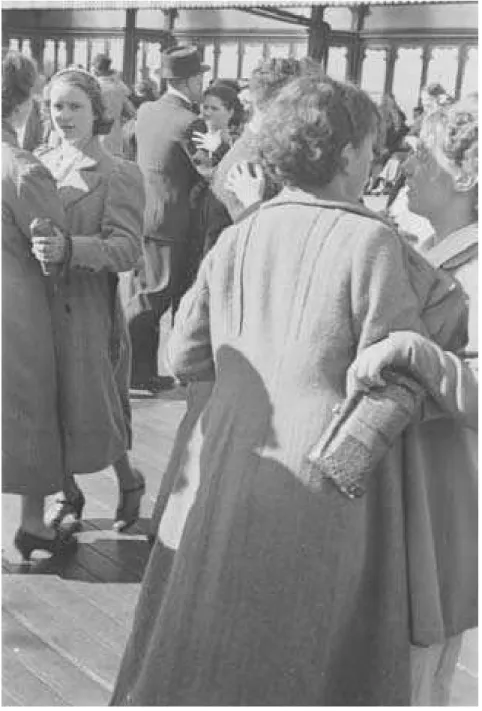
3.3 Spectators overlooking dancers at Blackpool’s Tower Ballroom 68 3.4 An MC moves to curtail jitterbugging at Blackpool’s Tower
Ballroom 72
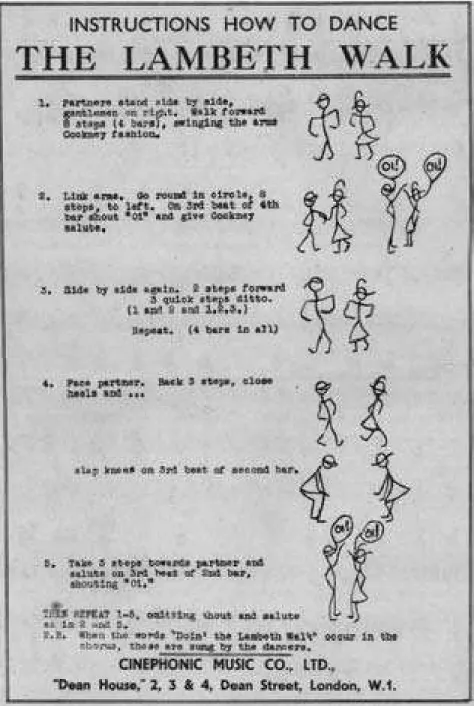
3.5 Blackpool: girls dancing together on the Pier 74 3.6 Instructions on how to dance the ‘Lambeth Walk’ 79 5.1 An involvement continuum for music media uses 131 6.1 Group collectivist and individualist sociality on the Atlantis
dance floor 164
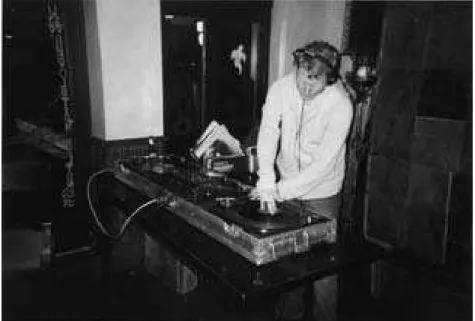
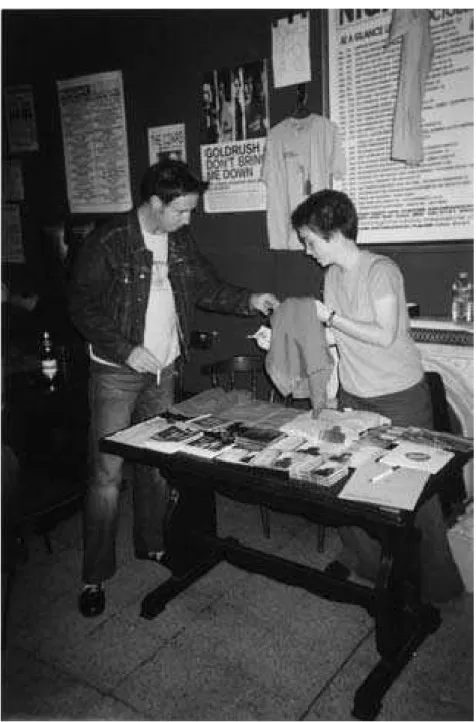
6.2 Inclusive, open-plan DJ-ing practices at Revolution 165 6.3 Inclusive support networks at Night and Day 167 6.4 An accessibility continuum for public music practices 170 6.5 An involvement and accessibility model for youth music
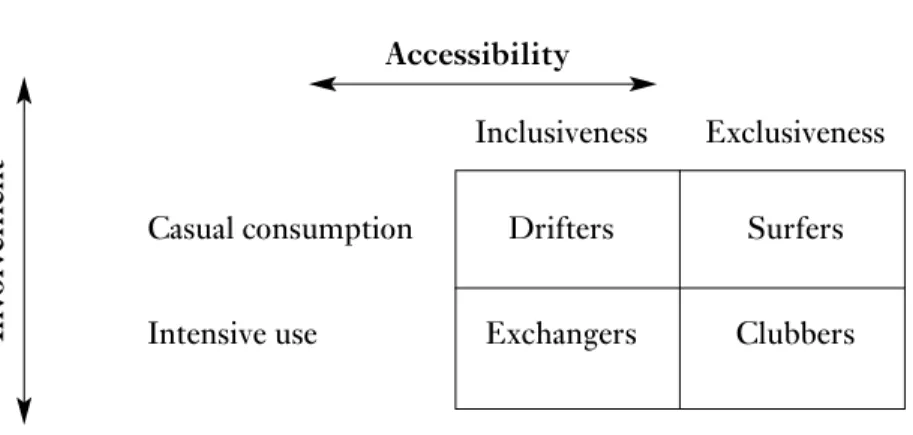
practitioners 175
6.6 Moshing at The Star and Garter (Manchester city centre)
gig venue 176
6.7 Exclusive promenade performances in dance and talk at Bar
Juice 195
6.8 Inclusive promenade performances as demonstrated at the
Ritz 197
7.1 A situational interactionist model 204
Tables
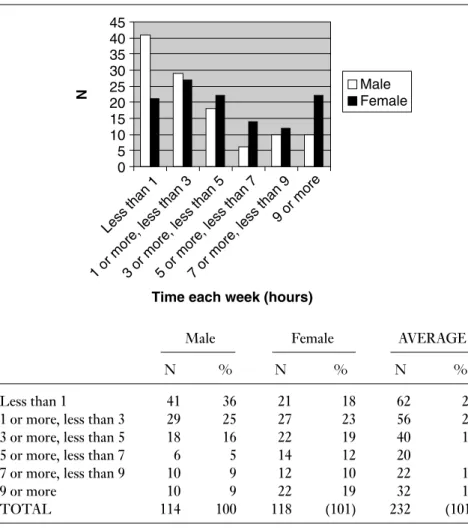
5.1 Recorded music consumption on average each week (hours) 118 5.2 Gender and music radio consumption on average each week
(hours) 124
5.3 Gender and music media consumption 126
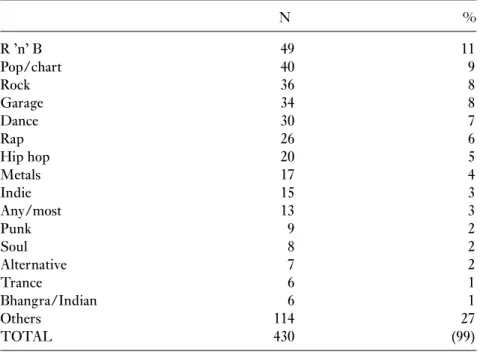
5.4 Preferred music genres/acts 147
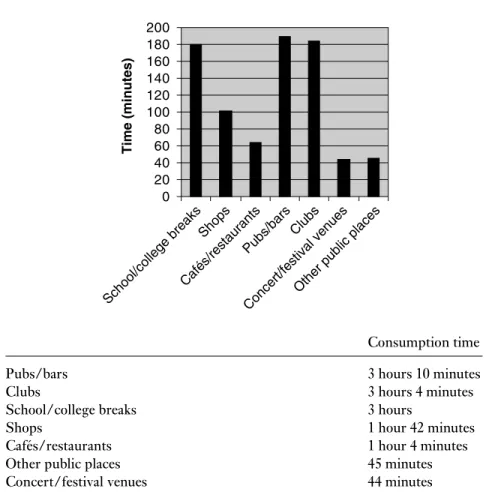
5.5 Everyday life narratives on music influences 152 6.1 Public music consumption on average each week (hours) 171
6.2 Gender and public music consumption 173
The relationship between music and youth culture is fraught with clichés.
All the theorising imaginable, therefore, could not have provided me with a better understanding of this subject area than the thoughts and feelings of those young people that I have talked to over the past few years. It is difficult, in fact, to be sure of a particular moment when I started to write this book. The research began the day before 9/11 but many of the ideas emerged a long time before that. My Masters dissertation in 1999 covered similar ground, but perhaps the inspiration came a few years earlier during secondary school teacher training. As part of my training I devised a short – and very primitive – questionnaire for a Year 11 class. One question asked, ‘Which item of popular culture would you choose to donate to your school library: A. a novel, B. a film, C. a computer or video game, D. a tele- vision show, or E. a music album?’ Every one of the thirty respondents chose E. Subsequently I organised a lunchtime music club which met each week to exchange tastes and news about the latest ‘thing’. At the same time I read several fascinating studies into children and television but wondered why, when music seemed to be far more important to young people, there was little comparable research into youth and popular music. The spark was lit and here is the end result. The discerning reader will note, however, that the term ‘popular music’ is conspicuous by its absence. Young people tend not to describe their music – consumed or produced – as ‘popular’ and in any case the range of different descriptors that they do use suggest the inadequacy of a singular category. ‘Popular music’ says just as little about music experienced in everyday life as ‘youth’ says about the different char- acteristics of young people’s everyday lives.
Many individuals and several institutions have helped to bring about this publication, and I certainly do not have the will or inclination to name them one by one. Perhaps most importantly of all, I would like to acknowl- edge a three-year University of Salford Research Studentship that helped
to fund the research contained herein. The supervision of Professor Brian Longhurst has provided an invaluable source of ideas and guidance that leaves its influence both within and beyond the confines of this book.
Thanks are also due to Professor Tia DeNora, Professor Derek Scott, Dr Greg Smith and Professor Sheila Whiteley for providing useful comments on the work in progress. I would like to thank colleagues at the School of Cultural Studies, Leeds Metropolitan University, for their encouragement and support. Further thanks are due to Sarah Edwards at Edinburgh University Press for her invaluable editorial advice.
I am grateful to all those members of staffat schools and colleges who participated in this research by assisting me in the arrangement of inter- views with their students. Of course, I am also indebted to all those young people who volunteered to be respondents. The interest in and response to the fieldwork surpassed all expectations.
The archival research for this book has benefited from the help of staff at several public libraries in north-west England, the Mass-Observation Archive at the University of Sussex and the Blackpool Leisure Parcs Archive – thanks to Ted and Ann Lightbown for their assistance. The warm hospitality of several cheap guest houses in Brighton and Blackpool deserves a mention too.
Last but by no means least, I would like to thank my family – and espe- cially my mum and dad, Win and Bill Laughey – for fully supporting (i.e.
paying for) my studies and being my fiercest critics. During the course of researching and writing the book I have started a family of my own, and so I would like to dedicate Music and Youth Culture to Nicky, Harry and another who is yet to take breath.
Introduction
Music is considered by many to be the highest form of art and culture.
Music is also considered by many to epitomise their values and tastes, as well as those of other people. Music is very often a product of its time – both a reflection of the ‘here and now’ and a ‘recaller’ of memories.
Meantime, music and youth are usually deemed to hold a special relation- ship with each other. Music is delivered and sold to youth audiences, and young people on the whole are fans of one music genre or another. Any attempt to study young people’s relationship to music, therefore, is imme- diately faced with a list of commonly held assumptions – and the above name but few – that need critical evaluation. I could wax lyrical about how my love of music has evolved since a very tender age. I will resist this temp- tation, however, because this book is partly motivated by a desire to appre- ciate the role of everyday music beyond those texts, artists and genres that are consumed for personal pleasure. Youth and music may represent a special relationship but young people – like everyone else – exhibit all kinds of different preferences that can frequently lead to pressure, conflict and division. Having said this, the research contained herein shows that different kinds of music and different kinds of young people retain a remarkable bond that has withstood the test of time since at least the early twentieth century (and probably earlier). And whilst not every young person is a music follower, I will argue that music retains a social and cul- tural force of identification and presentation in nearly all young people’s lives, whether they like it or not.
What follows is an attempt to understand how music interacts with young people’s everyday lives. In relation to a considerable and expanding body of previous research in this subject area, I will adopt an interaction- ist perspective to shed light on orthodox structuralist frameworks for con- ceptualising youth music cultures. Structuralist approaches to studying youth music cultures as macro social units or ‘collective wholes’ have
dominated sociological and cultural analysis for at least the past fifty years. Structuralism and subsequent post-structuralist modifications have wielded their influence in particular through the theories of Roland Barthes (1993,first published in 1957) who showed how cultural texts and objects acquire meanings in what they are not as well as what they are.
Barthes set out to understand signs (in the sense of units of meaning, such as a word or image) and developed a structuralist approach which is now known as ‘semiotics’ – a method of textual analysis which reads language as a signifying system that is capable of generating cultural myths. In Subculture (1979), Dick Hebdige perceptively draws similarity between semiotics and a literary critical approach to the study of lived culture. He then suggests that semiotics is able to reject the literary canon in favour of reading
the normally hidden set of rules, codes and conventions through which meanings particular to specific social groups (i.e. those in power) are ren- dered universal and ‘given’ for the whole society. (1979: 9)
These ‘rules, codes and conventions’ form the dominant ideology that serves to maintain the status quo over subordinate groups through a process called ‘hegemony’ (Gramsci 1985) as applied to music and youth subcultures by Hebdige.
To whatever extent semiotics can read hegemonic struggles by youth cultures in the subversive meanings that they attach to everyday texts and objects such as music, the method cannot probe beyond the textual ‘end product’ to examine the contextual ‘means’ by which these ends are for- mulated. Rather than seek out ‘hidden meanings’ through textual analyses such as semiotics, as have so many structuralist perspectives on subcul- tures, club cultures and post-subcultures, the empirical methods deployed in this book – interviewing, simple observation and a questionnaire-based survey – are designed to contextualise young people’s music consumer and producer practices through their own everyday actions and narratives. The interactionist approach deployed here argues that the macro-structures of cultural industries and texts – such as music – are subject to constant change in response to actions and meanings that are generated on the micro-social level.1Youth music practitioners in this study are therefore contextualised as diffused audiences and performers for both mediated and co-present music phenomena; not as homogeneous members of subcul- tural worlds whose music is radically appropriated to exist in harmony with autonomous beliefs or styles. By the same token, this study avoids a narrow focus on specific music cultures (e.g. rock fans) and instead assesses how
various types of music made accessible across multimedia as well as public contexts might be used to cut heterogeneous socio-cultural identities within quite tightly defined demographic and geographic characteristics.
To this end, the field where I have located my youth sample has been further and higher education institutions (mostly schools and colleges) around the close-knit Bolton, Manchester and Salford segment of the Greater Manchester conurbation in north-west England. My fieldwork and the theoretical insights that emerged are informed by archival research into early accounts of young people’s music cultures and media in the same geographical area.
Informed by wider theoretical developments in the sociology of consumption and everyday life as well as cultural and media studies, the research presented here is less interested in how young people are located within music structures than in how music interacts with the structures of their everyday lives. Classic structuralist accounts of youth subcultures (e.g. Clarke and Jefferson 1973; Willis 1978) have tended to locate music alongside other artefacts within an all-embracing style as homology. In the case of punks, for example, a preference for heavy rock music was not understood in relation to everyday education, work and leisure contexts, but solely in relation to syntagmatic leisure contexts in which the punk style – heavy rock, outlandish hairstyles, leather boots and jackets, safety pins and homemade clothes – was collectively lived out. This study, in stark contrast, intends to situate music in relation to the various leisure and non-leisure contexts recurrent in young people’s lives. Music is not pre- sumed to fit into spectacular systems of signification that are opposed to dominant social and cultural forces but is instead situated in the localised interactions that typify the ordinary, routine and mundane circumstances of young people’s everyday experiences. Theories of everyday life that work outside the orthodox neo-Marxist paradigm of effects and resistance (exemplified by Hall 1992) towards a paradigm of performance and enact- ment (Finnegan 1997a; Abercrombie and Longhurst 1998) keep more in sympathy with this research agenda.
With regard to specific theories of consumption in everyday life, I am particularly interested to explore the merits of perspectives that relate music consumer to producer practices rather than those that clearly dis- tinguish one from the other. As such, this book is aligned to the ethno- graphic turn in media studies of audiences although it disassociates itself from many ethnographic studies that have continued to use the vocabulary of incorporation and resistance. Those studies that maintain a structural- ist paradigm have focused on the ways in which youth cultures resist incor- poration into dominant national and global structures, but have largely
been reluctant to detail ethnographically those localised everyday interac- tions where resistance is presumably located (Bennett 2000). In particular, a focus on symbolic as opposed to actual resistance (e.g. P. Cohen 1992) has meant that artefacts such as music have been bestowed with meanings exclusively applicable to youth againstrather than withinparental cultures.
The interactionist approach endorsed here, on the other hand, situates young people’s music practices in relation to local and inter-generational contexts of uses and influences. In contrast to structuralist formulations that effectively define youth as an intra-generational, extra-local unit, my fieldwork and archival findings will reveal the significance of familial as well as peer group networks to young people’s music practices, and the significance to these practices of concrete local places containing conven- tions and traditions more than ‘symbolic defences of communal space’
(Hebdige 1979: 39).
Notions of tastes and performances as applied to youth music cultures will be intended to accommodate the characteristics of respondents’ medi- ated as well as their co-present practices. Whilst the majority of music media were accessible to all in the sample, particular media such as the Internet afforded variable levels of user involvement. In the case of public music practices, there were also variable levels of involvement in – added to variable degrees of accessibility to – such practices. Unlike structuralist models of youth music cultures that have discussed the inequalities expe- rienced by collective groups or even a whole generation of young people so defined by a single demographic characteristic, the research agenda here attempts to detail the variations in access to and involvement in music practices within these collective units. Conceptualisations of distinction (Bourdieu 1984) deployed in studies of club cultures (Thornton 1995), for instance, have tended to operate on a simplistic level that has distinguished between clubbers and non-clubbers. Much finer distinctions as well as belongings perceived by respondents in terms of their own and others’
music practices, however, will be conceptualised in this study to evince the complexities of practitioner involvement and accessibility. Whereas the literature on youth subcultures has generally avoided any prolonged exam- ination of media consumption because of its concerns to analyse subver- sive practices that are opposed to the ideological functions of media productions, I will explore the complementary relationship between medi- ated and co-present music practices, each of which accorded similar significance to young people on the basis of empirical analyses.
Furthermore, a focus on the enactment of tastes, narratives and performances through processes of presentation and identification will inform a fluid, dynamic model of the role that music plays in respondents’
everyday life narratives. Previous research (e.g. Frith and McRobbie 1990) has overstated the emotional relationship between young people and their musical affiliations where emphasis has been placed on fanatical or enthu- siastic consumption at a given moment in time. A key consideration in my deployment of an ethnographic interviewing method – in which I made return visits to several respondents over a sixteen-month fieldwork period – was to account for temporal changes in respondents’ presenta- tions of and identifications with specific music cultures. Accounts of per- manent changes in music tastes over the fieldwork period proved to be few and far between, but the conservatism suggested by this finding could be explained by the mostly broad, omnivorous music tastes articulated by these young people. Respondents’ broad music tastes also explained why changes in these tastes were rarely permanent but frequently temporary in aiding the articulation of everyday life narratives about particular moods or actions. Two types of narratives about music tastes and performances that accorded to different timeframes will thus be substantiated: narratives that are embedded – frequently in family contexts – through memories facilitated by (domestic) music experiences; and narratives that are radi- cally contextualised (Ang 1996) – frequently in peer group contexts – in immediate relation to the whims of music fashions.
Youth as a concept
Taken at face value, the concept of ‘youth’ appears to be reasonably straightforward. Youth refers to people within a particular age band who are neither immature children nor fully fledged adults. This definition of youth offers a starting point but not much else. Wyn and White (1997) problematise this common sense of youth as it derives from an orthodox approach to thinking about age as an essentially biological process:
Although each person’s life span can be measured ‘objectively’ by the passing of time, cultural understandings about life stages give the process of growing up, and of ageing, its social meaning. (1997: 10)
Understanding youth as a social and cultural rather than a biological concept is further reinforced by changing historical values, beliefs and atti- tudes to young members of society. The concept of ‘youth’ is actually a rel- atively recent one and is difficult to trace much further back than the early seventeenth century. In the Middle Ages the associated concept of child- hood was only loosely acknowledged, given that children were expected to be independent from the age of seven (Aries 1962). Youth followed well
behind childhood as a widely recognised phase in the life course and only became widely used in the 1950s when it was initially applied to a particu- lar type of gendered (male) and class-specific (working-class) young people (Frith 1986). Despite the relatively late arrival of ‘youth’ as a social and cul- tural phenomenon, classic studies of young people in terms of adolescence (e.g. G. S. Hall 1904) and delinquency (e.g. Robison 1936) had already inspired a large body of theory and research about young people during the first half of the twentieth century. It is not the intention of this book to review the early psychological and sociological literature on youth.
However, the legacy of this literature should not be underestimated and it clearly influenced much of the early work on subcultures that will be dis- cussed in Chapter 2.
Ideas about adolescence and delinquency (now sometimes referred to as anti-social behaviour) continue to occupy much research time and money but have been countered by other ways of thinking about youth from contemporary perspectives in sociology, social policy and cultural studies. Some of these perspectives have been influenced by the subcul- tures literature but others have cast doubt on an understanding of youth as a set offixed, homologous and non-hierarchical experiences. As such, ideas about the fluidity of youth lifestyles and consumption (Miles 2000;
Roberts and Parsell 1994), youth governance in relation to criminalisation (Muncie and Hughes 2002) and youth transitions through employment, education and leisure activities (Wallace and Cross 1990; Furlong and Cartmel 1997) have all offered fresh approaches to the concept of youth.
The opening lines of Steven Miles’s Youth Lifestyles in a Changing World speak volumes about the tired emphasis on delinquency and subcultures that has dogged so-called ‘classic’ sociologies of youth: ‘For too long social scientists have portrayed young people as excluded risk-taking trouble- makers motivated by nothing more than their own rebellious self-interest’
(Miles 2000: 1). I would extend this comment to numerous cultural studies scholars and a significant generation of academics and journalists who have written about youth culture as though they were still living in 1968 among their fellow hippies. More recent authors have better under- stood the complexities and flexibilities of youth transitions from one context to another; from one set of identities to a different set. Rather than conceive of youth during a static moment of rebellious leisure, new per- spectives have tried to grasp the ‘plethora of transitional transitions’
(2000: 11) experienced by young people in everyday life contexts. Miles’s discussion of ‘lifestyle’ is particularly apt at approaching the dynamics of youth experiences by embracing the interplay between structure and agency, and expressing young people’s social mobility both upwards and
– where the emphasis has usually been placed by youth sociologists – downwards.
As well as offering a dynamic examination of lifestyles, new perspectives on youth transitions have helped to inform how youth might be situated in relation to music and other cultural practices. A major limitation of much youth cultural and particularly subcultural research has been to only fleetingly examine the activities of routine, workaday young people outside their more creative and visible – indeed, ‘spectacular’ – leisure-based activ- ities. This book is therefore less interested in how young people interact with music and wider social structures than in how music is situated in the fast- moving and changing structures of their everyday lives – and how this ulti- mately impacts upon the transient nature of successive youth generations:
During the last two decades, changes in patterns of educational participa- tion, delayed labour market transitions and an extension in the period of dependency have all had implications for the lifestyles which young people adopt and for the ways in which they spend their free time. (Furlong and Cartmel 1997: 53)
The ‘transitions’ approach to understanding youth has been particularly helpful in showing how the concept is not determined by objective struc- tural categories such as age and class but is subject to social and cultural changes in the experiences and practices of being young. Perhaps the most notable change that has occurred during the last twenty to thirty years – particularly in Western societies – has seen the protraction of youth as a life stage. Wallace and Kovatcheva (1998: 181–4) argue that the endless revivals of youth cultural styles in Eastern and Western Europe, such as 1970s disco, point to a present-day concept of youth that no longer applies merely to young people and their supposedly distinctive, original, possibly subcultural activities. The very idea that ‘youth subcultures’ might exist today is therefore problematised not so much by the notion of ‘subculture’
as by that of ‘youth’.
Situating music in youth culture
Much early work around youth and music (e.g. Adorno various; Hall and Whannel 1990,first published in 1964) started with the music and applied it – often without sound empirical evidence – to a given youth culture or generation. However, there are important exceptions to this rule. A strand of thinking about youth culture and music from the perspective of those characterised by the former concept can be traced back to a pioneering
analysis of ‘youth culture’ as a social entity (Parsons 1942). Following in this tradition, Mungham (1976), Murdock and McCron (1976) and Frith (1978; 1983; 1986) were among the first youth sociologists who both worked alongside exponents of a youth cultural studies tradition but at the same time redressed the lack of empirical insights that had thus far informed an understanding of youth (music) cultures. My own account of young people’s music uses and practices, and the ways in which they are narrated and performed so diversely and vividly, owes much to these broader perspectives on youth and social change. The value of this body of work as a rejoinder to the seminal textual analyses of youth culture (e.g.
Hall and Jefferson 1993) will be made explicit in the following chapter but for now a short example will suffice. Whilst semiotic or historical readings of youth subcultures have suggested quite uncritically the working-class position of youth subcultures, more rigorous sociological research (Stewart 1992; Hollands 1990) has demonstrated the complexity of social class, given that a typical lengthening of the transitional phase among more affluent young people has led to greater parity in levels of disposable income experienced by youth of all social classes.
Consistent with the concept of youth ‘in transition’ between varying degrees of leisure, education and employment, this book approaches an analysis of music only in relation to all the other everyday activities of young people. Ian K. Birksted’s (1976) research into how a group of teenage boys viewed their school performance to be inextricably affected by work, leisure and holiday activities points towards a wider concern to contextualise routine, recurrent, temporal phenomena. Like school per- formance for these teenage boys, music for many young people that I researched could feature across leisure, work and education times but would hold different levels of attention in accordance with the various con- texts in which it was consumed and produced. Moreover, experiences of music and other activities across leisure, work and education contexts were not easily distinguishable. Indeed certain work activities were often moti- vated by a desire to accumulate the necessary financial capital for leisure and even education activities. Likewise, certain education contexts such as school breaks were also important contexts for leisure activities. The way in which these different types of activities closely juxtaposed with each other to banish the segregated notion of hedonistic weekends at leisure or long holidays without work, and to instead shift certain leisure times towards weekday nights, would problematise any suggestion that these young people could find the time and commitment required for spectacu- lar subcultural or indeed club cultural pursuits.
Situating music in juxtaposition with the everyday transitions of youth
cultures is also helpful in order to understand how the process of growing up can correspond to changing contexts of leisure. Theories of subculture have tended to assume that public contexts free from parental controls accommodate the spaces for youth musical expression. For many inter- viewees of different ages in this research, though, the parental home (but very rarely the street corner) provided a central context for what they per- ceived to be leisure time.2As well as facilitating rest and recuperation from education and work time, a young person’s home and those of others often accommodated multimedia entertainment technologies, cheaper or even free food and drink, warmth, hygienic amenities, security and familiarity.
Moreover, someone’s parents were always likely to be eating out or away from home to allow temporary escape from the everyday regulations of these domestic leisure contexts. As might be expected, public music prac- tices would be easier to access and more likely accessed as young people grew older. Indeed private/mediated music practices offered an alternative to the drawbacks associated with access to public/co-present ones, whilst co-present music practitioners tended to explain their activities without reference to mediated choices. This latter point perhaps indicates why studies that overstate co-present music practices within subcultural (e.g. Hall and Jefferson 1993) or localised art worlds (Finnegan 1989) rarely encounter mediated music influences. As these initial findings show, though, it is unhelpful to focus on the public/co-present to the ignorance of the private/mediated music practices given that the activities associated with each set of practices provided definite choices in response to my respondents’ other everyday leisure, work and education activities.
Book structure
The aims of this book are fivefold and generally correspond to the inten- tions of particular chapters. First, I aim to analyse classic theories of youth music cultures as subcultures – together with contemporary revisions of these classic theories in terms of club cultures and post-subcultures – from an interactionist methodological standpoint. A second aim of the research is to apply sociological and cultural theories of everyday life to young people’s music consumption and production in general, and their enact- ment of tastes, narratives and performances in particular. Third, the aim is to situate contemporary young people’s music cultures within a histori- cal context by exploring an early period of mass music activity among British youth prior to the post-war phenomena of subcultures. Fourth, and informed by extensive empirical information, I aim to contextualise the local sites of everyday interaction wherein young people’s music cultures
and media are enacted and influenced, detailing the similarities as well as the differences between their involvement in mediated and accessibility to co-present music experiences. The fifth and final aim of this book is to evince the relationship between young people’s music media and public music practices, which by necessity will demand a model for indicating the relationship between private and public consumer as well as local and global producer practices. These five aims underpin how the book is struc- tured, chapter-by-chapter details of which now follow.
Following this introduction, Chapter 2 reviews the literature on subcul- tures, club cultures and post-subcultures from an interactionist perspec- tive. My argument here is that the prevalent deployment of semiotics, structuralism and postmodernism in understanding post-Second World War youth cultures has resulted in a dearth of empirically informed, soci- ologically detailed accounts of young people’s localised interactions with familiar others. Instead of focusing on young people’s relations to the people and places that provide meaningful everyday sources of reference and influence, youth cultural studies – particularly those derivative of the European tradition of critical and cultural theory – have tended to locate respondents in collective, intra-generational units that share homologous commitments to spectacular deviances or symbolic resistances. In turn, much previous research into the role of music in youth cultures has worked within a structural Marxist framework centred on the effects of and resist- ances to the commercial function inherent in mass music texts that young people have consumed throughout the twentieth century to the present day. Such a framework persists in theories of fandom, club and taste cultures that are also guilty of a narrow focus on intensely committed, emotional consumer practices. Theories of post-subcultures, on the other hand, go some way to rejecting structuralist perspectives but continue to deploy subcultural discourses, besides sometimes showing a postmod- ernist aversion to rigorous social research.
Rather than presuppose a static youth cultural world characterised by certain musical ideologies and political affiliations, then, I will suggest an interactionist approach to the study of young people that attempts to understand their everyday cultural values withinrather than againstthose cultural values of other social groups. This approach is therefore able to evince heterogeneous youth (music) cultures through understanding dynamic intergenerational and local relations that are complemented rather than contrasted to relations with globally mediated phenomena. A dynamic interactionism used to problematise structuralism as a framework for understanding music cultures and media is then further outlined with reference to archival research in Chapter 3. The archive in question is the
Mass-Observation Archive, named after the social research organisation that generated its ethnographic material. This chapter will interpret the findings of Mass-Observers located in north-west England who observed youth music and dance practices during the pre-war and intra-war years (1936–49). These practices and the various contexts in which they were enacted (ballrooms, dance schools, living rooms) are seen to resonate in particular with ideas about the ‘carnivalesque’ (Bakhtin 1984) and every- day consumer tactics which escape the influence of producers (de Certeau 1984). I will argue that the notion of what might be termed ‘promenade performances’ of demonstration and display afforded by varying levels of involvement and competence in dancing practices illustrates the significance of interactive processes of cultural exchange – or cultural transmission (Fine and Kleinman 1979) – scarcely evident in many con- temporary youth cultural accounts.
Theoretical frameworks other than those reliant upon a dichotomy between dominant parental and resistant youth cultures are assessed in Chapter 4. This chapter applies various concepts associated with the soci- ology of consumption together with theoretical accounts of everyday life to young people’s music consumer and producer practices. Propelled by a relatively recent tradition of media audience ethnographies, research that can be defined as owning an interactionist dimension has attempted to detail the complex relationships between music texts and young people’s everyday, local contexts. I will therefore discuss the merits of approaches to young people’s music practices that are situated in everyday narratives, self-identities and self-presentations as well as specific localities. These approaches possess the potential to contextualise the differences encoun- tered by young people in their everyday experiences of music consumption and production. In particular, the notion of self-presentation (Goffman 1969a) combined with those previously discussed ideas about the ‘carniva- lesque’ and tactics will inform contextual analysis of differential display and demonstration by youth music practitioners through promenade per- formances. Instead of focusing entirely on how music structures youth cul- tural values, the theoretical concerns endorsed throughout this chapter will anticipate later fieldwork intentions to situate music in relation to all the other cultural practices that characterise young people’s daily social interactions. It will be argued that the starting point for situating music in young people’s lives should be the individual, peer group or familial con- texts through which consumer and producer practices are learnt.
Chapters 5 and 6 present research findings from fieldwork that provide empirical support for the main arguments presented earlier in the book.
During the fieldwork period (July 2001–June 2003), in order of significance,
I conducted fifty-two interviews either with groups or individuals, a questionnaire-based survey with 232 respondents, and simple observation at fifty-four diverse research locations where public music functioned to some degree. Mediated music uses and influences are the concern of Chapter 5 only in so far as they relate to the ‘other’ type of music experi- ence (i.e. the co-present type). Although mostly private/domestic contexts provide the situations for music media consumption, I will show how medi- ated music consumption is a pervasive feature of these young people’s public leisure as well as educational and work contexts. Differences in music media uses among the sample will be understood along an involvement con- tinuum from intensive to casual media consumption. Implicit to this focus on young people’s heterogeneous consumer involvement in specific music cultures will be a rejection of subcultural and club cultural – as well as many post-subcultural – accounts of youth music consumption framed within homologous structures of style. This chapter will also focus on mediated music influences and argue that such influences need to be understood through contexts of reception as much as the music texts themselves. Family and peer group influences in domestic and educational contexts will be shown to stamp very localised meanings on global music media products.
Media uses and influences will then be conceptualised in reference to the earlier theoretical discussion of literacies and narratives. The productive outcomes of young music consumers’ media literacies as well as their every- day life narratives will be radically situated in relation to those contexts through which these literacies are learnt and these narratives are articulated.
Chapter 6 will build upon analyses in the previous chapter by initially presenting those distinct facets of young people’s public music practices before combining such facets with those identified as distinctive to medi- ated music practices. Differences in public music practices among respondents will be partly understood along an accessibility continuum from exclusiveness to inclusiveness. However, for such differences in young people’s co-present music experiences to be fully understood it will be deemed fit to combine scales of accessibility with those of involvement as devised in analysis of mediated music experiences. As a result, a dual configuration of analyses of mediated music involvement and co-present music accessibility will result in four groupings of youth music practition- ers regardless of their preference for either music media or public music practices: clubbers, who access exclusive co-present contexts and inten- sively consume mediated music; surfers, who also access exclusive co- present contexts but tend to casually consume music media; exchangers, who tend to enact inclusive public music practices but are intensively involved in media uses; and drifters, who also enact inclusive public music
practices and are casually involved in media uses. The rest of Chapter 6 will propose various applications of these four groupings. Developing theoret- ical discussion about performances, I will conceptualise respondents’ pre- sentations of and identifications with their public music practices through interactionist perspectives on impression management and judgement as well as age playing techniques. After discussing perceptions of space/place in respect of localised meanings and media influences in respect of glob- alised meanings that are exerted upon co-present music contexts, this chapter finishes by outlining a notion of promenade performances as first proffered in Chapter 3. These performances of display and demonstration will return to interactionist concerns about how young people’s everyday music cultures are situated in intergenerational and local contexts.
Chapter 7 ties together the theories and research on music and youth cultures. Here I will advocate a situational interactionist model for the study of everyday youth music cultures and media which conceptualises contexts, practices, involvement and accessibility in terms that support previous theoretical propositions and fieldwork/archival analyses. This model will then be applied to a more thorough examination of two central themes to have emerged in the course of this study: those of intergenera- tional narratives and localised performances. The overall conclusions (Chapter 8) will evaluate the extent to which the five aims of this book have been successfully addressed and will present their theoretical outcomes.
Where this study of music in young people’s everyday lives attempts to contribute to the knowledge and understanding of its subject area is in the rejection of dominant structuralist and postmodernist theoretical frame- works in favour of the adoption of a less frequently undertaken interac- tionist approach. This approach will conceptualise youth music consumers as diffused audiences and performers rather than homogeneous partici- pants of an exclusive, collective subcultural or club cultural world.
Notes
1. This is a brief and necessarily generalised distinction between structuralist and interactionist perspectives. I would recommend Cuffet al. (1990) for a more detailed exposition of these perspectives and their theoretical agendas.
2. Roberts et al.’s (1990) longitudinal survey of approximately four thousand young men and women aged 16–19 years – similar to the ages of most of the respondents in my sample – in mid-1980s Scotland also revealed the impor- tance of domestic settings for listening to recorded music on a regular basis, partly due to economic constraints.
Subculture, Club Cultures and Post- Subcultures: Music/Social Interactions?
What is a subculture? There is no simple, catch-all definition and this chapter will show how an understanding of subculture is inextricably dependent on competing methodological approaches. To understand the theories and research into youth and music subcultures that represented a substantial area of scholarly activity in the USA and Britain during the latter half of the twentieth century, it is first necessary to trace the process by which subcultural ideas arose from wider perspectives on culture and society. Early developments in cultural studies from different critical tra- ditions in North American social research, and European literary and cultural theory, had a fragmentary impact on subsequent studies of sub- cultures. A consequence of such an impact was the tendency for British cultural studies of youth groups and their musical affiliations – the most influential of which derived from the Centre for Contemporary Cultural Studies (CCCS) at the University of Birmingham – to adopt an almost entirely structuralist perspective on subcultures as exclusive signifying systems.1In the USA, by contrast, and particularly through the work of the Chicago School (of sociology and criminology), subculture was con- ceived to be a phenomenon to which every individual in any everyday context potentially could belong. Of interest to US researchers were the ways in which subcultural groups interacted with and overlapped each other. Although this distinction between traditional North American and European cultural studies is not clear-cut in all cases, it is significant to later formations of subculture.
If it follows that studies of youth subcultures were influenced by earlier ethnographies from Chicago School sociologists in the 1920s and 1930s (Hebdige 1979: 75), it is puzzling to discover how little they seem to have been influenced by interactionist perspectives that subsequently aided interpretation of these early studies and informed their predecessors.
Due to the weighty influence of the CCCS literature on more recent
accounts of club cultures and post-subcultures, and despite the numerous critiques of subculture included in these and other accounts,2interaction- ist analyses of subcultures are conspicuous by their absence (early excep- tions here are Fine and Kleinman 1979; Mungham 1976). The club cultures and post-subcultures literature furthermore shares many of the flaws found in the study of subculture which it has intended to supersede.
I will argue that the most fundamental criticism of subcultural theory in general and British subcultural studies in particular has been the construction of closed semiotic spaces that define youth groups homoge- neously againstother groups and ignore the everyday interactions between young people (and others) within these different groups. The concept of club cultures, whilst a useful rejoinder to the semiotic bias of subcul- tural accounts, should be criticised similarly for lacking detailed sociolog- ical examination of young people’s everyday lives. The postmodernist slant to the post-subcultures argument deserves credit for occasionally moving beyond the dominance-resistance model of structuralism but, perhaps reflecting contemporary cynicism about empiricism, also tends to lack applied social research. Incorporated into this analysis are studies that more promisingly depart from structuralist and constructionist tendencies towards an analysis of young people that does not presuppose collective cultural identities channelled through music, fashion and other ostensibly omnipresent forms of intensive consumption. Instead, these contributions together with my own are more likely to reject the sociology of youth subcultures by diverting attention to the dynamic interactions experienced by young people in everyday contexts of cultural consumption.
Culture to subculture
It is from the North American tradition of social and cultural research that the concept of ‘subculture’ first emerged and from which interactionist studies of subculture developed – in stark contrast to the structuralist tra- ditions of early European cultural studies. Two pioneering studies from the Chicago School, although not alluding to the precise term ‘subculture’, paved the way for such a concept by ethnographically detailing the activi- ties of a particular cross-section of the wider US population. First, Paul G.
Cressey (1932) and a team of observers began a project in 1925 to investi- gate what were perceived in criminal terms as ‘taxi-dancers’. Taxi-dancers were usually young females who offered themselves for hire to male dance partners in return for half of the patrons’ charges, the other half of which would be retained by the proprietors of the Chicago dance halls who
employed the taxi-dancers. Interpreting multiple observers’ accounts of their experiences, Cressey states that the taxi dance hall
is a distinct social world, with its own ways of acting, talking, and thinking.
It has its own vocabulary, its own activities and interests, its own conception of what is significant in life, and – to a certain extent – its own scheme of life.
(1932: 31)
This depiction smacks of concepts like argot and homology familiar to the subcultures literature that flourished in US academic circles from about 1960 (D. R. Cressey 1970) and Britain about a decade after.3The taxi dance hall was approached as a mysterious institution shunned by the wider pop- ulation as the least socially acceptable form of dance entertainment on a scale of acceptability in which government-funded municipal ballrooms and dance schools were differentiated as of the highest status. P. G. Cressey could then locate the ‘distinct social world’ of the taxi dance hall in rela- tion to competing social worlds to account for the everyday structural forces that shaped the micro-industry of dance entertainment.
The legacy of Cressey’s study, therefore, was ethnographic observations of interactions among taxi-dancers and their customers that suggested ways in which the wider structure of an urban community situated these social interactions but also ways in which actors perceived themselves within the wider social structure. For example, fierce competition both among taxi dance halls, and between them and other dance institutions, fostered amalgamation of different ethnic groups in Chicago after dance- hall managers lifted exclusion policies for certain groups so as to attract a larger clientele. The consequence of the processes by which these struc- tural market forces increased interactions between ‘Italians’, ‘Poles’,
‘Filipinos’ and ‘Orientals’ was increased racist violence between these groups, often caused by accusations of mixed ethnic sexual relations for which taxi dance halls were considered to be ‘breeding grounds’. In order to deter these violent interactions, it was deemed necessary by structuring influences such as the police for these dance halls to revive exclusion poli- cies whereby each manager would agree to serve clientele of a particular ethnic group. This historically informed location of structuring and inter- acting yet ‘distinct’ social worlds reveals much about each social world itself but has so rarely been of concern to analyses of magically vacuumed subcultural spaces. Although, for instance, Hebdige’s (1979: 45) ‘phantom history of race relations since the War’ refers to the significance of racial relations in the formation of British youth subcultural identities, I agree with Simon Jones’s criticism of this ‘phantom history’ of stylistic, ahistor- ical spaces for ignoring ‘concrete experience and interaction’ (1988: xxv).4
Second, William F. Whyte’s participant observation of young people on the streets of Chicago undoubtedly influenced ethnographic research on youth subcultures. Whyte relied on informants from the youth groups that he participated in so as to retrieve ‘insider accounts’ of what later was referred to as delinquent subcultural behaviour (see Downes 1966: 1–11).
Despite the influence of Whyte’s Street Corner Society(1993, originally published in 1943) on social research methods, Andy Bennett (2000) has recently suggested that later research on subcultures
began to shift away from the ‘local’ as a frame of reference for the acquired deviant sensibilities of youth and towards a new approach which suggested youth itself was capable of generating a series of norms and values, that youth was, in effect, a ‘culture’ or subculturein its own right. (2000: 15) Whilst I agree with Bennett’s statement, I would rather cite Cressey’s (1932) study as a model of how a youth subculture is not created in an autonomous space but is negotiated through localised interactions shaped by structuring influences. The main drawback of Whyte’s participant observation was that it focused on the leaders of these groups, not the fol- lowers; the extraordinary, not the mundane; the strikingly visible, not the private and concealed. As will be discussed in Chapter 4, my empirical aims to understand everyday youth cultural consumption and production avoided the production of ‘exotic data’ (Naroll and Naroll 1963) as associ- ated with the participant observer in practice.
Following these pioneering studies into subcultural worlds or societies, Milton M. Gordon’s article entitled ‘The Concept of the Sub-culture and its Application’ (1970, originally published in 1947) proffered perhaps the first sustained consideration of ‘subculture’ using that precise term. This concept would enable sociologists
to discern relatively closed and cohesive systems of social organisation which currently we tend to analyse separately with our more conventional tools of
‘class’ and ‘ethnic group’. (1970: 33)
The emphasis on ‘organisation’ here points to this early formulation of
‘sub-culture’ as essentially a subsection of the whole culture, whether this meant a regional or national culture. Subcultures were inclusive in that they had ‘an integrated impact on the participating individual’ who could in turn adopt a subcultural personality that might change with their varying degrees of social mobility (1970: 32). Although this early formula- tion of subculture alongside other North American studies suffered from ecological fallacies whereby everyday environments were perceived to
generate – often hostile – effects on individuals, they were nevertheless informed by an empirical research tradition that was far less important to the European tradition of critical and cultural theory at this time.
These early models of subculture laid the foundations for later accounts of deviance from within this ethnographic social research tradition.
Howard Becker’s (1953) account of marijuana use by jazz musicians more usefully showed how the pleasures of drug use stem from a ‘learning process’ acquired through experiences that parallel becoming accepted deviant group members. The use of marijuana by musicians could be understand as a device to aid perception of their ‘hip-ness’ in contrast to the ‘square-ness’ of their audience, whose musical tastes were distinctly other than their own (Becker 1951: 139). These unavoidable if discouraged interactions with their audience in intimate performance contexts such as weddings impressed on these musicians the feeling that their musical tastes and, by extension, their lifestyles deviated from normal laypeople. As one jazz player said, ‘outside of show people and professional people, every- body’s a f– square. They don’t know anything’ (1951: 140). Drug use by these musicians was thus defined against ‘square’ drug use. As Becker noted, synonyms for marijuana ‘change as [soon as] musicians feel that they have gained currency among outsiders’ (1951: 144). Unlike accounts of a commonly structured deviant counter-culture that somehow escaped inter- action with other groups outside their ‘new leisured class’, Becker’s study more convincingly suggested that it is these very interactions between deviant groups and outsiders which fostered perceptions of how certain subcultures could structure their everyday lives in contrast to other group cultures. Chris Jenks (2005: 56) offers a structuralist critique of Becker in which he argues that little is considered about how problems caused by the social structure mean that interactions between, say, the police and deviant individuals are always underpinned by ‘power differentials’. To some extent this is a valid critique and yet Jenks neglects to understand Becker’s point that social structures are both producers and the products of power rela- tions in everyday interactive contexts, and therefore need to be examined through precisely the kind of micro-ethnographic studies conducted by Becker and other interactionist researchers.
Ned Polsky’s (1971) ethnography of the beat scene in New York in 1960 similarly highlighted the interactionist dimension of youth subcultural deviance. Drawing on interviews with a commendably large sample of 300
‘beats’, he noticed that ‘the large majority of beats do not flaunt their phys- ical presence before the public gaze’ (1971: 149) and instead structure their communal activities within timeframes that operate outside normal tourist hours. Inconspicuous ‘badges’ such as beards of certain lengths enabled
one beat to identify another in everyday interactions motivated by a desire not ‘to call the attention of outsiders to themselves’ (1971: 150 and 151).
Essentially, the beats considered their deviance to be slight, and through a means of negotiating and interacting with dominant social groups by taking temporary paid work, they believed that what was presently cate- gorised by outsiders as their deviance would be socially acceptable in the future. So when certain US states relaxed restrictions on marijuana use in large schools,
Proselytizers for marihuana – beats, hippies and college users alike – interpret all this to mean that marihuana will be adopted by ever-widening segments of the population and one day replace liquor in the affections of most Americans. (1971: 173)
The important point made here by Polsky, then, is that youth subcultures can have conformist as well as deviant goals, mainstream as well as subter- ranean social ends. Therefore, what outsiders perceive to be deviance might amount to a misinterpreted definition of young people’s mainstream political intentions. Polsky’s views would appear to have owed much to the influence of Becker’s earlier labelling theory (1963).
Before considering the theoretical turn towards youth subcultural resis- tance that emerged from the European tradition of cultural studies, a further study that critiqued commonsense assumptions about subculture from a labelling theory perspective – rather than proposing a radically alternative subcultural theory – was Stanley Cohen’s (1980a) study of the mods and rockers in mid-1960s Britain. The behaviour and actions of youth subcultures were not the overriding factors by which they were defined as deviant. Polsky (1971) noted the reaction of beats to definitions of them by others:
The individuals in question resent any label whatever, and regard a concern with labelling as basically square. (1971: 149)
The label ‘beats’ was therefore refused from within the ‘beats’ subculture and presumably created by outsiders. According to Cohen (1980a), mass media were the creators of the mods and rockers following societal reac- tion to their sensational reporting of disturbances between the two groups at English seaside resorts. Contrary to the lay view of news media as objec- tive carriers of information, in institutional contexts
the information has been subject to alternative definitions of what consti- tutes ‘news’ and how it should be gathered and presented. The information
is further structured by the various commercial and political constraints in which newspapers, radio and television operate. (1980a: 16)
So Folk Devils and Moral Panics(1980a) – along with Jock Young’s (1971) study of drug-taking – usefully focused on the transactional relationship between deviant groups and the moral panics which they evoked in the wider society. These panics were thus structured and constructed by dom- inant ideological apparatus such as mass media and the police. This metaphorical battleground between the dominant and the dominated was much more literally read by exponents of a resistance framework wherein mass media were charged with partaking in a dominant hegemonic agenda.
A striking instance of the differences between the traditions of North American and European cultural studies is the story of Theodor W. Adorno’s aversion to US mass communications research after emigrat- ing from his native Germany following the hostilities instigated by its Nazi government during the Second World War. Adorno’s argument that popular music exerted a ‘soporific effect upon social consciousness’ (1945, quoted in Morrison 1978: 346) to distract the masses from realising the futility of capitalism has continued to pervade the study of music con- sumption to the present day. Despite his famous polemical attack on the stultifying popular ‘culture industry’ that rendered ‘the masses redundant as producers’ (with Horkheimer 1944: 150), Adorno nevertheless sug- gested in a footnote to ‘On Popular Music’ that ‘The attitude of distrac- tion is not a completely universal one. Particularly youngsters who invest popular music with their own feelings are not yet completely blunted to all its effects’ (1992: 223). He further noted that a demographic focus on age differences had no room in his study. Tracing Adorno’s thoughts to the period following his move to the US, David E. Morrison has shown that while Adorno recognised that
young people were still capable of investing popular music with meaning, the radio industry itself, with its monotonous and repetitive ‘plugging’fitted well the rhythms of the industrial process and undermined the possibility of such ‘meaning’. (Morrison 1978: 344)
The US radio industry as such typified all that was aesthetically impover- ished about contemporary culture in its broadcasting of standardised Tin Pan Alley songs and its elevation of Hollywood stars like Ginger Rogers to a level of idolatry that ‘the girl behind the counter’ emotionally relates to her predicament of ‘missed fulfillment’ (Adorno 1992: 222).
It is unfortunate but perhaps unsurprising given Adorno’s distrust of the quantitative sociology advocated by Paul F. Lazarsfeld (Morrison 1978)
that he failed to allow himself the necessary room to pursue his earlier hypothesis about meaningful youth music consumption. Perhaps the derogatory German meaning of Kultur with its racist and authoritarian undertones coupled with his own lambast of the capitalist-driven enter- tainment industry contradicted the value-free judgements of mass cultural and communications studies to such an extent that Adorno would have dis- tanced himself from foreign research practices peculiar to democratic soci- eties such as accessing government documents. Aversion to the empiricism of North American social research, however, was by no means a limitation of Adorno’s and the Frankfurt School’s critical theory alone. F. R. Leavis and Denys Thompson (1933) as well as T. S. Eliot (1948) were influential British contributors to a European tradition of literary studies in which a close scrutiny of texts was considered to provide the richest interpretations of their cultural value regardless of how these texts were used – presum- ably with far less scrutiny – by the majority of their readers.5Moreover, this tradition remained antagonistic to pragmatic analyses of popular culture and media in its concern to uphold a canon of authentic or organic literature (R. Williams 1966). So whilst the emergence of cultural studies in Europe sprang from more established traditions of literary and critical theory, the North American roots of cultural studies by contrast emerged from the social research ethos of sociology and mass communications studies. Perhaps this difference explains the fact that studies of subculture began within a North American tradition which was more likely to inves- tigate such a grounded phenomenon. After all, youth subcultures were hardly represented in the kinds of texts that the European tradition con- sidered worthy of scrutiny.
Youth subcultures
The syntagmatic shift from culture to subculture more or less indepen- dently construed by North American and European theorists has impacted on much of the literature on youth subcultures. I will show here that the tangible transition from understanding subcultures as deviant subsections of a wider culture to a European theoretical tradition that understood youth subcultures as vacuums of resistance was borne out of perceptions that the ideological function of mass media needed to be assessed by exploring signifying systems in texts. This new theoretical framework, epitomised by Stuart Hall’s ‘Encoding/Decoding’ (1992, originally pub- lished in 1980), was a reaction in particular to empirical aspects of North American social and communications sciences that afforded little scrutiny to textual analyses.
The resistance thesis maintained by British CCCS theorists superseded that of deviance by developing a distinct methodology that Cohen (1980b: xxv) later called ‘new subcultural theory’. Armed with the seman- tic weapons of semiotics, both CCCS staff and students produced a significant body of work throughout the 1970s that substituted deviance as a negotiation between differently adjusted social groups for resistance as a more politicised opposition between youth and dominant or parental culture. As such, CCCS work was removed further from examining inter- actions between subcultures and outsiders, towards a single-minded struc- turalist objective more in keeping with the ‘great tradition’ or ‘ideal order’
of artistic authenticity in European cultural and literary criticism. Two outcomes of this objective that contradict my aims in this book to formu- late an understanding of everyday youth cultural practices will be dis- cussed here:first, a limiting trend to analyse a singular social variable such as – in particular – social class rather than to accommodate multivariate analysis; and second, a preoccupation with decoding homologous styles.
First, class-specific youth subcultural resistance was based on the assumption that variations in age, gender and ethnicity had no bearing on a collective response to socio-cultural circumstances. John Clarke et al. were concerned with ‘how “class” and “generational” elements interact together in the production of distinctive group-styles’ (1993: 52). However, both these ‘elements’ were presupposed: for ‘class’, read working class; for ‘gen- erational’, read youth. As Gary Alan Fine and Sheryl Kleinman (1979) have rightly pointed out,
In the case of youth [. . .] it seems inadequate to deal with the wide range of belief systems (and subcultures) within that age group by means of the concept of a single demographically based subculture. (1979: 3)
Furthermore, ‘While a small group can be studied as a closed system, it is erroneous to conceive of group members as interacting exclusively with each other’ (1979: 8). Such criticism can be similarly levelled at John B.
Mays’s study of juvenile delinquency in inner-city Liverpool in which he concluded that each child within distinctly different youth groups
‘exhibits the same symptoms’ (1954: 147) of uncreative leisure pursuits which account for their impoverished social situation. Mays clearly believed that ‘a love of good music or drama or literature’ would somehow alleviate the material poverty in which his respondents lived, and he revealed a Leavisite sympathy characteristic of highbrow European cul- tural theory by claiming that ‘cultivated’ young people ‘are so rarely met that their aesthetic deviation seems phenomenal’ (1954: 73).
Whilst Mays painted a dim picture of British working-class youth, CCCS researchers tended to paint a very different picture of youth groups as heroic and subversive. Nonetheless, British cultural studies had main- tained the ‘great tradition’ of tainting every subcultural group with the same brush. Presuppositions of social class and generational unity were fundamental to Clarke et al.’s dialectic analysis of youth subcultural resis- tance to the means of production governed by the dominant, ruling class of party politicians and media professionals among others. As David Muggleton (2000) has rightly argued, this a priorineo-Marxist framework rendered an assertion of the authentic origins of subcultural resistance very hard to falsify. The homogeneous working-class character of youth subcultures was thus romanticised as a lone oppositional voice against the hegemonic bloc successfully secured by the dominant with the consent of the subordinate parental culture. Subcultural youth was in this sense a class of its own, united in resistance and isolated from what were surely their differing socio-economic backgrounds as determined by their parents’ occupations. This isolation from the parental culture, however, was demanded because incongruous class positions problematised the assumed unity of youth subcultural resistance. Such a narrow structural- ist conception of subcultural resistance, then, effectively misrepresented the complexities of a ‘generational element’. Moreover, a class-specific resistance in substitution for the more contested characteristics of deviance would mean that the new concept could only be applied empirically to the most marginal and atypical groups. Little prolonged consideration is afforded to non-resistant members of a youth generation who are thus structurally excluded from a presupposed, intensely political arena.
The archetypal study of the correspondence between social class and youth subcultures is Phil Cohen’s (1992) participant observation of working-class communities in London’s East End. Using not dissimilar language to previous deviant counter cultural studies, he observed ‘genera- tional conflict’, a breakdown of family continuity and ‘interpersonal tension’ that was managed by young people via collective ‘symbolic systems’
(1992: 82). These symbolic systems were generated by working-class youth
‘to retrieve some of the socially cohesive elements destroyed in their parent culture’ (1992: 83) through social structuring such as the demolition of ter- raced housing and its replacement with alienating high-rise blocks. Again, this exclusive conception of youth as somehow a closed system in conflict with elders who experienced the same class structure begs the question about where any details of intercommunity relations between the genera- tions were included in this hegemonic struggle. P. Cohen’s notion of terri- toriality, for instance, only operates within a symbolic dimension of warfare