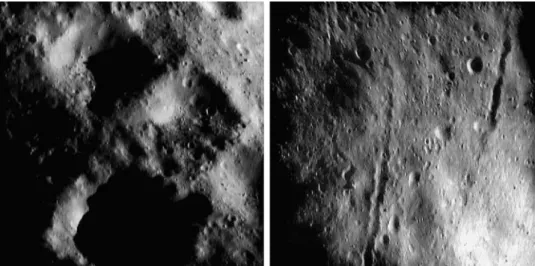
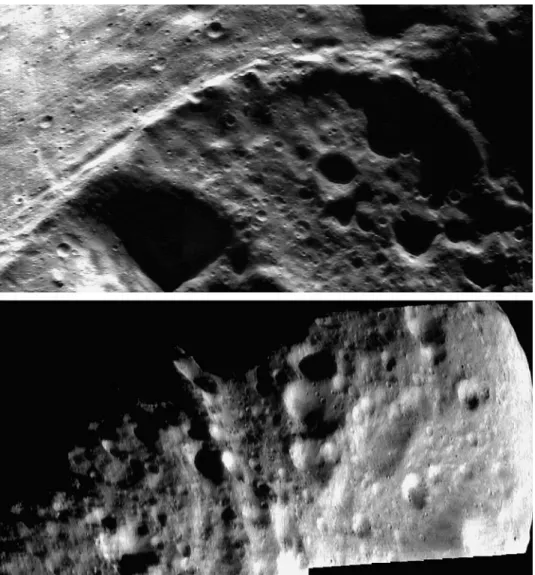
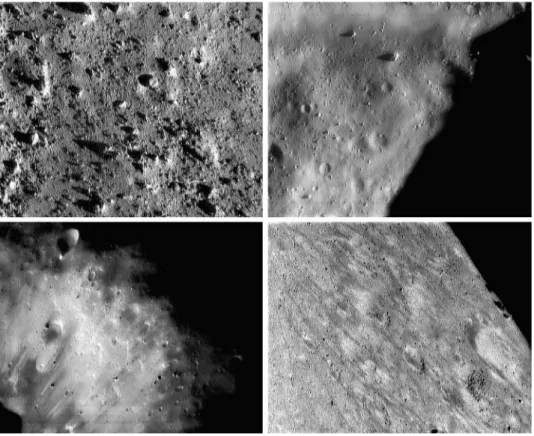
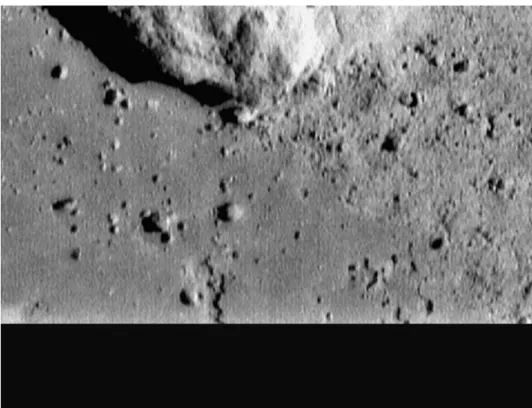
In the final phase of the descent, the spacecraft acquired 68 images with resolutions ranging from 60 cm down to 1 cm/pixel (Veverka et al. 2001b). The work of Murchie and Pieters (1996), in the context of the Gaffey et al. 1993a) classification scheme, offered some extremely interesting possibilities for the geology and mineralogy of Eros. Radioscience measurements of the mass (Yeomans et al. 2000) when combined with an image-based volume of Eros allow the calculation of bulk density of g/cm3.
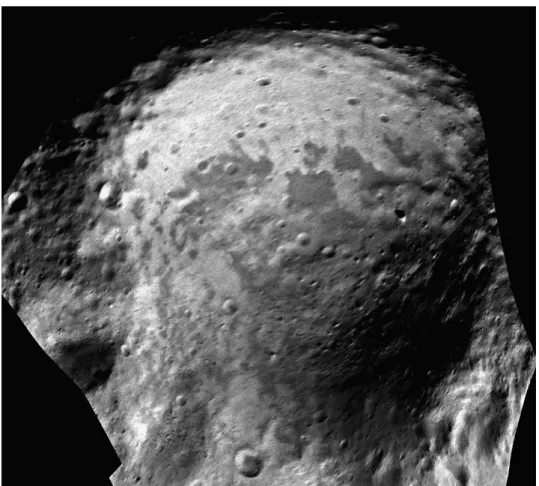
A surprise of the mission was the discovery of a family of smooth deposits that appear to fill the depressions (Figure 10) (Veverka et al.
Mineralogy
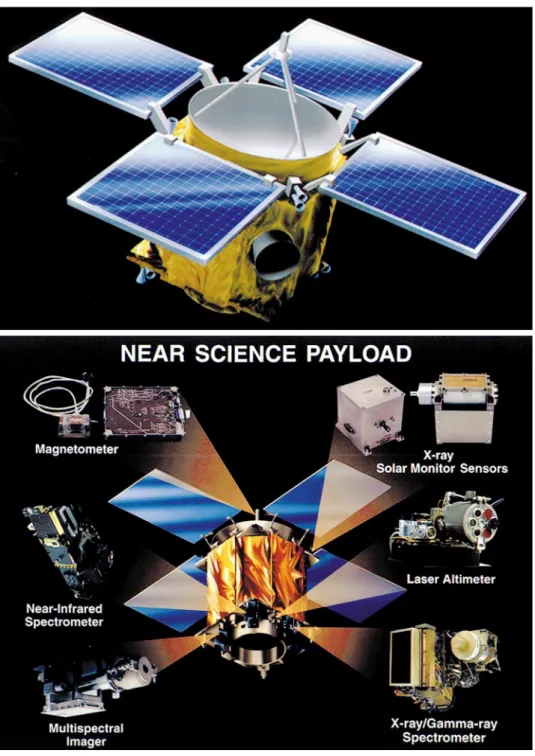
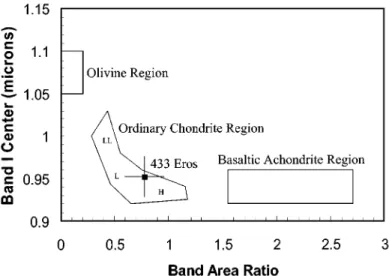
The end result of these multiple absorption features and their dependence on mineral composition is that the band area ratio (Band II/Band I; 2 micron/1 micron) is a function of the olivine:orthopyroxene ratio while the band central positions reflect the composition of olivine and pyroxene (Cloutis et al. 1986). Understanding the mineralogical composition of Eros in the context of meteorites has been a major goal of the multi-spectral imager/near-infrared spectrometer science team for NEAR (McFadden et al.'s mean reflectance spectrum of Eros has absorption features centered at 0.95 and 2.0 μm ( Fig. 13 ) ( McFadden et al. 2001 ), indicating the existence of olivine and pyroxene.
The line is the spectrum of an H5 common chondrite and the dashed line is the spectrum of the primitive achondrite Acapulco. The smaller ellipse represents the 2×standard error of the mean and represents the uncertainty in our knowledge of the average composition. The average Mg/Si and Al/Si abundances correspond to a wide range of chondrites (e.g. H, L, LL, CO, R) and primitive achondrites (e.g. acapulcoites, winonaites, brachinites), but distinguish from meteorites. formed by extensive melting and differentiation (e.g. eucrites, lodranites), providing strong evidence against global melting and differentiation of 433 Eros. 2001) X-ray fluorescence measurements of the surface elemental composition of asteroid 433 Eros.
Simultaneous resolution of the relationships between band II position and Ca and Fe concentration yields a single pyroxene of composition Fs62Wo15-18 (McFadden et al. 2001). Although the position of band II cannot uniquely determine either the orthopyroxene:augite ratio or orthopyroxene composition, the best match among common chondrites is the LL chondrite ( McFadden et al. 2001 ). This type of reddening is believed to be due to the alteration of the asteroid's surface layer in response to exposure to the space environment (eg, micrometeor impacts, solar wind splash), and these processes are collectively called space erosion (e.g. e.g., Pieters et al.
Magnetism
In contrast, the band II position (2.0 µm) for Eros can be used to constrain the pyroxene composition. The band II position appears to be best fit by the presence of two pyroxenes (a low-calcium orthopyroxene and a high-calcium augite) (McFadden et al. 2001), similar to those found in common chondrites. A remarkable feature of Eros is that it is extremely uniform in its inferred mineralogy (Bell et al. 2002) and, like most asteroids, its spectrum is significantly redder (steeper) than spectra of analogous meteorites measured in the laboratory.
Notably, there are significant albedo differences across the entire surface and high-albedo units are associated with specific steeply sloping (slopes above 25º) features (Murchie et al. 2002). Compared to other S asteroids (Ida and Gaspra) observed by spacecraft, the range of reflectance variation on Eros is a factor of 2 larger, but the range of color variation is two to four times smaller. 2002) found that as the slope of the surface increases, the surface becomes increasingly dominated by materials with higher reflectance and lower color ratios of 0.950 µm/0.760 µm. This appears to indicate the downward movement of the "relatively dark" component of the regolith, leaving behind "fresher", "less altered" material.
Using NIS data for the crater Psyche, Clark et al. 2001) also found that material on the steep slopes is brighter than the background material in and around the crater. The NEAR magnetometer obtained extensive magnetic field observations at distances ranging from more than 100,000 km from Eros to those performed on the surface after landing (Acuña et al. 2002). Certainly the almost complete absence of a global magnetic field indicates a primitive, chondritic body that has not experienced significant heating or melting.
Chemical composition
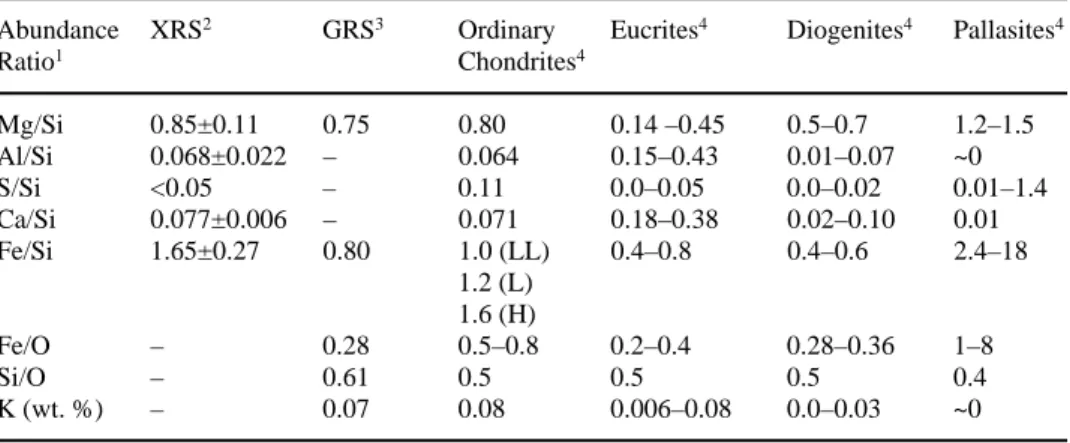
The potassium abundance and Mg/Si, Fe/Si, Si/O and Fe/O ratios derived from GRS data taken on the surface of Eros have been reported by Evans et al. Perhaps the most surprising result from the NEAR XRS experiment is the discovery that the surface of Eros is highly depleted of sulfur (Fig. 17) (Trombka et al. 2000; because the average value for five measurements is within one sigma of zero , Nittler et al. 2001 ) reported a two-sigma upper limit for the S/Si ratio of 0.05, a factor of two lower than the average value measured in common chondrites.
Also, as argued by McCoy et al. 2000), partially differentiated asteroids can be expected to show large spatial heterogeneity in their mineralogy and chemical composition. No such heterogeneity has been observed on Eros, but mixing in the asteroid's regolith could in principle homogenize the surface. 2001) favored an explanation of the low observed S/Si ratio by space weathering. In fact, the low Fe/Si and Fe/O ratios measured by GRS are consistent with a chondritic composition that has had its metallic component removed (Evans et al. 2001).
Regolith processes may well separate materials as a function of depth due to size-sorting effects such as the "Brazil emergency", where large grains rise to the surface of a shaken mixture of spheres of different sizes (Rosato et al. 1987). The low Fe/Si and Fe/O ratios in the gamma-ray derived composition are consistent with removal of Fe-rich (but Si- and O-free) metal and sulfide from a silicate matrix with minor Fe and significant Si and O. Rendered from Evans et al. 2001). As discussed by Nittler et al. 2001), without a detailed understanding of these processes, it is probably not possible to determine whether the surface iron abundance determined by remote sensing is representative of the bulk asteroid.
Mineralogical-chemical synthesis
Conclusions and epilogue
From a scientific point of view, NEAR has fully achieved the stated scientific objectives (Cheng et al. 1997): to characterize the physical and geological properties of Eros and to deduce its elemental and mineralogical composition, to clarify the relationship between asteroids, comets and meteorites, and advancing our knowledge. understanding processes and conditions during the formation and early evolution of the planets. Some results from the NEAR mission may have been predictable, such as evidence that asteroids are more geologically complex than previously thought. Others were unexpected, such as providing both spectral and chemical evidence pointing to complex processes taking place in the regolith of asteroids, or providing our first centimeter-scale images of an asteroid that proved that an asteroid's surface can offer regions of a benign landing. sights for future exploration.
While returning samples may ultimately be necessary to answer many of the questions we have about asteroids, we are just beginning to explore the diverse group of small bodies that make up the asteroid belt. There are more than a dozen different types of asteroids, and basic questions about the diversity within each type, the full range of geologic processes that operated during their formation, and the extent of heterogeneity within an individual asteroid remain unanswered. These questions will not be best answered by a single sample return mission, but by a fleet of missions that will explore a range of asteroid types.
Finally, NEAR points to the geological diversity that can occur on a single asteroid and the need to use global geological, mineralogical and chemical studies as part of any sample return mission to ensure we sample the full range of diversity on any asteroid . . The meteorites enclosed in the box but outside the circles are barred by both datasets. The most likely meteoritic analogues of 433 Eros appear to be H, L, LL or CO chondrites altered on the surface of the asteroid or a type of primitive achondrite derived from a progenitor with a mineralogy similar to these chondrites.

Acknowledgements
McCoy T. J., Burbine T. H., McFadden L. A., Starr R. D., Gaffey M. J., Nittler L. R., Evans L. G., Izenberg N., Lucey P., Trombka J. I., Bell J. F. III., Clark B. E., Clark P. E., Squyres S. W., Chapman C. R., Boynton W. V., Veverka J (2001) Ti komposision ti 433 Eros: Ti mineralogiko-kemikal a sintesis. McFadden LA, Wellnitz DD, Schnaubelt MW, Gaffey MJ, Bell JF III, Izenberg N, Chapman CR (2001) Mineralohiko a panangipalawag kadagiti espektro ti panaganinaag ti Eros manipud kadagiti NEAR NIS a nababa a paset a panagtayab. Murchie S, Robinson MS, Hawkins SE III, Harch A, Helfenstein P, Thomas P, Pabo K, Darlington EH, Balitok R, Clark B, Bell JF III, Merline W, Izenberg N, Veverka J (1999) Kalibrasion ti panagtayab ti Asideg Multi-espektral nga imahe.
Murchie S, Robinson M, Clark B, Li H, Thomas P, Joseph J, Bussey B, Domingue D, Veverka J, Izenberg N, Chapman C (2002) Color variations on Eros from NEAR multispectral imaging. Nittler LR, Starr RD, Lim L, McCoy TJ, Burbine TH, Reedy RC, Trombka JI, Gorenstein P, Squyres SW, Boynton WV, McClanahan TP, Bhangoo JS, Clark PE, Murphy ME, Killen R (2001) X-ray fluorescence measurements of the composition of the surface elements of asteroid 433 Eros. Thomas PC, Joseph J, Carcich B, Veverka J, Clark BE, Bell JF III, Byrd AW, Chromko R, Robinson M, Murchie S, Procter L, Cheng A, Izenberg N, Malin M, Chapman C, McFadden LA, Kirk R, Gaffey M, Lucey PG (2002) Eros: Shape, topography and tilting processes.
Veverka J, Thomas P, Harch A, Clark B, Bell JF III, Carcich B, Joseph J, Chapman C, Merline W, Robinson M, Malin M, McFadden LA, Murchie S, Hawkins SE III, Farquhar R, Izenberg N, Cheng A (1997) NEAR'S FLYBY OF 253 Mathilde: Slike asteroida C. [PubMed] Veverka J, Robinson MS, Thomas P, Murchie S, Bell JF III, Izenberg N, Chapman C, Harch A, Bell M, Carcich B, Cheng A, Clark B, Domingue D, Dunham D, Farquhar R, Gaffey MJ, Hawkins E, Joseph J, Kirk R, Li H, Lucey P, Malin P, Martin M, McFadden L, Merline WJ, Miller JK, Owen WM ml., Peterson C, Prockter L, Warren J, Wellnitz D, Williams BG , Yeomans DK (2000) NEAR at Eros: Rezultati slikanja in spektra. Veverka J, Thomas PC, Robinson M, Murchie S, Chapman C, Bell M, Harch A, Merline WJ, Bell JF III, Bussey B, Carcich B, Cheng A, Clark B, Domingue D, Dunham D, Farquhar R, Gaffey MJ, Hawkins E, Izenberg N, Joseph J, Kirk R, Li H, Lucey P, Malin M, McFadden L, Miller JK, Owen WM Jr, Peterson C, Prockter L, Warren J, Wellnitz D, Williams BG, Yeomans DK (2001a) Slikanje majhnih značilnosti na 433 Eros From NEAR: Dokazi za kompleksen regolit, Znanost.