on Electroweak Parameters
Thesis by Rebecca Joan Erwin
In Partial Fulfillment of the Requirements for the Degree of
Doctor of Philosophy
California Institute of Technology Pasadena, California
2007
(Defended May 24, 2007)
c 2007 Rebecca Joan Erwin
All Rights Reserved
Acknowledgments
I would like to thank my advisor, Michael Ramsey-Musolf, for giving me an interesting thesis project, and for letting me switch to electroweak physics halfway through my graduate career. I would also like to thank my collaborators and fellow graduate students, Peng Wang and Jennifer Kile, for their insights into countless physics issues. I have had many helpful discussions with Brad Filippone, Mark Wise, and Petr Vogel. I also acknowledge the support of a Forris Jewett Moore Fellowship from Amherst College.
Few people have influenced me as much as my undergraduate advisor, Professor Robert Hilborn, whose example as a researcher and as a person I do my best to follow every day.
Most of all I must thank Matt, whose support and patience were constant and boundless.
Abstract
We use the scale of neutrino mass and naturalness considerations to obtain model-independent expectations for the magnitude of possible contributions to muon decay Michel parameters from new physics above the electroweak symmetry-breaking scale. Focusing on Dirac neu- trinos, we obtain a complete basis of effective dimension four and dimension six operators that are invariant under the gauge symmetry of the Standard Model and that contribute to both muon decay and neutrino mass. We show that—in the absence of fine tuning—the most stringent neutrino mass naturalness bounds on chirality-changing vector operators rel- evant to muon decay arise from one-loop operator mixing. The bounds we obtain on their contributions to the Michel parameters are two orders of magnitude stronger than bounds previously obtained in the literature. In addition, we analyze the implications of one-loop matching considerations and find that the expectations for the size of various scalar and tensor contributions to the Michel parameters are considerably smaller than those derived from previous estimates of two-loop operator mixing. We also show, however, that there exist gauge-invariant operators that generate scalar and tensor contributions to muon de- cay but whose flavor structure allows them to evade neutrino mass naturalness bounds. We discuss the implications of our analysis for the interpretation of muon decay experiments.
We then repeat the analysis with Majorana neutrinos. Since the lowest dimension mass operator in this case is a five-dimensional operator, we start with a new basis of effective dimension five and dimension seven operators that contribute to muon decay and neutrino mass through radiative corrections. In contrast to similar studies of magnetic moments and masses using Dirac and Majorana neutrinos, which found substantially weaker bounds for Majorana magnetic moments, we find that the limits on muon decay Michel parameters from Majorana neutrinos are similar in magnitude to the limits from Dirac neutrinos. We also find, similar to the Dirac case, that there are operators in our basis whose coefficients are not bound by neutrino mass.
Finally, we calculate one-loop renormalization factors of twist-two operators in massless QCD with domain-wall fermions. The Shamir type domain-wall fermion, with an infinitely large extra dimension to describe the massless fermion, is used.
Contents
Acknowledgments iii
Abstract iv
1 Introduction 1
1.1 Notation and Conventions . . . 3
2 Muon Decay 4 2.1 Purpose . . . 4
2.2 Muon Decay and the Michel Parameters . . . 4
2.3 Experimental Details and Results . . . 6
3 Dirac Neutrinos and µ-decay 10 3.1 Introduction . . . 10
3.2 Operator Basis . . . 15
3.3 Operator Renormalization: Mixing and Matching Considerations . . . 19
3.3.1 Matching with OM, AD(4) . . . 19
3.3.2 Mixing among n= 6 operators . . . 23
3.4 Neutrino Mass Constraints . . . 29
3.5 Conclusions . . . 33
4 Majorana Neutrinos and µ-decay 35 4.1 Introduction . . . 35
4.1.1 Majorana neutrinos . . . 36
4.2 Operator Basis . . . 38
4.2.1 n= 7 operators contributing to neutrino mass . . . 38
4.2.2 Flavor structure . . . 40
4.3 Operator Renormalization: Matching and Mixing . . . 43
4.3.1 7D →5D matching . . . 43
4.3.2 Mixing among the 7D operators . . . 46
4.4 Neutrino Mass Constraints . . . 48
4.5 Conclusions . . . 51
A Perturbative Renormalization for Domain-Wall Fermions 52 A.1 Introduction . . . 52
A.2 Domain-Wall Action and Propagators . . . 57
A.2.1 Physical quarks . . . 60
A.3 Renormalization . . . 61
A.3.1 Wavefunction renormalization . . . 66
A.3.1.1 Sunset diagram . . . 67
A.3.1.2 Numerical evaluation of the sunset diagram . . . 70
A.3.1.3 IR singularities . . . 72
A.3.1.4 Tadpole diagram . . . 74
A.3.1.5 Renormalization constants: Z2, Zw, and Zm . . . 76
A.3.2 Vertex renormalization . . . 80
A.3.2.1 Scalar and pseudoscalar currents . . . 82
A.3.2.2 Vector and axial vector currents . . . 85
A.3.2.3 Tensor current . . . 87
A.4 Twist-Two Operators . . . 89
A.4.1 Vertex diagram . . . 92
A.4.2 Sails diagrams . . . 93
A.4.3 Tadpole diagram . . . 96
A.5 Conclusions . . . 97
B Domain-Wall Propagators 99
Bibliography 104
List of Figures
2.1 A conceptual drawing of the TWIST spectrometer. The superconducting solenoid is inside the steel yoke (the yoke itself is required to produce the highly uni- form 2 Tesla field for the drift chamber). The drift chambers and proportional chambers (measuring the energies of the particles) are symmetrically placed from the central target. Picture taken from [6]. . . 8 3.1 Contributions from the operators (a) O(6)V , AD˜ and (b) OW, AD(6) (denoted by the
shaded box) to the amplitude for µ-decay. Solid, dashed, and wavy lines denote fermions, Higgs scalars, and gauge bosons, respectively. After SSB, the neutral Higgs field is replaced by its vev, yielding a four-fermion µ-decay amplitude. . 19 3.2 One-loop graphs for the matching contributions of then= 6operators (denoted
by the shaded box) to then= 4mass operatorOM, AD(4) . Solid, dashed, and wavy lines denote fermions, Higgs scalars, and gauge bosons, respectively. Panels (a, b, c) illustrate contributions from OB,W(6) , OV(6)˜ , and O(6)F , respectively, to OM, AD(4) .. . . 20 3.3 One-loop graphs for the mixing among n = 6 operators. Notation is as in
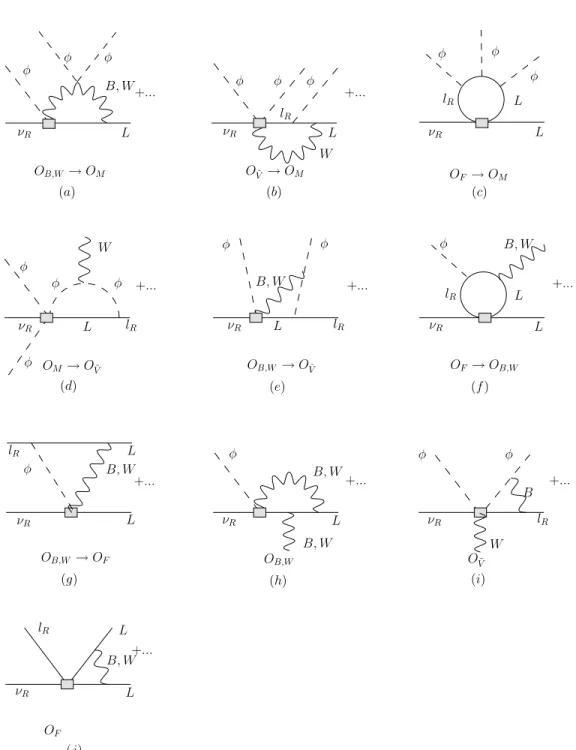
previous figures. Various types of mixing (a–g) and self-renormalization (h–j) are as discussed in the text. . . 26 3.4 Two-loop graphs for the mixing of the n = 6 operators. Only representive
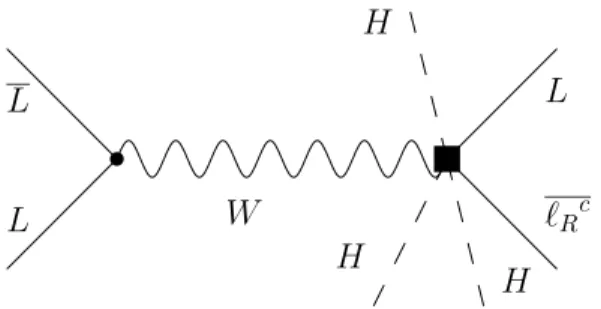
graphs for the mixing of the four-fermion operators O(6)F, ABCD intoOM, AD(6) are shown. . . 27 4.1 Contributions of the operators OV , AE(7)˜ and O(7)V , EA˜ (denoted by the solid box)
to muon decay. Solid, dashed, and wavy lines denote fermions, Higgs scalars, and gauge bosons, respectively. After SSB, the neutral Higgs field is replaced by its vev, yielding a four-fermion µ-decay amplitude. . . 43
4.2 One-loop graphs for the matching of the n= 7 operators (denoted by the box) into the n = 5 mass operator O(5)M, AE. Solid, dashed, and wavy lines denote fermions, Higgs scalars, and gauge bosons, respectively. Panels (a, b) illustrate mixing of OF(7) and O4(7), respectively, into OM, AE(5) . . . 45 4.3 One-loop graphs for the mixing of the n= 7 operatorO(7)V˜ (denoted by the box)
into the n = 7 mass operator O(7)M, AE. Solid, dashed, and wavy lines denote fermions, Higgs scalars, and gauge bosons, respectively. . . 46 A.1 Sunset diagram for physical quarks. Solid and curly lines represent fermions
and gluons, respectively. . . 69 A.2 Tadpole diagram for physical quarks. Solid and curly lines represent fermions
and gluons, respectively. . . 74 A.3 Vertex diagram for quark bilinear operators (denoted by the box). Solid and
curly lines represent fermions and gluons, respectively. . . 81 A.4 Momentum conventions for the twist-two operator q(x)ΓD¯ νq¯(denoted by the
box). Solid and curly lines represent fermions and gluons, respectively. . . 90 A.5 Vertex diagram for twist-two operators (denoted by the box). Solid and curly
lines represent fermions and gluons, respectively. . . 92 A.6 Sails diagram for twist-two operators (denoted by the box). Solid and curly
lines represent fermions and gluons, respectively. . . 93 A.7 Tadpole diagram for twist-two operators (denoted by the box). Solid and curly
lines represent fermions and gluons, respectively. . . 97
Chapter 1
Introduction
This thesis is a collection of three phenomenological projects I have worked on as a grad- uate student. Two of the three fall under the somewhat small but interesting umbrella of
“neutrino-matter interactions”; these two projects are the focus of this dissertation and I have attempted to reflect this focus with the title. The third project is in a very different area — namely, the lattice — and is an excerpt from a longer paper I worked on before moving to electroweak physics.
Since it would be neither interesting nor insightful to construct this thesis as simply a collection of papers, I have endeavored to make it more than the sum of its parts by adding material to provide background and context. The brief review of muon decay theory and experiment in the next chapter is an example. Muon decay, a purely leptonic process, is important because it provides a direct test of the spin structure of the charged weak current and as a result is one of the best methods available to test the structure of physics beyond the Standard Model (SM). With this in mind, the chapter is intended to make the results of the two subsequent chapters, on the theoretical connection between Dirac and Majorana neutrinos and muon decay, more illuminating by contrasting them with experimental findings and describing how these findings are obtained.
With the discovery of neutrino oscillations, neutrino mass has become the focus of much theoretical and experimental work since it provides a unique window onto beyond the SM physics. Much of this work has focused on crucial areas such as finding the number of neutrino species, the values of the mass eigenstates and mixing angles, whether or not neutrinos violate charge and parity (CP), are neutrinos “Dirac” or “Majorana” particles, and if neutrinos have (measurable) effects on other particle physics processes. It is the last question that this thesis explores. As I will show, neutrino mass can be related to
muon decay in amodel-independent way: our phenomenological analysis will not make any assumptions about the dynamical origin of neutrino mass. At the same time, I will assume a very generous limit for the neutrino mass — based on experimental and cosmological data
— that still gives interesting results. Since the number of candidates for physics beyond the SM is large, model-independent studies of neutrino-matter interactions and neutrino mass are a valuable tool in the search for new physics.
Chapter 3 discusses how Dirac neutrino mass limits can be used to put interesting constraints on muon decay parameters. The first step is constructing the operator basis, which means looking for chirality-changing operators that contribute to both processes.
This is, in fact, a specific example of a general connection between neutrino mass and certain neutrino-matter interactions: under minimal assumptions, we will see that these chirality-changing interactions generate contributions to neutrino mass through loop effects.
After constructing the basis we will proceed with the operator analysis, calculating matching contributions from higher-dimensional operators to lower-dimensional operators, and mixing between operators. In the end, we will see that neutrino mass does put strong constraints on some contributions to muon decay parameters.
The work described in Chapter 4 is similar in outline and scope and is intended to complement the material in Chapter 3. I will first discuss the reasons why a separate analysis for Majorana neutrinos is necessary. The rest of the chapter will then closely follow the previous chapter: we will construct the operator basis using five-dimensional and seven-dimensional operators and perform the operator analysis with matching and mixing calculations. As it turns out, the limits on muon decay parameters from Majorana neutrinos will not be much different than those obtained from Dirac neutrinos, and we will explore some of the implications of this result.
The two appendices address the very different area of the lattice, which is the only way at present to study quantum chromodynamics (QCD) in a non-perturbative way. I will be looking at a specific type of fermion implemented on the lattice, called the “domain-wall fermion,” giving a pedagogical introduction to how it is constructed and using it to calculate the matching coefficients for various twist-two operators. I first introduce the domain-wall action and then move into a review of lattice perturbation theory, with a few illustrative examples. The remainder is devoted to presenting results for specific operators, including quark self-energies and bilinears and twist-two operators. The last results, on twist-two
operators, are new and have not appeared in the literature.
1.1 Notation and Conventions
We work throughout in units in which ¯h=c= 1.
We use the Weyl or chiral basis for the Dirac matrices
γµ=
0 σµ
¯ σµ 0
, γ5=
−1 0 0 1
,
whereσµ= (1, ~σ), ¯σµ= (1,−~σ), and theσis are the Pauli matrices
σ1 =
0 1 1 0
, σ2 =
0 −i i 0
, σ3=
1 0 0 −1
.
In Chapter 4 we will need a new way of writing fermion mass terms using the charge- conjugation matrix C. In the chiral representation of the Dirac matrices,
C =
− 0
0
,
whereis the antisymmetric matrix. So for a Dirac spinorψ, the conjugate spinor is [1]
ψc≡Cγ0ψ∗
and
ψc=ψTC . The Majorana mass is then written
L=−1
2m ψTLCψL+ h.c.
. (1.1)
All other conventions are the standard ones in the literature.
Chapter 2
Muon Decay
2.1 Purpose
The study of neutrino-matter interactions has the potential to set bounds on beyond-the- Standard Model parameters that may soon be accessible by experiment. For muon decay, these bounds are on some of the so-calledMichel parametersthat contain information about contributions to muon decay from unknown physics. In the Standard Model, there are well- known predictions for what these parameters should be. In order to analyze the effect of neutrino masses on the Michel parameters (MPs), we will need to cover some background material.
I will first review what should be the familiar process of muon decay by looking at the muon decay spectrum and its use. I will then examine the Michel parameters — essentially a way of parameterizing contributions to muon decay from beyond the Standard Model
— by explaining how they are constructed. Lastly, I will roughly sketch how muon decay experiments work and give some recent results for a particular experiment.
2.2 Muon Decay and the Michel Parameters
Muon decay (µ− → e−ν¯eνµ) is an ideal laboratory for testing electroweak interactions in the Standard Model because it provides a direct test of the spin structure of the charged weak current. Since this process only involves leptons, there is no need to consider more complicated and unknown strong interaction contributions. This means that we have a clean way to probe the electroweak V −A structure, and a careful analysis of the muon decay spectral shape parameters can illuminate potential physics beyond the Standard Model.
Muon decay is typically described with the following effective interaction:
Lµ−decay =−4Gµ
√2 X
γ, α, β
gαβγ e¯αΓγνeν¯µΓγµβ, (2.1)
where γ = S, V, T indicate scalar, vector, and tensor interactions, and α, β = R, L indi- cate the chiralities of the charged leptons. The chiralities of the neutrinos are determined by the values of γ, α, and β. The coupling constants g parameterize the strength of the corresponding phenomenological interactions. In the SM, we can easily see that gVLL = 1, while all othergs are expected to be zero. In many extensions of the SM, however, some of the other coupling constants besides gVLL = 1 can be nonzero. In the left-right symmetric model, for instance, gVRR, gLRV , and gVRL are no longer zero, although the details of that will not be discussed here.
The Michel parameters, of which there are many, describe the energy of the decay electron or positron, its angular distribution of the electrons if the muons are polarized, and its spin polarization. In extensions of the SM, any new interactions of the muon would affect these observables, so they are highly sensitive to deviations caused by physics beyond the SM. The Michel parameters themselves are bilinear combinations of the coupling constants g. For example, one of the parameters, called ρ, can be written as [2]
ρ= 3 4− 3
4[|gLRV |2+|gRLV |2+ 2|gTLR|2+ 2|gTRL|2+Re(gSRLgTRL∗ +gSLRgLRT∗)]. (2.2) The four most commonly used parameters, ρ, η, ξ, and δ, describe the momentum depen- dence of the isotropic part (ρ) of the electron energy spectrum plus an additional small term proportional to another parameter (η), while the asymmetry is proportional to a third parameter (ξ) multiplied by the muon polarizationPµ, and a fourth parameter (δ) describes the momentum dependence. In the Standard Model, these parameters are expected to be ρ= 3/4, η= 0,ξ = 1, andδ= 3/4.
We will now examine the muon decay spectrum in some detail to see where the Michel parameters fit in. For the four-fermion interaction, the differential decay rate at tree-level for a polarized muon, after doing the neutrino phase space integrals and before integrating
over the electron phase space (and where the final state spin is not detected), is [3]
d2Γµ→eνµν¯e
dxdcosθ = G2Fm5µ 192π3 x2
FIS(x)
z }| { 6(1−x) + 4ρ
4x 3 −1
± Pµcosθ
FAS(x)
z }| { 2ξ
1−x+ 2δ 4x
3 −1 .
(2.3) Here we have assumed that thee±and neutrino masses are zero, θis the angle between the longitudinal muon polarizationPµand thee±momentum, the plus/minus sign corresponds toµ± decay, andxis a reduced electron energy (notice thatµ/2 is the maximume±energy in theme →0 limit. The isotropic (FIS(x)) and anisotropic (FAS(x)) parts of thee±energy spectrum are labeled.
All of the previously mentioned Michel parameters, aside fromη, are visible in Eq. (2.3).
The parameterηoccurs when thee±mass in the rate formula is not neglected, and so does not enter into this simplified formula. There are also less-commonly used MPs that arise from takinge± polarization into account, such asξ0, ξ00, η00, α, andβ, but they do not enter into this analysis. In the SM with massless neutrinos, the muon polarization magnitude Pµ is one; in actual experiments, only the product Pµξ is measured. When comparing experimental values for the Michel parameters with the rate formula, corrections due to radiative effects should first be subtracted from the data.
2.3 Experimental Details and Results
In order to elucidate the practical considerations behind measuring muon decay parameters, we will briefly look at the experiment at TRIUMF responsible for some of the most recent spectral shape parameter measurements, TWIST (TRIUMF Weak Interaction Symmetry Test). The goal of TWIST is to measure the entire differential spectrum of positrons from the decay of polarized muons. It recently improved on the accepted Particle Data Group values of two Michel parameters by factors of 2.5 (for ρ[7]) and 2.9 (for δ [8]). In the past, each of the Michel parameters was determined in dedicated experiments, so TWIST is the first muon decay experiment to measure more than one MP with the same apparatus [4].
The experiment requires an high-intensity beam of spin-polarized muons fromπ+decay.
The charged pions are produced by the collisions of energetic protons in a proton beam with the nuclei of a heavy metal target. Ideally, the pions, with mass mπ± = 139.5669 MeV, then simply decay at the surface of a production target to produce a muon and a muon
neutrino. Not suprisingly, however, these charged pions and muon decay products behave differently in the target depending on whether they are positively or negatively charged.
Negative pions that stop in the target behave like heavy e−, rapidly cascading down to tightly bound orbitals where they are almost always captured by the nucleus instead of decaying to negative muons. In contrast, the positive pions that come to rest in the target take up positions between atoms and are usually too far from any nuclei to be captured.
For these reasons, TWIST uses a polarizedµ+ beam.
Theµ+resulting fromπ+ decay are completely spin polarized and decay anisotropically via the weak interaction to a positron (and neutrinos) whose momentum is correlated with the muon angular momentum at the instant of decay. The pions that happen to come to rest just within the surface of the pion production target decay to low momentum (up to 29.6 MeV) “surface” muons that only need to travel a short distance out of the target and into the beamline vacuum. Unfortunately, the surface muon beam is not monoenergetic — the muons come from pions decaying at various depths in the pion production target, and those travelling from deeper in lose more of their energy — and the muon spectrum rises with momentum and drops sharply at the “surface muon edge.” It is desirable to use those muons with lower energy so that they can be stopped in the thinnest targets possible. As a result, the muon beam must be fine-tuned into a narrow momentum range, typically just below the surface muon edge, in order to obtain the greatest beam density.
After being tuned or “degraded,” the beam enters a 2 Tesla superconducting solenoid and is stopped in a thin target at the center of a symmetric array of 56 low-mass, high- precision planar drift chambers, which are used to track the paths and energies of the particles (see [5] for a more complete description of muon beamlines). The drift chambers were constructed to minimize the effects of multiple scattering and energy loss of both the incomingµ+ and the outgoinge+from the target. The final errors are primarily limited by systematic effects, since the statistical precision in this experiment is very high. See Fig. 2.3 for a schematic cutaway diagram of the TWIST spectrometer.
By accumulating 109 muon decays, TWIST’s goal is to achieve precisions that are 3−10
Figure 2.1: A conceptual drawing of the TWIST spectrometer. The superconducting solenoid is inside the steel yoke (the yoke itself is required to produce the highly uniform 2 Tesla field for the drift chamber). The drift chambers and proportional chambers (measuring the energies of the particles) are symmetrically placed from the central target. Picture taken from [6].
times better than previous experiments; this means
∆ρ < 1×10⁻⁴
∆δ < 3×10⁻⁴
∆(Pµξ) < 2×10⁻⁴.
The most recent results from TWIST are for the Michel parametersρ, δ, and Pµξ [7, 8, 9]:
ρ = 0.75080±0.00032(stat.)±0.000097(syst.)±0.00023 δ = 0.74964±0.00066(stat.)±0.00112(syst.)
Pµξ = 1.0003±0.0006(stat.)±0.0038(syst.).
Deviations from the SM value of ρ = 3/4 imply mixing of left- and right-handed muon and electron couplings so that the muon decay Lagrangian would include scalar, vector, or tensor couplings between left-handed muons and right-handed electrons, or vice versa. (Such deviations can occur, for example, in left-right symmetric models.) The last uncertainty in ρrepresents the dependence ofρon the MPη, and is the change inρwhenηchanges within its uncertainty. In the SM, δ is also 3/4; it is in the anisotropic part of the Michel decay spectrum and parameterizes the momentum dependence of the outgoing electron. Finally, Pµξ= 1 in the SM. The parameter ξ expresses the level of parity violation inµ-decay. All of these quantities agree with previous measurements and the SM values.
With the context for muon decay now set by this chapter, we may now examine the particular details of the connection between neutrino mass and muon decay.
Chapter 3
Dirac Neutrinos and µ-decay
3.1 Introduction
Precision studies of muon decay continue to play an important role in testing the Standard Model (SM) and searching for physics beyond it. In the gauge sector of the SM, the Fermi constantGµthat characterizes the strength of the low-energy, four-leptonµ-decay operator is determined from the µ lifetime and gives one of the three most precisely known inputs into the theory. Analyses of the spectral shape, angular distribution, and polarization of the decay electrons (or positrons) probe for contributions from operators that deviate from the (V −A)⊗(V −A) structure of the SM decay operator. In the absence of time- reversal (T) violating interactions, there exist seven independent parameters — the so-called Michel parameters [10, 11] — that characterize the final state charged leptons: two (ρ, η) that describe the spatially isotropic component of the lepton spectrum; two (ξ, δ) that characterize the spatially anisotropic distribution; and three additional quantities (ξ0, ξ00, η00) that are needed to describe the lepton’s transverse and longitudinal polarization1. Two additional parameters (α0/A,β0/A) characterize a T-odd correlation between the final state lepton spin and momenta with the muon polarization: ˆSe·ˆke×Sˆµ.
Recently, new experimental efforts have been devoted to more precise determinations of these parameters. The TWIST Collaboration has measuredρ and δ at TRIUMF [7, 8], improving the uncertainty over previously reported values by factors of ∼2.5 and ∼3, re- spectively. An experiment to measure the transverse positron polarization has been carried out at the Paul Scherrer Institute (PSI), leading to similar improvements in sensitivity over the results of earlier measurements [12]. A new determination of Pµξ with a similar de-
1The parametersηandη00are alternately written in terms of the independent parametersα/Aandβ/A.
gree of improved precision is expected from the TWIST Collaboration, and one anticipates additional reductions in the uncertainties inρ and δ [13].
At present, there exists no evidence for deviations from SM predictions for the Michel parameters (MPs). It is interesting, nevertheless, to ask what constraints these new mea- surements can provide on possible contributions from physics beyond the SM. It has been conventional to characterize these contributions in terms of a set of ten four-fermion oper- ators
Lµ−decay=−4Gµ
√2 X
γ, , µ
gγµ ¯eΓγννΓ¯ γµµ (3.1) where the sum runs over Dirac matrices Γγ = 1 (S),γα (V), andσαβ/√
2 (T), and the sub- scriptsµanddenote the chirality (R, L) of the muon and final state lepton, respectively2. In the SM, one has gVLL = 1 and all othergµγ = 0. A recent, global analysis by Gagliardi, Tribble, and Williams [15] give the present experimental bounds on thegγµthat include the impact of the latest TRIUMF and PSI measurements.
Theoretically, thegγµcan be generated in different scenarios for physics beyond the SM.
The most commonly cited illustration is the minimal left-right symmetric model that gives rise to non-zero gRRV , gVRL, and gVLR. From a model-independent standpoint, the authors of [16] recently observed that the operators in Eq. (3.1) having different chiralities for the muon and final state charged lepton will also contribute to the neutrino mass matrixmABν through radiative corrections. Consequently, one expects that the present upper bounds on mν should imply bounds on the magnitudes of thegµγ . The authors of [16] argued that the most stringent limits arise from two-loop contributions, because the one-loop contributions are suppressed by three powers of the tiny, charged lepton Yukawa couplings. The two-loop constraints are nonetheless stronger than the present bounds given in [15] and could become even more so with the advent of future terrestrial and cosmological probes of the neutrino mass scale.
In this chapter, we present the results of a follow-up analysis of mν constraints on the µ-decay parameters, motivated by the observations of [16] and the new experimental developments in the field. Our study follows the approach of [17, 18, 19], used recently in deriving model-independent naturalness bounds on neutrino magnetic moments implied by the scale of mν. We concentrate on the case of Dirac neutrinos, deferring a detailed
2The normalization of the tensor terms corresponds to the convention adopted in [14]. We do not specify the neutrino flavors in Eq. (3.1) since theµ-decay experiments do not observe the final state neutrinos.
consideration of Majorana neutrinos to the following chapter. Although there exists a long-standing theoretical prejudice favoring the see-saw mechanism with light Majorana neutrinos as an explanation of the small scale ofmν, we see several reasons for studying the Dirac and Majorana cases separately:
(i) From the standpoint of string phenomenology, obtaining models with neutrino self- couplings and a type I see-saw mechanism appears to be quite difficult. Recently, the authors of [20] performed a systematic study of 175 viable ways of embedding the Standard Model gauge group in the E8 ×E8 heterotic string with Z3 orbifold compactification and found that only two of the twenty classes of such inequivalent models admitted neutrino self-couplings. The natural scale ofmν in these two classes lies many orders of magnitude below the scale implied by neutrino oscillation data.
Interactions leading to Dirac masses occur more abundantly in such constructions. On the other hand, a subsequent study of a specific Z3×Z3 orbifold string construction [21] indicated the plausibility of obtaining a type II see-saw mechanism, wherein left- handed lepton-number-violating neutrino self-couplings arise from interactions with scalar SU(2)L triplet fields. Either way, however, the appearance of Majorana mass terms is not at all a generic feature of string constructions, leaving the Dirac case as a logical possibility.
(ii) Experimentally, there exists no conclusive evidence for or against the presence of light Majorana neutrinos. New searches for neutrinoless doubleβ-decay (0νββ) could pro- vide conclusive proof that the light neutrinos are Majorana, provided the neutrino mass spectrum has the “inverted” rather than “normal” hierarchy (for recent reviews, see, e.g., [22, 23]). If, on the other hand, future long-baseline oscillation experiments establish the existence of the inverted hierarchy and/or ordinary β-decay measure- ments indicate a mass consistent with the inverted hierarchy, a null result from the 0νββ searches would imply that neutrinos are Dirac particles3. Either way, the invest- ment of substantial experimental resources in these difficult measurements indicates that determining the charge conjugation properties of the neutrino is both a central question for neutrino physics as well as one that is not settled. Until it is, considering the implications of Dirac neutrinos remains a valid enterprise.
3We thank S. J. Freedman for useful discussions on this point.
(iii) The phenomenological analyses of Dirac and Majorana masses for other neutrino properties and interactions are quite distinct. As illustrated by the recent analyses of neutrino magnetic moments in [17, 18, 19], the characteristics of the operator basis and renormalization can be sufficiently different and complex for the two cases that separate studies of each are warranted. Moreover, the parameterization of theµ-decay Michel spectrum in the presence of Majorana neutrinos may require modification from the standard form, as indicated by the recent work of [24]. Rather than lose the reader in the details of differences in both the Michel parameterization and operator renormalization for Dirac and Majorana neutrinos, we prefer to concentrate on the Dirac case in the present study and consider the Majorana case in a separate chapter.
Having this focus in mind, we work with an effective theory that is valid below a scale Λ lying above the weak scale v ≈ 246 GeV and that contains SU(2)L×U(1)Y-invariant operators built from Standard Model fields plus right-handed (RH) Dirac neutrinos. We consider all relevant operators up to dimension n= 6 that could be generated by physics above the scale Λ. For simplicity, we restrict our attention to two generations of lepton doublets and RH neutrinos. Extending the analysis to include a third generation increases the number of relevant operators but does not change the substantive conclusions. While the spirit of our work is similar to that of [16], the specifics of our analysis and conclusions differ in several respects:
i) The effective theory that we adopt allows us to compute contributions to mν from scales lying between the weak scalev and the scale of new physics Λ. In contrast, the authors of [16] used a Fierz transformed version ofLµ−decay in Eq. (3.1), which is not invariant under the SM gauge group and, therefore, should be used to analyze only contributions below the weak scale.
ii) We show that for the two-flavor case the operators in Lµ−decay proportional to gLRS,T andgS,TRL arise from twelve independent dimensionn= 6 gauge-invariant four-fermion operators, while those containing gLRV and gRLV are generated by four independent n= 6 operators that contain two fermions and two Higgs scalars.
iii) While the operators that contribute to µ-decay have dimension n= 6 or higher, the lowest dimension neutrino mass operator occurs at n= 4. The authors of [16] used
dimensional regularization (DR) to estimate the mixing between the n = 6 µ-decay and neutrino mass operators4 but did not consider matching with then= 4 operator at the scale Λ that cannot be determined with DR. We derive order-of-magnitude expectations for the n = 6 operator coefficients implied by this matching, which depends only linearly on the lepton Yukawa couplings and which gives the dominant constraints for Λv.
iv) For Λ not too different from v, constraints associated with mixing among the n= 6 operators can, in principle, be comparable to expectations arising from contributions to the n = 4 mass operator. We carry out a complete, one-loop analysis of this mixing and show that only the neutrino magnetic moment and two-fermion/two- Higgs operators mix with the n = 6 neutrino mass operator to linear order in the lepton Yukawa couplings. We derive the resulting bounds on the gLR,RLV that follow from this mixing and find that they are comparable to expectations based on one-loop matching with then= 4 mass operator for Λ>∼v.
v) From the mixing with the n = 6 mass operator, we find that the bounds on the
|gLR,RLV |are two or more orders of magnitude stronger than those obtained in [16] and at least three orders of magnitude below the experimental limits given in [15].
vi) The neutrino mass implications for the couplingsgLR,RLS,T are more subtle. Of the twelve independent four-fermion operators that contribute to these couplings, only eight are directly constrained by the scale of neutrino mass and naturalness considerations.
Based on one-loop matching, we expect that their contributions to the gLR,RLS,T are generally∼104 times smaller than the present experimental bounds, and ∼103 times smaller than obtained in the analysis of [16]. We show, however, that the flavor structure of the remaining four operators allows them to evade constraints implied by either one-loop matching or two-loop mixing. While from a theoretical perspective one might not expect their contributions to be substantially larger than those from the constrained operators, experimental efforts to determine the gS,TLR,RL remain a worthwhile endeavor.
A summary of our results is given in Table 3.1. In the remainder of the chapter we give
4Since the computation of [16] did not employ gauge invariant operators, we consider the results to give at best reasonable estimates of constraints implied by two-loop mixing.
Table 3.1: Constraints on µ-decay couplings gµγ . The first eight rows give naturalness expectations in units of (v/Λ)2 ×(mν/1 eV) on contributions from n = 6 muon decay operators (defined in Section 3.2 below) based on one-loop matching with then= 4 neutrino mass operators. For Λ∼v, the bounds ongVLR,RLobtained from one-loop mixing are similar to those listed. The ninth row gives upper bounds derived from a recent global analysis of [15], while the last row gives estimated bounds from [16] derived from two-loop mixing of n = 6 muon decay and mass operators. A “-” indicates that the operator does not contribute to the given gµγ , while “None” indicates that the operator gives a contribution unconstrained by neutrino mass. The subscript D runs over the two generations of RH Dirac neutrinos.
Source |gSLR| |gLRT | |gSRL| |gRLT | |gVLR| |gVRL| OF,(6)122D 4×10⁻⁷ 2×10⁻⁷ - - - - O(6)F,212D 4×10⁻⁷ - - - - -
O(6)F,112D None None - - - -
O(6)F,211D - - 8×10⁻⁵ 4×10⁻⁵ - - O(6)F,121D - - 8×10⁻⁵ - - -
O(6)F,221D - - None None - -
O(6)V ,˜ 2D - - - - 8×10⁻⁷ - O(6)V ,˜ 1D - - - 2×10⁻⁴
Global [15] 0.088 0.025 0.417 0.104 0.036 0.104
Two-loop [16] 10−4 10−4 10−2 10−2 10−4 10−2
the details of our analysis. In Section 3.2, we write down the complete set of independent operators through n = 6 that contribute to mABν and/or µ-decay. Section 3.3 gives our analysis of operator mixing and matching considerations, while in Section 3.4 we discuss the resulting constraints on thegLR,RLγ that follow from this analysis and the present upper bounds on the neutrino mass scale. We summarize in Section 3.55.
The material presented in this chapter was published in [37].
3.2 Operator Basis
To set notation, we follow [17] and consider the effective Lagrangian Leff =X
n,j
Cjn(µ)
Λn−4 O(n)j (µ) + h.c. (3.2)
5This work was done in collaboration with Jennifer Kile, Michael Ramsey-Musolf, and Peng Wang.
where µ is the renormalization scale, n ≥ 4 is the operator dimension, and j is an index running over all independent operators of a given dimension. The lowest dimension neutrino mass operator is
O(4)M, AD = ¯LAφν˜ RD (3.3)
where LA is the left-handed (LH) lepton doublet for generation A, νRD is a RH neutrino for generation D, and ˜φ=iτ2φ∗ with φ being the Higgs doublet field. After spontaneous symmetry breaking, one has
φ→
0 v/√
2
(3.4)
so that
CM, AD4 OM, AD(4) → −mADν ν¯LAνRD mADν = −CM, AD4 v/√
2. (3.5)
The other n= 4 operators are those of the SM and we do not write them down explicitly here.
For the case of Dirac neutrinos that we consider here, there exist no gauge-invariant n = 5 operators. In considering those with dimension six, it is useful to group them according to the number of fermion, Higgs, and gauge boson fields that enter:
Four-fermion:
Lγ¯ µLLγ¯ µL
`¯Rγµ`R`¯Rγµ`R
`¯Rγµ`Rν¯RγµνR
¯
νRγµνRν¯RγµνR
L`¯ R`¯RL Lν¯ Rν¯RL ijL¯i`RL¯jνR
Here`R is the right-handed charged lepton field. Several of the operators appearing in this list can contribute to µ-decay, but only the last one can also contribute to mADν through
radiative corrections. Including flavor indices, we refer to this operator as
OF, ABCD(6) =ijL¯Ai `CRL¯Bj νRD (3.6) where the indices i, j refer to the weak isospin components of the LH doublet fields and 12=−21= 1.
Fermion-Higgs:
i( ¯LAγµLB)(φ+Dµφ) i( ¯LAγµτaLB)(φ+τaDµφ)
i(¯`ARγµ`BR)(φ+Dµφ) (3.7) i(¯νRAγµνRB)(φ+Dµφ)
i(¯`ARγµνRB)(φ+Dµφ)e
Neither of the first two operators in the list (3.7) can contribute significantly to mADν since they contain no RH neutrino fields. Any loop graph through which they radiatively induce mADν would have to contain operators that contain both LH and RH fields, such as OM, AB(4) or other n= 6 operators. In either case, the resulting constraints on the operator coeffi- cients will be weak. For similar reasons, the third and fourth operators cannot contribute substantially because they contain an even number of neutrino fields having the same chi- rality and since the neutrino mass operator contains one LH and one RH neutrino field.
Only the last operator
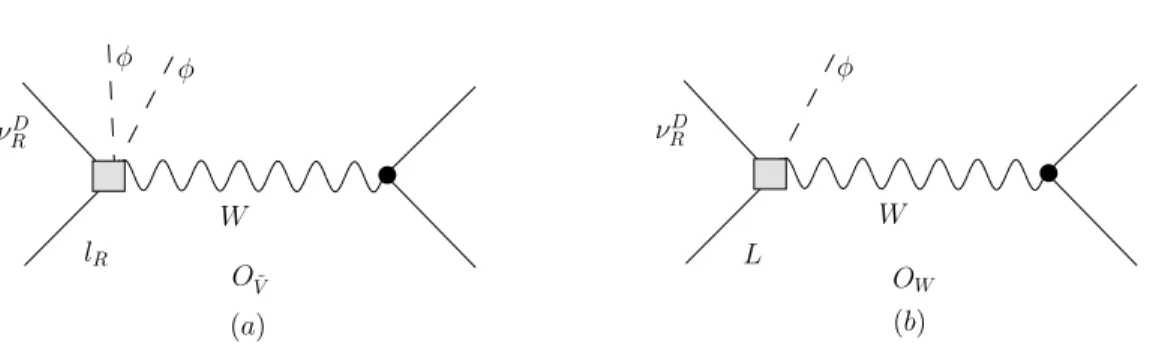
O(6)V , AD˜ ≡i(¯`ARγµνRD)(φ+Dµφ)e (3.8) can contribute signficantly tomν since it contains a single RH neutrino. It also contributes to theµ-decay amplitude after SSB via the graph of Fig. 3.1a since the covariant derivative Dµcontains chargedW-boson fields. We also write down then= 6 neutrino mass operators OM, AD(6) = ( ¯LAφνe RD)(φ+φ) (3.9) as well as the charged lepton mass operator ( ¯Lφ`R)(φ+φ) that we do not use in the present analysis.
Fermion-Higgs-Gauge:
Lτ¯ aγµDνLWµνa Lγ¯ µDνLBµν
`¯RγµDν`RBµν
¯
νRγµDννRBµν (3.10)
g2( ¯Lσµντaφ)`RWµνa g1( ¯Lσµνφ)`RBµν g2( ¯Lσµντaφ)νe RWµνa g1( ¯Lσµνφ)νe RBµν
As for the fermion-Higgs operators, the operators in (3.10) that contain an even number of νR fields will not contribute significantly to mABν , so only the last two in the list are relevant:
OB, AD(6) = g1( ¯LAσµνφ)νe RDBµν (3.11) O(6)W, AD = g2( ¯LAσµντaφ)νe RDWµνa (3.12)
In addition to these operators, there exist additional n= 6 operators that contain two derivatives. However, as discussed in [17], they can either be related toOB, AD(6) and O(6)W, AD
through the equations of motion or contain derivatives acting on the νRfields so that they do not contribute to the neutrino mass operator. Consequently, we need not consider them here. We also observe that the operatorOW, AD(6) will also contribute to theµ-decay amplitude via graphs as in Fig. 3.1b. We have computed its contributions to the Michel parameters and find that they are suppressed by ∼(mµ/Λ)2 ∼<1.7×10⁻⁷ relative to the effects of the othern= 6 operators. This suppression arises from the presence of the derivative acting on the gauge field and the absence of an interference between the corresponding amplitude and that of the SM. Finally, we note that the operators whose chiral structure suppresses their contributions to the neutrino mass operator (as discussed above) may, in general, contribute to muon decay via the terms in Eq. (3.1) having =µ. We do not consider these terms in this study.
W φ νRD
lR
φ
W φ νRD
L
(a) (b)
OV˜ OW
Figure 3.1: Contributions from the operators (a) OV , AD(6)˜ and (b) OW, AD(6) (denoted by the shaded box) to the amplitude for µ-decay. Solid, dashed, and wavy lines denote fermions, Higgs scalars, and gauge bosons, respectively. After SSB, the neutral Higgs field is replaced by its vev, yielding a four-fermion µ-decay amplitude.
3.3 Operator Renormalization: Mixing and Matching Con- siderations
In analyzing the renormalization of operators that contribute to bothµ-decay and mADν it is useful to consider separately two cases: (i) one-loop matching conditions at the scale Λ involving the n = 6 operators that enter µ-decay and the n = 4 mass operator, O(4)M, AD, and (ii) mixing among the relevant n = 6 operators. In general, contributions to mADν involving the second case will be smaller than those implied by matching with OM, AD(4) by
∼ (v/Λ)2, since OM, AD(6) contains an additional factor of (φ†φ)/Λ2. We first consider this case and employ dimensional analysis to derive neutrino mass naturalness expectations for the n = 6 operator coefficients. For v not too different from Λ, the impact of the n = 6 mixing can also be important, and in this case we can employ a full renormalization group (RG) analysis to derive robust naturalness bounds.
3.3.1 Matching with O(4)M, AD
The analysis of [16] employed dimensional regularization (DR) to regularize the one- and two-loop graphs through which four-fermion operators containing a singleνRfield contribute to the n= 6 mass operator. Mixing with lower-dimension operators does not arise in DR since the relevant graphs are quadratically divergent and must be proportional to the square of a mass scale. For µ > v, all fields are massless, andµitself appears only logarithmically.
Since the mass operator exists for zero external momentum, all quadratically-divergent
graphs vanish in this case.
Then= 4 mass operator will nevertheless receive contributions at the scale Λ associated with loop graphs containing then= 6 operators. Simple power counting shows that these contributions go as∼Λ2/(4π)2 times a product n= 6 operator coefficientC6/Λ2 and the gauge couplings ∼ g2 appearing in the loop. Thus, matching of the effective theory with the full theory (unspecified) at the scale Λ implies the presence of a contribution toCM4 of order ∼ αC6/4π. As emphasized in [25], the precise numerical coefficient that enters this matching contribution cannot be computed without knowing the theory above the scale Λ.
One may, however, estimate the size of these contributions either using a gauge-invariant regulator, such as the generalized Pauli-Villars regulator of [26], or using naive dimensional analysis. Since we are interested in order-of-magnitude expectations, use of the latter is sufficient. We emphasize that these expectations can only be relaxed in specific models that suppress the matching conditions.
νR L L
φ
OB,W (a)
L lR
νR
φ φ
OV˜ (b)
νR L
φ
lR L
OF (c)
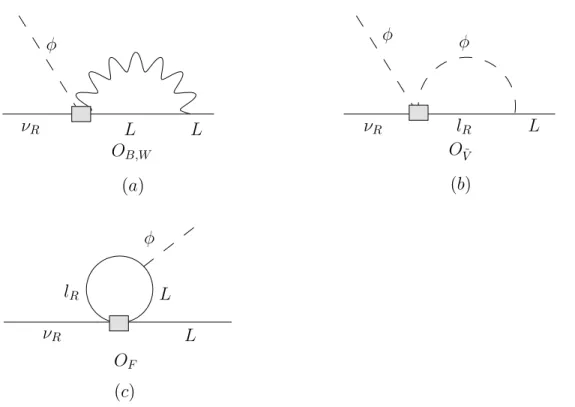
Figure 3.2: One-loop graphs for the matching contributions of then= 6 operators (denoted by the shaded box) to the n = 4 mass operator OM, AD(4) . Solid, dashed, and wavy lines denote fermions, Higgs scalars, and gauge bosons, respectively. Panels (a, b, c) illustrate contributions from OB,W(6) , OV(6)˜ , and OF(6), respectively, to O(4)M, AD.
The relevant one-loop graphs are shown in Fig. 3.2. For the matching of the four-fermion operators O(6)F, ABCD onto OM, AD(4) , two topologies are possible, associated with either the fields ( ¯LA, νRD) or ( ¯LB, νRD) living on the external lines. For the matching of OF, ABCD(6) as well as of O(6)V , AB˜ into O(4)M, AD, one insertion of the Yukawa interaction fAC∗ ¯lCRLAis needed to convert the internal, RH lepton into a LH one. In contrast, no Yukawa insertion is required for the matching ofOB, AD(6) andOW, AD(6) onto OM, AD(4) .
To simplify the analysis of matching involving the OF, ABCD(6) we note that one may always redefine the fields LA and `DR so that the charged lepton Yukawa matrix fAD is diagonal. Specifically, we take
LA → LA0 =SABLB (3.13)
`CR → `C0 =TCD`D
withSAB and TCD chosen so that
L¯f `˜ = ¯L0f˜diag`0 (3.14)
whereL,L0denote vectors in flavor space, ˜f denotes the Yukawa matrix in the original basis, and ˜fdiag = ˜S†f˜T˜. We note that the field redefinition (3.13) differs from the conventional flavor rotation used for quarks, since we have performed identical rotations on both isospin components of the left-handed doublet. Consequently, gauge interactions in the new basis entail no transitions between generations. We also note that Eq. (3.13) also implies a redefinition of the operator coefficients CM, AD4 , CF, ABCD6 , etc. For example, one has
CM, A4,6 0D = CM, AD4,6 SM, A0A (3.15) CF, A60 0B0C0D = CF, ABCD6 SA0ASB0BTC∗0C
where a sum over repeated indices is implied. Diagonalization of the neutrino mass matrix requires additional, independent rotations of the νL,RD fields after inclusion of radiative contributions to the coefficients CM, AD4,6 generated by physics above the weak scale. Since we are concerned only with contributions generated above the scale of SSB, we will not perform the latter diagonalization and carry out computations using the L0, `0R basis6.
6For notational simplicity, we henceforth omit the prime superscripts.
In this case, the only four fermion operatorsO(6)F, ABCD that can contribute substantially to mADν are those having either A=C orB =C. Thus, we obtain the following estimates of the contributions from then= 6 operators to the coefficient of then= 4 mass operator:
OB, AD(6) → CM, AD4 (Λ)∼ α
4πcos2θWCB, AD6 (Λ) O(6)W, AD → CM, AD4 (Λ)∼ 3α
4πsin2θW
CW, AD6 (Λ) OV , AD(6)˜ → CM, AD4 (Λ)∼ fAA
16π2CV , AD6˜ (Λ) (3.16) OF, ABAD(6) → CM, BD4 (Λ)∼ fAA
8π2CF, ABAD6 (Λ) O(6)F, ABBD → CM, AD4 (Λ)∼ fBB
16π2CF, ABBD6 (Λ)
whereθW is the weak mixing angle and where we have made the dependence on the matching scale Λ explicit7.
The relative factor of 3 cot2θW for the mixing of OW, AD(6) compared to the mixing of O(6)B, AD arises from the ratio of gauge couplings (g/g0)2 and the presence of a~τ·~τ appearing in Fig. 3.2a. The factor of two that enters the mixing of OF, ABAD(6) compared to that of O(6)F, ABBD arises from the trace associated with the closed chiral fermion loop that does not arise forOF, ABBD(6) .
We observe that there exist two four-fermion operators that contribute to µ-decay that do not contribute to CM, AD4 in the basis giving a diagonal fAB: O(6)F, AABD with either A= 1, B= 2 orA= 2, B= 1. It is similarly straightforward to see that these operators do not mix with CM, AD6 , since in the basis of charged lepton mass eigenstates, there exist no Yukawa interactions that couple lepton doublet and charged lepton singlet fields of different generations. As we discuss in Section 3.4, the operatorsO(6)F, AABDwith eitherA= 1, B= 2 orA= 2, B= 1 contribute togS,TLR andgS,TRL, respectively. Consequently, the magnitudes of these couplings are not directly bounded bymν and naturalness considerations, as indicated in Table 3.1.
These conclusions differ from those in [16], which did not take into account operators that contribute toµ-decay but do not mix with the neutrino mass operators. The corresponding bounds on gS,TLR and gRLS,T obtained in that work are, thus, not general and would apply
7In relating the coefficients C(Λ) to those at the weak scale as needed for the analysis of both µ-decay andmν, we will neglect corrections to the relations in Eq. (3.16) generated by running, as they are higher order in the gauge couplings and numerically insignificant for our purposes.