Diplomatic and
Mediated Arguments in the North Korean Crisis
Engaging the Hermit Kingdom Edited by
Thomas A. Hollihan
Diplomacy
Series Editors
Kathy Fitzpatrick, University of South Florida, Tampa, FL, USA
Philip Seib, University of Southern California,
Los Angeles, CA, USA
in world affairs and international relations. As a result, global interest in public diplomacy has escalated, creating a substantial academic and professional audience for new works in the field.
The Global Public Diplomacy Series examines theory and practice in public diplomacy from a global perspective, looking closely at public diplomacy concepts, policies, and practices in various regions of the world.
The purpose is to enhance understanding of the importance of public diplomacy, to advance public diplomacy thinking, and to contribute to improved public diplomacy practices.
More information about this series at http://www.palgrave.com/gp/series/14680
Editor
Diplomatic and Mediated
Arguments
in the North Korean Crisis
Engaging the Hermit Kingdom
Thomas A. Hollihan
Annenberg School for Communication and Journalism
University of Southern California Los Angeles, CA, USA
ISSN 2731-3883 ISSN 2731-3891 (electronic) Palgrave Macmillan Series in Global Public Diplomacy
ISBN 978-3-030-70166-6 ISBN 978-3-030-70167-3 (eBook) https://doi.org/10.1007/978-3-030-70167-3
© The Editor(s) (if applicable) and The Author(s), under exclusive license to Springer Nature Switzerland AG 2021
This work is subject to copyright. All rights are solely and exclusively licensed by the Publisher, whether the whole or part of the material is concerned, specifically the rights of translation, reprinting, reuse of illustrations, recitation, broadcasting, reproduction on microfilms or in any other physical way, and transmission or information storage and retrieval, electronic adaptation, computer software, or by similar or dissimilar methodology now known or hereafter developed.
The use of general descriptive names, registered names, trademarks, service marks, etc.
in this publication does not imply, even in the absence of a specific statement, that such names are exempt from the relevant protective laws and regulations and therefore free for general use.
The publisher, the authors and the editors are safe to assume that the advice and informa- tion in this book are believed to be true and accurate at the date of publication. Neither the publisher nor the authors or the editors give a warranty, expressed or implied, with respect to the material contained herein or for any errors or omissions that may have been made. The publisher remains neutral with regard to jurisdictional claims in published maps and institutional affiliations.
Cover illustration: © WENHAI TANG/Alamy Stock Photo
This Palgrave Macmillan imprint is published by the registered company Springer Nature Switzerland AG
The registered company address is: Gewerbestrasse 11, 6330 Cham, Switzerland
First, I want to thank the outstanding scholars who contributed chap- ters to this volume. It has been my pleasure to work with all of you.
Some I have known over many years including Takeshi Suzuki, Hiroko Okuda, Ye Lu, Gail Fann Thomas, and Jeff Kline. Others are my current or past graduate students at USC including: Jeeyun (Sophia) Baik, Hyun Tae (Calvin) Kim, and Nathaniel Ming Curran. Finally, the book includes authors whom I have only come to know through your writing: Shusuke Murai, Ruiming Zhou, and Jenna Gibson. Clearly, the project would not exist without your efforts.
Second, I want to acknowledge the ongoing insights that I have gained from my USC colleagues who share my interest in political communica- tion and in the role of media in the formation of foreign policy. I would especially acknowledge the value of my interactions with Phil Seib who is editing this series. I would also like to thank Tom Goodnight, Clay Dube, Randy Lake, Gordon Stables, Nicholas Cull, Rebecca Weintraub, and Jay Wang.
Third, I especially valued the insights that I gained into the Korean controversy from my friend Bohan Park, who serves as a diplomat in the Republic of Korea’s consular office in Los Angeles. Bohan helped me better understand both the history of the controversy and the evolving position of the South Korean government with regard to its relations with North Korea, China, Japan, and the United States.
v
Fourth, I want to thank my daughter Alexandra H. Crawford who once again served as my editorial assistant. She has a keen eye for detail and her assistance with preparing the manuscript was very helpful. Her discipline and dedication to whatever tasks she takes on are remarkable and she has always been a source of pride for me. I also want to thank my son Sean Hollihan for all of the assistance he provided me during the COVID-19 quarantine and for his warm and generous spirit.
Fifth, I want to thank my colleague, partner, spouse, and friend Patricia Riley. She contributed a chapter to the volume and served as a sounding board for discussions about this project and every other project that I undertake. I admire her intellect, her compassion, her gentle disposition, and of course her unmatched culinary talents!
Finally, I wish to dedicate this book to my late USC colleague and mentor Walter R. Fisher and to my late father-in-law Charles R. Riley.
Both were heroic veterans of the Korean War who regaled me with stories of their service.
Los Angeles, CA, USA June 2020
1 Introduction 1 Thomas A. Hollihan
2 Media Coverage of the North Korea Nuclear
Controversy in the United States 25
Thomas A. Hollihan
3 North Korean Media Diplomacy: From Rocket Man
to the Red Carpet 63
Patricia Riley, Jeeyun (Sophia) Baik,
Nathaniel Ming Curran, and Hyun Tae (Calvin) Kim 4 Frame-Changing in the South Korean Legacy Media
Coverage of the North Korean Nuclear Controversy 93 Jeeyun (Sophia) Baik and Thomas A. Hollihan
5 Legacy Media Coverage of North Korea’s Nuclear
Threats in Japan 125
Hiroko Okuda
6 Social Media Conversations About the North Korea
Crisis in Japan 185
Takeshi Suzuki and Shusuke Murai
vii
7 One North Korea, Many Voices: Liquid Journalistic
Practice in the Era of New Technology in China 215 Ye Lu and Ruiming Zhou
8 The Velvet Glove That Cloaks the Fist of Power: The Role of U.S. Military Communication in Addressing
the North Korea Threat 241
Gail Fann Thomas and Jeff Kline
9 Rocket Man and the Rocket Nation: Visual Portrayals
of North Korea 271
Jenna Gibson and Nathaniel Ming Curran
10 The Failed Negotiations: What We Learned 295 Thomas A. Hollihan
Jeeyun (Sophia) Baik is a Ph.D. candidate in the Annenberg School for Communication and Journalism at the University of Southern California.
Her research focuses on political communication, privacy, and surveil- lance. She has examined the politics of information collection and flow in various settings of the current networked media environment. Her research has been published in peer-reviewed journals such as Telematics and Informatics,Mass Communication and Society, and theInternational Journal of Communication. Prior to joining the doctoral program, she produced news at the Los Angeles Bureau of SBS (Seoul Broadcasting System), a major Korean broadcaster. She also worked in Public Relations at the Busan International Film Festival and undertook research for a KBS (Korean Broadcasting System) documentary project.
Nathaniel Ming Curran is an Assistant Professor in the Department of English at The Hong Kong Polytechnic University. He holds a Ph.D.
from the Annenberg School for Communication and Journalism at the University of Southern California and an M.A. in Asian Studies from the University of California, Berkeley, and he has conducted a wide variety of research on both North and South Korea. His current research examines globalization and cosmopolitanism through the lens of online language learning. His research has been published in numerous peer-review jour- nals, including,International Journal of Communication,Media, War &
Conflict, andMedia, Culture & Society.
ix
Jenna Gibson is a Ph.D. student in the Department of Political Science at the University of Chicago in the subfield of International Relations.
Her research interests include: foreign policy rhetoric, public and cultural diplomacy, and South Korean politics. She is a Korea columnist for The Diplomat and has also written for Foreign Policy and NPR. Before pursuing her doctorate, she was Director of Communications at the Korea Economic Institute of America (KEI) and lived for two years in South Korea as a Fulbright English Teaching Assistant. She earned an M.S.
in Foreign Service degree from Georgetown University in 2015, and a Bachelor of Journalism from the University of Nebraska-Lincoln in 2011.
Thomas A. Hollihan, Editor is Professor of communication in the Annenberg School for Communication and Journalism at the Univer- sity of Southern California. Hollihan chairs the executive committee of the USC U.S.-China Institute and is a faculty fellow of the USC Center for Public Diplomacy and the Center for Communication Leadership and Policy. He publishes in the areas of argumentation, media and politics, contemporary rhetorical criticism, and the impact of globalization on public deliberation. He is the author of several books and monographs including, The Dispute over the Diayou/Senkaku Islands: How Media Narratives Shape Public Opinions and Challenge the Global Order; Uncivil Wars: Political Campaigns in a Media Age; Media Diplomacy and U.S. - China Military-to Military Cooperation: Perspectives on Public Diplomacy;
Arguments and Arguing: The Products and Process of Human Decision Making; andArgument at Century’s End: Reflecting on the Past and Envi- sioning the Future.In addition, Hollihan has published more than 60 arti- cles and book chapters. He has long been interested in the arguments shaping American foreign policy. He has served as a visiting professor at Renmin University and the Communication University of China. He has taught Strategic Communication Workshops for the U.S. Navy, for the China Development Research Foundation, and in the World Bank Devel- opment Institute. Finally, he has consulted for the International Atomic Energy Agency of the United Nations.
Hyun Tae (Calvin) Kim received his Ph.D. from the Annenberg School for Communication and Journalism at the University of Southern Cali- fornia. His Ph.D. dissertation examined the concept of efficacy from both quantitative and qualitative perspectives, specifically concerning the strategic communication of social impact-focused U.S. pharmaceu- tical industry startups and media coverage of potential solutions to
the problem of high prescription drug prices. He has also co-authored research on intercultural communication, public diplomacy, and tech- nology affordances for social and political change. He has published in the International Journal of Communication, Journal of Intercultural Communication Research, and Asian Communication Research. He is a multi- and mixed-methods researcher, leveraging primarily experiments, surveys, quantitative content, and qualitative frame analyses for identifying and answering research questions that address the capabilities of individ- uals, groups, and societies to actively embrace positive social change. He has presented at the meetings of the International Communication Asso- ciation, American Political Science Association, Western States Commu- nication Association, and the International Society for the Study of Argu- mentation. He obtained a B.A. in Political Science from the University of Chicago, and a Masters of International Affairs degree from Columbia University’s School of International & Public Affairs (SIPA). He has also served as a language specialist officer for the Republic of Korea Joint Chiefs of Staff, where he also worked on bilateral and multilateral military-to-military diplomacy issues.
Jeff Kline is Professor of Practice, Operations Research at the Naval Postgraduate School in Monterey, California. Kline is a retired surface warfare officer of the United States Navy. He has completed several sea tours, two as Commanding Officer. During his last command tour, he operated extensively with the South Korean Navy. At the Naval Postgrad- uate School, he teaches Joint Campaign Planning, systems analysis, risk assessment and contributes to the maritime security education programs at the school. Kline supports applied analytical research in naval warfare, maritime operations and security, tactical analysis and future force compo- sition studies. He was a member of the 2017 Chief of Naval Operations Fleet Design Advisory Board and has also served on several Navy Study Board Committees.
Ye Lu is a Professor in the School of Journalism and the Center for Infor- mation and Communication Studies, Fudan University, Shanghai, China.
She earned a Bachelor’s degree in engineering at Huazhong University of Science and Technology in 1983, a Master’s degree in journalism at Beijing Broadcasting Institute (now Communication University of China) in 1988, and a Ph.D. in journalism at Fudan University. She was a Fulbright visiting scholar at the USC Annenberg School for Communi- cation and Journalism in 1998–1999, and was a visiting professor at the
Chinese University of Hong Kong, University of Glasgow, King’s College London, and University of Wisconsin-Madison. Her research interests include journalistic professionalism and news production, media effects and audience studies, new technology and everyday life. She was the keynote speaker of theJournalism Education and Research Association of Australia (JERAA) annual conference 2019. Her recent academic publi- cations in English have appeared inCommunication and the Public, Global Media and China, and theChinese Journal of Communication.
Shusuke Murai is an editor who works to develop an online commu- nity of business professionals for LinkedIn Japan. He is espe- cially interested in how content helps to form virtual communities where new ideas and opportunities are generated through “cross- border” communication of diverse people. Before joining LinkedIn, Murai worked as a staff writer for the Japan Times. He has also published academic works, including book chapters in The Dispute over the Diaoyu/Senkaku Islands: How Media Narratives Shape Public Opinion and Challenge the Global Order (Ed. by Thomas A. Hollihan), which discussed how ultra-conservative ideologies among online communities in Japan have become intensified over the Sino-Japan territorial dispute.
He received an MA in Media, Culture and Communication at the New York University in 2012.
Hiroko Okuda is a Professor in the College of Interhuman and Symbi- otic Studies at Kanto Gakuin University in Yokohama, Japan. She is the author of three books:Hibakusha wa Naze Matenaika: Kaku/Genshiryoku no Sengoshi (Why Hibakushas Can’t Wait?: The Development of Nuclear/Atomic Energy in Post-war Japan),Okinawa no Kioku: Shihai to Teik¯o no Rekishi (The Okinawan Memory: A History of Occupation and Resistance), and Genbaku no Kioku: Hiroshima/Nagasaki no Shiso (The Atomic-Bombed Memory: Reflections on Hiroshima/Nagasaki). She has also published many journal articles including the forthcoming “Argu- mentation in Epideictic Oratory at the Annual State Ritual of March 11 Disasters,” “Analyzing Public Diplomacy for Japan-U.S. Reconcilia- tion” and “China’s ‘Peaceful Rise/Peaceful Development’: A Case Study of Media Frames of the Rise of China.” She was trained as a rhetor- ical critic and historian of public address and received her Ph.D. from Northwestern University. Most of her research has focused on Japan’s war memories, foreign policy discourse, and peace studies.
Patricia Riley is Associate Professor of communication in the Annenberg School for Communication and Journalism at the University of Southern California and a faculty fellow in USC’s Center in Public Diplomacy and in the Annenberg Center for Communication Leadership. Riley is the director of the Global Communication Master’s program, a dual degree program, offered in conjunction with the London School of Economics.
She is also the director of the Annenberg School’s Scenario Lab, which helps complex organizations imagine alternative futures. She publishes in the area of organizational communication, strategic communication, globalization, leadership, and field research methods. Riley heads the World Bank Institute Program in Global Governance and Sustainability.
In addition, she participates in the Strategic Communication Workshops conducted for senior U.S. Navy leaders. She also teaches in an executive education program created for senior Chinese government and business executives that is sponsored by the China Development Research Foun- dation. She serves as a consultant for the International Atomic Energy Agency of the United Nations in Vienna and has also consulted with several large companies and non-governmental organizations in the fields of healthcare, media, and technology.
Takeshi Suzuki is a Professor in the School of Information and Commu- nication, Meiji University. Suzuki is a former president of the Japan Debate Association (JDA) and a former vice-president of the Japan Asso- ciation of Media English Studies (JAMES). He has published in the area of rhetorical criticism and political communication. He is the author of several books including two published in English:The Rhetoric of Emperor Hirohito: Continuity and Rupture in Japan’s Dramas of Modernity(2017) andThe Age of Emperor Akihito: Historical Controversies over the Past and the Future (2019). He has organized the Tokyo Conferences on Argu- mentation six times since 2000, and he has been a keynote speaker at media and argumentation studies conferences in Japan and the United States. He was a Fulbright visiting professor at the University of Southern California Annenberg School for Communication in 2007, and a visiting scholar at the Centre for Film and Screen, University of Cambridge in 2017, and also at the Buffett Institute for Global Affairs at Northwestern University in 2018.
Gail Fann Thomas is Associate Professor of Management, Naval Post- graduate School (NPS) in Monterey, California. She was Program Manager for the Strategic Communication (SC) in NPS’s Center for
Executive Education 2005–2020. The program has assisted more than 350 teams in the development of their communication strategies and capabilities. SC workshop participants come from the U.S. Navy as well as U.S. Combatant Commands. She also conducts executive communica- tion coaching for U.S. Navy senior officers going to major commands. She has also worked with numerous organizations including the U.S. Army, NATO, the U.S. Treasury Department, the U.S. Department of Home- land Security, The World Bank, Yellowstone National Park, and the Singa- porean Armed Forces. Thomas conducts research on inter-organizational collaboration, strategic communication, and social media. Her research related to strategic communication has most recently focused on the use of social and semantic network analysis to study social media narratives in real-world events. She has published in several academic journals and co-authored a booklet on conflict management.
Ruiming Zhou is a “Hundred Talents Program” Research Fellow at College of Media and International Culture, Zhejiang University, Hangzhou China. Prior to joining Zhejiang University, he earned a Ph.D.
in communication at Fudan University and worked for many years as a journalist for renowned media outlets in China. He served as a visiting scholar at the University of Wisconsin-Madison in 2016, and at City University of Hong Kong in 2018. He conducts research on media soci- ology, especially on journalism, online media platforms, and social change.
His research has appeared in African Journalism Studies, Journalism &
Communication,and other journals both in English and Chinese.
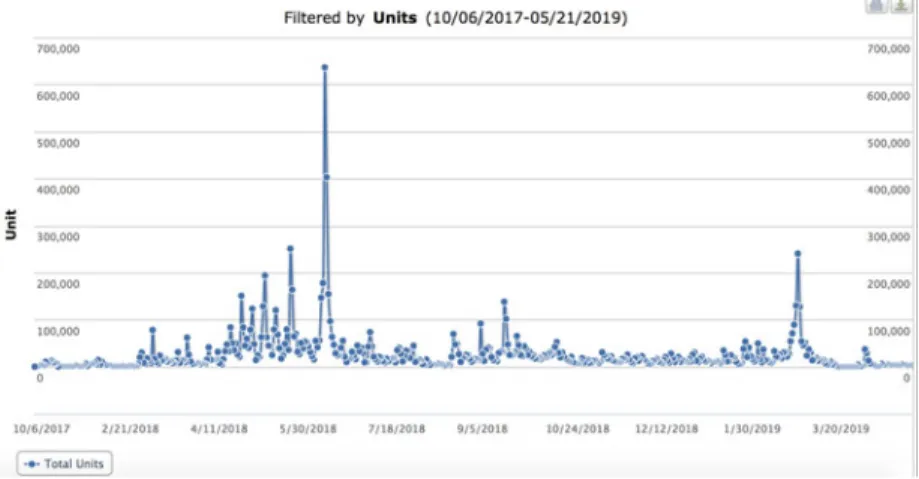
Fig. 3.1 DiscoverText data 74
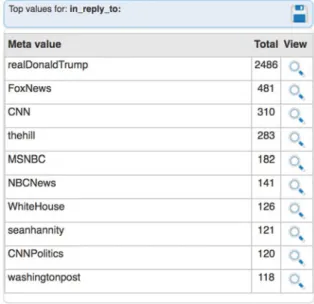
Fig. 3.2 Top values for: in reply to 77
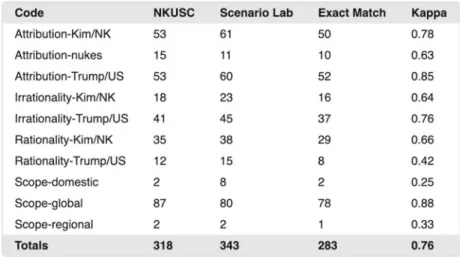
Fig. 3.3 Coding Risks and Threats 78
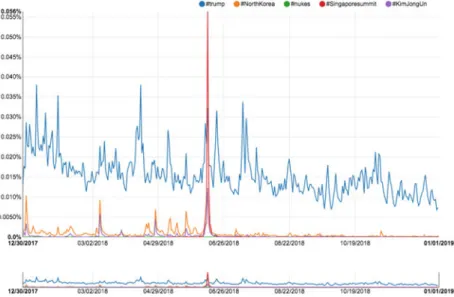
Fig. 3.4 Data from social media observatory showing
the Singapore Summit activity spike 80
Fig. 3.5 Mentions and retweet network from #SingaporeSummit
(Davis et al. 2016) 81
Fig. 3.6 Data from social media observatory co-occurrence
network for #SingaporeSummit 83
Fig. 4.1 Timeline 98
Fig. 5.1 A result of keyword search:Kita ch¯osen (North Korea)
&genshiryoku(atomic energy) 133
Fig. 5.2 A result of keyword search:Kita ch¯osen (North Korea)
&setogiwa-gaik¯o(brinkmanship diplomacy) 134 Fig. 5.3 A result of keyword search:Kita ch¯osen (North Korea)
&kakuheiki(nuclear weapons) 135
Fig. 5.4 A result of keyword search:Kita ch¯osen (North Korea)
&kakuhoy¯u-koku(the nuclear weapon state) 136 Fig. 5.5 A result of keyword search:Kita ch¯osen (North Korea)
&kakuyokushi(nuclear deterrence) 137 Fig. 8.1 Military’s spectrum of communication 245 Fig. 8.2 Military activities for strategic messaging—continuum
from soft to hard power 252
Fig. 8.3 Stakeholder map representing impact and non-support
for North Korea’s nuclear capability 260
xv
Fig. 9.1 Picture of the Korean Peninsula at night taken from space (credit NASA), showing bright lights in South Korea and darkness in North Korea (“The
Koreas at Night”, 2014) 279
Fig. 9.2 Over the caption “Mad Man,” Kim Jong-un in silhouette reaches for a nuclear missile (Landgren,
2013) 286
Image 3.1 Missile test credit threat tactics report—North Korea vs. the United States (2018), U.S. Army TRADOC via https://commons.wikimedia.org/wiki/File:Threat_
Tactics_Report_-_North_Korea_vs_the_United_States_
(March_2018),_U.S._Army_TRADOC.pdf 82
Image 3.2 Cropped Michelle Obama Portrait credit cropped version of Image ID: 2C5AFR0 Martin Shields/Alamy
Stock Photo 85
Image 3.3 Digital rendition of the South Korean Flag credit first
author P. Riley 86
Image 7.1 The Koreas at Night (credit NASA, 2014) 217
Image 7.2 People’s Daily 225
Image 7.3 Global Times 225
Image 7.4 The Paper 226
Image 7.5 The Chosun Ilbo 226
Image 7.6 Yonhap News Agency 227
Image 7.7 JoongAng Ilbo 227
Image 7.8 North Korea Today 228
Image 7.9 Writer Cui Chenghao 228
Image 7.10 Zhihu Answer 229
Table 5.1 Japanese Cabinet Office Survey 2000–2018 (except 2001 and 2015): Most important issues in Japan–DPRK
relations 158
Table 7.1 North Korea issues relatedWeiboaccounts 220 Table 7.2 North Korea issues related short video uploaders
onKwai andTikTok 222
Table 7.3 Q&A onZhihu: What are the precautions for Chinese
people to travel to North Korea? 223
Table 7.4 Top five most frequent words 230
Table 7.5 Rank of country leaders in the top 80 most frequent
words 230
Table 8.1 Examples of DIME activities 243
Table 8.2 Inducements for North Korea reduction of nuclear threat 256 Table 8.3 Primary actors’ strategic objectives for North Korea
denuclearization 259
xvii
Introduction
Thomas A. Hollihan
When President Barack Obama met President-elect Donald J. Trump shortly before he took office in 2017, he warned his successor that the most urgent foreign policy threat that he faced was North Korea. Obama spoke both of North Korea’s efforts to develop nuclear weapons and intercontinental missiles capable of striking the United States and also its increasing capability to conduct cyber warfare against the United States (Shelbourne,2017). Throughout the 2016 presidential campaign candi- date Trump had offered tough talk regarding North Korea, repeatedly assuring his supporters that his administration would never tolerate a North Korea capable of striking the United States with nuclear weapons (Warrick et al., 2017). It is evident that this declaration did not deter the regime in Pyongyang, for even as Trump took the oath of office, the Democratic People’s Republic of Korea (DPRK) continued to test increasingly powerful nuclear weapons at its below ground test site near the Chinese border. The North Koreans also test fired several
T. A. Hollihan (
B
)Annenberg School for Communication and Journalism, University of Southern California, Los Angeles, CA, USA e-mail:[email protected]
© The Author(s), under exclusive license to Springer Nature Switzerland AG 2021
T. A. Hollihan (ed.),Diplomatic and Mediated Arguments in the North Korean Crisis, Palgrave Macmillan Series in Global Public Diplomacy, https://doi.org/10.1007/978-3-030-70167-3_1
1
newly designed intercontinental ballistic missiles (ICBMs) capable of reaching the United States. Demonstrating to the global community that these developments were occurring openly and with the full support of the North Korean leader Kim Jong-un, the regime released several photographs of Kim standing alongside a nuclear warhead proudly smiling and observing the missile tests through binoculars (“Who’s Laughing Now,”2017).
The North Korean nuclear threat emerged as a pressing issue capturing the world’s attention. Controversies such as this one challenge the power and ability of governments, experts, and journalists to explain the unfolding situation, appropriately assess the level and severity of risks that are faced and prevent the spread of a contagion of panic that could lead to overreaction that actually serves to exacerbate the risks (Wimmer &
Quandt, 2006). Much uncertainty remained regarding North Korea’s nuclear capabilities. Some predicted that North Korea might already possess as many as 60 warheads, while others thought the number was likely much smaller, perhaps half that many (Warrick et al.,2017). Experts concurred that the North Koreans had mastered the ability to “minia- turize” the weapon so that it could be carried on top of an ICBM (Vartabedian, 2017). Yet, they were not yet convinced that the North Korean weapons were sufficiently “hardened” so that they could survive reentry into the atmosphere and thus the weapons might break up in space (Kang & Kong,2017) and be difficult to target. Some worried, for example, that the DPRK might attempt to hit the United States but drop a nuclear warhead in Canada instead (Elliott, 2017). Almost all experts conceded, however, that the DPRK had made significant progress, both on the development of its nuclear warheads and on its ICBMs, and at a much faster pace than had been expected (Sanger & Broudy, 2017).
Some, such as the Union of Concerned Scientists, argued that the DPRK had already achieved its goal and that by the time Trump was sworn into office they already had the ability to obliterate an American city with a nuclear weapon (Cohen et al.,2017).
While the tensions with North Korea have vexed the United States and its Asian allies—especially South Korea and Japan—for many decades, a nuclear-armed North Korea significantly raised the stakes and increased anxieties. Fears were also intensified due to the fact that the DPRK was now ruled by Kim Jong-un, the brash, young (he was born in 1984), and relatively unknown authoritarian leader and heir to the Kim family dynasty. Kim Jong-un is the grandson of Kim Il-sung, the founder of
the DPRK, and the son of Kim Jong-il, who had ruled the nation with an iron fist and plunged it into poverty and famine. Kim Jong-un had already gained significant global notoriety on the basis of news reports that he had consolidated his own power by brutally purging and even murdering rivals including his own uncle and his half-brother (Bowden, 2015).
It is not just the new leadership of the DPRK that was unsettling to global citizens, however, anxiety and uncertainty were also increased due to other political dynamics in the region and beyond. The election of President Donald Trump—widely seen as boastful, mercurial, and inex- perienced—proved to be a disruptive force in both the United States and overseas. The unconventional Trump candidacy redefined notions of what going forward would be tolerated or even deemed appropriate campaign discourse. Trump insulted and demeaned his political opponents, made harshly critical comments about a “Gold Star” family that had sacrificed their son in battle, and alleged that Mexican immigrants were rapists and murderers. Clearly this President would represent a significant change from any previous administration. While Trump had asserted hardline and belligerent declarations that he would not tolerate a nuclear armed North Korea, he had also offered equivocal responses regarding his commit- ment to long-standing U.S. security commitments both in Asia and in Europe. He had, for example, rattled European allies during the 2016 campaign when he declared that the North Atlantic Treaty Organization (NATO) was “obsolete,” and that it cost the United States too much money because our partner nations failed to pay their full share (Johnson, 2017). Furthermore, even in the midst of the increased tensions with the DPRK during the spring of 2018, Trump instructed the Pentagon to begin preparing options for significantly reducing the number of Amer- ican troops in Asia. The announcement alarmed both South Korea and Japan, who had long depended on the bulwark of America’s military pres- ence to protect themselves from external threats such as the regime in North Korea and a rapidly rising China (Choe & Rich,2018).
But there had been still more disruptions in the political order. South Korea too had recently experienced a political transition. In 2017, Pres- ident Park Geun-hye, South Korea’s first female head of state, and the daughter of former dictator Park Chung-hee was removed from office and sentenced to 24 years in prison after being impeached on charges of corruption (Hancocks et al.,2018). With Park’s ouster, the conservative party lost power to the liberals, and President Moon Jae-in was elected to
lead South Korea. Moon had been a student activist and a human rights lawyer before entering politics. His parents were also refugees from North Korea who had fled the violence of the Korean war. President Moon wanted to open a dialogue with North Korea and also sought to redefine his nation’s relationship with the United States to assure that his nation could act to pursue its own goals and assure its own safety in the event of either a U.S. downsizing of forces and commitment to the region, or in the face of hostile provocations sparked either by North Korean aggres- sion or U.S. preemptory strikes against the North’s nuclear facilities or weapons (Choe,2018a).
Finally, the other nations that also had a stake in this situation were also undergoing important political changes. The confrontation on the Korean Peninsula was also impacted by events in China, Japan, and Russia. In China, President Xi Jinping was pursuing an increasingly assertive if not openly aggressive policy in the East and South China Seas. In the East China Sea, he was challenging Japan over sovereignty and control over the disputed Diaoyu/Senkaku Islands (Hollihan, 2014). In the South China Sea, he was literally building islands on top of shoals and reefs in the vicinity of the Spratly Islands, waters that were also claimed by Vietnam, the Philippines, Taiwan, India, Brunei, Indonesia, and Malaysia.
China was not only claiming these islands, and the oil and gas deposits that may lay beneath them as their own territory, it was also constructing ports, military installations, and airstrips that permitted it to project its power into the region (“Territorial Disputes,”2018). China has also been systematically building its military capacity and developing new weapons and missiles to make it clear that “China is prepared. China is not afraid to fight a war against anyone who dares to challenge China’s sovereignty and territorial integrity” (Wong,2019). How might a newly ambitious China, that was trying to assert its own hegemonic authority in Asia, respond to increased tensions on the Korean Peninsula? This remained an open question, especially given that China’s leader, Xi Jinping, had managed to consolidate his authority and end term limits, thus permitting him to rule indefinitely (Buckley & Myers,2018).
Certainly, the rise of China had not gone unnoticed in Japan, where Prime Minister Shinzo Abe had recently pursued increased military spending and had gone so far as to propose possible changes to the Japanese constitution to give his nation more freedom to assert itself militarily if necessary to influence conditions in the region (Rich, 2017).
Russia, although perhaps not as directly threatened by the events on the
Korean Peninsula, also potentially played an important role. The Soviet Union had for many years served as the primary patron of North Korea and it was the Soviets who had turned power over to Kim Il-sung, the father of the DPRK. How might these new developments on the Korean Peninsula be understood in Russia? Some have observed that Vladimir Putin’s primary objective was to rebuild Russian power and influence in world events which was squandered away following the collapse of the Soviet Union. Russia was also engaged in direct confrontations with the United States and its allies in the Ukraine, Syria, and in information warfare and cyberattack efforts intended to weaken the western alliance (Kirchick,2017). With President Trump trying to distance himself from charges that his campaign might have colluded with the Russians in a cyber campaign to damage the reputation of the Democratic candidate Hillary Clinton, amidst claims that the Russians had “compromising”
information to hold over Trump, this was already a uniquely challenging moment in U.S.-Russian relations (Isikoff & Corn, 2018). An escalation of tensions in the Pacific would not be helpful.
As these political tensions were ramping up, South Korea was also preparing to host the Winter Olympic Games of 2018. Anxious that the potential for conflict might undermine the games and possibly cause sports fans from around the world to stay home, the South Korean government reached out to the North. South Korea’s President Moon Jae-in publicly declared that he favored postponing the annual joint mili- tary exercises with the United States, a gesture that mattered very much to the DPRK regime. In addition, the Olympics committee reached out to the North, inviting them to participate in the winter games.
Soon, Kim Jong-un responded that he would send athletes to partic- ipate in the opening ceremonies of the games and to march under a unified Korean flag alongside South Koreans. This represented a genuine breakthrough and thawing of relations between the two long-standing adversaries (Perlez et al., 2018). Kim Jong-un also decided to send his sister Kim Yo-jong to attend the opening ceremony, where she was seated very close to U.S. Vice President Mike Pence, creating a visual image that rapidly circulated around the world (“Vice President Mike Pence,”2018).
Events moved very quickly in the days and weeks following the Olympic diplomacy, but they did not always move in a predictable and coherent manner. In March 2018, Kim Jong-un invited Trump to meet
for negotiations over its nuclear program and Trump quickly accepted, surprising many of his own advisors and America’s allies. Trump gloated that Kim had “talked about denuclearization with the South Korean representatives, not just a freeze” (Landler, 2018). In April, 2018, Kim and Moon met to sign a declaration for peace, and officially ending the Korean War that began in 1950 (Sampathkumar, 2018). On May 24, 2018, again without notifying his allies, Trump sent out a public letter canceling the proposed summit meeting with North Korea reacting to what he called the “tremendous anger and open hostility” expressed by the Pyongyang government. Trump further declared that the U.S.
military is “ready if necessary” (Borger & Haas, 2018). It seems that North Korea had been especially provoked when John Bolton, Trump’s extremely conservative and hawkish national security advisor, publicly declared that he thought the Libya model might be an appropriate way to think about the denuclearization of the North Korean regime (Baker, 2018a). Obviously, Kim’s regime realized that that this option did not end up well for Libya’s leader Colonel Muammar el-Qaddafi, who not only lost power when his government was overthrown but wound up dead (Lee,2018). Others assert that Kim’s government took a far more hardline position because they were encouraged to do so when Kim met with China’s President Xi Jinping, who badly wanted to preserve China’s influence over its longtime ally, and who in addition signaled a willing- ness to relax economic sanctions and ease the financial crisis gripping North Korea (Lee,2018). After a flurry of additional diplomatic activities, however, eight days later, Trump issued a new surprise, announcing that the North Korea summit was back on, and agreeing to meet with Kim Jong-un in Singapore on June 12, 2018. The new announcement sought to downplay the likelihood that this meeting would resolve the conflict, however, and suggested that this would be only the first in a series of negotiations (Baker,2018b). This head-spinning series of announcements demonstrates the complexity of foreign policy and diplomacy in the era of global media. A second summit meeting was held in Hanoi in February 2019, but the two parties proved to be so far from agreement that the meeting was abruptly cut short and Kim and Trump failed to even give a joint closing statement to suggest that they had a possible path forward (Liptak & Diamond,2019). Since this failed meeting there have been announcements that the talks would resume, but they have not yet restarted.
Purpose of This Book
This volume examines the diplomatic and foreign policy controversies surrounding North Korea’s acquisition of nuclear weapons as they have played out in official speeches, statements, and media coverage in China, Japan, South Korea, and the United States. Each of these nations has a clear interest in this controversy, and each also has created complex historical narratives to explain how the Peninsula came to be separated into two nations at odds with each other. The book’s chapters consider the role of both legacy media outlets and social media in shaping public conversations in these different nations as they have come to explain and understand this issue.
The central argument of the book is that there is an important rela- tionship between domestic and foreign policies. Political leaders naturally pursue their national economic, security, and political interests as they seek to manage global conflicts and conduct foreign policy. In doing so, however, they are also constrained by domestic political issues and problems. National leaders seek to appear strong, wise, strategic, and loyal to the national narratives that shape patriotic and civic identity and give legitimacy to their rule. McKimmon, O’Loughlen and Roselle (cited by Hinck & Cooley,2020, p. 1334) argued that strategic narratives constitute “a communicative tool through which political actors—usually elite—attempt to give determined meaning to past, present, and future in order to achieve political objectives.” The media, both traditional legacy media and social media, help create a common conversation and provide useful news narratives that help shape productive deliberating political communities (Anderson et al., 1994). These media narratives contribute to how people come to understand the swirling facts and competing explanations about issues that may be otherwise unknown to them. These competing narratives are often tactical and strategic responses that will be accepted by audiences if they “resonate with local political myths”
and accepted understandings of historical events and present conditions (Hinck & Cooley,2020, p. 1334).
Hinck and Cooley (2020, p. 1332) further argued that “news media are on the front line of international conflict, with media messages playing a key role in diplomatic negotiations—especially contentious ones.” Yet, the media narratives also compete for acceptance and adherence. The North Korea conflict is thus best understood as both a material problem and as an exemplar of the intersection of these competing critical media narratives. This book examines how these governments have used the
media to communicate simultaneously with their domestic audiences and with overseas audiences, through official (i.e., diplomatic) or public (non-governmental) channels. The book argues that this controversy is embedded in broader issues that have attracted significant attention from academics, policymakers, and political pundits including: the election of the mercurial, inexperienced, and uninformed President Donald Trump;
his comments that have undermined the future of American global hege- mony; the rise of China; the future of the authoritarian regime in North Korea; the political turnover and assertion of political independence in South Korea; and Prime Minister Shinzo Abe’s efforts to change the Japanese Constitution and build a strong military capable of playing a more assertive role in the region. Research has suggested that a close relationship exists between how international publics perceive a nation’s political leader and their perceptions of the country. Thus, “when people perceive the leader of a country negatively, this will influence their judg- ment of the country as a whole” (Sonnevend & Kim, 2020, p. 1399).
Although the Korean nuclear controversy has been frequently discussed in foreign policy literature it has not previously been examined from a comparative media or public diplomacy perspective. This book fills in that gap and offers independent case studies offering a diverse array of conceptual and methodological approaches to the topic.
The History of the Korean Controversy
The conflicts on the Korean Peninsula have confounded the United States and its allies for decades. Following the defeat of Japan in World War II in 1945, Korea was partitioned into two separate zones at the 38th parallel, with Soviet and American troops entering the northern and southern zones respectively. As Demick (2010, p. 22) noted:
The line bore little relationship to anything in Korean history or geography.
The little thumb jutting out of China that is the Korean peninsula is a well- delineated landmass with the Sea of Japan to the east, the Yellow Sea to the west, and the Yalu and Tumen Rivers forming the boundary with China.
Nothing about it suggests that there is a natural place to divide it in two.
For the 1,300 years prior to the Japanese occupation, Korea had been a unified country governed by the Chosun dynasty, one of the longest-lived monarchies in world history.
Demick further argues “Koreans were infuriated to be partitioned in the same way as the Germans. After all, they had not been aggressors in World War II, but victims. Koreans at the time described themselves with a self- deprecating expression, saying they were ‘shrimp among whales,’ crushed between the rivalries of the superpowers” (2010, p. 22). The original intent was that the Soviets and Americans would agree on a plan to reunify Korea so that it might be managed by a trusteeship of shared gover- nance, because neither of the major powers was willing to allow Korea to become fully independent. Unfortunately, the two former allies were by then highly suspicious of each other and disputes over occupied territories in Europe as well as in Korea contributed to igniting what would soon become the protracted Cold War. In 1948 two separate governments were formed within the two zones: The Democratic People’s Republic of Korea in the North—allied with the Soviet Union, and the Republic of Korea in the South—allied with the United States. Both claimed to represent the entire Korean Peninsula. The Soviets brought to power Kim Il-sung, a former guerrilla soldier and communist who had been active in China in efforts to defeat the occupying Japanese forces during WWII. The United States selected the American-educated Syngman Rhee, a contro- versial figure who was flown back to Korea from the United States on a military airplane and installed as head of the South by the Pentagon over the objections of the State Department. With the support of the military occupying forces, Rhee was selected as President of the newly- formed Republic of Korea in 1948. It is thus apparent, that these two rival nations, and their leaders, were a product of the Cold War tensions that divided their patron states (Robinson, 2007, Lone & McCormack, 1993).
Both Syngman Rhee and Kim Il-sung vied for zero-sum reunification entailing the destruction of the other’s system and ideology and the exclu- sion of the other’s patron state (Cha, 2016). Both regimes also quickly moved to repress their political opposition in order to consolidate their hold on power. The Soviets poured heavy weapons and armament into the North to prop-up Kim Il-sung’s regime, thereby providing Pyongyang with offensive military capabilities. The United States, on the other hand, resisted requests from Rhee to match those weapons, perhaps to restrain his ambitions. It limited military aid to those weapons that were deemed necessary to preserve internal order and to provide for self-defense (Cha, 2011). Kim Il-sung was impatient and he strongly implored both Stalin
and Mao to support an effort to reunify the two nations. This impa- tience was translated into action in 1950, when Kim sent thousands of troops across the 38th parallel in an attempt to reunify Korea through force. The surprise attack was spectacularly successful and DPRK forces soon captured almost the entire Peninsula. Unwilling to allow Korea to be unified under Communist rule, however, and still smarting from Mao Tse-tung’s ultimate victory over Chiang Kai-shek a year earlier in China, the United States, joined by 15 nations in a United Nations (UN) coali- tion, counter attacked (Demick, 2010). The superiority of the United States and allied troops and weaponry was quickly apparent. Within a couple of weeks, the DPRK forces were swept away, and the United States had pushed all the way to the Chinese border. General Douglas MacArthur, the supreme commander of both United States and allied multinational forces organized under UN auspices, openly expressed his desire to cross the border into China. The presence and perceived threat of U.S. forces on his border provoked Mao Tse-tung into action. In October of 1950, China sent hundreds of thousands of its own soldiers across the Yalu River directly intervening in support of the DPRK. The Chinese forces were terribly ill prepared for the fight. Many of the troops did not have boots or winter uniforms and went to war in sandals, sneakers, and cotton tunics (Zhu, n.d.). The troops were often poorly fed as supply lines were badly stretched (Stewart, n.d.). Despite such short- ages, the sheer number of Chinese soldiers and their tenacity caused the war to grind on for three more years, however, with the United States and allied forces again falling back behind the 38th parallel. By the time a truce was called in 1953, it is estimated that more than two million, and perhaps as many as four million soldiers and civilians were killed, and American bombs had caused serious damage to almost every significant structure in the DPRK (Stack, 2018). General MacArthur proposed the idea of detonating a nuclear bomb over North Korea. Although that idea was rejected, by the end of the conflict it is estimated the that the United States and its allies dropped 635,000 tons of conventional weapons on North Korea, more than was dropped in the entire Pacific region in World War II. “That included 200,000 bombs unleashed on Pyongyang—one for every citizen in the capital (Fifield,2019, p. 20).
The demilitarized zone (DMZ), 160 miles long and two and a half miles wide, was established to enforce the truce and separate the two Koreas. This border is often declared the most dangerous spot in the world because two committed armies stare down the barrels of their guns
ready to confront their fellow Koreans and fiercest adversaries. In the hills alongside this border, the North has placed thousands of artillery guns believed capable of lobbing 500,000 highly accurate shells into the city of Seoul, home to 25 million people located only 35 miles from the DMZ.
Should the North launch such an attack it would also kill many U.S.
troops, as more than 35,000 Americans are based in South Korea as a tripwire force to assure that any attack on a key U.S. ally would also be considered an attack on the United States (Roehrig,2017).
The Korean Armistice Agreement of 1953 put an immediate end to the heavy fighting on the Korean Peninsula; however, the two Koreas remained at war with each other as the agreement was not a peace treaty.
Three generations of the Kim family have presided over the DPRK, and each has governed with a harsh and oppressive hand. Media coverage is highly censored, political dissent is suppressed, potential enemies of the regime have been arrested or executed, and the nation has devoted the largest share of its meager economic resources to building up its military capabilities (Kuhnhenn et al., 2020, Lankov, 2013). Today the DPRK has the fourth largest standing army in the world while its public has endured several recent deadly famines and remains chronically underfed.
The DPRK has also over decades offered up hostile military threats against the ROK, Japan, and the United States. At times, these threats have resulted in bizarre crimes against humanity such as the kidnapping of Japanese nationals who were spirited back to North Korea to teach the Japanese language and to provide intelligence about Japan. In many other cases, however, the attacks were even more aggressive and provoca- tive. The DPRK seized thePueblo, a U.S. navy spy ship in international waters in 1968, killing one crew member and holding 83 others hostage.
Although the crew was eventually allowed to return to the United States, the ship was not released, and it remains on display in North Korea as a trophy of war (Lerner, 2018). In 1968 the North Koreans attempted to assassinate South Korean President Park Chung-hee in a coordinated attack upon the Blue House, the South Korean equivalent of the White House. Although the attack failed, it resulted in the death of 26 South Koreans and four Americans, and the wounding of 66 others. Of the 31 North Korean attackers, 29 were killed, one was captured, and one managed to escape and find his way back to the DPRK (Gauthier,2013).
In 1987, ten months before Seoul was scheduled to host the 1988 Summer Olympics, North Korean agents detonated a bomb on a South Korean airliner killing all 115 people on board. Their intended goal was
to discourage international visitors from attending the Olympic Games (“North Korea Blows Up,” 2017). In 1999, after a sustained effort to redraw the sea boundary with the South, the North sent fishing and mili- tary boats to the waters surrounding Yeonpyeong Island in an attempt to formally claim the disputed territory. The South responded by sending its own military vessels and a heated battle resulted. At least four North Korean vessels were sunk and an unknown number of DPRK sailors were killed. Although the North Koreans withdrew their vessels following the battle, tensions in the region remained high. The battle at Yeonpyeong Island was engaged again in 2002 when two North Korean ships entered South Korean waters and attacked ROK Navy vessels. The North Koreans withdrew after taking significant damage from the South Koreans, but it is believed that 13 North Koreans and six South Korean sailors were killed in the battle (“Understanding North Korea’s,” 2010). In March of 2010, the North torpedoed and sank the ROKS Cheonan, a South Korean naval corvette, killing 46 members of the crew (Jackson, 2017).
In response the United States announced its intention to step up efforts to train and conduct operational missions with its South Korean allies. In a counter response, later that same year, the North again shelled Yeon- pyeong Island, this time killing four South Koreans and injuring 19 more.
The South responded by shelling North Korean gun positions and the incident threatened to break out into a full-scale war (Macfie,2010).
In their early years both the DPRK and the ROK were mired in extreme poverty and struggled to reindustrialize following the tremen- dous losses of the Korean War. For a time these nations developed in a fairly similar fashion and at about the same pace. When the Soviet Union collapsed, however, the DPRK lost its primary patron for aid, military assistance, and trade. South Korea, which had begun to grow at a faster pace under the authoritarian regimes of Park Chung-hee and Chun Doo- hwan, began to transition from an authoritarian to a more democratic regime around roughly the same time period. This transition led to an improvement in political conditions, which in turn attracted significant development capital. Significant investments in higher education paid off handsomely and the South became a leading producer of electronics, home appliances, automobiles, and now even popular culture. The South emerged as one of the world’s “tiger” economies and grew increasingly wealthy. North Korea, in contrast, became increasingly isolated and shut out of the global economy (Robinson, 2007; Cumings, 2005). Today, North Korea is arguably the most isolated nation in the world, and its
people have very little access to global news and media flows (Kuhnhenn et al.,2020).
To secure the future of the regime and to counter the rise of the South and the nagging presence of the U.S. forces in Seoul, the DPRK has over many years carried on a program to develop nuclear weapons and the ICBMs to carry them as far as Seoul, Tokyo, and even to the major cities in the United States. The proliferation efforts have started and stopped many times over the years as the United States and the South Koreans have alternately threatened, negotiated, and gone to the United Nations to win the support for economic sanctions intended to discourage the development of the nuclear capacity (Volpe, 2017). Despite such efforts, however, the North Koreans determined that only by becoming a nuclear state, and by demonstrating the credibility of their missiles to launch attacks against its adversaries, could the regime assure its own survival and be treated as an equal partner in the community of nations.
All of these past incidents provide the backdrop of public memory that provided context for this most recent controversy. The citizens of each of the nations included in this study experienced these events as they were explained and given meaning by official government statements, in text- books, and of course in media narratives. This book includes chapters that consider the arguments in the controversy, as they have emerged in formal speeches and statements, legacy media reports, military and secu- rity communications, and social media outlets in the United States, South Korea, China, and Japan.
Media Diplomacy
This study takes a media diplomacy perspective. Certainly, in this instance the primary actors in the unfolding narratives Kim Jong-un, Donald Trump, and Moon Jae-in were using the media to speak directly to each other (especially since their nations did not have formal diplo- matic relations), to other nations, and to the general public in their own nation and beyond. There were, however, several other actors using media to influence public opinion. Media diplomacy merges formal govern- mental diplomacy and public diplomacy, journalism, and now social media interactions, and explains how people come to understand such a rapidly developing controversy (Hollihan,2014). Unlike formal diplo- macy, public diplomacy arguments are framed within multidirectional information flows from a variety of sources. As Eytan Gilboa (1998)
explained, media diplomacy permits political actors to “use the media to send messages to leaders of rival states and to non-state actors”. Today’s media environment is dramatically changed from even the recent past. As Nicholas Cull (2019, p. 14) argued:
Today, there are many stories competing for public attention and many sources for those stories, not simply a handful of governments and their associated centralized media machines. A generation ago, international relations was largely a monopoly of the nation-state. Today, interna- tional action and communication rests not only with nation-states, but with a bewildering array of actors including international organizations, regional groupings, nongovernmental organizations (both genuine and fake), corporations, subnational governments like provinces, and networks of individuals who wish to be connected to one another because of shared ideas.
In recent years we have also seen dramatic changes in media ecology.
Legacy media outlets in each nation may tend to favor or privilege expla- nations that are closely aligned with the broader national narratives and with views of historical events that justify the legitimacy of the political regime (Hollihan, 2014, p. 251). The globalization of media, however, means that audiences, and indeed other reporters, are also exposed to media outlets from other nations. Thus, it is possible for Americans, for example, to access English-language editions of legacy news outlets from South Korea, China, Japan, and of course many other nations around the world. Such changes in media systems enhance the power of media and enable governments to have greater ability to use media to shape foreign policy than ever before. As Manuel Castells (2009) argued, new devel- opments in communication technologies and media systems have led to the creation of increasingly sophisticated strategies for states to exercise their power in the network society. As the chapters in this book will argue, there is also an interaction effect between the legacy media outlets and the social media conversations occurring as citizens discussed these issues. It is also noteworthy that non-governmental diplomatic events, in this case the Winter Olympics to be held in South Korea in 2018, also provided an important impetus to shift the narrative that was unfolding on the Korean Peninsula away from threats and the risk of war, and toward nego- tiations and a welcoming of the “Hermit Kingdom” into the community of nations.
This controversy is also noteworthy in that the DPRK, one of the poorest and most backward nations in the world, and a nation that had long been isolated and shunned, was suddenly afforded attention on the world stage. Kim put on a “charm offensive” in his efforts to soften his image in regard to the PyeongChang Winter Olympics, and by doing so he sought to soften his own image in order to attempt to alter the global public image of his nation (Sonnevend & Kim, 2020). If Kim Jong-un achieved nothing else, and even if further diplomatic efforts fail, he managed to assure that at least for a time he was treated as an equal by other world leaders. He was, in short, awarded some respect as media narratives evolved from treating him as “a murderous dictator and nuclear lunatic” to acknowledging that he was a shrewd and capable leader (Choe, 2018b). It is arguable that it is also changes in media that helped achieve this transformation. As Sonnevend and Kim (2020, p. 1400) argued:
“Although charm offensives certainly existed before digital media, they operate especially well in the current media environment that is charac- terized by the continuous transnational flow of visual and textual material and the ability for a global audience to respond instantaneously.” As Castells argued, technological developments in media have also altered the power relations between nations, and “this is why the fundamental power struggle is the battle for the construction of meaning in the minds of people” (Castells, 2012, p. 5). What this suggests, of course, is that in addition to developing nuclear weapons, the ultimate expression of
“hard” power, Kim Jong-un had also achieved a significant amount of
“soft” power as he successfully burnished his image and redefined his public character. Although the media environment had changed, Kim’s political strategy was familiar, for as Sonnevend and Kim (2020, p. 1401) observed: “Throughout its history, North Korea has been known to oscil- late between offensive military threats and appeasing calls for dialogue, especially in relation to South Korea.” Kim was thus merely deftly playing his hand in a risky game that had previously been played by both his grandfather and father.
Joseph Nye (2008), writing about the concept of “soft power,” noted that “politics has become a contest of competitive credibility. The world of traditional power politics is typically about whose military or economy wins. Politics in an information age may ultimately be about whose story wins.” Cull (2019, p. 17) warns that: “There is such a thing as negative soft power: negative policies and behaviors can reduce an actor’s ability to lead on the international stage: cultures of discrimination and inequality;
ugly words from bigoted leaders; and withdrawal from alliances can all repel as surely as noble ideas can attract.” Certainly, this notion of “neg- ative soft power” may be an important factor in assessing the media narratives submitted by Kim, who represented a regime with a long history of tyranny and oppression, or Trump, a highly narcissistic and mercurial figure seemingly willing to disrupt the established global order.
In this controversy, Trump, Kim, and South Korea’s Moon were all telling rival stories that competed for the attention and adherence of other governments and the world’s citizenry. The book will argue that contro- versies such as this one, embedded in longstanding historical conflicts;
pose unique and important challenges to the global peace and security and to the vitality of the global economy.
The book will explicitly seek to answer key questions including: (1) What differences are apparent in legacy media narratives of the contro- versy in the United States, South Korea, China, and Japan? (2) How have digital/social media shaped public understanding of the contro- versy in these same nations? (3) What alternative historical narratives have emerged to account for the current controversy? (4) To what extent and to what effect have the United States, South Korea, Japan, and China engaged in media diplomacy regarding the controversy? (5) What role have military communications and threats to use hard power played in shaping this controversy?
Preview of the Following Chapters
Chapter 2 Media Coverage of the North Korea Nuclear Controversy in the United States—Thomas Hollihan
This chapter examines the media narratives discussing the efforts by the DPRK to acquire nuclear weapons and ICBMs from 2016 to 2020. The chapter uses Google and Lexis-Nexus to search for essays in leading U.S.
newspapers and newsmagazines and then identifies the primary narrative themes and messages in this coverage. Special attention is paid to the use of historical narratives to account for the present situation and to shape notions of the future. In addition, the chapter considers how the characters are used (heroes, villains, dupes, victims, etc.) to give life to these narratives.
Chapter 3 North Korean Media Diplomacy: From Rocket Man to the Red Carpet—Patricia Riley, Jeeyun (Sophia) Baik, Nathaniel Ming Curran, and Hyun Tae (Calvin) Kim
This study analyzes North Korea’s shifting public diplomacy strategy that began in 2018, and its impact on social media discourse in the United States and other Anglophone regions. North Korea has long espoused a “military first” philosophy, beginning its quest for nuclear weapons in earnest during the early 2000s. In 2017, Kim Jong-un ramped up his rhetoric to match his growing cache of nuclear missiles as he and Donald Trump began tossing word grenades at each other with an intensity that concerned much of the world. Then in 2018, Kim abruptly changed public diplomacy strategies and went on a “charm offensive”—he sent his sister to the Olympics, flattered Trump, attended peace summits, and claimed he halted missile production. The impact of this shift in strategic communication is investigated by focusing on the
“Twitterverse,” the social media platform favored by Donald Trump and news media elites. Messages were coded for threat and risk utilizing a framework based on attribution and social amplification theories. Online narratives were analyzed for their assessments of threats and risks and whether Kim’s strategic communication plan was successful. His charm offensive was intended to build upon the “great relationship” blooming between himself and Trump, but it dissembled. Their ego-fueled ride through a media maelstrom convinced few that a better future lies ahead.
Chapter 4 Frame-changing in the South Korean Legacy Media Coverage of the North Korean Nuclear Controversy—Jeeyun (Sophia) Baik and Thomas Hollihan
This chapter explores the narratives that emerged in the South Korean legacy media coverage of the North Korean nuclear controversy. The chapter will focus on three moments/transitions—Trump’s inauguration in the United States, and his statements about the DPRK, Moon’s inau- guration in South Korea and his diplomatic approach to diffuse tensions, and North Korea’s sixth nuclear test. These events cover the period from September 2016 to December 2017. Using framing and priming theories, the chapter will first identify major media frames that appeared in coverage of the three focal points and consider what beliefs were primed in the messages of each period. Then, similarities and differences across various South Korean legacy media outlets will be discussed to see any unifying and/or divergent media frame(s) communicated across the legacy media when considering their political orientations. The chapter will further place the prevailing media narratives the South Korean legacy media were
engaging in juxtaposition with the formal communications from govern- ments and South Korean citizens’ reactions to the media coverage on the North Korean nuclear issue.
Chapter 5 Legacy Media Coverage of the North Korea’s Nuclear Threats in Japan—Hiroko Okuda
This chapter will examine the media narratives describing the DPRK’s path to become a nuclear state from 2002 to 2018. The chapter will search the individual newspaper databases of four Japanese national dailies: the Asahi Shimbun, Mainichi Shimbun, Nihonkeizai Shimbun, and Yomiuri Shimbun focusing specifically on the Japan-DPRK Summit in October 2002, a series of six-party talks with China, Russia, United States, Japan, and South Korea from 2003 to 2009, and the growing nuclear weapons and missiles capabilities from 2013 to 2017. The study will identify the primary narrative themes and messages in the legacy media coverage, then explore the news coverage representing DPRK as a communist, authoritarian, and totalitarian nation, and as a rogue international actor. The chapter will argue that such coverage served to distract the Japanese public from other domestic issues of importance.
The chapter will also examine Prime Minister Shinzo Abe’s hawkish posi- tions on the DPRK and discuss their impact on the national political scene. In addition, the study will consider the ways in which the three generations of the Kim family were socially constructed in the myth of the hermit kingdom, noting the coverage of crimes against humanity such as the abduction of Japanese citizens and the representations of undercover North Korean agents.
Chapter 6 Social Media Conversations about the North Korea Crisis in Japan—Takeshi Suzuki and Shusuke Murai
This chapter will discuss the many social controversies that have impacted relations between the DPRK, the ROK, and Japan. It will trace how the mutual hostilities that developed prior to the 1990s were dimin- ished somewhat during the 2002 Japan-Korea World Cup and during the Hanryu (Korean-style) boom that followed, but then the bilateral rela- tionship worsened as the issue of the World War II “comfort women”
again came to dominate media and political discussions. The chapter will also discuss how Korean presidents’ strategically used Koreans’ anti- Japanese feelings to manipulate public opinion, and how they lost control of the issue. The chapter will discuss how social media in South Korea and Japan inflamed nationalist sentiments and influenced Japan’s foreign
policy as the Abe administration was encouraged to take a more hard- line approach to deal with North Korea’s increasingly isolationist policies while also focusing on improving its relationship with the United States and China.
Chapter7One North Korea, Many Voices: Liquid Journalistic Practice in the Era of New Technology in China—Lu Ye and Zhou Ruiming
North Korea, “the land of bad options” in the western view, has a long and complicated relationship with China. As a legacy of the Cold War, the North Korea problem complicates China’s diplomatic relations with South Korea, America, Japan, and other countries in the global landscape today. How did the Chinese mainstream media talk about the North Korea problem? Were the Chinese public encouraged to think about North Korea in the same way that the citizens of other nations did? What political or diplomatic factors influenced this coverage or were influenced by it? How did the social media in China shape understanding of this issue? We answer these questions based on cases studies about the coverage of the North Korea problem in People’s Daily, Xinhua News Agency, The Paper (an online news outlet), the discussions about North Korea inSina Weibo (social media) and the online Q&A commu- nity Zhihu. We also discussed the short video sharing platforms Kwai and TikTok. This chapter will outline the basic features of the image of North Korea in China and try to find more in-depth explanations on the relations between China and the world today.
Chapter8The Velvet Glove that Cloaks the Fist of Power: The Role of U.S. Military Communication in Addressing the North Korea Threat—
Gail Fann Thomas and Jeff Kline
This chapter focuses on the role that military communications (words, actions, and images) play in shaping the North Korea controversy. The military uses a wide variety of public statements that range from passive (also known as soft power) to actions of force (hard power). One of the most passive forms of military communication is “staff talks”—formal flag or general-level discussions with allies who share similar aims. The most aggressive statements (hard power) are kinetic strikes. Most of these state- ments are conducted in combination with others’ statements, or they are used with other elements of national power. For example, a UN resolution preventing North Korea from arms trade might be used in combina- tion with naval interceptions of DPRK and other flag vessels leaving and entering the country. The chapter will discuss a stakeholder approach the
military might use to retard the maturing of the DPRK’s nuclear capa- bility. These stakeholders include Russia, China, South Korea, Japan, and the United Nations. Finally, it discusses the unintended consequences or risks of these military communications.
Chapter 9 Rocket Man and the Rocket Nation: Visual Portrayals of North Korea—Jenna Gibson and Nathaniel Ming Curran
This chapter examines contemporary visual representations of North Korea. It analyzes images of North Korea and Kim Jong-un found in sources such asTIME magazine, The New York Times, as well as phot