© 2014 Brad Alexander Gordon
A thesis presented in partial fulfillment of the requirements for completion Of the Bachelor of Arts degree in International Studies at the
Croft Institute for International Studies Sally McDonnell Barksdale Honors College
The University of Mississippi
University, Mississippi April, 2014
Approved:
Advisor: Dr. Joshua First
Reader: Dr. William Schenck
Reader: Dr. Valentina Iepuri
Table of Contents
Acknowledgements………p. 3 Part I: Interwar Émigrés and Their Literary Contributions
Introduction: The Russian Intelligentsia and the National
Question………...p. 4 Chapter 1: Russia’s Eschatological Quest: Longing for the
Divine………p. 14 Chapter 2: Nature, Death, and the Peasant in Russian Literature and
Art………..p. 26 Chapter 3: Tsvetaeva’s Tragedy and Tolstoi’s
Triumph………...p. 36 Part II: The Émigrés Return
Introduction: Nostalgia’s Role in Contemporary Literature and
Film………p. 48 Chapter 4: “Old Russia” in Contemporary Literature: The Moral Dilemma and the Reemergence of the East-West
Debate………p. 52 Chapter 5: Restoring Traditional Russia through Post-Soviet Film: Nostalgia,
Reconciliation, and the Quest for the Russian
Soul………...p. 60 Conclusion: The Future of the Russian
Soul………...p. 76 Bibliography………..p. 79
Acknowledgements
Firstly, I would like to thank my mentor Dr. Joshua First for his help throughout this entire process. It has been at times arduous, but he has kept me on task and given me wonderful advice and excellent feedback throughout the writing process. I would also like to thank him for the immense stack of books he lent me while writing my thesis.
Secondly, I want to thank my wife, Jacqueline Gordon, for enduring my rants and philosophical musings as I wrote and thought out my thesis. Sometimes it just helps to have someone to talk at. My parents have given me great moral support, and I am very thankful for this as well. Lastly, I want to thank Dr. William Schenck and Dr. Valentina Iepuri for being my second and third readers, respectively, and for the support they have given me while writing this thesis.
Part I: Interwar Émigrés and Their Literary Contributions Introduction
The Russian Intelligentsia and the National Question
While most people look to the classic Russian authors, such as Dostoevsky, Tolstoy, and Pushkin, in order to try to understand Russia, one cannot forget the substantial contribution to Russian literature given by interwar émigrés. These émigrés hold a particularly fraught place within Russian literature, as they both affirmed their devotion to the continuation of Russian literature abroad while noticeably distancing themselves from the historical trajectory their homeland was taking in the wake of the Bolshevik Revolution. While the émigrés came from different backgrounds, moved to different lands, and adhered to various schools of art and thought, they all contributed to the Russian national literary cannon. The majority of those who emigrated were either from the aristocracy or the intelligentsia. These were people with either apolitical leanings, who could not tolerate the ultra-political nature of the new Soviet regime, or whose politics put them in direct conflict with official Soviet ideology. With uncertainty in the air, some artists fled, and others were thrown out of the country. These artists, composed of painters, novelists, poets, actors, as well as ballerinas, offer a particularly captivating picture of this emigration. Because of the nature of their professions, there is a wealth of sources from which to gauge the social, political, and cultural currents of the émigré community. The majority of émigrés fled to France, Germany, and China.
(Sabennikova, p. 156) My research will focus on those emigrants who fled to Paris because this is where the heart of the Russian emigration was, and Paris was home to a group of émigrés that was one of the largest around the world. The rich history between
the Russian and French states explains much of this emigration, particularly because France was the source of cultural and social norms for the Russian aristocracy for a substantial amount of time. The sheer size of the émigré group in Paris, however, is not the main reason for which it is so important to the Russian literary cannon. It is important for the way in which it preserved and imagined pre-revolutionary Russia, thereby
creating the myth of “Old Russia.”
This myth is steeped in notions of what it means to be Russian. This question of identity is tricky, particularly in English, because there are two ways to render the English word “Russian” into the Russian language. Rossiyanin carries a civic or
territorial connoation, i.e. the Russian Empire, whereas russkii denotes Russian blood and nationality. To render the situation more complex, one can be russkii and not be
Rossiyanin or be Rossiyanin but not russkii. These questions of nationality and ethnicity are not only very complex and at times heated, but the very notions themselves change depending on what culture is viewing the dilemma. As Benedict Anderson states in his cornerstone work on nationalism, Imagined Communities, “Communities are to be distinguished, not by their falsity/genuineness, but by the style in which they are
imagined” (p. 6). This quote points to two very important traits of nationality: firstly, it is a socially constructed concept, which, however, does not detract from its “realness,” and secondly, there are many different styles in which a nation can be imagined. The concept of time is extremely important in determining nationality because it can determine who people let in their group. The French, for instance, nowadays do not consider people from Burgundy and the Loire Valley of separate nationalities because a sufficient amount of time has passed to allow collective memories to form linking Burgundians and people of
the Loire under the banner of “French.” While ethnicity (i.e. bloodline/kinship) is often thought the most representative trait of nationality/nationalism, language, religion, and other cultural dimensions can be just as important in representing a nation.
In light of the national question, this thesis aims to uncover the way in which Russian émigrés in Paris imagined “Old Russia” and in return how these imaginings aided in constructing notions of Russian nationality and informed Russian nationalism.
Furthermore, I will show how their legacy has continued to shape and structure the national question in contemporary Russian through various media, specifically literature and film. More specifically, I look at the role that Russian émigrés played in defining (and in their minds preserving) the culture of “Old Russia.” I focus primarily on the artistic community of émigrés including novelists and poets, as well as painters because I believe that this group of people in particular captures and preserves best the thoughts and feelings of “Old Russia.” More importantly, however, I argue that the creation of the
“myth of Old Russia” would be impossible without the émigré community in Paris precisely because it offered them a permanent (at the very least more permanent) abode in which they could settle down and continue their work; in addition, much of the culture of “Old Russia” was heavily influenced by French intellectual thought. Writers and poets will constitute the largest part of my research in part because many of the most well known émigrés, especially those who went to Paris, were authors. Writers, like the other members of the artistic émigré community, form part of the intelligentsia, a ‘class’ that came to fruition in nineteenth century tsarist Russia. The Soviet intelligentsia differed considerably from the intelligentsia who fled after the Bolshevik revolution. The intellectuals who fled were “aristocratic in spirit, poor in means” (Boym, p. 67).
Therefore, they offer a clear picture of the culture and beliefs of “Old Russia,” and its aristocracy. In fact, many members of the intelligentsia were also from noble families.
Anthony Smith writes, “The modern world has become inconceivable and unintelligible without nations and nationalism” (p. 106). Indeed, nationalism is a term that is indispensible in any analysis of Russian émigré literature, or Russian literature in general. While many may view this as a negative term, I like to think of the concept as simply extant. Namely, nationalism is a phenomenon that exists, and as for anything that exists, it may have its positive and negative representations. Olga Maiorova defines Russian nationalism in particular as, “those beliefs and discursive practices that take the Russian people as their primary object of devotion and concern” (p. 28). This definition not only presents the concept of nationalism in moderate terms, but it also distinguishes between nationalism and support for the government of Russia at a given time, i.e.
patriotism. While these two -isms have coincided before, they often did not, particularly among the Russian intelligentsia. However, one has to take care not to lump all members of the Russian intelligentsia under one roof. There are Westernizers, Slavophiles, and Pan-Slavists, as well as various permutations and nuances in the groups above. These three categories, however, set up the academic battlefield in terms of the national question.
It should be noted that nationality and nationalism were not very important concepts until the idea of nation-states arrived in Western Europe. Until the concept of the citizen came about during the Enlightenment, there were kingdoms, realms, and sultanates composed of various ethnic groups, none of which played a civic role in daily life. Instead rulers reigned through primogeniture and a claim to le droit divin. If divine
right and birth therefore determined leadership and prestige, there was no reason for the concept of the nation. When Western intellectuals challenged these long held traditions, ethnic communities could begin to envision themselves as the entitled rulers of a
particular state. It was the Russian intelligentsia who, having correspondence with
Western intellectuals, particularly French and German, introduced notions of nationalism into the Russian Empire. Up until then, Russian rulers controlled a vast territory
composed of myriad ethnic groups. Even large majorities of the nobility were either Polish or German. French was the language of the court and even the language of the intelligentsia that would later promote Russification of the empire. As Maiorova points out in her book, From the Shadow of Empire, the year 1812, being the year in which the French army was expelled from Moscow, played a huge role in defining the Russian nation because it was a chance to highlight that Russia was better than the West. It also served as a break in Francophilia, at least in theory. While official rhetoric turned to Russification, French remained an important language for the aristocracy, and even the intelligentsia until the October Revolution in 1917. Maiorova states:
Nationalism always seeks to highlight a national community’s uniqueness and continuity. In an era of fundamental change under the obvious
influence of Western European models, this impulse ran rampant…(p. 11).
So while undoubtedly influenced by their Western contemporaries, Russian intellectuals strived to highlight the uniqueness of the Russian nation in spite of and because of this influence. Perhaps because of Western influence, which was greatest in large urban centers, the “prostoi narod [common people] came to be seen as the truest exemplars of the Russian national character” (Perrie, p. 28). However, this has an ironic
quality to it. The “common people” were the most uneducated and the least concerned with the concept of Russian nationality. The works of intellectuals praising the common people’s russkost’ (Russianness) would have been inaccessible and, furthermore,
unreadable by the majority of peasants. Dostoevsky, whose ideas had some of their origins in Slavophilism, belonged to the reactionary social organization called the
Pochvennichestvo, (Return to the Soil), later in his life, but he was still a fluent speaker of French, as befitted his birth into the nobility. He often intermingled French language into his novels, such as in his autobiographical work Igrok (The Gambler), and he was an accomplished translator from French to Russian. As his audience was the educated community of intellectuals in Russia, this bilinguism is hardly surprising. However, it is ironic that someone belonging to an extremely anti-Europeanist organization would consistently use French in his works. This dynamic highlights the complex relationship between the Russian intellectuals and Western Europe. Doestoevsky, and his philosophy, would come to influence many of the ideas of the émigrés, most notably Nikolai
Berdyaev, and the East-West dichotomy is ever present in their works.
The Émigrés and Their Role in Russian Literature
In order to have a complete understanding of the trends of Russian nationalism during the late 19th and early 20th centuries, one has to look at the Russian émigrés. More specifically, one has to look at those members of the intelligentsia who left Russia, many of whom made the difficult decision never to return to their native land. Not only were they greatly influenced by Russian nationalists, such as Dostoevsky, but also they managed to preserve a very traditional form of Russian literature with them abroad.
While there were many different people from various social strata who left Russia in the
wake of the Bolshevik Revolution, the intelligentsia in particular plays a big role in society, particularly Russian society. The first notions of an intelligentsia rose up in the 19th century, in the current territory of Poland, although at the time the land was under the control of Imperial Russia. Following the definition of Hegel, the intelligentsia is
composed of those people in “the circles of educated, professionally active people, who were regarded as a group able to become the spiritual leaders of the whole society”
(Kizwalter, 242). Furthermore, intellectuals are a “subcategory of the former
[intelligentsia] that includes only those who serve as culture-bearers and the custodians of the tradition of creative and critical thinking about society’s problems” (Andryczyk, p. 5).
These definitions highlight the political, social, and cultural role taken up by the
intelligentsia. Falling directly into this category are novelists, poets, painters, and the like.
Many members of the Russian intelligentsia took this calling very seriously, and it is for this reason that an analysis of Russian nationalism would be incomplete without delving into the topic of intelligentsia artists. All the émigrés in Part I are important figures not only for their position among the intelligentsia, but, by being first-wave emigrants, they felt most keenly the loss of “Old Russia”; ergo, they are the only Russian émigrés who truly carry in their works the necessary elements needed to define what is meant by “Old Russia.” Furthermore, while there are other émigrés who are perhaps better known, such as Vladimir Nabokov, the author of Lolita, the émigrés discussed in this thesis are underdeveloped. They therefore are deserving of more scholarship in light of their literary contribution to the Russian canon.
The complex East-West relationship, as well as the difficulty inherent in determining the characteristics of Russkost’ (Russianness), are both social and political
dilemmas with which the émigré community in Paris were concerned and well aware.
One major component used in highlighting the exceptionalism of the Russian nation is its religious and apparent eschatological character. In my first chapter, I will analyze the émigrés Nikolai Berdyaev and Vladislav Khodasevich, along with his wife, the poet and author, Nina Berberova, in order to highlight this character/trope of the Russian nation.
Berdyaev was a Russian religious philosopher in the vein of Dostoevsky, and therefore, he presents very traditional and well-founded cultural ideas found throughout “Old Russia.” The poetry of Khodasevich and the philosophical work of Berdyaev, Russkaya Ideya (The Russian Idea), portray a longing for the divine on earth and introduce the reader to the eschatological concept found throughout Russian literature and art.
Furthermore, Berdyaev’s conception of the divine on earth is compounded with the idea of the Russian muzhik (peasant), another trope common to Russian national discourse.
Nina Berberova’s autobiography, Kursiv Moi (The Italics are Mine), is an important work because Berberova was in correspondence with the large majority of émigré Russians in Paris after the Bolshevik revolution, and her autobiography will reveal the dynamics and personal stories of many émigrés, thereby personalizing the nationality debate.
Berverova’s autobiography also helps one to understand the life and struggles of Khodasevich more clearly.
My second chapter will begin with an analysis of Ivan Bunin’s Zhizn’ Arsen’eva (The Life of Arseniev). This highly autobiographical book will not only give insight into Bunin’s personal life and philosophy, but it will also highlight certain concepts found within the émigré nationalist rhetoric of the interwar period. Natalya Goncharova was an avant-garde painter who ended up working for the Ballet Russes while in Paris. She
carried abroad a strongly Russian character in her work, and in particular, several of Goncharova’s paintings are categorized as neo-primitivist; in this sense, they harken back to a more “organic” form of Russianness, which again reflects back to the notion that the Russian muzhik is representative of the Russian nationality. Her paintings not only reflect the philosophy of Berdyaev, but they are also consistent with Bunin’s preoccupation with nature and death.
My third chapter will be an analysis of two Russian émigrés who decided to return to Soviet Russia after a brief interlude in Paris: Marina Tsvetaeva and Alexsei Tolstoi. I am particularly interested in why both of these émigrés decided to return to their homeland, when many did not, as well as why Tsvetaeva’s return ended so
tragically, while Tolstoi returned to Soviet Russia and gained renown. I believe that part of the answer to why Tsvetaeva’s return ended so tragically in suicide has to do with the fact that she was unwilling to truly change her philosophy in regards to Russian
nationalism, whereas Tolstoi was able to reassess the Russian nation in light of the Soviet rehabilitation of Russian Imperial History. My analysis of Tsvetaeva is concerned
primarily with her poetry. For Tolstoi, I will be looking exclusively at his novel, Peter I.
This novel is an important key to understanding how Tolstoi became so popular in Soviet Russia despite his noble background. Through the novel, Tolstoi was able to use the tsar Peter to propound the communist ideal while giving it a historical anchor.
While the people, events, and periods in this thesis vary considerably, they are all linked by a common thread—the desire by the Russian intelligentsia to define the
Russian nation under the shadow of Western intellectual influence. In particular, the role of those intellectuals who immigrated to Paris after the Russian revolution of 1917 has set
the tone for their contemporaries’ notions of Russian nationality/nationalism.
Furthermore, their legacy continues to shape such notions among Russia’s contemporary intelligentsia in the disciplines of literature and cinematography. While the academic debates on the exact nature of Russian nationalism will undoubtedly continue to rage indefinitely, it can be said with confidence that the Russian émigré community in Paris has earned itself a special and distinct role in the history of these debates. In Part II, I will focus specifically on the legacy of these émigrés in contemporary Russia, and how a strong nostalgia for pre-Revolutionary Russia has led to the enhanced interest in and rehabilitation of the émigré artists.
Chapter 1
Russia’s Eschatological Quest:
Longing for the Divine
Religiosity of any sort is a singular trait of Russianness, and while the majority of Russian intellectuals would identify with the Orthodox Church, there are some, such as Khodasevich, who were Catholic. While the Orthodox Church was a large influence in pre-revolutionary Russia and has regained its eminence in contemporary Russia, the official Russian Orthodox Church has not always been the religious focus in literature and philosophy. The official church is often seen as corrupt and too friendly with the government; however, the Orthodox religion is nonetheless a focal point for Russian nationalist discourse. Opposition to, or alliance with, the Catholic Church has long been a trait of Russian religious thought. Vladimir Solov’ev, best known for his Divine Sophia or the Eternal Feminine, long sympathized with Catholicism, and he converted at the end of his life. Therefore, the Orthodox Church is not the defining characteristic of
Russianness; rather, the defining characteristic is a longing (stremlenie) for the divine.
(Berdyaev) This longing breaches any official church boundaries.
In this chapter, Berberova’s The Italics are Mine sets the stage on which the émigré community in Paris fought its inner crisis. Namely, the estrangement (ostranenie) felt by the émigrés in the absence of their homeland forced them to look elsewhere for comfort. Many times this solace was sought in the divine, and this thematic element is found both in the poetry and critical writings of Khodasevich, as well as in the
philosophy of Berdyaev.
Berberova-Khodasevich: The Young and the Old
While in essence I will treat the works of Nina Berberova and Vladislav Khodasevich separately, an understanding of their works cannot be attained without acknowledging their many years together as a married couple. They were at the same time one and yet very different from each other. Berberova was born at the turn of the century, 1900, while Khodasevich was born in 1886. Despite their close bond together, they were from two generations. The fourteen-year gap in age is enough that while Khodasevich felt very acutely the loss of the Old Russia, Berberova’s loss was less clearly defined. While Berberova was young and felt a certain freedom in this youth, Khodasevich was constantly in spiritual torment, leading in his last years on earth to a waning of poetic drive and will. I will not focus on Berberova the poet, but rather Berberova the memoirist. In particular, her authobiography Kursiv Moi (The Italics are Mine) provides a strikingly honest representation of not only herself, but also the other émigrés in general; this is despite her claim that “This book is about myself, not about other people” (p. 3). Through her recollections, one can truly gain an understanding of the circumstances into which the émigrés found themselves thrust at the beginning of the 1920s.
Berberova and the Moral Crisis of the Émigrés
In the years of the Russian Civil War, Nina Berberova moved to the south of Russia like many other members of the intelligentsia and aristocracy, as this was where the White Army had its stronghold in its fight against the Bolsheviks. (Berberova) It was in the midst of this war that the end of the Old Russia began to become ever more clear. As Berberova puts it herself,
The sense of an imminent end began to appear—not so much a personal one but a kind of collective abstract one, which, however, did not impede one’s way of staying alive; it was not a physical end certainly,… but perhaps a spiritual end. (p. 143, italics in the original)
This quote not only points to the collective nature of the ‘end,’ but it also points to the forthcoming spiritual conflict that would besiege the majority of Russian émigrés, not the least of all being Berberova’s own husband. The decision to leave Russia was
difficult. Berberova and Khodasevich moved around Europe a lot before finally settling down in Paris. Return to Russia always seemed to be a viable option; that is until Khodasevich found out that his name was on a list of authors not permitted to enter Russia or to be forced to leave. (Nikolai Berdyaev, discussed in the following section, was among those deported to Germany in 1922.) Even then, in the face of governmental opposition, it was hard to accept the life of an émigré. Berberova states, “we didn’t go to Paris, because we feared Paris—yes, both of us feared Paris—and emigration…We were afraid of not returning, the finality of our fate, and the irrevocable decision to remain in exile” (p. 200). This fear points not only to the anguish felt at the deprivation of one’s homeland, but it also highlights the role that Paris had to play for the émigrés. It is as if Paris held a special spiritual, or at least mental, power over the émigrés. It was in Paris that the East-West conflict in the souls’ of the Russians’ reached its peak. Suddenly, the French culture with which many, if not most, of the intelligentsia grew up seemed strange and incomprehensible to them. Berberova states that French, “the language that, though I knew it, suddenly seemed not at all like the one taught to me in childhood” (p. 214). The mal du pays felt by Berberova and the émigrés quickly turned into, as Baudelaire coined
it, the mal du siècle. This woe and sense of the loss of homeland turned into the defining factor of émigré literature.
Berberova’s autobiography sheds light on the complexity of the émigré position and the difficulty in defining it. Each émigré has a different story to tell, and each had various political/social views. While at first glance, it may seem that the intelligentsia and the aristocracy would have gotten along quite well in émigré France (or any émigré city), as they both enjoyed a life of relative ease in Russia, this was not the case. The
aristocracy continued to live a life of relative ease, while the intelligentsia was in utter poverty. Even more disheartening were the fractures within the émigré community.
Berberova was particularly aware of this tragedy. She says,
It was not the split between the intelligentsia and the people, but the split between the two parts of the intelligentsia that always seemed to me fatal for Russian culture. The separation between intelligentsia and the people was much less pronounced than in many other countries…when the intelligentsia is severed in two to its foundation, then the very hope disappears for something like a strong, spiritual civilization uninterrupted in its flow, and a national intellectual progress, because there are no values that would be respected by all. (p. 172)
The split was mainly caused by politics; namely, traditional conservative émigrés versus the avant-garde liberal émigrés, many of whom supported communism. This failure is perhaps the most demoralizing aspect of émigré life abroad. Politics entered into literature in a way that was unprecedented and which cleaved friends and family apart.
The decision to be on the ‘right’ or the ‘left,’ or the decision to remain or to return were
momentous and life altering decisions. There was indeed a great moral crisis for these émigrés; namely, “Khodasevich said he could not exist without writing, that he could write only in Russia, he could not exist without Russia, but he could not live or write in Russia” (p. 215). However, Khodasevich continued to write and to live. In addition, Dmitry Merezhkovsky, the Symbolist poet and Russian religious thinker in exile, says, “I am also here and not there, because Russia without freedom does not exist for me.
But…What good is freedom to me if there is not Russia? What can I do with this freedom without Russia?” (Berberova, p. 242). There seemed to be no good choice in this
dilemma. However, both Khodasevich and Dmitry Merezhkovsky stayed and died in Paris, plagued with the desire to be in Russia but choosing their own freedom. As Berberova states in her autobiography, many who returned were killed in repressions or ended their life with suicide. (Yet they had their homeland). This crisis posed a difficult choice indeed for the émigrés.
Khodasevich: Preserving the ‘Old Russia’ in a New World
In Berberova’s Italics, she quotes an unfinished poem of Khodasevich in which he writes, “But I have packed my Russia in my bag,/And take her with me
anywhere I go” (p. 147). Khodasevich had the conviction that the émigré community had a mission. This mission was to preserve as much of the Old Russia as possible, and for Khodasevich, this task was especially important for the young generation of émigré artists who fled Russia before being able to complete their education. Khodasevich felt the weight of this burden ever more clearly because he was married to a poet of the younger generation. Although Vladimir Nabokov described Khodasevich as “modern-day Russia’s best poet,” to some (i.e. conservative nationalists) it would seem that
Khodasevich is the antithesis of russki dukh (the Russian spirit); he was born from Polish parents, baptized Roman Catholic, and never converted to Orthodoxy. However, it is clear that for Khodasevich himself, as well as for Berberova, his background in no way prevented him from feeling a spiritual connection with Russia. Berberova states, “he, who had in himself not a drop of Russian blood, was for me the personification of Russia” (Berberova, p. 224). This understanding of Russianness points perhaps to the superiority of dukh (spirit) over krov’ (blood).
The suffering of the émigré community in Paris is most evident in the poetry and life of Khodasevich. He was constantly depressed, tortured by the loss of homeland, and often contemplated suicide. While Khodasevich continued to produce good work while abroad, he was severely critical of himself and his talents. As David Bethea points out,
“the word-seeds that once fell into the ‘black earth’ of a still vital Russian poetic tradition are cast, in Khodasevich’s last collection, onto the alien pavement of European cities” (p.
277). Khodasevich feared oblivion; he feared that all was being lost and that after he was gone there would be no one to ensure the continued preservation of Russian culture.
Furthermore, the preservation of “Old Russia,” i.e. traditional Russia, was also part of a greater fear for Khodasevich; namely, he lived in “an era that was in the middle of losing its spiritual light” (Demadre, p. 771). Khodasevich’s fear of losing “Old Russia” is therefore deeply intertwined with a fear of modernity. Just as the romantic poets of France in the wake of the Industrial Revolution opined the destruction of nature, Khodasevich opines the destruction of the intelligentsia and a bygone era. Yet, in both instances, the poet is utterly powerless, at least in a physical sense. The soul is still a powerful agent in mediating with the world and overcoming its “now:”
Walk over, jump over
Fly over, cross over—in any way you like But break away: as a rock from the sling, As a star running wild in the night.
You lost it yourself, now look for it…
Only God knows, what you mumble to yourself searching for your pince-nez or keys.1
This poem (1921) reflects Khodasevich’s frustration in his current era. The use of the prefix pere- “brings us to a sense of passage, of transgression, of an escape away from this world toward others” (Nivat, p. 317). The poem is unclear in defining what was lost—perhaps this is a reference to the loss of “Old Russia.” Regardless, it is up to the poet, and to all of us, to find it. Furthermore, the majority of the verbs in the poem are in the imperative; namely, Khodasevich views himself as a mentor. It is likely that he is imploring the younger generation of poets to “break away” from their current era and not to get swept away by the influence of Western European culture.
Vladislav Khodasevich was also an important figure in trying to find a common link between émigré and Soviet literature. A group of émigrés, including Viktor
Shklovsky, an émigré writer in Berlin, (whom Khodasevich credits with the original idea) and Maxim Gorky, author of the famous Soviet Work Mother, worked with Khodasevich to create a journal in which both Soviet and émigré authors could read one another freely;
in such a way, “Western ideas were to make their way into Russia and Russian ideas
1 Pereshagni, pereskochi,/ pereleti,—/no vyrvis’: kamnem iz pere—chto
khochesh’prashchi,/zvezdoi, sorvavsheysya v nochi…/sam zateryal, teper’
ishchi…/Bog znaet, chto sebe bormochesh’/ishcha pensne ili kluchi
were to make their way into the West” (Bethea, p. 269). This effort was plagued with many difficulties, including Soviet censorship and financial problems. Perhaps the most difficult aspect, which would lead to the failure of the journal, was Gorky’s faith in the Soviet Union and his decision to return to Soviet Russia. This decision by Gorky was not only a heavy blow to Khodasevich in the fact that they were great friends, but it was also the end of the dream of “a Russian literature that was free from interference and that was read and appreciated” (Bethea, p. 271).
As a result, Khodasevich became increasingly pessimistic and judgmental toward Soviet literature as he grew older. In his “O Sovetskoi Literature” (On Soviet Literature), Khodasevich lays down what he believes to be the failures of this literature and the impossibility of it to survive. It is not simply censorship that is the problem, but the Soviet brand of communism in particular that is the death of its literature. He states
“There is no genuine life in Soviet literature. There is nothing serious or sincere to
observe, and there is nothing to follow in it” (p. 2). Furthermore, Khodasevich blames the false sense of happiness and the lie promulgating that the Soviet Union has achieved the final goal of socialism for Soviet literature’s stagnation. He asserts “It stands that there is nothing for the Soviet author to do because for himself and for his readers (as he
imagines them) there is no longer anything to wish for and no longer anything about which to worry” (p. 6). Khodasevich wrote this critical article in 1938 only a year before his death. It shows a man at the brink who realizes that his dream of preserving “his”
literature is close to extinction. Even if Russian literature continues to survive abroad, free from the influence of Soviet communism, it will undoubtedly be influenced by Western Europe. Therefore, in the mind of Khodasevich, all one can hope for is the death
of Soviet literature and the fall of the Soviet Union. It is only in this atmosphere free from authoritarianism that Russian literature can return home and truly flourish.
Berdyaev’s Apocalypse
For Berdyaev, the concept of the narod (the people, namely peasants) and the iskanie Tsarstva Bozh’ego na zemle (the search for the Kingdom of God on earth) go hand in hand. They in fact form part of the basis of the Russkaya Ideya (The Russian Idea). Berdyaev believes not only that true Orthodoxy is to be found among the peasants, but he also believes that the eschatological element found in this hunt for the Kingdom is a particular Russian occurrence (osobennoe russkoe yavlenie). Peasants play a
particularly important role in the Russian Idea for Berdyaev. Berdyaev early on in his work separates the members of the intelligentsia that supported the Tsar and the members that supported the people. He says that the members of the intelligentsia who supported the people “felt their own guilt in the presence of the people and wanted to serve them”
(p. 38). This group of the intelligentsia, of which Berdyaev could be considered to be a part, recognized something special and particularly Russian in the people. Berdyaev is particularly occupied with the difference between the freedom of the body and the freedom of the soul that separates the Russian peasant from a Westerner who would, at first glance, be considered free. In his view, the soul’s freedom is much more important.
He says, “The Russian peasant is much more an individual than the Western bourgeois, even though he is in serfdom” (p. 67-68). The acclamation of the peasant to a spiritual level formed part of the movement of narodnichestvo (populism, although this term is difficult to translate and means much more than the Western notion of populism).
Berdyaev states, “At the base of this [narodnichestvo] lay a faith in the people as the
defenders of truth” (p. 104). This movement therefore was much more than a desire for the welfare of the people. It placed in the people’s hands the elements of salvation and truth.
Berdyaev was firmly convinced that even the most atheist of Russians had within them elements of godliness. He defends this argument with the idea that all within Russia are preoccupied with the days to come, the revelation of Heaven on earth. He says, “I cannot imagine Russia and the Russian people without these searchers (iskatelei) of God’s truth” (p. 197). Berdyaev even goes so far as to posit that the Bolsheviks fall in line with this Russian Idea because the “Messianic idea of Marxism, linked with the mission of the proletariat, was connected with and identified with the Russian Messianic idea” (p. 242). Namely, just as Berdyaev argues that Russia is set apart by its strive to reach the end of times, in which there is a singular point to be reached, the Bolsheviks do not stray from this Russianness because they too look to a singular end. Berdyaev states clearly that the Russian idea is “an eschatological address to the end [of times]” (p. 246).2 It is perhaps this nature of Russian culture propagated by Berdyaev that makes one think twice about the relation of Soviet literature to the Russian Idea. As seen earlier in the critique of Soviet literature by Khodasevich, Soviet writers promulgated the idea that the end had been reached and that all were happy in the Soviet Union. While this
proclamation is clearly a lie, it differs sharply from the characteristics of Berdyaev’s Russian Idea. Before defending the Bolsheviks as falling under the fold of the Russian Idea in having a “Messianic idea,” Berdyaev states, “There is always a striving toward something endless. Russians always have a thirst for a different life, a different world—
2 Russkaya ideya—eskhatologicheskaya, obrashchennaya k kontsu
there is always a lack of satisfaction with that which is” (p. 194). This quote indicates that while Berdyaev may defend the Bolsheviks’ striving for a communist utopia (a singular end), it would be impossible for him to defend Bolshevik policy. In addition, Berdyaev was a friend of many Soviet leaders before being expelled, and it is therefore
understandable that he would sympathize in some way with Bolshevik ideology, if not with the regime. If, as Khodasevich posits, the end has been reached in Soviet literature (albeit falsely), then there is something extremely un-Russian in the communists’
assertion of this end. This assertion is ever more un-Russian in the fact that it is
completely devoid of any spirituality, not to mention the fact that repression and violence were wide spread during the Soviet period; this aggression against humanity was known or at least guessed by Berdyaev. The Kingdom of God on earth is supposed to bring peace and happiness, not violence and death. Of course, while the communist leadership of the Soviet Union may not have upheld the Russian Idea, it would be false to assume that this Idea was not preserved in the Russian peasantry throughout the Soviet period.
Conclusion
The loss of homeland led the émigrés to a spiritual crisis. While they were free to write what they wanted to write, they could not easily find ways to publish their works, and they had in a sense lost their muse, Russia. Despite the sadness and horror felt at the loss of Russia, Khodasevich, Berberova, and Berdyaev managed to continue writing in Paris. In fact, their spiritual crisis connected them in a very intimate way. Their aspiration for the divine was an element of their Russianness that no government could take away, and therefore it became for them their hope. Hope that despite the fact that return to Russia was impossible, there was a future to look forward to, perhaps not in this life, but
the next. Ivan Bunin and Natalya Goncharova, while they share with the émigrés in this chapter a preoccupation with the divine future, are more struck by the loss of Russian priroda (nature). It is this aspect of Russianness that they wish to depict and share with Westerners.
Chapter 2
Nature, Death and the Peasant in Russian Literature and Art
Out of all the émigrés, the trope of the Russian peasant and the Russian paysage is most clearly depicted in the works of Ivan Bunin and Natalya Goncharova. These two thematic elements are focal points for Russian national discourse because, as highlighted with Berdyaev, the peasants are seen as the guardians of Russian truth. Bunin and
Goncharova also express a concern with a spiritual future; however, unlike Khodasevich, Bunin did not believe in the afterlife, and therefore, his fear of death and oblivion was more pronounced, at least internally. Bunin’s novel is an effort to preserve traditional Russianness, not only in the tropes and archetypes used in the novel, but in the very fact that it is written in the classic realist style. Goncharova’s artwork, while deviating largely from traditional art, still evokes traditional elements that would have been appreciated by the more conservative members of the émigré community.
Bunin’s Ghosts: Nature and the Fear of Death
Ivan Bunin is perhaps the most important figure of the Russian émigré scene, though perhaps not the best known, at least not to Western readers. He was the first Russian to win a Nobel Prize in literature—a deep disappointment to Soviet Leaders—, and, as a lover of classical Russian literature, he carried on the great tradition of Russian realism and romanticism with him to France. His only novel, Zhizn’ Arsen’eva (The Life of Arseniev), was published over the course of many years, but written entirely in
emigration. While not an autobiography per se, the fictional work contains many autobiographical moments and truths from Bunin’s life. Although the novel does not refer at any point to the Bolshevik Revolution, nor does it overtly mention the fact that
the main character is in exile in France at the moment of writing, it still evokes and reflects the feelings, often of anger, frustration, and loneliness, felt by Bunin while abroad. While it would be erroneous to classify Bunin as an avid political nationalist, the ideas expressed in The Life of Arseniev clearly point to the fact that Bunin believed Russia to be one of the greatest countries in the world and one very dear to him. It is also clear, however, that the Russia he describes in the novel is no longer to be found. With this thought in mind, I will analyze the novel in terms of how he describes Russia, while then relating the seemingly unconnected obsession with death to the fall of Tsarist Russia.
Nature (priroda) plays an extremely important role in Bunin’s novel. At the very beginning of the novel, Arseniev says, “I was born…in the village, in my father’s country estate” (Bunin, p. 411). From his very first moments in the world, Aleksei Arseniev is surrounded by nature. Much of his childhood is spent wandering the fields around his father’s estate, and the majority of it is spent in solitude (odinochestvo). While at first solitude might seem like a bad situation, Arseniev says,
The world expanded before our eyes, but it wasn’t people, or humanity that attracted to itself our attention—it was the plant and animal life more than anything. And what’s more is that our favorite places were those where there weren’t any people. (p. 421)
Arseniev, and his family, are one with nature. It appears to Aleksei that the countryside is just as much a part of his family as his siblings and parents are. It is even more interesting to consider that fact that the word priroda contains within itself the word rod, which can be translated as kin, or bloodline. It is nature that helps Aleksei to come to
the understanding that he is Russian. On his way to the gymnasium by train, Aleksei stares out the window, taking in all the fields and homes. He says,
Undoubtedly, it was namely on this night that it was first grounded into my consciousness that I was Russian and lived in Russia… and I suddenly felt this Russia. I felt her past and present. I felt her wild, frightening, and yet captivating singularity, as well as my own blood relation to her. (p.
453).
This passage not only reflects the power of nature, but it also highlights the collective aspect of nationality. While each person has his or her own moment in which they are conscious of belonging to a group, it is necessary to have a collective, a
community, for nationality, and therefore nationalism, to exist. It is only through traveling across the Russian countryside that Aleksei becomes conscious of a world outside of his own backyard—a world composed of various people, places, and
landscapes, but nonetheless bound together by the simple notion that they are in Russia.
Furthermore, the portrayal and role of nature in Russian literature is not limited to Bunin. For many of the classical poets, such as Alexander Pushkin, nature, and the “wild, frightening, and yet captivating” (Bunin) aspect of it made many appearances in their works. However, Bunin did carry on this great trope of Russian literature into exile, and the prominence of nature in his novel is solid evidence of the effect it had on him and his understanding of the Russian nation. It would be a long and arduous process, and
furthermore an unnecessary one, to count the number of times Bunin describes the way the sun shone or made its slow journey around his house, the way the wind hit his face as he stepped outside, or the way the sky looked at sunset. Suffice it to say that each of these
details of nature, sometimes described in extremely diligent detail lasting a full paragraph or even a page, highlight for Bunin the Russia that he knew and loved. It was for him a land that “a European person could not even imagine” (p. 440). This line affirms the notion for many Russians that there is a special, “organic” quality to the Russian people, which shapes them and makes them unique, and furthermore incomprehensible to others.
It is evident from reading the novel that the concept of death both amazed and frightened Bunin; however, it is unclear whether he was more terrified of his own death or the death of everything that he knew. For Bunin, the concept of death was an
extremely religious one, and he struggled to make sense of death in light of his
understanding of God. Aleksei says in chapter 10 of book 1, “I already knew and, even half fearful, felt, that all on this earth must die…especially during the Lenten holiday” (p.
428). He feels this fear during Lent in particular because “even the Savior himself died”
(p. 428). Although Aleksei understands the inevitability of death and, with this, the concept of immortality (bessmertie), it still frightens him. It frightens him because he knows that one day all he knows, including himself, will be gone. He feels this fear especially when his brother is arrested and taken away from the family on charges of conspiring in a socialist plot. Back at home he visits the Monastery’s cemetery. There he reflects on the lives of those now dead, and says,
I crossed myself in front of the gates, all the more intensely feeling that with every minute I became more sorry for myself and my brother—that is, I loved myself, him, father, and mother more than ever…I fervently asked the saints to help us; for, no matter how painful, no matter how sad it can be in this incomprehensible world, it is nevertheless beautiful, and
we nonetheless frightfully want to be happy in it and love one another. (p.
482).
Despite the fear, Aleksei, and therefore understandably Bunin, have an intense desire to live life. Aleksei is obsessed with travelling and seeing things with his own eyes, in order to write better poetry. Poetry is a means by which Aleksei cannot only confer his feelings so that others can see and take part in them, but it is also a way to preserve himself after death. Part of Aleksei’s obsession with writing poetry is an intense desire to become famous and well known. When he is contemplating “what to start with to write down his own life,” he comes to the conclusion that it must at the very least start with something about Russia. He wishes to “give an understanding to the reader to what country [he belongs]” (p. 608). Ergo, Aleksei not only wishes to preserve himself in writing but also his rodina. Because The Life of Arseviev was written completely in exile, the text offers a window through which one can see the true sentiments Bunin felt toward Russia, especially the way he viewed its culture and the loss he felt in leaving it.
The character of Lika, the girl with whom Aleksei ends up falling in love with at the end of the novel, was not based upon any real woman in Bunin’s life. This being the case, she undoubtedly represents something in Bunin’s life. Aleksei and Lika often fight, they have many misunderstandings with one another, and at one time or another they both feel the desire to see other people and things. In the end, Lika leaves Aleksei
unexpectedly and without letting him know where she is going. He later finds out that she went home with a sickness and died a week later. He ends the novel saying,
Not long ago I saw her in a dream—the single time in my long life without her. She was the same age as she had been then—in the time of our shared
life and shared youth—but there was already in her face the charm of a withered beauty…I saw her hazily, but with such a power of love, happiness, and bodily and spiritual proximity that I have never felt towards anyone. (p. 650).
This description is reminiscent of Bunin’s feelings toward Russia. For him, in the wake of the October Revolution, Russia is dead. For Bunin, Soviet Russia is a mockery of his homeland. He cannot and will not return. Just as Aleksei sees Lika in the dream as she once and always was when they were together, Bunin wants to envision the Russia that he knew. Through the character of Aleksei, Bunin manages to convey to the reader exactly what Aleksei speaks of in the novel. Bunin makes clear to the reader that he is Russian, and he paints for the reader a picture of the Russia he knew and loved, thereby giving it, and himself within it, an element of immortality. This immortality was an important aspect of the émigré mission to preserve the culture of “Old Russia” because if
“Old Russia” were embedded in the works of these émigrés, it would be accessible to all generations to come.
The Primitive Russian in Goncharova’s Art
Nataliya Goncharova is an interesting figure among the émigrés in Paris. She was not as active in the circle of émigrés, judging from the fact that Nina Berberova mentions her only once in the entirety of her memoirs and has very little to say about her. This lack of information of course could be due to personal reasons, but it may also point to the obscurity of Goncharova during her time abroad. She, along with Alexander Benois, worked on sets for the Ballets Russes. Most art historians consider her to be an avant- gardist and this categorization would explain Goncharova’s absence from the literary
circles of the likes of Berberova. The majority of Goncharova’s most famous art works were produced before she went to Paris. This was a result of the difficult lives lead by the émigrés in Paris.
The majority of them, at least the writers and painters, were in utter poverty; therefore, while in Paris, Goncharova had to focus on surer ways of making money, and she turned to designing sets and costumes. However, the pre- exile work of Goncharova deserves attention and still
carries within it the underlying
characteristics of her work. Much like Berdyaev, Goncharova has a particular focus on the peasantry and the divine. The first two
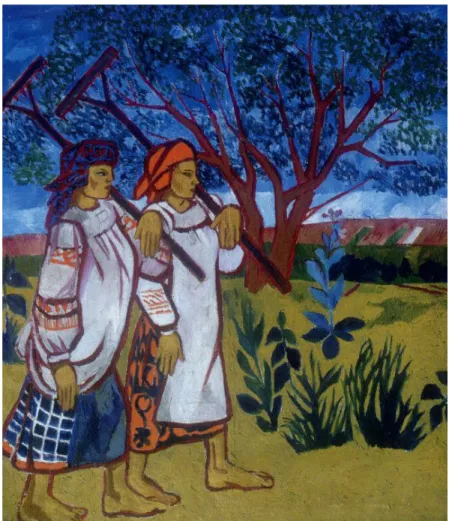
Figure 1-‐Baby s grabliami
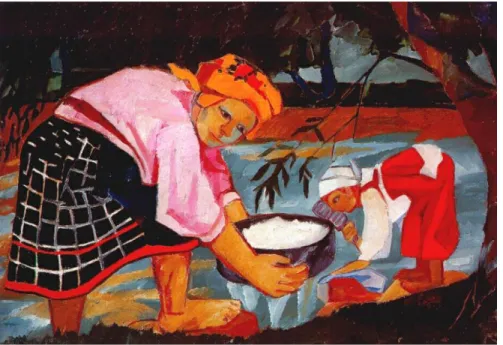
Figure 2-‐Krest'yanki
paintings shown in figures 1, Baby s grabliami (Peasant Women with Rakes, 1907) and 2, Krest’yanki (Peasant Women, 1910) are particularly interesting representations of the peasantry. First, they portray only women. Second, these women are shown as hard workers and in this sense, Goncharova portrays peasant women as the backbone of Russian society. They are shown bosikom (barefoot), an aspect that enhances the notion of the strength and perseverance of these peasant women, as they have acclimated to the harsh Russian countryside enough to walk around without any protection. The women are also clothed in traditional garments. These garments recall the idyllic and traditional notions of the malorusskie, a term which designates Ukrainians. The malorusskie were seen as a more primitive form of the Russian (velikorusskie). This dichotomy is made ever more clear by the literal translations of these two terms; malo means little, while veliko means great or grand. While at first this designation seems to evince a derogatory nature (and for many it was and continues to be), the malorusskie were very respected among parts of the Russian intelligentsia. Bunin was in awe of them, and judging by Goncharova’s artwork, it appears that she was too. The peasant represents in her
paintings the organic nature of Russian culture; it is a peasant steeped in the nature of the Russkaya Ideya. The term baby is in fact a term that is used among peasants themselves.
It comes from a shortening of the word babushka (grandmother). The term not only is a designation of peasantry, but in using the term for the title of her painting, Goncharova
“throws [herself] down and wants to join with the earth and with the peasantry” to use Berdyaev’s phraseology. (Berdyaev, p. 122).3
3 Russkii genii…brocaetsya vniz i khochet slit’sya s zemlei i narodom
Goncharova does not stray away from the eschatological nature of
Russian culture. This trend is
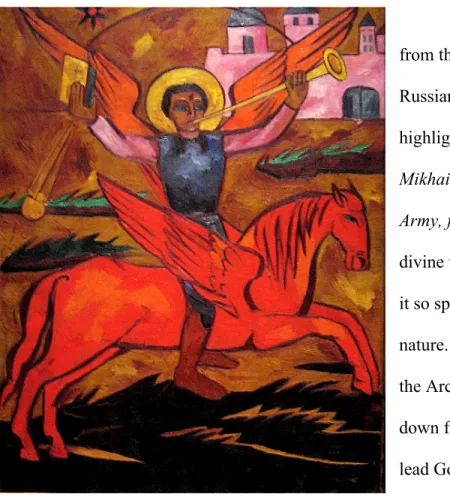
highlighted in her painting “Arkhistratig Mikhail” (Michael-Leader of God’s Army, figure 3). It is not simply the divine theme of the painting that makes it so special, but rather its apocalyptic nature. In the book of Revelation, it is the Archangel Michael who will come down from heaven at the end of times to lead God’s army and defeat Satan and bring about the New Jerusalem. In the painting, Michael is blowing a trumpet and holding aloft the word of God. These are symbols of the new world to come, when truth and harmony will reign. Therefore, Goncharova’s paintings fall directly in line with Berdyaev’s Russian Idea in that they not only portray the eschatological nature of the Russian, but they do so in evoking
traditional notions of the Russian peasantry; in particular, they portray the peasantry as the hard-working backbone of Russian society in which there is to be found true devotion and the true organic nature of Russianness.
Conclusion
What one sees in the artistic work of the Parisian émigrés is a desire to hold on to something on the verge of being lost, at least from their point of reference. While the
Figure 3-‐Arkhistratig Mikhail
members of the intelligentsia were influenced by Western ideas and philosophy, they strive to highlight the singularity of Russian culture. The peasant and the divine play a particularly grandiose role in these émigrés’ portrayals of traditional Russian culture.
Bunin, Berdyaev, and Goncharova all highlight the importance of the peasantry, and they can be seen as defenders of the common people. These essential aspects of the Russian Idea, lost during the majority of the Soviet period, would slowly find their way back into Russian society thanks to the life and work of these émigrés. In October of 2013, an exhibit entitled Natal’ya Goncharova: Mezhdu Zapadom i Vostokom (Natal’ya
Goncharova: Between West and East) opened in the Tret’yakov Gallery in Moscow. This opening highlights the renewed interest in émigré art and how the legacy of the Parisian émigrés is continuing to insert itself into contemporary Russian culture. In the next chapter, I will discuss two returnees to Soviet Russia, Marina Tsvetaeva and Aleksei Tolstoi. While they were once émigrés themselves, their works differ in substantial ways from those of the émigrés discussed in the previous two chapters in terms of style and content. They are also important figures in the attempt to reconcile émigré and Soviet literature, a process that is becoming more evident in contemporary Russia.
Chapter 3
Tsvetaeva’s Tragedy and Tolstoi’s Triumph
While the figures in the past two chapters left Russia and made the difficult decision never to return, Marina Tsvetaeva and Aleksei Tolstoi (no direct relation to Lev’
Tolstoi) decided to return to their rodina (homeland), which had transformed into a socialist state. While Aleksei Tolstoi returned rather early to Soviet Russia in 1923, only five years after he left in 1918, Marina Tsvetaeva returned on the brink of war in 1939.
Tolstoi came to sympathize with the Bolshevik cause despite the fact that he fought in the White Army during the Russian Civil War. Receiving a warm welcome upon his
homecoming in 1923, Aleksei Tolstoi went on to become a successful Soviet writer hailed by many, including fellow returnee Maxim Gorky. His most notable work to this day is his novel Petr I (Peter the First, 1929-34), which Gorky called “the first real historical novel of the Soviet age” (cover page, Tolstoi). Meanwhile, Marina Tsvetaeva received no such praise from Soviet officials upon her return to Russia or in the ensuing days until her death. She had trouble finding someone to publish her works in Russia, and her daughter and husband were arrested not long after their homecoming. Although Tsvetaeva longed for her homeland the entirety of her absence from Russia, Russia showed no sign that it had missed her at all. The only seeming similarity between Tolstoi and Tsvetaeva is their decision to return to Soviet Russia. They both could not resist the call to return to the Motherland although Tsvetaeva resisted the call much longer. It is in fact the differences between the fates of Tolstoi and Tsvetaeva, more than their
similarities, which shed light on the literary situation in the Soviet Union and what one needed to do as an émigré in order to be “returned to the fold” so to speak. While many
have tried to simplify the Soviet realist novel, there are actually many nuances to what could be written and the political and cultural symbols used. Katerina Clark contends that the Soviet realist novel is bound by a master plot and, “If a novel [Soviet realist] is to be written to the cannon, this master plot controls the most crucial moments of the novel—
its beginning, climax, and end” (p. 5). She goes on to mention that rather than the Soviet novel taking on a class struggle characteristic, the master plot was more shaped by a coming to consciousness. (Clark, p. 15-24). This process is seen very well in Tolstoi’s Peter I, as the reader watches Peter grow from an impetuous young boy to a skillful leader and ruler. Tsvetaeva’s poetry was noticeably lacking this element of
“consciousness,” and it is for this reason that she could not successful be incorporated into Soviet literature.
The Intimacies and Ideologies of Marina Tsvetaeva
The life of Marina Tsvetaeva was, like that of many Russian poets, quite tragic.
Nina Berberova describes in her autobiography how Tsvetaeva’s material situation in emigration was very poor; it made matters worse that “as a poet in emigration, she had no readers, [and] there was no reaction to what she wrote” (Berberova, p. 202). However, Tsvetaeva’s tragedy lies not in her material poverty and her lack of readers. There were countless poets and artists in the same predicament who did not end their lives in suicide.
Yet again, neither does her tragedy lie in her suicide. The tragedy lies in the fact that for Tsvetaeva her suicide was in a sense inevitable. Berberova writes,
His [Sergei Esenin’s] end was unwarranted. Tsvetaeva, on the contrary, moved towards it her whole life, through her trumped-up love for her husband and children, through her poems praising the White Army, her
image of the hump borne so proudly, the scorn for those who did not understand her, humiliation transmuted into a proud mask, through all the fiascos of her infatuations and the ephemeral nature of the roles she assigned herself. (p. 204)
Compounded to these tragic happenings in her life, Tsvetaeva, much like
Khodasevich, struggled to live in her era. Again, like Khodasevich, this struggle stemmed from a desire to return to Russia, as well as an internal spiritual crisis. In one of her letters, Tsvetaeva writes, “Maybe my voice corresponds to the epoch, but not I. I hate my century” (Lartseva, p. 13). Perhaps Tsvetaeva hoped to find solace in her homeland, and for this she returned to Soviet Russia. However, the Russia to which she returned offered no solace because it was not the same Russia that she left. In turn, it offered no cure to her spiritual crisis. The best place to look in order to understand this crisis is her poetry.
Tsvetaeva’s poems are often of an extremely personal nature and they “convey the intimate aura of her own unfortunately turbulent life” (Pashovich, p. 1).
The beginning of Tsvetaeva’s poem Tebe—cherez sto let (To you-in a hundred years) is rather indicative of the nature and possible cause of her spiritual crisis. It begins,
To you, having been born After a century, as I respire,--
From the very depths, as condemned to death With my own hand—I write:
--Friend! Do not look for me! There’s a different style!
Not even the old remember me. (Tsvetaeva, p. 34)
This beginning highlights two distinct natures of Tsvetaeva’s tragedy. First, there is a fear of becoming obsolete. She writes to someone being born a hundred years later, and she tells him that if he looks among the writers of the preceding century, he will find no mention of her. Not even the old, who might have been alive contemporaneously with her, will remember her. This fear of becoming obsolete is coupled with the theme of death. She is writing this poem “as condemned to death with [her] own hand”; this phrase is a chilling foresight into her coming suicide. Unlike Khodasevich, who turned to critical writing and running émigré newspapers after his poetic talents “dried up”, Tsvetaeva had no such talents to fall back upon. In one of her poems, Tsvetaeva writes, “This century of mine is my poison, this century of mine is my harm,/this century of mine is my enemy, this century of mine is my hell” (p. 13).4 Like a poison, her century did kill her, even if the death was brought about by her own hand. The poem in its original Russian (given in the footnote) is even more evocative of Tsvetaeva’s struggle with her century. While the repetition and word choice come across quite well in the English translation, what is lost is the rhythm and harshness of the ending consonants. The succinctness of the Russian phrasing and the repetition of the voiceless consonants k and t at the end of words (i.e.
vek, vrag and yad, vred, ad) are evocative of frustration and anger—frustration and anger at her era and at the fact that she is not appreciated within this era by her peers.
Tsvetaeva’s homecoming was not successful in part because of her spiritual crisis, i.e. her fear of becoming obsolete, but it was also due in part to her inability to accept and condone repression. When she returned to Soviet Russia, she was met with repression.
Perhaps she expected repression, but hoped for the best. In a letter of hers from the year
4 Vek moi-‐yad moi, vek moi-‐vred moi,/vek moi-‐vrag moi, vek moi-‐ad
1934, she explains why she hates the Soviet Union. She says, “I hate [the Bolsheviks]
because they can (such as always was) deny Boris Pasternak access to his favorite Marburg, or me to my birthplace of Moscow.” She goes on to speak of the senseless sentencing and murdering of people by their own “brothers” as “an abomination to which I would submit in no place, as to any organized violence in general” (p. 12-13). The aura of repression surrounding the Soviet Union finds its way into her poem “The Soul”:
The soul, not knowing bounds,
The soul of a flagellant and of a fanatic, Anguishing under the lash.
The soul—toward a meeting with the executioner, Like a butterfly in its cocoon!
The soul, not having swallowed the offense, That they don’t burn more witches.
How tall and black they burn Smoking under the sackcloth…
The shrieking heretic, A sister of the Savanarali—
A soul worthy of the bonfire! (p. 47)
While this poem is dated as written in 1921, it was compiled with many other poems in 1940. Although this poem is rather enigmatic, the prosecution of heretics is clearly visible. This imagery is possibly a reflection of Tsvetaeva’s feelings toward Soviet censorship and repression. Tsvetaeva claims that the “soul” is worthy of the bonfire. The repressors are not destroying insignificant people. They are martyrs and
worthy of the fire. There is of course pain in martyrdom as evidenced by the “shrieking heretic,” but these martyrs are welcoming of the pain. They are “flagellant[s]” and
“fanatic[s].” Tsvetaeva can be considered to be herself one of these flagellants. In the end, it is possible that expecting repression upon returning to Soviet Russia, she decided to face it anyways in order to die in her homeland. Viewed in this way, she welcomed death as the only way through which she could overcome becoming obsolete; namely, death offered her martyrdom, sainthood, and therefore a way to be remembered. This sentiment reminds one of Bunin’s fear of becoming obsolete, and it confirms that this fear is a central component of the Russian émigré.
Unlike Tolstoi, who seems to have been able to reconcile himself rather early on with the repression of the Bolsheviks (at the least their ideology), Tsvetaeva could not bring herself to be content within a system that destroyed its writers and its “brothers.”
Moreover, she did not receive the recognition and fame in the Soviet Union, as did Tolstoi. This disparity in recognition could be due to the fact that while Tsvetaeva’s poems were extremely personal and intimate, the works of Aleksei Tolstoi could be used to advance the socialist ideal.
Stalin the Great? Peter the First and Soviet Historiography
Aleksei Nikolaievich Tolsoi certainly lives up to his namesake and the general trend of Russian novelists as a whole with his work Peter the First. He worked on this historical novel for two decades and after over 700 pages, having died before he could finish the novel, he had only described half of the Tsar’s life. Peter the First not only describes the person of Peter Alekseevich Romanov in all his contradictory nature, but it also paints a detailed picture of Petrine Russia and the immense social and cultural