
We have examined all important and much smaller museum holdings of Phyllomys species and list below all specimens of the mentioned forms encountered. The first described species that we now know as Phyllomys was Nelomys blain-vilii Jourdan, published in the Comptes Rendus of the Academy of Sciences for July-December 1837. 34;Ce genre forme aux depens du genre Echy-mys [sic ] des auteurs , a pour type 1'Echimys crsitatus [sic]." Thus Nelomys is a junior synonym of Echimys according to the author's definition.
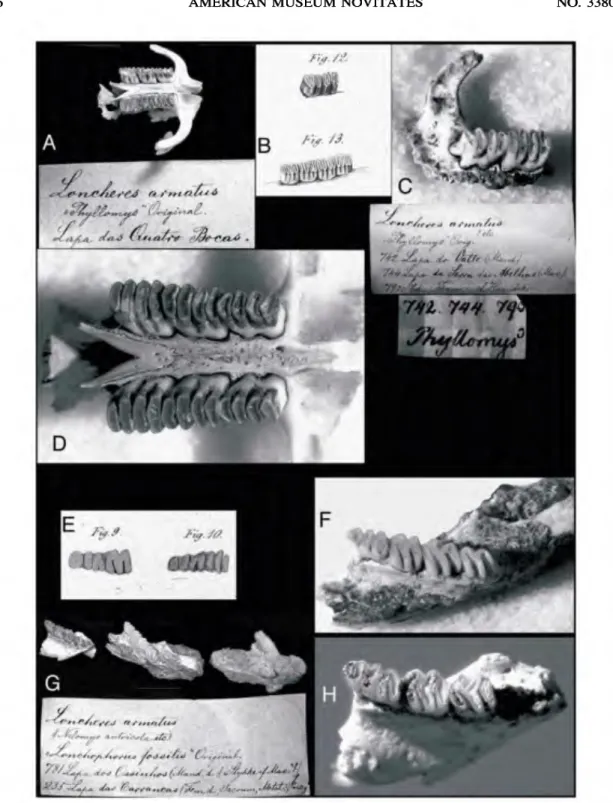
Phyllomys brasiliensis is thus the type species of the genus according to the subsequent monotypy (ICZN, 4th edition, article 69.3), although Lund never diagnosed or calculated the species. 9, and therefore the holotype of Lonchophorus fossils; G, the three mandibular fragments and associated label of the Lonchophorus fossils box; H, the mandibular fragment corresponding to Lund's (1840c) fig. Mastoid process is long and extends below the horizontal midline of the external auditory canal (EAM).
TYPE MATERIAL: Lund's first use of this name (1840c: 294) was in the same table in which the name Phyllomys brasiliensis also appears, the only description of the taxon being the illustration on the accompanying color plate (pi. The teeth on each of the three mandibles are thus distinct in size, that they certainly represent three species, all of the genus Phyllomys (our Fig. Therefore, the material on which Jourdan based his description of Nelomys blainvilii was originally part of the collections sent by Blanchet to the Geneva Museum.
His measurements, which he stated were simply of one of the three, and not necessarily the holotype (HB.
We find no ambiguity in either the identity of the holotype or the assignment of the latter specimens to the taxon (but see comments on P. kerri below). Shoes reddish-brown with black stripes, covered with relatively narrow (1 mm), medium-length (27 mm), black aristiform hairs, with thin whip-like tips (fig. 4C). Postorbital process of zygoma rounded or spinose, formed by jugal or both squa-mosal and jugal.
The type locality was not mentioned in the original description and it was long considered unknown (Cabrera, 1961; Woods, 1993), although it was published by Mertens (1925) and later by Moojen (1952), who correctly assigned the species has. to Phyllomys. Originally described as uniformly pale rusty red-brown dorsally ("diluted ferrugineo-brunea"), now faded but the right side of the specimen is still rusty and gradually grades into a buff vent. The species is the second largest of the genus (table 1) and it shares many features with P.
Aristiforms on the trunk are long (26 mm) and very fine (about 0.2 mm), paler at the base and blackish distally, with thin, whip-like tips (Fig. 4D). The cheeks are large, the palatine width is usually less than the tooth width at Ml, and the tooth rows are parallel (Fig. 11). Aristiforms on the trunk long (33 mm), relatively narrow (0.7 mm), gray-brown proximally and black distally, with a thin, whip-like tip (Fig. 4E).
Cheek teeth relatively wide, palatine width equal to or greater than tooth width at Ml, teeth parallel to slightly divergent posteriorly (fig. 12). Skull robust and long; auditory tympanic bullae small; incisive foramen drop-shaped and small (fig. 13). Mastoid process short, extending to the horizontal midline of the external auditory meatus.
The external measurements he published also do not correspond to those of the holotype, but to those of a paratype: BMNH 3.9.5.99. Cheeks broad, palatine width equal to or shorter than tooth width at Ml, tooth rows diverge slightly at both ends (Fig. 14). Skull long and narrow, palatal width equal to or greater than tooth width at Ml, tooth rows almost parallel (fig. 15).
We examined 61 specimens of the species we describe below housed at BMNH, MBML, MNRJ, MZUSP, MVZ, UFPB, UFV, and UZMC. Bergallo (HGB), Lena Geise and Rui Cerqueira (initials FS, IG), be deposited at MNRJ.

Monte Sao Francisco, Jacarepagua, Rio de Janeiro, 22°55'S 43°21'W (BMNH
Patton, in recognition of his outstanding contributions to the knowledge of the evolution and systematics of Neotropical mammals, particularly to the understanding of the diversification of echimid rodents. Most aristiforms do not have the characteristic flagellar tip on the back, which is present in all other species of Phyllomys (Fig. 4H). The spines are noticeable from the base of the tail to the head, but are longest and largest on the back.
Cutting foramen spherical and long, extending from the base to the midline of the rostrum in ventral view. Aristiforms on the rump robust, approx. 1 mm wide and 20•25 mm long; most with a blunt tip (Fig. 4H). Older animals tend to have more orange-tipped aristiforms, especially on the sides, for which it was named the rusty Atlantic woodrat by Emmons and Feer.
Pure white spots are common on venter around neck, chest and axillary and inguinal regions; some individuals have a continuous narrow white median line extending from the neck to the genitalia. These hairs are shorter near the base (3.5 mm) and lengthen near the tip of the tail, where they can reach 2 cm. Selected body and skull measurements (in millimeters) of the holotype and four adult paratypes of Phyllomys pattoni.
Penetrating foramen narrow and long, extending from base to midline of rostrum in ventral view; bullet shaped. In addition, Leite (2001) found considerable genetic differentiation (more than 10%) in DNA sequences of the mitochondrial cytochrome b gene between P. Thomas (1916b) tentatively used the name brasiliensis for the specimens from the "Rio de" Janeiro -region", and was followed by subsequent authors.
Our investigations of members of the genus Phyllomys revealed that all the taxa mentioned are valid species with characteristic sets of characters (table 3, species key), but further studies are needed of several species that are currently underrepresented. samples, including P. Forests within the range of members of the genus are much reduced and highly fragmented. On the other hand, the remaining populations of most species of Phyllomys may be small and patchy.

KEY TO SPECIES OF PHYLLOMYS Specimens of undescribed species can not
Supraorbital ridges well developed, beads well developed well developed well developed poorly developed Interorbital region divergent posterior divergent posterior divergent posterior convergent posterior'. Large: head and body length over 290 mm, greatest skull length over 56 mm; endemic to the island of Sao Sebastiao, on the coast of Sao Paulo P. Thorns conspicuous: aristiforms on cross more than 0.7 mm wide 5 Thorns inconspicuous or absent: aristiforms on cross less than 0.5 mm wide 6 5.
Larger body size, head and body more than 250 mm, hind foot more than 40 mm; longer maxillary dentition (length > 13.0 mm); incisors nearly orthodontic P. Aristiform on rump longer than 25 mm; mesopterygoid fossa more than 4.0 mm wide, interorbital constriction more than 12.0 mm P. Tail thickly hairy with a tuft at tip; scariforms on rump less than 0.9 mm wide P.
We thank Joel Clary for kindly providing us with photographs of the Lyon specimens and Manuel Ruedi for investigating the source of the Geneva specimens. Karen Klitz prepared one of the figures and Robert Jones carefully prepared the type specimens of P. A revision of the arboreal Echimyidae (Rodentia: Echimyidae, Echimyinae); with descriptions of two new genera.
Systematics of the Atlantic tree rats, the genus Phyllomys (Rodentia, Echimyidae) and the evolution of echimyid rodents in South America.