i
OBSERVATIONAL LEARNING OF ACADEMIC AND SOCIAL BEHAVIORS DURING SMALL GROUP DIRECT INSTRUCTION
By
Jennifer R. Ledford
Dissertation
Submitted to the Faculty of the Graduate School of Vanderbilt University
in partial fulfillment of the requirements for the degree of
DOCTOR OF PHILOSOPHY in
Special Education December, 2012
Nashville, Tennessee
Approved:
Professor Mark Wolery Professor Ann Kaiser Professor Mary Louise Hemmeter
Professor Glen Dunlap
ii
ACKNOWLEDGEMENTS
I am grateful for financial support provided by the Semmel Family, the Peabody College Dean's Professional Development Fund, and the Early Childhood Special Education Leadership Grant. I am thankful to the members of my committee—Drs. Mark Wolery, Ann Kaiser, Mary Louise Hemmeter, and Glen Dunlap—for their guidance and feedback.
I am also grateful to the teachers and administration at the Susan Gray School,
particularly Dr. Ruth Wolery who helped me during this study and others, and Abby Green, for always welcoming me to her classroom. Thanks to Jessica Decker, Meredith Shanks, Meredith James, Courtney Murphy, and Maria Lemler for their help—it would have been impossible to do this alone.
Without the tireless support and advising of Dr. Mark Wolery, the conception and conduct of this dissertation would not have been possible. I am thankful for the opportunity to learn from the best.
iii
TABLE OF CONTENTS
Page
ACKNOWLEDGEMENTS ... ii
LIST OF TABLES ... iv
LIST OF FIGURES ...v
Chapter I. INTRODUCTION ...1
II. METHOD ...6
Participants ...6
Settings ...13
Teaching and Measuring Academic Behaviors ...14
Screening Condition...14
Probe Conditions ...16
Instructional (PTD) Conditions...17
Teaching and Measuring Sharing ...22
Training Group Mates to Share...22
Instructional Sessions...25
Generalization Sessions ...27
Collateral Measures ...30
Free Play Sessions...30
Peer Preference Sessions...33
Experimental Design ...36
Procedural Fidelity ...37
Probe and Instructional Conditions ...37
Generalization ...40
Collateral Measures ...43
Interobserver Agreement (IOA) ...43
Probe and Instructional Conditions ...43
Generalization ...44
Collateral Measures ...44
III. RESULTS ...46
Academic Behaviors ...46
Research Question #1 ...47
Research Question #2 ...58
Sharing ...61
Research Question #3 ...61
iv
Research Question #4 ...62
Research Question #5 ...64
Collateral Measures of Affiliation ...70
Research Question #6 ...71
Research Question #7 ...73
Research Question #8 ...79
IV. DISCUSSION ...82
Academic Behaviors ...82
Sharing ...85
Collateral Measures ...88
Limitation ...89
Implications...91
Appendix A. GLOSSARY...93
B. ASSESSMENT OF INCLUSION CRITERIA ...96
C. VERBAL IMITATION SCALE/DATA COLLECTION FORM ...97
D. MOTOR IMITATION SCALE/DATA COLLECTION FORM ...98
E. IMPLEMENTER, PROCEDURES, AND PARTICIPATING CHILDREN ...99
F. SHARING EXAMPLES AND NON-EXAMPLES FOR GENERALIZATION SESSIONS ...101
G. RULES FOR PROXIMITY ...102
H. CODING DEFINITIONS, EXAMPLES, AND NON-EXAMPLES FOR FREE PLAY SESSIONS ...104
I. EXAMPLES FOR SEGMENTING RULES FOR SOCIAL INTERACTIONS DURING FREE PLAY SESSIONS ...106
J. DATA FOR WITHDRAWN PARTICIPANT...107
K. DATA FROM INDIVIDUAL SESSIONS WITH COBY ...108
REFERENCES ...109
v
LIST OF TABLES
Table Page
1. Participant Information ...10
2. Assignment of Stimuli to Sets and Participants ...18
3. Average Procedural Fidelity and Ranges across Sessions by Researcher Behavior during Probe Sessions ...38
4. Average Procedural Fidelity and Ranges across Sessions by Researcher Behavior during Instructional Sessions ...39
5. Procedural Fidelity Data for Generalization Sessions ...41
6. Procedural Fidelity Data for Free Play Sessions ...42
7. Average Interobserver Agreement by Group and Condition ...44
8. Measures of Efficiency of Teaching Academic Behaviors by Participant ...57
9. Observational Learning of Academic Behaviors ...60
10. Sharing and Negative Interactions by Condition ...77
11. Peer Preference Rankings ...81
vi
LIST OF FIGURES
Figure Page
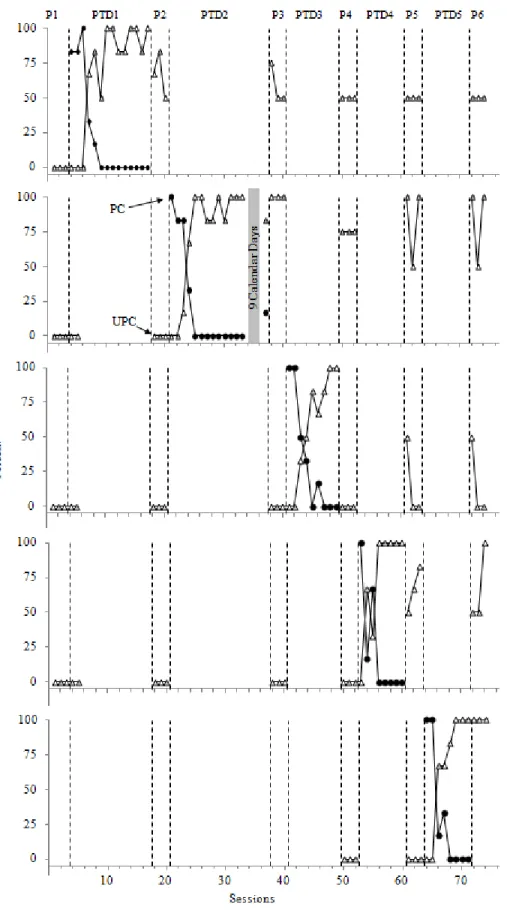
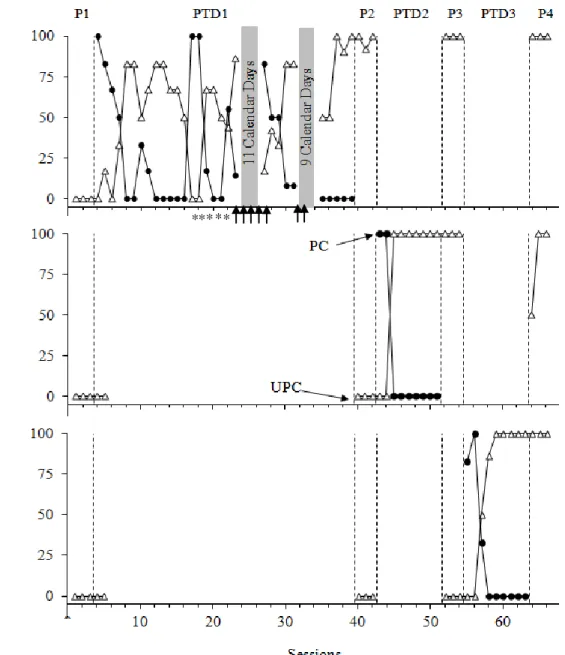
1. Prompted (PC) and unprompted (UPC) correct responses during
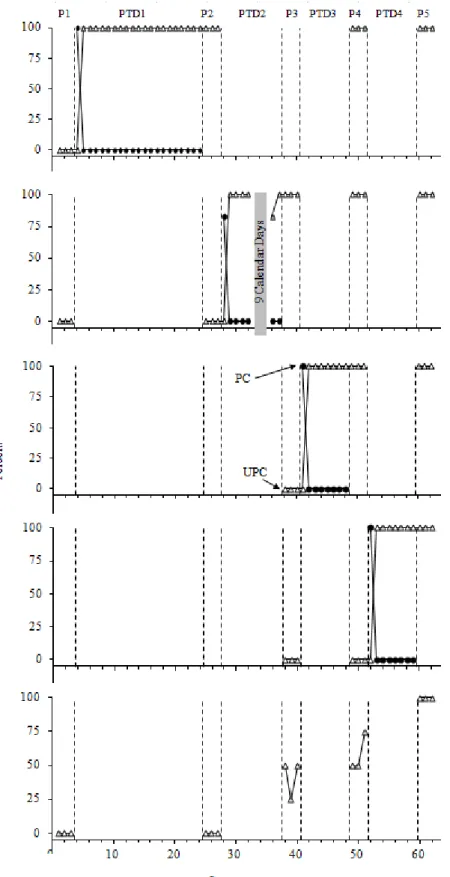
probe (P) and instructional (PTD) conditions for Alex. ...48 2. Prompted (PC) and unprompted (UPC) correct responses during
probe (P) and instructional (PTD) conditions for Ani. ...49 3. Prompted (PC) and unprompted (UPC) correct responses during
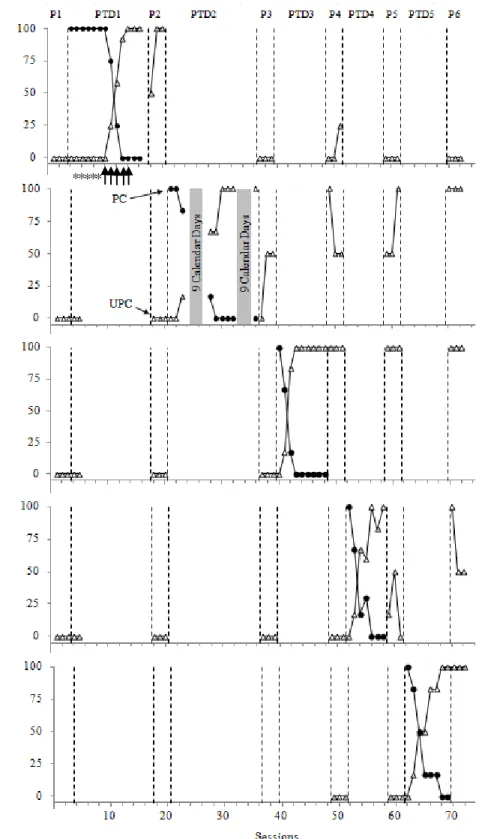
probe (P) and instructional (PTD) conditions for Adam. ...50 4. Prompted (PC) and unprompted (UPC) correct responses during
probe (P) and instructional (PTD) conditions for Brad. ...51 5. Prompted (PC) and unprompted (UPC) correct responses during
probe (P) and instructional (PTD) conditions for Blair. ...52 6. Prompted (PC) and unprompted (UPC) correct responses during
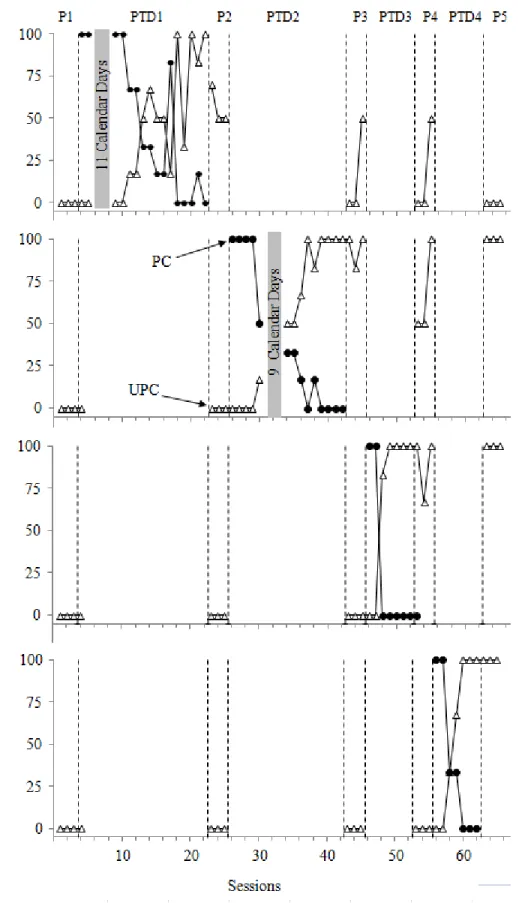
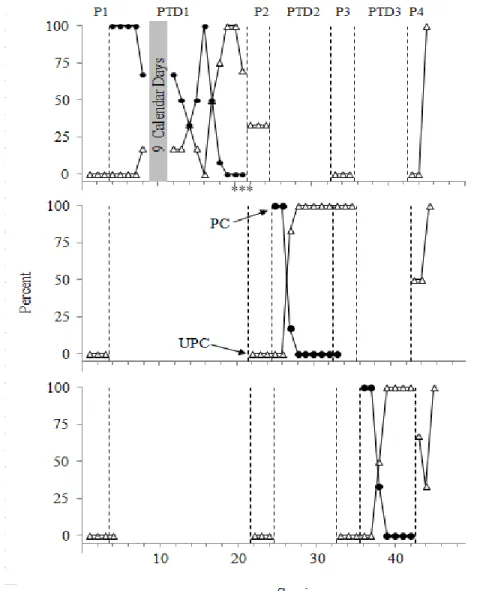
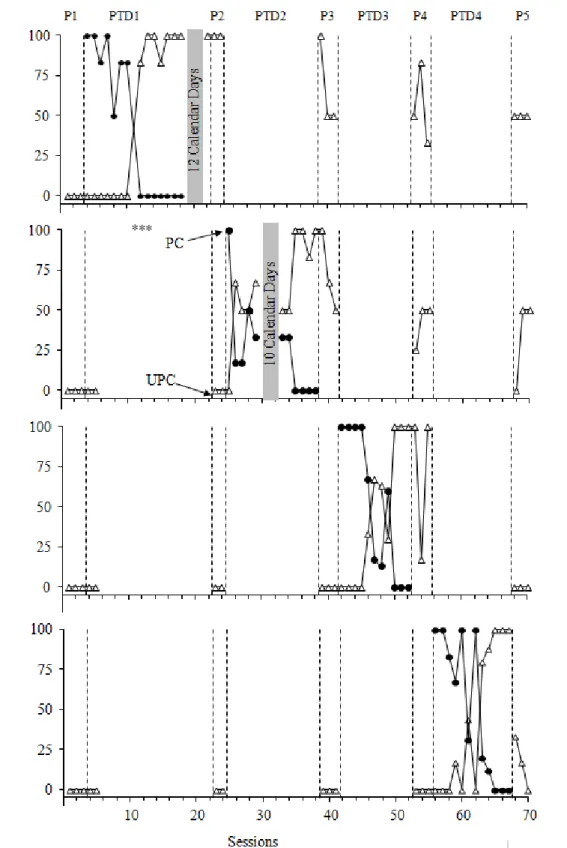
probe (P) and instructional (PTD) conditions for Beck. ...53 7. Prompted (PC) and unprompted (UPC) correct responses during
probe (P) and instructional (PTD) conditions for Coby. ...54 8. Prompted (PC) and unprompted (UPC) correct responses during
probe (P) and instructional (PTD) conditions for Cade. ...55 9. Prompted (PC) and unprompted (UPC) correct responses during
probe (P) and instructional (PTD) conditions for Cain. ...56 10. Acquisition of unprompted sharing behaviors during instruction by
participants with disabilities (Alex, Brad, and Coby), and their group
mates during baseline and observational learning conditions ...64 11. Percent of opportunities immediately (within 10 s) following material
access during which children shared. ...67 12. Total number of shares for group mates with and without disabilities
during generalization sessions ...69 13. Duration of proximity to group mates for participants during free play
sessions conducted prior to small group instruction, before sharing training,
and following sharing training ...72
vii
14. Social interactions among group mates during free play sessions conducted prior to small group instruction, before sharing training,
and following sharing training. ...74 15. Social interactions directed towards group mates with disabilities by
their group mates during free play sessions conducted prior to small
group instruction, before sharing training, and following sharing training ...75
1 CHAPTER I
INTRODUCTION
Using response prompting procedures during small group direct instruction has been effective for almost 200 participants with and without disabilities in at least 47 published studies (for a review, see Ledford, Lane, Elam, & Wolery, 2012), including 7 studies conducted with preschool-aged participants (e.g., Alig-Cybriwsky, Wolery, & Gast, 1990; Venn, Wolery, &
Greco, 1996). If each participant is taught different behaviors during small group direct instruction, they may learn behaviors taught to their group mates, referred to as observational learning (Bandura, 1977). Learning observationally from group mates results in increased teaching efficiency. In the review, 33 of 47 studies were structured so observational learning could occur. Almost all participants (98%) learned at least some behaviors not directly taught to them, and about 20% learned all behaviors taught to their group mates (Ledford et al., 2012).
In previous studies, observational learning was typically measured for discrete academic behaviors (e.g., naming words) for school-age participants. Few studies with preschool
participants measured observational learning of stimuli assigned to group mates. Only one published study was conducted with groups of participants with and without disabilities; this study did not measure observational learning (Venn et al., 1996). Given that small group
instruction has been successful for many participants, including preschoolers, small group direct instruction with opportunities for observational learning is recommended practice for early childhood classrooms to increase instructional efficiency when teaching academic skills (Wolery
& Hemmeter, 2012). The evidence for the occurrence of observational learning for academic
2
behaviors raises the question of whether social behaviors, such as peer-directed prosocial behaviors, could be acquired observationally in small group direct instruction on academic behaviors. Ledford and Wolery (in press) evaluated this proposition by showing initial evidence that some social skills (i.e., sharing and to a lesser extent saying “thank you”) can be acquired observationally during small group instruction on academic behaviors.
Acquisition of social skills is important because peer-related prosocial behaviors are necessary for successful performance in early childhood settings (Lane, Stanton-Chapman, Jamison, & Phillips, 2007) and are important predictors of later school performance and peer acceptance (Kohn & Rosman, 1972; Odom et al., 2006; Ullman, 1957). Prosocial behaviors (e.g., sharing, helping, and giving compliments) benefit young children by increasing friendship
opportunities and access to play activities and progressively more complicated social exchanges (Ladd, 2008). However, children who do not exhibit prosocial behaviors may be denied these learning opportunities, leading to more delayed social skills. In addition, failure to exhibit prosocial behaviors may lead to decreased peer affiliation for preschoolers with and without disabilities (Quay & Jarrett, 1984; Walker, 2004; Wood, Cowan, & Baker, 2002). Reported peer preference for children with disabilities is lower when compared with typically-developing peers (Kuhne & Wiener, 2000; Sale & Carey, 1995), and does not always improve following social skills interventions, even when direct observation shows an increase in prosocial behaviors in typical settings (Odom et al., 1999). Interventions that result in positive changes in both prosocial behaviors and peer affiliation may be particularly advantageous for young children with disabilities.
Sharing, in particular, is a prosocial behavior that is likely to result in positive responses from peers when exhibited by both children with and without disabilities (Hendrickson, Strain,
3
Tremblay, & Shores, 1982; Strain, 1985). In addition, parents and teachers report that sharing behaviors (e.g., "waits turn") are important for preschoolers (Lane et al., 2007), and young children commonly name sharing as a positive behavior exhibited by other children (Tisak, Holub, & Tisak, 2007). Therefore, it may be that increasing sharing by children with disabilities would increase reported preference for those children by their peers. However, opportunities to share may not occur frequently enough during typically-occurring activities for children with disabilities to become proficient sharers. Thus, sharing appears to be an important behavior for children with disabilities to learn, and the acquisition of this behavior may occur when increased observation and practice opportunities are provided in the context of small group direct
instruction.
In the Ledford and Wolery (in press) study, the acquisition of sharing behaviors during small group instructional sessions was measured when one participant with disabilities and two typically developing group mates were taught discrete academic skills using a progressive time delay procedure (PTD; Wolery, Ault, & Doyle, 1992). Prior to the small group sessions, peers were taught with PTD to share tokens given for correct responding and to say "thank you" when their peers shared (independent variable for observational learning of sharing by child with disabilities). Typically developing peers shared with high fidelity (i.e., frequently) during small group instructional sessions, and participants with disabilities shared during some instructional sessions. During generalization sessions (art and snack activities) conducted before and after instruction on each academic behavior set, sharing consistently increased. Thus, it may be that small group instruction is not only a likely context for learning academic behaviors
observationally, but for learning consistently modeled social behaviors as well. The increase in sharing during generalization sessions may be the result of frequent (a) opportunities to observe
4
peers share; (b) opportunities to be the recipient of sharing; and (c) practice sharing in a simple, predictable context. Because peers shared many times across sessions, children with disabilities were the frequent recipients of prosocial sharing initiations. Thus, the increase in sharing by children with disabilities is in line with previous research showing increased peer social initiations resulted in greater social overtures by young children with disabilities (Strain &
Kohler, 1995).
The results of the Ledford and Wolery (in press) study suggest children with disabilities may learn social behaviors modeled by typically developing peers during small group direct instructional sessions. This study, however, had a number of limitations. First, generalization sessions were conducted by the adult who also conducted instructional sessions; her presence may have become the discriminative stimulus for sharing. Second, the research design evaluated the acquisition of academic behaviors rather than sharing behaviors. Thus, although sharing increased for all participants across time in instructional and generalization sessions, no controls existed for common threats to internal validity such as maturation or history. Changes in sharing may have occurred because of factors other than peer modeling during small group direct
instructional sessions. Third, no measures of affiliation or of social behaviors during classroom activities were collected, although anecdotal teacher reports suggested positive changes in both.
It is unclear whether the anecdotally-reported changes in affiliation were due to small group instruction (e.g., the observation of teaching and reinforcement for correct responding), to peer modeling of sharing (e.g., increased opportunities for prosocial interactions), both experiences, or none of these possibilities.
The present study was designed to address these limitations. Two concurrently
implemented research designs were used to evaluate eight questions related to the acquisition,
5
observational learning, and generalization of academic and sharing behaviors and changes in peer affiliation over time. The research questions related to academic behaviors are: (1) Is PTD effective for teaching names of academic stimuli to preschoolers with and without disabilities in small group direct instruction? and (2) Will preschoolers with and without disabilities learn to name their group mates’ academic stimuli through observational learning? The research questions related to sharing are: (3) Is PTD (used in two short sessions following an initial baseline condition but outside regular small group instructional sessions) effective for teaching participants without disabilities to share during small group instructional sessions? (4) Will participants with disabilities share more often during instructional sessions when group mates without disabilities model sharing than in no-sharing (baseline) instructional sessions? and (5) Will all participants share more in generalization contexts (art and snack) when specific opportunities to share exist and the instructor of the small group direct instruction sessions is absent? The research questions related to possible collateral changes in peer affiliation are:
Following small group instruction with and without modeling of sharing by typically-developing group mates, will group mates with and without disabilities: (6) Exhibit higher rates of social interactions directed towards their group mates during free play? (7) Engage in more interactions with each other during free play? and (8) Will participants with and without disabilities rate their group mates more favorably on a post-instruction peer preference measure when compared with pre-instruction ratings?
6 CHAPTER II
METHODS
In this study, two research designs were used: One to evaluate acquisition of academic behaviors and another to evaluate acquisition of sharing behaviors. Some sessions were designed to assess academic behaviors (screening and probe sessions), others were designed to teach or assess sharing (teaching typically developing group mates to share [TGMS] and generalization sessions), and others were designed both to teach academic behaviors and to assess sharing behaviors (instructional sessions). Two types of sessions (free play and peer preference sessions) were used to assess changes in affiliation, a potential side effect of small group instruction.
Following a description of participants, I describe methods used in three sections. First, I describe sessions and measurement related to academic behaviors. Second, I describe sessions and measurement related to social behaviors. Instructional sessions will be described in both sections, first in relation to the measurement of academic behaviors, and then in relation to measurement of social behaviors. Finally, I discuss sessions and measurement related to
affiliation. In Appendix A, a glossary is included to define the children involved in the study, the adult personnel used to carry out the study, and the types of sessions.
Participants
Three preschoolers with disabilities and 6 preschoolers without disabilities were recruited from an inclusive university-affiliated early childhood program. Each small group had one participant with a disability and two participants without disabilities. Inclusion criteria for all participants were: (a) age between 36 and 66 months, (b) verbal imitation, (c) motor imitation
7
(measured with the Motor Imitation Scale; Stone, Ousley, & Littleford, 1997), (d) identified reinforcers, (e) identified unknown academic stimuli, and (f) consistent attendance. An additional inclusion criterion for participants with disabilities was teacher nomination as a child who did not share materials with classmates during typical activities. Additional inclusion criteria for participants without disabilities were: (a) attendance in the same class for at least an hour each day as the identified participant with a disability, and (b) teacher nomination as a child who was likely to share in typically-occurring activities. Additional classmates served as comparison peers during peer preference assessments but are referred to as peers rather than participants for the remainder of the manuscript. These peers were chosen randomly to match disability status and gender of group mates (when possible), but no additional inclusion criteria were used.
Dimensions, sources, and criteria for inclusion-related variables are shown in Appendix B;
Verbal and Motor Imitation Scales are shown in Appendices C and D.
Alex was a 4-year old child with autism who participated in small group instruction with Adam and Ani (Group A; Table 1). Alex had many age-appropriate academic skills (e.g., naming shapes, colors, letters, and numbers; counting with 1:1 correspondence). He often displayed aggressive behaviors towards peers and when asked to share, Alex would respond with "no" or ignore a peer, often turning away. When peers had preferred items, Alex would often push, hit, or kick the child, grab the items, and run away. At the beginning of the study, Adam, Ani, and Alex were all assigned to different classrooms but were in the same room for early care (7:30- 8:30 AM) each day. Approximately halfway through the study, children in the school were assigned to different classrooms, and at this time Alex and Ani were assigned to the same classroom throughout the day. Adam continued to attend early care in the same room with his group mates and his class shared twice-daily playground times with Ani and Alex's class.
8
Brad was a 4-year old with profound sensorineural hearing loss and language delays who participated in small group instruction with Blair and Beck (Group B; Table 1). Brad wore a cochlear implant in one ear and a hearing aid in the other; a sound field FM system was available in the classroom but was used only during whole-group activities. Brad often chose to play in areas away from peers, and did not engage in sharing without teacher prompting. One typically- developing peer originally chosen as a group mate for Brad left shortly after the study began (during instruction on the first behavior set). Blair replaced this group member during the final four sessions of instruction on the first behavior set, but she was presented with known stimuli (letters) during these instructional sessions rather than unknown stimuli. Thus, she was taught 3 rather than 4 sets of words. Throughout the study, Blair and Brad were in the same classroom all day; Beck was in a different classroom until 3:00 PM but was in the same group as Blair and Brad from 3:00-4:00 each day and shared twice-daily playground times with Blair and Brad's class.
Coby was a 3-year old child with autism who participated in small group instruction with Cade and Cain (Group C; Table 1). Coby had recently learned to name some academic stimuli (e.g., letters, colors) and was able to name some pictures of common items. Coby often engaged in escape behaviors when peers were in proximity, took items from peers without asking, and often cried or screamed when peers took preferred items. At the beginning of the study, teachers reported never having seen Coby communicate meaningfully and independently with a peer.
Teachers also reported he did not imitate peers during typical classroom activities. Cade, Cain, and Coby were all assigned to the same classroom for the duration of the study; halfway through the study, all group mates moved together from one classroom to another.
9
Neither Brad nor Coby was intelligible to novel listeners without contextual clues. Brad was intelligible to familiar adults and peers, and often used gestures and intonation appropriately to assist listeners to understand his speech. Coby was sometimes intelligible to familiar adults, particularly at the single-word level. He did not use gestures, intonation, or other strategies to increase understandability and he primarily communicated by physically moving adult hands to gain access to preferred items or activities.
10 Table 1
Participant Information
Age
Race/
Gender Diagnosis Academic Behaviors Social Behaviors
Group A Alex
58 months
W/
Male
Autism Correctly named colors, shapes, all uppercase letters, and his own name;
when asked to name words, he often guessed a previously taught word with one or more shared letters; named one previously untaught word during initial probe sessions (zebra)
Often played alone and did not tolerate proximity to peers without teacher support unless peers had preferred materials (electronic devices or cars); often engaged in aggressive behaviors (e.g., throwing toys at peers, hitting), particularly when a peer had a preferred item; did not share
materials with peers unless prompted
Ani 47
months
AA/
Female
None Correctly named colors, shapes, 15/26 uppercase letters, her own name in print and other words specifically taught in a separate study; attempted to name some words by guessing previously taught words with one or more shared letters;
named no previously untaught words
Played appropriately with peers most of the time; exhibited appropriate sharing and other prosocial behaviors (e.g., helping) often; exhibited some minor inappropriate behaviors (ignoring teacher requests,
"bossing" other children); did not typically attempt to play with Alex during their regular early care play time, would occasionally engage with him by telling him what to do
Adam 45
months
AA/
Male
None Correctly named colors, shapes, all uppercase letters, and his own name in print; when asked to name any other words, he named the beginning letter or said "I don't know that one"
Played appropriately with peers; exhibited appropriate sharing and other prosocial behaviors (e.g., helping) often; did not typically attempt to play with Alex during early car
11 Table 1, cont.
Group B
Brad 51
months M/
Male
Hearing and speech impairment
Correctly named colors, shapes, 18/26 uppercase letters; recognized own name in print but no other screened words;
when asked to name words, he often named the beginning letter
Often played alone; rarely recruited peer attention although he would sometimes engage in appropriate activities with peers when they initiated play; sometimes engaged in inappropriate behavior with peers (e.g., grabbing)
Blair 47 months
W/
Female
None Correctly named colors, shapes, 24/26 uppercase letters; recognized own name in print but no other screened words; did not attempt to name unknown words
Played appropriately with peers; exhibited appropriate sharing and other prosocial behaviors (e.g., helping) often; did not typically attempt to play with Brad during their regular late care play time
Beck 54
months A/
Male
None Correctly named colors, shapes,
uppercase letters; recognized own name in print; attempted (incorrectly) to name most screened words by guessing a familiar word with the same beginning letter
Played appropriately with peers; exhibited appropriate sharing and other prosocial behaviors (e.g., helping) often; did not typically play with Brad during their regular late care play time
Group C
Coby 47
months W/
Male
Autism Correctly named colors, shapes, all uppercase letters; did not recognize any words, including his own name; when asked to name words, he often named the beginning letter
Often wandered alone during play times and avoided classroom areas where peers were playing; often took preferred
materials from peers without requesting them; if a peer took a requested item or had a requested item he could not grab, he often cried/screamed
12 Table 1, cont.
Cade 56
months A/
Female
None Correctly named colors, shapes, all uppercase letters, and many common words
Played appropriately with peers; exhibited appropriate sharing and other prosocial behaviors (e.g., helping) often; was named as the peer who most often tried to engage Coby and the peer he would tolerate proximity to most often
Cain 47
months W/
Male
None Correctly named colors, shapes, 12/26 uppercase letters, and his own name in print. When asked to name other words, he said "I don't know" or said a sentence while pointing to each letter
Played appropriately with peers but played alone more than many typically developing peers; had only been attending his current school for 2 months; exhibited appropriate sharing and other prosocial behaviors (e.g., helping) often
Note: W=White/Caucasian, AA=African American, M=Multiracial, A=Asian
13 Settings
Participants were all enrolled in a full-day, year around, university-affiliated early childhood program. Participants were enrolled in classes serving primarily 3- to 5-year-old children with and without disabilities. During the school day, classes were staffed by a teacher, teaching assistant, and a paraprofessional employed by the local school system. All sessions were conducted in one of four classrooms or common areas at the school (e.g., a multipurpose room used during after care, playground) while other children participated in typical classroom activities. Sessions occurred at different times during the school day for each group. Participants in Group A engaged in study activities during "early care" (7:30-8:30 a.m.). During early care, two teachers and/or teaching assistants supervised up to fifteen 3- to 5-year olds during free play in one of the four preschool classrooms before the beginning of the school day, at which time the children were taken to their assigned classrooms. Participants in Group B engaged in study activities during "late care," between 3:00 and 4:00 p.m. During this time, after the school day ended, one teacher or teaching assistant supervised approximately 6-12 children as they
participated in free play or other activities (e.g., music and movement, art, blocks). Because early and late care locations were rotated throughout the school, Group B received instruction in a different classroom each day. Group C participated in study activities during the time when their classmates were finishing clean-up for lunch and settling for nap (a time designated by classroom teachers as problematic for Coby due to high rates of stereotypic and disruptive behaviors). This group participated in study activities in a multi-purpose classroom used during late care, and were returned to their classroom for nap when the transition between lunch and nap was finished for their classmates. The exception to this timing for Group C is for free play sessions, which were conducted during that group's normal free play time in the classroom (approximately 9:30
14
a.m.). When time did not permit all members of a group to complete individual screening or probe sessions during their scheduled time, these individual sessions were conducted at other times during the school day designated as convenient by the classroom teacher. All sessions were conducted by the researcher or one of five graduate students; implementers and participating children for each session type are shown in Appendix E.
Teaching and Measuring Academic Behaviors
Acquisition of academic behaviors (reading words) was assessed during screening and probe conditions, and these behaviors were taught during instructional conditions. These conditions are described below, in the order in which they occurred. Screening, probe, and instructional conditions were all conducted by the researcher who also collected data on student responses. A video camera was used for recording each session; it was set up prior to bringing participants to the area so that stimuli were visible and the participants' verbal responses could be heard. Recordings were used to assess interobserver agreement and procedural fidelity; a live recorder of data was not used so that graduate students (who were implementers of
generalization sessions) could remain unaffiliated with instruction.
Screening condition. The purpose of the screening condition was to identify unknown academic stimuli to be assigned to sets for teaching. Screening occurred prior to the first probe condition. Three participants from each of three small groups (9 participants) were tested in 1:1 sessions across 3 days. The sessions occurred at a table with the child sitting at a side near a corner and the researcher sitting at the end of the table. The researcher recorded data on participant responses during each trial.
Target stimuli and materials. For screening sessions, 46 potential target words (presented once each) and 10 known stimuli (uppercase letters; presented 5 times each) were
15
presented in 3 sessions (32 trials per session). Target and known stimuli were randomly intermixed using the random function to order a list of words in Microsoft Excel®. Materials used during screening sessions include: Instructional stimuli, tokens and token boards, stickers, and small edibles. Words and letters were presented on 8x13 cm cards with Times New Roman size 72 font. Tokens were colored plastic disks (2.5 cm in diameter). Token boards, provided as a location to place earned tokens, were 22x28 cm laminated construction paper with circles printed to indicate to participants where tokens should be placed. For each of three tokens earned, a single edible was available at the end of the session (e.g., for 18 correct responses during screening sessions, 18 tokens and 6 edibles were given; for 6 correct responses during
instruction, 18 tokens and 6 edibles were given). If a child received more tokens than "circles"
were available, a section of the token board was designated for "extra tokens" but no additional reinforcers were provided for these tokens—thus, a maximum of 6 edibles could be earned in a single session.
Target behaviors and response definitions. All participants were asked to name printed
words from common preschool themes (transportation, animals, food, and playground/water play), excluding words that were likely to be used as labels in classrooms (e.g., "cars"). The target behavior was for children to name a word or letter presented on a small card when asked
"What is this?" or a similar phrase ("What's this?" "What's this one?"). During screening sessions, three responses were possible: (a) unprompted corrects—participant said a correct response to "What is this" within 3 s of the question; (b) unprompted errors—participant said a word that was different from the correct response within 3 s of the question; and (c) no
response—participant said no word within 3 s of the question. Non-word vocal stereotypy was not considered a response.
16
Procedures. To begin each session, the researcher gave a general attending cue ("Look"
or "Ready?") and presented the first stimulus after the participant oriented towards the stimulus or researcher. For each trial, "What word?" or a similar question (e.g., "What's that?") was asked by the researcher as the word was presented and the child was given a 3-s response interval. The researcher delivered praise and a single token for correct responses, and ignored incorrect answers and no responses. Following sessions, tokens were exchanged for small edibles (e.g., fish crackers). Following screening conditions for all groups, 24 stimuli were chosen for each group (8 target stimuli per participant).
Probe conditions. The purposes of probe conditions were to assess whether (a)
participants correctly named target words assigned to each behavior set and (b) named the target words assigned to their group mates. Three participants from each of three small groups (total=9) participated in 1:1 sessions across 3 days in each condition. Probe conditions occurred for three sessions prior to instruction on the first behavior set and following criterion-level performance on each behavior set. Blair and Coby were taught three sets of words, and participated in 4 probe conditions; Brad, Beck, Cade, and Cain were taught four sets of words, and participated in 5 probe conditions; all participants in Group A were taught 5 sets of words and participated in 6 probe conditions. The researcher conducted probe sessions and collected data on participant responding during trials (with the exception of data for Coby, which were collected from video recordings). The seating arrangement was as described for “Screening condition.”
Target stimuli and materials. During each probe condition, participants were asked to
name each word assigned as a target stimulus and to name each word assigned as a target stimulus to each group mate. During probe conditions, the researcher presented between 1 and 3 trials for each of 6 (Blair and Coby), 8 (Brad, Beck, Cade, and Cain), or 10 (Group A) target
17
stimuli and each of 12-20 stimuli taught to group mates (with more trials occurring for recently instructed sets or for the next behavior set to be taught). Thus, between 36 and 48 trials for instructional stimuli and 8-26 trials for previously known stimuli (e.g., letters) were presented.
More previously known stimuli were included in the first probe condition (n=15; due to the large number of unknown stimuli) and in all probe conditions for Coby (n=26; due to problematic behaviors and inattention during sessions with many unknown stimuli which occurred prior to the beginning of the study). All other probe sessions included 8-10 previously named stimuli.
Target stimuli, stimuli assigned as targets for group mates, and known stimuli were randomly intermixed using the random function to order a list of words in Microsoft Excel®. A fifth word set was added for Group A; these words were initially screened and were included in probe conditions 4, 5, and 6. All materials used were the same as those described under "Screening condition."
Target behaviors and response definitions. All target behaviors (verbally naming words
and letters) and response definitions (unprompted correct, unprompted error, and no response) were the same as those described under "Screening condition."
Procedures. All participants were asked to name printed words chosen following
screening and to name known stimuli identified prior to the beginning of the study (uppercase letters). All teacher behaviors, including antecedent (attending cue followed by task direction) and consequent events (praise and token for correct responding, ignoring for incorrect
responding or failure to respond) were the same as those described under "Screening condition."
Instructional (PTD) conditions. The purpose of the PTD conditions was to teach participants to read a pair of assigned target words from common preschool categories (specific stimuli shown in Table 2). Participants were taught in groups of three; thus six words were
18
taught in each session. The researcher conducted instructional sessions and recorded responding during each trial for Groups A and B; the researcher recorded responding using video recordings for Group C. Preference was given to seating the participant with disabilities between his group mates. In some sessions, participants sat on a single side of a long table and in some sessions, two group mates sat along one side while the third group mate sat near them on an adjacent side.
Table 2
Assignment of Stimuli to Sets and Participants
Participant
Behavior Set
1 2 3 4 5
Alex bus slide hippo cookie pig
plane pool frog milk lion
Ani truck swing monkey apple goat
boat ball zebra banana giraffe
Adam crane goggles camel rice owl
tractor tunnel sheep cheese duck
Brad swing bus cookie frog --
pool plane banana zebra --
Blair -- truck apple monkey --
-- boat milk sheep --
Beck goggles crane rice camel --
tunnel tractor cheese hippo --
Coby apple -- truck swing --
milk -- bus pool --
Cadea rice camel accident recess --
popsicle gazelle vacation exercise --
Cain cookie monkey boat slide --
banana frog plane ball --
Note: Some participants were taught more behavior sets than others; -- indicates that no behaviors were taught. aCade identified some previously unknown target words prior to instruction on the third word set. At this time, new words were assigned to word sets 3 and 4 (accident, vacation, recess, exercise). Her data are shown in Figure 8.
19
Target stimuli and materials. Six stimuli (two per participant) were taught during each
session, and were randomly intermixed, using the random function to order a list of words in Microsoft Excel®, with no stimulus presented for more than two consecutive trials and no participant receiving more than two consecutive trials. Each stimulus was presented three times per session, for a total of six trials per participant and 18 trials per session. The same materials were used in instructional conditions as in screening and probe conditions: Instructional stimuli, tokens and token boards, stickers, and small edibles (as described above, under "Screening condition").
Target behaviors and response definitions. The target behavior for all participants
during instructional conditions was to name target words when presented with the stimulus and asked "What is this?" During 0-s delay sessions, three responses were possible: (a) prompted corrects—participant said the correct response to the question within 3 s of a teacher model; (b) prompted errors—participant said a word different than the correct response, within 3 s of a teacher model; and (c) no response—participant said no word within 3 s of teacher prompt.
During delay sessions (1-s, 2-s, 3-s, or 4-s), those three responses and two additional were possible: (a) unprompted corrects—participant said the correct response to "What is this" before the researcher prompt; and (b) unprompted errors—participant said a word that was different from correct response before the researcher prompt. Non-word vocal stereotypy was not considered a response.
Procedures. During instructional conditions, the researcher used a progressive time delay
procedure (Wolery, Ault, et al., 1992). To begin each trial, the researcher gave a general
attending cue (e.g., "Ready?") and presented the stimulus after participants oriented towards the stimulus or researcher. If the target participant did not respond to the attending cue, an individual
20
direction was given (e.g., "[Name], you need to look"). Then the researcher said "(Target participant's name), what is this?" During the first two sessions, the delay was 0 s, so the question was followed immediately by a researcher's verbal model of the correct name for the stimulus. Following two consecutive sessions of 100% prompted corrects, a 1-s delay was used:
The researcher paused for 1 s following the question, and then provided the model prompt if the participant did not respond. After one day with no more than one error (e.g., at least 83%
prompted plus unprompted correct responses), a 2-s delay was used. Following the same guideline, the delay was increased to 3 and then 4 seconds. If a participant made more than one error (e.g., fewer than 83% prompted plus unprompted correct responses), the delay was
decreased by 1 s during the next session. At the beginning of each session, the researcher gave 1 of 2 reminders; either "We have new words today, so I'll tell you what it is right away and you say what I say" (for 0-s delay sessions) or "I am going to wait to see if you know it, but if you do not know, remember to wait and I will tell you" (for 1- to 4-s delay sessions).
Following both prompted and unprompted correct responses, the researcher delivered praise and three tokens. The researcher ignored non-responding and errors emitted after the prompt. Unprompted errors following the question but prior to the prompt resulted in the researcher saying, “Wait and I will tell you.” A group criterion was used to move to the next probe condition; instruction continued until each participant responded correctly before the prompt for an average of 90% of opportunities across 3 consecutive sessions. During all sessions, if the participant did not initiate placing or giving his tokens in the first 5 s and did not finish placing or giving tokens within another 5 s, the researcher gave a reminder to "do something with your tokens so we can do the next word." If, after another 5 s, the participant had not placed or given his tokens, the researcher gave a specific verbal or physical prompt to put tokens on the
21
token board. This occurred less than once per session for each participant in both probe and instructional conditions, with the exception of the first four instructional sessions for Coby, when it occurred for most trials.
Modifications to instructional procedures. For most participants, two sessions with 0-s
delays were used when a new set of words were introduced. For Cade, only one 0-s session was used, since she had previously demonstrated quick acquisition of word-naming and because she requested to "answer by herself" during the second instructional session. Thus, Cade's minimum number of sessions through an individual criterion was 4; for all other participants, the minimum number of sessions was 5.
If a participant did not exhibit any unprompted correct responses for the first 5 days of instruction during which these responses were possible (e.g., not including 0-sec delay sessions), or if 5 instructional sessions were conducted with no increase in correct responding, a
modification was made such that the participant was asked to match the target stimulus to an identical stimulus in a field of two, prior to the task question "What is it?" This was done to ensure the child was attending to the stimulus (modifications, used for Blair, Coby, and Cain, are noted on figures with asterisks). Because previous experience in a different study suggested that Ani would need to match stimuli to encourage attending, she performed this task throughout instruction for the first two behavior sets (there was no 5-day criterion for her). Because she learned target words assigned to the second behavior set quickly, matching was discontinued for the remaining behavior sets and responding for behavior sets 3-5 did not require reinstatement of the matching response. For all participants, this modification was discontinued after 1 day at criterion (e.g., 1 day at 100% correct responding) and was not used during any probe condition.
22
If the child exhibited no unprompted correct responding after five additional sessions (after matching was instated), a second modification was made such that the child was presented with 6 individual trials immediately prior to daily instruction, using the same delay interval used during instruction. Responses during these trials were reinforced with small edibles rather than tokens. These trials were used to give the child additional learning opportunities while keeping the number of opportunities to earn and share tokens similar across participants. This was done for Ani and Coby (sessions noted with arrows on figures). This modification was discontinued after the first day of reaching criterion (e.g., 1 day at 100% correct responding).
Teaching and Measuring Sharing
The independent variable designed to increase sharing for participants without disabilities was sharing training using the PTD prompting procedure (Training group mates to share;
TGMS). The independent variable designed to increase sharing for participants with disabilities was the opportunity to observe sharing by participants without disabilities during instructional sessions. Measurement of generalization was done by measuring sharing of different items during generalization sessions for all participants. Each type of session is described below.
Instructional and TGMS sessions were video recorded as described above ("Instructional [PTD]
conditions"); recordings were used for data collection to measure procedural fidelity and interobserver agreement. Generalization sessions were conducted by one graduate student and recorded by a second student.
Training group mates to share (TGMS). The purpose of TGMS sessions was to teach typically-developing group mates to share tokens given for correct responding; their sharing served as observational learning opportunities for their group mate with disabilities during instructional sessions. TGMS sessions occurred in dyads of typically developing group mates
23
from the same group (Ani & Adam, Blair & Beck, Cade & Cain). This training was time-lagged across participant groups to establish experimental control. A graduate student, serving as a proxy for the participant with disabilities, sat between the participants without disabilities and the researcher sat across from them. The researcher conducted the sessions and recorded participant responses on a data sheet.
Target stimuli and materials. The target stimuli were known items included in screening
and probe sessions (uppercase letters). Tokens, token boards, stickers, and small edibles also were used (materials described under "Screening condition" above).
Target behaviors and response definitions. The target behavior was to share tokens
given for correct responding, by giving one token to the other typically-developing group mate, and one token to a graduate assistant, serving as a proxy for the participant with disabilities.
Shares were recorded when a typically-developing group mate (a) put a token in another group mate's hand (or the hand of the graduate student); or (b) placed the token on or near the token board of the other group mate or graduate student, and away from her own. Three responses were possible: (a) unprompted shares occurred when one typically developing group mate shared the tokens before the researcher’s verbal prompt was given; (b) prompted shares occurred when one typically developing group mate shared, within 4 s of a verbal prompt from the researcher to
"share", (c) prompted no shares occurred when a group mate failed to share after a verbal prompt from the researcher. Two behaviors were scored per trial: one toward the other group mate and a second toward the graduate student; for each, a prompted or unprompted share or a no share was recorded.
Procedures. At the beginning of TGMS sessions, the researcher told participants that they were going to look at letters and that they were going to practice being good friends by
24
sharing the tokens given for correct responding. Then, she modeled sharing one token with each of two participants and told the participants to share with each other. The researcher also told the participants that the graduate student was "pretending to be (Alex, Brad, or Coby)" and that she might not share her tokens. She explained that when (Alex, Brad, or Coby) "came back", they should continue sharing with them, but that it was "okay" if (Alex, Brad, or Coby) did not share their tokens, and that they should continue being good friends by sharing their own tokens.
During the initial 10 trials (five per typically developing participant), the researcher used a 0-s delay; she delivered the tokens and immediately provided a verbal prompt to give one token each to the other group mate without disabilities and to the graduate student, who served as the third group member. During the next 12 trials, the researcher used a 1-s delay following token presentation before giving the prompts (4 trials were presented for each participant, and 4 were presented for the graduate student). Participants were given examples of specific appropriate behaviors to exhibit when the graduate student shared (e.g., "You can say thank you," "You can look at her and smile") and when she did not share (e.g., "You can just look at me, so you'll be ready for the next turn"). During these trials, no responses resulted in a verbal prompt
("Remember to give one to [group mate name] and one to [graduate student name]") and
prompted and unprompted correct responses were praised. Errors were ignored. On three of four trials, the graduate student did not share her tokens to expose participants to non-sharing trials.
During these trials, correct responding to non-shares (e.g., ignoring) was verbally praised, and incorrect responding (e.g., asking for a token, holding hand out expectantly) resulted in
corrective feedback ("Remember to keep your hands in your lap and just wait"). The following day or later in the same day (at least 2 hours elapsed between sessions), another training session was held, with 24 trials identical to the final 12 trials during session one, with the exception of
25
the response interval, which was 2 s for the first 12 trials and 3 s for the last 12 trials. The sessions lasted approximately 7 min across groups.
Instructional sessions. The purpose of instructional sessions was to teach naming of words; additionally, the sessions were used to provide observational learning opportunities of sharing for participants with disabilities. Initial instructional sessions served as "baseline"
sessions for sharing; these sessions occurred prior to TGMS sessions and did not include planned observational learning opportunities. Sessions occurring after TGMS sessions for each group served as intervention sessions for participants with disabilities (during these sessions, they had observational learning opportunities when their group mates shared). Instructional sessions were conducted daily after the initial probe condition, except on days during which probe conditions were in effect. Because TGMS was implemented in a time-lagged fashion, each group
participated in a different number of baseline and intervention sessions. All instructional sessions were conducted by the researcher; she collected data during each trial for Groups A and B and collected data via video recordings for Group C. The seating arrangement was that described above for “Instructional (PTD) sessions.”
Target stimuli and materials. The target stimuli and materials for trials are the same as
those previously described for screening, probe, and instructional sessions (see "Screening condition" above).
Target behaviors and response definitions. The target social behavior during instruction
was to share two of three tokens given for correct responding, one with each of two group mates.
During instruction, because sharing was not prompted, only two sharing responses were possible.
Shares were scored if a participant gave one or more tokens to a group mate and no shares were scored if a participant did not give a token to a group mate. Thus, during any trial in which a
26
participant responded correctly (prompted or unprompted) by naming a target word, and all three group mates were present, two opportunities to share existed (e.g., a participant shared with each group mate, did not share with either group mate, or shared with one group mate but not with the other).
Procedures. Throughout the experiment, instructional sessions were identical across tiers
(behavior sets) with respect to academic instruction and consequences (see "Instructional [PTD]
conditions" above). For all groups, initial sessions occurred prior to TGMS, and were considered baseline sessions for sharing behaviors. Because observational learning of sharing by the
participants with disabilities was contingent on watching group mates without disabilities share, responding of participants without disabilities was the independent variable for the observing intervention. All procedures (other than sharing by group mates) were exactly the same across conditions, with exceptions noted below.
Group mates without disabilities received a small reward (e.g., stamp or sticker) if they shared for each opportunity (an individual criterion) at the end of each small group instructional session. In all sessions following TGMS, if group mates without disabilities did not share for each opportunity, a verbal reminder was given (e.g., "You did a great job sharing with [Group Mate 1] and [Group Mate 2] some times, but remember you have to share every time if you want a [sticker/stamp]") at the end of the daily small group instructional sessions. These rewards (stickers and stamps) and verbal reminders were given when the group mate with disabilities was not present or was occupied with other materials. If a group mate without disabilities failed to share for more than 20% of trials for two consecutive sessions after TGMS sessions were completed, pre-session reminders were given (e.g., "Remember to share with [Group Mate 1]
and [Group Mate 2] every time") when the participant with disabilities was not present.
27
Modifications for observational learning opportunities. If the child with disabilities did
not exhibit sharing after several sessions during which group mates did so (following TGMS sessions), additional modifications were made. The first modification was to praise sharing by group mates on a VR-3 trials schedule (OL+Praise; two praise statements to each typically developing group mate per session). The second modification (made after an additional 5 sessions with no sharing by Alex and 3 sessions with no sharing for Coby) was that all children were provided praise and a preferred item (cars or edibles; OL+Reinforcement) when sharing occurred, on a VR-3 trials schedule. This reinforcement schedule was thinned to once per session after consistent sharing occurred for all three group mates for 3-4 sessions (VR-6 schedule). The first modification was made to increase salience of sharing and the second modification was made to increase reinforcement for engaging in the desired behavior. These modifications were made because increased salience and reinforcement are likely to increase observational learning (Bandura, 1977).
Generalization sessions. The purpose of generalization sessions was to assess whether token-sharing generalized to contexts more like typical classroom activities, when specific opportunities to share existed and the small group instructor was not present. Two types of sessions occurred: snack and art. These sessions were conducted prior to instruction on the first word set, and following criterion-level performance on each word set. Thus, these conditions occurred simultaneously with probe conditions (generalization and probe sessions occurred on the same days). Each generalization condition lasted for four days, with one art or snack session occurring on each day, alternated such that art occurred first for groups A and B and snack occurred first for group C. Sessions were conducted only when all three participants were present, and were conducted by a graduate student unaffiliated with instructional sessions and
28
recorded by a second graduate student. Preference was given to seating the participant with disabilities between his group mates; in some sessions, participants sat on a single side of a long table and in some sessions, two group mates sat along one side while the third group mate sat near them on an adjacent side.
Generalization sessions were conducted using identical procedures throughout the study;
some occurred before instruction on the first behavior set (pre-instruction), some occurred after small group instruction had started but before sharing training for group mates (pre-sharing), and some occurred after both small group instruction and sharing training for group mates occurred (post-sharing).
Target stimuli and materials. Materials used during art generalization sessions consisted
of typical preschool art materials, including: (a) less preferred items (crayons) that were typically available in classrooms, (b) more preferred items that were less typically available (glitter glue, shimmer glue, glitter markers, glitter pens, dot markers, and paint pens), and (c) colored
construction paper. Materials used during snack generalization sessions consisted of: (a) less preferred edibles (apples and carrots), (b) highly preferred edibles (3 types of small crackers, 3 types of small cookies), and (c) plates.
Target behaviors and response definitions. The target behavior was to share preferred
materials within 10 s of receiving them by giving all or part of the materials in a participant's possession to one or more group mates with or without a reciprocal give by the receiving group mate and with or without a request. The 10 s criterion was used as an attempt to capture
"immediate" shares of preferred materials. Attempted shares were coded as shares: Negative responses to sharing (e.g., pushing materials away, saying "I don't want that!") did not negate a sharing code (e.g., a participant who attempted a share was given credit for sharing, even if a
29
group mate pushed away materials). Initial shares were those occurring within 10 s of receiving materials (e.g., a share was coded as the initial response for each group mate—Participant 1 to Participant 2 and Participant 1 to Participant 3). If no response occurred during the first 10 s to one or both group mates, the initial sharing behavior was recorded as no share. Examples and non-examples of sharing for each generalization condition are shown in Appendix F. For each session, one initial share was possible for each participant towards each group mate, for a total of eight possible opportunities (in four sessions) during each condition. A secondary dependent variable was the number of total shares occurring for each group mate during each session.
These included (a) immediate shares of preferred materials, (b) shares of preferred materials after 10 s, (c) trading preferred or less-preferred materials with a group mate with agreement from that group mate, and (d) giving non-preferred items to a group mate.
Procedures. In each activity, less preferred materials were available for the duration of
the activity. For art activities, all children had continuous access to crayons and paper. During snack activities, all children had continuous access to carrots, apples, and plates until all were consumed or refused. Approximately 1 min after starting the activity, the graduate student provided one participant with three highly preferred materials (e.g., 3 cookies, 3 glitter pens) and stood in a nearby area while pretending to be engaged with a cellular phone or paperwork for approximately 90 seconds. When she returned, she removed the highly preferred materials and provided additional preferred items (e.g., 3 crackers, 3 paint pens) for the second and third trials, to a different participant during each, using the same procedures described above. Each
participant was given materials during one trial and materials were not re-used during a single condition; the ordering of trials and materials assigned to each were randomly determined, with some exceptions: (1) During the first session of each generalization condition, the participant
30
with disabilities was assigned to the first trial, and (2) No material was given twice to a single participant (e.g., Alex was not given paint pens during two trials) until all materials had been made available to each participant (e.g., Alex was assigned paint pens and glitter markers during the first condition, during the second condition, he was randomly assigned materials from the remaining four: glitter glue, glitter pens, shimmer glue, dot markers). This assignment of materials was done to decrease the likelihood of sharing materials due to satiation.
Sharing of materials was not prompted or praised during generalization sessions.
Graduate students were instructed to respond to queries about sharing (e.g., "Coby's not
sharing!") by ignoring responses while attempting to look preoccupied with their own materials.
If ignoring was not feasible, graduate students were asked to redirect attention (e.g., "I love your artwork!") rather than making a general or specific related statement ("I don't have any more" or
"Coby has all the markers"). The use of each type of response was recorded (described below, under the heading "Procedural Fidelity"). Following the third trial, she instructed group mates that the activity was finished and assisted them in transitioning to another classroom activity, based on classroom teacher direction.
Collateral Measures
To determine whether collateral changes in affiliation occurred among group mates, two additional types of sessions were conducted: free play sessions and peer preference sessions.
Proximity and social interactions were directly measured during free play; self-reported affiliation was measured via a paired-choice peer preference assessment.
Free play sessions. The purpose of free play sessions was to assess whether participants remained in proximity to group mates for longer durations and whether they engaged in more frequent social interactions with group mates over time during typically-occurring free play
31
activities in the classroom; this was designed to be a measure of affiliation among group mates.
Free play sessions occurred during regularly scheduled free play periods, and were conducted by the researcher and video recorded by a graduate student; all data were collected from these video records using ProCoder for Digital Video (Tapp, 2003). Sessions occurred once per week during instructional conditions only when all three group mates were present. Sessions began when free play started and ended after 12 min, or when any child was removed from free play by classroom staff. Three group mates were recruited to join the researcher in the blocks center; no specific arrangement was prescribed and any child in the class could elect to come to the center.
Free play sessions were conducted using identical procedures throughout the study; some occurred before instruction on the first behavior set (pre-instruction), some occurred after small group instruction had started but before sharing training for group mates (pre-sharing), and some occurred after both small group instruction and sharing training for group mates occurred (post- sharing).
Target stimuli and materials. Materials available during free play sessions included any
materials available in the classroom "blocks" area, including blocks, cars, animals, and other building materials. All areas were approximately 2 x 2.5 meters in size; with the exception of the play center for Group C during the first 7 weeks of the study, which was approximately 2 x 1.5 meters in size. Children were not prohibited from bringing in other materials (e.g., books, puppets), unless classroom rules prohibited such. In addition, children were free to move to any other classroom area, where other typical materials were available (e.g., plastic food in
housekeeping, books in a reading area, art supplies at a writing center).
Target behaviors and response definitions. Two target behaviors were measured: (1) proximity to group mates, and (2) social interactions with group mates. Proximity was defined as
32
remaining in the same center as at least one group mate. If one participant left the center, he was considered to be out of proximity and the video recorder continued recording the participants who remained in the center. If two participants left the center and stayed together in another center, those children were in proximity, and the lone participant left in the blocks center was considered to be out of proximity. If all participants were in different centers, all were considered out of proximity. Thus, the duration measure estimated how long each group mate stayed in proximity to either or both of his/her group mates. Proximity was measured using real-time recording from video records. Rules for determining proximity are shown in Appendix G.
The maximum duration of proximity to group mates for all participants was 720 s (12 min), except for during three sessions: During one, Alex was required (by classroom staff) to sit with an adult to complete a task contingent on problem behavior (hitting a non-participant).
During two sessions, a classroom teacher told Cade to go to the bathroom. In all cases, the video was stopped when children were removed; these sessions were approximately 9 min in duration.
Because all videos were not equal in length, duration was calculated as a percentage of time during which participants were proximal to one or both group mates.
Social initiations and responses for each of three group mates in each group were
measured from video records using event recording. Social interactions included verbal and non- verbal initiations and responses. Sharing responses were coded as a specific type of interaction;
negative interactions were coded as a second specific type. All other interactions (e.g., neutral and positive non-sharing interactions) were coded simply as interactions. Talking with no secondary indicator (e.g., if participant said "block" but did not use a group mate's name or look at her) was not coded as a social interaction. On looking behavior was not scored as an
interaction, but looking in response to a request was coded as such. Negative interactions were
33
coded as such if a child engaged in name-calling, aggression, threats, or purposeful destruction of property that included a negative response from a group mate or other peer (e.g., crying, saying no, telling a teacher). Definitions, examples, and non-examples of all behaviors for these sessions are shown in Appendix H. Two different behaviors (e.g., two statements) with more than a 1-s pause or a peer response following the first but before the second behavior were coded as two separate interactions. Examples of these segmenting rules are shown in Appendix I.
Procedures. The researcher started each session by asking all participants to "play with
me in blocks for a few minutes". The researcher then spent approximately 2-3 min playing with the group but did not prompt or praise any social interactions. After 2-3 min, she said, "I have to go, but you can keep playing if you want to." Prior to her departure, the researcher tried to engage children, including up to two redirections if children attempted to leave (e.g., "Do you want to play with the bus?" [1] "What about the cars?" [2]). However, participants were not physically prevented from leaving the center during any time. Following the researcher's
departure, participants were free to choose a different center at any time, consistent with typical classroom procedures. Following the farewell, adults interacted minimally with participants during the remainder of the play session, but answered questions and provided redirections consistent with classroom policy (e.g., instructions to not throw toys if throwing occurred;
interruption of aggressive acts if they occurred).
Peer preference sessions. The purpose of peer preference sessions was to determine the relative preference for each of a participant's group mates when compared with two randomly chosen peers; this relative rank was compared between sessions conducted prior to the beginning of instruction and those conducted following the fifth probe condition. A change in relative rank from pre- to post-instruction would indicate a change in affiliation; this change was described as