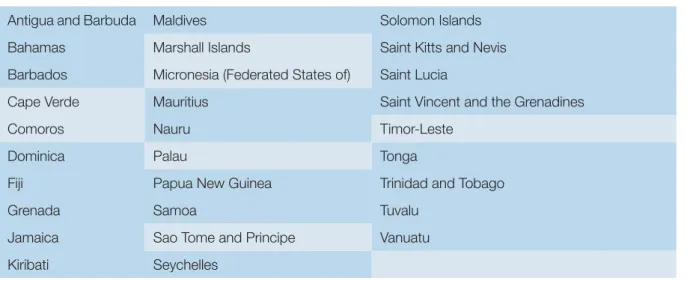
This publication, The Ocean Economy: Opportunities and Challenges for SIDS, is a product of the Division for International Trade in Goods and Services and Commodities (DITC). BRICS Brazil, Russia, India, China and South Africa CARIFORUM Forum of the Caribbean Group of States of the APC DDA Doha Development Agenda. FAO Food and Agriculture Organization of the United Nations GATS General Agreement on Trade in Services.
UNCLOS United Nations Convention on the Law of the Sea UNCTAD United Nations Conference on Trade and Development UNEP United Nations Environment Programme.
INTRODUCTION
The oceans economy and its particularities
- Concept
- Jurisdiction and regulatory frameworks
It also seeks to contribute to mitigation and adaptation efforts to address the risks of climate change manifested in sea level rise and seawater acidification. The comprehensive framework agreement governing the management of the oceans is provided by the United Nations Convention on the Law of the Sea (UNCLOS) of 1982, which establishes a comprehensive framework for the use and development of the oceans. That is, to the extent that activities on land affect the marine environment or the habitat of marine species, they are addressed by different provisions of the Convention.
At the regional level, the United Nations Environment Program (UNEP) Regional Marine Program and other regional marine environmental programs include multilateral agreements dealing with the use and protection of the marine environment.
THE OCEANS ECONOMY AND SIDS
In the case of the Bahamas, an integrated marine policy framework for the management of ocean space and marine resources is being implemented with the aim of giving greater clarity to the roles, functions and actions of some 34 government bodies. In 2013, Mauritius issued its first ocean economy roadmap, which seeks to harness the enormous economic potential of the oceans.10 The plan emphasizes the need to utilize the untapped value locked in the exclusive economic zone by ensuring sustainable and coordinated use of living and non-living resources. Also, in 2013, OECS member states approved the Eastern Caribbean Regional Ocean Policy.
Other SIDS could also consider developing a broader regional ocean governance architecture based on the UNCLOS framework that ensures sustainable management of living and non-living resources as an effective way to promote economic growth and development.
TRADE AND THE OCEANS ECONOMY: CHALLENGES AND
- Sustainable fishing and aquaculture
- Renewable marine energy
- Marine bio-prospecting
- Maritime transport and open ship registration
- Marine and coastal tourism
Of the €12.9 billion in fisheries subsidies granted to the fishing sector by the EU and its members since 2000, only 1 percent were useful subsidies for the marine environment.21 The European Commission has found that the capacity of the fishing sector The EU fleet is two to three times above sustainable levels in a number of fisheries. Several international treaties22 codes of conduct23 and guidelines24 have been adopted under the auspices of UNCLOS, FAO and UNEP to address some of these issues, but the capacity to implement, monitor and enforce them still needs to be improved. Although most of the production is intended for human consumption, there are also other uses such as: aquariums, fashion items and the production of pharmaceuticals and perfumes.
While disaggregated aquaculture-specific statistics for SIDS are not available, total aquaculture production in the Caribbean and Oceania combined represents less than 1 percent of global aquaculture production.30 SIDS in Oceania31, led by Fiji, Papua New Guinea and Vanuatu, they represent approximately 10 percent of the total aquaculture production in the region. Notable examples are the Marine Stewardship Council and Aquaculture Stewardship Council schemes, which cover checking stock levels, impacts on ecosystems and management systems. In addition, the current reporting and assessment process of the State of the Marine Environment under the UN Ad Hoc Working Group of the Whole1 could shed light on the level of implementation and effectiveness of these regional agreements.
Negotiations and capacity building could be considered to strengthen fisheries management and monitoring in all country groups to ensure the sustainability of the fisheries sector in SIDS. Global offshore wind energy capacity is growing at an incredible rate of 40 percent per year, producing 7,100 megawatts of electricity in 2013.34 In the EU, offshore wind energy already represents around 10 percent of total renewable energy produced and is expected to reach around 20 percent amounts per year. cents by 2030.35 This was possible thanks to significant green industrial policy and public support. The use of algae as biomass for energy production also offers promising opportunities for the future development of second and third generation non-food-based biofuels.
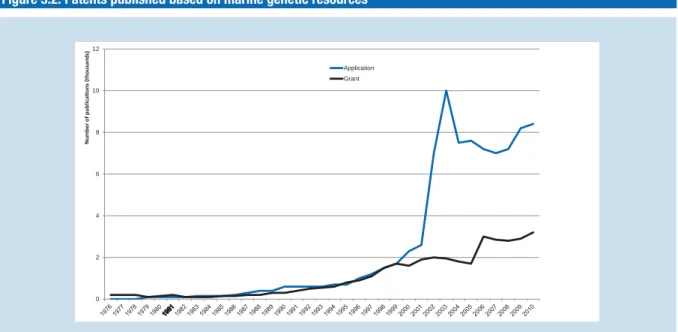
Almost all SIDS are part of the CBD, and five have already ratified or acceded to the Nagoya Protocol.42 The implementation of the CBD and Nagoya principles in the marine environment can prove challenging; regardless of this, SIDS should continue to engage in establishing a public policy framework that will support potential economic development of marine bioprospecting with mutual benefits. It gives an idea of the number of samples that have been used for bio-prospecting and R&D from around the world. Maritime transport is very important for SIDS, as their socio-economic prospects depend heavily on their ability to connect with the rest of the world and access international markets.
For example, greenfield foreign direct investment in SIDS targeting hotels and restaurants reached USD 475 million in 2012.56 This is 44 percent more than in 2011 and indicates the growth potential of this sector regardless of remoteness concerns.
THE OCEANS ECONOMY AND MULTILATERAL TRADE POLICY AND NEGOTIATIONS
- WTO and other negotiations to discipline fisheries subsidies
- General prohibitions and flexibilities
- Relevant regional initiatives
- Breaking the fish subsidies deadlock
- NAMA negotiations and fish trade
- Multilateral, plurilateral and regional environmental goods negotiations
- WTO environmental services negotiations
This proposed broad exemption for LDCs is generally supported in recognition of the persistent underexploitation of their marine resources. It is likely that the environmental chapter of the final agreement will include recognition of the importance of the marine fisheries sector for the development and survival of fishing communities, including artisanal or small-scale fisheries. While the CARIFORUM-EU EPA deals with some elements of ocean economy, it is limited in scope and largely limited to the use of 'living marine resources' for CARIFORUM Member States.
Given that the proposed disciplines of the TPP have generated wide attention, SIDS could seek to build on what appears to be an emerging consensus on the need to establish a sustainable balance between the conservation of marine resources and the economic exploitation of fisheries resources. Fish and fish products are one of the 14 sectors identified for sectoral negotiations or 'initiatives'67, and under the draft rules, members participating in the sectoral initiative will eliminate duties on eligible products (see Table 4.1). The liberalization of marine resources, especially fish and fish products, must be seen in the light of the potential harmful effects that such liberalization can have on ecological sustainability.
Any potential outcome of the WTO NAMA negotiations must be accompanied by parallel disciplines of fisheries subsidies to avoid creating further incentives for overexploitation. Within the Doha Round, negotiations on environmental services take place under the auspices of the special session of the Committee on Trade in Services (CTS), while negotiations related to environmental goods take place mainly in the Committee on Trade and Environment (CTE). and the Negotiating Group on Market Access.73 However, they have not yet reached specific outcomes. To the extent possible, SIDS could consider pursuing a strategy within WTO negotiations that explicitly aligns trade liberalization with transparency and monitoring of the potential impacts on marine ecosystems.
Furthermore, members agreed in paragraph 31 (iii) of the Ministerial Declaration on 'the reduction or, as appropriate, the elimination of tariff and non-tariff barriers to environmental goods and services'.71. To this end, on the sidelines of the 2014 World Economic Forum meeting in Davos, 14 WTO members agreed to negotiate an agreement aimed at eliminating tariffs on environmental goods. Proponents represent 90 percent of global trade in environmental goods under the APEC list, so a successful conclusion of these negotiations will certainly have a measurable impact on the global market for such goods.
SIDS, through SVE proponents, can explore proposals that aim to further link trade measures with actions that specifically support the sustainable development of the ocean economy and that enable trade in sustainably harvested products.

MOVING FORWARD AN OCEANS ECONOMY TRADE AND DEVELOPMENT AGENDA
- Including oceans as a key component in future Sustainable Development Goals
- Ensuring more sound and transparent multilateral and regional governance in the
- Taking a regional ocean space/maritime spatial planning approach
- Overcoming the impasse in fish subsidies in the WTO post-Bali work programme
- Dealing with WTO NAMA and fisheries subsidies negotiations in parallel
- Incorporating a water management approach and expanding the scope of
- Harnessing access and benefit-sharing regimes on marine genetic resources for sustainable
Food and Agriculture Organization (FAO) 2014a, 'Fact sheet: international fish trade and global fisheries', available at: www.globefish.org/upl/various/COFI_FT_Factsheet.pdf (accessed 3 August 2014). International Center for Trade and Sustainable Development 2013, 'Submission to the Open Working Group on the Sustainable Development Goals; Fisheries, Trade and Sustainable Development', available at: www.ictsd. Office of the United States Trade Representative (USTR) 2014, 'USTR Announces Intent to Open WTO Negotiations on Environmental Goods', Press Release, March, available at: www.ustr.gov/about-us/press-office/.
United Nations Environment Program (UNEP) 2008, 'Fisheries subsidies: a critical issue for trade and sustainable development in the WTO – an introductory guide', available at: www.unep.ch/etb/areas/pdf/. United Nations Environment Program (UNEP), UN Department of Economic and Social Affairs, & Food and Agriculture Organization 2012, SIDS-focused green economy: an Analysis of Challenges and Opportunities, UNEP, Nairobi, available at: www.unep.org /pdf/Green_Economy_in_SIDS.pdf (accessed August 3, 2014). World Trade Organization 2014a, ‘Trade and Environment’, www.wto.org/english/tratop_e/envir_e/envir_e.htm (accessed 4 August 2014).
10 Office of the Prime Minister of Mauritius 2013, 'The Ocean Economy: A Blueprint for Mauritius', available at: www.oceaneconomy.mu/. 12 Food and Agriculture Organization 2014a, 'Details: International Fish Trade and Global Fisheries', available at: www.globefish. 26 See: Food and Agriculture Organization (FAO) 2014b, 'Regional Fishery Body Secretariats Network (RSN)', www.fao.org/fishery/.
57 United Nations Environment Program 2008, 'Fisheries Subsidies: A Critical Issue for Trade and Sustainable Development in the WTO – An Introductory Guide', available at: www.unep.ch/etb/areas/pdf/UNEP-ETB%20Brochure%20on %20Fisheries%20 Subsidies_May2008 .pdf (accessed 4 August 2014). 60 World Trade Organization 2007, "Draft consolidated chair texts of the AD and SCM Agreements", TN/RL/W/213, 30 November, available at: www.wto.org/english/tratop_e/rulesneg_e/rules_chair_text_nov07_e.htm ( accessed) 4 August 2014). 69 World Trade Organization 2014a, 'Trade and environment', www.wto.org/english/tratop_e/envir_e/envir_e.htm (accessed 4 August 2014).
88 World Trade Organization 2014b, 'Environmental services', www.wto.org/english/tratop_e/serv_e/environment_e/environment_e.htm (accessed 4 August 2014).