p-ISSN : 2442-6563 e-ISSN : 2525-3027 Page 37 – 69 Available online at https://e-journal.unair.ac.id/JEBIS doi:10.20473/jebis.v9i1.37806
OPTIMIZATION STRATEGY OF CASH WAQF LINKED SUKUK INSTRUMENT FOR PROCUREMENT OF HEALTH FACILITIES IN INDONESIA
Ismi Siti Rabbania Aas Nurasyiahb
Rida Rosidac Abdul Ghafar Ismaild
a,b,cIslamic Economics and Finance Study Program, Faculty of Economics and Business
Education, Universitas Pendidikan Indonesia
dPutra Business School, Universitas Putra Malaysia
Email: [email protected]a; [email protected]b; [email protected]c; [email protected]d
ARTICLE HISTORY Received:
26 July 2022 Revised 07 June 2023 Accepted:
09 June 2023 Online available:
30 June 2023
Keywords:
Waqf, Cash Waqf Linked Sukuk, Procurement of Health Facilities, Analytical Network Process,
Economic Development.
*Correspondence:
Name: Ismi Siti Rabbani E-mail:
ABSTRACT
This study aims to identify problems, solutions, and strategies that hinder the use of Cash Waqf Linked Sukuk (CWLS) as an instrument for procuring health facilities in Indonesia as seen from the dimensions of waqif, promotion, government, regulation, and nadzir.
The data analysis technique used is the Analytic Network Process (ANP), using seven expert respondents from academics, regulators, and practitioners. The results of this study indicate that the priority dimension of problems and solutions in general in the use of the CWLS instrument for the procurement of health facilities in Indonesia has to do with the promotional dimension. This is because promotion is a means of communicating to the public about the CWLS instrument. Therefore, promotional activities can minimize people who do not know about the CWLS instrument. The overall strategic priority is the implementation of waqf literacy classes by the Ministry of Religion and the Indonesian Waqf Board to the community. Literacy is an essential component in influencing someone to contribute to waqf. Thus, with this strategy, it is hoped that the public will know about the CWLS instrument. This research is expected to provide benefits for stakeholders of the CWLS instrument to evaluate the strategies that have been carried out previously so that in the future, the utilization of the CWLS instrument in the health sector is more optimal, and the role of waqf in economic development can be achieved.
INTRODUCTION
Currently, the phenomenon of cash waqf types has been introduced by many people. The term cash waqf is defined as waqf of movable property (Hasan 2010).
According to Hazami (2016), the estimated potential for cash waqf in Indonesia can be collected at 3 trillion per year, assuming the number of people who make waqf is 10 million. This is shown in the calculation in Table 1 below. If 20 million Muslims in
Published by University of Airlangga.
This is an open access article under the CC BY license ( https://creativecommons.org/licenses/by-nc-sa/4.0/ )
Indonesia contribute cash waqf of IDR 100,000 per month, the funds collected are IDR 24 trillion annually. Likewise, if 50 million muslims perform waqf, then per year will be collected waqf funds of IDR 60 trillion. In addition, according to Joko Widodo as reported by the media Tempo.co (2021), the cash waqf in Indonesia has the potential to reach IDR 188 trillion per year.
Table 1
Estimated Potential of Cash Waqf in Indonesia
Income Level /Month
Total of Muslim(s)
Waqf Contribution
/Month
Cash Waqf Potential/
Month
Cash Waqf Potential/Year IDR 500,000 IDR 4 million IDR 5,000 IDR 20 billion IDR 240 billion IDR 1 million –
2 million
IDR 3 million IDR 10,000 IDR 30 billion IDR 360 billion IDR 2 million –
5 million
IDR 2 million IDR 50,000 IDR 100 billion IDR 1.2 trillion IDR 5 million IDR 1 million IDR 100,000 IDR 100 billion IDR 1.2 trillion
Total IDR 3 trillion
Source: Hazami (2016)
Despite the excellent potential of cash waqf mentioned above, the accumulated fund has not fully realized the existing potential. Data from the Ministry of Religious Affairs of Indonesia noted that the realization of cash waqf in Indonesia from 2011-2019 was only IDR 31.9 billion per year on average. It happens due to various factors, both internal factors from the waqf institution itself as well as public awareness and regulations that support waqf (Sukmana 2021).
Thus, so that the potential of cash waqf in Indonesia to provide significant benefits to the community, modern management is needed to manage waqf more productively. The nadzir must work hard to optimize the potential of the cash waqf (Hazami 2016). It is due to the current realization of waqf being far below its potential.
Therefore, managing cash waqf funds as an investment instrument can be an alternative to proper waqf management (Atabik 2016).
Currently, there are innovations in Islamic financial instruments, including Islamic financial instruments that are commercial and social. One is the integration of Sukuk and cash waqf, known as Cash Waqf Linked Sukuk (CWLS). CWLS is a new creative financing program in Indonesia and the first in the world, the benefits of which can have a blessing impact over time (Putri et al., 2020). This program is also an innovation in collaboration with the Indonesian Waqf Board (BWI), Bank Indonesia (BI), and the Ministry of Finance (Kemenkeu). According to Fitri & Wilantoro (2018), one of the obstacles that affect the management of waqf assets is the managerial ability and creativity of nadzir, which is still low. So, one alternative in dealing with these obstacles is the existence of waqf management in the form of the CWLS instrument.
39
CWLS is a form of the government’s commitment to supporting the National Cash Waqf Movement (GNWU) while at the same time assisting the development of social investment in Indonesia. The purpose of the CWLS instrument is to provide facilities for waqif to perform waqf through social investment instruments (Ministry of Religious Affairs of Indonesia 2021). In addition, CWLS can be used to finance social- based government programs, such as health facilities and infrastructure development in remote areas to finance national recovery due to the pandemic (Rahman, Nurwahidin, and Adnan 2021).
In addition, people in remote areas still have limitations in choosing a place for health services. Meanwhile, in urban areas, there are relatively many health service providers. People cannot use health facilities optimally in remote areas where first- level service facilities and referrals are limited. Thus, improving health facilities in remote areas is necessary (Yandrizal et al. 2014).
The allocation of national-level government expenditures for the health sector other than salaries is a minimum of 5 percent of APBN funds (state budget).
Meanwhile, the allocation of local-level government spending for the health sector other than salaries is a minimum of 10 percent of the local government budget or APBD funds (Central Statistics Agency 2020). The following is the development of the budget allocation for the health sector, namely:
Figure 1. Health Budget in Indonesia 2016-2022 (in billion) Source: Ministry of Finance of the Republic of Indonesia (2022)
Based on Figure 1, it can be seen that the budget for the health sector each year has relatively increased in the 2016-2022 period. The most significant increase occurred in 2022 by 50.42 percent, which was 169.723,70 billion in the previous year, to 255.292,30 billion. It proves that Indonesia’s health financing burden is getting heavier daily.
According to the National Development Planning Agency (Bappenas) (2019), one of the strategic problems of health financing is the unmet adequacy of health financing, followed by the efficiency and effectiveness of budget use. It can be seen from the National Medium-Term Development Plan (RPJMN) for 2019-2024, which has been prepared by Bappenas, as show in Figure 2.
2016 2017 2018 2019 2020 2021 2022
92,758.60 92,166.00 109,037.20 113,619.60 132,179.50
169,723.70
255,292.30
Published by University of Airlangga.
This is an open access article under the CC BY license ( https://creativecommons.org/licenses/by-nc-sa/4.0/ ) Figure 2. Sources of Funds for the 2019-2022 RPJMN (in Trillion)
Source: Hendrawan (2020)
As is known in Islamic history, the role of waqf cannot be separated from an instrument of economic support for Muslims (Saptono 2018). Waqf in community development through public facilities can be seen in the development of Islamic sultanates whose historical evidence can still be seen today, such as in the health, education, public sector, and many others (Shulthoni and Saad 2018). However, in current reality, the benefits of this large waqf have not been appropriately managed.
Waqf has a contribution to the modern economy, one of which is that waqf can lower interest rates. This is because waqf provides social services without any cost from the government (Cizakca 1998). In addition, waqf also has other economic objectives, namely as a mechanism for redistributing wealth in the economic system (Cizakca 1997). Thus, the collected waqf assets can be used as future investment capital for the benefit of future generations.
This research refers to previous studies, such as Musari's research (2022) which states that the integration of green sukuk and CWLS is an innovation in the future as a source of fiscal funding to combat climate change, which is currently a priority for the sustainable development agenda. Furthermore, according to Rahma et al. (2023) and Zain, Sumbulah, and Badruddin (2021), CWLS has fulfilled aspects of good Sharia governance in providing benefits to the community through the management of CWLS funds. This study uses a qualitative analysis approach through a literature review so that the discussion focuses theoretically.
The research conducted by Berakon et al. (2022) states that religiosity does not moderate the relationship between perceptions of usefulness and individual intentions to donate through CWLS. Meanwhile, research conducted by Maulina (2022) that the factor of financial excess, trust in waqf institutions, and trust in the government affects individual willingness to make waqf through CWLS. This study uses a quantitative research approach, which only integrates the relevant variable constructs to provide comprehensive results based on the hypotheses that have been formulated.
41
Anindhita & Widana's research (2022) discusses optimizing the role of CWLS for state development. This study uses a qualitative analysis approach through interviews and focus group discussions (FGD). Based on the results of this analysis, the main problem is still low public literacy regarding CWLS. The proposed solution is to increase public literacy regarding CWLS through a social marketing approach. However, this research has not yet answered the problems that occurred at the time of publishing the CWLS, so further research is needed to discuss priority issues, solutions, and strategies that must be implemented so that the use of CWLS can be more optimal for sustainable economic development.
Lately, problems regarding CWLS have been increasingly studied in interesting journals to be used as research topics. What has not been discussed in previous research is formulating strategies to overcome problems and solutions that can be applied for further CWLS publications. Therefore, this research was conducted by analyzing existing problems from the side of the parties concerned with CWLS, then finding solutions and strategies to overcome these problems. However, research on this matter is still limited considering that CWLS is a breakthrough financial instrument.
So it is important to examine more deeply related to this problem.
Based on the explanation above, the researchers are interested in conducting research related to CWLS as an alternative instrument for procuring health facilities.
The results of previous studies indicate that CWLS has great potential in developing the country's infrastructure, including health facilities. The authors will use the Analytic Network Process (ANP) method in this research. In this study, the formulation of the aspects studied was seen from five dimensions which, according to the author, have an essential role in formulating strategies to utilize CWLS as an alternative instrument for procuring health facilities in Indonesia. The five dimensions include waqif, promotion, government, regulation, and nadzir. Thus, ANP can determine what aspects or indicators have the highest priority by calculating subjective values from experts who are competent in their fields.
LITERATURE REVIEW Cash Waqf Concept
Imam Az-Zufar states that cash waqf must be invested through commercial contracts, such as mudharabah contracts. The profits obtained can be allocated for social purposes (Ali 1998). Meanwhile, Cizakca (1998) states that the waqf system can contribute significantly to the modern economy, such as a large reduction in government spending leads to a small budget deficit, reducing the need for government borrowing, limiting the “crowding-out effect” and leading to lower interest rates, thereby curbing the basic constraints for private investment and growth.
But the most important thing in the contribution of the waqf is that waqf can reduce interest rates. This is because waqf provides social services without any cost from the government. Waqf can fulfill this contribution by holding voluntary donations made by
Published by University of Airlangga.
This is an open access article under the CC BY license ( https://creativecommons.org/licenses/by-nc-sa/4.0/ )
able people. Thus, the collected donated capital can be used to finance all types of social services to the community. At this point, the contribution of waqf becomes clear, helping to reduce government expenditure budgets and lowering interest rates and waqf as a mechanism for redistributing wealth in the economic system (Cizakca 1998).
Sovereign Sukuk Concept
Sovereign Sukuk in securities issued by the state based on sharia principles as evidence of ownership of the state sharia securities (SBSN) assets, both in Indonesian rupiah (IDR) and foreign currencies (Soemitra 2009). In Law Number 19 of 2008, it is stated that the underlying asset is an SBSN asset which is an object of SBSN financing and/or state property (BMN) that has economic value, in the form of land and/ or buildings as well as other than land and/ or buildings, which are within the framework of issuing SBSN used as the basis for the issuance of SBSN (Kholis 2011). The Indonesian government began issuing retail Sukuk starting in 2009. Retail Sukuk issuance was carried out to broaden public investors while optimizing the domestic market. Retail Sukuk is securities issued by the state that are sold to individuals or Indonesian citizens through selling agents with a predetermined minimum volume. Retail Sukuk issued will provide strategic value to the country. It is because retail Sukuk can facilitate the mobilization of public funds in financing the state budget. It is expected that State budget financing from Sukuk funds can gradually lead to state independence in financing development (Pridityo 2014).
Cash Waqf Linked Sukuk Concept
CWLS is a modern combined innovation of Sukuk and waqf. The provisions for CWLS are contained in the sharia opinion of the DSN-MUI regarding CWLS, namely the Fatwa and the Statement of Sharia Conformity in the DSN-MUI Fatwa No. 76/DSN- MUI/VI/2010 concerning SBSN Ijarah Assets to be Leased and DSN-MUI Fatwa No.
95/DSN-MUI/VII/2014 concerning SBSN Wakalah, and others. This opinion explains that the CWLS instrument issued by the Ministry of Finance of the Republic of Indonesia is legal according to sharia principles. The purpose of issuing CWLS in the fatwa is an effort to manage unproductive cash waqf funds (Rahman et al. 2021). The value of the benefits of waqf assets must be appropriately managed to provide significant benefits for the community's welfare. Of course, this still pays attention to the main principle of waqf management, which is not allowed to reduce the principal value of the waqf. The use of waqf funds in Sukuk is divided into two contracts: (a) social waqf, in which the waqif only expects reward and pleasure from Allah SWT alone; (b) waqf Sukuk with ijarah contracts, in which the purpose of the contract is business. The returns obtained by the waqif are managed by themselves to benefit the people and individuals. From this explanation, cash waqf and Sukuk collaborated to
43
become CWLS instruments to increase the more significant benefit (Paul and Faudji 2020).
Health Facility Financing Concept
Speaking comprehensively, three elements in the health system need to be financed (Bappenas, 2019): (1) Public Health Efforts (UKM); (2) Individual Health Efforts (UKP); and (3) Governance. However, the implementation of UKM and UKP activities in Indonesia is still far from expected. Based on Law No. 36 of 2009 concerning Health and Law No. 40 of 2004 particularly on the National Social Security System (SJSN), it is known that UKM programs are financed from taxes (state budget (APBN) and local government budget (APBD), while UKP programs are financed as follows: (1) Health Insurance; (2) Taxes in the form of premium subsidies for the poor; (3) Payment of tariffs (out-of-pocket payment or cost-sharing); and (4) Health financing in the regions.
Bappenas (2019) has identified issues regarding health financing, one of which is limited operational funds to implement programs and activities for health goals set by the central and regional governments so that not all people are optimally protected in health services. In the 2020-2024 National Medium-Term Development Plan (RPJMN), the government lists non-government funding sources as sources of infrastructure financing, one of which is Islamic philanthropic funds, namely waqf. This source of waqf funds is used as an alternative for health financing that has not been fulfilled by the government.
Previous Studies
Previous research on the use of CWLS in agriculture was conducted by Yunita (2020) and Siregar et al. (2021), who revealed that CWLS can be used as a medium for sustainable food security in Indonesia by using a salam contract. Furthermore, research conducted by Ubaidillah et al. (2019) explained that CWLS can be alternative financing for infrastructure development with its potential. This finding is in line with research conducted by Tanjung & Windiarto (2021); Paul et al. (2021); Fauziah et al.
(2021); Baiti & Syufaat (2021); Rahman et al. (2021); Hendrawan (2020); Musari (2019);
Rahayu & Agustianto (2020); Anindhita (2021); Ascarya (2021); Putri et al. (2021); and Sukmadilaga et al. (2021). In these studies, research studies focus more on the use of CWLS for economic recovery and infrastructure development in general. So research on the use of CWLS in the health sector in particular is still limited.
Furthermore, research conducted by Musari (2022) states that the integration of green sukuk and CWLS is an innovation in the future as a source of fiscal funding to fight climate change which is currently a priority for the sustainable development agenda. According to Zain et al. (2021) and Rahma et al. (2023) in their research explained that CWLS has fulfilled aspects of good sharia governance in providing benefits to the community through the management of CWLS funds. There is also research on issues, challenges, and future directions for CWLS conducted by Yasin
Published by University of Airlangga.
This is an open access article under the CC BY license ( https://creativecommons.org/licenses/by-nc-sa/4.0/ )
(2021) and Sasongko et al. (2021) revealed that even though CWLS has great potential, there are still challenges in developing CWLS products in Indonesia. Meanwhile, research conducted by Paul & Faudji (2020) states that the management of CWLS will be free from the risk of loss because the placement of cash waqf in sukuk will be guaranteed by the state. However, these studies use a qualitative analysis approach through a literature review, so the discussion focuses theoretically.
Research conducted by Hiyanti et al. (2020) stated that literacy and religiosity factors influenced the intention to give waqf in CWLS. However, the study by Berakon et al. (2022) states that religiosity does not moderate the relationship between perceptions of usefulness and individual intentions to donate through CWLS.
Meanwhile, research conducted by Maulina (2022) that the factor of financial excess, trust in waqf institutions, and trust in the government affects individual willingness to make waqf through CWLS. This study uses a quantitative research approach so that this research study only integrates the relevant variable constructs to provide comprehensive results based on the hypotheses that have been formulated.
Furthermore, research conducted by Satyawan, Firdaus and Possumah (2018) used SWOT analysis as a dimension in their research. Based on the results of this analysis, waqf regulation is an aspect of strength; the lack of socialization of waqf is an aspect of weakness; increasing nadzir professionalism is an aspect of opportunity, and the waqf socialization process is a strategic aspect of productive waqf management.
Anindhita and Widana's research (2022), discusses optimizing the role of CWLS for state development. This study uses a qualitative analysis approach through interviews and focus group discussions (FGD). Based on the results of this analysis, the main problem is still low public literacy regarding CWLS. The proposed solution is to increase public literacy regarding CWLS through a social marketing approach. However, this research has not answered the problems that occurred at the time of publishing the CWLS, so further research is needed to discuss priority issues, solutions, and strategies that must be implemented so that the use of CWLS can be more optimal for sustainable economic development.
Putri, Tanjung and Hakiem's research (2020) discuss the strategy for implementing CWLS management in supporting the economic development of the people. This study uses the ANP analysis approach. Based on the results of this analysis, the delay in the implementation of CWLS management, seen from the priority aspect of the problem, is nadzir. As seen the priority aspect of the solution is the regulator. However, the limitation of this study is that the dimensions analyzed only use three dimensions, including wakif, regulator, and nadzir.
Based on the explanation above, this study will focus on examining the use of CWLS in the health sector using the ANP analysis approach. In this study, the formulation of the aspects studied is seen from five dimensions which according to the author have an important role in formulating strategies to utilize CWLS as an alternative instrument
45
for procuring health facilities in Indonesia. The five dimensions include waqif, promotion, government, regulation, and nadzir.
Problem Approach
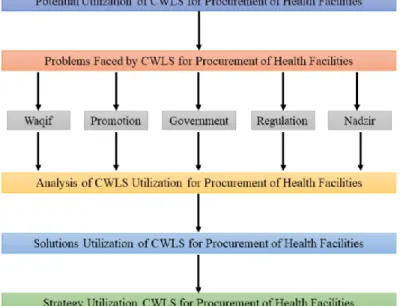
The author summarizes from theoretical studies and previous research into five aspects that influence the use of CWLS for the provision of health facilities, including waqif, promotion, government, regulation, and nadzir.
Based on theoretical and previous studies, the following is the approach to the problem in this research, namely:
Figure 3. Research Problem Approach Source: Authors (2021)
RESEARCH METHODS
The method used in this research is a descriptive method with a qualitative approach. The data analysis technique used is the Analytic Network Process (ANP). In this study, five dimensions are the object of research, namely wakif, promotion, government, regulation, and nadzir. Each indicator of the five dimensions is obtained based on the results of the author's analysis of various kinds of previous research references. In the next stage, the authors validated the model through interviews with selected experts who had a deep understanding of CWLS. The following are the indicators in each dimension, namely:
Table 2
Each Dimension Indicator
Dimensions Indicator Instrument
Waqif
[(Pardiansyah and Rahmat 2018); (Paul
The level of public literacy regarding waqf through the CWLS instrument.
Increase public literacy regarding waqf through the CWLS instrument.
Published by University of Airlangga.
This is an open access article under the CC BY license ( https://creativecommons.org/licenses/by-nc-sa/4.0/ )
Dimensions Indicator Instrument
and Faudji 2020); (Baiti and Syufaat 2021);
(Ubaidillah et al. 2019);
(Fauziah et al. 2021);
(Tanjung and Windiarto 2021); (Yasin 2021); and (Paul et al. 2021)]
Public interest in the CWLS instrument for health facilities.
Conduct more intensive socialization of the use of CWLS instruments for health facilities.
Doubts on CWLS
instruments according to Sharia law.
Inform about the DSN-MUI fatwa rules regarding cash waqf and SBSN.
Promotion [(Yunita 2020); (Baiti and Syufaat 2021);
(Putri et al. 2021); and (Yasin 2021)]
Information regarding waqf through the CWLS instrument.
Promoting CWLS instruments with attractive marketing strategies.
Brand implementation of the CWLS instrument.
Creating a brand towards the implementation of the CWLS instrument.
digital marketing service. Transforming digital-based marketing strategies.
Government [(Ubaidillah et al. 2019);
(Yunita 2020);
(Pardiansyah and Rahmat 2018); and (Baiti and Syufaat 2021)]
CWLS instrument
development efforts
Support CWLS instrument development efforts.
A facilitator between CWLS instrument stakeholders and the community.
Carry out collaboration between CWLS instrument stakeholders and community organizations.
Regulation
[(Tanjung and
Windiarto 2021);
(Pardiansyah and
Rahmat 2018);
(Ubaidillah et al. 2019);
(Yasin 2021); (Fauziah et al. 2021); and (Yunita 2020)]
DSN MUI fatwa rules.
about the CWLS
instrument specifically.
Make DSN-MUI fatwa rules regarding CWLS instruments specifically.
Government regulations governing the use of CWLS instruments for health facilities.
Strengthen government regulations in regulating the use of CWLS instruments for health facilities.
Nadzir
[(Paul and Faudji 2020);
(Putri et al. 2020); (Baiti and Syufaat 2021);
(Harahap and Darwanto 2021); and (Yasin 2021)]
Professional Nazir Conduct professional nadzir recruitment.
Nadzir’s transparency and accountability.
Inform transparent
management and
accountability.
Nazir competence. Sustainably improving nadzir competency.
Source: Authors (2021)
47
Research respondents were selected from three groups of expert respondents. The first group came from academics from IPB University, University of Indonesia, and the National Committee for Islamic Economics and Finance. The respondents were selected based on their professional background in Islamic economics and finance. The second group is from the regulators from Bank Indonesia and the Ministry of Finance of the Republic of Indonesia. The respondents were selected based on experts who studied in the field of CWLS. Meanwhile, the third group came from practitioners from the Indonesian Waqf Board and Indonesian Sharia Bank. The respondents were selected based on experts who practice CWLS. The population of respondents from experts from academics, regulators, and practitioners in the field of CWLS is limited in number, but the authors did not get information on the exact number. Therefore, the selection of respondents in this study was carried out by considering the respondents' understanding of CWLS problems in Indonesia. The following is a list of experts who will be used as respondents in this study, namely:
Table 3
List of Names of Expert Respondents
No. Name Institutions Position Occupancy
1. Khalifah Muhammad Ali
IPB University Lecturer Academics
2. Nurul Huda University of Indonesia
Lecturer Academics
3. Urip Budiarto National Committee for Islamic Economics and Finance
Head of Sharia Social Fund Division
Academics
4. Rifki Ismal Bank Indonesia Deputy
Director of the Department of Islamic
Economics and Finance
Regulators
5. Muhammad Iqbal Balatif
Ministry of Finance of the Republic of Indonesia
Head of
Transaction Planning and Development Section
Regulators
6. Imam Teguh Saptono
Indonesian Waqf Board
Vice Chairman Practitioners 7. Anggit
Pragusto Sumarsono
Indonesian Sharia Bank
Branch Manager
Practitioners
Source: Authors (2021)
According to Saaty (2008), ANP is a mathematical theory that can analyze impacts in the form of using hypothetical methods to solve problems. The ANP concept represents a network structure that is applied to model criteria in complex decision-
Published by University of Airlangga.
This is an open access article under the CC BY license ( https://creativecommons.org/licenses/by-nc-sa/4.0/ )
making so that ANP provides a further realistic methodology for better decision- making (Yucelgazi and Yitmen 2020).
Mathematically, AHP and ANP are tools based on Multi-Criteria Decision Making (MCDM), which are used to measure intangible factors through pairwise comparisons with judgments that represent one element that dominates over other elements (Chung, Lee, and Pearn 2005). The concept of AHP represents a framework with a hierarchical structure, while ANP is the development of AHP with a network structure (Yüksel and Daǧdeviren 2007). A process of deciding on a problem or problem can not necessarily be arranged in the form of a hierarchical structure. This happens because a problem or issue involves interactions and dependencies between high-level and low-level elements (Odzemir and Saaty 2005). Thus, this research uses ANP analysis because the problems in this study involve various parties concerned with CWLS. ANP can accommodate complex relationships to provide accurate results (Atmaca and Basar 2012). So that ANP can determine which aspects or indicators have the highest priority in identifying problems, solutions, and strategies that hinder the use of CWLS as an instrument for procuring health facilities. ANP provides good results from decisions made and quality is guaranteed through a consistency index and facilitates efficient and realistic decisions (Yucelgazi and Yitmen 2020).
The following are the stages of using the ANP method, namely the first stage, analyzing the overall problem based on theoretical and empirical literature studies.
The second stage clarifies the structure of the problem which is divided into each dimension appropriately so that there is an appropriate linkage between dimensions.
Tin the third stage, the construction of the model that has been prepared will be evaluated by relevant experts, who use questions in the questionnaire in the form of pairwise comparisons between dimensions in clusters, to find out which of the two has a greater level of importance through a numerical scale of 1-9. The fourth stage, data analysis uses the calculation of the Geometric Mean and Rater Agreement (Yitmen, Al- Musaed, and Yücelgazi 2022).
Geometric Mean calculations are used to obtain individual research results from respondents and determine the results of opinions in one group. While the Rater Agreement calculation is used to show the level of agreement or agreement of the respondents on a problem in one cluster. The tool used to measure Rater Agreement is Kendall's Coefficient of Concordance (W; 0 < W ≤ 1) which shows perfect compatibility (Saaty 2016). The following is Kendall's Coefficient of Concordance assessment table:
49
Table 4
Kendall's Coefficient of Concordance
W Interpretation
0 No Agreement
0.10 Weak Deal
0.30 Medium Deal 0.60 Strong Deal 1.00 Perfect Deal
Source: Saaty (2016)
RESULT AND ANALYSIS
Geometric Mean (GmK) of the Problem Aspect Waqif Dimensions
In the waqif dimension, the problem of using CWLS in the health sector is related to the level of literacy and public understanding of the CWLS instrument. The following are the results of the GmK of waqif dimension on the aspect of the problem, namely:
Figure 4. Geometric Mean Dimension of Waqif on Problem Aspect Source: Data Processing Results (2022)
Based on Figure 4, the most problematic indicator in the waqif dimension is the lack of public literacy regarding cash waqf through the CWLS instrument, with a GmK value of 0.3844. While the second priority problem on the dimension of waqif is that the public interest in cash waqf through the CWLS instrument is still low, with a GmK value of 0.3419. The indicators considered not problematic on the waqif dimension are public doubts about the CWLS instrument from the perspective of fiqh law, with a GmK value of 0.2356.
Promotion Dimension
In the promotion dimension, the problem of using CWLS in the health sector is related to the marketing strategy of the CWLS instrument. The following are the results of the GmK promotion dimensions on the aspect of the problem, namely:
0.0000 0.0500 0.1000 0.1500 0.2000 0.2500 0.3000 0.3500 0.4000
The lack of public literacy in cash waqf by
CWLS instrument
Public interest in cash waqf through CWLS instrument is still low
There is a public doubt about CWLS instrument
in terms of fiqh laws
0.3844 0.3419
0.2356
Published by University of Airlangga.
This is an open access article under the CC BY license ( https://creativecommons.org/licenses/by-nc-sa/4.0/ ) Figure 5. Geometric Mean Dimension of Promotion on Problem Aspect
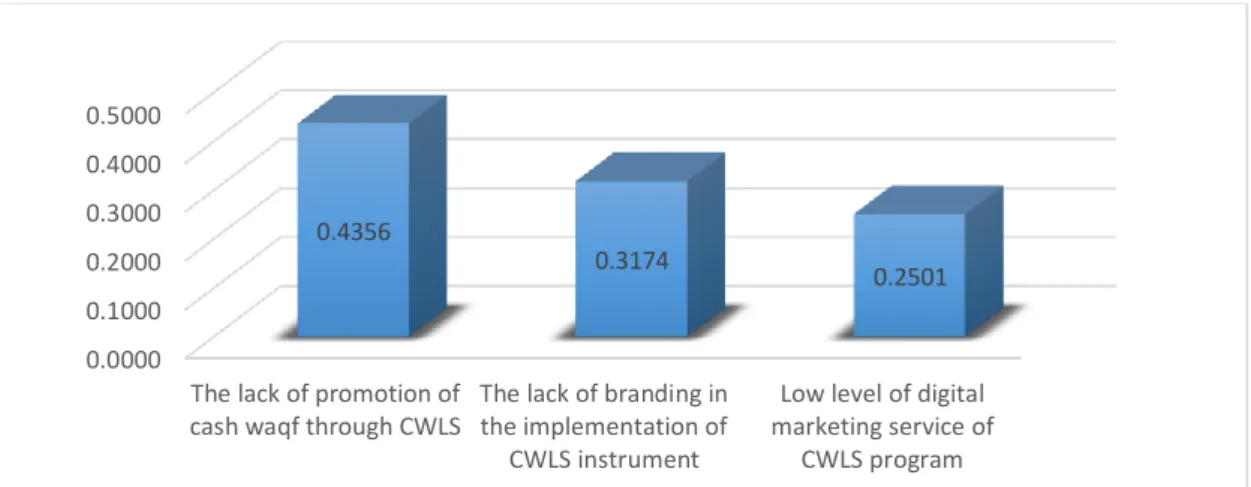
Source: Data Processing Results (2022)
Based on Figure 5, the most problematic indicator in the promotion dimension is the lack of information in the community for cash waqf through the CWLS instrument, with a GmK value of 0.4356. Meanwhile, the second priority problem for the promotion dimension is the lack of a brand for implementing the CWLS instrument, with a GmK value of 0.3174. The indicator considered not problematic in the promotion dimension is the low level of digital marketing services for the CWLS instrument, with a GmK value of 0.2501.
Government Dimension
CWLS in the health sector is related to the government's role in developing the CWLS instrument. The following are the results of the GmK of government dimensions on the aspect of the problem, namely:
Figure 6. Geometric Mean Dimension of Government on Problem Aspect Source: Data Processing Results (2022)
Based on Figure 6, the most problematic indicator in the government dimension is the lack of cooperation between the stakeholders of the CWLS instrument and community organizations, with a GmK value of 0.5222. The indicator considered not problematic on the government dimension is the lack of cooperation or support among the stakeholders of the CWLS instrument and community organizations, with a GmK value of 0.3661.
0.0000 0.1000 0.2000 0.3000 0.4000 0.5000
The lack of promotion of cash waqf through CWLS
The lack of branding in the implementation of
CWLS instrument
Low level of digital marketing service of
CWLS program 0.4356
0.3174
0.2501
0.0000 0.1000 0.2000 0.3000 0.4000 0.5000 0.6000
Lack of support for CWLS instrument development
Lack of supports among CWLS instrument stakeholders and
community organizations
0.3661 0.5222
51 Regulatory Dimension
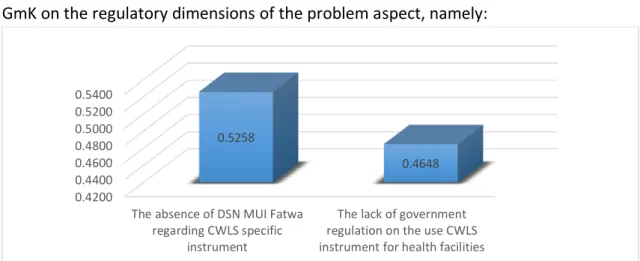
In the regulatory dimension, the problem of using CWLS in the health sector is related to the regulation of the CWLS instrument. The following are the results of the GmK on the regulatory dimensions of the problem aspect, namely:
Figure 7. Geometric Mean Dimension of Regulation on Problem Aspect Source: Data Processing Results (2022)
Based on Figure 7, the most problematic indicator on the regulatory dimension is the absence of a fatwa regulation by the DSN MUI regarding the CWLS instrument specifically, with a GmK value of 0.5258. The indicator considered not problematic in the regulatory dimension is the lack of government regulations governing the CWLS instrument, with a GmK value of 0.4648.
Dimensions of Nadzir
In the nadzir dimension, the problem of using CWLS in the health sector is related to the role of the nadzir in managing the CWLS instrument. The following the are results of the GmK on the dimensions of nadzir on the aspect of the problem, namely:
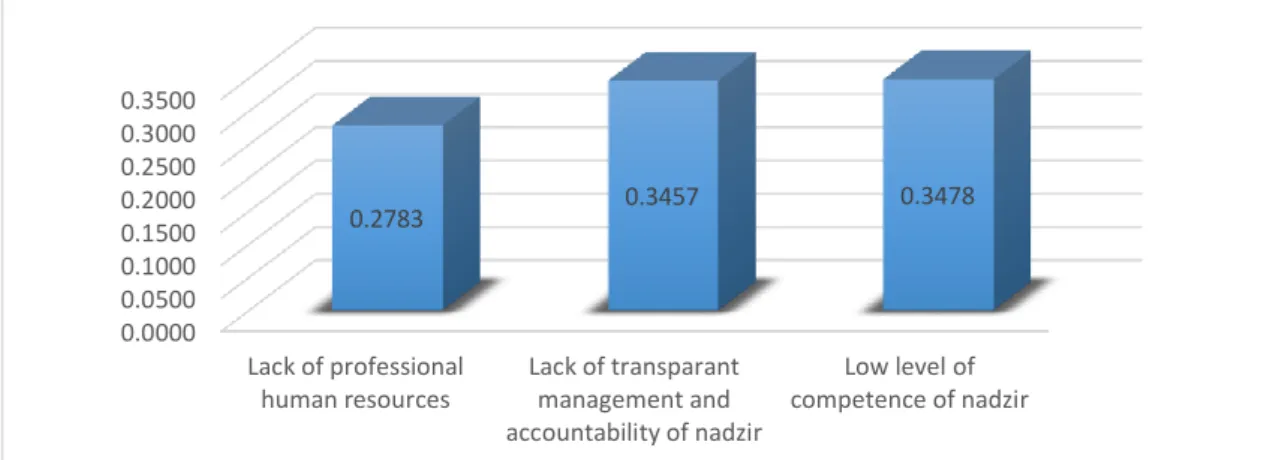
Figure 8. Geometric Mean Dimension of Nadzir on Problem Aspect Source: Data Processing Results (2022)
Based on Figure 8, the most problematic indicator on the nadzir dimension is the low competence of nadzir, with a GmK value of 0.3478. Meanwhile, the priority problem of the two dimensions of nadzir is the lack of transparent management and accountability of nadzir, with a GmK value of 0.3457. The indicator that is considered not problematic on the nadzir dimension is the minimum number of professional nadzir human resources, with a GmK value of 0.2783.
0.4200 0.4400 0.4600 0.4800 0.5000 0.5200 0.5400
The absence of DSN MUI Fatwa regarding CWLS specific
instrument
The lack of government regulation on the use CWLS instrument for health facilities 0.5258
0.4648
0.0000 0.0500 0.1000 0.1500 0.2000 0.2500 0.3000 0.3500
Lack of professional human resources
Lack of transparant management and accountability of nadzir
Low level of competence of nadzir
0.2783 0.3457 0.3478
Published by University of Airlangga.
This is an open access article under the CC BY license ( https://creativecommons.org/licenses/by-nc-sa/4.0/ )
General Dimension
In this section, each of the dimensions is juxtaposed to determine which dimensions are the most problematic and which are not problematic in general. Here are the results of GmK problems in general, namely:
Figure 9. Geometric Mean Aspects of General Problems Source: Data Processing Results (2022)
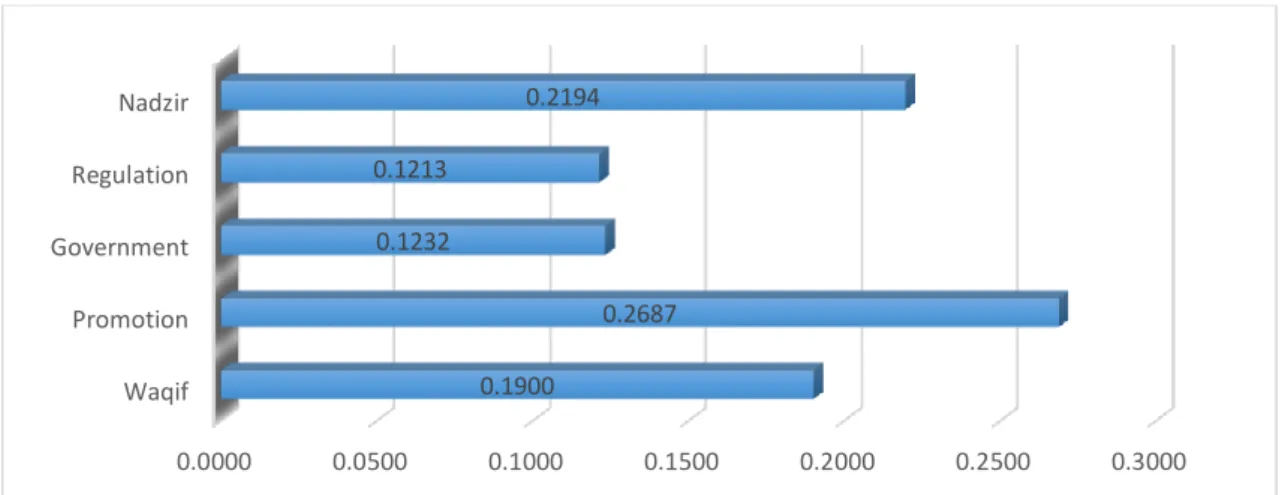
Based on Figure 9, the most problematic dimension, in general, is the promotion dimension, with a GmK value of 0.2687, as it is known that cash waqf is a new type of contemporary waqf in Indonesia and even in the world. Thus, the public will not know about the CWLS instrument if promotional activities are not carried out. Therefore, the promotion dimension is the dimension that is considered the most problematic.
The regulatory dimensions are considered not problematic in general, with a GmK value of 0.1213. It is known that regulations regarding waqf, in general, have already existed, but in practice, these regulations do not support the development of the CWLS instrument. So, in this study, the regulatory dimension is considered not to be the most problematic dimension.
Rater Agreement Aspects of the Problem
In this study, the expert respondents' agreement was calculated through the Rater Agreement with Kendall's Coefficient or the W value as a measure. The following are the results of Kendall's Coefficient aspects of the problem, namely:
Table 5
Kendall's Coefficient Aspect Problem
Dimension W Information
Waqif 1.4059 Perfect Deal
Promotion 1.0998 Perfect Deal Government 2.1769 Perfect Deal
Regulation 0.1361 Weak Deal
Nadzir 0.3175 Medium Deal
General 0.7442 Strong Deal
Source: Data Processing Results (2022)
0.0000 0.0500 0.1000 0.1500 0.2000 0.2500 0.3000
Waqif Promotion Government Regulation Nadzir
0.1900
0.2687 0.1232
0.1213
0.2194
53
Based on Table 5, the waqif dimension perfectly agrees with the W value of 1.4059.
Most people in Indonesia still understand waqf as limited to immovable objects, such as land, buildings used for mosques, Islamic boarding schools, orphanages, and graves (Purwaningsih and Susilowati 2020). Ultimately, this paradigm will limit people who want to contribute to waqf because people will think that only people from wealthy groups can do waqf (Jufri and Kusuma 2020). In fact, with cash waqf, the entire community can perform waqf without waiting to be wealthy first (Berakon et al. 2017).
Therefore, the problem indicators that exist in the waqif dimension have perfect agreement among expert respondents.
Next, the promotion dimension has a perfect agreement with the W value of 1.0998. Lack of promotion of goods or services will make people unfamiliar with the product. Therefore, people will choose to use products from companies they are familiar with. (Aprianto 2016). Likewise, concerning the waqf sector, if the promotion of the CWLS instrument is not massive, then the public will choose to do waqf through waqf programs offered by other waqf institutions. According to Maruto, the Associate Director of Fixed Income Anugerah Sekurita (2020), the CWLS instrument is still less prestigious than other Indonesian Ministry of Finance instruments. Therefore, public interest in the CWLS instrument is still low. It means that the brand on the CWLS instrument is not yet known in the community. In addition, according to research conducted by Iqbal and Nadya (2019) and Hudzaifah (2019) states that there are still few advertisements about waqf in Indonesia. Therefore, the problem indicators on the promotion dimension have perfect agreement among expert respondents.
Furthermore, the government dimension has a perfect agreement with a W value of 2.1769. The government's inadequate supervision indicates the lack of government support. It is because the waqf instrument is still underestimated and has not become a top priority in the source of state financing (Fitri and Wilantoro 2018). Even so far, the government has been supported by waqf instruments for infrastructure development (Fawwaz et al. 2021). Therefore, the indicators of problems that exist on the government dimension have perfect agreement among expert respondents.
Then, the regulation dimension has a weak agreement with a W value of 0.1361.
This is because there are different points of view between regulators and academics and practitioners. Regulators consider that the CWLS regulation is sufficient and can sustain the development of CWLS. Meanwhile, academics and practitioners consider that existing regulations do not fully support the development of CWLS. According to Saptono (2018) states that the current CWLS regulations do not fully support optimizing the use of CWLS instruments for infrastructure development. Even though the waqf regulation refers to Law No. 41 of 2004 concerning waqf, the application of this regulation has not had a visible impact on the development of CWLS instruments in Indonesia. Several factors influence this, including the existing regulations that still have convoluted bureaucratic channels, such as setting operational costs, nadzir appointments, changes in nadzir status to institutions, and so on (Ali et al. 2018).
Published by University of Airlangga.
This is an open access article under the CC BY license ( https://creativecommons.org/licenses/by-nc-sa/4.0/ )
Then, the nadzir dimension has a moderate agreement with a W value of 0.3175.
This is because there are different points of view between regulators and practitioners and academics. Academics consider that the nadzir has an important role in managing waqf assets because structurally the nadzir has a strategic function and position in the development of waqf assets (Ilmiah 2019). However, in practice, regulators and practitioners consider that the large number of nadzirs in the CWLS instrument doesn’t make their profession the main cause they do not have good competence in managing and developing waqf assets (Rozalinda 2015). The nadzir should always be trustworthy and fully responsible for managing waqf funds and objects (Rusydiana and Rahayu 2019). So, the existence of this will have an impact on the stagnant development of waqf, so the distribution of waqf is not optimal (Syakur et al. 2018).
In this study, the expert respondents’ assessment of the problem, in general, has a strong agreement with the W value of 0.7442. Considering that a promotion dimension is a form of communication to disseminate information to the public (Prasetya et al.
2021). Thus, the dimensions of the problem must immediately receive more special attention from the stakeholders of the CWLS instrument.
Geometric Mean (GmK) Solution Aspect Waqif Dimensions
In the waqif dimension, the solution for using CWLS in the health sector is related to the level of literacy and public understanding of the CWLS instrument. The following are the results of the GmK waqif dimension on the solution aspect, namely:
Figure 10. Geometric Mean Dimension of Waqif on Solution Aspect Source: Data Processing Results (2022)
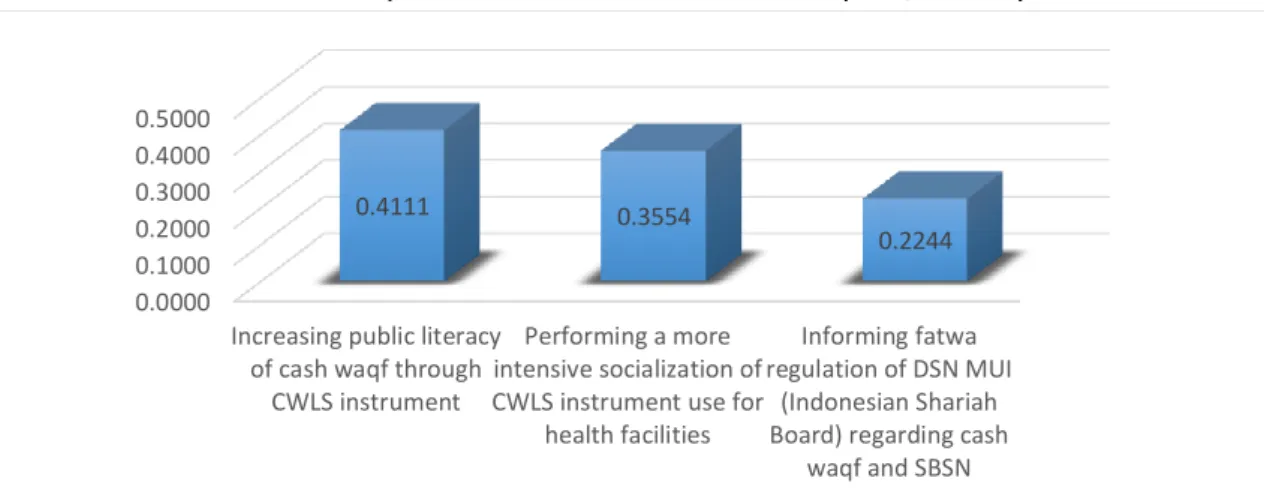
Based on Figure 10, The solution prioritized on the waqif dimension is to increase public literacy regarding cash waqf through the CWLS instrument, with a GmK value of 0.4111. At the same time, the second priority solution on the waqif dimension is to conduct more intensive socialization regarding using the CWLS instrument for health facilities, with a GmK value of 0.3554. The less prioritized solution on the waqif
0.0000 0.1000 0.2000 0.3000 0.4000 0.5000
Increasing public literacy of cash waqf through
CWLS instrument
Performing a more intensive socialization of CWLS instrument use for
health facilities
Informing fatwa regulation of DSN MUI
(Indonesian Shariah Board) regarding cash
waqf and SBSN
0.4111 0.3554
0.2244
55
dimension is to inform the DSN-MUI fatwa rules regarding cash waqf and sukuk, with a GmK value of 0.2244.
Promotion Dimension
In the promotion dimension, the solution for using CWLS in the health sector is related to the marketing strategy of the CWLS instrument. The following are the results of the GmK promotion dimensions on the solution aspect, namely:
Figure 11. Geometric Mean Dimension of Promotion on Solution Aspect Source: Data Processing Results (2022)
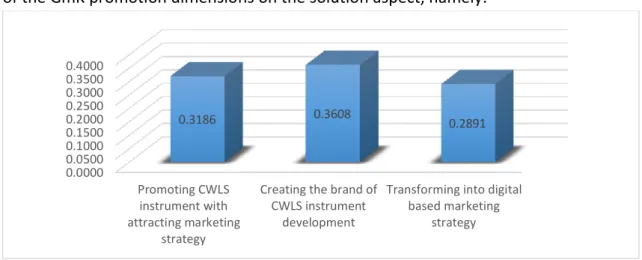
Based on Figure 11, the prioritized solution in the promotion dimension is to create a brand for developing the CWLS instrument, with a GmK value of 0.3608. In comparison, the second priority solution on the promotion dimension is to promote the CWLS instrument with an attracting marketing strategy, with a GmK value of 0.3186. The less prioritized solution in the promotion dimension is to transform into digital-based marketing strategies, with a GmK value of 0.2891.
Government Dimension
In the government dimension, the solution for using CWLS in the health sector is related to the government's role in developing the CWLS instrument. The following are the results of the GmK government dimensions on the aspect of the solution, namely:
Figure 12. Geometric Mean Dimension of Government on Solution Aspect Source: Data Processing Results (2022)
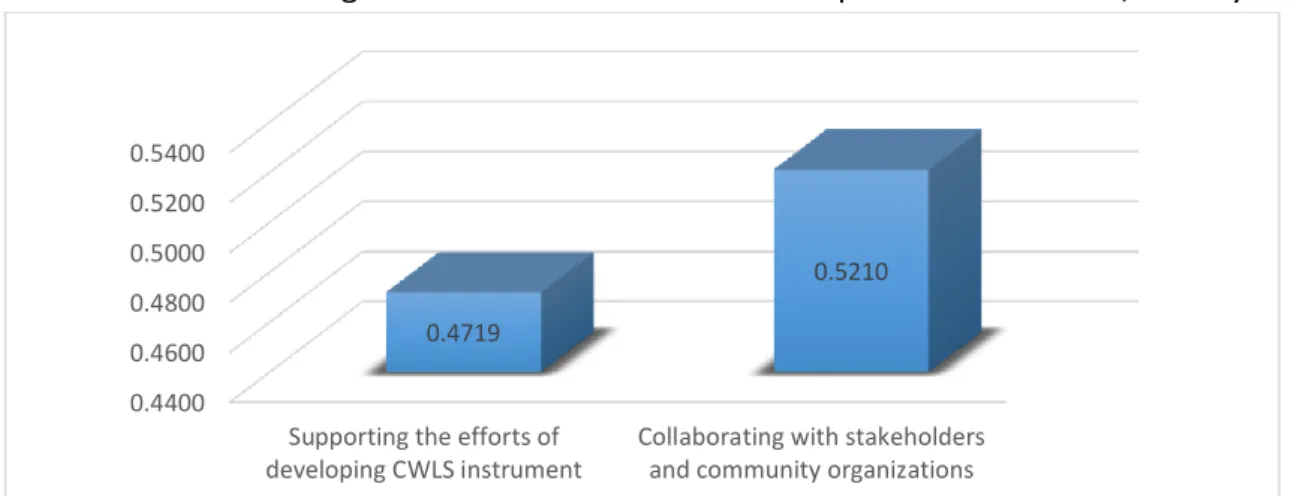
Based on Figure 12, the solution prioritized in the government dimension is to collaborate with the stakeholders of the CWLS instrument and community
0.0000 0.0500 0.1000 0.1500 0.2000 0.2500 0.3000 0.3500 0.4000
Promoting CWLS instrument with attracting marketing
strategy
Creating the brand of CWLS instrument
development
Transforming into digital based marketing
strategy
0.3186 0.3608
0.2891
0.4400 0.4600 0.4800 0.5000 0.5200 0.5400
Supporting the efforts of developing CWLS instrument
Collaborating with stakeholders and community organizations 0.4719
0.5210
Published by University of Airlangga.
This is an open access article under the CC BY license ( https://creativecommons.org/licenses/by-nc-sa/4.0/ )
organizations, with a GmK value of 0.5210. The solution that is less prioritized on the government dimension is to support the socialization and development of the CWLS instrument, with a GmK value of 0.4719.
Regulatory Dimension
In the regulatory dimension, the solution for using CWLS in the health sector is related to the regulation of the CWLS instrument. The following are the results of the GmK regulatory dimensions on the solution aspect, namely:
Figure 13. Geometric Mean Dimension of Regulation on Solution Aspect Source: Data Processing Results (2022)
Based on Figure 13, the solution prioritized on the regulatory dimension is to make DSN-MUI fatwa rules regarding the CWLS instrument specifically, with a GmK value of 0.5043. The less prioritized solution in the regulatory dimension is strengthening government regulations in using the CWLS instrument for health facilities, with a GmK value of 0.4907.
Dimensions of Nadzir
In the nadzir dimension, the solution for using CWLS in the health sector is related to the role of the nadzir in managing the CWLS instrument. The following are the results of the nadzir dimension GmK on the aspect of the solution, namely:
Figure 14. Geometric Mean Dimensions of Nadzir on Solution Aspect Source: Data Processing Results (2022)
0.4800 0.4850 0.4900 0.4950 0.5000 0.5050
Making DSN MUI rules or fatwa regarding specific CWLS
instrument
Strengthening government regulations in the use of CWLS
instrument 0.5043
0.4907
0.2800 0.2900 0.3000 0.3100 0.3200 0.3300 0.3400 0.3500 0.3600
Recruiting professionals nadzir
Informing transparant and accountable management of CWLS
program
Enhancing the nadzir's competence continuously
0.3096 0.3156
0.3552
57
Based on Figure 14, the solution prioritized on the nadzir dimension is to increase nadzir's competence on an ongoing basis, with a GmK value of 0.3552. At the same time, the second priority solution on the nadzir dimension is to inform the transparent management and accountability of nadzir, with a GmK value of 0.3156.
The less prioritized solution on the nadzir dimension is to conduct professional nadzir recruitment, with a GmK value of 0.3096.
General Dimension
In this section, each of the dimensions is compared to find out which dimensions should be prioritized and not prioritized in general. The following are the results of GmK solutions in general, namely:
Figure 15. Geometric Mean Aspects of Solutions in General Source: Data Processing Results (2022)
Based on Figure 15, the dimension of the solution that is prioritized in general is the promotion dimension, with a GmK value of 0.2530. Those promotional activities are a means of communicating to the public about the CWLS instrument. So, with this promotion, the public will be aware of the CWLS instrument.
The dimension of the less prioritized solution, in general, is the regulation dimension, with a GmK value of 0.1283. It is known that regulations regarding waqf in general already exist, but in practice, these regulations do not support the development of the CWLS instrument. So, in this study, the regulatory dimension has not been the primary solution priority.
Rater Agreement Aspect Solution
In this study, the expert respondents' agreement was calculated through the Rater Agreement with Kendall's Coefficient or the W value as a measure. The following are the results of Kendall's Coefficient aspects of the solution, namely:
Table 6
Kendall's Coefficient Aspect Solution
Dimension W Information
Waqif 2.0522 Perfect Deal
Promotion 0.1474 Weak Deal
Government 0.1361 Weak Deal
Regulation 0.0340 No agreement
0.0000 0.0500 0.1000 0.1500 0.2000 0.2500 0.3000
Waqif Promotion Government Regulation Nadzir
0.1403
0.2530 0.1671
0.1283
0.2479
Published by University of Airlangga.
This is an open access article under the CC BY license ( https://creativecommons.org/licenses/by-nc-sa/4.0/ )
Dimension W Information
Nadzir 0.1474 Weak Deal
General 0.9293 Strong Deal
Source: Data Processing Results (2022)
Based on Table 6, the waqif dimension has a perfect agreement with the W value of 2.0522. Cash waqf literacy is a person's ability to process and understand information about cash waqf (Santika 2022). Thus, increased literacy in the community will have an impact on the practice of waqf, so that it can increase the collection of cash waqf in Indonesia. The movement for providing education can be carried out in various ways, such as providing education through social media, visiting educational institutions, maximizing the role of the Office of Religious Affairs (KUA), and optimizing through mosques and waqf institutions (Mubarok 2021). Therefore, the solution indicators on the waqif dimension have perfect agreement among expert respondents.
Subsequently, the promotion dimension has a weak agreement with a W value of 0.1474. According to Kotler & Armstrong (2012), promotion is an activity that communicates the benefits of a product and persuades target consumers to buy the product. When associated with waqf, an attractive promotion can be helpful to invite the public to contribute to waqf through the CWLS instrument (Karsono, Purwanto, and Salman 2021). However, in this study, the solution indicators on the promotion dimension have weak agreement among expert respondents. This shows that each expert respondent has a different opinion regarding the solution on the promotion dimension.
Furthermore, the government dimension has a weak agreement with a W value of 0.1361. It is hoped by academics and practitioners that the CWLS instrument can be achieved as expected if other government elements jointly contribute to the development of the program, but in reality, some other government elements have not comprehensively provided support for the CWLS instrument (Yunita 2020).
However, on the other hand, regulators have supported the development of the CWLS instrument, as was done by the Ministry of Religion of West Kutai Regency which invited all Civil Servants (ASN) to give their sincerity to participate in the CWLS instrument program (Humas Kemenag Kutai 2020). So that in this dimension, the respondents have different perspectives on the solutions offered in the government dimension.
Then, the regulatory dimension did not reach an agreement with a W value of 0.0340. Good waqf management must be supported by good regulations. Strong regulations regarding the CWLS instrument will have an impact on the productivity of the parties involved in the CWLS instrument (Rusydiana 2018). According to Urip Budiharto, Head of the KNEKS Sharia Social Funds Division, said that currently, the focus of waqf management will be on strengthening the waqf regulations themselves (Beritasatu.com 2021). However, this shows that the expert respondents' assessment
59
of the solutions in the regulatory dimension tends to vary, so they do not reach an agreement.
Afterward, the nadzir dimension has a weak agreement with a W value of 0.1474.
Terms of appointment as nadzir are carried out in various ways, one of which is appointment based on "who wants" and based on "who is able". Not a few nadzir waqf positions become "inheritance" (a father whose profession becomes nadzir, if his father dies then his nadzir profession is replaced by a child or family), without going through any administrative process, without qualifications and competence (Baharuddin and Iman 2018). Even though someone who becomes a nadzir must have experience, master administration, finance, and other things needed to carry out his duties in managing waqf (Huda et al. 2017). So that in this dimension, the respondents have different perspectives on the solutions offered in the nadzir dimension.
In this study, the expert respondents' assessment of the solution generally had a strong agreement with the W value of 0.9293. It is assumed that promotion can be useful for attracting public interest in waqf through the CWLS instrument (Yasin 2021).
The existence of creativity in the promotion, then the public will know more about the CWLS instrument.
Geometric Mean (GmK) Strategy Aspect
The following are the results of the Geometric Mean (GmK) of the overall strategy, namely:
Figure 16. Geometric Mean Aspect of Overall Strategy Source: Data Processing Results (2022)
Based on Figure 16, the overall priority strategy is the implementation of waqf literacy classes by the Ministry of Religion and the Indonesian Waqf Board to the community, with a GmK value of 0.1760. The strategy that is not prioritized is to issue a fatwa specifically related to CWLS by the National Sharia Council of the Indonesian Ulema Council, with a GmK value of 0.0720.
First Priority: The Implementation of Waqf Literacy Classes by the Ministry of Religion and the Indonesian Waqf Board to the Community
0.0000 0.0200 0.0400 0.0600 0.0800 0.1000 0.1200 0.1400 0.1600 0.1800 PR-1
PR-2 PR-3 PR-4 PR-5 PR-6 PR-7
0.1760 0.1315
0.1122
0.1569 0.1326 0.0720
0.0948
Published by University of Airlangga.
This is an open access article under the CC BY license ( https://creativecommons.org/licenses/by-nc-sa/4.0/ )
In implementing waqf literacy classes, the community will be given comprehensive knowledge about waqf. In 2020, the Ministry of Religion, through the sub-directorate of Education, Innovation, Cooperation, Zakat, and Waqf Partnership, has conducted a zakat and waqf literacy class program intending to educate the public about knowledge of zakat calculation, zakat, and waqf management, the impact of zakat and waqf on the economy, education, and health, to the mechanism for creating transparency and accountability of zakat and waqf institutions. The class was carried out through the Zoom Meeting platform and the Bimas Islam TV Youtube Channel. However, due to the enactment of Large-Scale Social Restrictions (PSBB) therefore, the literacy class is not implemented comprehensively. Therefore, the waqf literacy class must be held regularly every month (Muhammad 2020).
Second Priority: Collecting Corporate Social Responsibility (CSR) Funds from Companies to Participate in the CWLS Instrument
CSR is a commitment in the form of a company's responsibility to the community and the surrounding environment. CSR is necessary to carry out, among other things, because it shows the company's concern for state development to give the public confidence in the company. Thus, this is an opportunity for waqf institutions to collect CSR funds for companies to participate in the CWLS instrument.
Third Priority: Leveraging the Role of Influencers in Promoting the Benefits of the CWLS Instrument
An influencer is someone who has the power to persuade his followers. However, a good influencer must be able to do the right personal brand to persuade their followers. A personal brand creates a public perception of a person's aspects to generate a positive response and can be used as a marketing tool If it is associated with the waqf areas, then this influencer or public figure's role can help to increase the public awareness on cash waqf and ultimately to promote its collection. It is because influencers invite their followers to contribute to waqf through the CWLS instrument.
In addition, the advertising content created must also contain interesting and attractive content, bearing in mind that information spread on social media will have a positive impact on its users (Pardiansyah and Rahmat 2018); (Aldeen, Ratih, and Pertiwi 2021).
Fourth Priority: Creating a Crowdfunding Platform for CWLS Instruments
Crowdfunding has enormous potential as a medium for raising funds (Farras 2019).
The potential of existing crowdfunding platforms with the number of worldwide crowdfunding platforms reached around 1,250 units, raising funds amounting to USD 34.4 billion in 2015 and USD 16.2 billion in 2014 (Akbar 2014). As research conducted by Mukti et al. (2022) and (Berakon, Aji, and Hafizi 2021) states that with a digital platform that is integrated with mobile banking, Islamic banking is expected to be able to provide complete information about CWLS while increasing waqf literacy to the public so that this can make it easier for people who want to make waqf through CWLS.
61
Thus, this crowdfunding platform can be utilized to increase the collection of cash waqf.
Fifth Priority: Creating a Website That Contains the CWLS Instruments Database Currently, the website regarding the CWLS instrument is still integrated with the Ministry of Finance of the Republic of Indonesia website. In practice, this website contains not only databases related to the CWLS instrument but also other information. Thus, creating a specific website for the CWLS instrument can be helpful for the community so that the public knows about the development of the CWLS instrument.
Sixth Priority: The Implementation of Training Classes for the Nadzirs Involved in the CWLS Instrument
The nadzir training has been carried out by the Ministry of Religion of each region.
As has been done by the Ministry of Religion of Pati Regency, the nadzirs have been given guidance on the management of productive waqf. The purpose of this activity is to encourage and increase the empowerment of nadzirs in managing waqf land and to increase the role of nadzirs in managing waqf land to be more professional (Humas Kemenag Pati 2017). However, the training classes were not carried out comprehensively. So, the suggestions for the training class are that it should be held regularly every month. A study conducted in Malaysia by Ab Shatar, Hanaysha, and Tahir (2021) states that the level of trust in nadzir has a positive effect on contributions to participating in cash waqf. Thus, nadzirs in Indonesia must be trustworthy in carrying out their profession by having professional skills.
Seventh Priority: Issuing Fatwa Specifically Related to CWLS by the National Sharia Council of the Indonesian Ulema Council
Until now, there is no DSN-MUI fatwa regarding CWLS. It's just that there is a sharia opinion from the DSN-MUI regarding CWLS, namely the Fatwa and the Statement of Sharia Conformity in the DSN-MUI Fatwa No. 76/DSN-MUI/VI/2010 concerning SBSN Ijarah Assets to be Leased and DSN-MUI Fatwa No. 95/DSN-MUI/VII/2014 concerning SBSN Wakalah, and others. In other words, the basis for CWLS is based on another DSN-MUI fatwa. However, this step must still be implemented immediately by DSN- MUI, considering that there are still doubts in the community regarding the CWLS instrument. If the fatwa has been issued, the public's interest in cash waqf through the CWLS instrument will increase.
Rater Agreement Strategic Aspect
In this study, the expert respondents' agreement was calculated through the Rater Agreement with Kendall's Coefficient or the W value as a measure. The following are the results of Kendall's Coefficient of strategic aspects obtained from 7 expert respondents, namely: