Plan Optimization to Bilingual Dictionary Induction for Low-Resource Language Families
ARBI HAZA NASUTION∗,Universitas Islam Riau, Indonesia
YOHEI MURAKAMI,Ritsumeikan University, Japan
TORU ISHIDA,Waseda University, Japan
Creating bilingual dictionary is the first crucial step in enriching low-resource languages. Especially for the closely-related ones, it has been shown that the constraint-based approach is useful for inducing bilingual lexicons from two bilingual dictionaries via the pivot language. However, if there are no available machine- readable dictionaries as input, we need to consider manual creation by bilingual native speakers. To reach a goal of comprehensively create multiple bilingual dictionaries, even if we already have several existing machine-readable bilingual dictionaries, it is still difficult to determine the execution order of the constraint- based approach to reducing the total cost. Plan optimization is crucial in composing the order of bilingual dictionaries creation with the consideration of the methods and their costs. We formalize the plan optimization for creating bilingual dictionaries by utilizing Markov Decision Process (MDP) with the goal to get a more accurate estimation of the most feasible optimal plan with the least total cost before fully implementing the constraint-based bilingual lexicon induction. We model a prior beta distribution of bilingual lexicon induction precision with language similarity and polysemy of the topology as𝛼and𝛽parameters. It is further used to model cost function and state transition probability. We estimated the cost of all investment plan as a baseline for evaluating the proposed MDP-based approach with total cost as an evaluation metric. After utilizing the posterior beta distribution in the first batch of experiments to construct the prior beta distribution in the second batch of experiments, the result shows 61.5% of cost reduction compared to the estimated all investment plan and 39.4% of cost reduction compared to the estimated MDP optimal plan. The MDP-based proposal outperformed the baseline on the total cost.
CCS Concepts: •Computing methodologies→Value iteration;Planning under uncertainty;Lan- guage resources;Lexical semantics; •Theory of computation→Constraint and logic programming; • Mathematics of computing→Bayesian networks;Distribution functions.
Additional Key Words and Phrases: plan optimization, low-resource languages, closely-related languages, pivot-based bilingual lexicon induction
ACM Reference Format:
Arbi Haza Nasution, Yohei Murakami, and Toru Ishida. 2020. Plan Optimization to Bilingual Dictionary Induction for Low-Resource Language Families.ACM Trans. Asian Low-Resour. Lang. Inf. Process.19, 6, Article 1 (October 2020), 29 pages. https://doi.org/10.1145/1122445.xxxxxxxxxx
∗This is the corresponding author
Authors’ addresses: Arbi Haza Nasution, Universitas Islam Riau, Informatics Engineering, Pekanbaru, Riau, Indonesia, [email protected]; Yohei Murakami, Ritsumeikan University, Faculty of Information Science and Engineering, Kyoto, Japan, [email protected]; Toru Ishida, Waseda University, School of Creative Science and Engineering, Tokyo, Japan, [email protected].
Permission to make digital or hard copies of all or part of this work for personal or classroom use is granted without fee provided that copies are not made or distributed for profit or commercial advantage and that copies bear this notice and the full citation on the first page. Copyrights for components of this work owned by others than ACM must be honored.
Abstracting with credit is permitted. To copy otherwise, or republish, to post on servers or to redistribute to lists, requires prior specific permission and/or a fee. Request permissions from [email protected].
© 2020 Association for Computing Machinery.
2375-4699/2020/10-ART1 $15.00
https://doi.org/10.1145/1122445.xxxxxxxxxx
arXiv:2010.02396v1 [cs.CL] 5 Oct 2020
1 INTRODUCTION
Machine-readable bilingual dictionaries are important language resources which are often utilized as language services [12] for various purpose such as supporting intercultural communication and collaboration [11, 15, 22]. Unfortunately, low-resource languages lack such resources. Previous study on high-resource languages showed the effectiveness of parallel corpora [3, 7] and comparable corpora [6, 23] in extracting bilingual lexicons. It is clear that bilingual lexicon extraction is not an easy task, yet challenging for low-resource languages due to the lack of parallel and comparable corpora. We introduced the promising approach of treating pivot-based bilingual lexicon induction for low-resource languages as an optimization problem [18] where the only language resources required as input are two bilingual dictionaries. In spite of the great potential of our constraint-based bilingual lexicon induction in enriching low-resource languages, when actually implementing the induction method, we need to consider adding a more traditional method to the equation, i.e., manually creating the bilingual dictionaries by bilingual native speakers. Despite the high cost, the inclusion of the manual creation will be unavoidable if no machine-readable dictionaries are available. When we want to comprehensively create all combination of bilingual dictionaries from a set of target languages, even if we already have several existing machine readable bilingual dictionaries, it is still difficult to determine the execution order of the constraint-based method to reducing the total cost. Moreover, when the constraint-based method failed to return the satisfiable size of output bilingual dictionary, the manual creation will fill in the gap. Considering the methods and their costs, we recently introduced a plan optimizer to find a feasible optimal plan of creating multiple bilingual dictionaries with the least total cost [19]. The plan optimizer will calculate the best bilingual dictionary creation method (constraint-based induction or manual creation by human) to take in order to obtain all possible combination of bilingual dictionaries from the language set with the minimum total cost to be paid. However, the paper lacks actual data and experiment. It only presents a comparative simulation of the proposed MDP model and three heuristic models with an estimated total cost as a measure. The state transition probability modeling is also too naive as the precision of constraint-based bilingual lexicon induction assumed to be equals or exceeds input languages similarity. To obtain a better estimation of constraint-based bilingual lexicon induction precision and a better plan than our previous work, we extend the plan optimizer and address the following research goals:
• Modeling prior beta distribution of constraint-based bilingual lexicon induction precision: We model language similarity and polysemy of the topology as beta distribution parameters.
• Formalization of plan optimization in creating bilingual dictionaries using Markov Decision Process: Modeling bilingual dictionary dependency with AND/OR graphs as states, modeling constraint-based bilingual lexicon induction and manual dictionary creation by human as actions, and utilizing beta distribution of constraint-based bilingual lexicon induction precision to model cost function and state transition probability.
• Evaluating the plan optimizer:We evaluate the generated plan by conducting an experiment to create 10 bilingual dictionaries from 5 languages following the plan.
The rest of this paper is organized as follows: We will briefly discuss a motivating scenario to lead reader into understanding the whole picture of our approach in Section 2. In Section 3, we will explain related research on pivot-based bilingual lexicon induction and introduce our novel modeling of constraint-based bilingual lexicon induction precision prior beta distribution. Section 4 provides details on how to model dictionary dependency. The plan optimization formalization, a core component of our proposal is discussed in Section 5. Section 6 describes our experiments and the results. Finally, Section 7 discuss the potential dynamic use of plan optimization and Section 8 concludes this paper.
d
(x,y)1.𝑤$%− 𝑤$' 2.𝑤)%− 𝑤)'
d
(x,z)Input Dictionaries Transgraphs Transgraphs with new edges
WPMax-SAT Solver
CNF
Translation
Results Output
Dictionary 𝒘𝟏𝒙
𝒘𝟐𝒙 𝒘𝟏𝒛 𝒘𝟐𝒛
𝒘𝟏𝒚 𝒘𝟐𝒚
d
(z,y)𝒘𝟏𝒙 𝒘𝟐𝒙
𝒘𝟏𝒛 𝒘𝟐𝒛
𝒘𝟏𝒚 𝒘𝟐𝒚
Fig. 1. One-to-one constraint approach to pivot-based bilingual lexicon induction.
2 MOTIVATING SCENARIO
In order to illustrate the needs of optimal plan for creating multiple bilingual dictionaries with the least total cost we present an example motivating scenario. Consider a stakeholder has a motivation to obtain all 10 combination of bilingual dictionaries from 5 languages with a minimum size of 2,000 translation pairs each. Currently, the stakeholder already has a bilingual dictionary of language 1 and 3 (𝑑(1,3)) with 2,100 translation pairs and two bilingual dictionaries (𝑑(1,2)and𝑑(2,3)) with a number of translation pairs below 2,000. Obviously, the stakeholder can just hire native speakers to create and evaluate the bilingual dictionaries following the traditional investment plan to reach his goal with a total cost of𝐶. However, he can save cost of bilingual dictionary creation by utilizing our constraint-based bilingual lexicon induction with a zero creation cost. Even though the resulting bilingual dictionary still needs to be evaluated by native speakers, by following the optimal plan, the stakeholder can cut about half of the total cost.
At this point, the reader might wonder that even before executing the optimal plan, how can we know that utilizing the constraint-based bilingual lexicon induction to enrich𝑑(2,3)resulting a satisfying size bilingual dictionary above 2,000 translation pairs or below 2,000 translation pairs that need to be invested more by native speakers to fill in the gap. To answer this question, the constraint-based bilingual lexicon induction precision need to be estimated in order to calculate the resulting size bilingual dictionary. This uncertainty is the research challenge that we want to address in the following sections by modeling beta distribution of constraint-based bilingual lexicon induction precision and further utilize it in formalizing plan optimization in creating bilingual dictionaries using Markov Decision Process (MDP), since MDP can handle planning under uncertainty. If one try to utilize both our constraint-based bilingual lexicon induction and manual creation by native speakers and try to create the plan (order of dictionary creation task to take) manually without our MDP approach, the total cost might be higher than following our MDP plan.
Since the created bilingual dictionary can be used as input for inducing the other unsatisfying size dictionary, the order of dictionary creation task to take is crucial.
3 CONSTRAINT-BASED BILINGUAL LEXICON INDUCTION
The first work on bilingual lexicon induction to create bilingual dictionary of language x and language y,𝑑(𝑥 ,𝑦), via pivot language z is Inverse Consultation (IC) [27]. It utilizes the structure of input dictionaries to measure the closeness of word meanings and then uses the results to trim incorrect translation pair candidates. The approach identifies equivalent candidates of language x words in language y by consulting𝑑(𝑥 ,𝑧)and𝑑(𝑧,𝑦). These equivalent candidates will be looked up and compared in the inverse dictionary𝑑(𝑦,𝑥).
The pivot-based approach is very suitable for low-resource languages, especially when dictionar- ies are the only language resource required. Unfortunately, for some low-resource languages, it is often difficult to find machine-readable inverse dictionaries and corpora to identify and eliminate the incorrect translation pair candidates. To overcome this limitation, our team [29] proposed
(c) HIGHEST average polysemy = 10 (b) MEDIUM
average polysemy = 3 N = 3 (a) LOWEST
average polysemy = 2 N = 4
N = 4 N = 6 N = 10 N = 10
N is the number translation pairs of pivot language and non-pivot language
Fig. 2. Average polysemy of the topology.
to treat pivot-based bilingual lexicon induction as an optimization problem. They assume that closely-related languages share a significant number of cognates (words with similar spelling/form and meaning originating from the same root language), thus one-to-one lexicon mapping should often be found. This assumption yielded the development of a constraint optimization model to induce an Uyghur-Kazakh bilingual dictionary using Chinese language as the pivot, which means that Chinese words were used as bridges to connect Uyghur words in an Uyghur-Chinese dictionary with Kazakh words in a Kazakh-Chinese dictionary. The proposal uses a graph whose vertices represent words and edges indicate shared meanings; following [25] it was called a transgraph. The proposal proceeds as follows.
(1) Use two bilingual dictionaries as input.
(2) Represent them as transgraphs where𝑤𝑥
1 and𝑤𝑥
2are non-pivot words in language x,𝑤𝑧
1and 𝑤𝑧
2are pivot words in language z, and𝑤
𝑦 1,𝑤
𝑦 2 and𝑤
𝑦
3 are non-pivot words in language y.
(3) Add some new edges represented by dashed edges based on the one-to-one assumption.
(4) Formalize the problem into conjunctive normal form (CNF) and use the Weighted Partial MaxSAT (WPMaxSAT) solver [1] to return the optimized translation results.
(5) Output the induced bilingual dictionary as the result.
These steps are shown in Figure 1. However, the assumption of one-to-one mapping is too strong to induce the many translation pairs needed to offset resource paucity because few such pairs can be found. Therefore, we generalized the constraint-based bilingual lexicon induction by extending constraints and translation pair candidates from the one-to-one approach to attain more voluminous bilingual dictionary results with many-to-many translation pairs extracted from connected existing and new edges [17]. We further enhance our generalized method by setting two steps to obtaining translation pair results. First, we identify one-to-one cognates by incorporating more constraints and heuristics to improve the quality of the translation result. We then identify the cognates’
synonyms to obtain many-to-many translation pairs. In each step, we can obtain more cognate and cognate synonym pair candidates by iterating the n-cycle symmetry assumption until all possible translation pair candidates have been reached [18].
3.1 Modeling Prior Beta Distribution of Constraint-Based Bilingual Lexicon Induction Precision
The constraint-based bilingual lexicon induction has characteristics where it work better on closely- related languages and a higher polysemy pivot rate will hurt the precision. Having these positive
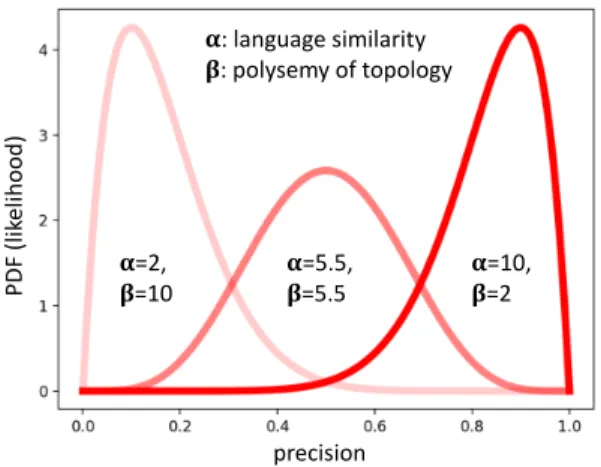
and negative parameters, a beta distribution is the best distribution to model the constraint-based bilingual lexicon induction precision. A beta distribution is a family of continuous probability distributions defined on the interval [0, 1] parametrized by two positive shape parameters, denoted by𝛼 which positively affecting the probability (x-axis) and 𝛽 which negatively affecting the probability (x-axis). The two parameters control the shape of the distribution. Beta distribution is usually used in Bayesian statistics as prior distribution for either a proportion, or the probability of occurrence of an event, or the value of any random variable [0, 1] such as the reliability of a component [8]. The constraint-based bilingual lexicon induction precision is useful to estimate the resulting bilingual dictionary size. However, before actually implementing our constraint-based bilingual lexicon induction, it is difficult to precisely know the precision beforehand. We can treat the precision as a random variable [0, 1] that can be modeled with a beta distribution. When sample observations are not available, a beta distribution can be defined by using subjective information [5]. A precision of the constraint-based bilingual lexicon induction for closely-related low-resource languages is likely to fall in the middle area between 0 and 1, and the likelihood is getting slimmer as the precision close to 0 or 1, therefore, the precision is better modeled with a bell-shaped beta distribution with𝛼 ≥2and𝛽≥2.
After determining the shape of beta distribution, we further model the𝛼and𝛽parameters for the prior beta distribution. Since𝛼has a positive contribution to the precision, a language similarity of the target dictionary is a best fit because our constraint-based bilingual lexicon induction works better on a closely-related languages [18]. Automated Similarity Judgment Program (ASJP) was proposed by [9] with the main goal of developing a database of Swadesh lists [26] for all of the world’s languages from which lexical similarity or lexical distance matrix between languages can be obtained by comparing the word lists. We utilize ASJP to select the target languages used in our case studies. We calculate language similarity between each language pair following our previous work [21].
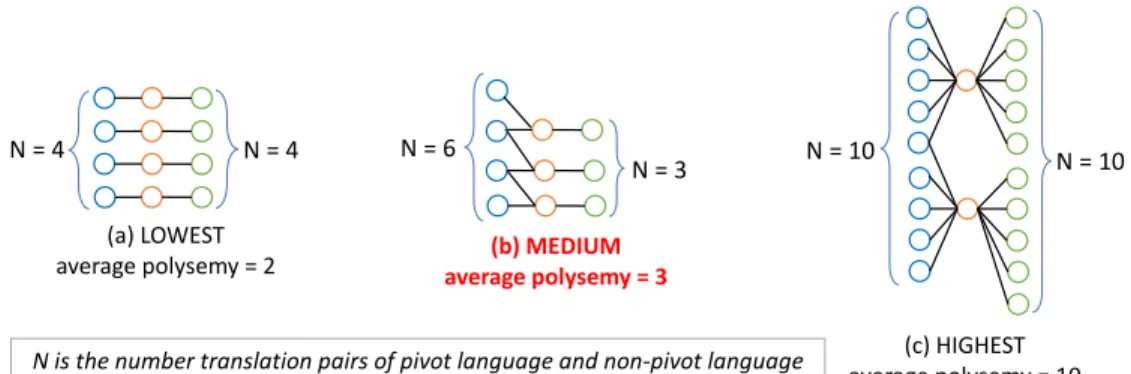
On the other hand, polysemy of the pivot word could cause a mistranslation when we induce a translation pair candidate from the connected edge in the transgraph as shown in Figure 1. However, considering low-resource languages have limited resources, our constraint-based bilingual lexicon induction only consider input bilingual dictionary as list of translation pairs without any additional information like part-of-speech or sense information. Therefore, we assume that an edge in a transgraph represents distinct sense/meaning. We define a polysemy of the topology as an average number of connected edges to pivot word in all transgraphs. When a one-to-one topology rate is 1 which means that every pivot word is only connected to one word from each of the non-pivot language as shown in Figure 2a, the polysemy of the topology is the lowest = 2. When each pivot word is connected to five word from each of the non-pivot language as shown in Figure 2c, the polysemy of the topology is 10. We assume that the highest polysemy of topology is 10. The higher the polysemy of the topology, the more likely it is polysemous, hence negatively affect the constraint-based bilingual lexicon induction precision. So, we define𝛽as the polysemy of the topology ranging from 2 to 10. The language similarity is normalized into𝛼∈ [2,10]to balance it with𝛽. The beta distribution of constraint-based bilingual lexicon induction precision will have different bell-shaped depends on the𝛼 and𝛽parameters as shown in Figure 3. The probability density function (PDF) is calculated by the following equation:
𝑓(𝑥;𝛼 , 𝛽)= 1
𝐵(𝛼 , 𝛽)𝑥𝛼−1(1−𝑥)𝛽−1; 0<𝑥 <1;𝛼 , 𝛽 ≥2 (1)
precision
PDF (likelihood)
!=2,
"=10 !=5.5,
"=5.5 !=10,
"=2
!: language similarity
": polysemy of topology
Fig. 3. Variety of beta distribution bell-shaped depends on𝛼and𝛽.
d(x,z)
d(z,y) d(x,y)
d(z,y) d(x,z)
(d(x,z)AND d(z,y)) OR (d(x,q)AND d(q,y))
d(x,q) d(q,y) d(x,q)
d(q,y) d(x,y)
d(x,y)
Fig. 4. Modeling Bilingual Dictionary Induction Dependency.
3.2 Modeling Dictionary Dependency
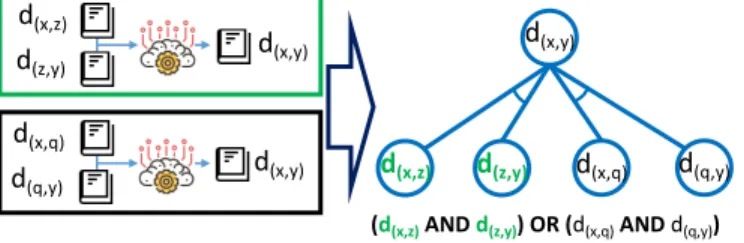
Our constraint-based bilingual lexicon induction requires two bilingual dictionaries that share the same pivot language. We can induce bilingual𝑑(𝑥 ,𝑦)from𝑑(𝑥 ,𝑧)and𝑑(𝑧,𝑦)as input (language z is the pivot). Nevertheless, we can also induce𝑑(𝑥 ,𝑦)with different input bilingual dictionaries using language q as the pivot language for instance. We use an AND/OR graph to model the dependency:
bilingual𝑑(𝑥 ,𝑦)can be induced from𝑑(𝑥 ,𝑧)and𝑑(𝑧,𝑦)OR from𝑑(𝑥 ,𝑞)and𝑑(𝑞,𝑦)as shown in Figure 4.
If two sets of input dictionaries can be used to induce𝑑(𝑥 ,𝑦), if we have to choose between the two sets, we need to prioritize input dictionaries that can induce𝑑(𝑥 ,𝑦) with more correct translation pairs. But, the number of correct translation pairs that can be induced depends on the constraint-based bilingual lexicon induction precision and the size of translation pair candidates generated from the transgraph.
4 FORMALIZING PLAN OPTIMIZATION
The plan optimization to bilingual lexicon induction involves discovering the order of bilingual dictionary creation task from a set of possible tasks including constraint-based bilingual lexicon induction and manual creation by native speakers to minimize the total cost. We assume that the number of existing translation pairs for existing bilingual dictionaries and the minimum number of translation pairs the output bilingual dictionary should have,𝑠𝑖𝑧𝑒(𝑑𝑚
(𝑥 ,𝑦)), are both known. Multiple candidate plans exist to finally obtain all bilingual dictionaries. One criteria for selecting a plan is
to establish a model of optimality and select the plan that is most optimal. We formulate the plan optimization in the context of creating multiple bilingual dictionaries from a set of language of interest as a constraint optimization problem (CSP) [16]. Formally, a constraint satisfaction problem is defined as a triple⟨𝑋 , 𝐷 , 𝐶⟩, where𝑋 ={𝑋1, . . . , 𝑋𝑛}is a set of variables,𝐷={𝐷1, . . . , 𝐷𝑛}is a set of the respective domains of values, and𝐶={𝐶1, . . . , 𝐶𝑚}is a set of constraints [24].
4.1 Variable
If𝑛is a number of target languages specified, the total number of all possible combinations of target bilingual dictionaries isℎ= 𝑛2. For example, if we have 4 languages (𝐿1,𝐿2,𝐿3,𝐿4), there will be ℎ= 42
=6target bilingual dictionaries:𝑑(1,2),𝑑(1,3),𝑑(1,4),𝑑(2,3),𝑑(2,4), and𝑑(3,4). A state𝑆𝑖stores ℎbilingual dictionaries, each𝑑(𝑥 ,𝑦)has four possible status types: not existing𝑑(𝑥 ,𝑦):𝑛, existing but number of translation pairs is below minimum dictionary size requested by user:𝑑(𝑥 ,𝑦):𝑒𝑢, induced with constraint-based bilingual induction with𝑧as pivot language but the number of translation pairs is below minimum dictionary size requested by user:𝑑(𝑥 ,𝑦):𝑝𝑢(𝑧), and existing or manually created by native bilingual speakers or induced with constraint-based bilingual induction where the number of translation pairs equals or exceeds minimum dictionary size requested by user:
𝑑(𝑥 ,𝑦):𝑠, hence, the maximum number of state is4ℎ=46=4,096. Based on the status, we further categorize the bilingual dictionary as either𝑆 𝐴𝑇 𝐷𝑖𝑐𝑡(𝑑(𝑥 ,𝑦):𝑠) or𝑈 𝑛𝑆 𝐴𝑇 𝐷𝑖𝑐𝑡(𝑑(𝑥 ,𝑦):𝑛,𝑑(𝑥 ,𝑦):𝑒𝑢, or 𝑑(𝑥 ,𝑦):𝑝𝑢(𝑧)). A variable𝑋𝑖is a possible bilingual dictionary creation method applied to enrich the size hence changing the status of bilingual dictionaries inside state𝑆𝑖. The number of state increases exponentially with the number of target languages. So as to cast formulation complexity into a graph theory problem, we initially create only one start state𝑆1along with variable𝑋1where each bilingual dictionary status is labeled based on the size of existing bilingual dictionaries given by user. The following states𝑆2,𝑆3, ...,𝑆𝑚and the respective variables𝑋2,𝑋3, ...,𝑋𝑚are created as each value in domain𝐷𝑖is defined.
4.2 Domain
Some bilingual dictionary creation methods such as the inverse consultation method, the one-to- one constraint-based approach, and our constraint-based bilingual lexicon induction require only bilingual dictionaries as input. However, since our method outperformed both previous methods, we model our method as one of value that can be assigned to variable𝑋𝑖and call it pivot action𝑎
𝑝 (𝑥 ,𝑧,𝑦)
to create dictionary𝑑(𝑥 ,𝑦)where𝑧is the pivot language. For low-resource languages, adequate machine-readable bilingual dictionaries are often unavailable, so, we define another value, manual bilingual dictionary creation by a native speaker as investment action𝑎𝑖
(𝑥 ,𝑦). The purposes of assigning the two values, the pivot action and investment action, are to enrich the size and change the category of the bilingual dictionaries stored in each state𝑆𝑖from𝑈 𝑛𝑆 𝐴𝑇 𝐷𝑖𝑐𝑡to𝑆 𝐴𝑇 𝐷𝑖𝑐𝑡. 4.3 Constraints for Domain Reduction
The following constraints are used to reduce the domain of a variable𝑋𝑖.
4.3.1 Adequate Dictionary Size Constraint (𝐶1).A dictionary𝑑(𝑥 ,𝑦) inside a state𝑆𝑖 cannot be created or enriched if the dictionary status is𝑑(𝑥 ,𝑦):𝑠 where the number of translation pairs equals or exceeds minimum dictionary size requested by user,𝑠𝑖𝑧𝑒(𝑑𝑚
(𝑥 ,𝑦)). In other word, neither𝑎𝑖
(𝑥 ,𝑦)
nor𝑎
𝑝
(𝑥 ,𝑧,𝑦); for any pivot language𝑧can be assigned to the variable𝑋𝑖. If all dictionaries in a state 𝑆𝑖 have a status of𝑑(𝑥 ,𝑦):𝑠, there are no available value to be assigned to variable𝑋𝑖 in the domain 𝐷𝑖.
d(1,2) d(2,3)
d(1,3)
d(1,4) d(2,4)
d(3,4)
Fig. 5. Bilingual Dictionary Induction Dependency Model.
4.3.2 Initial Dictionary Status Constraint (𝐶2).Initially, user provides information about the size of machine readable bilingual dictionaries if exist. The dictionary size information is mapped to a dictionary status of either𝑑(𝑥 ,𝑦):𝑛,𝑑(𝑥 ,𝑦):𝑒𝑢, or𝑑(𝑥 ,𝑦):𝑠. An𝑈 𝑛𝑆 𝐴𝑇 𝐷𝑖𝑐𝑡with status of𝑑(𝑥 ,𝑦):𝑛or 𝑑(𝑥 ,𝑦):𝑒𝑢 inside a variable𝑋𝑖 can be enriched by both investment action𝑎𝑖
(𝑥 ,𝑦) and pivot action 𝑎
𝑝
(𝑥 ,𝑧,𝑦). Both values can be assigned to the variable𝑋𝑖.
4.3.3 One-Time Induction Constraint (𝐶3).For an𝑈 𝑛𝑆 𝐴𝑇 𝐷𝑖𝑐𝑡 with status𝑑(𝑥 ,𝑦):𝑝𝑢(𝑧) inside a variable𝑋𝑖, however, the next action is limited to investment action𝑎𝑖
(𝑥 ,𝑦) only, because pivot action𝑎
𝑝
(𝑥 ,𝑧,𝑦)was already executed exactly one step prior. Thus, investment action𝑎𝑖
(𝑥 ,𝑦)is the only possible value to be assigned to the variable𝑋𝑖.
4.3.4 Dictionary Induction Dependency Constraint (𝐶4).A pivot action can be taken with a pair of input dictionary𝑑(𝑥 ,𝑧)and𝑑(𝑧,𝑦) as input when both of dictionaries have a status of𝑠, where the number of translation pairs equals or exceeds minimum dictionary size requested by user,𝑒𝑢, which exists but the number of translation pairs is below minimum dictionary size requested by user, or𝑝𝑢(𝑧)induced with constraint-based bilingual induction with𝑧as pivot language but the number of translation pairs is below minimum dictionary size requested by user. However, allowing dictionary with a status of𝑝𝑢(𝑧)as input can cause inconsistency of the translation pair result size. We consider the worst case scenario and choose the minimum translation pair result size. The bilingual lexicon induction dependency is shown in Figure 5.
4.4 Objective Function
In order to create or enrich bilingual dictionaries inside a state𝑆𝑖, a constraint-based bilingual lexicon induction as pivot action𝑎
𝑝
(𝑥 ,𝑧,𝑦) or a manual bilingual dictionary creation by a native speaker as investment action𝑎𝑖
(𝑥 ,𝑦)can be assigned to a variable𝑋𝑖. When we take an investment action, we are actually asking a native speaker to manually create and evaluate a bilingual dictionary and we need to pay for the time and effort incurred. On the other hand, for taking pivot action, i.e., using the constraint-based bilingual lexicon induction, when we already have the input dictionaries, we can generate the output dictionary in a short time. Thus, we assume that there is no cost for creating the bilingual dictionary, however, we still need to pay the native speaker to evaluate it.
Let𝑊be the set of candidate plans. Let𝐶(𝑤 , 𝑋𝑖, 𝑎)be the cost function associated with assigning a value𝑎in a corresponding domain𝐷𝑖for variable𝑋𝑖 in some plan,𝑤. The objective function is to minimize the expected total cost of assigning values in the corresponding domain to all variables
ALGORITHM 1:State Transition Graph Generation
Input: targetLanguages, targetLanguageInfo, existingDictionaries
/* 5 targetLanguages: [Indonesia "𝑖𝑛𝑑",Malay "𝑧𝑙𝑚",Minangkabau "𝑚𝑖𝑛",Javanese
"𝑗 𝑎 𝑣",Sundanese "𝑠𝑢𝑛"] */
/* targetLanguageInfo is a list of pair of language similarities and 𝑠𝑖𝑧𝑒(𝑑𝑚
(𝑥 ,𝑦))=2,000 */
/* existingDictionaries=[𝑠𝑖𝑧𝑒(𝑑(𝑖𝑛𝑑 ,𝑧𝑙𝑚))=711, 𝑠𝑖𝑧𝑒(𝑑(𝑖𝑛𝑑 ,𝑚𝑖𝑛))=2,590, 𝑠𝑖𝑧𝑒(𝑑(𝑧𝑙𝑚,𝑚𝑖𝑛))=1,246] */
Output:S, A, TS, T, C, dictionaryList /* Abbr: States, Actions, Target States, State Transition Probabilities, Costs */
/* Generate all 52
=10 combinations. Initialize the size to0 and status to not existing (𝑛)
*/
1 dictionaryList←generateDictionaryList(targetLanguages);
2 foreach𝑑(𝑥 ,𝑦)in existingDictionariesdo
3 dictionaryList.updateSizeAndStatus(𝑑(𝑥 ,𝑦));
4 end
5 S[0]←createStartState(dictionaryList); /* In this example S[0] = [𝑑(𝑖𝑛𝑑 ,𝑧𝑙𝑚)
:𝑒𝑢,𝑑(𝑖𝑛𝑑 ,𝑚𝑖𝑛)
:𝑠, 𝑑(𝑖𝑛𝑑 , 𝑗 𝑎 𝑣):𝑛, 𝑑(𝑖𝑛𝑑 ,𝑠𝑢𝑛)
:𝑛,𝑑(𝑧𝑙𝑚,𝑚𝑖𝑛)
:𝑒𝑢, 𝑑(𝑧𝑙𝑚, 𝑗 𝑎 𝑣):𝑛, 𝑑(𝑧𝑙𝑚,𝑠𝑢𝑛)
:𝑛,𝑑(𝑚𝑖𝑛, 𝑗 𝑎 𝑣):𝑛,𝑑(𝑚𝑖𝑛,𝑠𝑢𝑛)
:𝑛, 𝑑(𝑗 𝑎 𝑣,𝑠𝑢𝑛):𝑛] */
6 unvisitedStates.add(S[0]);
7 whileunvisitedStates is not emptydo
8 state←getStateWithLowestId(unvisitedStates);
9 A[state]←createPossibleActions(state); /* Adhere to all constraints in Section 4.3 */
10 foreach action in A[state]do
11 TS[state, action]←createTargetStates(state, action);
12 foreach targetState in TS[state, action]do
13 T[state, action, targetState]←calculateTransitionProb(state, action, targetState, targetLanguageInfo);
/* Section 4.5.3 */
14 C[state, action, targetState]←calculateCost(state, action, targetState, targetLanguageInfo);
/* Section 4.5.4 */
15 unvisitedStates.add(targetState);
16 end
17 end
18 unvisitedStates.remove(state);
19 end
20 return S, A, TS, T, C, dictionaryList;
while satisfying all four constraints. A plan optimization is a way to find an optimal plan,𝑤∗, that results in the minimal expected total cost of assignment. Formally,
𝑤∗ =argmin
𝑤∈𝑊
𝐸
∑︁
𝑎∈𝐷𝑖
𝐶(𝑤 , 𝑋𝑖, 𝑎)
subject to satisfying all constraints𝐶1, 𝐶2, 𝐶3, 𝐶4
(2) The expectation operator,𝐸(.), in the above equation is necessary due to the stochastic nature of constraint-based bilingual lexicon induction. Based on the constraint-based bilingual lexicon induction precision, the resulting bilingual dictionary size can be above or below the minimum dictionary size requested by user,𝑠𝑖𝑧𝑒(𝑑𝑚
(𝑥 ,𝑦)). That is why we can only estimate the total cost before actually execute the task. A stochastic nature of the constraint-based bilingual lexicon induction is best handled by a Markov Decision Process (MDP), a well-known technique to solve problems containing uncertainty. Therefore, we model the plan application to bilingual dictionaries creation as a directed acyclic graph with MDP. A MDP has been used to model workflow composition and optimization [4, 30].
4.5 Markov Decision Process (MDP)
A MDP is a discrete time stochastic control process which provides a mathematical framework for modeling decision making in situations where outcomes are partly random and partly under the control of a decision maker. A MDP is often used for studying optimization problems solved via dynamic programming (value-iteration or policy-iteration) or reinforcement learning (Q-learning).
Both value-iteration and policy-iteration assume that the agent knows the MDP model of the world (i.e. state-transition probability and reward/cost functions), in contrary, Q-learning does not know the model, it tries to learn the environment. In this paper, we use value-iteration method to find optimal policy for every state since we can estimate the state transition probability and the cost functions. A MDP is the tuple (𝑆,𝐴,𝑇(𝑠, 𝑎, 𝑠′),𝐶(𝑠, 𝑎, 𝑠′)), where𝑆is a set of states,𝐴is a set of actions,𝑇(𝑠, 𝑎, 𝑠′)is a transition probability distribution over the state space when action a is taken in state s, and𝐶(𝑠, 𝑎, 𝑠′)is the negative reward or cost for taking action a in state s. The formalization to MDP is described in Algorithm 1.
4.5.1 State.We model a MDP state similar with the way we define CSP variable. If𝑛is a number of target languages specified, the total number of all possible combinations of bilingual dictionaries in the state isℎ= 𝑛2as shown in Algorithm 1 line number 1. Each state storesℎbilingual dictionaries, each𝑑(𝑥 ,𝑦)with four possible status types: not existing𝑑(𝑥 ,𝑦):𝑛, existing but number of translation pairs is below minimum dictionary size requested by user:𝑑(𝑥 ,𝑦):𝑒𝑢, induced from pivot action with 𝑧as pivot language but the number of translation pairs is below minimum dictionary size requested by user:𝑑(𝑥 ,𝑦):𝑝𝑢(𝑧), and existing or manually created by native bilingual speakers or induced with pivot action where the number of translation pairs equals or exceeds minimum dictionary size requested by user:𝑑(𝑥 ,𝑦):𝑠, hence, the maximum number of MDP states is also4ℎ =46 =4,096. Based on the status, we further categorize the bilingual dictionary as either𝑆 𝐴𝑇 𝐷𝑖𝑐𝑡(𝑑(𝑥 ,𝑦):𝑠) or 𝑈 𝑛𝑆 𝐴𝑇 𝐷𝑖𝑐𝑡(𝑑(𝑥 ,𝑦):𝑛,𝑑(𝑥 ,𝑦):𝑒𝑢, or𝑑(𝑥 ,𝑦):𝑝𝑢(𝑧)). After an agent takes an action in state𝑠to enrich an 𝑈 𝑛𝑆 𝐴𝑇 𝐷𝑖𝑐𝑡of language𝑥and𝑦, if the size of the output dictionary satisfies minimum dictionary size requested by user, the agent will transit to the next one step ahead state,𝑠𝑠𝑎𝑡′ , which has an 𝑆 𝐴𝑇 𝐷𝑖𝑐𝑡of the same languages,𝑥and𝑦, while the other bilingual dictionaries in𝑠𝑠𝑎𝑡′ are unchanged from the previous state,𝑠. On the other hand, if the size of the output dictionary below user request, the agent will transit to the next one step ahead state,𝑠′
𝑢𝑛𝑠𝑎𝑡, which has an𝑈 𝑛𝑆 𝐴𝑇 𝐷𝑖𝑐𝑡of the same languages,𝑥and𝑦, while the other bilingual dictionaries in𝑠′
𝑢𝑛𝑠𝑎𝑡 are unchanged from the previous state,𝑠.
The number of states increases exponentially with the number of languages. So as to cast formulation complexity into a graph theory problem, we initially create only one start state where each bilingual dictionary status is calculated based on the input bilingual dictionaries size given by user as shown in Algorithm 1 line number 5. A list of unvisited states,𝑢𝑛𝑣𝑖𝑠𝑖𝑡 𝑒𝑑 𝑆 𝑡 𝑎𝑡 𝑒𝑠is initialized with the start state as shown in line number 6. For each possible action of each state, target states are generated. Each target state which is not in𝑢𝑛𝑣𝑖𝑠𝑖𝑡 𝑒𝑑 𝑆 𝑡 𝑎𝑡 𝑒𝑠list will be registered. After assigning all possible actions to the current state, it will be unregistered from the𝑢𝑛𝑣𝑖𝑠𝑖𝑡 𝑒𝑑 𝑆 𝑡 𝑎𝑡 𝑒𝑠 list as shown in line number 18. The iteration is stopped when the𝑢𝑛𝑣𝑖𝑠𝑖𝑡 𝑒𝑑 𝑆 𝑡 𝑎𝑡 𝑒𝑠list is empty and the final state is reached where all𝑚bilingual dictionaries from𝑛languages are available and the number of translation pairs equals or exceeds user requested number of translation pairs.
4.5.2 Action.We also model a MDP action similar with the way we define CSP value in a domain.
We apply our method as one of MDP action and call it pivot action𝑎
𝑝
(𝑥 ,𝑧,𝑦)to create dictionary 𝑑(𝑥 ,𝑦)where𝑧is the pivot language. We also define manual bilingual dictionary creation by a native speaker as investment action𝑎𝑖
(𝑥 ,𝑦). The purposes of the pivot action and investment action are to enrich and change the category of the bilingual dictionaries stored in each state from UnSATDict
!(#,%,&)(
0.74 0.26
1 d(1,2):eu, d(1,3):eu, d(2,3):eu
!(#,&))
d(1,2):s, d(1,3):eu, d(2,3):eu d(1,2):pu(3), d(1,3):eu, d(2,3):eu
s’unsat
s’sat
Bilingual Dictionary Status:
•n: not existing
•eu: existing with unsatisfying size
•pu: induced with unsatisfying size
•s: satisfying size
s
Fig. 6. Example of State Transition.
to SATDict. Adhering to CSP constraints, we assign all possible actions to a state based on the state’s situation as shown in Algorithm 1 line number 9. An UnSATDict with status𝑑(𝑥 ,𝑦):𝑛 or 𝑑(𝑥 ,𝑦):𝑒𝑢can be enriched by both investment action and pivot action. For an UnSATDict with status 𝑑(𝑥 ,𝑦):𝑝𝑢(𝑧), we limit the next action to investment action only because pivot action𝑎
𝑝
(𝑥 ,𝑧,𝑦) was already tried exactly one step prior. If other pivot such as𝑣is used to enrich𝑑(𝑥 ,𝑦):𝑝𝑢(𝑧), there will be a redundancy issue on the output dictionary. We can not estimate the duplicate entries when we merge𝑑(𝑥 ,𝑦):𝑝𝑢(𝑧)and𝑑(𝑥 ,𝑦):𝑝𝑢(𝑣), thus, the output dictionary size will be misleading. A pivot action can be taken from input dictionaries with status𝑑(𝑥 ,𝑦):𝑠,𝑑(𝑥 ,𝑦):𝑒𝑢, and𝑑(𝑥 ,𝑦):𝑝𝑢.
4.5.3 State Transition Probability.The state transition probability from a state𝑠to a target state𝑠′ after taking an action is calculated as shown in Algorithm 1 line number 13. The size of dictionaries in the current state affects performance of the pivot action taken in the current state, and thus the number of induced translation pairs in the next state. When the bilingual dictionary output by the pivot action𝑎
𝑝
(𝑥 ,𝑧,𝑦)in the current state𝑠 equals or exceeds minimum dictionary size requested by user, the agent will transit to the next state,𝑠′
𝑠𝑎𝑡 in which the bilingual dictionary status of languages𝑥and𝑦is𝑑(𝑥 ,𝑦):𝑠 or else transit to the next state,𝑠′
𝑢𝑛𝑠𝑎𝑡in which the bilingual dictionary status of languages𝑥and𝑦is𝑑(𝑥 ,𝑦):𝑝𝑢(𝑧)and the remaining bilingual dictionaries in the next state are unchanged from the previous state𝑠 as shown in Figure 6. In practice, we predict that the topology in Figure 2b is more likely to be generated, so, we estimate the number of translation pair candidates,𝑠𝑖𝑧𝑒(𝑑𝑐
(𝑥 ,𝑦)), twice the minimum size of the two input dictionaries. Formally, 𝑠𝑖𝑧𝑒(𝑑𝑐(𝑥 ,𝑦))=2×min
𝑠𝑖𝑧𝑒(𝑑(𝑥 ,𝑧)), 𝑠𝑖𝑧𝑒(𝑑(𝑦,𝑧)) (3)
The number of induced translation pairs is calculated by multiplying the pivot action precision with the number of translation pair candidates. Formally,
𝑠𝑖𝑧𝑒(𝑑(𝑥 ,𝑦))=𝑝𝑟 𝑒𝑐𝑖𝑠𝑖𝑜𝑛(𝑎
𝑝
(𝑥 ,𝑧,𝑦)) ×𝑠𝑖𝑧𝑒(𝑑𝑐
(𝑥 ,𝑦)) (4)
To calculate the required number of translation pairs to be induced or invested, for dictionary with the following status:𝑑(𝑥 ,𝑦):𝑒𝑢or𝑑(𝑥 ,𝑦):𝑝𝑢(𝑧), it can be obtained by subtracting the minimum dictionary size requested by user to the dictionary size𝑠𝑖𝑧𝑒(𝑑(𝑥 ,𝑦):𝑒𝑢)or𝑠𝑖𝑧𝑒(𝑑(𝑥 ,𝑦):𝑝𝑢(𝑧)). Formally, 𝑠𝑖𝑧𝑒(𝑑𝑟(𝑥 ,𝑦))=𝑠𝑖𝑧𝑒(𝑑𝑚(𝑥 ,𝑦)) −𝑠𝑖𝑧𝑒(𝑑( (𝑥 ,𝑦))) (5) However, for empty dictionary with no existing translation pairs:𝑑(𝑥 ,𝑦):𝑛, the required number of translation pairs to be induced or invested equals the minimum dictionary size requested by user.
Formally,
𝑠𝑖𝑧𝑒(𝑑𝑟
(𝑥 ,𝑦))=𝑠𝑖𝑧𝑒(𝑑𝑚
(𝑥 ,𝑦)) (6)
precision
PDF (likelihood)
CDF
Survival Function
!=7.58,
"=3.5, k=0.6
Fig. 7. Cumulative distribution function (CDF) and survival function.
In order for𝑑(𝑥 ,𝑦)to satisfy the required number of translation pairs,𝑠𝑖𝑧𝑒(𝑑𝑟
(𝑥 ,𝑦)), the pivot action precision should be at least equals to,
𝑘 = 𝑠𝑖𝑧𝑒(𝑑𝑟
(𝑥 ,𝑦)) 𝑠𝑖𝑧𝑒(𝑑𝑐
(𝑥 ,𝑦)) (7)
The state transition probability for taking a pivot action depends on the size of output bilingual dictionary which also depends on the precision of the constraint-based bilingual lexicon induction.
If the precision is 1, then all translation pair candidates are taken as translation pairs. We model the state transition probability for taking a pivot action from the current state𝑠and fail to satisfy the minimum dictionary size requested by user,𝑠𝑖𝑧𝑒(𝑑𝑟
(𝑥 ,𝑦))and going to𝑠′
𝑢𝑛𝑠𝑎𝑡 using beta distribution cumulative distribution function (CDF) ranging from 0 to𝑘. Formally,
𝑇(𝑠, 𝑎, 𝑠𝑢𝑛𝑠𝑎𝑡′ )=𝐹(𝑘;𝛼 , 𝛽)=
∫ 𝑘
0
𝑓(𝑥;𝛼 , 𝛽)𝑑 𝑥 (8)
In the case of successfully satisfying the minimum dictionary size requested by user,𝑠𝑖𝑧𝑒(𝑑𝑟
(𝑥 ,𝑦)) and going to𝑠′
𝑠𝑎𝑡, we use survival function. Formally, 𝑇(𝑠, 𝑎, 𝑠𝑠𝑎𝑡′ )=1−𝐹(𝑘;𝛼 , 𝛽)=1−
∫ 𝑘
0
𝑓(𝑥;𝛼 , 𝛽)𝑑 𝑥 (9)
For instance, when we want to enrich UnSATDict𝑑(1,2):𝑒𝑢 from an existing dictionary size of 4,000to a minimum dictionary size requested by user,𝑠𝑖𝑧𝑒(𝑑𝑚
(𝑥 ,𝑦))=10,000, we can calculate the required number of translation pairs to be induced with Equation (5),𝑠𝑖𝑧𝑒(𝑑𝑟
(𝑥 ,𝑦))=10,000−4,000= 6,000. If we enrich𝑑(1,2):𝑒𝑢 with pivot action𝑎
𝑝
(1,3,2)from existing UnSATDict𝑑(1,3):𝑒𝑢with input dictionary size equals5,000and𝑑(2,3):𝑒𝑢with input dictionary size equals6,500, using Equation (3) we can get the number of translation pair candidates𝑠𝑖𝑧𝑒(𝑑𝑐
(1,2)) =2×5,000 = 10,000. Using Equation (7), we can calculate the minimum constraint-based bilingual lexicon induction precision, 𝑘 =6,000/10,000=0.6. If the beta distribution parameters are known,𝛼 =7.58, 𝛽 =3.5, using Equation (8), we can calculate the𝑇(𝑠, 𝑎, 𝑠′
𝑢𝑛𝑠𝑎𝑡)=0.259, and using Equation (9), we can calculate the𝑇(𝑠, 𝑎, 𝑠′
𝑠𝑎𝑡)=0.741. As shown in Figure 7, there is 74% probability of getting precision above the minimum constraint-based bilingual lexicon induction precision to satisfy the required number of translation pairs to be induced, thus agent will transit to𝑠′
𝑠𝑎𝑡 and there is 26% probability of
getting precision below the minimum constraint-based bilingual lexicon induction precision to satisfy the required number of translation pairs to be induced, thus agent will transit to𝑠′
𝑢𝑛𝑠𝑎𝑡as shown in Figure 6.
4.5.4 Cost.In the MDP model, the agent expects to get a reward after taking some actions. The reward will guide the agent to reach the final state and obtain the best path or in this case the best plan. Because for creating a bilingual dictionary we need to pay some cost instead of getting some rewards afterward, here we cast the reward as a cost. The terms of reward and cost are interchangeable in many previous MDP studies [28]. The cost of taking an action𝑎from a state𝑠to a target state𝑠′is calculated as shown in Algorithm 1 line number 14. When we take an investment action, we are actually asking a native speaker to manually create and evaluate a bilingual dictionary and we need to pay for the time and effort incurred, however, in the MDP model, we define the cost as duration/time taken to do the task. To calculate the cost of taking investment action𝑎 ∈𝐴𝑖 from state𝑠to state𝑠′, the required number of translation pairs is multiplied by both𝑐𝑟 𝑒𝑎𝑡 𝑖𝑜𝑛𝐶𝑜𝑠𝑡 and𝑒 𝑣 𝑎𝑙𝑢𝑎𝑡 𝑖𝑜𝑛𝐶𝑜𝑠𝑡. By estimating 0.8 human accuracy for manual dictionary creation, the cost of investment action is as follow,
𝐶(𝑠, 𝑎, 𝑠′)= 𝑠𝑖𝑧𝑒(𝑑𝑟
(𝑥 ,𝑦))
0.8 × (𝑐𝑟 𝑒𝑎𝑡 𝑖𝑜𝑛𝐶𝑜𝑠𝑡+𝑒 𝑣 𝑎𝑙𝑢𝑎𝑡 𝑖𝑜𝑛𝐶𝑜𝑠𝑡);𝑎∈𝐴𝑖 (10) On the other hand, for taking pivot action, i.e., using the constraint-based bilingual lexicon induction, when we already have the input dictionaries, we can generate the output dictionary in a short time. Thus, we assume that there is no cost for creating the bilingual dictionary, in other word, the 𝑐𝑟 𝑒𝑎𝑡 𝑖𝑜𝑛𝐶𝑜𝑠𝑡 =0, however, we still need to pay native speaker to evaluate it. To calculate the cost of taking pivot action𝑎 ∈𝐴𝑝from state𝑠to state𝑠′, the number of translation pair candidates is multiplied by𝑒 𝑣 𝑎𝑙𝑢𝑎𝑡 𝑖𝑜𝑛𝐶𝑜𝑠𝑡.
𝐶(𝑠, 𝑎, 𝑠′)=𝑠𝑖𝑧𝑒(𝑑𝑐
(𝑥 ,𝑦)) ×𝑒 𝑣 𝑎𝑙𝑢𝑎𝑡 𝑖𝑜𝑛𝐶𝑜𝑠𝑡;𝑎∈𝐴𝑝 (11)
Since the action cost,𝐶(𝑠, 𝑎, 𝑠′), for pivot action, depends on the number of translation pair can- didates,𝑠𝑖𝑧𝑒(𝑑𝑐
(𝑥 ,𝑦)), and for investment action, depends on the required number of translation pairs,𝑠𝑖𝑧𝑒(𝑑𝑟
(𝑥 ,𝑦)), which are both calculated based on the size of the input dictionaries, which are unknown except for the existing dictionaries, we need to estimate the size of each dictionary in every state beforehand. This involves estimating the size of output dictionary in state𝑠′after taking investment action and pivot action in state𝑠. Based on Equation (10), estimating 0.8 human accuracy, we can easily predict the output dictionary by dividing the required number of translation pairs with 0.8,𝑠𝑖𝑧𝑒(𝑑𝑟
(𝑥 ,𝑦))/0.8. However, for pivot action, we need to estimate the precision of the constraint-based bilingual lexicon induction when the agent transit to𝑠′
𝑠𝑎𝑡 and𝑠′
𝑢𝑛𝑠𝑎𝑡. To calculate the expected value (mean) of a beta distribution, we can use the following Equation:
𝐸(𝑋)=
∫ 1 0
𝑥 𝑓(𝑥;𝛼 , 𝛽)𝑑 𝑥 = 𝛼
𝛼+𝛽 (12)
However, the above equation consider the whole beta distribution, while we need to calculate upper mean and lower mean to estimate the precision of the constraint-based bilingual lexicon induction when the agent transit to𝑠′
𝑠𝑎𝑡and𝑠′
𝑢𝑛𝑠𝑎𝑡, respectively. To do this, firstly, we need to truncate the beta distribution of constraint-based bilingual lexicon induction precision by𝑘, the minimum precision to satisfy minimum dictionary size requested by user,𝑠𝑖𝑧𝑒(𝑑𝑚
(𝑥 ,𝑦)), and further calculate the upper mean and lower mean of the truncated beta distribution. This mean of a truncated distribution is
precision
PDF (likelihood)
E(X | 0<X<k) = 0.507 E(X | k<X<1) = 0.746
!=7.58,
"=3.5, k=0.6
E(X) = 0.684
Fig. 8. Mean of truncated beta distribution.
pretty straightforward with a beta. For a positive random variable we have
𝐸(𝑋|𝑋 <𝑘)=
∫𝑘
0 𝑥 𝑓(𝑥;𝛼 , 𝛽)𝑑 𝑥
∫𝑘
0 𝑓(𝑥;𝛼 , 𝛽)𝑑 𝑥
(13) Moving from Equation (1), we have
𝑥 𝑓(𝑥;𝛼 , 𝛽)=𝐵(𝛼+1, 𝛽)
𝐵(𝛼 , 𝛽) 𝑓(𝑥;𝛼+1, 𝛽)= 𝛼 𝛼+𝛽
𝑓(𝑥;𝛼+1, 𝛽) (14) Substituting Equation (14) to Equation (13), the mean of the truncated beta distribution is simplified as Equation (15) to calculate the lower mean of the truncated beta distribution to estimate the precision of the constraint-based bilingual lexicon induction when the agent transit to𝑠′
𝑢𝑛𝑠𝑎𝑡. Now the two integrals are just beta CDFs which are easily computed.
𝐸(𝑋|0<𝑋 <𝑘)= 𝛼 𝛼+𝛽
∫𝑘
0 𝑓(𝑥;𝛼+1, 𝛽)𝑑 𝑥
∫𝑘
0 𝑓(𝑥;𝛼 , 𝛽)𝑑 𝑥
(15) Following Equation (15), we can calculate the upper mean of the truncated beta distribution to estimate the precision of the constraint-based bilingual lexicon induction when the agent transit to 𝑠′
𝑠𝑎𝑡 as
𝐸(𝑋|𝑘 <𝑋 <1)= 𝛼 𝛼+𝛽
1−∫𝑘
0 𝑓(𝑥;𝛼+1, 𝛽)𝑑 𝑥 1−∫𝑘
0 𝑓(𝑥;𝛼 , 𝛽)𝑑 𝑥
(16) Using the same example in Section 4.5.3, using Equation (12), Equation (15), and Equation (16), the beta distribution overall mean equals 0.684, lower mean equals 0.507, and upper mean equals 0.746 as shown in Figure 8. Now we can estimate the size of the SATDict,𝑠𝑖𝑧𝑒(𝑑(𝑥 ,𝑦):𝑠)and the UnSATDict, 𝑠𝑖𝑧𝑒(𝑑(𝑥 ,𝑦):𝑝𝑢(𝑧))after taking pivot action with Equation (17) and Equation (18), respectively.
𝑠𝑖𝑧𝑒(𝑑(𝑥 ,𝑦):𝑠)=𝐸(𝑋|𝑘 <𝑋 <1) ×𝑠𝑖𝑧𝑒(𝑑𝑐
(𝑥 ,𝑦)) (17)
𝑠𝑖𝑧𝑒(𝑑(𝑥 ,𝑦):𝑝𝑢(𝑧))=𝐸(𝑋|0<𝑋 <𝑘) ×𝑠𝑖𝑧𝑒(𝑑𝑐
(𝑥 ,𝑦)) (18)
Table 1. Similarity Matrix of The Target Languages
Language Indonesian Javanese Sundanese Malay Palembang Malay Minangkabau
Javanese 24.09
Sundanese 39.43% 21.82%
Malay 85.10% 21.36% 41.12%
Palembang Malay 68.24% 31.85% 38.90% 73.23%
Minangkabau 61.59% 25.01% 30.81% 61.66% 63.60%
Banjarese Malay 71.57% 32.5% 38.72% 70.93% 63.53% 60.39%
4.5.5 Value Iteration.We use value iteration algorithm [10] to calculate utility (optimal policy) of each state by summing the cost for starting at state s and acting according to policies thereafter.
Bellman [2], via his Principle of Optimality, showed that the stochastic dynamic programming equation given below is guaranteed to find the optimal policy for the MDP.
𝑉𝑖(𝑠)=
(min𝑎∈𝐴(𝑠)Í
𝑠′𝑇(𝑠, 𝑎, 𝑠′) 𝐶(𝑠, 𝑎, 𝑠′) +𝑉𝑖−1(𝑠′) 𝑖 >0
0 𝑖=0 (19)
The above function,𝑉𝑖, quantifies the long-term negative value, or cost, of reaching each state with𝑖 actions remaining to be performed. Every state will have a policy of best action in order to minimize cumulative costs. Once we know the cost associated with each state of the plan, the optimal action for each state is the one which results in the minimum expected cost. In Equation (20) below,𝜋∗is the optimal policy which is simply a mapping from states to actions. Following the policy, we will obtain the optimal plan with the minimum cumulative costs.
𝜋∗(𝑠)=argmin
𝑎∈𝐴(𝑠)
∑︁
𝑠′
𝑇(𝑠, 𝑎, 𝑠′)𝐶(𝑠, 𝑎, 𝑠′) +𝑉𝑖−1(𝑠′) (20) 5 EXPERIMENT
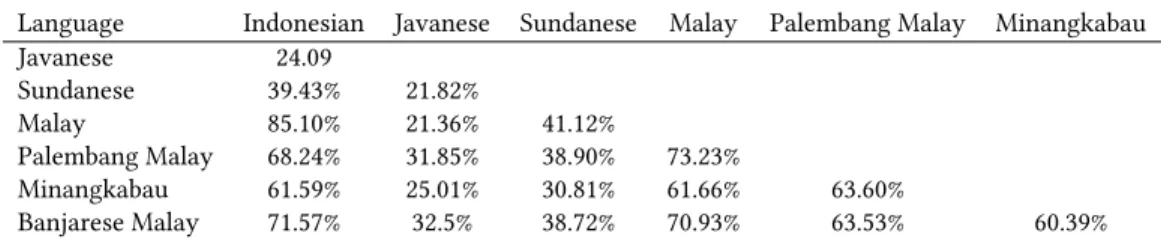
To evaluate our MDP plan optimizer, we provide a sample experiment in Indonesia as part of Indonesia language sphere project [14]. To select target languages, we use an Automatic Similarity Judgment Program (ASJP) [9] following our previous work [21]. Indonesia has 707 low-resource eth- nic languages [13] that require our attention. There are two factors we consider in selecting the target languages: language similarity and number of speakers. In order to ensure that the induced bilingual dictionaries will be useful for many users, we listed the top 10 Indonesian ethnic languages ranked by the number of speakers. Since our constraint-based approach works better on closely related lan- guages, we further generated the language similarity matrix by utilizing ASJP as shown in Table 1.
Based on number of speaker, we select Javanese and Sundanese. To find and coordinate native speak- ers of those languages, we collaborate with Telkom University. Based on relatedness with Indonesian, we select Malay, Minangkabau, Palembang Malay and Banjarese Malay. To find and coordinate native speakers of those language, we collaborate with Islamic University of Riau. Hence, we target 7 lan- guages, i.e., Indonesian (ind), Malay (zlm), Minangkabau (min), Palembang Malay (plm), Banjarese Malay (bjn), Javanese (jav), and Sundanese (sun). We want to enrich/create the following dictio- naries:𝑑(𝑖𝑛𝑑 ,𝑧𝑙𝑚),𝑑(𝑖𝑛𝑑 ,𝑚𝑖𝑛),𝑑(𝑖𝑛𝑑 ,𝑏 𝑗 𝑛),𝑑(𝑖𝑛𝑑 ,𝑝𝑙𝑚),𝑑(𝑖𝑛𝑑 , 𝑗 𝑎 𝑣),𝑑(𝑖𝑛𝑑 ,𝑠𝑢𝑛),𝑑(𝑧𝑙𝑚,𝑚𝑖𝑛),𝑑(𝑧𝑙𝑚,𝑏 𝑗 𝑛),𝑑(𝑧𝑙𝑚,𝑝𝑙𝑚), 𝑑(𝑧𝑙𝑚, 𝑗 𝑎 𝑣),𝑑(𝑧𝑙𝑚,𝑠𝑢𝑛),𝑑(𝑚𝑖𝑛,𝑏 𝑗 𝑛),𝑑(𝑚𝑖𝑛,𝑝𝑙𝑚),𝑑(𝑚𝑖𝑛, 𝑗 𝑎 𝑣),𝑑(𝑚𝑖𝑛,𝑠𝑢𝑛),𝑑(𝑏 𝑗 𝑛,𝑝𝑙𝑚),𝑑(𝑏 𝑗 𝑛, 𝑗 𝑎 𝑣),𝑑(𝑏 𝑗 𝑛,𝑠𝑢𝑛),𝑑(𝑝𝑙𝑚, 𝑗 𝑎 𝑣), 𝑑(𝑝𝑙𝑚,𝑠𝑢𝑛), and𝑑(𝑗 𝑎 𝑣,𝑠𝑢𝑛)with at least 2,000 translation pairs each,𝑠𝑖𝑧𝑒(𝑑𝑚
(𝑥 ,𝑦))=2,000. To compare the effectiveness of the beta distribution model, we conducted two batch of experiments. The first batch of experiments includes 5 languages: Indonesian, Malay, Minangkabau, Javanese, and Sundanese with 10 combination of bilingual dictionaries:𝑑(𝑖𝑛𝑑 ,𝑧𝑙𝑚),𝑑(𝑖𝑛𝑑 ,𝑚𝑖𝑛),𝑑(𝑖𝑛𝑑 , 𝑗 𝑎 𝑣),𝑑(𝑖𝑛𝑑 ,𝑠𝑢𝑛),