Concepts and Applications for
Medicinal Chemistry
JOSEPH E. RICE
Associate Professor of Medicinal Chemistry Department of Medicinal Chemistry Ernest Mario School of Pharmacy
Rutgers, The State University of New Jersey Piscataway, NJ 08854-8020
AMSTERDAM • BOSTON • HEIDELBERG • LONDON NEW YORK • OXFORD • PARIS • SAN DIEGO SAN FRANCISCO • SINGAPORE • SYDNEY • TOKYO
Academic Press is an imprint of Elsevier
© 2014 Elsevier Inc. All rights reserved.
No part of this publication may be reproduced, stored in a retrieval system or transmitted in any form or by any means electronic, mechanical, photocopying, recording or otherwise without the prior written permission of the publisher.
Permissions may be sought directly from Elsevier’s Science & Technology Rights Department in Oxford, UK: phone (+44) (0) 1865 843830; fax (+44) (0) 1865 853333;
email: [email protected]. Alternatively you can submit your request online by visiting the Elsevier web site at http://elsevier.com/locate/permissions, and selecting Obtaining permission to use Elsevier material.
Notice
No responsibility is assumed by the publisher for any injury and/or damage to persons or property as a matter of products liability, negligence or otherwise, or from any use or operation of any methods, products, instructions or ideas contained in the material herein.
Because of rapid advances in the medical sciences, in particular, independent verification of diagnoses and drug dosages should be made.
Library of Congress Cataloging-in-Publication Data Rice, Joseph E., author.
Organic chemistry concepts and applications for medicinal chemistry / Joseph E. Rice, Rutgers, the State University of New Jersey.
pages cm
Includes bibliographical references (pages).
ISBN 978-0-12-800739-6
1. Clinical chemistry. 2. Biochemistry. 3. Organic compounds. I. Title.
QD415.R48 2014 547--dc23
2014005300 British Library Cataloguing in Publication Data
A catalogue record for this book is available from the British Library ISBN: 978-0-12-800739-6
Printed and bound in USA
14 15 16 17 18 10 9 8 7 6 5 4 3 2 1
For information on all Academic Press publications visit our web site at store.elsevier.com
This book is dedicated to my wife Dorothy and my daughters Jennifer and Christina.
ix
Medicinal chemistry is a discipline that is focused on the relationship between chemical structure and biological activity. This relationship serves as the basis for the design and synthesis of new drug entities. Knowledge of medicinal chemistry is therefore of utmost importance to students in phar- macy programs, to medical and nursing students, and to chemists involved in the drug design process.
Pharmacy students at Rutgers take organic chemistry as sophomores but are not taught medicinal chemistry until their fourth year. Shortly after I started teaching medicinal chemistry I noticed that many students had dif- ficulty recalling some of the important concepts from two years prior. To address that need I wrote an extended handout to serve as a review. Over the years that handout has been revised and amended numerous times. This book grew out of those efforts.
The first four chapters provide a review of important concepts first introduced in organic chemistry. Among the topics covered are chemical bonding, stereochemistry and conformation, functional groups and acid–
base chemistry. It is essential that the students thoroughly understand these principles so as to be able to fully grasp the subtle relationship between chemical structure and pharmaceutical activity that is at the core of medici- nal chemistry. Reaction mechanisms and chemical transformations, while certainly of great importance to those involved in the synthesis of new drug entities, are not discussed in this book.
Chapter five introduces the student to partition coefficients, a subject not likely covered in undergraduate organic chemistry courses. The ease with which a drug passes from one compartment of the body to another is related to its partition coefficient. Like every other property, partition coef- ficients depend on structure with each portion of a molecule contributing to its overall hydrophobicity or hydrophilicity.
An integral part of medicinal chemistry education at Rutgers is training students to draw the correct structure of a drug when presented with its systematic name. The sixth chapter of this book is therefore concerned with nomenclature. While the naming of simple compounds such as alkanes, alkenes, alkynes, alcohols, amines, and carbonyl derivatives is introduced in almost all organic chemistry courses, the systematic nomenclature of het- erocyclic compounds and complex polycyclic ring systems is generally not
covered. Chapter six begins with a discussion of relatively simple heterocy- clic ring systems and then progresses to more complex compounds that involve fused, bridged, and spiro polycyclic compounds. Such ring systems form the basis of a majority of drug structures. A series of rules for number- ing these ring systems is described. Methods are also described for specify- ing the attachment of highly complex substituents onto parent compounds.
The last section of this chapter focuses on the special nomenclature and numbering of a few natural product classes of medicinal interest including steroids, prostaglandins, and morphinans.
The chemistry of drug metabolism is reviewed in the final chapter of this book. Most foreign chemicals become transformed once they enter the body. In this process, which is known as metabolism, some existing func- tional groups on compounds undergo chemical changes while in other instances new functionality is added. Most commonly this is done to aid in the removal of the foreign substance from the body. The reader will learn to associate a variety of structural features of drug molecules with likely meta- bolic pathways and will become familiar with the chemical processes that are involved in the formation of specific metabolites.
Joseph E. Rice Ernest Mario School of Pharmacy Rutgers, The State University of New Jersey
Organic Chemistry Concepts and Applications for Medicinal Chemistry © 2014 Elsevier Inc. 1 http://dx.doi.org/10.1016/B978-0-12-800739-6.00001-2 All rights reserved.
CHAPTER
Bonding in Organic Compounds
By the time most students in the pharmaceutical sciences get to their third or fourth year, they have very likely already taken general chemistry and organic chemistry and have been exposed to the concepts of chemical bonding several times. The reader is likely asking: Why waste time going over this again when there are more interesting topics to explore? After all, it’s pretty simple. Electrons are shared between two atoms to form bonds. There are single bonds, double bonds, and triple bonds. Can we now move on and get to something new?
The truth is that one cannot begin to understand organic chemistry unless he/she has a thorough understanding of the bonds that hold organic com- pounds together. It is the bonds that determine the three-dimensional shapes of molecules. With many drug molecules, shape is a factor that determines how the drug molecule interacts with its receptor. The bonds in a molecule also determine its chemical reactivity and properties. Again with drug molecules, reactivity relates to its chemical stability and to the types of metabolic transfor- mations the drug may undergo. Bonds affect the acid/base properties of a com- pound and also affect the solubility. For drugs, the relative solubility in water and lipids affects how the molecule passes from one bodily compartment to another.
ATOMIC ORBITALS
Most drugs are organic compounds and have structures that are largely com- posed of carbon atoms. Carbon (atomic number 6) has a nucleus containing six positively charged protons. As a counterbalance, six negatively charged elec- trons orbit the nucleus. Electrons are restricted to orbitals, which are the func- tions that represent the probability of finding a given electron in space. Any orbital can be occupied by a maximum of two electrons, and these must have opposite spin quantum numbers (represented as ↑ or ↓). The shapes of orbitals are designated with small letters such as s, p, d, or f. Elements that are in the first row of the Periodic Table (hydrogen and helium) have only a single shell of electrons that reside in an s-orbital. In the second row, two shells exist. The second shell being larger than the first can contain more electrons, which are held in one s-orbital and three p-orbitals. Third row elements have three shells of electrons with the third now capable of having five d-orbitals in addition to
1
the one s- and three p-orbitals. Thus the row number in the Periodic Table tells how many shells of electrons a particular element contains (Table 1.1).
Electrons in s-orbitals are distributed spherically symmetrical about the nucleus (like a hollow ball with the nucleus at the center). Carbon, being found in the second row of the Periodic Table, has two shells of electrons. Two electrons are contained within the 1s orbital and the remaining four are found in the orbitals of the second shell. Note the fact that carbon is located in Group IV of the Periodic Table and has four electrons in the outer shell or valence shell. Electrons completely populate lower energy orbitals before higher energy orbitals. This is known as the Aufbau principle. Thus the 1s orbital, being closer to the nucleus, is filled before the 2s orbital. Within a given shell, the s-orbital is lower in energy than the p-orbitals. The three p-orbitals are dumb- bell shaped and are mutually perpendicular to one another, directed along the x-, y-, and z-axes (px, py, and pz). They are also equivalent in energy (degener- ate). The remaining valence electrons first fill the 2s orbital and then partially fill two of the degenerate p-orbitals. Hund’s Rule states that electrons must be placed singly into degenerate orbitals before they can be paired. Thus the electronic configuration for carbon becomes 1s22s22px12py1. In general, only electrons in the valence shell participate in chemical bonding (Figure 1.1).
Elements in the second row of the Periodic Table have four orbitals in the valence shell and these can hold up to a total of eight electrons (Table 1.2). Neon, with each of its orbitals completely filled, cannot accept any more electrons and is reluctant to give any away. It is therefore chemically inert, as are other members of Group VIII. As you move from left to right
Table 1.1 The First Three Rows of the Periodic Table
I II III IV V VI VII VIII
1 H He
2 Li Be B C N O F Ne
3 Na Mg Al Si P S Cl Ar
y x z
x x x
y y y
z z z
2s 2px 2py 2pz
Figure 1.1 Valence shell orbitals of second row elements.
across the Periodic Table within a particular row, each nucleus has one more proton than its neighbor at the left. The nuclear charge increases accord- ingly, but the distance from the nucleus to the valence electrons remains about the same. Thus the attraction of the nucleus for the valence electrons increases from left to right. This is known as electronegativity. Electronegativ- ity also increases as you move up the Periodic Table within any given group (column) [as you move up in any group, the valence shell electrons are get- ting closer to the nucleus and are thus pulled at by the nucleus to a greater extent]. Fluorine is the most electronegative element (4 on a scale of 0–4).
Now that we know something about carbon it is time to start combining it with other elements to form molecules. The simplest organic compound is methane, CH4, so let us see how it is constructed. Organic compounds are held together primarily by covalent bonds. Such bonds are formed whenever two valence electrons are shared between adjacent atoms. Since the 2px
orbital of carbon has a single electron, it can overlap with a hydrogen 1s orbital, which also has one electron, and they can form a C–H bond. A simi- lar scenario can be achieved with the 2py orbital of carbon and another hydrogen atom. However, a problem now arises when trying to bond the remaining two hydrogens with carbon. The 2pz orbital is vacant, and over- lapping with a 1s orbital of hydrogen would not result in a bond being formed because a covalent bond requires two electrons to be shared. Like- wise, the carbon 2s orbital is completely filled, and overlapping with a hydro- gen 1s orbital would result in two atoms sharing three electrons, which is also impossible. Thus if we use only the atomic orbitals of carbon to bond with hydrogen, we can form only CH2 and predict that it would have a H-C-H bond angle of 90°. As anybody who has ever driven past a landfill can attest to, however, methane is a very real compound. Moreover, it has been estab- lished that CH4 is tetrahedral in shape. The question is, therefore, how can we account for both the composition of methane and its shape (Figure 1.2)?
Table 1.2 Electronic Configurations for the Second-Row Elements
Li 2s1 Group I
Be 2s2 Group II
B 2s22px1 Group III
C 2s22px12py1 Group IV
N 2s22px12py12pz1 Group V O 2s22px22py12pz1 Group VI F 2s22px22py22pz1 Group VII Ne 2s22px22py22pz2 Group VIII
HYBRID ORBITALS
Orbitals, as mentioned previously, are probability functions. Linus Pauling rec- ognized that as functions they can be manipulated mathematically by taking linear combinations [1]. When combining four functions, one obtains four new functions. In the case of the valence orbitals of carbon, those four functions are the 2s, 2px, 2py, and 2pz orbitals. These are combined as follows:
2s + 2px + 2py + 2pz = sp3 hybrid orbital 2s + 2px + 2py − 2pz = sp3 hybrid orbital 2s + 2px − 2py + 2pz = sp3 hybrid orbital 2s − 2px + 2py + 2pz = sp3 hybrid orbital
Each of the resulting hybrid orbitals have 25% s-character and 75%
p-character and so look like distorted dumbbells, with one lobe substan- tially larger than the other. In addition, the four new sp3 hybrid orbitals are directed to the corners of a tetrahedron (Figure 1.3).
The newly formed sp3 hybrid orbitals are degenerate and hence each is populated by a single electron from the carbon’s four valence electrons (Figure 1.4). Since there are now four singly populated orbitals, it becomes easy to see how they can each overlap with a hydrogen 1s orbital to form four C–H bonds. Also, since those orbitals point to the corners of a tetrahe- dron, the three-dimensional shape of methane must also be tetrahedral. The
2px 2py 2pz
2s
1s Carbon valence orbitals
H-1 1s H-2
1s H-3
1s H-4 Energy
Hydrogen valence orbitals H1s
H1s C2px
C2py
C2s
H
C H
Figure 1.2 The atomic orbitals involved in forming methane. Inset box shows a pictorial representation of the results of using the carbon atomic orbitals to bond with hydrogen.
geometry places the four hydrogen atoms as far away from each other as possible while still maintaining a bonding relationship with the central car- bon. This minimizes electron repulsions from one bond to another and is known as the Valence-Shell Electron-Pair Repulsion (VESPR) rule. When four equivalent bonds are formed with carbon, the bond angle approaches the ideal 109.5° angle of a regular tetrahedron and the bond lengths will be identical (Figure 1.5). If the groups are different, then there will be devia- tions from this angle, as well as differences in their bond lengths. It will be seen later that there are often large deviations from this ideal bond angle in three- and four-membered rings. These deviations have a pronounced affect on the chemical reactivity of such compounds.
The overlap of a hybrid orbital of carbon with a hydrogen s-orbital forms what is known as a σ-bond (sigma bond). If one were to connect the two nuclei involved in a σ-bond with an imaginary line, the electron density
+
+
+
- +
- +
+ +
+
+
-
Figure 1.3 Pictorial representation of taking a linear combination of the four carbon valence orbitals to form sp3-hybrid orbitals.
sp3 sp3 sp3 sp3 2px 2py 2pz
2s
Hybridization
Figure 1.4 Result of hybridization of all four of the carbon valence orbitals.
H
H H
H C
109.5°
Figure 1.5 The tetrahedral structure of methane.
would be distributed cylindrically symmetrical about that line. In a similar manner, σ-bonds can also be formed if the two hybrid orbitals overlap head- to-head, or if two s-orbitals overlap (Figure 1.6). Sigma bonds are usually depicted as a single line joining two atom symbols (C–H). While this is con- venient, it must be remembered that the line drawn represents a pair of electrons. It is not a rigid spacer that connects the atoms, but something that can be bent, compressed, and stretched depending on the forces that it encounters. It is also not necessary for the electrons in a bond to be equally shared by both nuclei. If one atom is more electronegative than the other, the electrons will lie closer to the more electronegative atom and the bond will be polarized. The end with greater electron density will have a partial negative charge, whereas the opposite end will be electron deficient and has a partial positive charge. The distribution of electron density within bonds deter- mines many of the chemical and physical properties of organic compounds.
Just as the four valence atomic orbitals of carbon were mixed to form a new set of four hybrid orbitals centered on carbon, the process of covalent bond formation also involves orbital mixing. To form a C–H bond, a hybrid orbital of carbon is mixed with the 1s orbital of hydrogen. The result is a new orbital called a σ-orbital, and it is lower in energy than either the hybrid orbital or the 1s orbital. One electron in the sp3 hybrid orbital and the one in the 1s orbital can both be placed into the new σ-orbital, which is called a bonding molecular orbital (MO). However, because two orbitals were com- bined, two new orbitals must be formed. Hence in addition to the bonding σ-orbital, a so-called antibonding σ*-molecular orbital is also formed. The σ*- orbital is higher in energy than either the sp3 or s-orbital, and is not popu- lated with any electrons under ordinary conditions. When electrons occupy only bonding MOs, the resulting system is stabilized. Electrons placed into antibonding MOs destabilize a bond by increasing its energy. Therefore,
s
s s
C
H
Electron-density
σ-bond σ-bond σ-bond
σ-bond
C O
δ+ δ- More electro- negative Lesselectro-
negative
A polar covalent bond sp3 sp3 sp3
Figure 1.6 Various types of σ-bonds.
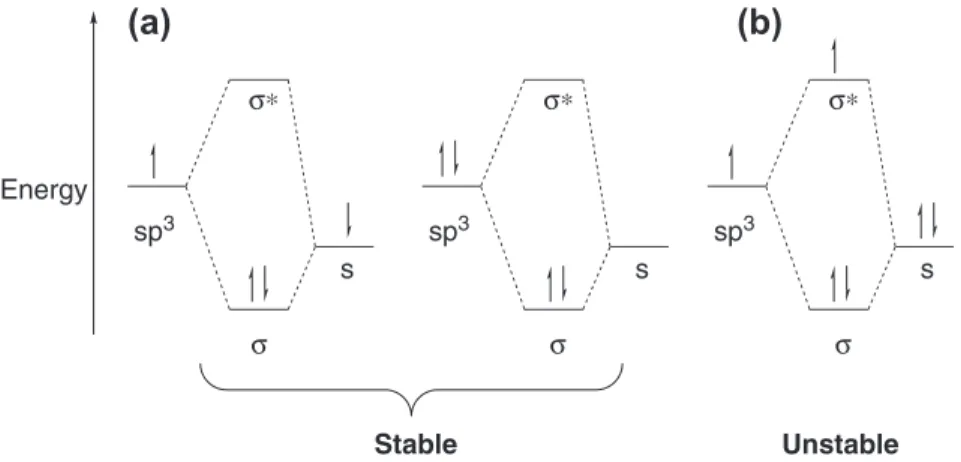
stable bonds will be formed when the total number of electrons in the over- lapping atomic or hybrid orbitals is two. This can be realized by the overlap of two orbitals, each occupied by a single electron or by one orbital having two electrons overlapping with a vacant orbital (note that orbitals exist even if they have no electrons). An orbital with two electrons will not form a stable bond with an occupied orbital. This is because after filling the bond- ing molecular orbital, the remaining electrons would have to be placed into antibonding orbitals (Figures 1.7 and 1.8).
The molecule ethylene, C2H4, consists of an array of two carbon and four hydrogen atoms, in which each carbon is bonded to the other carbon and two hydrogens. Unlike methane, there are only three other atoms attached to carbon and therefore the geometry around each carbon is dif- ferent than in methane. The VESPR rule requires that the three attached atoms be arranged in the same plane as the carbon and spaced approxi- mately 120° apart from one another to minimize repulsions between the bonding electrons. This cannot be achieved using sp3 hybrid orbitals and so a different hybridization scheme is required, one that will result in three
C–C σ*-orbital C–H σ*-orbital
Figure 1.7 Pictorial representation of antibonding orbitals. Note that the orbitals interact out-of-phase.
sp3
s σ σ∗
sp3
s σ σ∗
sp3
s σ σ∗
Stable Energy
Unstable
D E
Figure 1.8 (a) Overlap of two partially filled or one filled and one vacant orbital to form a stable σ-bond. (b) Overlap of a filled and a partially filled orbital to form an unstable system.
hybrid orbitals, not four. Such a set of orbitals is obtained by mixing the 2s orbital with two of the three 2p orbitals to give a set of three sp2 hybrid orbitals. Since any two p-orbitals will reside in a plane, the resulting hybrid orbitals will also be planar and directed to the vertices of an equilateral triangle. As three singly occupied hybrid orbitals will be needed to form the three covalent bonds from carbon, each is populated by a single valence shell electron. The remaining electron remains in the unused 2pz atomic orbital which of necessity must be perpendicular to the plane of the three sp2 hybrid orbitals (Figure 1.9).
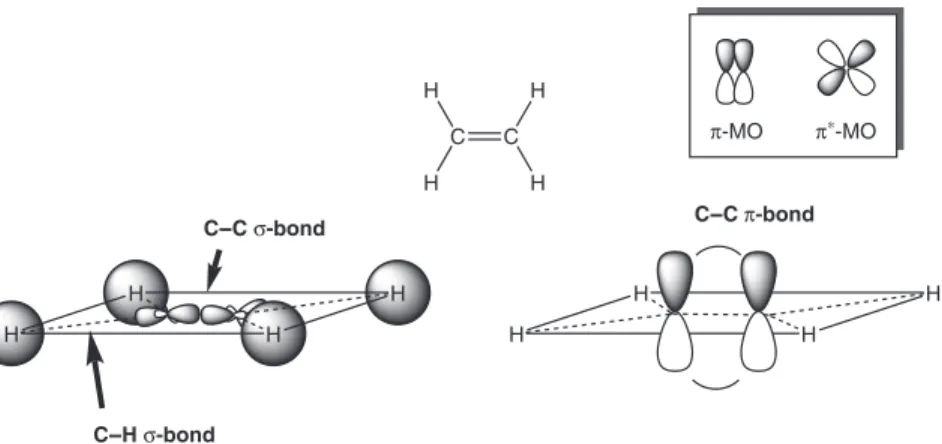
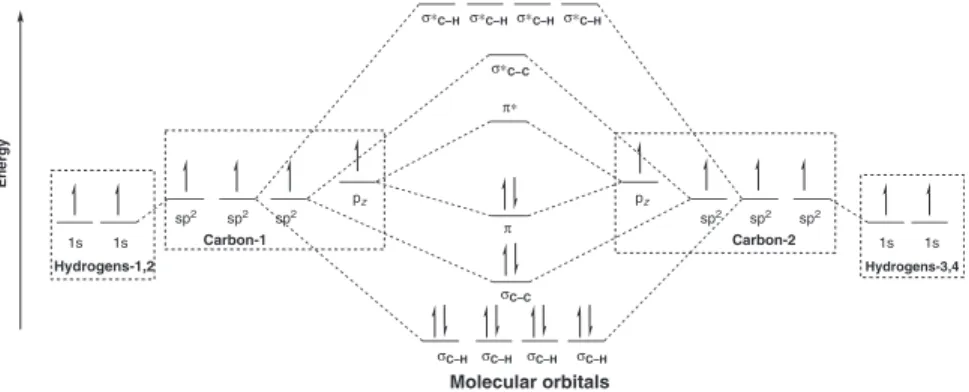
Two sp2 orbitals from each carbon now overlap with two hydrogen 1s orbitals to form C–H σ-bonds. The remaining sp2 orbital overlaps head-to- head with an sp2 orbital on the other carbon to form a C–C σ-bond. The pz-orbital on each carbon now overlaps side-to-side to form a second bond between the carbons that is called a π-bond (a π-molecular orbital occupied by the two electrons from the pz orbitals). An antibonding π* orbital (unoc- cupied) is also formed at the same time. The carbons are joined by two dif- ferent bonds and ethylene is said to possess a double bond with the formula often written as H2C]CH2. It is important to realize that the two bonds are not identical; one is a σ-bond and the other a π-bond. In ethylene, the H–C–H bond angle and the H–C–C bond angles are different, with the former being 118.7°and the latter 120.7°. If the C–C bond length (1.53 Å) in ethane (C2H6), in which both carbons are sp3 hybridized, is compared to that of the ethylene 1.34 Å, it is seen that one effect of the π-bond in ethyl- ene is to shorten the C–C bond length. In general, double bonds are shorter than the corresponding single bonds (Figures 1.10 and 1.11).
The presence of a double bond in a molecule has a great effect on its properties. In σ-bonds, the electron density is localized along the axis con- necting the two atoms and is relatively unexposed. Electron density in a π-bond however is more accessible, being located above and below the
2s
2px 2py 2pz 2pz
sp2 sp2 sp2
Hybrid orbitals Hybridization
Figure 1.9 Mixing of the carbon 2s, 2px, and 2py orbitals to create three sp2-hybrid orbitals.
plane of the molecule, and is therefore more susceptible to attack by electro- philes (electron-deficient reactive species). While atoms connected only by a σ-bond may rotate freely about the bond (like two wheels joined by an axle), this is not possible for atoms connected by double bonds. This allows for the existence of geometrical isomers (more about this later). If one exam- ines a p-orbital (or a π-bond), it can be seen that there are two lobes of electron density, one above and the other below the plane of the molecule that decrease in size until they become zero in the plane of the molecule (a node). In practical terms, this means that there is a zero probability of finding an electron in the nucleus. One implication of this is that since electron density in p-orbitals decreases to zero in the plane where σ-bonds have
Figure 1.10 Representation of the two different types of bonds found in ethylene. Inset box shows a bonding and antibonding π-orbital.
Figure 1.11 Molecular orbitals of ethylene formed as a result of bonding between two sp2-hybridized carbon atoms and four hydrogen atoms. Note that the π-orbital is higher in energy (more reactive) than the σ-orbitals.
their greatest electron density, there is no interaction (orbital overlap) between the electrons in p-orbitals (or π-bonds) and those in σ-orbitals. Put simply, orbitals that are perpendicular to one another do not overlap. Thus the π-electron system can be treated as being independent of the σ-electron system (Figure 1.12).
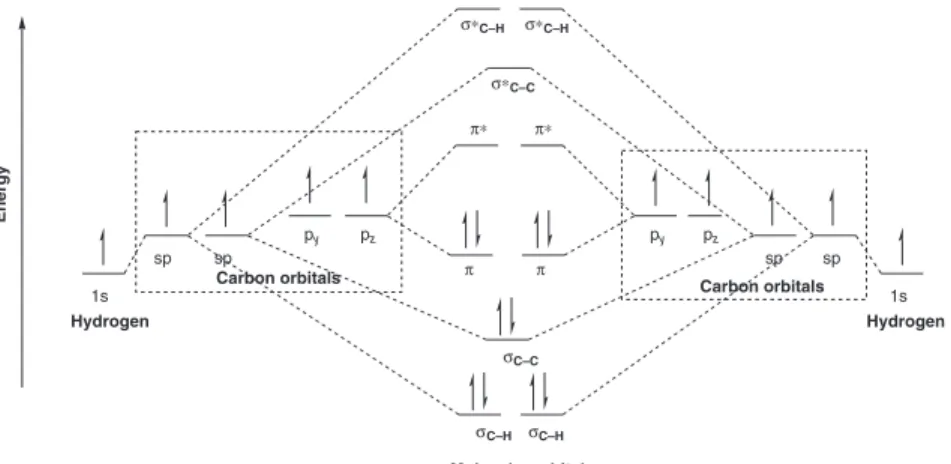
The molecule acetylene, C2H2, presents yet another bonding situation for carbon. In this case, each carbon is bonded to hydrogen and the other carbon. Acetylene and related compounds are linear, with the two groups attached to carbon 180° apart from each other. This arrangement cannot be obtained using sp3 or sp2 hybrid orbitals, and so when only two groups are attached to carbon, the atomic orbitals combine themselves in a different way to form a new set of hybrid orbitals. Mixing the 2s orbital with only one of the p-orbitals creates a set of two sp hybrid orbitals with an angle of 180°. For acetylene, overlap of one of the sp orbitals on each carbon with a hydrogen 1s orbital creates two new C–H σ-bonds. Overlap of the remain- ing sp orbital on each carbon produces a new C–C σ-bond. That only accounts for two of the valence electrons on each carbon. The remaining two are located, one each, in the remaining two p-orbitals. These p-orbitals are mutually perpendicular and are also perpendicular to the σ-bonding array (H–C–C–H). When the corresponding p-orbitals overlap side-to-side, they form two π-bonds. Therefore, the two carbons of acetylene are con- nected by three bonds—one σ-bond and two π-bonds. This is known as a triple bond, and is depicted as H–C^C–H. The C–C bond length in acety- lene is 1.18 Å which is shorter still than that of ethylene as a result of the additional π-bond. As with double bonds, triple bonds are also more reac- tive because the electron density is concentrated away from the interatomic bond axis (Figures 1.13 and 1.14).
Figure 1.12 The p-orbital does not have any significant overlap with the hybrid orbital that is in a perpendicular plane.
The discussions on bonding to this point show that molecular geometry is dependent on hybridization. Whenever carbon is attached to four other groups, it organizes into sp3 hybrid orbitals and the geometry at that carbon is tetrahedral. This means that the carbon and any two of the other groups attached to it are all in the same plane. Of the remaining two groups attached to the carbon, one will be in front of the plane and the other will be behind the plane. It is common to try to depict such three-dimensional arrange- ments using either heavy solid lines or solid wedges for groups coming out from the paper and hashed lines or hashed wedges for those groups which are oriented behind the paper (Figure 1.15).
A carbon that is connected to only three other groups will be sp2 hybrid- ized and all three attached groups will be in one plane in a trigonal array
C C
H H
π-bond
π-bond σ-bond
Figure 1.13 Bonding picture of acetylene showing the σ-bond and the two perpen- dicular π-bonds connecting the two carbon atoms.
sp sp sp sp
pz pz
π π∗
σ σ∗C–H
Energy
Molecular orbitals
py py
π π∗
1s Carbon orbitals Carbon orbitals 1s
σC–C σ∗C–H σ∗C–C
σC–H C–H
Hydrogen Hydrogen
Figure 1.14 Molecular orbitals formed as a result of bonding between two sp- hybridized carbon atoms and two hydrogen atoms in acetylene. Note that the π-orbitals are higher in energy (more reactive) than the σ-orbitals.
(∼120°) around the carbon. When only two groups are connected to the carbon, then the two groups and the carbon will be in a linear array with the bond angle between the two groups 180°. These relationships do not just pertain to carbon however. Other common elements can also form hybrid orbitals, with the same geometric relationships as carbon.
Nitrogen is next to carbon on the Periodic Table and can also reorganize its valence shell electrons into four sp3 hybrid orbitals. As a Group V element, however, it has one more valence shell electron than carbon and therefore one of the sp3 hybrid orbitals will be completely filled (Figure 1.16).
The three partially filled orbitals can form three covalent bonds by over- lapping with three partially filled s- or hybrid orbitals on other atoms. The remaining filled sp3 orbital is known as a lone pair. Nitrogen can therefore form three covalent bonds to other atoms with a lone pair remaining associ- ated with the nitrogen as the fourth group that completes the tetrahedral geometry (again the nitrogen and two of the attached groups are in one plane with one of the remaining groups in front of the plane and one behind the plane). The lone pair on nitrogen is responsible for the fact that many nitrogen compounds act as bases (more about this later). Since any chemical bond can only have two electrons, the only way the lone pair can form a bond is by overlapping with an unoccupied (vacant) orbital (for example,
W
X Z C
Y
W
X Z C
Y
Figure 1.15 Tetrahedral geometry. In these drawings, the carbon and attached groups W and X are all in the plane of the paper. Group Y is in front of the plane (solid wedge or heavy line) and group Z is behind the plane (hashed wedge or hashed line).
2s
2px 2py 2pz
Nitrogen valence shell orbitals sp3 Hybrid orbitals Lone pair
Energy
Figure 1.16 Reorganization of the valence shell atomic orbitals of nitrogen into four sp3 hybrid orbitals.
a proton which is a hydrogen atom that has lost its one electron). If this hap- pens, the nitrogen will then acquire a positive charge because those electrons are no longer localized exclusively on the nitrogen rendering it electron deficient. The geometry at the nitrogen is still tetrahedral because the fourth group takes the place of the lone pair (Figures 1.17 and 1.18).
Oxygen has one more valence shell electron than nitrogen and therefore has two filled and two partially filled sp3 hybrid orbitals. As a result, oxygen tends to form two covalent bonds with two lone pairs remaining on the oxygen atom. Because of the sp3 hybridization, the geometry around oxy- gen is tetrahedral. The lone pairs of oxygen are not donated as readily to form bonds with vacant orbitals as with nitrogen because oxygen is much more electronegative than nitrogen (Figure 1.19).
Fluorine is in Group VII of the second-row elements and therefore has seven valence shell electrons. This gives rise to three filled sp3 orbitals and one partially filled orbital. The result of this is that fluorine forms only one cova- lent bond and has three lone pairs of electrons arranged in a tetrahedral geom- etry. Due to its extremely high electronegativity, fluorine is very reluctant to donate its lone-pair electrons to vacant orbitals on other atoms (Figure 1.20).
A nitrogen atom that is attached to only three groups is sp2 hybridized.
One of the sp2 orbitals is filled with two electrons (the lone pair) while the other two and the remaining p-orbital each have one electron. Upon
sp3 Hybrid orbitals on nitrogen
3 Hydrogen 1s orbitals
σ σ σ
σ∗ σ∗ σ∗
Bonding molecular orbitals Antibonding molecular orbitals
Non-bonding atomic orbital (lone pair)
Energy
Figure 1.17 Orbital picture for ammonia (NH3).
H H N
H
H
H
H H N
H
Figure 1.18 The reaction of ammonia with a proton (a hydrogen atom that has lost its electron and therefore has a vacant 1s orbital). Notice that the nitrogen becomes posi- tively charged as a result of this reaction.
forming a bond with another sp2-hybridized atom (X), an N]X double bond is created (again, a σ-bond and a π-bond). The π-bond has little if any effect on the lone pair because they are in planes that are perpendicular, and therefore, the orbitals do not overlap (Figure 1.21).
If sp2-hybridized nitrogen uses its lone pair to bond to another atom with a vacant orbital, the geometry at the nitrogen will still be planar, but the nitrogen will acquire a positive charge because those electrons are no longer associated exclusively with the nitrogen (Figure 1.22).
The situation in which oxygen is attached to only three groups is similar except that with the extra valence electron, two of the sp2 hybrid orbitals contain lone pairs. The remaining sp2 orbital can overlap with a similar
sp3 Hybrid orbitals on oxygen
Hydrogen 1s orbitals
σ σ
σ∗ σ∗
Bonding molecular orbitals Antibonding molecular orbitals
Energy
Two lone pairs
Figure 1.19 The orbital picture of water (H2O).
sp3 Hybrid orbitals on fluorine
Hydrogen 1s orbital σ
σ∗
Bonding molecular orbital Antibonding molecular orbital
Energy
Three lone pairs
Figure 1.20 The orbital picture of hydrogen fluoride (HF).
orbital on another atom (carbon for example) to form a σ-bond. The adja- cent p-orbitals can then overlap to form a π-bond giving rise to a C]O double bond. This bond is extremely common and is known as a carbonyl bond (Figure 1.23).
2s
2px 2py 2pz 2pz
sp2 sp2 sp2
Hybrid orbitals Lone pair
R X
R
R N X
R R
R N–X σ-bond
π-bond
N
Figure 1.21 Hybrid orbitals (sp2) on nitrogen and the formation of N]X double bonds.
Note that the lone pair and the π-bond are in perpendicular planes.
N C
R
R
R H
N C
R
H
Figure 1.22 The reaction of an imine nitrogen with a proton to form an iminium cation.
2s
2px 2py 2pz 2pz
sp2 sp2 sp2
Hybrid orbitals Lone pairs
R
O R O C
R
R π-bond
O–C σ-bond
Figure 1.23 Oxygen sp2 hybrid orbitals and the formation of carbonyl bonds. Both lone pairs are in a plane perpendicular to the π-bond.
Nitrogen can also form triple bonds with other atoms. In this case, the lone pair is located in an sp orbital on the nitrogen. A C^N bond is known as a nitrile (or cyano group). Unlike sp2-hybridized nitrogen, the lone pair on the nitrogen of a nitrile is not readily donated to form bonds with atoms possessing vacant orbitals because the short bond length of the sp hybrid orbital keeps the lone pair close to the nitrogen (electronegativity in general increases as you go from sp3 to sp2 to sp) (Figure 1.24).
RESONANCE
There are no uncharged species with triple bonded oxygen. For oxygen to form a triple bond with carbon for example, one of the lone pairs must overlap with a vacant orbital on carbon (a cation). This leaves the oxygen electron deficient and it acquires a positive charge. The resulting species is called an acylium ion, and it is a highly reactive intermediate and not a stable organic compound. Since oxygen is more electronegative than carbon, a positive charge is better tolerated on carbon than on oxygen. Relocating a pair of electrons from one of the π-bonds back onto oxygen reestablishes a lone pair and creates a vacant orbital on carbon, imparting a positive charge. This is called an acyl cation. An acylium ion and an acyl cation are two species that have the same constitution but differ only in the way the electrons are distributed. These are referred to as resonance structures. Each of these structures has advantages and disadvantages: the acyl cation has the positive charge on the less electronegative element, which is good, but has a vacant orbital, which is bad [nature does not like a vacuum]; while the acylium ion has an extra bond, which is good, but has the positive charge on the more electronegative element, which is bad. Overall, the true picture
2s
2px 2py 2pz
sp sp
Hybrid orbitals Lone pair
R N C R
N–C σ-bond π-bonds
2py
N
2pz
Figure 1.24 sp-Hybrid orbitals on nitrogen.
of electron distribution in these species is a combination of these two extremes. It is a common practice to draw all possible resonance structures and join them with resonance arrows (↔). Alternatively, a composite reso- nance hybrid structure can be drawn (Figure 1.25).
When a charge is present in a compound, the ability of the molecule to delocalize that charge affects the total energy of the compound. In other words, a charge that is localized on a single atom raises the energy of a com- pound relative to a charge that can be spread out by resonance over several atoms. The example below will serve to illustrate this point.
Examination of the example in Figure 1.26 shows that for the top struc- ture, the negatively charged oxygen is connected by a single bond to a
C O
R
C O
R
or R C O
Acyl cation Acylium ion Resonance hybrid structure Figure 1.25 Acyl cation and acylium ion resonance structures.
OH
OH
Base
Base
O
O Hf = –43.00 kcal/mol
Hf = –5.41 kcal/mol
O O O
O No resonance structure possible C5H8O
C5H8O
Figure 1.26 Treatment of isomeric alcohols with base generates two different alkoxide anions. The structure on top is 37.59 kcal/mol more stable (lower in energy) than the struc- ture below. The reason for this great stability is that the negative charge in the top struc- ture can be delocalized by resonance (see inset box), whereas the charge for the lower compound is localized on the oxygen. Calculations of heats of formation (Hf) were per- formed using semiempirical molecular orbital methods (PM3), Spartan 06, Wavefunction, Inc.
double bond that, in turn, is connected by another single bond and then to another double bond. This pattern of alternating single and double bonds is called a conjugated system. Conjugation acts much like a piece of copper wire does in conducting an electric current. It allows electrons to be conducted throughout the entire conjugated system. To see how this is possible, it is necessary to look at the orbitals involved in such a system. The oxygen is sp3 hybridized and when a base removes a proton from the O–H bond, the elec- trons remain with the oxygen. Since the oxygen has two lone pairs plus one of the electrons from the C–O bond and one from the O–H bond, the addi- tion of one extra electron from hydrogen gives a total of seven valence elec- trons (it should have six) and thus gives the oxygen a negative charge, represented as a filled sp3 orbital. If the oxygen rehybridizes to sp2, that extra electron pair will now reside in a p-orbital that can align with the rest of the p-orbitals of the carbons. The excess electrons can now be delocalized through- out the resulting conjugated system, landing on every other atom (O, C-2, and C-4) but not on C-1 and C-3. The energy gained by forming a conjugated system more than compensates for any energy expended in rehybridization of the oxygen. With the lower compound in Figure 1.26, however, the filled sp3 orbital of the negatively charged oxygen has nowhere to go with its elec- trons because the carbon adjacent to it is sp3 hybridized, and hence all of the orbitals are completely filled. In situations like this, the saturated carbon (sp3 carbon) acts like an electrical insulator and prevents the conductance of elec- trons from oxygen to the carbon–carbon double bonds (Figure 1.27).
The compound benzene, C6H6, is cyclic and flat. Since each carbon is bonded to two carbons and one hydrogen, they are all sp2 hybridized and each carbon also has a p-orbital that is partially filled with one electron. The flatness of the ring allows these orbitals to overlap to the maximum amount
O O O
O sp3
sp2 1 2 3 4
Rehybridization
Figure 1.27 Orbital picture of the conjugated system from Figure 2.26.
to create three π-bonds separated from one another by σ-bonds—a conju- gated system. The p-orbitals can also pair up in the opposite direction to give three other π-bonds. These two structures are in resonance and the actual distribution of electron density around the ring is a combination of these structures (Figure 1.28).
AROMATICITY
Benzene has three π-bonds, each with two electrons, for a total of six electrons in the π-system. Compounds such as benzene that are cyclic and flat, in which each atom in the ring contributes a p-orbital and that have six electrons in the π-system are said to be aromatic, and experience tremendous stabilization (energy lowering, ∼36 kcal/mol) relative to the three isolated double bonds. The com- pound naphthalene is another example of aromaticity, this time with two fused aromatic rings. The entire structure is flat, each atom in each ring has a p-orbital with one electron, and therefore within each ring, the π-system contains six electrons. Note that the p-orbitals on the two carbons common to both rings (ring fusion positions) belong to both rings (Figure 1.29).
Figure 1.28 The major resonance structures of benzene (hydrogen atoms omitted for clarity). A circle inscribed in a hexagon is often used to represent all the resonance forms of benzene.
Naphthalene
Figure 1.29 The major resonance structures of naphthalene. Note that the two p- orbitals are shared by both rings.
Consider now the cycloheptatrienyl cation. This species has a seven- membered ring, with three conjugated double bonds. The remaining car- bon is attached to only three other groups and so is sp2 hybridized. The p-orbital however is vacant which places a positive charge on this carbon.
Such a situation can arise if for example a group that is attached to a sp3- hybridized carbon leaves with both electrons from its former bond. In the cycloheptatrienyl cation, there are a total of six electrons in the π-system, each atom of the ring has a p-orbital, and the ring is flat. This therefore represents another aromatic ring system (Figure 1.30).
Another example of aromaticity is found in the cyclopropenium cat- ion. This is a three-membered ring with one π-bond and a vacant p-orbital on the remaining carbon (creating a positive charge). The charge can then be distributed all around the ring by overlap of the vacant p-orbital with the p-orbitals from the π-bond. This ring system is flat and each atom in the ring has a p-orbital, but it only has two electrons in its π-system (Figure 1.31).
H X
–X
H H H H
H H
H
+
Figure 1.30 Resonance and aromaticity in the cycloheptatrienyl cation.
H X
–X
H
H H H H
H
H H
H
H H
+
Figure 1.31 Resonance and aromaticity in the cyclopropenium cation.
The fact that six-electron systems and two-electron systems can be aro- matic suggests that a more generalized definition of aromaticity be proposed.
Thus for a system to be considered as aromatic, it must conform to each of the following requirements:
• It must by cyclic.
• It must be flat.
• Each atom in the ring must contribute a p-orbital.
• The total number of electrons in the π-system must be a solution to the expression 4n + 2 where n is any integer (0, 1, 2, 3…). Thus systems that satisfy the first three conditions and that have 2, 6, 10, 14… electrons in the π-system are aromatic. By far, the most common situation you will encounter is a system with six π-electrons.
In contrast to the compounds discussed above are those that fulfill the first three requirements for aromaticity, but have only four electrons in the π-system (actually 4n systems with 4, 8, 12… electrons). Such compounds do not experience any stabilization (energy lowering), but are actually desta- bilized. These are known as antiaromatic compounds. An example of an antiaromatic compound is cyclobutadiene, which can only be isolated and studied at extremely low temperatures because of its instability. An explana- tion for this phenomenon requires an understanding of orbital symmetry considerations, which is beyond the scope of this chapter (Figure 1.32).
At first glance, it would also appear that the compound cyclooctatet- raene should also be antiaromatic since a two-dimensional representation appears to be a completely conjugated eight-electron system. This com- pound, however, is perfectly stable and readily available. The reason is that it is not flat, and thus resonance throughout the ring cannot occur. It behaves simply as a cyclic compound with four isolated double bonds and is neither aromatic nor antiaromatic (Figure 1.33).
Aromatic rings can also contain heteroatoms. Pyridine, C5H5N, for exam- ple, is a six-membered ring nitrogen heterocycle (contains an atom other than carbon in the ring). Like benzene, each atom of the ring is sp2 hybridized, and
Cyclobutadiene (Isolatable only at
extremely low temperatures)
-Flat -Cyclic
-Each atom in the ring has a p-orbital -Has 4 electrons in the S-system Antiaromatic
Figure 1.32 Cyclobutadiene and antiaromaticity.
each therefore has a p-orbital with one electron that overlap to form three π-bonds. The ring is flat and has a total of six electrons in the π-system, and is aromatic. One might ask “What about the lone pair on nitrogen?” If the lone pair electrons were included together with the electrons already in the π-system, it would give a total of eight π-electrons, which would result in pyridine being an antiaromatic compound. The lone pair, however, cannot be included with the electrons in the π-system. Remember that for sp2-hybrid- ized nitrogen, the lone pair is contained within a sp2 hybrid orbital. Applied to pyridine, this means that the lone pair is in an orbital that is in the plane of the ring. The p-orbitals are perpendicular to this plane and cannot overlap with the sp2 hybrid orbital. The lone pair can therefore act independent of the π-system, a fact that accounts for the propensity of that electron pair to react readily with most electrophiles, including protons (Figure 1.34).
Other six-membered ring nitrogen heterocycles that are fully unsatu- rated are also aromatic. Included here are compounds such as pyridazine, pyrimidine, pyrazine, quinoline, isoquinoline, and acridine (Figure 1.35).
Unlike the nitrogen heterocycles, six-membered ring oxygen heterocy- cles cannot be aromatic unless the oxygen is positively charged (pyrilium ion). The reason is that there will always be at least two saturated
N N
Lone pair in sp2 orbital
N
Pyridine
Figure 1.34 Pyridine as an aromatic heterocycle.
Stable Cyclooctatraene
Figure 1.33 The structure of cyclooctatraene showing why it is not antiaromatic.
(sp3 hybridized) atoms in the ring. Why? Oxygen forms only two covalent bonds (unless it is charged). If oxygen is part of a ring, those two bonds join it to the remainder of the ring. If there are two C]C bonds in the ring, then there will be one other atom that does not have a double bond, and therefore, the requirement that each atom in the ring has a p-orbital cannot be met and the ring cannot be aromatic. While it is possible to prepare pyrilium ion, it is highly reactive and is generally employed as a reactive intermediate in organic synthesis (Figure 1.36).
Certain five-membered rings can also be aromatic. An example of this is the cyclopentadienyl anion. If cyclopentadiene is treated with a suitable base, a proton is removed from the sp3 carbon and the electron pair from the C–H bond remains with that carbon. The hybridization of the carbon becomes sp2 and the pair of electrons is contained within the p-orbital. At this point, the ring is flat, each atom in the ring has a p-orbital and there are six electrons in the π-system (four from double bonds and two from the filled p-orbital). The fact that this anion is
N N
N N
N
N N
N
N
Pyridazine Pyrimidine Pyrazine Quinoline
e n i d i r c A e
n il o n i u q o s I
Figure 1.35 Several aromatic six-membered heterocycles.
O
2H-Pyran (Not aromatic)
Saturated carbon
O Saturated oxygen
Pyrilium ion (Aromatic)
Figure 1.36 Structural differences between 2H-pyran and the pyrilium ion.
aromatic explains why cyclopentadiene is more acidic than most other hydrocarbons (Figure 1.37).
Fully unsaturated five-membered ring heterocycles may also be aro- matic. 1H-Pyrrole, for example, is a five-membered nitrogen heterocycle with two double bonds. The nitrogen at first glance appears to be sp3 hybridized because it is bonded to two carbons, a hydrogen, and also has a lone pair. The ring however is flat and has two double bonds (four electrons in a π-system). All that is needed to make the ring aromatic is one more p-orbital and two additional electrons. In nature, molecules tend to exist in their most stable (lowest energy) form. For 1H-pyrrole, this is achieved by making the ring aromatic. The nitrogen is actually sp2 hybridized and the lone pair is housed within the p-orbital. These electrons join the π-system to complete the aromatic sextet (Figure 1.38).
A comparison of pyridine with pyrrole reveals an important point.
Remember that the lone pair of pyridine is contained within an sp2 orbital that is in the plane of the ring and that does not interact with the π-electron system. This lone pair is capable of forming bonds with another species that
H H
Base
H
H
Figure 1.37 Aromaticity of the cyclopentadienyl anion. Note that cyclopentadiene itself is not aromatic because it has one saturated carbon.
N H
N H Lone pair
Pyrrole
Figure 1.38 Aromaticity in 1H-pyrrole. The lone pair on the nitrogen is located in the p-orbital and overlaps with the other p-orbitals to make the ring aromatic.
has a vacant orbital, such as a proton. Thus, pyridine acts as a base. In pyrrole, however, the lone pair is located in a p-orbital that is part of the π-system making the ring aromatic. This lone pair is tied up and is therefore not capable of forming a bond with a proton. This means that unlike pyridine, pyrrole does not behave as a base.
Imidazole is another aromatic five-membered ring heterocycle that has two nitrogens. These nitrogens, however, have different properties. The one with its lone pair in a p-orbital uses those electrons to complete the aro- matic sextet and this nitrogen, as in pyrrole, is neutral. The other nitrogen has its lone pair contained within an sp2 orbital and those electrons are therefore in the plane of the ring, do not interact with the π-system, and can act as a base (Figure 1.39).
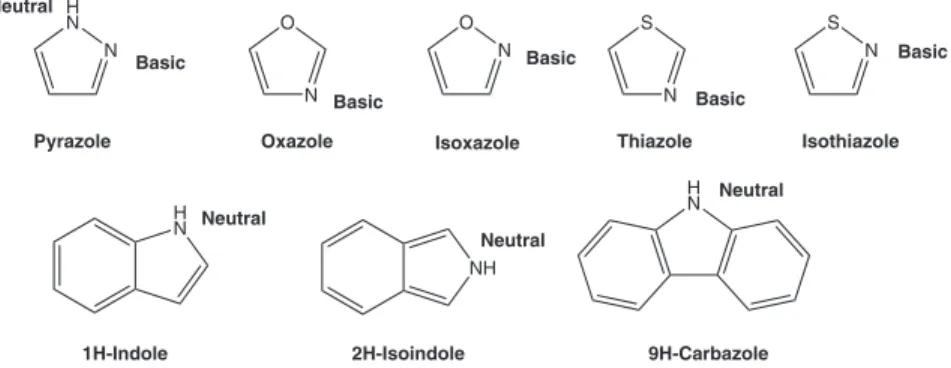
Several other aromatic nitrogen-containing five-membered ring hetero- cycles are shown below (Figure 1.40).
Included in the structures shown above are several heterocycles contain- ing oxygen or sulfur. These behave similar to pyrrole in that the oxygen or
N N H
Lone pair (Basic)
Imidazole
N H N
Lone pair (Neutral) Neutral
Basic
Figure 1.39 Structure of imidazole showing that one lone pair is part of the aromatic π-system, while the other is not.
N HN
N O
N O
N S
N S
HN
NH
HN
Pyrazole Oxazole Isoxazole Thiazole Isothiazole
1H-Indole 2H-Isoindole 9H-Carbazole
Neutral
Basic
Basic
Basic
Basic
Basic
Neutral
Neutral
Neutral
Figure 1.40 Several other five-membered and benzo-fused five-membered nitrogen- containing aromatic heterocycles.
sulfur is sp2 hybridized with one lone pair contained in the p-orbital com- pleting the aromatic sextet. The remaining lone pair is in an sp2 orbital, in the plane of the ring. Other aromatic five-membered ring heterocycles containing oxygen or sulfur are shown below (Figure 1.41).
REFERENCE
[1] L Pauling, The Nature of the Chemical Bond, third ed., Cornell University Press, Ithaca, 1960, pp. 111–144.
O S O
O
Furan Thiophene Benzofuran Benzisofuran
S
Benzothiophene
Figure 1.41 A selection of five-membered oxygen and sulfur-containing aromatic heterocycles.
Organic Chemistry Concepts and Applications for Medicinal Chemistry © 2014 Elsevier Inc. 27 http://dx.doi.org/10.1016/B978-0-12-800739-6.00002-4 All rights reserved.
CHAPTER
The Three-Dimensional Structure of Organic Compounds
One of the critical factors associated with drug–receptor interactions is the three-dimensional structure of both the drug and receptor molecules. Effi- cient interaction between a drug and its receptor depends not only on the absolute and relative positioning of groups in space but also on the ability of the molecule to modify its shape by rotating about single bonds. These aspects of chemical structure are known as stereochemistry and conformation and are the topics covered in this chapter.
ISOMERS
Two or more compounds that have the same empirical formula but differ with respect to how the various atoms are joined are called isomers. Isomers are broken down into two broad categories. The first is constitutional isomers—
compounds that differ in constitution or make-up. Thus cyclopropane and propylene (Figure 2.1) are constitutional isomers because cyclopropane is composed of three CH2 (methylene) groups arranged into a three- membered ring, whereas propylene is acyclic with a vinyl and a methyl group. The alcohols n-propanol and i-propanol are also constitutional iso- mers that are similar chemically but differ in the position to which the hydroxyl group is attached (also called positional isomers). Thus n-propanol has the hydroxyl group attached to methylene with an ethyl group attached to the same carbon. In contrast, i-propanol has the OH group attached to a CH (methine) that is also attached to two methyl groups. Another example of this is seen with isobutylene and cis- or trans-2-butene. Isobutylene has one sp2-hybridized carbon with two methyl groups and another one with two hydrogen atoms attached, whereas cis- and trans-2-butene have two sp2 carbons each with one methyl group and one hydrogen atom. Thus, isobu- tylene and cis- or trans-2-butene are constitutional isomers. But what is the relationship between cis- and trans-2-butene? Since they have the same con- stitution but differ in the special arrangement of the various groups, they are called stereoisomers.
![Figure 1.21 Hybrid orbitals (sp 2 ) on nitrogen and the formation of N]X double bonds](https://thumb-ap.123doks.com/thumbv2/123dok/12131527.0/21.648.98.582.102.328/figure-21-hybrid-orbitals-nitrogen-formation-double-bonds.webp)