A supplementary description of Danielopolina wilkensi (Hartmann, 1985) based on new material from the type locality (Lanzarote lava tube) is provided, including the first description of an adult male and juveniles. Strong tidal currents are evident in the cave, especially at the bottom of the Sima and at the limit. White carbonate submarine cement covers the upper surface of many exposed rocks in the cave.
1st joint with 2 setae (1 dorsal, 1 lateral), except lateral setae, which is absent in female Thaumatocypris echinata [the presence of setae on the 1st joint in Thaumatocyprididae species is unique among Myodocopa]. 3rd joint dorsally: female inverted; they are correctly shown in the picture of the limb with 1 short bristle; male with sclerotized process. 8th joint with 3 terminal bristles (thin dorsal d-bristle with short marginal spines, 1 long filiform lateral e-bristle with widely separated marginal spines and 1 long filiform medial f-bristle, narrower and shorter than e-bristle) .
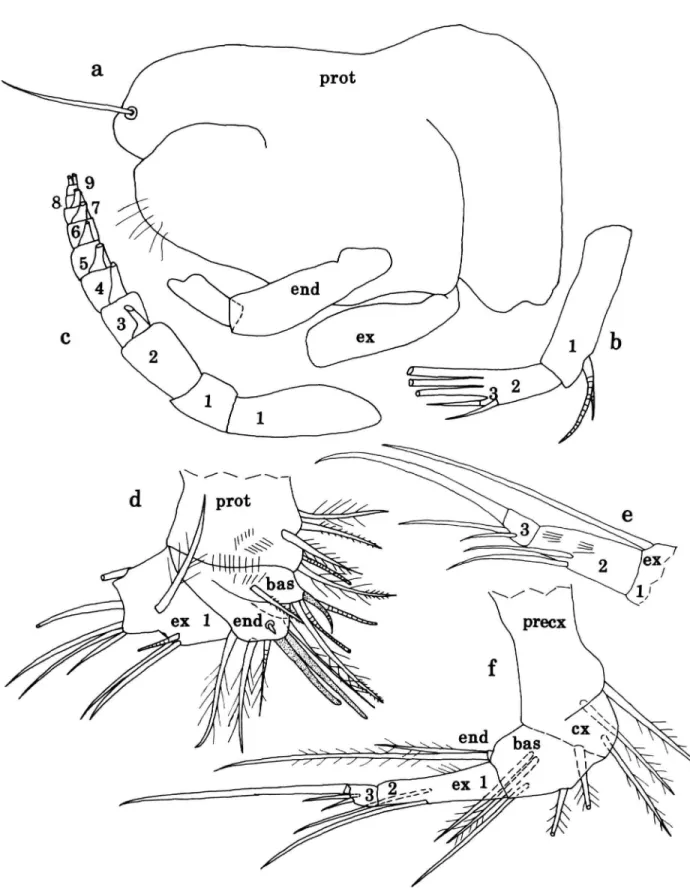
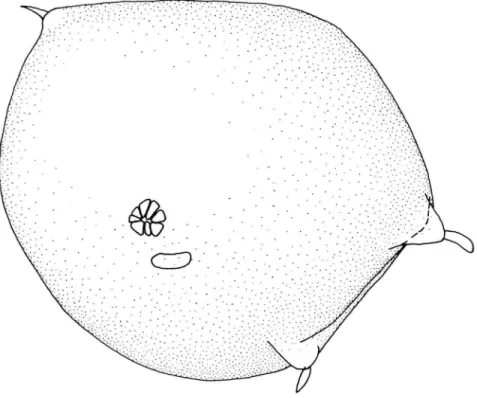
5th joint with 3 filament-like hairs (ventral of these slightly wider and with closely spaced distal spines (short triangular spines followed by longer curved hairlike spines (detail in Fig. 6a)) ). Descriptions of the adult male and some juveniles are presented here, as well as a supplementary description of the female. The walls of the webs on the outer surface of the shell consist of continuous and discontinuous ridges.
7th joint with 3 terminal hairs (short A short flat with bare ring and 2 b- and c-like hairs on ventral filament). 8th joint with 3 terminal spines (thin d-dorsal setae with few short marginal spines, 1 long filiform electrical hair, with widely separated marginal spines and f-filaments similar to electrical hairs but more narrow). 8th joint with 3 terminal spines (slender d surrounded dorsally by few marginal spines, 1 long filament-like spine with widely separated marginal spines, and f-spines similar to electric spines but more long, narrower and the marginal spine is not respected).
One of the ventral bristles on the male bears distal curved hairs (the distribution and number of hairs varies between species). The 1st instar has 1 bristle on the end joint of the 5th limb, is without the 6th and 7th limbs, and the furca bears 3 claws on each lamella. 2nd instar has 2 bristles on terminal joint of 5th limb, a small bare thumb-like 6th limb, no 7th limb, and the furca bears 4 claws on each lamella.
The 3rd instar has 2 setae on the terminal joint of the 5th arm, many setae on the 6th arm, the 7th arm is absent, and the furka bears 4 claws on each lamella. The adult has fully developed limbs and each lamella of the furke bears 8 claws, followed by a small triangular outgrowth. All species known so far have been collected in the open marine environment of the northern hemisphere (Chavtur, 1983:109).
Exopodite with 9 joints (Figure 14c); a long ringed bristle on each of joints 1-8 (hairs on the bristles, if present, not resolved); 9th joint with 2 bristles (1.

The first endopodial joints of the mandibles of all seven species have 2 or 3 proximal ventral spines, which are absent in E. Previously described species of the genus have 3 central ascending muscular attachments (not known for E. difficilis). Previously described species of the genus have an anterior spine on the exopodite of the mandible, which is apparently absent in the diaphanous exopodite of E.
The morphology of antenna 1 suggests that it belongs to the subfamily Polycopinae, but the mandible and organ of Bellonci are obscured on the mounted specimen, so it could not be further identified. COMPARISONS.—This species is easily distinguished from Eupolycope pnyx by having truncated processes along the anteroventral margin of the carapace instead of serrations; also the 7th and 8th segments of the 1st antennae bear a total of 5 long setae (Fig. \6b) compared to 4 on E. New data on ostracods of the family Polycopidae (Ostracoda, Cladocopa) for the eastern seas.] V [Pelagic and Benthic Investigations organisms from the Far Eastern seas].
Transaktioner fra Institute of Marine Biology, Far East Science Center, Academy of Sciences of the U.S.SJt. On the Systematic Position of the Modern Ostracoda in the Family Polycopidae (Ostracoda, Cladocopinae).] Trudy Institute Okeanologiia, 115:53-60. Videnskabsakademiet i USSR, Far-Eastern Science Center, Institute of Marine Biology, Vladivostok, 132 sider.
The adult male of the troglobitic Ostracode Spelaeocia bermudensis Angel and Iliffe, 1987, from an Anchialine Cave in Bermuda (Crustacea: Ostracoda: Halocypridoidea). Requests for special treatment - use of color, fold-outs, case-bound covers, etc. - require, on the same form, an added approval from the sponsoring authority. The first page of text should bear the title and author at the top of the page; the second page should have only the author's name and professional mailing address, to be used as an unnumbered footnote on the first page of printed text.
Synonymy in zoology should use the short form (taxon, author, annual page), with the full reference at the end of the paper under. Extensive notes should be collected together and placed at the end of the text in a notes section. For titles of books and articles, use capital letters in the style of sentences according to the rules of the language used (exception: write all main words in English).
Legends for illustrations should be submitted at the end of the manuscript, with as many legends typed, double-spaced, on the page as appropriate. The use of the metric system of measurement is preferred; where the use of the English system is unavoidable, give the metric equivalents in brackets.