JUDUL: PAINTING PROCESS IMPROVEMENT FOR AUTOMOTIVE INDUSTRY
SESI PENGAJIAN: 2008/2009
Saya, MUHAMMAD FARID BIN M FATHIL (860619-29-6045) (HURUF BESAR)
mengaku membenarkan tesis (Sarjana Muda / Sarjana / Doktor Falsafah)* ini disimpan di perpustakaan dengan syarat-syarat kegunaan seperti berikut:
1. Tesis ini adalah hakmilik Universiti Malaysia Pahang (UMP).
2. Perpustakaan dibenarkan membuat salinan untuk tujuan pengajian sahaja.
3. Perpustakaan dibenarkan membuat salinan tesis ini sebagai bahan pertukaran antara institusi pengajian tinggi.
4. **Sila tandakan (√)
SULIT (Mengandungi maklumat yang berdarjah keselamatan atau kepentingan Malaysia seperti yang termaktub di dalam AKTA RAHSIA RASMI 1972)
TERHAD (Mengandungi maklumat TERHAD yang telah ditentukan oleh organisasi / badan di mana penyelidikan dijalankan)
TIDAK TERHAD
Disahkan oleh:
_________________________ __________________________
(TANDATANGAN PENULIS) (TANDATANGAN PENYELIA)
Alamat Tetap:
Lot 2429 Taman Lati DR KUMARAN KADIRGAMA
17000 Pasir Mas (Nama Penyelia)
Kelantan
Tarikh: 10 NOVEMBER 2008 Tarikh: 10 NOVEMBER 2008
CATATAN: * Potong yang tidak berkenaan.
** Jika tesis ini SULIT atau TERHAD, sila lampirkan surat daripada pihak berkuasa/organisasi berkenaan dengan menyatakan sekali tempoh tesis ini perlu dikelaskan sebagai SULIT atau TERHAD.
Tesis dimaksudkan sebagai tesis bagi Ijazah Doktor Falsafah dan Sarjana secara Penyelidikan, atau disertasi bagi pengajian secara kerja kursus dan penyelidikan, atau Laporan Projek Sarjana Muda (PSM).
√
PAINTING PROCESS IMPROVEMENT FOR AUTOMOTIVE INDUSTRY
MUHAMMAD FARID BIN M FATHIL
UNIVERSITI MALAYSIA PAHANG
PAINTING PROCESS IMPROVEMENT FOR AUTOMOTIVE INDUSTRY
MUHAMMAD FARID BIN M FATHIL
A report is submitted in partial fulfillment of the requirements for the award of the degree of
Bachelor of Mechanical Engineering with Automotive Engineering
Faculty of Mechanical Engineering UNIVERSITI MALAYSIA PAHANG
NOVEMBER 2008
ii
SUPERVISOR’S DECLARATION
We hereby declare that we have checked this project and in ouropinion this project is satisfactory in terms of scope and quality for the award of the degree of Bachelor of Mechanical Engineering with Automotive
Signature
Name of Supervisor : Dr Kumaran Kadirgama Position : Lecturer
Date : 10th November 2008
Signature
Name of Panel : Mohd Rashidi Maarof Position : Lecturer
Date : 10th November 20008
STUDENT’S DECLARATION
I hereby declare that the work in this thesis is my own except for quotations and summaries which have been duly acknowledged. The thesis has not been accepted for any degree and is not concurrently submitted for award of other degree.
Signature
Name : MUHAMMAD FARID BIN M FATHIL ID Number : MH05032
Date : 7th November 2008
iv
ACKNOWLEDGEMENTS
Alhamdulillah. First of all, I would like to express my grateful to ALLAH S.W.T for the successful finish this project. I also want to thank to my supervisor, Ir.
Hj Nik Mohd Zuki b Nik Mohamad for his germinal ideas, invaluable guidance, continuous encouragement and constant support in making this project possible.
I also would like to thank to Mr. Tarmizi Mat Ariff, Maneger of Paint Shop, for giving the permission to do my case study at AMM Sdn. Bhd. Also, not forget, Mr Amin Azman, Foreman of Paint Shop, for his cooperate and information that I needed, and lastly the workers at Paint shop. May Allah Bless them.
Not forgetting to my friends for helping me to grow further and influence my project in order to finish this project. I appreciate very much to them because of the idea and information given along done this project.
I acknowledge my sincere indebtedness and gratitude to my parents for their love, dream and sacrifice throughout my life. I cannot find the appropriate words that could properly describe my appreciation for their devotion, support and faith in my ability to attain my goals. Special thanks should be given to my committee members.
I would like to acknowledge their comments and suggestions, which was crucial for the successful completion of this study.
Dedication;
To My late father, M Fathil B Che Mahmood, My mother, Nur Aisyah Bt Jusoh, and
All My beloved persons
vi
ABSTRACT
Painting process is an important process in automotive industry. The purposes of the process are to give more attractive appearance to the vehicles and to provide the layer of protection against corrosion and weathering. The painting process are include a few other process, which are Pre-Treatment and Electrodeposition (ED) Process, ED sanding, process, sealant and PVC process, primer process, and top coat process. The objective of the project are to identify the problems occur in ED sanding process and reduce the problems to improve the ED sanding. The study was done at AMM plant in Pekan, Pahang. The methods used to identify the problems are based on the four M method, which are Manpower, Machine, Method, and Materials. The study implement total quality management tools to analysis the problems. From the study that have done, the major problems are the foreign material and the scratch. The foreign material can be reduced by making the solvent so that the layer of anti- corrosion can be eliminate. Meanwhile, the scratch is cause by manpower. The lesss the worker touch the vehicle body, the less scratch formed on the vehicle surface body.
ABSTRAK
Proses mengecat merupakan suatu process yang penting dalam industi automotif.
Proses ini bertujuan untuk memberi penampilan yang menarik kepada kereta dan menyediakan lapisan perlindungan melawan cuaca dan karat atau hakisan. Proses mengecat terdiri daripada beberapa proses yang lain, iaitu proses pra-rawatan dan Elektrodeposisi (ED), proses ED sanding, proses sealant dan PVC, proses primer, dan proses Top Coat . Objektif projek ini adalah untuk mengenalpasti masalah yang berlaku di dalam Ed sanding dan mengurangkan masalah yang berlaku untuk menambahbaikan ED sanding . Kajian dilakukan di kilang Automotive Manufacturer Malaysia (AMM) Sdn. Bhd. di Pekan, Pahang. Keadah yang dilakukan untuk mengenalpasti masalah yng berlaku adalah berdasarkan kepada empat M, iaitu Menpower (tenaga kerja), Machines ( mesin atau peralatan), Methods (keadah- kaedah) dan Materials (bahan-bahan). Analisis yang digunakan di dalam kajian ini adalah dengan menggunakan Alat-Alat Pengurusan Kualiti Keseluruhan (Total Quality Management Tools). Daripada kajian yang dibuat, masalah-masalah yang paling besar adalah bendasing dan calar pada permukaan badan kereta. Bendasing boleh dikurangkan dengan membuat pelarut supaya lapisan anti-karat dapat dihapuskan. Manakala, calar disebabkan oleh tenaga kerja. Semakin sedikit pekerja menyentuh badan kereta, semakin kurang calar terbentuk di permukaaan badan kereta.
viii
TABLE OF CONTENTS
Page
SUPERVISOR DECLARATION ii
STUDENT’S DECLARATION iii ACKNOWLEDGEMENTS iv
ABSTRACT vi
ABSTRAK vii TABLE OF CONTENTS viii
LIST OF TABLES xi
LIST OF FIGURES xii
LIST OF SYMBOLS xiii
LIST OF ABBREVIATION xiv
LIST OF APPENDICES xv
CHAPTER 1 INTRODUCTION 1.1 Project Background 1 1.2 Problem Statement 2 1.3 Project aim and objective 2 1.4 Scopes 3
2.1 History of Automotive Painting 4
2.2 Introductions 7
2.3 Painting Process 9
2.3.1 Pre-treatment and ED 9
2.3.2 ED sanding 11
2.3.3 Sealant and PVC line 11
2.3.4 Primer 13
2.3.5 Top Coat 14
CHAPTER 3 METHODOLOGY
3.1 Introduction 17
3.2 Flow Chart of Methodology 18
3.2.1 Start 19
3.2.2 Literature 19
3.2.3 Visit plant 19
3.2.4 Collecting Data 20
3.2.5 Analysis Data 21
3.2.6 Propose 21
3.2.7 Documentation 21
3.3 Collecting Data and Analysis 22
3.4 ED Sanding Process 23
3.5 Total Quality Management (TQM) 25
3.5.1 Knowledge of TQM Tools 25
3.5.1.1 Cause-and-Effect Diagram 26
3.5.1.2 Pareto chart 27
x
CHAPTER 4 RESULTS AND DISCUSSION
4.1 Introductions 30
4.2 Problems in ED Sanding process 31
4.3 ED sanding process analysis 32 4.3.1 Manpower 32
4.3.2 Method 34
4.3.3 Machine 34
4.3.4 Material 34
4.4 Pareto chart analysis 36 4.4.1 Foreign Materials 37 4.4.2 Scratch 38 4.5 Conclusion 39 CHAPTER 5 CONCLUSION AND RECOMENDATION 5.1 Conclusion of Analysis 41
5.2 Recommendation and suggestion 42
REFERENCES 43
APPENDICES
A Gantt Chart 45
LIST OF TABLES
Table No. Page
2.1 Composition solvent in basecoat 14
2.2 Composition solvent in clearcoat 15
4.1 The problems occur at ED sanding line 35
xii
LIST OF FIGURES
Figure No. Page
2.1 Painting Processes 8
2.2 Overview Painting Process 9
2.3 Pre-treatment and ED process 11
2.4 Apply sealant using robotic equipment 13
2.5 Basecoat process using robotic 15
3.1 Flow Chart of Methodology 18
3.2 AMM Sdn. Bhd 20 3.3 The ED sanding booth 23
3.4 Fish-bone diagram (cause-and-effect diagram) 27
3.5 Pareto chart 28
4.1 Fishbone diagram for the problems in ED sanding 31
4.2 Training matrix of manpower in ED sanding 33
4.3 Pareto chart for problems occur in ED sanding process 36
4.4 The conveyor 40
LIST OF SYMBOL
% Percentage
oF Degree of Fahrenheit
oC Degree of Celsius
xiv
LIST OF ABBREVIATION
4M Manpower, machine, method and material AMM Automotive Manufacturer Malaysia
BIW Body-in-White
DC Direct Current
ED Electrodepositon
HBR High Bake Repair
JIT Just-in-Time
LBR Low Bake Repair
OEM Original Equipment Manufacturer
PVC Poly-vinyl Chloride
TQM Total Quality Management
UV Ultra-violet
LIST OF APPENDICES
Appendix Page
A Gantt Chart 45
CHAPTER 1
INTRODUCTION
1.1 PROJECT BACKGROUND
The automotive industry involved in the manufacture of motor vehicles, including most components, such as engines and bodies, but excluding tires, batteries, and fuel. The industry's principal products are passenger automobiles and light trucks, including pickups, vans, and sport utility vehicles. This industry involved in design, manufacture, and marketing of the vehicle. There are several processes in automotive industry in manufacturing a vehicle. The processes in manufacturing a vehicle are stamping process, body assembly process, painting process, and trims and final processes.
One of the major cost factors in car manufacturing is the painting of body and other parts such as wing or bonnet. Surprisingly, the painting may be even more expensive than the body itself. Maybe the high costs are in terms of processes that occur in painting process and not the machines that applied in paint shop. From this point of view it is clear that car manufacturers need to observe the painting process carefully to avoid any deviations from the desired result. Reduced paint use and reduced defects would save $683 million annually for the Big 3 manufacturers and would lower costs and improve quality for consumers.
With these time costs, manufacturers could only afford sampled quality control, measuring approximately 1 to 3 cars per day, or about 1 out of every 500 vehicles. Moreover, the slowness of the quality control contributed to poor feedback response time. By the time quality control detected a problem and made proper adjustments, up to 100 vehicles had passed through the defective painting production line. Manufacturers had to repair all vehicles with defective paint coatings by using one or both of the low bake repair (LBR) and high bake repair (HBR) processes, at a cost of $600 to $1,200 per vehicle in 1995. In some extreme cases, the manufacturer had to completely scrap the vehicle.
Car painting is a complex combination of different layers of base coat, color and protective finishing coat. The setup for the painting process requires the optimal adjustment of a variety of different parameters such as humidity, temperature and the consistence of the lacquer itself.
1.2 PROBLEM STATEMENT
There are impossible to achieve zero defects in the whole painting processes.
The problems come from the 4M, which are men, machines, methods and materials.
Therefore, to improve the process is by reducing the defects or problems as lower as possible. The tasks are to study the method that use in the process and propose a new method that can overcome the defects or problems.
1.3 THE PROJECT AIM AND OBJECTIVES
The aim of this project is to reduce the problems that occur at painting processes. In order to achieve the aim, the following objectives are required
• To identify the defects that occurs in painting processes
• To improve the painting process in the automotive industry
3
1.4 SCOPES
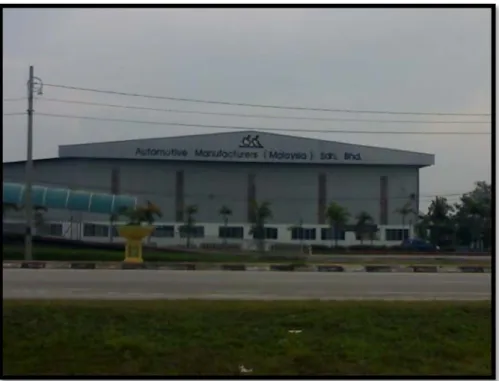
The study is held at Automotive Manufacturer (Malaysia) AMM Sdn. Bhd., Pekan, Pahang. The model vehicle involve are two models, which are Naza Forza and Suzuki Swift. The detail studies are on ED sanding process in painting process.
CHAPTER 2
LITERATURE REVIEW
2.1 HISTORY OF AUTOMOTIVE PAINTING
Ever since the first automobiles were made in the late 1800’s, there have been many changes in paint technologies to protect and beautify these manmade transportation devices, from natural products to high tech polymers. In the first part of the 20th century automotive paint technology was based on the same air-dry varnish systems that were used for wooden furniture and horse drawn carriages. The major drawback was that the only choice of color offered was black. In addition, they required tedious brush application of multiple coats and days of drying time, which created a production bottleneck.
The history of paint protectants goes back to the days of horse drawn carriages also. The coatings were mainly protected by applying animal fats. Later, waxes and oils were used. The fats and oils helped seal the coatings from moisture and kept the wood frame from drying out. They also helped increase the gloss and the beauty of the finish. These materials had to be applied frequently to maintain their protective properties. This method of protecting and beautifying the finish was carried over to automobiles, which replaced carriages. The early automobiles also had a wood frame and had very similar coatings as well.
5
Being a ferrous metal, steel must be coated to prevent corrosion and although some body parts were later galvanised, paint was the obvious solution because it is both protective and decorative [5].
The lack of coatings that were easy to apply, more durable, and fast drying, became obvious handicaps to the efficient production of the motorcar. As advances in chemistry were discovered in the laboratory, advances in coatings technology were close behind. In 1923, E.I. DuPont De Nemours developed nitrocellulose lacquer systems, which offered many color choices and easier application using spray guns. However, lacquer systems required spray application of 3-4 coats of paint to achieve the desired properties. Lacquers also by their very nature have poor resistance to certain chemical solvents.
Nitrocellulose paints ushered in the practice of spray application and their drying time was significantly shorter. Another benefit to this advancement was that a larger number of colors became available. Chemistry’s next gift to the automotive finish industry was alkyd resins. These were used in the making of alkyd enamels.
Alkyd resins were derived from glycerin processed from animal and vegetable fats.
This glycerin was primarily used in explosives and in solvents such as those used in paint.
The alkyd enamels of the 1930s represented the early stages of what could be recognized as the modern process of automotive finishing. These enamels offered an excellent gloss finish and a reasonable color palette. As with previous advances in coatings, alkyd enamels were more durable, and of course, faster. When domestic development resumed after World War II, acrylic lacquers gave the OEM and refinish industries a quantum leap forward. Lacquer offered an exceptionally fast drying time compared to the early enamels. This translated into a significant
to meet the high post-war demand. The acrylic lacquer formulation also brought an even greater expanse to available color formulations. Nitrocellulose lacquers were used on some passenger cars until about 1957, when solution acrylic lacquers were introduced. Acrylic lacquers offered much improved durability and a wider range of bright, pleasing colors – especially metallics.
Enamels outperformed the lacquers by eliminating the buffing required after drying to achieve a high-gloss finish and also provided an improved resistance to UV damage. They also benefited users by both retaining durability and outpacing the speed of the earlier application methods. The use of catalysts, which began shortly after the introduction of acrylic enamels, boosted performance up to 50 percent over lacquers to provide further improvements in appearance and durability, a new type of finish, called “Basecoat/Clearcoat,” was developed and introduced in the late 70’s.
The topcoat paint system was split into a pigmented enamel basecoat, followed by a clear enamel finish. The key to this technology was the development of a clearcoat material with superior durability in all climates. Initially, the cost of the basecoat/clearcoat paint system was prohibitive and it was only used on some high- end automobile finishes. However, refinements in the material technology and processing helped to reduce costs, and by the late 80’s this paint system had become widespread. In fact, only a small percentage of cars manufactured today do not use this basecoat/clearcoat paint system.
The benefits of this two-layer system were many. It increased the gloss of paint considerably, which was unsurpassed by any other paint system. It also allowed the paint formulators to incorporate UV absorbers to protect the clearcoat and the pigments in the basecoat from oxidation. Therefore, it could take years to show any dulling effect.
7
2.2 INTRODUCTIONS
The painting processes start after the body of vehicle is assembles. The purpose of this processes are to give more attractive appearance to the vehicles and to provide the layer of protection against corrosion and weathering. The paints and coatings industry is made up of many different types of operations, ranging from large-volume original equipment manufacturers (OEMs) that run highly automated, closely monitored systems to custom shops performing a range of contract work with manually operated equipment [1]. There are five major processes in painting processes; pre-treatment and electrodeposition (ED), ED sanding, sealant and PVC line, primer, and top coat. (See Figure 2.1)
In addition to being responsible for the colors and attractiveness of a vehicle, automotive paints provide protection against corrosion and weathering. Conventional paint films are only as thick as a human hair, but consist of four layers. In a conventional process, an automotive chassis is prepared, dipped in an electrocoat and then has a primer applied to it to provide corrosion protection. For adhesion, these layers are baked onto the chassis in an oven. Then the basecoat, which provides the actual color, and clearcoat for appearance and scratch resistance are applied. The chassis is again baked in an oven to complete the painting process.
Figure 2.1: Painting Processes Sealant and PVC line Pre-treatment and ED
Top coat From the body
assembly
Primer ED sanding
End painting process
9
Figure 2.2 Overview Painting Process
2.3 PAINTING PROCESS
2.3.1 Pre-treatment and ED
The vehicle bodies, which are generally made of light-weight steel, undergo surface preparation and pre-treatment. This preparation involves through washing and wipe-cleaning. The pre-treatment process causes a chemical crystalization to occur on the vehicle surface that provides improved paint adhesion and anti- corrosion protection.
The purposes of pre-treatment are to remove foreign materials, for examples oil, dust etc, and also to form a layer of zinc phosphate crystal on the surface of body of vehicles. Before the pre-treatment process, the cleaning the body of vehicles is
that the whole body exposed to the process that done.
The body vehicles were through several steps in pre-treatment process before electrodeposition (ED). The first step is the body was dip with water and rinse, for the first time. Then the body are dip with the surface chemical conditioning to easier the zinc phosphate layer for the next stage. The car, then are immersion in a zinc phosphate bath, which chemically reacts with the metal surface where the crystals form. The bodies are rinse again for the second time. The last step is the body immersing or rinsing the vehicle bodies in a chromic acid or acid chromate followed by a deionized water rinse [4].
Electrodeposition (ED) requires, however, an implied DC current to carry out the process. Metal parts pass through a multistage cleaning and treating process. The next step then immerses the metal parts in the process coating tank containing the coating (5 to 20 percent solids dispersed in water). The workpieces are connected to a DC power supply and, depending on whether the process is anodic or cathodic, they will be charged either positively (anode) or negatively (cathode). This creates a strong electric field in the tank. The electric field causes the coating with an opposite electrical charge to deposit on the metal surfaces.
As coating deposits uniformly, it covers, and thus, begins to isolate the parts from the electric field. This process diminishes the strength of the electric field, which, in turn, slows down the coating process. When coating has totally covered the workpiece, no charged part is left exposed. This reduces the electric field around the workpiece to zero, and no more coating can deposit. They then travel to a baking oven that cures the coating at 275o to 375°F for 15 to 30 minutes. The excess rinse water/coating that the rinse tank recovers passes through an ultrafiltration unit that concentrates coating while recycling the water for reuse [3].
11
Figure2.3: Pre-treatment and ED process
(http://www.metokote.com)
2.3.2 ED sanding
ED sanding is done in ED sanding booth. The purpose of this process is to smooth the surface of the body. The first step in this process is using light sanding on the body by hand. Then, continue sanding process with using sandpaper. Next step is major repair on the body using sanding disk. At final of this process is air blow, to remove the dust of sanding process from the body using air blower.
2.3.3 Sealant and PVC line
The automotive industry uses sealants in a large number of applications from windscreen bonding to underbody coating. However, within these broad parameters lies a range of rather interesting applications where materials are applied at the
‘‘body-in-white’’ stage of the car building process. The phrase ‘‘body-in-white’’
sealants and adhesives.
As sealants to prevent the ingress of water, salt and dirt, etc. and as adhesives to have excellent adhesion to a seemingly inexhaustible number of substrates, coated with a similar number of oils [6].
The main applications for sealants/adhesives in the body shop are:
(a) Anti-flutter: low modulus materials that prevent vibration between inner and outer panels
(b) Structural: high modulus materials that contribute to the torsional stiffness and impact resistance of cars.
(c) Spotweld/interweld/weld through sealers: materials that are applied to panels prior to spot welding. These materials seal the joints between spotwelds.
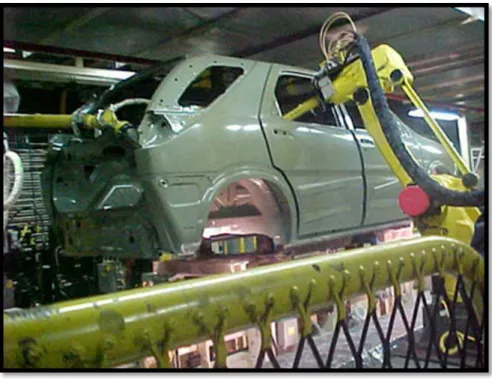
As the vehicle moves toward and into the primecoat spray booth, sealers and other protective coatings, such as antichip, are applied [4]. The sealant is applied at joined parts on the whole body of vehicle. The PVC process starts at installing the silencer on the interior base and the tyre housing.
The function of the silencer is to reduce the sound impact such as from stone while driving. Then the body is applied the stone guard on the both side to protect the lower part. Next, the body are through the oven booth to curing the sealant and PVC at150oC to 180oC. This process takes about seven to ten minute to harder the sealant and PVC.
13
Figure 2.4: Apply sealant using robotic equipment
(http://www.appliedmfg.com) 2.3.4 Primer
After the sealers, anti-chip and, the basecoat and clearcoat paints are applied on the vehicle by two ways, either by automated spray guns, such as reciprocating robots or stationary bells, or by manually operated spray guns. Many times a combination of the two practices, automated and manual application, is used.
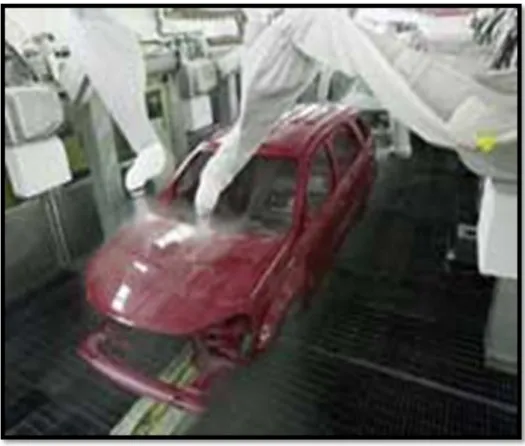
The basecoat is the paint that provides color for the vehicle. To prevent paint build-up on spray gun tips, each paint delivery hose and spray gun are purged with solvent between each change in color, which may be as often as every vehicle body.
In some plants, this "purge solvent" is collected and recycled [4].
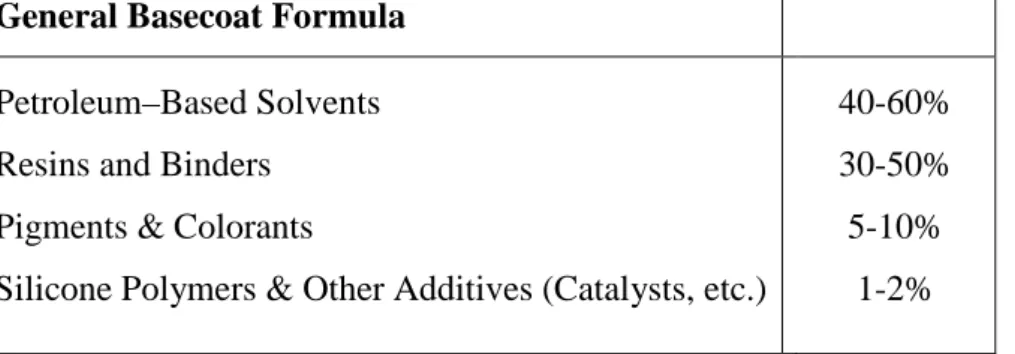
A typical basecoat paint system after the two components are mixed is shown in Table 2.1.
Table 2.1 Composition solvent in basecoat
Source: David Ghodoussi, 2004
2.3.5 Top Coat
A flash-off zone is employed between the basecoat and the clearcoat zones to allow the basecoat to partially dry before the clearcoat is applied. It also gives the engineers an opportunity to monitor the quality of the basecoat paint. The clearcoat is a topcoat that adds luster and hardness to the paint finish while protecting the base coat from ultraviolet radiation.
General Basecoat Formula Petroleum–Based Solvents Resins and Binders
Pigments & Colorants
Silicone Polymers & Other Additives (Catalysts, etc.)
40-60%
30-50%
5-10%
1-2%
15
Figure 2.5: Basecoatprocess using robotic
(http://www.pfonline.com) The clearcoat application is followed by an observation zone where the vehicle bodies are studied by quality control personnel and are labelled for either continuation down the line or for repair or paint touch-up if necessary. The vehicles then enter a series of ovens where the paint is cured, thus completing the painting process [4].
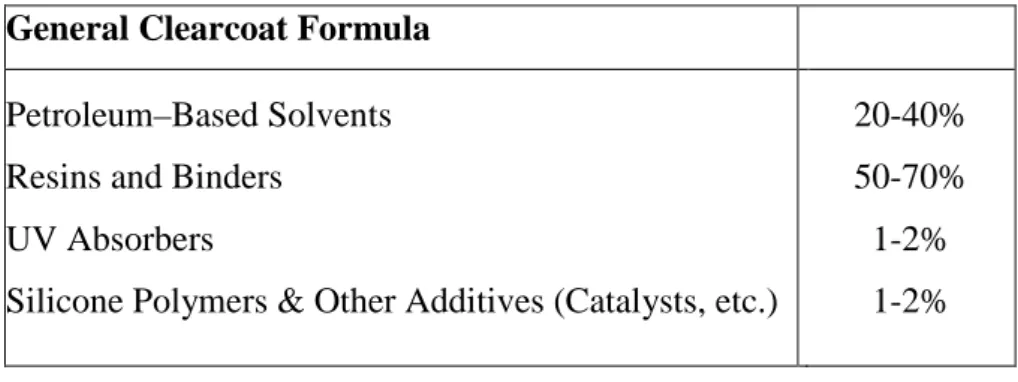
A typical clearcoat paint system after the two components are mixed is shown in Table 2.2.
Table 2.2 Composition solvent in clearcoat
General Clearcoat Formula Petroleum–Based Solvents Resins and Binders
UV Absorbers
Silicone Polymers & Other Additives (Catalysts, etc.)
20-40%
50-70%
1-2%
1-2%
Source: David Ghodoussi, 2004
17
CHAPTER 3
METHODOLOGY
3.1 Introduction
In this chapter, the details of methodology of the projects are stated and how the projects are carrying out. The data are obtained by visiting the automotive factory in Pekan, Pahang. This is important to obtain and observe the problems in the actual processes that occur at paint shop. The data are collected by observe and interaction between foremen or workers in each processes, but the details of the project will be on the ED sanding process.
3.2 Flow Chart of Methodology
Figure 3.1: Flow Chart of Methodology START
Literature review
Study on the painting process at AMM
Identify the problems that occur in ED process
Analysis the problem that occur in ED process
Propose the solution to improve the ED process
Thesis writing
END
19
3.2.1 Start
First of all, the project begins by choosing the title for study. Then, the project proceeds with the briefing and the overview from the supervisor about the title project that has been chosen.
3.2.2 Literature
The first tasks given by supervisor are searching the information about the processes in paint shop. The information was obtained through journal, books, case studies, internet and etc, that will used in literature review.
From the searching of information, the overview of the processes in the painting process is obtained. This is important to be as fundamental knowledge of painting process before doing case study at the factory.
3.2.3 Visiting Plant
The actual painting processes were obtained by visiting the automotive plant in Pekan. The plant visits are divided by two stages, which is weekly and daily. The weekly visit was done to observe the painting process in AMM plant.
The foremen from each process in paint shop are willing to give the details explanation about painting process. It’s done within the first semester during lecture week. The daily visit will be done during the semester break for one month duration.
Figure 3.2: AMM Sdn. Bhd
3.2.4 Collecting Data
From the observation and interaction between the foremen in the paint shop, the data are obtained and identify the problems that occur in paints shops. The detail observation occurs in the ED sanding booth, which is the process that happens after the curing of the ED process.
The importance parameters in collecting the data are the length of the ED sanding booth, quantity of vehicle that can occupied in sanding booth in one time, the number of workers involve, the skill level each workers and time taken for the sanding process.
21
3.2.5 Analysis Data
After identify the problems, the next step is analysis the problems that occur in ED sanding process. The data that obtained from the study is based on 4M elements, which are manpower, machines, methods and materials.
3.2.6 Propose solution
After identify and analysis the problems, propose the best solution to improve the painting process for automotive industry, either eliminate the defects or reduce the problem as lower as possible.
3.2.7 Documentation
After all the steps are completed, the next step is to provide the documentation for this project. The ways to overcome the problems obtained should be discussed in the details.
The data collected in these projects are obtained from visiting AMM factory in Pekan by observing and interaction between foremen in each process in paint shop. On the first visit, the paint shop manager gives the briefing about the overview of the whole painting process. Then proceed to each process in paint shop. These are important to identify the problems that occur in the process and to know where the problem came from.
The painting processes start when the vehicles are finish in body assembly at body shop. The body of vehicles will proceed with the pre-treatment and Electrodeposition (ED) process. Then, the vehicle will through ED sanding process.
After the sanding process finish, the body will apply the sealant and PVC. Next, the body will layered by primer coat for the second coat after ED process. The last but not least, the vehicle will proceed with the top coat process.
The study will be based on the 4M concept to identify the problem in ED sanding; manpower, materials, machines and methods. For the narrow scope of study, not all elements will be analyzed. The study will focus on two elements only, which are manpower and methods.
23
3.4 ED SANDING PROCESS
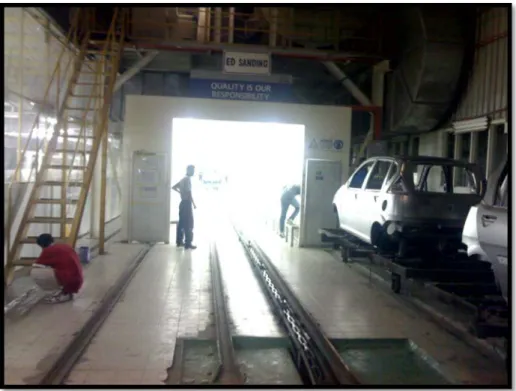
The ED sanding process is done after the body of vehicles comes out from the oven to cure the ED coating. The ED sanding line have a length about 50 metres.
The ED sanding Line can occupied about 10 to 13 vehicles at one time, depending on the models. Almost 90 % ED sanding process are done in the Booth that equipped with lighting system and air ventilation system.
The ED sanding can be divided into two processes, which are sanding process and cleaning process. The sanding processes only involve the outer surface of vehicles body. The ED sanding begin with the light sanding without using the machine. This process is done before enter the booth.
Figure 3.3: The ED sanding booth
Then, the process will proceed with machine sanding in the booth so that the dust from the sanding can sucked into the ventilation system. There are four important parts in the machine sanding. The parts are, left hand side sanding, right hand side sanding, roof top sanding, and hood and tail sanding.
After the sanding process is finish, the next process is cleaning. The cleaning process is done by using air blowing. The vehicle body must be clean before proceeding to the next line. The vehicles body must be free from the dust so that the sealant can be applied on the body.
There can be two way to clean the vehicle body from the dust, either air blowing or liquid dipping. The liquid dipping is a safe method compare to the air blowing but the liquid dipping required more cost and more time to dry the liquid.
The air blowing is an appropriate way to clean the dust from the body.
The ED sanding finish after the cleaning process is done. The vehicles body is ready to proceed to the next line, sealant and PVC process.
25
3.5 TOTAL QUALITY MANAGEMENT (TQM)
Total quality management (TQM) refers to a quality emphasis that encompasses the entire organization, from supplier to customer. TQM stresses a commitment by management to have a continuing companywide drive toward excellence in all aspects of products and services that are important to the customer.
One major aim is to reduce variation from every process so that greater consistency of effort is obtained.
There are seven concepts for the effective TQM program.
i. Continuous improvement ii. Six sigma
iii. Employee empowerment iv. Benchmarking
v. Just-in-time (JIT) vi. Taguchi concept
vii. Knowledge of TQM tools 3.5.1 Knowledge of TQM Tools
Total quality management (TQM) tools help organizations to identify, analyze and assess qualitative and quantitative data. These tools can identify procedures, ideas, statistics, cause and effect concerns and other issues relevant to their organizations.
Each of which can be examined and used to enhance the effectiveness, efficiency, standardization and overall quality of procedures, products or work environment, in accordance with ISO 9000 standards. ISO 9000 is a set of quality standards developed by the International Standards Organization (ISO). The focus of the standards is to establish quality management procedures, through leaderships, detailed documentation, work instructions, and recordkeeping.
In order to identify the problem that occur in ED sanding, two of the TQM tools are used in this study. There are seven tools that are particularly helpful in the TQM effort.
The tools are;
a. Check sheet b. Scatter diagram
c. Cause-and-Effect diagram d. Pareto chart
e. Flow chart f. Histogram
g. Statistical process control chart
Not all these tools will discuss in this chapter. The important and related tools only will be discussing detail. The related tools in this project are Cause-and-Effect diagram, also known as Ishikawa diagram or fishbone diagram, and Pareto chart.
3.5.1.1 Cause-and-Effect Diagram
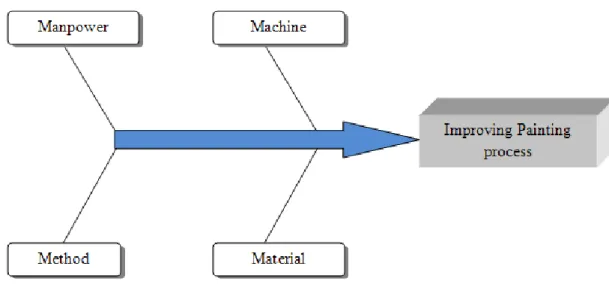
Cause-and-Effect diagram is a tool for identify quality issue and inspection points. The diagram also is known as an Ishikawa diagram or fish-bone diagram.
Individual causes associated with each category are tied in as separate bones along that branch, often through a brainstorming process. All the causes will lead to the effect of the problem of study.
27
Figure 3.4: Fish-bone diagram (Cause-and-Effect diagram)
3.5.1.2 Pareto chart
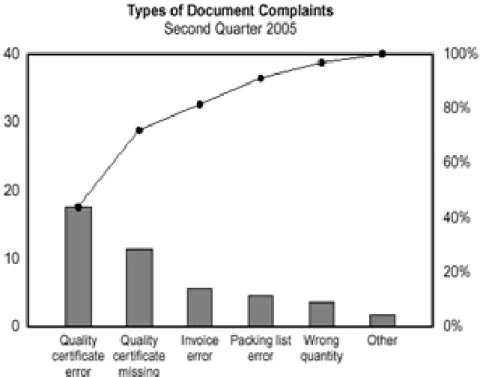
Pareto charts are a method of organizing errors, problems, or defects to help focus on problem solving efforts. A Pareto chart provides facts needed for setting priorities. It organizes and displays information to show the relative importance of various problems or causes of problems. It is a form of a vertical bar chart that puts items in order (from the highest to the lowest) relative to some measurable effect of interest: frequency cost or time.
Figure 3.5: Pareto chart
(http://www.asq.org)
Figure 3.4 show that the example of the Pareto chart. The chart is based on the Pareto principle, which states that when several factors affect a situation, a few factors will account for most of the impact.
The Pareto chart can be build by using the MINITAB software. From that software, all the percent of each problem or defect and the cumulative percent will be show in the graph. Then can determine the major defect from the Pareto chart which one should be focus.
Placing the items in descending order of frequency makes it easy to discern those problems that are of greatest importance or those causes that appear to account for most of the variation. Thus, a Pareto chart helps teams to focus their efforts where they can have the greatest potential impact.
29
Typically on the left vertical axis is frequency of occurrence, but it can alternatively represent cost or other important unit of measure. The right vertical axis is the cumulative percentage of the total number of occurrences, total cost, or total of the particular unit of measure.
The purpose is to highlight the most important among a (typically large) set of factors. In quality control, the Pareto chart often represents the most common sources of defects, the highest occurring type of defect, or the most frequent reasons for customer complaints.
CHAPTER 4
RESULT AND DISCUSSION
4.1 INTRODUCTIONS
In this chapter, the data from the case study at AMM factory will be discusses and analyzes the data to overcome the problem that occur in ED sanding process.
The data of the study obtained after observation of fully process of sanding and interaction with the foreman and the operator. The objective in this chapter is to identify the problem that occur in ED sanding and propose the solution on how to overcome the problem.
31
4.2 PROBLEMS IN ED SANDING PROCESS
The results are obtained during case study at AMM factory. The data is based on the real daily problems face by the company during the operation. The problems will be labeled in fishbone diagram.
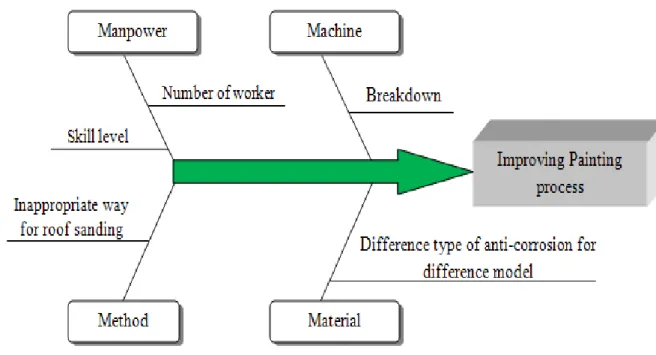
The fishbone diagram below show the problems that are occurring at the ED sanding line in a month. The problems are divided based on the four M, which are manpower, machine, method and materials.
Figure 4.1: Fishbone diagram for the problems in ED sanding
This schematic technique used to discover the possible location of quality problems. Overcoming these problems will cause increasing the quality of the vehicles and performance of the process and then, will tend to the improvement in ED sanding process.
These problems were affected the quality of the vehicles and performance of the production of company. If these problem are eliminated or reduced, there will improving the ED sanding process.
4.3 ED SANDING PROCESS ANALYSIS
4.3.1 Manpower
For the manpower, the number of worker and worker’s skill level at the ED sanding line will influence the time taken of sanding. Logically, the more workers did the sanding or air blowing, the faster time taken to finish the process. But, hired more worker to be added in ED sanding process will increase the cost of the company.
The Figure 4.2 shows that the number and the skill level of workers, and the own job of each worker in ED sanding process. From the figure, there are only three out of the six workers that have a high skill level, which is 50 % of total worker at ED sanding line. The rest only have basic skill in sanding process.
33
The appropriate methods used for roof section in sanding and air blowing process will reduce the defect (scratch) that occur on the surface at the bodies. The current method is the workers have to step up at bottom door frame to do the roof sanding and air blowing process. This inappropriate method will leave the scratch on step up area.
4.3.3 Machine
Breakdown the machine or equipment will slow the process, thus will take too long time to finish the process. This will reduce the performance of sanding process. The usual equipment breakdown is sanding machine.
4.3.4 Material
The different type of anti-corrosion used for difference models will cause difference defect on the surface of body vehicles. The AMM plant has a variety of model from different carmaker to assemble and produce the finish vehicle and deliver to the dealers. The carmakers use the anti-corrosion layer on stamped metal sheet to prevent the corrosion during the shipping process.
This anti-corrosion layer will form foreign material on the surface body. In order to eliminate or reduce the foreign material on the surface body, the sanding is done.
35
Table 4.1: The problems occur at ED sanding line
No Problems
Numbers
Naza Forza Suzuki Swift
1 Foreign Material 112 67
2 Scratch 143
3 Time Gap 61
4 Machine Break 25
From the case study, there are four major problems that occur in ED sanding line for the two models only, which are Naza Forza and Suzuki Swift. The total problems occur at ED sanding line is 408 times occur in a weeks.
The problems that count in this study are foreign material, scratch, time gap, and machine break. The foreign material and the scratch have contributed a large amount of problems in ED sanding process.
The foreign materials contribute 179 problems from the total problems for both models. The Naza Forza models have 112 problems and Suzuki Swift models have only 67 problems in term of the foreign material problems. The scratches have contributed 143 units and the time gap between the vehicles are 61 times. There are only 25 times machine or equipment were breakdown.
The table of the problems that occur at ED sanding line are plotted using Pareto chart. With this chart, the larger percentage will be the priority to focus on study.
equipment/machine break time gap
scratch foreign material
25 61
143 179
6.1 15.0
35.0 43.9
100.0 93.9
78.9 43.9
400
300 200
100 0
100 80 60 40 20 0
Defect
Count Percent Cum %
Percent
Count
Figure 4.3: Pareto chart for problems occur in ED sanding process
Figure 4.3 shows that the Pareto charts for the problems that occur in ED sanding process. This chart show graphical way of identify the few critical items as opposed to many less important ones.
37
The chart shown indicates that 43.9 % of the problems were caused by foreign materials. The scratch problems contribute 35.0 % of the total problems. For the time gap problems, there are 15.0 % of the total problem come from it.
Meanwhile, only 6.1 % of the total problems are come from equipments or machines causes. The analyses were done in details on the two large problems, which are foreign materials and scratches.
4.4.1 Foreign Materials
The foreign materials can come from the body of vehicle, the environment in the paint shop and also from the manpower. For the body vehicle itself, it came from the anti-corrosion layer from the body to prevent the corrosion from occur during the shipping process. The type of anti-corrosion depends on the where the stamped metal body from.
For the Naza Forza models, the stamped metal body came from China. The probability the low quality of anti corrosion used at Naza Forza model is high. The layer on the body surface did not fully disappear although the pre-treatment process was done at first process of painting process.
Meanwhile, for the Suzuki Swift, the stamped metal body came from Japan.
Because of that, Naza Forza models have large foreign materials compare to the Suzuki swift models. The foreign materials also can come from the environment of the process. It involves the ventilation system, and manpower itself.
One of the purposes of sanding is to eliminate or reduce the scratch from appearance at the body vehicle surface. The scratch will defects the body of vehicles.
The scratch comes from the manpower and the method used in this process.
At AMM factory, the body of vehicles is pushed by the worker using conveyer to move from the one line to another line. This direct contact between the bodies and workers will cause the scratch on the surfaces. This should be avoiding to minimum the scratch on the surface.
Another factor that will cause the scratch is when the worker do roof sanding and cleaning process. The stand is required for worker do the sanding and cleaning process. The company should provide the stand in order to reduce the scratch on the body surface.
39
4.5 CONCLUSION
The problem that contribute large defect in the ED sanding is foreign material. The root cause of foreign material is anti-corrosion layer on the surface body. The company (AMM Sdn. Bhd) cannot make the decision on reduce the usage of the layer or change with other type of anti-corrosion.
One of the ways to overcome this is the carmaker company (vendor) provide the composition of anti-corrosion content so that the company (AMM Sdn Bhd) can make solvent to eliminate the layer. The elimination process can be done on the pre- treatment process.
The scratch problem are rooted from manpower and method used. For the inappropriate method for roof section, the better way to overcome is provide the stand to the worker so that the workers no need to step up on the door frame. There will be choice in selecting the stand, whether using the permanent stand or lift stand controlled by hydraulic.
For the manpower, the worker cannot touch directly to the body. In pushing the body to the next line, provide the handle at the conveyer. This will prevent the worker have contact with the body. One more to prevent scratch from the worker is by provided the accessories cover, for example the cover for watch and belt. This is just protection to the body of vehicle.
Figure 4.4: The conveyer Conveyor
41
CHAPTER 5
CONCLUSION
5.1 CONCLUSION OF ANALYSIS
The purpose of this project is to identify the defect or problems that occur in the ED sanding at Automotive Manufacturer (Malaysia) AMM Sdn Bhd at Pekan, Pahang. By the using the several quality tool which is the Pareto chart and fishbone diagram, the major defect can be determined. The major problems are foreign material and scratch.
The major cause of foreign materials comes from the anti-corrosion layer on the body surface to protect the sheet metal during the shipping. The layer can be eliminate or reduce during the pre-treatment process if the solvent of the layer is known. This required permission from the company vendor.
Manpower is the major factor for the scratch problem. The direct contact between the vehicles body is the cause of forming the scratch. For the roof section in ED sanding, the company should provide the stand for the operator to avoid step up on the vehicle body. The worker must be forbid to touch the vehicle body and for the
that the worker do not have to touch the vehicle body.
5.2 RECOMMENDATION FOR THE FUTURE
This study had focus on the ED sanding process in painting process. The ED sanding is one of the processes in the paint shop. As known at the earlier chapter, there are five processes in painting process. The process are pre-treatment and ED process, ED sanding process, sealant and PVC process, primer process, and top coat process.
It is recommended that to study at another four processes so that the maximum improvement of painting process can be achieved.
It is strong suggested to do the study at the first process of painting. The process is pre-treatment process and ED. When the pre-treatment and ED process are improved, the problems of the next process will less.
43
REFERENCES
1. A. Andriyashin, M. Benko, W. Härdle, R. Timofeev and U. Ziegenhagen 2006, Color Harmonization in Car Manufacturing Processes, Volume 22, Issue 5–6, pages: 519 – 532, John Wiley and Sons Ltd, Chichester, UK.
2. Deborah Andrews, Paul Nieuwenhuis, Paul D. Ewing, 2005, Journal of Optics and laser technology Black and beyond: colour and the mass-produced motor car, vol. 38.
3. David Ghodoussi, Gene Praschan, 2004, Evolution of Automotive Paint and Protectant Technology, issue of Modern Car Care magazine.
4. E. Timothy Oppelt, 1996, Manual Pollution Prevention in the Paints and Coatings Industry, U.S. Environmental Protection Agency.
5. Jay Heizer, Barry Render, 2006, Operations Management, Eighth Edition Book, Pearson International Edition.
6. M. Lavery, 2002, Sealants in the automotive industry, International Journal of Adhesion and Adhesives, Volume 22, Issue 6, Pages 443-445.
7. Nicole Chardoul, Christian Davis, Scott Grasman, Colleen West, 1995, Paint Spray Booth Cleaning Practices In The Automotive Industry, National Pollution Prevention Center Case Study.
http://www.pfonline.com, 9.00 pm, 22 January 2008 http://www.asq.org, 11.30 am, 26 January 2008
http://www.appliedmfg.com, 4.00 pm, 30 January 2008 http://www.metokote.com, 3.30 pm, 1 February 2008
45
47