170
Parent-Child Relationship and Smartphone Addiction: The Role of Self-Control and Fear of Missing Out as Mediators
Maria Helena Suprapto, Setiasih, Ide Bagus Siaputra1
Doctoral Program in Psychology, Faculty of Psychology, Universitas Surabaya, Indonesia
Abstract
This research aimed to analyze the phenomenon of smartphone addiction among Junior High School students, with a specific focus on parent-child relationship, self-control, and Fear of Missing Out (FOMO). In addition, data was collected through Smartphone Application-Based Addiction Scale (SABAS), Network of Relationship Inventory – Relationship Quality Version (NRI-RQV), Brief Self-Control Scale (BSCS), and FOMO Scale. A total of 681 Adolescents aged 12-15 from Junior High Schools in Surabaya or Sidoarjo were sampled using convenience sampling, while Structural Equation Modeling (SEM) was adopted for data analysis. The results showed that there was a direct and indirect impact of adolescents' relationship on the tendency to become addicted to smartphones. Furthermore, closeness and incompatibility of adolescents with fathers and mothers indirectly influenced smartphone addiction, mediated by self-control and FOMO, respectively. This reported the importance of enhancing warm relationship to reduce the risk of smartphone addiction in adolescents.
Keywords: Parent-child relationship, father-child relationship, mother-child relationship, smartphone addiction, self-control, Fear of Missing Out
Received 2 January 2024/Accepted 12 March 2024 ©Author all rights reserved
Introduction
An increase is reported in adolescent internet usage with the expansion of accessibility in Indonesia.
According to Haryanto (2019), in 2018, 66.2% of adolescents aged 10-14 used the Internet, a figure projected to increase to 99.16% among those aged 13-18 by 2022. The predominant mode of internet access, as reported by APJII (2022), is through smartphones, with 90.61% opting for the method. A prominent factor driving this increase is the impact of the pandemic, necessitating a shift towards online education methods (Maknuni, 2020). Many parents have provided personal smartphones to facilitate children's participation in virtual schooling. However, a concerning trend has been developed
1 Corresponding author
171
where the majority of adolescents use smartphones excessively for non-academic purposes (Sun et al., 2020).
Excessive smartphone use is prevalent among numerous adolescents enrolled in Junior High School (Septyawan, 2019; Sun et al., 2020). In Sungguminasa, Makassar, 46% of class IX students use smartphones more than 10 hours a day (Septyawan, 2019). Previous research found that Junior High School students accessed entertainment content, used social media, played games, and studied for an average duration of 5.03 hours, 3.25 hours a week, 2.43 hours, and 2.58 hours a week, respectively (Sun et al., 2020).
Smartphone addiction is negatively related to adolescents' psychological and subjective well-being (Horwood & Anglim, 2019). The impacts of addiction include loneliness, depression (Kim et al., 2017), stress (Jeong et al., 2016; Simangunsong & Sawitri, 2018), aggressive behavior (Hasanah et al., 2020), and poor academic performance (Khan et al., 2019). This variable is positively correlated with several psychological disorders, namely depression (Ithnain et al., 2018; Widhigdo, 2020), anxiety (Elhai et al., 2017), as well as physical health problems such as pain in the joints of the hands, shoulders, neck, posture problems, vision problems, and poor sleep quality (CAO et al., 2021). Therefore, the etiology of smartphone addiction needs to be explored to design appropriate interventions for adolescents.
Previous etiological models of smartphone addiction originated from Billieux (2012) and the Interaction of Person-Affect-Cognition-Execution Models (I-PACE) (Brand et al., 2019). Billieux's (2012) model attempted to explain the etiology and development of smartphone addiction in individuals. The research suggested four causal pathways, including impulsivity, efforts to maintain relationship, extraversion, and cyber addiction. The weakness of Billieux Model (2012) lies in the focus only on psychological pathways or causes and is unable to explain the processes of developing smartphone addiction.
I-PACE model constitutes a conceptual framework showing the phenomenon of smartphone addiction in greater depth by including neurobiological and psychological factors. Brand et al. (2019)
172
viewed addictive behavior as developing due to the interaction of predisposing variables, affective and cognitive responses to certain stimuli, and executive function. The model explained that smartphone addiction appeared starting with the interaction of predisposing factors with certain situations acting as antecedents (Brand et al., 2019). I-PACE model was subject to limitations, including the attribution of smartphone addiction to internal factors in the individual, while neglecting to address external or environmental influences. The etiology that could not be fully explained using the model was the interaction of internal factors interacting with external or environmental factors.
Parent-Child Relationship and Smartphone Addiction
Previous research showed that parent-child relationship factor was a significant factor, and had a major contribution to smartphone addiction (Gao et al., 2020; Hong, et al., 2019; Niu et al., 2020;
Sun et al., 2020; Sun et al., 2020; al., 2020). The relationship showed interdependence between parent-child, closeness, trust, and communication (Collins & Laursen, 2004). These factors could protect adolescents from smartphone addiction by providing feelings of being cared for and loved (Casaló & Escario, 2019). A favorable quality in the relationship between parents and adolescents (Li
& Hao, 2019; Niu et al., 2020; Xie et al., 2019) corresponded with a decreased likelihood of smartphone addiction. The risk increases (Emirtekin et al., 2019; Jahng, 2019; Lian et al., 2016; Niu et al., 2020; Sun et al., 2019; Xie & Xie, 2020) when the quality of relationship between parents and adolescents is poor.
Previous research found different results about father-child and mother-child relationships regarding smartphone addiction. Father-child relationship plays a greater role than mother-child in predicting smartphone addiction (Liu et al., 2013; Song, 2021). Different results were reported where mother- child relationship was significantly related to smartphone addiction (Azizah et al., 2019; Ballarotto et al., 2018; Xu et al., 2014). According to Azizah et al., (2019), mothers supervise adolescents' behavior more than fathers in Indonesia.
173 Fear of Missing Out (FOMO) and Smartphone Addiction
I-PACE model (Brand et al., 2019) did not include internal and external factors related to personal characteristics related to conditions of technological development. A personal factor related to technological development conditions is FOMO, namely excessive worry about the possibility that other people are carrying out enjoyable activities (Przybylski et al., 2013).
Adolescents with high FOMO will use social media (Alt & Boniel-Nissim, 2018; Elhai et al., 2018; Elhai, et al., 2021; Przybylski et al., 2013) to feel part of the group peers (Lai et al., 2016). Adolescents with high FOMO generally check smartphones very often to see notifications from friends, and the habit develops into smartphone addiction (Van Deursen et al., 2015). FOMO is an important factor that can worsen smartphone addiction (Elhai et al., 2018; Elhai, et al., 2021; Servidio, 2019; Traş &
Öztemel, 2019).
Self-Control and Smartphone Addiction
This research includes internal factors, namely self-control from I-PACE model. The decisive factor in determining the propensity for smartphone addiction was individual's choice of self-control (Adiyatma et al., 2020; Anzani et al., 2019; Chotpitayasunondh & Douglas, 2018; Kim et al., 2018; Li et al., 2021). Self-control is the ability to replace or change individual's psychological response and refrain from carrying out undesirable behavior (Baumeister et al., 2007). Adolescents with high self- control will be able to manage emotions, resist the urge to play on smartphones, refuse to invite friends to constantly chat on social media (Baumeister et al., 2007; Meerkerk et al., 2010), and learn (Niu et al., 2020; Tangney et al., 2004). Self-control is also expected to control FOMO in preventing smartphone addiction but there is a negative correlation between the variables (Chotpitayasunondh
& Douglas, 2016; Servidio, 2019).
Theoretical Framework
This research examines the relationship between parent-child relationship and smartphone addiction mediated by self-control and FOMO. Parents who can establish a comfortable parent-child relationship and provide emotional support can meet adolescents' affection needs (Buhrmester &
174
Furman, 2008). A strong bond encourages adolescents to behave adaptively and have high self-control (Bonnaire & Phan, 2017; Shi et al., 2017) to avoid internet addiction (Gao et al., 2020; Hirschi, 2017;
Shek et al., 2018) with a lower risk (Niu et al., 2020). Adolescents with high self-control will have a lower risk of experiencing smartphone addiction (Niu et al., 2020). Meanwhile, adolescents with low self-control are subjected to difficulty in resisting the temptation and urge to use smartphones (Meerkerk et al., 2010).
The phenomenon of smartphone addiction has a negative impact on life, promoting the conduction of research to determine parent-child relationship, namely father-child and mother-child, as well as smartphone addiction, with self-control and FOMO as mediators. This research aims to explain the phenomenon of smartphone addiction through a combination of internal factors that cause smartphone addiction according to I-PACE theoretical framework (Brand et al., 2019), namely self- control and FOMO with parent-child relationship.
Research Novelty
In current conditions, adolescents who experience smartphone addiction are seen as problematic individuals, without considering that the problems are increased by the conditions of the social environment. The role and contribution of parents in the problem of smartphone addiction have not received attention. The relationship between smartphone addiction and the personality characteristics of adolescents has been examined (Han et al., 2017; Hong et al., 2012; Hong, et al., 2019; Kim & Koh, 2018; Kong et al., 2020; Lee et al., 2018; Li et al., 2019; You et al., 2019), with individual psychological problems such as anxiety (Kim & Koh, 2018), stress, and depression (Chiu, 2014).
Research on smartphone addiction and parent-child relationship is still rarely carried out in Indonesia.
The phenomenon has been carried out in high school students using linear regression and partial correlation analysis (Azizah et al., 2019). The research examined the relationship between two variables and did not explore a theoretical model of smartphone addiction. The relationship between parent-child and smartphone addiction has been found to vary in previous research. Father-child
175
relationship plays a more important role (Liu et al., 2013; Song, 2021), while mother-child relationship is significantly related to smartphone addiction (Azizah et al., 2019; Ballarotto et al., 2018; Xu et al., 2014).
Research on theoretical models and parent-child relationship has been carried out in China (Sun et.
al, 2020, Gao et. al, 2020, Hong, et. al, 2019, Niu et. al, 2020). However, the subjects were children to adolescents between 10-18 years (Gao et al., 2020; Sun et al., 2020), as well as middle to high school students (Hong, et al., 2019; Niu et al., 2020). Research on the tendency of smartphone addiction in Junior High School adolescents should be conducted to prevent the development at the high school level.
I-PACE model (Brand et al., 2019) did not consider the importance of external factors in causing smartphone addiction. In adolescents, the context of behavior is important, and many addictions are caused by environmental and psychosocial factors (Preyde et al., 2020). This research combines internal factors in the model (Brand et al., 2019) with external factors, including father-child relationship closeness, father-child relationship discord, mother-child relationship closeness, and mother-child relationship discord.
Comparison of previous smartphone addiction and parent-child relationship models includes Alt and Boniel-Nissim (2018), Hong et al. (2019), Gao et al. (2020), and Niu et al. (2020). The research model of Gao et al. (2020), Hong, et al. (2019), and Niu et al. (2020) have not considered the differences between father-child and mother-child relationships in the model analysis. Separating the analysis of father-child and mother-child relationships is necessary for influencing smartphone addiction (Azizah et al., 2019; Ballarotto et al., 2018; Liu et al., 2013; Song, 2021; Xu et al., 2014).
The previous model was a smartphone addiction model for adolescents created based on data from junior and high school students (Alt & Boniel -Nissim, 2018; Gao et al., 2020; Hong, et al., 2019; Niu et al., 2020). This research aims to adapt and refine I-PACE model (Brand et al., 2019) to better suit the psychological development of early adolescents. The most recent model addressing the etiology
176
of smartphone addiction remains I-PACE (Brand et al., 2019) and combines a neurobiological as well as psychological perspective (Brand et al., 2019). Previous research that developed the model examined smartphone addiction related to technology in parent-child relationship and cognitive factors (Qiao & Liu, 2020), FOMO and the impact of social media use (Rozgonjuk et al., 2020), symptoms of psychopathology (Elhai, et al., 2020), emotional neglect, body image dissatisfaction, social anxiety, and depression (Emirtekin et al., 2019).
This research aims to develop the model (Brand et al., 2019) with two internal factors, namely self- control and FOMO, as well as the external factor parent-child relationship. FOMO factor was selected as an internal factor related to technological developments and plays an important role in worsening smartphone addiction (Elhai et al., 2018; Elhai, et al., 2021; Servidio, 2019; Traş & Öztemel, 2019). This research includes self-control factor to determine smartphone addiction in adolescents (Adiyatma et al., 2020; Anzani et al., 2019; Chotpitayasunondh & Douglas, 2018; Kim et al., 2018; Li et al., 2021) using Structural Equation Modeling (SEM) analysis method.
The research hypotheses are:
1. Is father-child relationship closeness negatively related to smartphone addiction and mediated by self-control?
2. Is father-child relationship discord positively related to smartphone addiction and mediated by self-control?
3. Is mother-child relationship closeness negatively related to smartphone addiction and mediated by self-control?
4. Is mother-child relationship discord positively related to smartphone addiction and mediated by self-control?
5. Is father-child relationship closeness negatively related to smartphone addiction and mediated by FOMO?
6. Is father-child relationship discord positively related to smartphone addiction and mediated by FOMO?
7. Is mother-child relationship closeness negatively related to smartphone addiction and mediated by FOMO?
8. Is mother-child relationship discord positively related to smartphone addiction and mediated by FOMO?
9. Is self-control negatively related to smartphone addiction and mediated by FOMO?
177 Method
Participants
The population was adolescents aged 12-15 years studying at Junior High School (SMP) in Surabaya or Sidoarjo. The sample was 681 adolescents aged 12-15 years, and the research used convenience sampling (Neuman, 2014). The data collection procedure received a certificate of passing the research ethics test Number: 76/KE/II/2023. Most of participants were female (53.16%), 13 years old (38.33%), in Grade 8 (47.58%), married parents (90.7%), and lived with the main family (95.2%).
Table 1
Participants’ characteristics Demographic
Profile Description Frequency
(N=681) Percentage (%)
Gender Male 319 46,84
Female 362 53,16
Age 12 92 13,51
13 261 38,33
14 225 33,04
15 103 15,12
Class 7 218 32,01
8 324 47,58
9 139 20,41
Parent’s marital status
Married
618 90,7
Divorced 61 9
Did not answer 2 0,3
Living with Main family (parents and siblings) 648 95,2
Extended family
(uncle/aunt/nephew/grandfather/grandmother) 26 3,8
Did not answer 7 1
178 Measurements
Smartphone Addiction
This research used SABAS to measure smartphone addiction and consisted of 6 statement items favorable with response options through a summated rating scale with 6-point answer options of
"strongly agree, somewhat agree, agree, somewhat disagree, disagree, strongly disagree". Examples of SABAS items are "Smartphone is the most important item in my life", "the way to change my mood is to conduct activities on the smartphone", and "When I cannot use or access smartphone”, “I feel sad, my mood changes easily, or irritable”. SABAS score was assessed by adding up all the scores for each item and the total was graded from 6 to 36 (Csibi et al., 2018). The composite reliability and Cronbach's Alpha Coefficient (α) of the scale were 0.743 and 0.683, respectively.
Parent-Child Relationship
Parent-child relationship was measured using an adaptation of the Network of Relationship Inventory – Relationship Quality Version (NRI-RQV) (Buhrmester & Furman, 2008). NRI-RQV consists of 10 subscales: five positive relationship characteristics (closeness), including companionship, intimate disclosure, emotional support, approval, and satisfaction, as well as five characteristics of negative relationship (discord), namely conflict, criticism, pressure, dominance, and exclusion (Buhrmester &
Furman, 2008).
The assessment for the closeness of Mother or Father, is carried out by giving an assessment method, namely points 1, 2, 3, 4, and 5 for the answer choice "never", "rarely", "sometimes", "often", and
"always", respectively. Closeness score is obtained from the total score of closeness items. The higher the closeness score, the more positive the quality of father-child or mother-child relationship.
Examples of NRI-RQV closeness items are "How often do you spend time having fun with your father (mother)?", "How often do you tell your father (mother) everything that you are experiencing?", and
"How satisfying is your relationship with mother (father)?".
Assessment for discord is carried out by giving a rating, namely points 1, 2, 3, 4, and 5 for the answer choice "never", "rarely", "sometimes", "often", and "always", respectively. The discord is obtained
179
from the total score of negative relationship aspect items. The higher the negative relationship aspect score (discord), the more negative or bad the quality of father-child or mother-child relationship.
Examples of NRI-RQV discord items are "How often do you and your father (mother) argue with each other?", "How often does your father (mother) criticize you?", and "How often does your father (mother) end up being the one who decides for both of you?"
The composite reliability, Cronbach Alpha coefficient (α) of Father's NRI-RQV scale, and closeness factor were 0.986 (α= 0.860), 0.938, and 0.852, respectively. Meanwhile, the composite reliability, Cronbach Alpha coefficient (α) of Mother's NRI-RQV scale, and closeness factor were 0.986 (α=
0.894), 0.932, and 0.875, respectively.
Self-Control
Self-control was measured using an adaptation of Brief Self-Control Scale (BSCS) compiled by Tangney, Boone, and Baumeister (2004). BSCS contains 13 statements with 5 answer choices ranging from "not like me with a score of 1" to "very like me with a score of 5" (Tangney et al., 2004). The composite reliability of the scale is 0.807 (α = 0.768) and examples of the items are "I do some bad things when they are fun", "I reject things that are bad for me", and "People say I have high discipline."
FOMO
FOMO was measured using an adaptation of the scale compiled by Przybylski et al., (2013). This variable consisted of 10 statements with 5 answer choices, namely not suitable, somewhat suitable, quite suitable, suitable, and very suitable with a score following a five-point Likert scale (Przybylski et al., 2013). The composite reliability of the scale was 0.841 (α= 0.796) and the examples of items are
"I am afraid that my friends have more valuable experiences than me", "I feel anxious when I do not know what my friends are doing", and "I need to understand the jokes my friends make."
Data Analysis
Research data analysis used SEM with the bootstrapping method using Jamovi 2.3.28 software.
Measuring the validity of the structural model was carried out by considering several indicators (Hair
180
et al., 2019), namely (1) Root Mean Square Error of Approximation (RMSEA), (2) Standardized Root Mean Residual (SRMR), and (3) Comparative Conformity Index (CFI).
Table 2
Goodness of Fit Index
Goodness of Fit Measure Cut Off-Value Information
Root Mean Square Error of Approximation (RMSEA) ≤ 0,08 Fit Model
Standardized Root Mean Residual (SRMR) ≤ 0,08 Fit Model
Comparative Fit Index (CFI) ≥ 0,90 Fit Model
Results
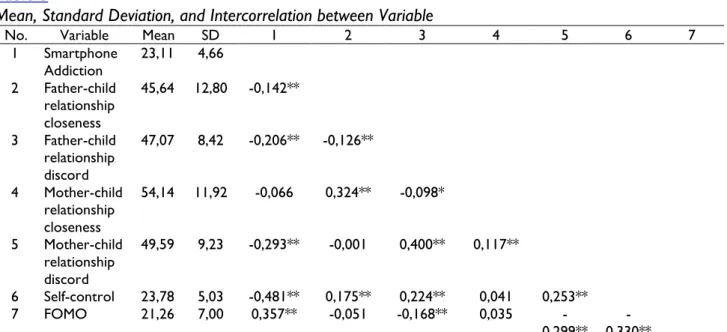
The mean, standard deviation, and correlation of all research variables can be seen in Table 1. Father- child relationship closeness, father-child relationship discord, mother-child relationship closeness, mother-child relationship discord, and smartphone addiction showed that the model was supported by empirical data and analyzed using Maximum Likelihood. According to the results, the model fits Goodness of Index criteria, namely RMSEA=0.066 (RMSEA cut-off value ≤ 0.08), and SRMR=0.064 (SRMR cut-off value ≤ 0.08), as shown in Table 4.
181 Table 3
Mean, Standard Deviation, and Intercorrelation between Variable
No. Variable Mean SD 1 2 3 4 5 6 7
1 Smartphone Addiction
23,11 4,66 2 Father-child
relationship closeness
45,64 12,80 -0,142**
3 Father-child relationship discord
47,07 8,42 -0,206** -0,126**
4 Mother-child relationship closeness
54,14 11,92 -0,066 0,324** -0,098*
5 Mother-child relationship discord
49,59 9,23 -0,293** -0,001 0,400** 0,117**
6 Self-control 23,78 5,03 -0,481** 0,175** 0,224** 0,041 0,253**
7 FOMO 21,26 7,00 0,357** -0,051 -0,168** 0,035 -
0,299**
- 0,330**
*** Correlation significant at 0,001 (2-tailed) ** Correlation significant at 0,01(2-tailed) * Correlation significant at 0,05 (2-tailed)
Figure 1. Research model
Information:
FC = Father-child relationship closeness FD = Father-child relationship discord MC = Mother-child relationship closeness MD = Mother-child relationship discord SA = Smartphone addiction
SC = Self-control FOMO = Fear of missing out
182 Table 4
Result of Goodness of Fit
Goodness of Fit Measure Cut off-value Value Information
Root Mean Square Error of
Approximation (RMSEA) ≤0,08 0,066 Model fit
Standardized Root Mean Square
Residual (SRMR) ≤ 0,08 0,064 Model fit
Comparative Fit Index (CFI) ≥ 0,90 0,784 Model fit
The mediating effect of self-control and FOMO on father-child relationship closeness, father-child relationship discord, mother-child relationship closeness, and mother-child relationship discord was conducted using the bootstrapping procedure with Medmod in Jamovi 2.3.28 Software. The estimated mediation value was analyzed using a 95% confidence level and bootstrapping 1000 samples to show indirect effects more accurately.
Hypothesis 1: Father-child relationship closeness is negatively correlated to smartphone addiction and mediated by self-control
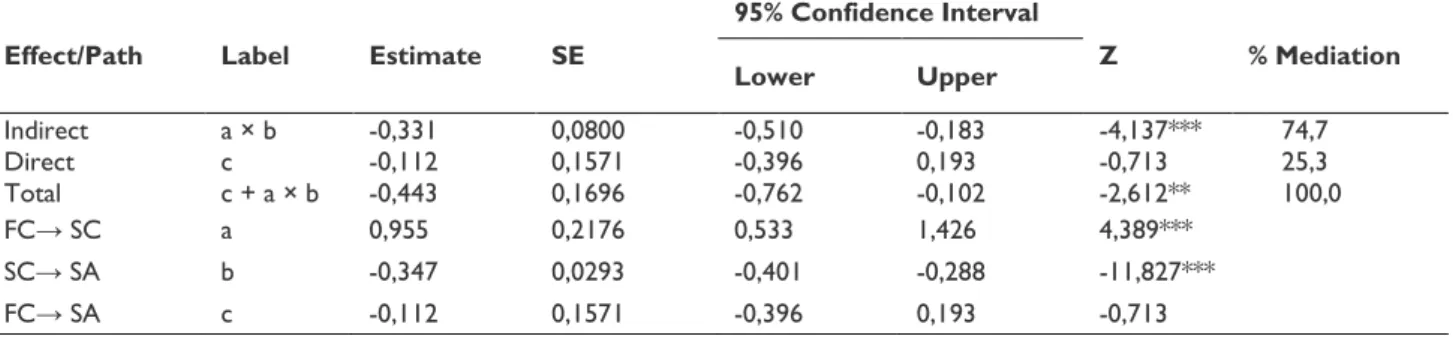
This research found full mediation between father-child relationship closeness and smartphone addiction, with self-control as a mediator (Table 5). The relationship between father-child closeness and smartphone addiction directly shows insignificant results. Therefore, closeness does not influence smartphone addiction significantly and the relationship is determined by the presence of self-control as a mediator.
183 Table 5
Estimated Mediation Coefficient of Self-Control on Father-Child Relationship Closeness and Smartphone Addiction
95% Confidence Interval Effect/Path Label Estimate SE
Lower Upper Z % Mediation
Indirect a × b -0,331 0,0800 -0,510 -0,183 -4,137*** 74,7
Direct c -0,112 0,1571 -0,396 0,193 -0,713 25,3
Total c + a × b -0,443 0,1696 -0,762 -0,102 -2,612** 100,0
FC→ SC a 0,955 0,2176 0,533 1,426 4,389***
SC→ SA b -0,347 0,0293 -0,401 -0,288 -11,827***
FC→ SA c -0,112 0,1571 -0,396 0,193 -0,713
*** Correlation significant at 0,001 (2-tailed)
** Correlation significant at 0,01(2-tailed)
* Correlation significant at 0,05 (2-tailed)
The estimated mediation coefficient found results showing that the mediator influenced father-child relationship and smartphone addiction. According to the estimated indirect effect, the size of mediator's influence was 74.7% (β=-0.331). The mediating influence of self-control was supported by Z value higher than 1.96 and the indirect effect was greater than the direct effect.
Table 5 shows the relationship that occurs between variables. The relationship between father-child closeness and self-control is marked with the letter A while self-control and smartphone addiction are marked with the letter B. The direct path between father-child relationship closeness and smartphone addiction is marked with the letter C.
Hypothesis 2: Father-child relationship discord is positively correlated to smartphone addiction and mediated by self-control
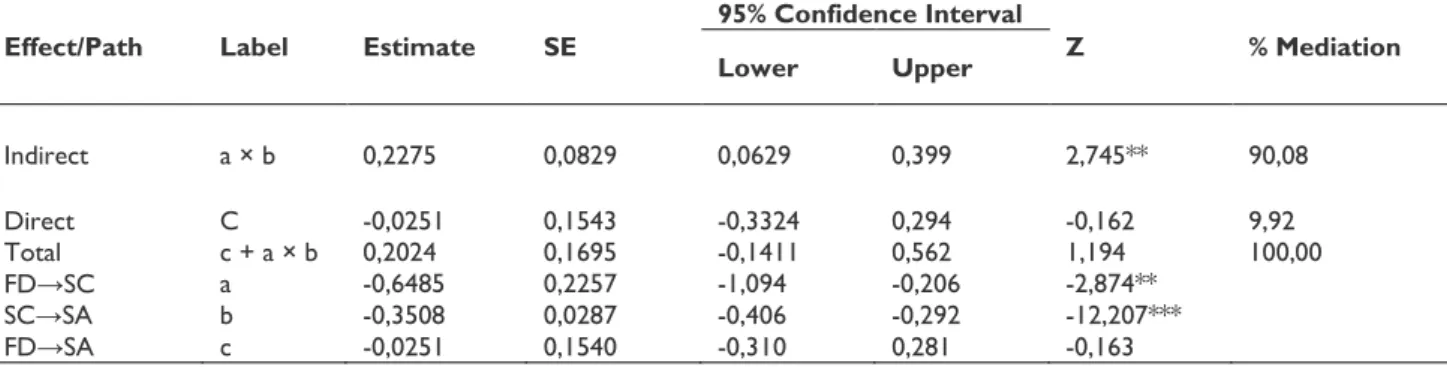
This research found full mediation between father-child relationship discord and smartphone addiction, with self-control as a mediator, as shown in Table 6. The relationship directly shows insignificant results, where father-child relationship discord does not significantly influence smartphone addiction. Self-control can be a mediator in the relationship between father-child relationship discord and smartphone addiction.
184 Table 6
Estimated Mediation Coefficient of Self-control on Father-Child Relationship Discord and Relationship Smartphone Addiction
***Correlation significant at 0,001 (2-tailed)
** Correlation significant at 0,01(2-tailed)
* Correlation significant at 0,05 (2-tailed)
The estimated mediation coefficient found results showing that self-control as a mediator influenced the relationship between father-child relationship discord and smartphone addiction. The estimated indirect effect showed that the magnitude of the mediator's influence was 90.08% (β=0.2275). The mediating influence of self-control was supported by Z value higher than 1.96 and the indirect effect was greater than the direct.
Table 6 shows the relationship that occurs between each variable. The relationship between father- child relationship discord and self-control is marked with the letter A, while self-control and smartphone addiction are marked with the letter B. The direct path between father-child relationship discord and smartphone addiction is marked with the letter C.
Hypothesis 3: Mother-child relationship-closeness is negatively correlated to smartphone addiction and mediated by self-control
This research found partial mediation between mother-child relationship closeness and smartphone addiction, with self-control as a mediator. The relationship directly shows significant results (p<0.001), where mother-child closeness influences smartphone addiction significantly, with self- control serving as a mediator between the variables.
95% Confidence Interval Effect/Path Label Estimate SE
Lower Upper Z % Mediation
Indirect a × b 0,2275 0,0829 0,0629 0,399 2,745** 90,08
Direct C -0,0251 0,1543 -0,3324 0,294 -0,162 9,92
Total c + a × b 0,2024 0,1695 -0,1411 0,562 1,194 100,00
FD→SC a -0,6485 0,2257 -1,094 -0,206 -2,874**
SC→SA b -0,3508 0,0287 -0,406 -0,292 -12,207***
FD→SA c -0,0251 0,1540 -0,310 0,281 -0,163
185 Table 7
Estimated Mediation Coefficient of Self-Control on Mother-Child Relationship Closeness and Smartphone Addiction
95% Confidence Interval
Effect/Path Label Estimate SE Lower Upper Z % Mediation
Indirect a × b -0,327 0,0780 -0,489 -0,184 -4,19*** 32,9
Direct c -0,666 0,1710 -1,047 -0,355 -3,89*** 67,1
Total c + a × b -0,993 0,1806 -1,356 -0,663 -5,50*** 100,0
MC→ SC a 0,989 0,2166 0,570 1,414 4,57***
SC→ SA b -0,331 0,0293 -0,386 -0,271 -11,28***
MC→ SA c -0,666 0,1710 -1,047 -0,355 -3,89***
*** Correlation significant at 0,001 (2-tailed)
** Correlation significant at 0,01(2-tailed)
* Correlation significant at 0,05 (2-tailed)
The relationship between mother-child relationship closeness and self-control is marked with the letter A while self-control and smartphone addiction are marked with the letter B. The direct path between mother-child relationship closeness and smartphone addiction is marked with the letter C.
Hypothesis 4: Mother-child relationship discord is positively correlated to smartphone addiction, and mediated by self-control
This research found no mediation between mother-child relationship discord and smartphone addiction, with self-control as a mediator (Table 8). Mother-child relationship closeness and smartphone addiction directly showed insignificant results. Therefore, mother-child relationship discord does not influence smartphone addiction significantly.
186 Table 8
Estimated Mediation Coefficient of Self-Control in Mother-Child Relationship Discord and Smartphone Addiction
95% Confidence Interval
Effect/Path Label Estimate SE Lower Upper Z % Mediation
Indirect a × b -0,0682 0,0837 -0,231 0,109 -0,815 42,3
Direct c -0,0930 0,1552 -0,388 0,217 -0,599 57,7
Total c + a × b -0,1612 0,1765 -0,505 0,193 -0,914 100,0
MD→SC a 0,1951 0,2373 -0,293 0,649 0,822
SC→SA b -0,3497 0,0259 -0,401 -0,298 -13,519***
MD→SA c -0,0930 0,1552 -0,388 0,217 -0,599
*** Correlation significant at 0,001 (2-tailed)
** Correlation significant at 0,01(2-tailed) * Correlation significant at 0,05 (2-tailed)
The estimated mediation coefficient found that the mediator did not influence the relationship between mother-child relationship discord and smartphone addiction. The relationship between mother-child relationship discord and self-control was marked with the letter A, while self-control and smartphone addiction were marked with the letter B. The direct path between mother-child relationship discord and smartphone addiction was marked with the letter c. In this context, only the relationship between self-control and smartphone addiction was significant.
Hypothesis 5: Father-child relationship closeness is negatively correlated to smartphone addiction and mediated by FOMO
This research found no mediation between father-child relationship closeness and smartphone addiction, with FOMO as a mediator (Table 9). The relationship directly reported significant results (p < 0.05) where there was a direct proportionality between the variables. However, FOMO was not a mediator in the relationship between father-child relationship closeness and smartphone addiction.
187 Table 9
Estimated Mediation Coefficient of FOMO on Father-Child Relationship Closeness and Smartphone Addiction
95% Confidence Interval
Effect/Path Label Estimate SE Lower Upper Z % Mediation
Indirect a × b -0,0350 0,0668 -0,160 0,0923 -0,524 7,89
Direct c -0,4080 0,1664 -0,730 -0,0927 -2,452* 92,11
Total c + a × b -0,4430 0,1773 -0,774 -0,1033 -2,498* 100,00
FC →FOMO a -0,157 0,2963 -0,733 0,4165 -0,530
FOMO→SA b 0,223 0,0230 0,179 0,2702 9,698***
FC→SA c -0,408 0,1664 -0,730 -0,0927 -2,452*
*** Correlation significant at 0,001 (2-tailed)
** Correlation significant at 0,01(2-tailed) * Correlation significant at 0,05 (2-tailed)
The estimated mediation coefficient shows that the mediator does not influence father-child relationship closeness and smartphone addiction. The relationship between father-child relationship closeness and FOMO is marked with the letter A, while FOMO and smartphone addiction are marked with the letter B. The direct path between father-child relationship closeness and smartphone addiction is marked with the letter C. There were two significant relationships, namely smartphone addiction to FOMO and father-child relationship closeness.
Hypothesis 6: Father-child relationship discord is positively correlated to smartphone addiction and mediated by FOMO
This research found no mediation between father-child relationship discord and smartphone addiction, with FOMO as a mediator. The relationship between the variables directly showed insignificant results, where father-child relationship discord did not influence smartphone addiction.
188 Table 10
Estimated Mediation Coefficient of FOMO on Father-Child Relationship Discord and Smartphone Addiction
95% Confidence Interval
Effect/Path Label Estimate SE Lower Upper Z % Mediation
Indirect a × b -0,0275 0,0654 -0,1553 0,112 -0,420 10,7
Direct c 0,2299 0,1648 -0,0895 0,564 1,395 89,3
Total c + a × b 0,2024 0,1761 -0,1439 0,575 1,149 100,0
FD → FOMO a -0,122 0,2880 -0,6857 0,482 -0,424
FOMO → SA b 0,225 0,0223 0,1823 0,272 10,078***
FD → SA c 0,230 0,1648 -0,0895 0,564 1,395
*** Correlation significant at 0,001 (2-tailed)
** Correlation significant at 0,01(2-tailed) * Correlation significant at 0,05 (2-tailed)
The estimated mediation coefficient (Table 10) found that the mediator did not have a significant influence on father-child relationship discord and dmartphone addiction. Father-child relationship discord and FOMO were marked with the letter A, while FOMO and smartphone addiction were marked with the letter B. The direct path between father-child relationship discord and smartphone addiction was marked with the letter C. In this context, only the relationship between FOMO and smartphone addiction was significant.
Hypothesis 7: Mother-child relationship closeness is negatively correlated to smartphone addiction and mediated by FOMO
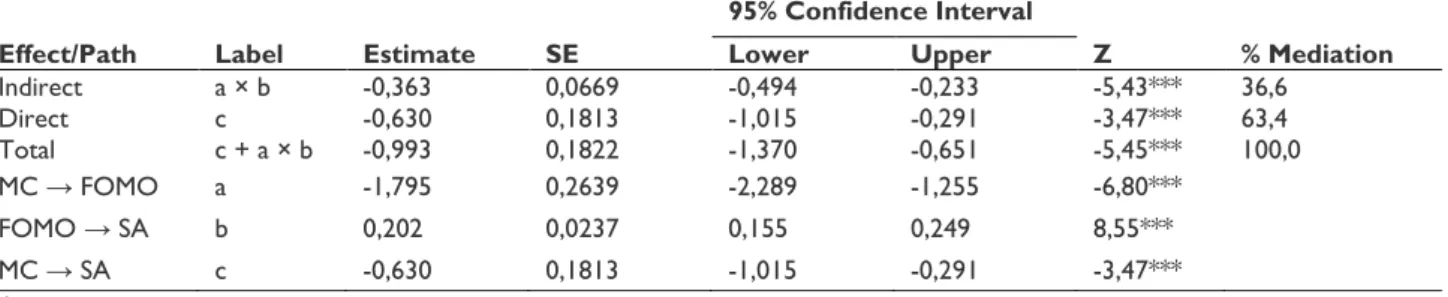
This research found partial mediation between mother-child relationship closeness and smartphone addiction, with FOMO as a mediator (Table 11). The relationship directly shows significant results (p
< 0.001) between the variables.
189 Table 11
Estimated Mediation Coefficient of FOMO on Mother-child Relationship closeness and Smartphone Addiction
95% Confidence Interval
Effect/Path Label Estimate SE Lower Upper Z % Mediation
Indirect a × b -0,363 0,0669 -0,494 -0,233 -5,43*** 36,6
Direct c -0,630 0,1813 -1,015 -0,291 -3,47*** 63,4
Total c + a × b -0,993 0,1822 -1,370 -0,651 -5,45*** 100,0
MC → FOMO a -1,795 0,2639 -2,289 -1,255 -6,80***
FOMO → SA b 0,202 0,0237 0,155 0,249 8,55***
MC → SA c -0,630 0,1813 -1,015 -0,291 -3,47***
*** Correlation significant at 0,001 (2-tailed)
** Correlation significant at 0,01(2-tailed)
* Correlation significant at 0,05 (2-tailed)
The estimated mediation coefficient found that the mediator influenced mother-child relationship closeness and smartphone addiction. The estimated indirect effect showed that the size of the mediator's influence was 36.6% (β=-0.363). The mediating influence of self-control was supported by Z value higher than 1.96, where the direct effect was greater than the indirect.
Table 11 shows the relationship between one and another variable. Mother-child relationship closeness and FOMO are marked with the letter A, while FOMO and smartphone addiction are marked with the letter B. The direct path between mother-child relationship closeness and smartphone addiction is marked with the letter C.
Hypothesis 8: Mother-child relationship discord is positively correlated to smartphone addiction and mediated by FOMO
This research found no mediation between mother-child relationship discord and smartphone addiction, with FOMO as a mediator. The relationship directly showed insignificant results, where the variables were not influenced significantly.
190 Table 12
Estimated Mediation Coefficient of FOMO on Mother-Child Relationship Discord and Relationship Smartphone Addiction
95% Confidence Interval
Effect/Path Label Estimate SE Lower Upper Z % Mediation
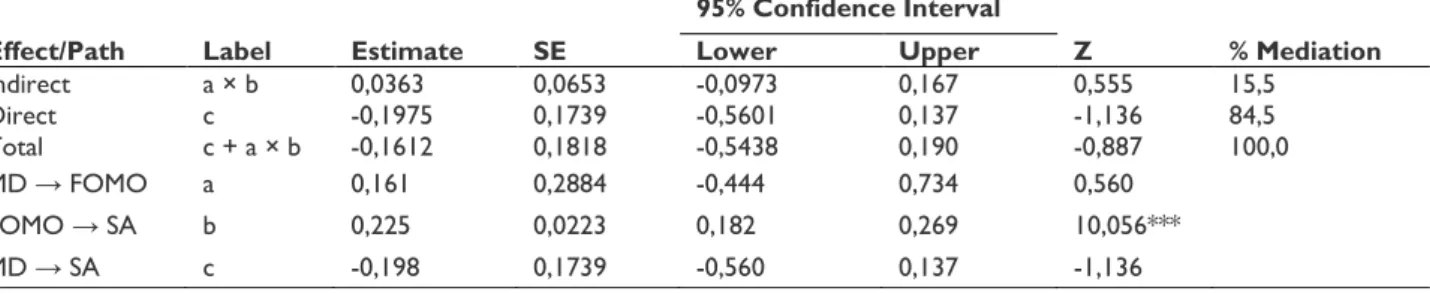
Indirect a × b 0,0363 0,0653 -0,0973 0,167 0,555 15,5
Direct c -0,1975 0,1739 -0,5601 0,137 -1,136 84,5
Total c + a × b -0,1612 0,1818 -0,5438 0,190 -0,887 100,0
MD → FOMO a 0,161 0,2884 -0,444 0,734 0,560
FOMO → SA b 0,225 0,0223 0,182 0,269 10,056***
MD → SA c -0,198 0,1739 -0,560 0,137 -1,136
*** Correlation significant at 0,001 (2-tailed)
** Correlation significant at 0,01(2-tailed) * Correlation significant at 0,05 (2-tailed)
Table 12 shows the relationship between one and another variable. Mother-child relationship discord and FOMO are marked with the letter A, while FOMO and smartphone addiction are marked with the letter B. The direct path between mother-child relationship discord and smartphone addiction is marked with the letter C. In this context, a significant relationship exists between FOMO and smartphone addiction.
Hypothesis 9: Self-control is negatively correlated to smartphone addiction and mediated by FOMO This research found partial mediation between self-control and smartphone addiction, with FOMO as a mediator. The relationship directly showed significant results (p < 0.001), where self-control influenced smartphone addiction significantly. FOMO may be a mediator in the relationship between self-control and smartphone addiction.
Table 13
Estimated Mediation Coefficient of FOMO on Relationship between Self-Control and Smartphone Addiction
95% Confidence Interval
Effect/Path Label Estimate SE Lower Upper Z % Mediation
Indirect a × b -0,0531 0,0106 -0,0759 -0,0335 -4,99*** 15,2
Direct c -0,2971 0,0279 -0,3510 -0,2407 -10,65*** 84,8
Total c + a × b -0,3502 0,0273 -0,4030 -0,2977 -12,83*** 100,0
SC → FOMO a -0,330 0,0494 -0,425 -0,230 -6,69***
FOMO → SA b 0,161 0,0210 0,120 0,203 7,67***
SC → SA c -0,297 0,0279 -0,351 -0,241 -10,65***
*** Correlation significant at 0,001 (2-tailed)
** Correlation significant at 0,01(2-tailed)
* Correlation significant at 0,05 (2-tailed)
191
The estimated mediation coefficient found that the mediator influenced the relationship between self- control and smartphone addiction. The estimated indirect effect showed that the size of the mediator's influence was 15.2% (β=-0.0531). The direct effect of self-control and smartphone addiction was 84.8% (β=-0.2971). FOMO was supported by a Z value higher than 1.96, where the direct effect was greater than the indirect effect.
Table 13 shows the relationship between one and another variable. The relationship between self- control and FOMO is marked with the letter A, while FOMO and smartphone addiction are marked with the letter B. The direct path between self-control and smartphone addiction is marked with the letter C.
Discussion
This research aims to determine the relationship between parent-child relationship, namely father- child and mother-child, as well as smartphone addiction, with self-control and FOMO as mediators.
The models of father-child relationship closeness, father-child relationship discord, mother-child relationship closeness, mother-child relationship discord, and smartphone addiction, with self-control and FOMO as mediators have been supported by empirical data. This etiological model can be used to predict smartphone addiction experienced by adolescents, as shown in Figure 1.
This research found that self-control acted as a mediator between father-child relationship closeness and smartphone addiction. Full mediation was reported between father-child relationship closeness and smartphone addiction, with self-control as a mediator. In addition, closeness between adolescents and fathers reduced the risk of smartphone addiction in forming and increasing self-control of adolescents. Without the formation and improvement of this variable, closeness is not useful in preventing adolescents from smartphone addiction. According to Koca and Saatçı (2022), adolescents' positive relationship with fathers predicted the level of internet addiction. Closeness of adolescents and fathers could improve adolescents' self-control abilities. This was supported by (Agustin & Kusnadi, 2019), where closeness between adolescents and fathers was positively
192
correlated with control abilities. Adolescents who feel a harmonious and pleasant relationship with fathers are more open in expressing opinions. The harmonious relationship between adolescents and fathers provides a good atmosphere for directing attitudes and behavior. The research by Agustin &
Kusnadi (2019) found that adolescents' closeness to fathers played a 63.3% role in self-control abilities. The results were supported by (Liu et al., 2013; Song, 2021) where father-child relationship played a role in determining the risk of smartphone addiction.
Self-control can be a mediator in the relationship between father-child relationship closeness and smartphone addiction. This research reported no mediation between the variables, with FOMO as a mediator (Table 9). Meanwhile, closeness between adolescents and fathers was negatively related to the risk of smartphone addiction, without being mediated by FOMO. Warm relationship between adolescents and fathers was not related to FOMO. Furthermore, no full mediation was reported between father-child relationship discord and smartphone addiction, with self-control as the mediator. Father-child relationship discord and smartphone addiction had indirect negative effects mediated by self-control. In this context, the indirect effect of the variables was greater than the direct effect. Incompatibility in the relationship between adolescents and fathers could reduce self- control abilities, increasing the risk of smartphone addiction. Therefore, adolescents in conflict with fathers had poor self-control skills and were unable to control smartphone use. This research also found that FOMO could not act as a mediator between father-child relationship discord and smartphone addiction.
This research found partial mediation between mother-child relationship closeness and smartphone addiction, with self-control as a mediator. Mother-child relationship closeness and smartphone addiction are related directly and indirectly. In indirect relationship, self-control acts as a mediator.
This research found partial mediation between mother-child relationship closeness and smartphone addiction, with FOMO as a mediator (Table 11). The variable had a direct and indirect negative relationship with smartphone addiction, mediated by FOMO. The direct effect was greater than the indirect, where closeness between adolescents and mothers fulfilled adolescents' emotional needs, preventing excessive use of smartphones as a compensation mechanism. According to (Azizah et al.,
193
2019; Ballarotto et al., 2018; Xu et al., 2014), closeness of adolescents and mothers reduced the risk of smartphone addiction. The results were consistent with Preyde et al. (2020), where addiction in adolescents was mostly caused by environmental factors.
Mother-child relationship discord is not directly or indirectly related to smartphone addiction, as shown in Table 8.12. This research found incompatibility between adolescents and mothers who were less able to influence smartphone addiction. Partial mediation is also reported between self- control and smartphone addiction, with FOMO as a mediator. In this context, self-control and smartphone addiction are related directly and indirectly, while FOMO acts as a mediator in indirect relationship. This research found that the direct effect was greater than the indirect. Self-control could directly influence smartphone addiction, or reduce the formation of FOMO and smartphone addiction.
This research found the importance of closeness between adolescents and fathers to form good self- control and reduce the risk of smartphone addiction. According to Shek et al. (2018), the quality of father-child and mother-child relationships is negatively related to the initial development of Internet addiction. The results differ from (Liu et al., 2013; Song, 2021) where father-child relationship plays a more important role in determining the risk of smartphone addiction. The results are also different from (Azizah et al., 2019; Ballarotto et al., 2018; Xu et al., 2014) where there is closeness between adolescents and mothers.
The relationship with fathers was less significantly related to the tendency for smartphone addiction in adolescents. According to Yoanita (2022), adolescents think that fathers do not have enough time to discuss. The research by Shek and Dou (2020) found that fathers were generally less concerned about controlling adolescent behavior compared to mothers. Therefore, the quality of an adolescent's relationship with fathers has a less significant influence on personality and life, regarding self-control, FOMO, and smartphone addiction.
194
The results complement I-PACE model regarding the etiology of smartphone addiction tendencies, viewed from individual factors, namely predisposing factors, affect, cognition, and decision-making related to self-control ( Brand et al., 2019). This is achieved by adding FOMO as an individual predisposing factor, and the influence of environmental or external factors, namely closeness of adolescents and mothers. According to the development of I-PACE model, smartphone addiction arises due to the interaction of individual vulnerability factors with certain aspects offered by specific situations (Brand et al., 2019). This research shows FOMO as a vulnerability factor for smartphone addiction. Adolescents with a high FOMO on posts on social media are more likely to experience smartphone addiction (Alt & Boniel-Nissim, 2018; Chotpitayasunondh & Douglas, 2016; Coskun &
Karayagız Muslu, 2019; Elhai et al., 2016; Gezgin, 2018; L. Li et al., 2020; Servidio, 2019; Traş &
Öztemel, 2019; Wang et al., 2019). FOMO is influenced by closeness between adolescents and mothers.
The interaction between predisposing and situational factors produces gratification and compensation experiences obtained by playing smartphones. Adolescents use smartphones to satisfy the needs and obtain gratification (Katz, et al., 1973). Some situations allow adolescents to use smartphones to fulfill the needs for information and knowledge, recreation, establishing contact with other people, or running away from problems (Katz, et al., 1973).
In the early stages of addiction, adolescents are faced with external or internal triggers to promote the desire to play with smartphone (Brand et al., 2019). Affective and cognitive responses lead to decision-making guided by impulsive and executive function or reasoning (Kahneman, 2003). The relationship between affective and cognitive responses as well as decision-making is moderated by the level of self-control (general inhibitory control) (Hahn et al., 2017).
Self-control is influenced by closeness and incompatibility between adolescent and mother, as well as adolescent and father (Niu et al., 2020). Adolescents who have a less closeness with mothers or fathers possess lower self-control. In addition, those with weak self-control abilities make decisions based on an impulsive or reactive system to enable excessive use of smartphones. Adolescents with
195
low self-control are also less able to control FOMO on social media. Smartphone activities such as playing games and shopping online can produce gratification in the form of satisfaction or relief, and freedom from negative moods (Laier & Brand, 2017). Feelings of satisfaction can be a reward for smartphone playing activities repeated every time adolescents face similar situations, and become a coping mechanism to change a negative mood (Kuss et al., 2018). The association between affective- cognitive responses, decision-making to play with smartphones, experiences of gratification, and expectations of getting rewards, becomes stronger in controlling the desire to play with smartphones.
This research found that self-control was indirectly related to smartphone addiction mediated by FOMO, as supported by Servidio (2019). Adolescents with high FOMO had a high frequency of smartphones and were at risk of experiencing addiction (Lai et al., 2016; Przybylski et al., 2013).
FOMO could be managed by adolescents with high self-control (Chotpitayasunondh & Douglas, 2016;
Servidio, 2019) to prevent addiction (Baumeister et al., 2007; Meerkerk et al., 2010).
Conclusions
In conclusion, closeness between adolescents and mothers as well as adolescents and fathers was negatively related to smartphone addiction tendencies through the mediating influence of self-control and FOMO. The results showed that warm relationship with fathers and mothers could increase self- control, control smartphone use, and reduce FOMO. Furthermore, the relationship characterized by incompatibility between adolescents and fathers was negatively related to smartphone addiction, mediated by self-control. This reduced self-control abilities due to the difficulty of controlling smartphone use.
This research supported I-PACE model (Brand et al., 2019) by including environmental factors, such as the role of closeness in mother-child relationship, and identified FOMO as a new predisposing variable relevant to technological developments. The theoretical implications reported the importance of environmental factors and provided a basis for understanding the dynamics of smartphone addiction tendencies in the framework of I-PACE model.
196
This research had several limitations, including the use of a convenience sampling method to reduce the generalizability of the results. As a cross-sectional analysis, the results did not explain the cause- and-effect between parent-child relationship and smartphone addiction. Recommendations for future research suggested the examination of the relationship between parent-child and smartphone addiction tendencies in adolescents from intact families. This was because differences in family marital status affected the quality of communication and relationship.
References
Adiyatma, R., Mudjiran, M., & Afdal, A. (2020). The contribution of self-control towards student smartphone addiction. Schoulid: Indonesian Journal of School Counseling, 5(1), 45–49. doi:
10.23916/08620011
Agustin, A., & Kusnadi, S. K. (2019). Kelekatan Orangtua Terhadap Kemampuan Kontrol Diri Pada Remaja Awal. Jurnal Psikologi Poseidon, 2, 67–80. doi: 10.30649/jpp.v1i1.32
Alt, D., & Boniel-Nissim, M. (2018). Parent–adolescent communication and problematic internet use:
The mediating role of Fear of Missing Out (FOMO). Journal of Family Issues, 39(13), 3391–3409.
doi: 10.1177/0192513X18783493
Anzani, D. R., Sudjiwanati, & Kristianty, E. P. (2019). Hubungan kontrol diri dengan smartphone addiction pada mahasiswa pengguna smartphone di program studi S1 teknik elektro Universitas Negeri Malang. Psikovidya, Jurnal Fakultas Psikologi Universitas Wisnuwardhana Malang, 23(2), 190–
202. doi: 10.37303/psikovidya.v23i2.147
Azizah, S. M., Andayani, T. R., & Scarvanovi, B. W. (2019). Kualitas relasi remaja dan orang tua dengan kecanduan internet pada siswa Sekolah Menengah Atas pengguna smartphone. Jurnal Psikologi Teori Dan Terapan, 9(2), 112–121. doi: 10.26740/jptt.v9n2.p112-121
Ballarotto, G., Volpi, B., Marzilli, E., & Tambelli, R. (2018). Adolescent internet abuse: A study on the role of attachment to parents and peers in a large community sample. BioMed Research International, 2018, 1–10. doi: 10.1155/2018/5769250
Baumeister, R. F., Vohs, K. D., & Tice, D. M. (2007). The strength model of self-control. Current Directions in Psychological Science, 16(6), 351–355. doi: 10.1111/j.1467-8721.2007.00534.x Billieux, J. (2012). Problematic Use of the Mobile Phone: A Literature Review and a Pathways Model.
Current Psychiatry Reviews, 8(4), 299–307. doi: 10.2174/157340012803520522
Brand, M., Wegmann, E., Stark, R., Müller, A., Wölfling, K., Robbins, T. W., & Potenza, M. N. (2019).
The Interaction of Person-Affect-Cognition-Execution (I-PACE) model for addictive behaviors:
Update, generalization to addictive behaviors beyond internet-use disorders, and specification
197
of the process character of addictive behaviors. Neuroscience and Biobehavioral Reviews, 104(June), 1–10. doi: 10.1016/j.neubiorev.2019.06.032
Casaló, L. V., & Escario, J. J. (2019). Predictors of excessive internet use among adolescents in Spain:
The relevance of the relationship between parents and their children. Computers in Human Behavior, 92(November 2018), 344–351. doi: 10.1016/j.chb.2018.11.042
Chiu, S. I. (2014). The relationship between life stress and smartphone addiction on taiwanese university student: A mediation model of learning self-Efficacy and social self-Efficacy. Computers in Human Behavior, 34, 49–57. doi: 10.1016/j.chb.2014.01.024
Chotpitayasunondh, V., & Douglas, K. M. (2018). The effects of “phubbing” on social interaction.
Journal of Applied Social Psychology, 48(6), 304–316. doi: 10.1111/jasp.12506
Collins, W. A., & Laursen, B. (2004). Parent-adolescent relationships and influences. In R. M. Lerner
& L. Steinberg (Eds.), Handbook of Adolescent Psychology (Second Edi, pp. 331–362). John Wiley &
Sons, Inc. doi: 10.1002/9780471726746.ch11
Csibi, S., Griffiths, M. D., Cook, B., Demetrovics, Z., & Szabo, A. (2018). The psychometric properties of the Smartphone Application-Based Addiction Scale (SABAS). International Journal of Mental Health and Addiction, 16(2), 393–403. doi: 10.1007/s11469-017-9787-2
Elhai, J. D., Gallinari, E. F., Rozgonjuk, D., & Yang, H. (2020). Depression, anxiety and fear of missing out as correlates of social, non-social and problematic smartphone use. Addictive Behaviors, 105(September 2019), 106335. doi: 10.1016/j.addbeh.2020.106335
Elhai, J. D., Levine, J. C., Alghraibeh, A. M., Alafnan, A. A., Aldraiweesh, A. A., & Hall, B. J. (2018). Fear of missing out: Testing relationships with negative affectivity, online social engagement, and problematic smartphone use. Computers in Human Behavior, 89(August), 289–298. doi:
10.1016/j.chb.2018.08.020
Elhai, J. D., Yang, H., & Montag, C. (2021). Fear of missing out (FOMO): overview, theoretical underpinnings, and literature review on relations with severity of negative affectivity and problematic technology use. Brazilian Journal of Psychiatry, 43(2), 203–209. doi: 10.1590/1516- 4446-2020-0870
Emirtekin, E., Balta, S., Sural, İ., Kircaburun, K., Griffiths, M. D., & Billieux, J. (2019). The role of childhood emotional maltreatment and body image dissatisfaction in problematic smartphone use among adolescents. Psychiatry Research, 271(December 2018), 634–639. doi:
10.1016/j.psychres.2018.12.059
Gao, Q., Sun, R., Fu, E., Jia, G., & Xiang, Y. (2020). Parent–child relationship and smartphone use disorder among Chinese adolescents: The mediating role of quality of life and the moderating role of educational level. Addictive Behaviors, 101(July), 106065. doi:
10.1016/j.addbeh.2019.106065
Han, L., Geng, J., Jou, M., Gao, F., & Yang, H. (2017). Relationship between shyness and mobile phone addiction in Chinese young adults: Mediating roles of self-control and attachment anxiety.
Computers in Human Behavior, 76, 363–371. doi: 10.1016/j.chb.2017.07.036
Haryanto, A. T. (2019). Pengguna internet Indonesia didominasi milenial. DetikInet.
198
https://inet.detik.com/telecommunication/d-4551389/pengguna-internet-indonesia-didominasi- milenial
Hirschi, T. (1969). Causes of Delinquency. Routledge.
Hong, F. Y., Chiu, S. I., & Huang, D. H. (2012). A model of the relationship between psychological characteristics, mobile phone addiction and use of mobile phones by Taiwanese university female students. Computers in Human Behavior, 28(6), 2152–2159. doi: 10.1016/j.chb.2012.06.020 Hong, W., Liu, R. De, Ding, Y., Oei, T. P., Zhen, R., & Jiang, S. (2019). Parents’ phubbing and
problematic mobile phone use: The roles of the parent-child relationship and children’s self- esteem. Cyberpsychology, Behavior, and Social Networking, 22(12), 779–786. doi:
10.1089/cyber.2019.0179
Hong, W., Liu, R. De, Oei, T. P., Zhen, R., Jiang, S., & Sheng, X. (2019). The mediating and moderating roles of social anxiety and relatedness need satisfaction on the relationship between shyness and problematic mobile phone use among adolescents. Computers in Human Behavior, 93(19), 301–
308. doi: 10.1016/j.chb.2018.12.020
Horwood, S., & Anglim, J. (2019). Problematic smartphone usage and subjective and psychological well-being. Computers in Human Behavior, 97(December 2018), 44–50. doi:
10.1016/j.chb.2019.02.028
Ithnain, N., Ghazali, S. E., & Jaafar, N. (2018). Relationship between smartphone addiction with anxiety and depression among undergraduate students in Malaysia. International Journal of Health Sciences and Research, 8(1), 163–171.
Jeong, S. H., Kim, H. J., Yum, J. Y., & Hwang, Y. (2016). What type of content are smartphone users addicted to?: SNS vs. games. Computers in Human Behavior, 54, 10–17. doi:
10.1016/j.chb.2015.07.035
Kim, E., & Koh, E. (2018). Avoidant attachment and smartphone addiction in college students: The mediating effects of anxiety and self-esteem. Computers in Human Behavior, 84, 264–271. doi:
10.1016/j.childyouth.2018.02.022
Kim, J., Oh, G., & Siennick, S. E. (2018). Unravelling the effect of cell phone reliance on adolescent self-control. Children and Youth Services Review, 87(September 2017), 78–85. doi:
10.1016/j.childyouth.2018.02.022
Koca, F., & Saatçı, F. (2022). The Mediator Role of Fear of Missing Out in the Parent-Adolescent Relationship Quality and Problematic Internet Use. International Journal of Mental Health and Addiction, 20(3), 1897–1912. doi: 10.1007/s11469-022-00822-0
Kong, F., Qin, J., Huang, B., Zhang, H., & Lei, L. (2020). The effect of social anxiety on mobile phone dependence among Chinese adolescents: A moderated mediation model. Children and Youth Services Review, 108(November 2019), 104517. doi: 10.1016/j.childyouth.2019.104517
Lee, J., Sung, M. J., Song, S. H., Lee, Y. M., Lee, J. J., Cho, S. M., Park, M. K., & Shin, Y. M. (2018).
Psychological factors associated with smartphone addiction in South Korean adolescents. Journal of Early Adolescence, 38(3), 288–302. doi: 10.1177/0272431616670751