PARENTAL DEPRESSION, ECONOMIC DISADVANTAGE, AND THE DUAL PROCESS MODEL OF RESPONSES TO STRESS IN CHILDREN
By
Michelle M. Reising
Thesis
Submitted to the Faculty of the Graduate School of Vanderbilt University
in partial fulfillment of the requirements for the degree of
MASTER OF SCIENCE in
Psychology May, 2009 Nashville, Tennessee
Approved:
Professor Bruce E. Compas Professor Judy Garber
ACKNOWLEDGEMENTS
This work would not have been possible without the support and mentorship of my advisor, Dr. Bruce Compas, who has been integral to both my clinical and research training.
His support has allowed to me to explore my research interests, form scientific hypotheses to test constructs and processes of interest, and practice my clinical research writing skills. I would also like to thank my fellow graduate students, and research assistants within the Stress and Coping Lab, as well as the many Vanderbilt faculty who have informed and shaped my work.
TABLE OF CONTENTS
Page
ACKNOWLEDGEMENTS...ii
LIST OF TABLES...iv
LIST OF FIGURES...v
Chapter Page I. INTRODUCTION...1
II. METHOD...17
Participants...17
Procedures...18
Measures...19
Chronic Stress...19
Children’s Stress Reactivity and Coping...20
Data Analysis...22
Hypothesis 1...22
Hypothesis 2...22
Hypothesis 3...22
III. RESULTS...24
Descriptive Statistics...24
Correlations among constructs...26
Independent effects of stressors...27
Interaction effects...28
IV. DISCUSSION...31
REFERENCES...38
LIST OF TABLES
Table Page
1. Demographic Statistics, Parental Depressive Symptoms, and
Children’s Affective Symptoms...25 2. Correlations of Family Income, Parental Depression Symptoms
and Stressors, Stress Reactivity, Secondary Control Coping, and
Affective Symptoms...27 3. Linear Regression with Chronic Stress Associated with Parental
Depression and Family Income and Children’s Affective Symptoms...28 4. Interaction of Chronic Stress Associated with Parental Depression and
Family Income, Children’s Coping, and Children’s Stress Reactivity in
Predicting Children’s Affective Symptoms...29
LIST OF FIGURES
Figure Page
1. Role of Parental Depression Stressors in Low
Income vs. High Income Families...30
CHAPTER I
INTRODUCTION
The present study examines the effects of chronic stress, stress reactivity, and coping on child and adolescent affective symptoms. Previous research has shown that both having a parent with depression and economic disadvantage are chronically stressful and lead to poorer mental health in children and adolescents, but these stressors have never been studied from an interactive approach in the context of stress reactivity and coping. The purpose of this study is to clarify the pathways by which chronic stressors affect each other and affect responses to stress with the ultimate goal of informing future interventions with such at-risk populations.
Chronic Stress
Stress is a common characteristic of modern life, including interpersonal,
financial, or professional stress, or simply the day-to-day hassles of living in a fast-paced environment. Contemporary stressors faced by humans, in contrast to earlier points in human history or other species, are more chronic and psychological and social in nature rather than the acute, direct threats to survival experienced by earlier societies or other species (Sapolsky, 1994). Chronic stress puts individuals at increased risk for
psychopathology (Miller et al., 2007).
Studies have found that the effects of chronic stressors are more debilitating than acute major life events in some circumstances. For example, Monroe et al. (2007) found that stressful major life events (e.g., divorce) were associated with fewer lifetime
episodes of depression than chronic difficulties (e.g., inability to pay bills) in a study of adults with histories of depression. Marin et al. (2007) found that episodic stressors were related to an increased stress response only in the context of chronic interpersonal stress.
It has also been established that the amount or dosage of exposure to chronic stress is significant. Some stress can be adaptive, even “inoculating” for an individual but there is a threshold at which chronic stressors begin to have cumulative, even potentiating effects, and become deleterious to the individual (Parker et al. 2004; Rutter & Sandberg 1992).
Not only does the dosage of exposure need to be taken into consideration when
examining the effects of chronic stress, but also the nature of the stress as well. Studies have shown the most pronounced adverse form of chronic stress is uncontrollable and unpredictable (Weiss 1970; Maier & Watkins 2005). Uncontrollable, unpredictable chronic stress for children and adolescents are exemplified by depression in a parent and economic disadvantage. In this study, I examine the independent and interactive effects of these stressors in the context of affective symptoms in adolescents.
Parental Depression and Economic Disadvantage as Prototypes of Chronic Stress
Parental depression and chronic stress for children. Children of depressed
parents are at increased risk for internalizing and externalizing forms of psychopathology.
Empirical evidence shows that having a depressed parent can put children and adolescents at an increased risk for emotional and behavioral problems, as well as
psychopathology. An integrative, developmental model of transmission of risk presented by Goodman and Gotlib (1999) includes (a) the heritability of depression; (b) innate dysfunctional neuroregulatory mechanisms; (c) exposure to negative maternal cognitions,
behaviors, and affect; and (d) the stressful context of the children’s lives. Depression in a parent creates chronic stress for children and adolescents through exposure to parental negative cognitions, impaired parent-child communication, stressful parent-child interactions and negative parenting, and elevated levels of stressors associated with depression in their environment.
Parental depression may lead to negative cognitions through three non-exclusive processes, including modeling of the parents’ negative cognitions, dysfunctional child- parent relationships, and exposure to stressful life events (Garber & Martin, 2002).
Through social learning, children and adolescents also may acquire these negative cognitions, behaviors, and affects. For example, infants of depressed mothers appear to
“match” their mother’s negative state (Field et al., 1990; Field, Healy, & LeBlanc, 1987).
Family communication and parent-child interaction are affected by having a depressed parent (Brennan, Brocque, & Hammen, 2003; Jacob & Johnson, 1997; Lovejoy et al., 2000). These differences can be especially important for children in that parenting and family dynamics are fundamental to healthy psychological outcomes in children and adolescents. For example, positive parent-child relationships contribute to positive outcomes for children in at-risk families (Rutter, 1990; Stouthamer-Loeber et al, 1993) as well as good parenting (Gest et al, 1993; Glantz, 1992). Brennan et al. (2003) examined the parent-child relationship as a resource factor and as a protective factor for resilient outcomes in families of parental depression. They found resilient outcomes in youth from the interaction of maternal depression and low levels of parental psychological control, high levels of maternal warmth, and low levels of maternal over-involvement (Brennan et al., 2003).
Other pathways by which parental depression may affect children and adolescents are stressful parent-child and family interactions (Brennan et al., 2003; Howard &
Medway, 2004; Jacob & Johnson, 1997; Sheeber et al., 1998) and negative parenting behaviors. For example, families of depressed mothers have been shown to be characterized by less positivity and congeniality than normal, control families when interacting with each other (Jacob and Johnson, 1997). Parenting behaviors are a
mediating factor between children and adolescent outcomes and their parent’s depression (Jaser et al., 2005, 2007, 2008).
Parents with depression are more likely to exhibit both withdrawn and intrusive behaviors than parents who have not experienced depression (Jaser, 2008). Withdrawn behaviors include avoiding interaction with the child, ignoring their children’s needs, and social withdrawal while intrusiveness includes irritability and over-involvement in their children’s lives. The vacillation between these types of behavior in an unpredictable pattern is hypothesized to exacerbate the effects of these behaviors alone (Langrock et al., 2002; Jaser et al., 2005). These behaviors contribute to the child’s stressful environment (Adrian & Hammen, 1993; Cummings et al., 2001; Lovejoy, Graczyk, O’Hare, &
Newman, 2002). Seifer et al. (2001) demonstrated that parents exhibit these negative parenting behaviors even outside of a depressive episode, suggesting chronicity of adolescents’ exposure to these stressors. Finally, children are not only exposed to the parental depression, but also to the stressors associated with depression, such as marital conflict (Goodman & Gotlib, 1999). Offspring of depressed parents are exposed to elevated levels of stressful events and situations, as well as elevated interpersonal conflict (Adrian & Hammen 1993). Furthermore, children with a depressed parent are more
vulnerable to the depressogenic effects of such stressful events (Bouma et al. 2008).
In summary, having a parent with depression puts children and adolescents at risk for psychopathology through both direct (inheriting a parent’s depression) and indirect (living in a chronically stressful environment associated with a parent’s depression) risks.
Economic Disadvantage as a Prototype of Chronic Stress. Familial economic hardship is another prototype of uncontrollable chronic stress for many children and adolescents and can be conceptualized according to socioeconomic status, poverty thresholds, or other measures of economic disadvantage. As of 2008, 37.3 million people, or 12.5% of families in the United States were living below the poverty line.
Poverty in the lives of children is especially problematic; the poverty rate for children under the 18 years old is now 18%, an increase from recent years, while the poverty rate for adults (18-64 years old) has remain unchanged (DeNavas-Walt et al., 2008; Barnett 2008). Children and adolescents living in economic disadvantage are at greater risk for psychopathology, increased behavioral problems with social and legal consequences, increased school related problems, and worse physical health outcomes, including shorter life expectancies (Wadsworth et al., 2008). Living in poverty creates chronic stress for children and adolescents through economic strain, family stress and negative parenting, and additional stressors associated with economic disadvantage.
Economic strain is defined as “the day-to-day hassles that arise when living with less money than one needs” (Wadsworth et al., 2008) and includes the most direct sources of stress in families of economic disadvantage. While children and adolescents are not typically primarily responsible for economic issues in the family, they are exposed to these stressors as well as the consequences associated with these stressors.
One such consequence is increased family stress. Family stress models of increased risk for children and adolescents living in poverty or low socioeconomic status are well supported in the literature. Beginning with studies of paternal behaviors and child outcomes during the Great Depression (Elder et al. 1985), economic downturn and difficulty have been associated with psychopathological symptoms, including depression and anxiety, as well as negative parenting, including less responsive, less nurturing, and less sensitive parenting behaviors. Additionally, a bidirectional model of economic distress and psychological distress in relation to marital conflict has been described (Barnett, 2008). Economic disadvantage has also been associated with greater family violence, greater prevalence of single parent families, and less effective parenting (Wadsworth & Compas, 2002).
Environmental stressors associated with economic disadvantage also contribute to chronic stress for children and adolescents in lower income, lower socioeconomic status families. Dallaire et al. (2008), however, found that poverty and unemployment
predicted depressive symptoms in an ethnically diverse, community sample of children and adolescents, even when controlling for parental education and parenting behaviors, suggesting prominent environmental effects, independent of family interactions.
Economic disadvantage is associated with poorer neighborhood quality, exposure to violence, frequent moves and transitions, discrimination, and increased exposure to traumatic events (Adler et al. 1994; Hanson & Chen 2007; Wadsworth & Compas 2002;
Wadsworth et al. 2008;). Similar to the role of parental depression in children and adolescent outcome, economic disadvantage puts children and adolescents at risk for psychopathology and other negative outcomes through both direct and indirect stressors
Dual Process Model of Responses to Stress
Children and adolescents are exposed to various sources of stress, including problems in the social environment, such as parental depression (Clarke et al., 2001;
Garber & Martin, 2002; Hammen, 2002; Langrock et al., 2002), family conflict (Wadsworth & Compas, 2002), and economic strain (Wadsworth & Compas, 2002).
Children and adolescents’ responses to stress are important for understanding child health and the development of psychopathology.
Responses to stress can be particularly significant for children and adolescents in at-risk environments. Stress responses include automatic reactivity, as well as voluntary attempts for dealing with the stress, or coping. Research shows that the most adequate fit model for coping responses includes primary categories of engagement and
disengagement coping (Connor-Smith et al., 2000). Engagement coping breaks down into primary and secondary control coping. Primary control coping includes problem solving, emotional expression, and emotional regulation. Secondary control coping includes cognitive reappraisal, positive thinking, acceptance, and distraction.
Disengagement coping includes denial, avoidance, and wishful thinking (Connor-Smith et al., 2000). While secondary control coping is associated with fewer
anxiety/depression symptoms, involuntary engagement is associated with higher anxiety/
depression symptoms (Langrock et al., 2002).
Voluntary coping efforts have been empirically shown to affect the psychological adjustment of children in at-risk environments (Connor-Smith et al., 2000). The type of coping employed by children and adolescents plays a significant role in how stress will
affect their cognitive, emotional, and behavioral health. For example, economic strain stressors in that primary control coping partially mediated the relationship between economic strain experienced in the family and the child’s anxiety/depression symptoms (Wadsworth & Compas, 2002). For family conflict stressors, primary and secondary control coping fully mediated the relationship between family conflict and
anxiety/depression (Wadsworth & Compas, 2002).
Langrock et al. (2002) examined more specifically the effect of the stress of living with a depressed parent on children’s coping, emotional, and behavioral problems.
Children of depressed parents had high rates of anxious/depressed symptoms, were exposed to moderate levels of parental stressors (including parental withdrawal and parental intrusiveness) and responded to these stressors in ways associated with psychopathology. Langrock et al. (2002) reported that secondary control coping and involuntary engagement coping mediated the relationship between parental stressors and child symptoms. Secondary control coping was associated with fewer anxious/depressive symptoms, while involuntary engagement coping was associated with more
anxious/depressed symptoms (Langrock et al., 2002). When parents and adolescents completed questionnaires regarding the children’s or adolescents’ coping, internalizing and externalizing symptoms, and parental depression, coping served as a mediator to the relation between children and adolescents’ report of parental stress and parents’ reports of children and adolescents’ internalizing symptoms (Jaser et al., 2005).
Unfortunately, not only do these situations create additional stress for children and adolescents, but these situations can actually impede effective coping (e.g., Boyer et al., 2003; Connor-Smith et al., 2000; Langrock et al., 2003; Wadsworth & Compas,
2002). Children and adolescents under chronic stress (as in the situations mentioned above), are less likely to engage in secondary control coping and more likely to engage in involuntary engagement coping. In fact, as the amount of stress increases, children and adolescents employ less primary and secondary control coping and more disengagement coping, which can lead to an increase in symptoms of psychopathology. Exposure to increasing stress worsens their coping effectiveness, which in turn leaves them more vulnerable to the effects of the stressor (Wadsworth & Compas, 2002). Chronic stress creates a dual process of stress, by which (1) chronic stress directly contributes to higher rates of psychopathological symptoms as well as physical health difficulties and (2) chronic stress impedes adaptive coping with stress. The biological, cognitive, and psychological mechanisms behind these dual processes have created a critical and rapidly-growing field of clinical research.
Chronic Stress: Effects on Stress Reactivity and Arousal
Many biological systems are indicated in normative stress response, including the HPA axis, SAM axis, and vagal tone, and trigger a cascade of responses adaptive for preparing an individual to deal with stress, whether physical or psychological.
HPA Axis. The cascade triggered by stress in the hypothalamic pituitary adrenal (HPA) axis involves the secretion of corticotrophin-releasing factor (CRF) by the paraventricular nucleus (PVN) of the hypothalamus, secretion of andrenocorticotropin hormone (ACTH) by the anterior pituitary gland, and the release of cortisol, a hormone indicated in many regulatory systems throughout the body, including the central nervous system, the immune system, and the metabolic system. Normative cortisol levels follow
a diurnal pattern, with cortisol levels peaking in the morning and declining throughout the afternoon and evening. In response to a specific stressor, there are four stages of
response: increase, peak, decline, and recovery; cortisol typically peaks twenty to thirty minutes after the stressor onset and returns to baseline through a fifty to sixty minute gradual recovery (Dickerson & Kemeny, 2004). Chronic activation of the HPA axis, however, can result in an altered diurnal pattern and/or altered acute response. This increased output of cortisol has widespread implications throughout the body (Gunnar &
Quevedo, 2007).
While many studies have examined the role of HPA activation in chronic stress response, there have been many inconsistencies. Miller et al. (2007) examined various studies and found that different stressor and person’s features can lead to different types of dysfunctional cortical output. Specifically, they found that chronic stress is
accompanied by a flattened diurnal pattern of secretion: lower levels in the morning and elevated levels throughout the day when cortisol levels should be declining. Other
research has shown that cortisol release is especially responsive to social evaluative threat (Dickerson & Kemeny, 2004).
SAM Axis. The sympathetic adrenal medulary (SAM) axis, in contrast, triggers a response in the adrenal medulla, which release catecholamines. Catecholamines, a class of hormones regulating the “fight or flight” response, include norepinephrine and dopamine. This release of hormones causes physical responses in the body that prepare an individual to respond to stress which include increase in heart rate, blood pressure, and blood glucose levels. While these responses are adaptive in response to acute, physical stressors, increased activation of these responses in response to chronic, intangible
stressors can be harmful to an individual (Sapolsky, 2004). Heart rate is a common indicator of SAM axis response used in laboratory settings. For example, Nater et al.
(2005) examined both HPA response (through salivary cortisol samples) and SAM response (through heart rate) in a psychosocial stress task and found significantly higher levels of stress response by both indicators between stress induction and rest conditions.
Other studies, however, have found dissociations between these two stress response axes.
For example, Schommer et al. (2003) found that habituation to stress was specific for a given response system in that HPA responses quickly habituated to a psychosocial stress task while the SAM axis showed repeated activation upon repeated exposure to the stress.
Vagal Tone. Closely linked to the SAM axis is the vagus nerve, a cranial nerve that mediates parasympathetic innervation of the heart. Vagal tone refers to the
parasympathetic regulation of heart beat, which is indicated in stress response. Vagal tone has been examined as an indicator of stress reactivity and self-regulation (e.g., DeGangi et al., 1991). Vagal tone has also been indicated in the stressful parent-child interactions, with children with higher basal vagal tone at baseline exhibiting both a larger heart rate increase in response to the stress and faster recovery from the stress response than children with lower vagal tone (Gottman & Katz, 2002).
It is important to consider, however, that these systems to do not exist in isolation (Sapolsky, 2004; Thayer & Sternberg, 2006). In response to stress, many bodily systems activate in parallel processes to prepare an individual to deal with the stressor. Over activation of these systems, however, can be harmful to an individual, however.
Therefore, indicators of stress reactivity have important implications for individual’s ability to cope with stress and risk for psychopathology.
Chronic Stress: Effects on Brain Development and Function
Activation of the HPA system in response to a stressor is an example of allostasis, the ability to achieve stability through change, chronic activation of this stress response system leads to allostatic load. The process by which chronic activation of the HPA axis results in chronically heightened levels of cortisol, has been shown to result in loss of density in nerve cells (dendrites) in the brain (McEwen, 1998).
Animal models have demonstrated the adverse effects of allostatic load on the prefrontal cortex and other brain regions responsible for higher-order cognitive processes.
Allostatic load, the process by which chronic activation of the HPA axis results in chronically heightened levels of cortisol, has been shown to result in loss of density in nerve cells (dendrites) in prefrontal and associated regions of the brain. For example, studies subjecting rats to chronic restraint stress have demonstrated significant loss of dendritic density (16% decrease) in the prefrontal cortex (Radley et al., 2006) and decreased dendritic length in the anterior cingulate (Perez-Cruz et al., 2007).
Additionally, Liston et al. (2006) found evidence for stress-induced dendritic remodeling in the prefrontal cortex and associated functional deficits. Stressed rats showed decreased arborization in the PFC, which was predictive of impaired attentional set-shifting, one type of higher-order cognitive process. Impaired synaptic plasticity between the hippocampus and PFC has also been shown to contribute to PFC dysfunction, as evidenced by disrupted working memory and behavioral flexibility in rats placed in chronic stress (Cerqueria et al., 2007). These studies suggest a process by which chronic stress impedes cognitive processes through injury to the prefrontal cortex and associated
regions.
Executive Function. Using neuroimaging techniques, the effects of prefrontal injury on executive function has been demonstrated in human models as well. The PFC, and specifically the dorsolateral PFC (dlPFC) have been implicated by deficits in
executive function in populations with direct injury to these areas, such as traumatic brain injury (TBI) patients and patients with prefrontal lesions (Anderson et al., 2005;
Anderson et al., 2006; Perlstein et al., 2004). The dlPFC has also been indicated as a region responsible for executive function in fMRI tasks requiring executive functions such as attention and working memory across a variety of populations including patients with ADHD, multiple sclerosis (MS), human immunodeficiency virus (HIV) as well as healthy controls (Anderson et al., 2006).
In a developmental study of executive function, Crone et al. (2006) found that the youngest cohort (ages 8-12 years old) both performed worse on working memory
manipulation tasks but showed little to no recruitment of the dlPFC and other cortical regions associated with working memory as compared to adolescents and adults. Other studies have suggested that injury to the prefrontal regions associated with executive function results in compensatory activation, that is, an individual will recruit more activation to these regions to obtain the same performance as an individual without such injury. For example, patients with MS both recruit more activity within the PFC regions directly associated with working memory but adjacent, nontraditional neural circuitry for these processes as well (Sweet, 2006; Wishart, 2004).
Coping and Executive Function. Executive function is an important component in the dual responses to stress model in its implications for coping. Adaptive coping skills
involve the use of higher order cognitive processing, such as working memory and attention. One such example is cognitive reappraisal, a common cognitive-behavioral approach, which is thinking about a stressor and changing one’s cognitions about that stressor to make it less stressful (e.g., “My mom is depressed today; it’s all my fault,”
could become “Mom is depressed today, but I know it’s not my fault; it’s something she struggles with and it will get better”). Cognitive reappraisal relies on working memory and attention; thus, an individual with impaired executive function will be less able to use such adaptive approaches to stress. Studies have also demonstrated the parallels between reports of coping and demonstrated executive functioning skills, such as inhibitory control and working memory. For example, both primary and secondary control are associated with neuropsychological measures of inhibitory control while the use of disengagement coping is associated with poorer performance on inhibitory control tasks (Copeland & Compas, 2009). Additionally, Campbell et al. (2009) demonstrated that less adaptive coping (less use of primary and secondary control, more use of disengagement) is associated with poorer performance on neuropsychological measures of executive function, especially working memory, and deficits in executive function and coping were both associated with greater emotional and behavioral problems in childhood survivors of acute lymphocytic leukemia.
Neuroimaging studies have further indicated the role of the PFC and associated regions in coping. When presented with negative film images, participants who were instructed to use reappraisal (think about the stimuli in a different, less stressful way) exhibited less negative emotional experience, and less activity in regions associated with emotional experience associated with activation of the PFC, while participants instructed
to use suppression (try not to think about the stimuli) still exhibited less negative emotional experience, but also greater activity in regions associated with emotional experience associated with activation of the PFC, suggesting that the use of coping skills not only directly affects the PFC but other regions involved in response to stress (Goldin et al., 2008). Other facets of coping skills are also associated with PFC activity, such as inhibition of negative affect and coping with emotional distractors to complete a working memory task (Dolcos et al., 2006; Phan et al., 2005). The PFC plays a vital role in an individual’s ability to cope with stress, thus deleterious effects of allostatic load to these regions only exacerbate an individual’s stress in impeding their ability, cognitively, to cope adaptively.
Current Study and Hypotheses
The current study is designed to establish preliminary findings for the role of stress reactivity and coping in chronic stress’ effects on child and adolescent outcomes using the both the independent effects and interaction of economic disadvantage and parental depression as prototypes of chronic stress. Through the use of questionnaires and structured clinical interviews, we test the following hypotheses:
1. Exposure to chronic stress associated with parental depression and economic disadvantage will be associated with higher levels of stress reactivity, lower levels of secondary control coping, and higher levels of children’s affective symptoms.
2. The association of chronic stress related to parental depression and economic
disadvantage with children’s affective symptoms will be partially accounted for by levels of stress reactivity and secondary control coping.
3. The interactive effects of chronic stress associated with parental depression and economic disadvantage will predict children’s affective symptoms. This association will also be partially accounted for by levels of stress reactivity and secondary control coping.
CHAPTER II
METHOD
Participants
Participants included 217 children of depressed parents from the areas in and surrounding Nashville, Tennessee and Burlington, Vermont. Children enrolled in the study ranged from 9 to 15-years-old and included 111 girls (mean age = 11.61, SD = 2.04) and 106 boys (mean age = 11.33, SD = 2.02). Seventy-three percent of children were Euro-American, 13.8% African-American, 1.8% Asian American, 2.3% Hispanic American, and 6.9% mixed ethnicity.
Parents with a positive history of current or past depression within the lifetime of the child(ren) enrolled in the study included 191 mothers (mean age of 40.80, SD = 6.84) and 26 fathers (mean age = 46.77, SD = 6.45). Parents’ level of education included less than high school (5.5%), completion of high school (8.3%), some college (29.0%), college degree (34.1%), and graduate education (23.0%). Eighty-one percent of target parents were Euro-American, 12.6% African-American, 2.3% Hispanic-American, .9%
Asian-American, .5% Native American, and 2.3% mixed ethnicity. Annual family income ranged from less than $5,000 to more than $180,000,with a median annual income in the range of $25,000-39,000. Sixty-five percent of parents were married, 18.9% were divorced, 4.6% separated, 10.6% had never married, and 1.4% were widowed.
Procedures
All families were recruited to participate in a family-based cognitive-behavioral randomized intervention trial aimed at preventing mental health problems in children of depressed parents. The intervention was conducted at Vanderbilt University in Nashville, Tennessee and the University of Vermont in Burlington, Vermont. Recruitment of
participants, measures, and procedures were consistent across the two sites. All data used in the current study were collected during the baseline assessment and prior to
randomization into the intervention trial.
Upon expressing interest in the study, each parent completed an initial phone interview to begin to determine initial eligibility for the intervention study. If determined eligible from the phone interview, the family then participated in various baseline
assessments in the laboratory to assess psychological history and determine eligibility.
These assessments included structured clinical interviews with the parent and the child, questionnaires completed by parents and children, and two fifteen-minute-long video taped interactions between the parent and the child. In families with multiple children, the parent would complete separate interviews, surveys, and videotaped interactions for each child in the age range.
Families were screened to determine eligibility, primarily to discern that at least one parent in the family had experienced at least one major depressive episode or dysthymia during the child’s lifetime. If two parents met criteria for depression or dysthymia, the parent who initially contacted the study was designated as the target parent. The following parental diagnoses or characteristics were permanently excluded from the sample: Bipolar I, Schizophrenia, or Schizoaffective disorder. If a parent met
criteria for current major depression accompanied by significant impairment (established by a Global Assessment of Function, GAF, score at or below 50) or acute active suicidal ideation, or drug or alcohol use disorders accompanied by significant impairment (GAF ≤ 50), the family was placed on hold temporarily and then re-assessed at a later time. If suicidal ideation or impairment had improved at time of re-assessment, the family was then eligible to participate. Certain child diagnoses that were permanently excluded were mental retardation, pervasive developmental disorders, alcohol or substance use
disorders, current Conduct Disorder, Bipolar disorder, and Schizophrenia or
Schizoaffective disorder. Additionally, if a child in the family met criteria for current depression or was acutely suicidal, the family was placed on hold, and the same re- assessment procedure was applied as described above.
All procedures in the study were approved by the Institutional Review Boards at Vanderbilt University and at the University of Vermont. Structured clinical interviews were conducted in the Department of Psychology and Human Development at Vanderbilt University and in Psychology Department at the University of Vermont by doctoral students in clinical psychology who completed extensive training for these interviews.
Measures Chronic stress
Parental depressive symptoms. Parents’ current depressive symptoms were assessed with the Beck Depression Inventory-II (BDI-II), a standardized and widely used self-report checklist of depressive symptoms with adequate internal consistency,
reliability and validity (Beck et al., 1996) and the Structured Clinical Interview for DSM
(SCID; First et al., 2001), a semi-structured diagnostic interview used to assess current and previous episodes of psychopathology according to DSM-IV criteria (American Psychiatric Association, 1994).
Family-stressors related to parental depression. Stressors associated with
parental depression were assessed using the 12 items on the Responses to Stress Questionnaire (RSQ; Connor-Smith et al., 2000). These stressors, including marital conflict (e.g., “My parents shout at each other”), parental withdrawal (e.g., “I seem my mom crying a lot and acting sad”), and parental intrusiveness (e.g., “My mom is upset, tense, grouchy, angry, and easily frustrated”), were positively associated with current parental depressive symptoms as reported on the BDI-II (r = .36, p < .001) and parents’
total number of threshold symptoms on the SCID (r = .17, p < .05).
Economic Disadvantage. Economic disadvantage was assessed by parent report of household income. Parents reported their annual family income in one of 9
categories: ( (less than $5,000), 2 ($5,000 to $9,999), 3($10,000 to $14,999), 4 ($15,000 to $24,999), 5 ($25,000 to $39,000), 6 ($40,000 to $59,000), 7 ($60,000 to $89,999), 8 (90,000 to $179,999), and 9 (Over $180,000) ).
Children’s Stress Reactivity and Coping.
Children’s stress reactivity and coping were assessed using the involuntary engagement and secondary control engagement factors on The Responses to Stress Questionnaire (RSQ; Connor-Smith, Compas, Wadsworth, Thomsen, & Saltzman, 2000).
The RSQ is a measure to assess the family stress and coping experienced and engaged by the adolescent. Confirmatory factor analyses have identified the subtypes and categories
Engagement coping includes both primary and secondary control coping. The goodness of fit indexes and errors were calculated for these categories and was found to be
statistically significant so that there is merit behind the organization of coping. In the end, when comparing the RSQ across samples as well as in comparison to other coping measurements, five broad categories have been established by this paper. The categories include primary control engagement coping, secondary control engagement coping, disengagement coping, involuntary engagement, and involuntary disengagement. This paper also took into account gender differences across two samples in which there were significant gender differences in that females reported higher levels of coping, both voluntary and involuntary. The association between internalizing and externalizing symptoms and coping were examined across different measures (including the RSQ) and across samples, reflecting that primary and secondary control coping were negatively related to symptoms while disengagement, involuntary disengagement, and voluntary disengagement were positively correlated.
The RSQ has well-established reliability and validity. Connor-Smith et al. (2000) employed the use of three different samples using the RSQ. The first sample was
comprised of 437 first year college students. The second sample was comprised of 364 adolescents in the New England region of the United States. Finally, the third sample was of much smaller proportion, with only 82 adolescents that suffer from recurrent abdominal pain (RAP). These three samples were all used to examine responses to stress, but are different enough from each other to establish reliability across measures.
Involuntary engagement responses to stress, as measured by the Responses to Stress Questionnaire (RSQ; Connor-Smith et al., 2000), has been demonstrated to be
strongly associated with direct measurement of stress reactivity as measured by heart rate change in response to laboratory stressors (Connor-Smith et al., 2000; Connor-Smith &
Compas, 2004). For example, Connor-Smith and Compas (2004) found that heart rate reactivity on a laboratory stress task was significantly correlated with the stress reactivity (involuntary engagement) scale on the RSQ (r = .29, p < .050 and disengagement coping on the RSQ (r = .31, p < .01). Connor-Smith et al. (2000) also found that the stress
reactivity (involuntary engagement) scale (r = .33, p = .01) and the disengagement coping scale (r = .28, p < .05) were significantly correlated with heart rate reactivity in response to a laboratory stress task. Thus, the stress reactivity (involuntary engagement) scale of the RSQ appears to be a valid indicator of physiological reactivity to stress. Internal consistency in this sample included children’s report of secondary control coping (α= .81) and stress reactivity (α= .89) as well as parent’s report of their children’s secondary control coping (α= .77) and stress reactivity (α= .90).
Data Analysis
Hypothesis 1. Pearson correlations will be used to assess the associations between chronic stress associated with parental depression and economic disadvantage, stress reactivity, secondary control coping, and children’s affective symptoms.
Hypothesis 2. Linear multiple regression analysis will be used to assess the role of stress reactivity and secondary control coping in the relation between chronic stress related to parental depression and economic disadvantage and children’s affective symptoms.
Hypothesis 3. Linear multiple regression analysis will also be used to assess the
interaction between parental depression and economic disadvantage as sources of chronic stress, as they relate to children’s affective symptoms. Linear multiple regression will also be used to assess the role of stress reactivity and secondary control coping in the relation between the interaction of parental depression and economic disadvantage stressors and children’s affective symptoms.
CHAPTER III
RESULTS
Descriptive Statistics
Demographic statistics and the means and standard deviations for all measures are reported in Table 1. Parent report of child affective symptoms on the CBCL yielded a mean T score of 60.06 with a standard deviation of 8.00. Child self-report of affective symptoms on the YSR yielded a T score of 55.96 with a standard deviation of 7.22. T scores were calculated for adolescent symptoms for descriptive purposes, while raw scores were used in analyses because the T score allows the adolescents’ reports of symptoms to be examined in comparison to the normative sample for the CBCL and YSR. These scores indicate that children’s mean affective problems scores were one-half to one standard deviation above the normative means on the CBCL and YSR. Parents’
and children’s reports of affective symptoms were significantly correlated (r = .46, p < . 01). Therefore, parent and child reports were combined to form a composite measure of affective symptoms that was used in all analyses.
Parents’ depressive symptoms, as reported on the BDI-II (Beck, Steer, & Brown, 1996), yielded a mean of 19.09 with a standard deviation of 12.73. Out of 9 possible symptoms of current major depression on the SCID, parents met threshold criteria for a mean of 2.64 symptoms, with a standard deviation of 2.61. All parents met criteria for either a past or current episode of depression, with 26.7% of parents being currently depressed and 94.5% of parents having experienced a past episode of depression.
Children who currently met criteria for depression were excluded from the study and put on a waitlist, but 14.3% of children in the study had experienced a past episode of depression.
Table 1
Demographic Statistics, Parental Depressive Symptoms, and Children’s Affective Symptoms
Children (n = 217)
Parents (n = 217) Demographics
Age 11.47 (2.03) 41.52 (7.06)
Euro-American 73.7% 79.9%
African American 13.8% 12.6%
Asian American 1.8% .9%
Hispanic American 2.3% 2.3%
Native American .5% .5%
Mixed Ethnicity 6.9% 2.3%
Measures of Parent and Child Depressive Symptoms and Disorders
CBCL DSM Affective
Symptoms T score 60.06 (8.00) n/a
YSR DSM Affective Symptoms
T score 55.96 (7.22) n/a
BDI-II n/a 19.09 (12.73)
SCID- Number of threshold
symptoms n/a 2.64 (2.61)
Currently depressed 0.0%b 26.7%
Past Episode of depression 14.3% 94.5%c
Note. YSR = Youth Self Report; CBCL = Child Behavior Checklist; Scores for the YSR and CBCL are normalized T scores. BDI-II = Beck Depression Inventory-II; SCID=
Structural Clinical Interview for DSM.
Note. Values in parentheses indicate standard deviation. Children and adolescents who met criteria for current depression were excluded from the study and put on a waitlist until they were out of episode. All parents met criteria for past and/or current depression.
Hypothesis 1. Associations between chronic stressors, stress reactivity, coping, and child affective symptoms.
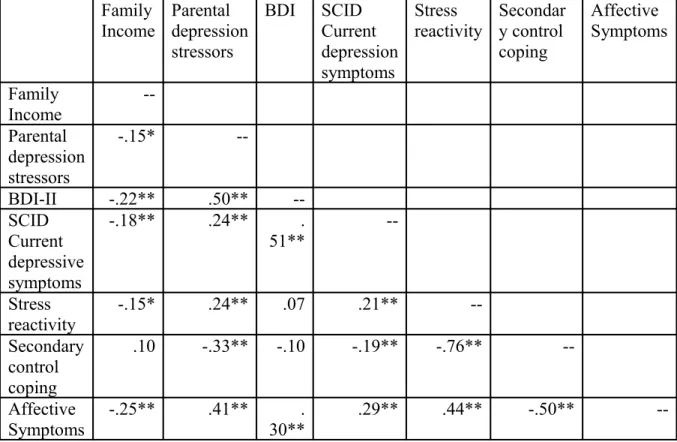
Correlations between family income, parental depressive symptoms, stressors related to parental depression, children’s stress reactivity, children’s secondary control coping, and children’s affective symptoms are displayed in Table 2. As expected, children’s affective symptoms were related to greater chronic stress as indicated by family income (r =-.25, p < .01), parental depression stressors (r = .41, p < .01), parental depression symptoms as reported on the BDI (r =.30, p < .01), and parental depressive symptoms as reported on the SCID (r = .29, p < .01). Children’s stress reactivity was associated with chronic stress as indicated by family income (r = -.15, p < .05), parental depression stressors (r = .24, p < .01), and parental depressive symptoms as reported on the SCID (r = .21, p < .01). Children’s secondary control coping was negatively
associated with greater chronic stress, as indicated by parental depression stressors (r = -.33, p < .01) and parental depressive symptoms as reported on the SCID (r = -.19, p < . 01); however, children’s coping was not significantly related to family income. Findings from previous studies were also replicated in that stress reactivity was associated with greater affective symptoms (r = .44, p < .01) and secondary control was associated with fewer affective symptoms (r = -.50, p < .01). Additionally, stress reactivity and
secondary control coping were negatively associated (r = -.76, p < .01).
Table 2. Correlations of family income, parental depression symptoms and stressors, stress reactivity, secondary control coping, and affective symptoms
Family
Income Parental depression stressors
BDI SCID
Current depression symptoms
Stress
reactivity Secondar y control coping
Affective Symptoms
Family Income
-- Parental
depression stressors
-.15* --
BDI-II -.22** .50** --
SCID Current depressive symptoms
-.18** .24** .
51** --
Stress reactivity
-.15* .24** .07 .21** --
Secondary control coping
.10 -.33** -.10 -.19** -.76** --
Affective Symptoms
-.25** .41** .
30**
.29** .44** -.50** --
Hypothesis 2. Independent contributions of chronic stress, stress reactivity, and coping in predicting child affective symptoms.
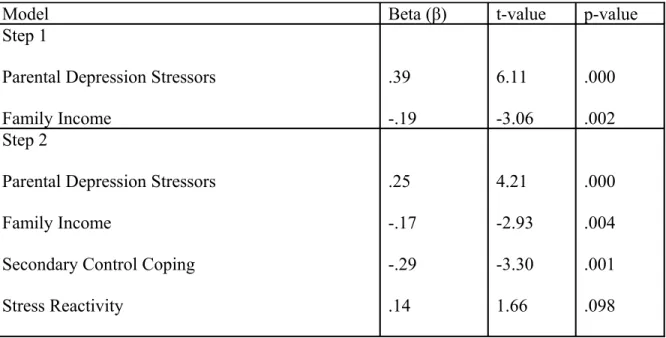
To test the relative effects of chronic stress resulting from parental depression and family income on children’s affective symptoms and the possibility the degree to which children’s stress reactivity and secondary control coping may account for the relations between stress and children’s affective symptoms, linear regression analyses were conducted. When family income and stressors related to parental depression were included in the first step of the regression model predicting children’s affective
symptoms, parental depression stressors (β = .38, p < .01) and family income (β = -.19, p
< .01) were independent significant predictors (see Table 3). Results indicated that when
children’s stress reactivity and secondary control coping were entered into the equation in a second step, both parental depression stressors (β = .25, p < .01) and family income (β
= - .17, p < .01) remained significant (see Table 3). Secondary control coping (β = -.29, p < .01) but not stress reactivity was also a significant contributing factor.
Table 3. Linear regression with chronic stress associated with parental depression and family income and children’s affective symptoms
Model Beta (β) t-value p-value
Step 1
Parental Depression Stressors Family Income
.39 -.19
6.11 -3.06
.000 .002 Step 2
Parental Depression Stressors Family Income
Secondary Control Coping Stress Reactivity
.25 -.17 -.29 .14
4.21 -2.93 -3.30 1.66
.000 .004 .001 .098
Hypothesis 3. The interaction between chronic stress associated with parental depression and family income, stress reactivity, and coping as predictors of child affective symptoms.
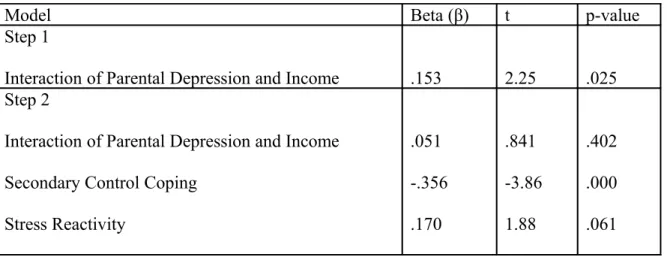
In order to test the interactive effects of chronic stress related to parental depression and family income stress, the interaction of these two factors was tested in predicting children’s affective symptoms and yielded a significant effect for the
interaction in the first step in the equation (β = .156, p < .05, see Table 4). To further test
income below $49,000, n= 94) and higher income families (household income $49,000 and above, n= 123). Chronic stress associated with parental depression was demonstrated to have a stronger association with children’s affective symptoms in lower income
families (β= .445, p< .01) then for higher income families (β= .340, p< .01). These equations are depicted graphically in Figure 1. It is noteworthy that chronic stress associated with parental depression was a significant predictor of affective symptoms in both lower and higher income families.
Stress reactivity and secondary control coping were then entered in a second step in the equation along with the interaction of family income and parental depression stressors to test the possible contributions of coping and stress reactivity on the relations between the interactive effects of both sources of chronic stress and children’s affective symptoms. This equation (see Table 4) revealed significant contribution by secondary control coping (β = -.356, p < .01) and marginal contribution by stress reactivity (β= .170, p= .06) but the effects of the interaction were no longer significant (β= .051, p= .402).
Table 4. Interaction of chronic stress associated with parental depression and family income, children’s coping, and children’s stress reactivity in predicting children’s affective symptoms
Model Beta (β) t p-value
Step 1
Interaction of Parental Depression and Income .153 2.25 .025 Step 2
Interaction of Parental Depression and Income Secondary Control Coping
Stress Reactivity
.051 -.356 .170
.841 -3.86 1.88
.402 .000 .061
Figure 1. Role of parental depression stressors in low income vs. high income families
10.00 20.00 30.00 40.00 50.00 60.00
Parental depression stressors
-2.00 0.00 2.00 4.00
R-Square = 0.17
R-Square = 0.12
Low Income
High Income
DSM Affective Symptoms
CHAPTER IV
DISCUSSION
Chronic stress has been extensively studied and has been established as
deleterious to psychological health. Chronic stress affects children and adolescents and can result from various sources. Past studies have indicated the most adverse chronic stress results from stressors that are uncontrollable. Living with a parent with depression and economic disadvantage are two prototypes of uncontrollable stressors for children and adolescents. Parental depression results in increased risk for emotional and behavioral problems, as well as psychopathology in children and adolescents through exposure to their parents’ negative cognitions, negative parent-child interactions, and chronically stressful environments. Likewise, economic disadvantage results in increased risk for children and adolescents through economic strain, family stress and negative parenting, and additional stressors associated with economic disadvantage.
The pathways by which chronic stressors lead to increased rates of
psychopathology are not clearly understood. The dual process model of responses to stress, by which stress is damaging to an individual both directly through negative experiences of stress and indirectly through the decreased ability to effectively deal with stress, is one contemporary avenue of research seeking to understand these pathways.
Allostatic load, the wear and tear on the body resulting from chronic activation of stress response symptoms, is hypothesized to account for the debilitating effects of stress on an individual’s ability to cope. In particular, the effects of chronically heightened levels of
cortisol on areas within the PFC, the area in the brain responsible for higher order cognitive functions, may limit a person’s cognitive resources necessary to use effective coping strategies. These strategies, such as secondary control coping (i.e., distraction, cognitive reappraisal, positive thinking) rely on the higher order processes involved in executive function and may suffer from damage to the areas responsible for these cognitive tasks.
In this study, two prototypes of uncontrollable chronic stress, parental depression and economic disadvantage, were examined to explore several of the possible pathways involved in the process by which chronic stress leads to poorer psychological outcomes, specifically the pathways between both the independent and interactive effects of chronic stress, responses to stress, and children’s affective symptoms. The role of stress
responses, specifically stress reactivity and secondary control coping, was also examined in the context of possible contributions of exacerbating and protective effects,
respectively, to the effects of chronic stress on children’s affective symptoms.
The first hypothesis for the present study examined the associations between chronic stress, stress reactivity, coping and children’s affective symptoms. As expected, exposure to chronic stressors associated with parental depression was associated with higher levels of stress reactivity, lower levels of secondary control coping, and higher levels of children’s affective symptoms. Other indicators of parental depression, such as the number of symptoms endorsed on the SCID and the BDI, were also associated with higher levels of children’s affective symptoms and stress reactivity. The number of parents’ symptoms endorsed on the SCID, but not the BDI, was associated with lower levels of secondary control coping as well. Additionally, economic disadvantage was
also associated with higher levels of stress reactivity and higher levels of children’s affective symptoms, though the association with secondary control coping was not significant. These results replicate previous findings for parental depression and economic disadvantage as significant uncontrollable stressors (Garber & Martin, 2002;
Wadsworth et al., 2008) and that chronic stress leads to an increased risk for psychopathology (Miller et al., 2007). Additionally, as demonstrated in previous research (Langrock et al., 2002), stress reactivity and secondary control coping were negatively associated in this sample.
The second hypothesis examined the independent contributions of chronic stress, stress reactivity, and coping as predictors of children’s affective symptoms. As expected, the association of chronic stress related to parental depression and economic
disadvantage with children’s affective symptoms was partially, but not fully accounted for by levels of stress reactivity and secondary control coping. When the two
independent sources of chronic stress were considered, each provided significant contribution to children’s affective symptoms, demonstrating the importance of each stressor’s relative contribution to children’s psychological outcome. Additionally, with the incorporation of stress responses, both the stressors and secondary control coping, though not stress reactivity, yielded significant contributions to affective symptoms, suggesting the importance of not only independent sources of uncontrollable chronic stress, but the use of coping strategies such as cognitive reappraisal, distraction, and positive thinking as well, replicating previous findings for the role of secondary control coping in accounting for the relation between stress and psychological outcome
(Langrock et al., 2002). Stress reactivity was not significant in the context of the
stressors themselves, suggesting that an individual’s maladaptive response to these stressors only marginally contributes to the affective symptoms resulting from these stressors, but that using adaptive coping strategies in this context may have alleviating effects.
The third hypothesis addressed the interaction between stress associated with parents’ depression and family income as a predictor of children’s affective symptoms.
As hypothesized, the interactive effects of chronic stress associated with parental depression and economic disadvantage predicted children’s affective symptoms. These findings confirm a cumulative effect of chronic stress, suggesting possible thresholds at which an individual’s risk for psychopathology exponentially increases (Rutter &
Sandberg, 1992), The interaction of these stressors was also found to predict lower levels of secondary control coping, but not stress reactivity, which confirms the dual responses to stress model in that individuals under more stress used less secondary control coping, an adaptive response to uncontrollable stressors (Wadsworth & Compas, 2002).
When responses to stress were examined in the contribution of the interactive effects of parental depression stressors and economic disadvantage on children’s affective symptoms, secondary control coping, but not stress reactivity, accounted for the
interactive effects of chronic stress associated with parental depression and economic disadvantage on children’s affective symptoms. These findings suggest that the cumulative effects of stress on children’s affective symptoms were accounted for by adaptive coping strategies for these types of stressors, but not by a maladaptive response to these stressors. This may also reflect that the importance of coping in maintaining psychological well-being becomes elevated as chronic stress increases, which also fits
with the dual responses to stress model.
Overall, the findings of this study indicate that the chronic stress associated with both parental depression and economic disadvantage, independently and in combination, is associated with not only higher levels of affective symptoms directly but also to lower levels of secondary control coping, which partially accounts for the effects of these stressors on affective symptoms in children. This study highlights not only the
importance of endurance and accumulation of chronic stress in children’s environments, but also the importance of children’s responses to these stressors.
This study has a number of strengths. First, the sample of parents with histories of depression within the lifetime of their children, was relatively large the range of family economic status was diverse. Additionally multiple method, multiple informant sources of data were obtained, including structured clinical interviews with parents about their children and self reports from both children and parents and questionnaires were completed by both parent and child report. The measures used in this study have established reliability and validity for the constructs of interest and our measure of economic disadvantage was direct reporting of income by the parents.
This study does have some limitations, however. Foremost, this study was cross- sectional, which prevented conducting mediation analyses with the constructs of interest (Maxwell & Cole, 2007). Additionally, the ultimate goal of understanding these
processes will require the ability to examine how chronic stress’ effects on coping and outcomes unfold over time, which was not possible with this cross-sectional sample.
Another limitation is the absence of any direct biological markers of stress reactivity or any direct measurement of executive functioning. While the variables used to serve as
proxies for these constructs (stress reactivity and secondary control coping factors on the RSQ), direct measurement of these constructs through biological markers and
neurocognitive testing, respectively, would have been ideal. Finally, a single variable (family income) was used to measure economic disadvantage. While several indicators were obtained to measure parental depression and its associated stressors, data on the stressors associated with economic disadvantage or other markers of economic disadvantage were not obtained. Because the RSQ anchors the respondent to the
stressors at the beginning of the questionnaire (in this case, parental depression) for their reporting of responses to those specific questionnaires, the findings between responses to stress and economic disadvantage may have been weakened. That findings remained for economic disadvantage in association with children’s affective symptoms and coping highlights the strength of this stressor’s effects on children, even when only a gross measure of this construct can be utilized.
This study represents important findings that should both be replicated and extended. Direct measurement of stress response, such as cortisol levels, heart rate, or skin conductance would further inform the association between chronic stress and stress response, stress response and allostatic load, and the effects of stress response on
psychological outcome for at-risk children. Additionally, direct measurement of
executive functioning through neurocognitive testing and brain function through imaging techniques such as EEG, fMRI, and MEG would further inform the processes by which allostatic load leads to dysfunction in brain regions essentially for executive functioning and coping with stress. Longitudinal studies examining these constructs will also provide opportunity for meditational analyses of stress response and executive functioning in the
relation between chronic stress and poorer psychological outcomes.
REFERENCES
Achenbach, T. M. (1991). Integrative guide for the 1991 CBCL/4-18 YSR, and TRF profiles. Burlington: University of Vermont, Department of Psychiatry.
Achenbach, T. M. (1991). Manual for the Youth Self-Report and 1991 Profile.
Burlington: University of Vermont, Department of Psychology.
Adler, N.E., Boyce, T., Chesney, M.A., Cohen, S., Folkman, S., Kahn, R.L., & Syme, S.L. (1994). Socioeconomic Status and Health: The Challenge of the Gradient.
American Psychologist, 49(1), 15-24.
Adrian, C., & Hammen, C. (1993). Stress Exposure and Stress Generation in Children of Depressed Mothers. Journal of Consulting and Clinical Psychology, 61(2), 354-359.
Anderson, V., Jacobs, R., & Harvey, A.S. (2005). Prefrontal lesions and attentional skills in childhood. Journal of the International Neuropsychological Society, 11, 817- 831.
Anderson, V., Anderson, D., & Anderson, P. (2006). Comparing attentional skills in children with acquired and developmental central nervous system disorders.
Journal of the International Neuropsychological Society, 12, 519-531.
Barnett, M.A. (2008). Economic Disadvantage in Complex Family Systems:
Expansion of Family Stress Models. Clinical Child and Family Psychology Review, 11, 145-161.
Beck, A.T., Steer, R.A., & Brown, G.K. (1996). Beck Depression Inventory-Second Edition, Manual. The Psychological Corporation.
Bouma, E.M.C., Ormel, J., Verhulst, F.C., & Oldehinkel, A.J. (2008). Stressful life events and depressive problems in early adolescent boys and girls: The influence of parental depression, temperament, and family environment. Journal of
Affective Disorders, 105, 185-193.
Boyer, M.C., Compas, B.E., Stanger, C., Colletti, R.B., Konik, B.S., Morrow, S.B., et al.
(2006). Attentional biases to pain and social threat in children with recurrent abdominal pain. Journal of Pediatric Psychology, 31, 209-220.
.
Brennan, Patricia A.; Brocque, Robyne Le; & Hammen, Constance. (2003). Maternal Depression, Parent-Child Relationships, and Resilient Outcomes in Adolescence.
Journal of American Academy of Child and Adolescent Psychiatry, 1469-1477.
E. (2009). Executive Function, Coping, and Behavior in Survivors of Childhood Acute Lymphocytic Leukemia. Journal of Pediatric Psychology, 34(3), 317-327.
Cerqueira, J.J., Mailliet, F., Almeida, O.F.X., Jay, T.M., & Sousa, N. (2007). The prefrontal cortex as a key target of the maladaptive response to stress. The Journal of Neuroscience, 27, 2781-2787.
Clark, L., & Watson, D. (1991). Tripartite model of anxiety and depression:
Psychometric evidence and taxonomic implications. Journal of Abnormal Psychology, 100, 316-336.
Clarke, G. N., Hornbrook, M., Lynch, F., Polen, M., Gale, J., Beardslee, W., et al. (2001).
A randomized trial of a group cognitive intervention for preventing depression in adolescent offspring of depressed parents. Archives of General Psychiatry, 8(12), 1127-1134.
Compas, B. (2006). Psychobiological Processes of Stress and Coping: Implications for Resilience in Children and Adolescents- Comments on the Papers of Romeo &
McEwen and Fisher et al. Annals of New York Academy of Sciences, 1094, 226- 234.
Compas, B.E., Connor-Smith, J.K., Saltzman, H., Thomsen, A.H., & Wadsworth, M.
(2001). Coping with stress during childhood and adolescence: Progress, problems, and potential. Psychological Bulletin, 127, 87-127.
Compas, B.E., Langrock, A.M., Keller, G., Merchant, M.J., & Copeland, M.E. (2001).
Children coping with parental depression: Processes of adaptation to family stress. In S. Goodman & I. Gotlib (Eds.), Children of depressed parents:
Alternative pathways to risk for psychopathology. Washington, DC: American Psychological Association.
Connor-Smith, J.K., Compas, B.E., Wadsworth, M.E., Thomsen, A.H., & Saltzman, H.
(2000). Responses to stress in adolescence: Measurement of coping and
involuntary responses to stress. Journal of Consulting and Clinical Psychology, 68, 976-992.
Copeland, W., & Compas, B.E. (2009). Coping and Executive Function: The Role of Executive Inhibition. Unpublished Manuscript.
Crone, E.A., Wendelken, C., Donohue, S., Leijenhorst, L.v., & Bunge, S.A. (2006).
Neurocognitive development of the ability to manipulate information in working memory. PNAS, 103(24), 9315-9320.
Dallaire, D.H., Cole, D.A., Smith, T.M., Ciesla, J.A., LaGrange, B., Jacquez, F.M., et al.
(2008). Journal of Youth and Adolescence, 37, 830-846.
DeGangi, G.A., DiPietro, J.A., Greeenspan, S.I., & Porges, S.W., (1991).
Psychophysiological characteristics of the regulatory-disordered infant. Infant Behavior and Development 14, 37–50.
DeNavas-Walt, C., Proctor, B.D., & Smith, J.C. (2008). Income, Poverty, and Health Insurance Coverage in the United States: 2007. US Census Bureau.
Dickerson, S.S., & Kemeny, M.E. (2004). Acute stressors and cortisol responses: A theoretical integration and synthesis of laboratory research. Psychological Bulletin, 130, 355-391.
Dolcos, F., Kragel, P., Wang, L, & McCarthy, G. (2006). Role of the inferior frontal cortex in coping with distracting emotions. Brain Imaging, 17(15), 1591-1594.
Elder, G.H., Nguyen, T.V., & Caspi, A. (1985). Linking family hardship to children’s lives. Child Development, 56(2), 361-375.
Field, T., Healy, B., Goldstein, S., & Guthertz, M. (1990). Behavior state matching and synchrony in mother-infant interactions of nondepressed versus depressed dyads.
Developmental Psychology, 26, 7-14.
Field, T., Healy, B., & LeBlanc, W. (1989). Sharing and synchrony of behavior states and heart rate in nondepressed versus depressed mother-infant interactions.
Infant Behavior and Development, 12, 357-376.
First, M. B., Spitzer, R. L., Gibbon, M., & Williams, J. B. W. (2001). Structured Clinical Interview for DSM-IV-TR Axis I Disorders, Research Version, Patient Edition (SCID-I/P). New York: Biometrics Research, New York State Psychiatric Institute.
Garber, J., & Martin, N.C. (2002). Negative cognitions in offspring of depressed
parents: Mechanisms of risk. In S. H. Goodman, & I. H. Gotlib (Eds). Children of depressed parents: Mechanisms of risk and implications for treatment. (pp. 121- 153). Washington, DC, US: American Psychological Association.
Gest, S.D., Neemann, J., Hubbard, J.J., Masten, A.S., & Tellegen, A. (1993). Parenting quality, adversity, and conduct problems in adolescence: testing process- oriented models of resilience. Developmental Psychopathology, 5, 663-682.
Glantz, M.D. (1992). A developmental psychopathology model of drug abuse vulnerability. Vulnerability to Drug Abuse, Glantz, M.D., Pickens, R., eds.
Washington, DC: American Psychological Association, 389-418.
Goldin, P.R., McRae, K., Ramel, W., & Gross, J. (2008). The Neural Bases of Emotion Regulation: Reappraisal and Suppression of Negative Emotion. Biological Psychiatry, 63, 577-586.
Goodman, S.H., & Gotlib, I.H. (1999). Risk for psychopathology in the children of depressed mothers: A developmental model for understanding mechanisms of transmission. Psychological Review, 106(3), 458-490.
Gottman, J.M. & Katz, L.F. (2002). Children’s emotional reactions to stressful parent- child interactions: The link between emotion regulation and vagal tone. Marriage and Family Review, 34, 265-283.
Gunnar, M. & Quevedo, K. (2007). The neurobiology and stress and development.
Annual Review of Psychology, 58, 145-173.
Hammen, Constance. (2002). Context of Stress in Families of Children with Depressed Parents. In S.H. Goodman & I.H. Gotlib (Eds). Children of Depressed Parents:
Mechanisms of Risk and Implications for Treatment. 175-195.
Hanson, M.D., & Chen, E. (2007). Socioeconomic Status, Race, and Body Mass Index:
The Mediating Role of Physical Activity and Sedentary Behaviors during Adolescence. Journal of Pediatric Psychology, 32(3), 250-259.
Howard, M.S.; & Medway, F.J. (2004). Adolescents’ Attachment and Coping with Stress. Psychology in the Schools, 41(3), 391-402.
Jacob, Theodore; & Johnson, Sheri L. (1997). Parent-Child Interaction Among Depressed Fathers and Mothers: Impact on Child Functioning. Journal of Family Psychology, 11, 391-409.
Jaser, S.S., Champion, J.E., Reeslund, K.L., Keller, G., Merchant, M.J., Benson, M., et al. (2007). Cross-situational coping with peer and family stressors in