INTRODUCTION
GUIDELINES
SITE INVESTIGATION
If the land is on railway property, you must also contact the Railway Property/Lease Department. During the various design phases, copies of the plans must be sent by the consultant to all utilities and agencies involved. Earth borings should be carried out for most projects to obtain sufficient information about the existing subsurface conditions at the site.
An investigation is usually required and any decision not to conduct a soil investigation should be based on the engineer's understanding of the location and complexity of the project.
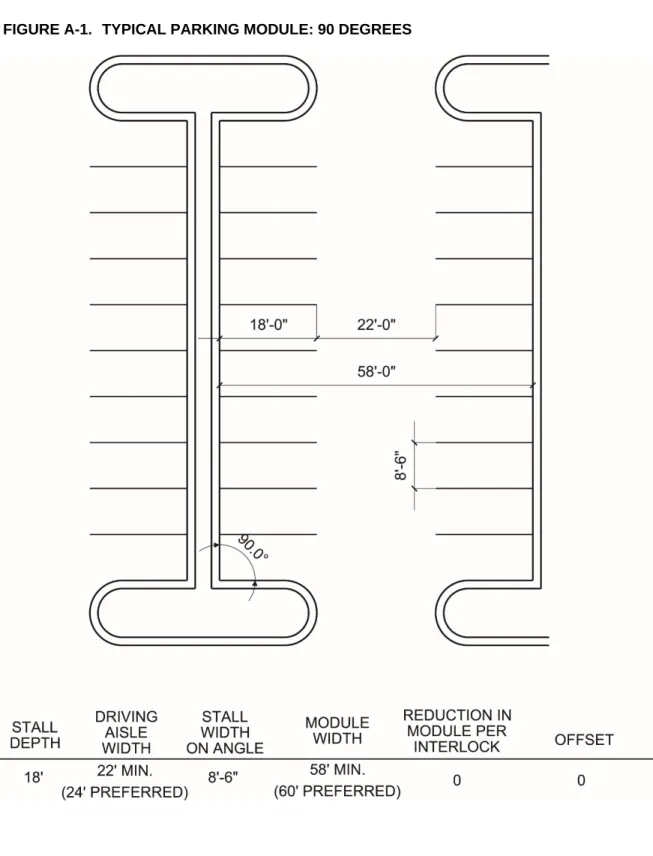
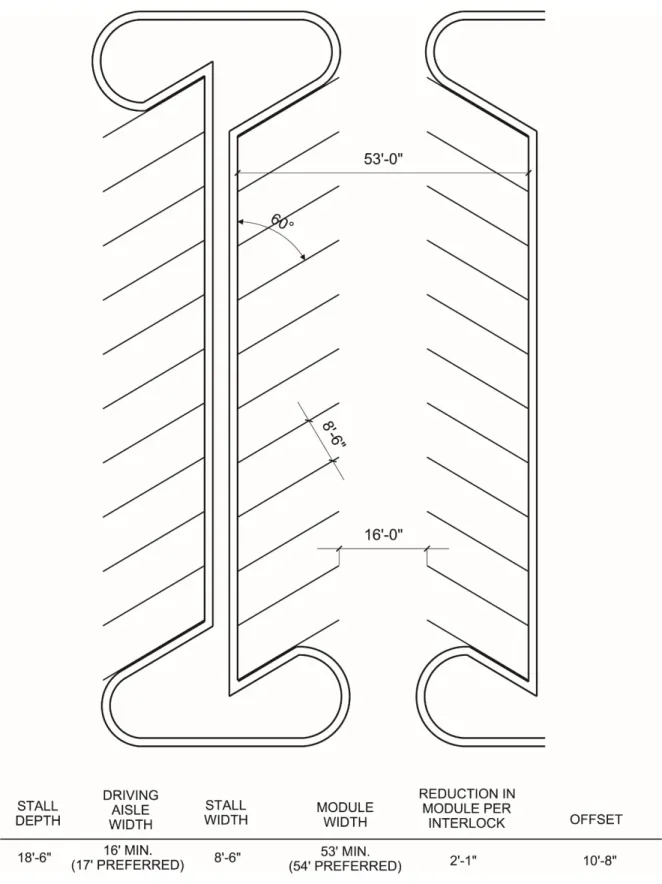
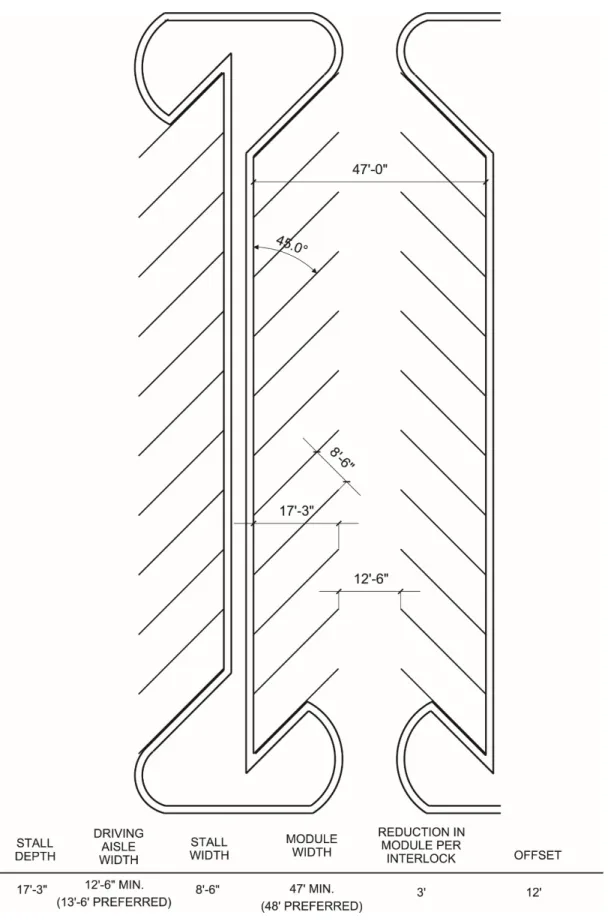
STALL DIMENSIONS AND LAYOUT
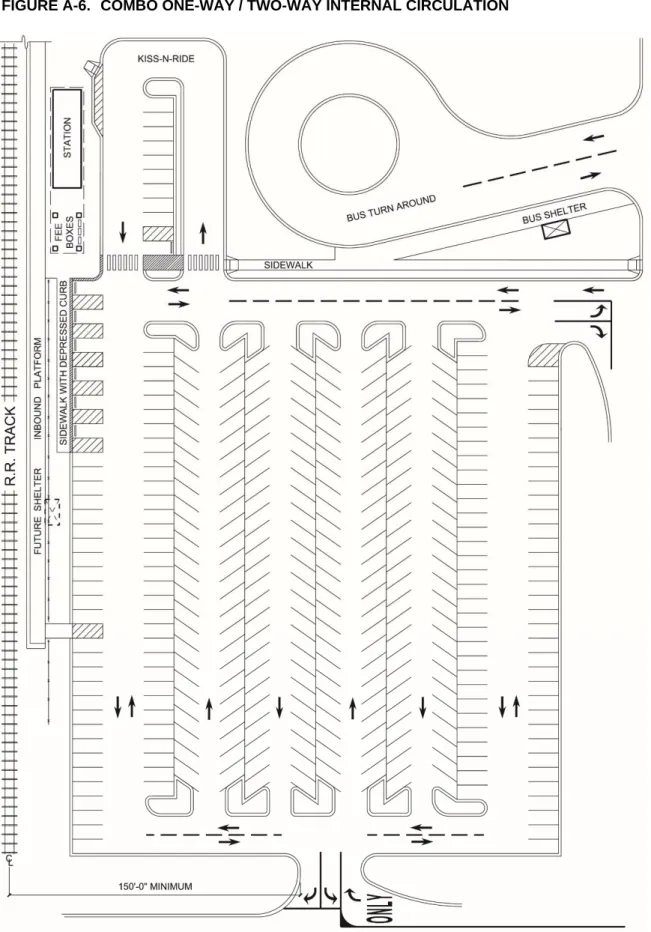
VEHICULAR AND PEDESTRIAN ACCESS CONSIDERATIONS
If any of the above criteria cannot be met, a traffic effect study must be considered. The shuttle parking facility should be designed to queue in the parking facility rather than on the adjacent road. As a general rule, there should be at least 150 feet between the access point and the at-grade crossing.
The turning should be designed according to the size of the largest vehicle expected to use the facility.
OTHER PARKING FACILITIES
The lighting design and pedestrian flow patterns or designated pedestrian walkways should be coordinated to complement each other. The minimum width of a sidewalk adjacent to a bus or taxi loading zone should be 12 feet. These barriers should be used with sight distances in mind for both pedestrian and vehicle movements.
The minimum horizontal distance between the barrier and the vehicle shall be five feet to allow room for vehicle access. Pedestrian paths between car parks, railway station and platforms should be investigated for necessary improvements in their condition and width. All parking areas, especially special use areas, must be clearly defined by signage, sidewalks, location and configuration.
At bus stands where buses will be idling for any period of time, a portland cement concrete surface should be used to prevent pavement degradation by oils. The most recent PACE development guidelines should be reviewed for design factors that may affect the parking lot design. Kiss and Ride provisions should only be considered for parking lots adjacent to shuttle stations.
The average number of available seats should be approximately 15% of the highest evening train disembarking within a 15-minute period. Existing lots adjacent to the platforms to be expanded must be taken into account due to the current demand for additional Kiss and Ride spaces.
PAVEMENT DESIGN AND SUSTAINABLE DESIGN STRATEGIES
The first option is an unloading lane, apart from the taxiways, parallel to the platform or sidewalk leading to the platform (Figure C-1). The direction of travel should allow the passenger side of the car to face the pavement or platform. This style is best for unloading, but should be revised to allow for adequate storage of cars awaiting the arrival of trains based on existing or estimated demand for this type of space.
It is also very important that Kiss 'N Ride drop-off lanes follow the strictest accessibility code requirements for the number of accessible spaces, entrance aisle, loading area and curb ramps. A second method is to provide a designated area of parking spaces for time-limited parking (Figure C-2). With this option, if the demand for parking increases or if the estimated volume of Kiss 'n Ride users is not reached, these spaces can be converted to all-day parking.
A combination of the two methods offers the most versatility, allowing for quick delivery and pick-up, as well as short wait times or driver-passenger exchanges. Materials and construction methods must be in accordance with Illinois Department of Transportation (IDOT) requirements, which are included in the latest addition to the. Sustainable design strategies, such as permeable paving, under-pavement rainwater storage or wadis, may be permitted if a parking facility is maintained by municipal stakeholders.
LIGHTING CONSIDERATIONS
A computerized photometric plot of the pavement illumination levels of the proposed system must be generated to verify the design. To avoid light pollution, the placement of fixtures is critical; sharply cut armatures or side shielding may be required. The control of the lighting system can be by photocell, timer or combination of the two.
The economics of the photocell system should compare the cost of providing photocells at each fixture with a single photocell operating either multiple fixtures. The use of a timer should be considered on sites with six or more fixtures to reduce energy costs and extend lamp life by turning off all but security lighting after the last train. Timers should be of the 7-day astronomical type with a backup system for power failures.
In large sections, a photocell can be used to turn the light on at sunset and off at sunrise along with a timer to turn off approximately half of the lights after the last train leaves for the night and turn them on again before the first one arrives. the morning train. For smaller parking lots, the designer should consider using small boxes mounted on light poles to house the controls instead of more expensive ground-mounted control cabinets. If the on-street parking strip lighting also functions as street lighting, it must be controlled by a photocell and comply with the street lighting requirements for the area of the street in question.
Currently, each local municipality, rather than Metra, maintains most of the commuter lots and as such local requirements must be followed. Color and design compatibility with adjacent lighting and station is another factor to consider.
STORM WATER DRAINAGE AND DETENTION
A photocell is the preferred control because it adapts to seasonal changes in daylight and cloudy skies. A separate storm water catchment outside the parking area will reduce the parking area. Therefore, the projected need for spaces must be compared with those that will be provided after the reduction of available spaces due to the retention basin.
Storage of rainwater on the surface of the car park is only recommended if no other storage area is available. This is due to the fact that it endangers unattended vehicles, inconveniences users and destabilizes the structure of the pavement by saturating the subsoil. For parking lot storage, a maximum water depth of 10 inches should be used and located outside the driveways.
Existing floodplains and/or wetlands affected by the proposed parking lot should be considered during development of the site's drainage system and mitigation efforts coordinated with the drainage plan. The project design must include provisions for soil erosion control and. The applicable provisions of the Illinois Environmental Protection Agency (IEPA) Soil Erosion and Sedimentation Standards and Specifications or the Illinois Soil and Water Conservation District (SCS) Association's Urban Soil Erosion and Sedimentation Control Procedures and Standards are used in the design of the project.
FEE COLLECTION SYSTEM
WAYFINDING AND REGULATORY SIGNS
Commuter parking lot signs must follow the Manual on Uniform Traffic Control Devices (MUTCD) as adopted by the State of Illinois, the Metra Station Sign Program. The main entrances to Metra commuter parking lots must be provided with entrance signs (see standard parking sign details in Metra's Station Sign Program Specifications). The entrance signs have a background color Metra Blue (PMS 301) and the color of the letters is white.
Additional signs guiding commuters to remote parking may be required at decision points along nearby roads. Trailblazer signs directing commuters from main roads to station locations may also be required. Depending on the traffic patterns around a station and the distance between stations, trail signs can be posted up to 2.5 miles from a station or parking facility.
Large and small standard pioneer signs are used based on the speed limit on the road. Parking space number signs for parking rates or parking permits can be mounted on a pole or on a tension wire. Painted sidewalk space numbers in place of signs should not be used because they are not visible when covered with vehicles, snow, ice or dirt.
Each accessible parking space must be equipped with a sign that complies with the strictest applicable accessibility codes. Accessible parking fines must be coordinated with the entity responsible for enforcement and must comply with the applicable code.
LANDSCAPING AND FENCING
Shrubbery should be located so that the mature height will not obstruct signs, site lighting or sight lines for motorists or pedestrians. Evergreen trees and shrubs should not be planted within six (6) feet of the rear curb to minimize road salt damage. Greening of pedestrian areas on the perimeter is desirable because it is easier to maintain than corridor plantings.
When installing site perimeter protection plantings, plants should be placed at least six (6) feet back of the curb to allow room for cars overhanging the curb and room for some winter snow storage. Perimeter shrubs should be set a certain distance from the property so that the plant remains in the parking lot when fully grown. The decision to use a fence as a pedestrian barrier should be based on the need to protect or control the pedestrian path.
A control fence should not obscure the site to the extent that public safety is compromised by creating hidden and obscure areas. Decorative fencing can be used in highly visible areas instead of a chain link fence. Chain link fencing should be PVC coated, black or brown in color and have a top bar and bottom tension wire.
Landscaping and fencing can be large expenses, and uses must be appropriate for the site. Low maintenance materials used wisely will keep landscaping and fencing from becoming a detriment to the project.
SHELTER DESIGN AND CONSIDERATIONS FOR COMMUTERS
FIGURES
TYPICAL SECTIONS AND DETAILS
KISS ‘N RIDE CONFIGURATIONS
SPECIAL SPACE CONFIGURATIONS
PARKING LOT SHELTERS