Part 5: CUTTING EDGE DECISION SUPPORT TECHNOLOGIES
Neural Computing
Genetic Algorithms
Fuzzy Logic
Integration
Chapter 17: Neural Computing:
The Basics
Artificial Neural Networks (ANN)
Mimics How Our Brains Work
Machine Learning
3
17.1 Opening Vignette: Maximizing the Value of the John Deere & Co.
Pension Fund
The Problem
Managing the Pension Fund of John Deere &
Co.
About $1 Billion Managed Internally by Corporate Finance
Want to Achieve a Better Return on Investment
The Solution
The Process
Build an individual, ANN for each of the 1000 largest U.S. Corporations
Historical Data: 40 inputs
Weekly, data updates into a stock prediction model (Figure 17.1)
Ranks the stocks based on anticipated performance
Selects a portfolio of the 100 top stocks
Results
Returns are well ahead of industry benchmarks
17.2 Machine Learning:
An Overview
ANN to automate complex decision making
Neural networks learn from past experience and improve their performance levels
Machine learning: Methods that teach
machines to solve problems, or to support problem solving, by applying historical cases
Complications
Many models of learning
Match the learning model with
problem type
What is Learning?
Accomplished by analogy, discovery and special procedures; by observing;
or by analyzing examples
Can improve the performance of AI methods
Is a Support area of AI
Learning as Related to AI
Learning systems demonstrate interesting learning behaviors
No claims about learning as well as humans or in the same way
Learning systems are not defined very formally; Implications are not well
understood
Learning in AI involves the manipulation of symbols (not numeric information)
Examples of
Machine Learning Methods
Neural Computing
Inductive Learning
Case-based Reasoning and Analogical Reasoning
Genetic Algorithms
Statistical methods
Explanation-based Learning
17.3 An Overview of Neural Computing
Constructing computers that mimic certain processing capabilities of the human brain
Knowledge representations based on – Massive parallel processing
– Fast retrieval of large amounts of information
– The ability to recognize patterns based on historical cases
Neural Computing = Artificial Neural
17.4 The Biology Analogy
Biological Neural Networks
Neurons: Brain Cells
– Nucleus (at the center)
– Dendrites provide inputs – Axons send outputs
Synapses increase or decrease connection strength and causes excitation or inhibition of
subsequent neurons
Artificial Neural Networks (ANN)
A model that emulates a biological neural network
Software simulations of the massively parallel processes that involve
processing elements interconnected in a network architecture
Originally proposed as a model of the human brain’s activities
The human brain is much more
complex
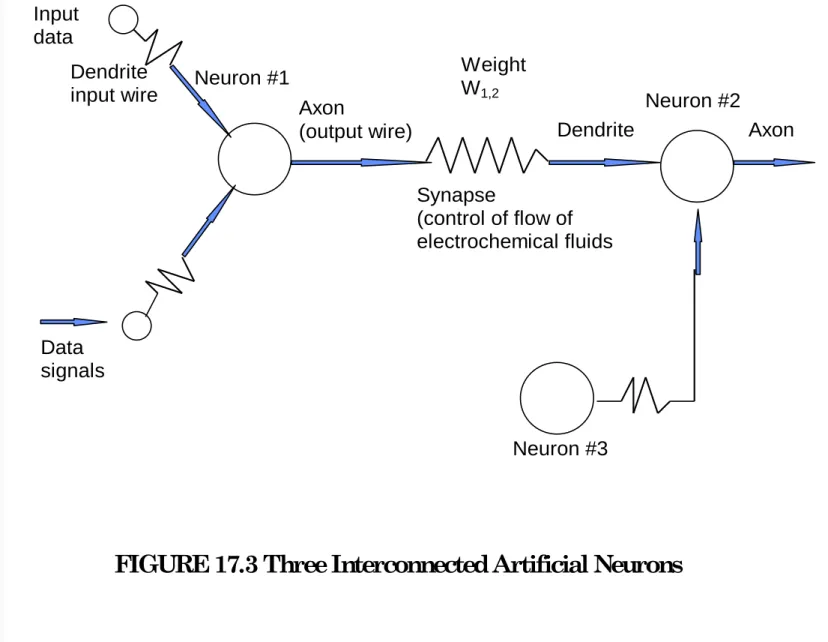
Input data
Dendrite
input wire Neuron #1
Axon
(output wire)
Weight W1,2
Dendrite
Neuron #2
Axon
Synapse
(control of flow of electrochemical fluids
Neuron #3 Data
signals
FIGURE 17.3 Three Interconnected Artificial Neurons
AIS In Focus 17.1:
The Relationship Between Biological and Artificial Neural Networks
Biological Artificial
Soma Node
Dendrites Input
Axon Output
Synapse Weight
Slow Speed Fast Speed
Many Neurons (109) Few Neurons (dozen to hundreds of thousands)
Medsker and Liebowitz [1994, p. 163]
17.5 Neural Network Fundamentals
Components and Structure
– Processing Elements – Network
– Structure of the Network
Processing Information in the Network
– Inputs – Outputs – Weights
– Summation Function
jth Neuron (Figure 17.6)
Transformation (Transfer) Function
Sigmoid Function (Logical Activation Function)
– where Y
Tis the transformed (normalized) value of Y
Y T 1 e Y 1
Learning Three Tasks
1. Compute Outputs
2. Compare Outputs with Desired Targets
3. Adjust Weights and Repeat the
Process
Set the weights by either some rules or randomly
Set Delta = Error = actual output
minus desired output for a given set of inputs
Objective is to Minimize the Delta (Error)
Change the weights to reduce the Delta
Information processing: pattern recognition
Different learning algorithms
AIS In Focus 17.4: How Patterns Are Presented and Recognized
Desired Outputs
Pattern Class
0 0 0 0 0 0 0 0 0 0 down
1 1 1 1 0 0 0 0 0 0 left
1 1 1 0 0 0 0 1 1 1 valley
0 1 0 1 0 1 0 1 0 1 alternating
0 0 0 0 0 0 1 1 1 1 right
0 0 0 1 1 1 1 0 0 0 hill
1 1 1 1 1 1 1 1 1 1 up
Historical Cases
Pattern Historical
Interpretation
Test cases
#1 1 1 0 0 1 1 0 0 1 1 alternating
#2 0 0 0 0 0 1 0 0 0 1 right
#3 1 1 0 1 1 1 0 0 0 0 left
#4 0 0 1 1 0 1 0 1 0 1 alternating
#5 0 0 0 1 1 0 1 1 0 0 alternating
Test cases
#6 1 1 1 0 1 1 1 0 1 1 alternating
#7 0 0 1 0 0 0 1 1 1 1 right
#8 0 1 0 1 1 0 1 1 0 0 alternating
#9 1 1 1 0 0 0 0 0 0 0 left
#10 1 1 1 1 0 0 1 1 1 1 valley
Source: C. W. Engel and M. Cran, " Pattern Classifications: A Neural Network Competes with Humans," PC AI, May/June 1991. Used with permission.)
17.6 Neural Network
Applications Development
Preliminary steps of system development are done
ANN Application Development Process
– Collect Data
– Separate into Training and Test Sets – Define a Network Structure
– Select a Learning Algorithm
– Set Parameters, values, Initialize Weights – Transform Data to Network Inputs
– Start Training, and Determine and Revise Weights – Stop and Test
17.7 Data Collection and Preparation
Collect data and separate into a training set and a test set
Use training cases to adjust the weights
Use test cases for network validation
17.8 Neural Network Architectures
Representative Architectures
Associative Memory Systems
– Associative memory - ability to recall complete situations from partial
information
– Systems correlate input data with stored information
– Hidden Layer
25
Recurrent Structure
Recurrent network (double layer) - each activity goes through the
network more than once before the output response is produced
Uses a feedforward and feedbackward approach to adjust parameters to
establish arbitrary numbers of
categories
17.9 Neural Network Preparation
(Non-numerical Input Data (text, pictures):
preparation may involve simplification or decomposition)
Choose the learning algorithm
Determine several parameters
– Learning rate (high or low)
– Threshold value for the form of the output – Initial weight values
– Other parameters
Choose the network's structure (nodes and layers)
Select initial conditions
17.10 Training the Network
Present the training data set to the network
Adjust weights to produce the desired output for each of the inputs
– Several iterations of the complete training set to get a consistent set of weights that works for all the training data
17.11 Learning Algorithms
Two Major Categories Based On Input Format
– Binary-valued (0s and 1s) – Continuous-valued
Two Basic Learning Categories
– Supervised Learning – Unsupervised Learning
Supervised Learning
For a set of inputs with known (desired) outputs
Examples
– Backpropagation – Hopfield network
Unsupervised Learning
Only input stimuli shown to the network
Network is self-organizing
Number of categories into which the network classifies the inputs can be controlled by varying certain
parameters
Examples
– Adaptive Resonance Theory (ART)
How a Network Learns
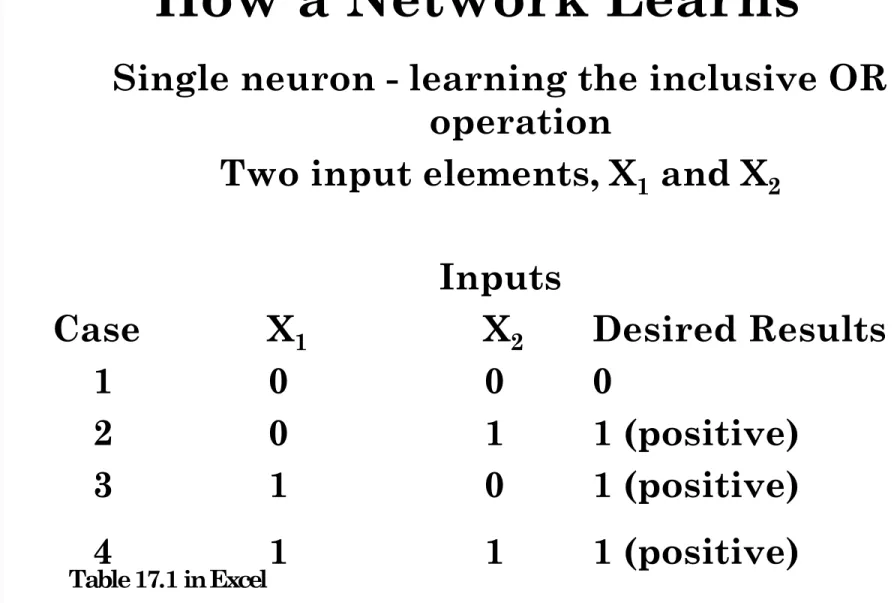
Single neuron - learning the inclusive OR operation
Two input elements, X1 and X2 Inputs
Case X1 X2 Desired Results
1 0 0 0
2 0 1 1 (positive)
3 1 0 1 (positive)
4 1 1 1 (positive)
Table 17.1 in Excel
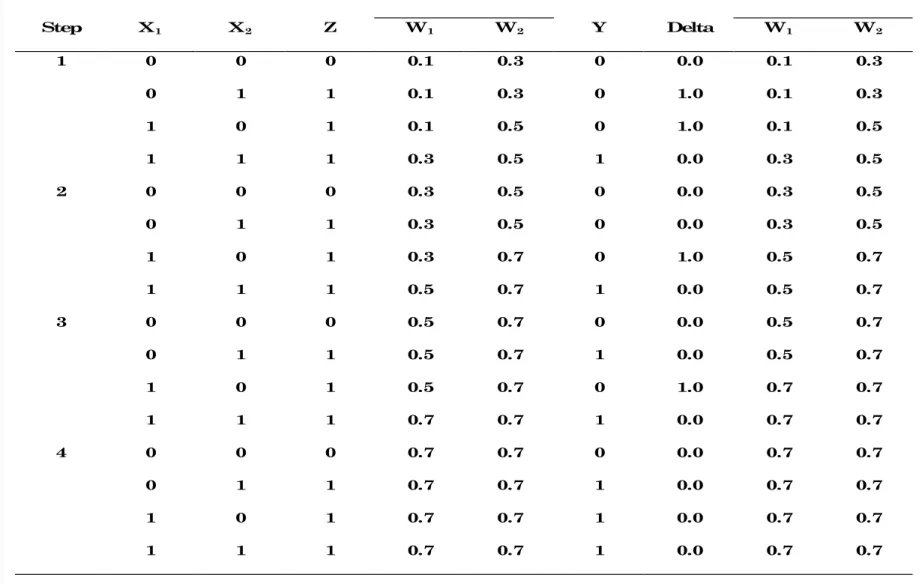
TABLE 17.1 Example of Supervised Learning
Initial Final
Step X1 X2 Z W1 W2 Y Delta W1 W2
1 0 0 0 0.1 0.3 0 0.0 0.1 0.3
0 1 1 0.1 0.3 0 1.0 0.1 0.3
1 0 1 0.1 0.5 0 1.0 0.1 0.5
1 1 1 0.3 0.5 1 0.0 0.3 0.5
2 0 0 0 0.3 0.5 0 0.0 0.3 0.5
0 1 1 0.3 0.5 0 0.0 0.3 0.5
1 0 1 0.3 0.7 0 1.0 0.5 0.7
1 1 1 0.5 0.7 1 0.0 0.5 0.7
3 0 0 0 0.5 0.7 0 0.0 0.5 0.7
0 1 1 0.5 0.7 1 0.0 0.5 0.7
1 0 1 0.5 0.7 0 1.0 0.7 0.7
1 1 1 0.7 0.7 1 0.0 0.7 0.7
4 0 0 0 0.7 0.7 0 0.0 0.7 0.7
0 1 1 0.7 0.7 1 0.0 0.7 0.7
1 0 1 0.7 0.7 1 0.0 0.7 0.7
1 1 1 0.7 0.7 1 0.0 0.7 0.7
– A step function evaluates the summation of input values
Calculating outputs
– Measure the error (delta) between outputs and desired values
– Update weights, reinforcing correct results
At any step in the process for a neuron, j, we get
Delta = Zj - Yj
where Z and Y are the desired and actual
The updated weights are
Wi (final) = Wi (initial) + alpha × delta × X1 where alpha is the learning rate parameter
Weights initially random
The learning rate parameter, alpha, is set low
Delta is used to derive the final weights, which then become the initial weights in the next
iteration (row)
Threshold value parameter: sets Y to 1 in the next row if the weighted sum of inputs is
greater than 0.5; otherwise, to 0
17.12 Backpropagation
Backpropagation (back-error propagation)
Most widely used learning
Relatively easy to implement
Requires training data for conditioning the network before using it for processing other data
Network includes one or more hidden layers
Network is considered a feedforward approach
Continue
Externally provided correct patterns are compared with the neural network output during training (supervised training)
Feedback is used to adjust the weights until all training patterns are correctly
categorized
Error is backpropogated through network layers
Some error is attributed to each layer
Weights are adjusted
A large network can take a very long time to train
May not converge
17.13 Testing
Test the network after training
Examine network performance: measure the network’s classification ability
Black box testing
Do the inputs produce the appropriate outputs?
Continue
Not necessarily 100% accurate
But may be better than human decision makers
Test plan should include
– Routine cases
– Potentially problematic situations
May have to retrain
17.14 Implementation
Frequently requires proper interfaces with other CBIS and user training
Gain confidence of the users and management early
Neural Computing Paradigms
Decisions the builder must make
Size of training and test data
Learning algorithms
Topology: number of processing elements and their configurations
Transformation (transfer) function
Learning rate for each layer
Diagnostic and validation tools
Results in the Network's Paradigm
17.15 Programming Neural Networks
An ANN can be programmed with
– A programming language – A programming tool
– Both
Tools (shells) incorporate
– Training algorithms
– Transfer and summation functions
May still need to
– Program the layout of the database
– Partition the data (test data, training data)
– Transfer the data to files suitable for input to an ANN tool
Development Tool Examples
NNetSheet (spreadsheet-based)
Neuralyst for Excel (front-ended by a spreadsheet)
KnowledgeNet and NeuroSMARTS (work with expert systems)
NeuralWorks, Explorer and Brainmaker (stand alone environments)
Languages (C++)
17.16 Neural Network Hardware
Advantages of massive parallel processing
Greatly enhances performance
Possible Hardware Systems for ANN
Training
Faster general purpose computers
General purpose parallel processors
Neural chips
Acceleration boards
Pentium MMX and II (Graphics Processors) (1998)
17.17 Benefits of Neural Networks
Usefulness for pattern recognition, learning, classification, generalization and
abstraction, and the interpretation of incomplete and noisy inputs
Specifically - character, speech and visual recognition
Potential to provide some of human problem solving characteristics
Ability to tackle new kinds of problems
Robustness
Fast processing speed
17.18 Limitations of Neural Networks
Do not do well at tasks that are not done well by people
Lack explanation capabilities
Limitations and expense of hardware technology restrict most applications to software simulations
Training times can be excessive and tedious
Usually requires large amounts of training and test data
17.19 Neural Networks and Expert Systems
ANN and ES technologies are so different that they can complement each other
Expert systems represent a logical, symbolic approach
Neural networks are model-based and use numeric and associative processing
Main features of each (Table 17.2)
TABLE 17.2 Comparing Expert Systems and Artificial Neural Networks.
Expert Systems Artificial Neural Networks 1 Have user development facilities, but
systems should preferably be developed by skilled developers because of knowledge acquisition complexities.
Have user development facilities and can be easily developed by users with a little training.
2 Takes a longer time to develop. Experts must be available and willing to articulate the problem-solving process.
Can be developed in a short time.
Experts only need to identify the inputs, outputs and a wide range of samples.
3 Rules must be clearly identified. Difficult to
develop for intuitively-made decisions. Does not need rules to be identified.
Well suited for decisions made intuitively.
4 Weak in pattern recognition and data
analysis such as forecasting. Well suited for such applications but need wide range of sample data.
5 Not fault tolerant. Highly fault tolerant.
6 Changes in problem environment warrant
maintenance. Highly adaptable to changing
problem environment.
7 The application must fit into one of the knowledge representation schemes (explicit form of knowledge).
ANNs can be tried if the application does not fit into one of ES's
representation schemes.
8 The performance of the human expert who helped create the ES places a theoretical performance limit for the ES.
ANNs may outperform human experts in certain applications such as forecasting.
9 Have explanation systems to explain why and how the decision was reached.
Required when the decision needs
explanation to inspire confidence in users.
Recommended when the problem-solving process is clearly known.
Have no explanation system and act like black boxes.
10 Useful when a series of decisions is made in the form of a decision tree and when, in such cases, user interaction is required.
Useful for one-shot decisions.
11 Useful when high-level human functions such as reasoning and deduction need to be emulated.
Useful when low-level human
functions such as pattern recognition need to be emulated.
12 Are not useful to validate the correctness of
ANN system development. In certain cases are useful to validate the correctness of ES development.
13 Use a symbolic approach (people-oriented). Use a numeric approach (data- oriented).
14 Use logical (deductive) reasoning. Use associative (inductive) reasoning.
15 Use sequential processing. Use parallel processing.
16 Are closed. Are self-organizing.
17 Are driven by knowledge. Are driven by data.
18 Learning takes place outside the system. Learning takes place within the system.
19 Are built through knowledge extraction. Are built through training, using examples.
Expert Systems
Especially good for closed-system
applications (literal and precise inputs, logical outputs)
Reason by using established facts and pre- established rules
Major Limitations
Experts do not always think in terms of rules
Experts may not be able to explain their line of reasoning
Experts may explain it incorrectly
Sometimes difficult or impossible to build the knowledge base
Neural Computing Use
Neural Networks in Knowledge Acquisition
Fast identification of implicit knowledge by automatically analyzing cases of historical data
ANN identifies patterns and relationships that may lead to rules for expert systems
A trained neural network can rapidly process information to produce associated facts and
17.20 Neural Networks For Decision Support
Inductive means for gathering, storing and using experiential knowledge
Neural network-based DSS to appraise real estate in New York (90% accurate)
Forecasting
ANN in decision support: Easy sensitivity analysis and partial analysis of input factors
The relationship between a combined expert system, ANN and a DSS (Figure 17.13)
ANN can expand the boundaries of DSS
Summary
ANN conceptually similar to biological systems
Human brain composed of billions of neuron cells, grouped in interconnected clusters
Neural systems are composed of
interconnected processing elements called
artificial neurons that form an artificial neural network
Can organize an ANN many different ways
Weights express the relative strength (or importance) given to input data
Each neuron has an activation value
An activation value is translated to an output
\through a transformation (transfer) function
Artificial neural networks learn from historical cases
Learning is done with algorithms
Continue
Supervised learning
Testing is done by using historical data
Neural computing is frequently integrated with traditional CBIS and ES
Many ANNs are built with tools that include the learning algorithm(s) and other computational procedures
ANNs lend themselves to parallel processing.
However, most us standard computers
Parallel processors can improve the training and running of neural networks
Acceleration boards expedite the computational work of neural computers
Neural computing excels in pattern recognition, learning, classification, generalization and
abstraction, and interpretation of incomplete input data
ANN do well at tasks done well by people and not so well at tasks done well by traditional
computer systems Continue
Machine learning describes techniques that enable computers to learn from experience
Machine learning is used in knowledge
acquisition and in inferencing and problem solving
Machines learn differently from people;
usually not as well
Neural networks are useful in data mining
Neural networks can enhance DSS
Questions for the Opening Vignette
1. Describe why neural networks were used.
2. Why is historical data used?
3. Is the neural network really learning? Why or why not?
4. How could the neural network possibly outperform a human?
5. What related applications can you think of for using neural computing?
Group Exercise
Self-organizing neural network class exercise. Everyone in the class should
stand in the front of the room, away from the desks and chairs (a room free of
furniture is even better). Without making a sound everyone should line up in order by height, tallest to shortest. Then, at a signal line up alphabetically. Notice that only
minimal information is really needed by each person to identify their position.
Discuss how this relates to how self-