Studies of the Subtribe Tachyina (Coleoptera: Carabidae: . Bembidiini), Part I: A Revision of the Neotropical Genus Xystosomus Schaum. This is the first paper to be issued in a long series that will review all groups of the subtribe Tachyina. I have changed some parts of the format of species descriptions here to make it shorter and easier to use.
The measurements used here are the width-to-length (W/L) ratio of the pronotum, total width and total length. DISTRIBUTION (Figures 69-72).—The combined ranges of the known species of this genus extend from Vera Cruz, Mexico southward to Santa Catarina, Brazil. The same type of sclerite is also well developed in all members of the genera Bembidion (except where it is secondarily reduced, for example in the villa group) and Asaphidion.
Smaller changes occur in the shape of the apex of the male median lobe of the genitalia (Figures 23, 24).

Xystosomus nigripalpis, new species
It is easily distinguished by the piceous palpi, the almost black covering of the dorsal surface, and the very convex lateral intervals of the elytra. It is easily distinguished from all species of the group by the repeated double posterior groove which forms a large loop. It is easily distinguished from all other species of the group by the complete absence of elytral striae.
VARIATION. The long series of specimens, all of type and locality, is remarkably homogeneous except for the size and proportions of the pronotum. Easily distinguished between the "smooth elytra-convex interval" group of species by the wavy sides of the pronotum. The members of this genus are not easily distinguished in character from other members of the group of "smooth elytra-convex interval" species.
FIGURES 31-35.—Female genitalia, left lateral view, of five species of the gruti group: 31, Xystosomus anterocostis, Hamburg Farm, Costa Rica; 32, X. Secondary sexual characters: male genitalia (Fig. 32) and female genitalia characteristic of the species group. Easily recognized by the widened lateral intervals of the elytra; other similar species with smooth elytra have convex intervals only in the basal half.
Secondary sexual characters: Male genitalia (Figure 33) and female genitalia characteristic of the species group. It is easily distinguished from all species of the group by the sulcated apex of the sutural striae. It is easily distinguished from all species of the group by the complete absence of pronotal and elytral microsculpture.
Easily distinguished from all species in the group by the punctate elytra together with the coarse, meshed microsculpture which gives a matte-like finish to the elytra. Secondary sexual characters: Male genitalia (Figure 35) and female genitalia characteristic of the species group.

Xystosomus grossipunctatns, new species
Color: Head and body beautiful; proboscis slightly darker than elytra, especially towards tip of elytra;. Elytra: Each elytron with eight rows of serial punctulae impressed at least in basal two-thirds;. The characteristics of the internal sac of the male genitalia, including the presence of a "brush sclerite", are similar to those of the members of the gruti group.
With the exception of the tip of the pen, the characteristics of the female genitalia also correspond to those of the members of the gruti group. DESCRIPTION.—Shape: Similar to members of the Holarctic genus Elaphrus, with broad elytra, narrow pronotum, and large eyes. Color: Head and body shiny; pronotum and elytra with metallic green sheen; appendages fashionable or dotted or two-colored.
Secondary sexual characters: Male genitalia characteristic of gruti-group members in internal sac; median lobe larger, more twisted and with bent tip (Figure 40). VARIATION.-The specimens I have seen can be divided into two groups on the basis of elytral puncture and leg color. One morph (all specimens south of the Amazon basin or in the southern part of it) has each elytron with eight complete rows of numerous small serial punctulae with small, non-coarse punctures basally in rows 4–6.
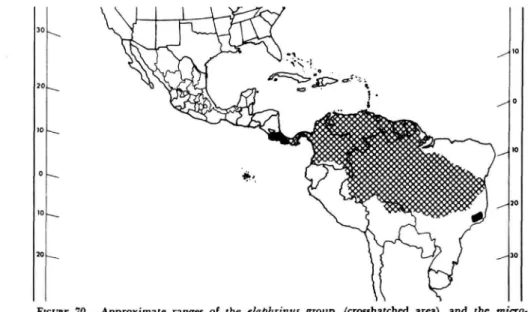
DISTRIBUTION (Figure 70).—The range of this species extends from Costa Rica to the Amazon basin in tropical lowland forests. Easily distinguished from the other two species of the group by the elytra, each of which has eight series of small, even punctulae all the way to the tip. Elytra: Each elytron with eight series of small, even punctulae, each entire to tip; lateral rows more impressed than discal rows; otherwise as in X.
Xystosomus spangleri, new species
DESCRIPTION.-Shape (Figure 43): Medium, broad, moderately convex (more so than X. gruti), with small flat eyes, narrow head, broad pronotum, and square humeri. Can be easily distinguished from the other species in the group (see below) by the shape of the pronotum. Pronotum (Figure 43): Transverse (W/L, x 1.58; row specimens); lateral setigerous pores present only in posterior angles; laterobasal carinae rudimentary; Posterior angles about 90°, sides anterior to the angles more or less equal; lateral margins beaded, not reflexed.
Elytra: Each elytron with six rows of partially striated serial punctures and punctulae, rows 2–6 obliterated before apex; page margins explain narrowly; humeral projection absent, humerus evenly rounded; chaetotaxy as in X. Secondary sexual characters: Male genitalia (Figure 45) with internal sac quite different from members of other species groups.

Xystosomus polytretus, new species
Members of the parainsularis group are characterized by similarities in male genitalia, female genitalia, and pronotal structure. However, the male genitalia of both species in the parainsularis group are very similar and bi. This group is represented by two known species, one from Brazil and one from Colombia-Venezuela (Fig. 71).
The allotype and two paratypes are simply labeled "Novo Gren." [Colombia] and two other paratypes are labeled "Colomb. Color: Head and body rufopiceous; pronotum and head slightly darker than elytra; testaceous appendages; antennae slightly infuscated apically. Pronotum (Figure 47): Slightly transverse (Figure 47): W/ L, x 1.45; row specimens); lateral setigerous pores present in anterior third and in posterior angles; laterobasal carinae well developed;.
Secondary sexual characters: Male genitalia (Figure 49) and female genitalia (Figure 51) characteristic of the species group.
Xystosomus bisulcifrons, new species
The male and female genitalia are of the same type, both groups are wingless, and both have partially fused elytra. I treat them as separate groups here on the basis of frons and pronotal structure. There are two known species of the inflatus group, both known only from Brazil (Figure 72).
Easily distinguished from the other species of the group by the well-developed laterobasal carinae of the pronotum and the deep triangular fova formed medial to the carina. Secondary sexual characters: Male genitalia (Figure 54) and female genitalia (Figure 55) characteristic of the inflatus group. Easily distinguished from all other species in the group by the small, sharp, toothed posterior corners of the pronotum.
Secondary sexual characters: Male genitalia (Figure 63) and female genitalia (Figure 68) characteristic of the species group. Some of the specimens are teneral, indicating at least that the pupal stage occurs in December. Easily distinguished from all species of the group that have no pronotal setae by the sharp posterior corners of the pronotum together with evenly curved lateral margins of the pronotum and bright reddish brown integument.
Secondary sexual characters: male genitalia (Figure 65) and female genitalia (Figure 68) characteristic of the species group. It is easily distinguished from all other species of the group by the black cover or swollen forehead areas in front of the eyes and the omission of the frontal furrows. Secondary sexual characters: Male genitalia (Figure 67) and female genitalia characteristic of the species group.

Xystosomus t hoi us, new species
Xystosomus turgidus (Schaum)
No conclusions can be drawn regarding periods of activity of the elaphrinus group, as only one specimen of X. Much more field work needs to be done to discover the true nature of the elaphrinus group. The leaf- and twig-running members of the gruti group do not have sharp eyes, nor do they have the bulky articles of the male tarsi found in members of the microtretus group.
The large eyes of the gruti group may be necessary for observing diurnal predators (birds, lizards, spiders, and other insects) and are in fact common to many diurnal carabid beetles (Cicindelini, Elaphrini, Notiophilini, Anthiini, Graphopterini, and all bark-running diurnal groups , leaves and twigs that I know). All species of the group are fully winged and the total geographical area is almost as large as that of the group of gruti. It is likely that this group is a fairly recent branch of the Gruti group compared to the following groups.
The limited overall range of the laevis group (Figure 72) is indicative of its immobility or, alternatively, of its restriction or withdrawal and of its specialization. Members of both groups are wingless and flightless, and have some or all of the muscle and sclerite reduction found in the laevis group. The infiatus group (X. infiatus) has strongly developed laterobasal carinae on the pronotum that are structurally similar to those of members of the gruti group or weakly developed carinae (X. convexus) that are still larger than all laevis.
The latter forms a morphocline and is either a result of convergence with members of the gruti group or, more likely, an indication that members of the infiatus group retain a gruti group characteristic while the laevis group has lost it. Externally, the group's two members are different in habitus, but the male genitalia are characteristically of the same type and much closer to the gruti group type than to the laevis group type. However, due to the small amount of material available for study, I do not think it is fair to erect a new name at this time.
Bombardier beetle reclassification and taxonomic revision of North and Central American species (Carabidae: Brachinida). If the submission is invited, the following print format requirements will govern the preparation of the copy.