In writing this thesis, it cannot be separated from the assistance of other parties to provide assistance and guidance so that the writer can complete the research and preparation of the final project. The purpose of this study is to find out the rebellion of women against the patriarchal system and to describe the impact of the patriarchal system on the society. The impact on society due to the patriarchal system was appealed through the actions of characters who lived and acted according to society's norms and pressures, to be an ideal in society's view, women would behave in a good way and follow all the rules of society. society to be a good person, even if it was different with their principles.
INTRODUCTION
Reason for Choosing the Title
Problem of the Research
Question of the Research
Objective of the Research
Scope of the Research
Significant of the Research
It was expected that this research would also be a reference material and a source of inspiration for other writers who were interested in exploring the subject in order to keep up with scientific breakthroughs. There were several acts in this novel that were considered abnormal by society, this study intended that the findings of this study would help society in general, and women in particular, to understand that patriarchal perceptions are not universal truths need not be accepted but must be followed on an ongoing basis and must be implemented continuously. This chapter contains some previous studies related to this study and some understanding related to the topic chosen by the author:.
Previous Studies
The fourth, in 2019, was a study titled Bedouin Women Status Under the Patriarchal System in Moral Tahawi's the Tent researched by. The researcher discovered that all the female characters in the series were still subjected to patriarchal oppression. The main purpose of this research was to look at how feminism was portrayed in the film Brave (2012) and how liberal feminism was portrayed in the film Brave (2012).
Novel
The last one, Human Rights in the novel Half the Sky by Wudunn and Kristof in 2022 by Rizqikah et al. The study aimed to analyze human rights violation and social conditions that impact human rights violation depicted in the novel "Half the Sky", this study applied descriptive qualitative data and used sociological study. The author discovered that the author depicted types of human rights and social conditions that impact human rights in the novel.
The novel, like other types of literary works, contains various messages from the author to the audience, regardless of whether they are explicitly stated in the story (Aisyah, 2021: 1). The novel came to be accepted as a new narrative form in the second half of the twentieth century, with a greater emphasis on analyzing both its formal components and cultural influences. As a result of the emergence of various subgenres of the novel in the second half of the twentieth century, the definitional activity of criticism concerned the Gothic, Oriental, sentimental, political and historical novel (Nixon, 2008: 24).
The narrator usually writes in the third person and comments on the events and characters that occur throughout the story. A witness is also called, therefore plays a supporting role in the events described, and it had some involvement in them, so it may not be objective. The narrator spoke only of what is seen or heard, and the narrator usually did so in the first or third person.
In the novel there were also characteristics that explain what a novel was by looking at its main characteristics, without these three characteristics it was difficult to identify that the work was a novel.
Patriarchal System
All books contain realism, whether in the form of a universal human feeling or connection, a historical setting or time period, or an explanation of how individuals interact with their surroundings. In The Other Sex, de Beauvoir examined what had classified women as society's "other," as well as how existential bad faith and uncertainty play a role in the objectification process. Beauvoir argued that there were biological aspects that were not present in a woman's real relationship.
Although patriarchy had a broad meaning, it did not exclude the possibility of increased public awareness, the evidence was that in recent years violence against women continued to be perpetrated by men. In the last 12 years, feminist sociological studies of various types of male violence against women that highlight the concept of patriarchy have leveled off or worsened, despite their contribution to some of the most important scientific achievements on the subject (DeKeseredy, 2020: 1). Patriarchy came to the surface because of the war that sees there was still very little presence of women in certain fields.
The patriarchal social system and structure placed women in a position where they were not equal to men and believes that the political arena is the realm of men. This was the reason that women's opportunities to become MPs were limited. Since man was aware that not all of his activities could be carried out outdoors, houses were the physical embodiment of the living tradition.
The dominance of men and women in specific rooms, as well as the duality in some parts of the house, are visible.
Existentialist of Feminism (de Beauvoir 1949)
Beauvoir claimed that only men could express the latter, while women were obliged to live a life of immanence that was not creative. Many of de Beauvoir's theories and thoughts were contained in her book The Second Sex, which was officially released in 1949. Simone de Beauvoir successively described her position in a very fundamental way, starting from data biology.
Beauvoir said that woman was very easy to define: she was a womb, an ovary, and of course she was a woman. In the history chapter, the Beauvoir theory of patriarchy explains that woman was dethroned by the advent of private property, and that her fate over the centuries had been linked to private property: her history was to a large extent linked to that of private property. The Heritage. Basically, women were controlled by parents, society or religion (De Beauvoir.
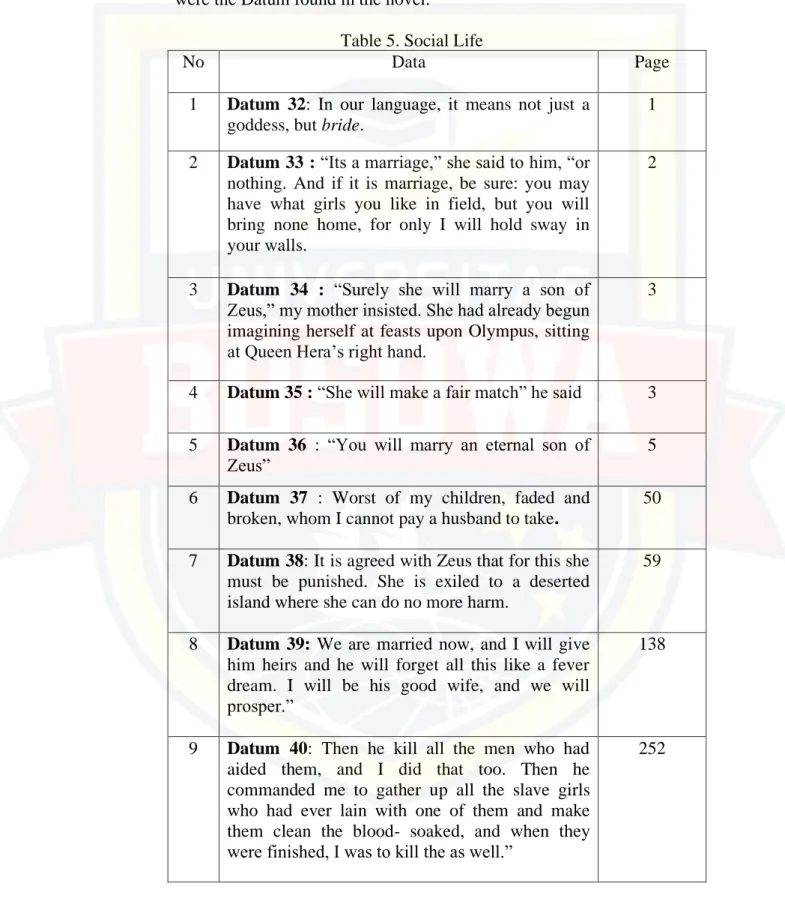
The following theory described the life of women today or Beauvoir, also called the formative years. Moving on from the chapter on the formative years, de Beauvoir again explained the social life, position, marital life and adulthood of a woman. But in men's defense it must be said that women should not stir up the issue.
Here it could be seen that men get irritated and put themselves on the defensive, because men did not want to be the subject, it could be concluded that this game was not fair (de Beauvoir.
METHODOLOGY
Source of The Data
Method of Collecting Data
Method of Analyzing Data
Finding
- Women Rebellion Against the Patriarchal System in the Novel of Madeline Miller Circe
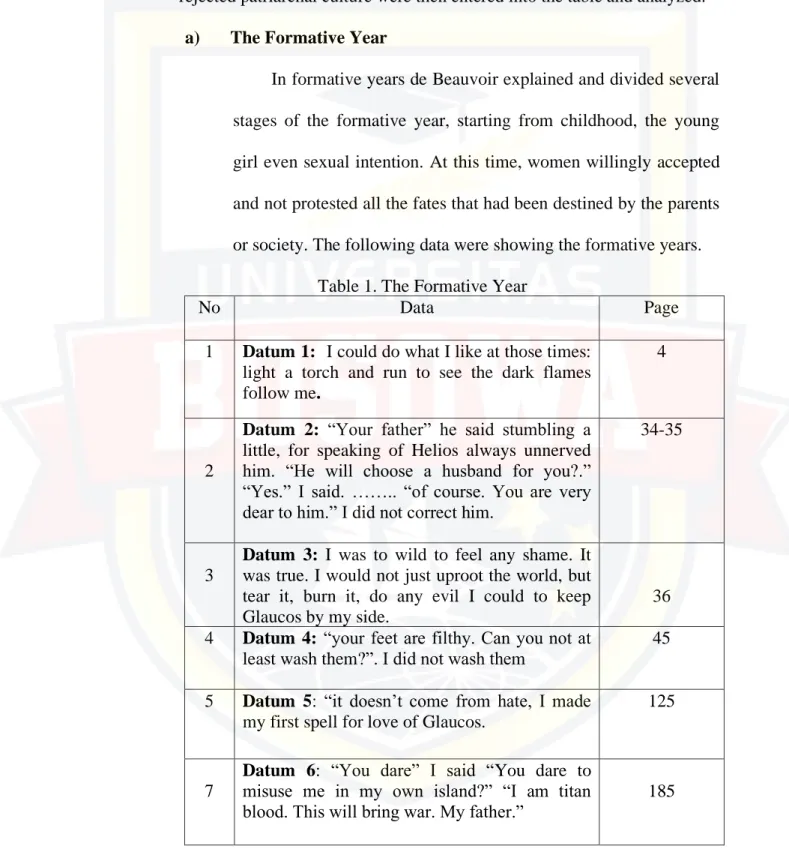
This chapter contains data quoted from the Circe novel which had 330 pages and 27 chapters. The writer found 31 data showing women's rebellion against patriarchy and 12 data showing the impact of the patriarchal system on society. categorized based on the appropriate phase. The events in the novel that rejected patriarchal culture were then tabulated and analyzed. a) The formative year. In the formative years, De Beauvoir laid and divided different stages of the formative year, from childhood, young girlhood and even sexual intention.
Datum 2: “Your father” he said stumbling a little, for speaking of Helios always unnerved
- The Impacts of Patriarchal System to Society in the Novel of Madeline Miller Circe
- Discussion
- Conclusions
- Suggestions
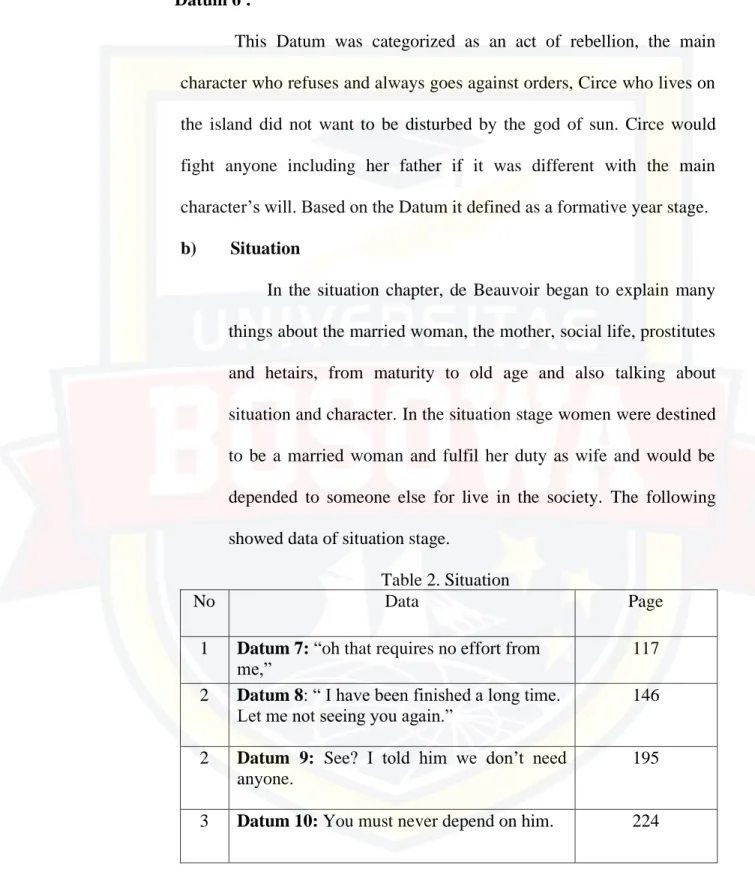
Circe would fight anyone, including her father, if it was against the main character's will. The Date would then be analyzed based on an explanation of the situation, including various things related to the events of the main character in the novel Circe. The behavior of the female protagonist who showed the nature of not needing others, the protagonist who made herself independent from anyone, even Circe was willing to evict anyone who wanted to offer.
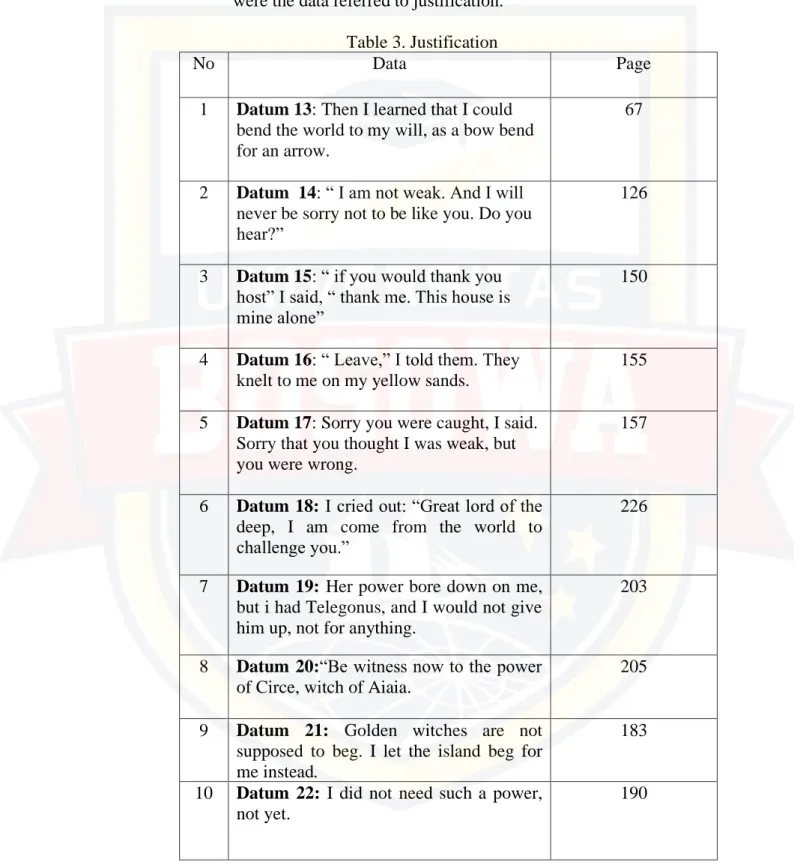
This Date is classified in the situation of the married woman, a situation where Circe was married and even had a son, but after grief by Glaucos, the main character felt that no one else needed to do it alone without the help of others don't. The Date was categorized in the justification stage which showed the strength of the main character. In this case, the main character had a narcissistic nature and was included in the category of justification.
The main character, who received the sentence of expulsion from the house of the sun god, did not follow the rule. Matching was performed only by the parents without asking the daughter's consent. At this stage, the writer found 6 pieces of information related to the formative year in the novel.
In general, the match between Circe and the son of the great god Zeus caused the main female character to be rejected due to an inappropriate desire. Having a man whom the main character loved made Circe one of the proofs of women's rebellion against the patriarchal system in the formative year type. The main character in this phase rejected the patriarchal system through the rules that were set, Circe chose to have no rules and destiny, in this phase Circe was never afraid of the rules being broken. To see the impact of the patriarchal system that took place in the novel, the writer used De Beauvoir's theory, which discusses society.