The 2
ndInternational Conference on Herbal and Traditional Medicine 2017
( HTM 2017 )
“Value-Added of Herbs and Phytotherapy:Challenges for the 21stCentury”
Proceedings
First Published : January 20, 2017 300 copies
ISBN :978-616-223-985-4
CopyrightFaculty of Pharmaceutical Sciences, Khon Kaen University.
All rights reserved.No part of this book and the attached CD can be reproduced or transmitted in any form by any means without permission of the publisher.Released in January 20, 2017.
Tel.6643 202 378, Fax.6643 202 137
Email:htm2017@kku.ac.th Facebook:https://www.facebook.com/htmthailand2017/
Published by:The Organizing and Scientific Committee of HTM 2017 The 2ndInternational Conference on Herbal and Traditional Medicine 2017,
Khon Kaen University, Khon Kaen 40002, Thailand
Khon Kaen University Printing House,
123 Mittraphap road, Nai Muang, Muang, Khon Kaen, 40002 Thailand Tel 6643 347 100 Email:kkuprinting@hotmail.com
Editorial Board
Editor-in-Chief
Waraporn Putalun Khon kaen University Editors
Banlue Sangthong Mahasarakam University Catheleeya Mekjaruskul Mahasarakam University Methin Phadungkit Mahasarakam University Prasoporn Rinthong Mahasarakam University Somsak Nualkaew Mahasarakam University Wanida Caichompoo Mahasarakam University Athip Sakunphueak Prince of Songkla University Juraitip wangsintaweekul Prince of Songkla University Bancha Yingngam Ubon ratchathani University Kusuma Jitsaeng Ubon ratchathani University Rawiwun Kaewamatawong Ubon ratchathani University Thaweesak Juengwatanatrakul Ubon ratchathani University Bungorn Sripanidkulchai Khon Kaen University Ekapol Limpongsa Khon Kaen University kiettipum Poltree Khon Kaen University Naphapuk Jaipakdee Khon Kaen University Natsajee Nualkaew Khon Kaen University Pramote Mahakunakorn Khon Kaen University Prathan Luecha Khon Kaen University Srisomporn Preeprame Khon Kaen University Supatra Porasupattana Khon Kaen University Suthasinee Thapphasaraphong Khon Kaen University Tanit Padumanonda Khon Kaen University Teerasak Damrongrungruang Khon Kaen University Suvara K.Wattanapitayakul Srinakharinwirot University
Editorial assistant
Arthit Vongprajan Khon Kaen University Taechit Cheunpratumtong Khon Kaen University Thongkum Vongprajan Khon Kaen University
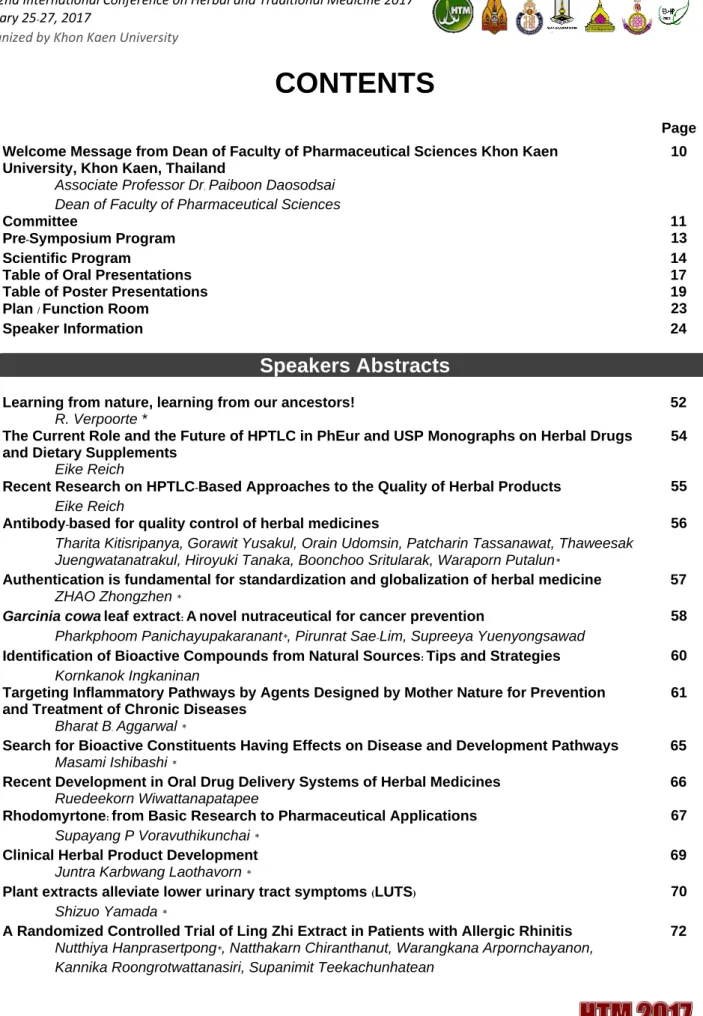
CONTENTS
Page Welcome Message from Dean of Faculty of Pharmaceutical Sciences Khon Kaen
University, Khon Kaen, Thailand
Associate Professor Dr.Paiboon Daosodsai Dean of Faculty of Pharmaceutical Sciences
10
Committee 11
Pre-Symposium Program 13
Scientific Program 14
Table of Oral Presentations 17
Table of Poster Presentations 19
Plan/Function Room 23
Speaker Information 24
Speakers Abstracts
Learning from nature, learning from our ancestors! 52
R. Verpoorte *
The Current Role and the Future of HPTLC in PhEur and USP Monographs on Herbal Drugs and Dietary Supplements
54
Eike Reich
Recent Research on HPTLC-Based Approaches to the Quality of Herbal Products 55 Eike Reich
Antibody-based for quality control of herbal medicines 56
Tharita Kitisripanya, Gorawit Yusakul, Orain Udomsin, Patcharin Tassanawat, Thaweesak Juengwatanatrakul, Hiroyuki Tanaka, Boonchoo Sritularak, Waraporn Putalun*
Authentication is fundamental for standardization and globalization of herbal medicine 57 ZHAO Zhongzhen*
Garcinia cowa leaf extract:A novel nutraceutical for cancer prevention 58 Pharkphoom Panichayupakaranant*, Pirunrat Sae-Lim, Supreeya Yuenyongsawad
Identification of Bioactive Compounds from Natural Sources:Tips and Strategies 60 Kornkanok Ingkaninan
Targeting Inflammatory Pathways by Agents Designed by Mother Nature for Prevention and Treatment of Chronic Diseases
61
Bharat B.Aggarwal*
Search for Bioactive Constituents Having Effects on Disease and Development Pathways 65 Masami Ishibashi*
Recent Development in Oral Drug Delivery Systems of Herbal Medicines 66 Ruedeekorn Wiwattanapatapee
Rhodomyrtone:from Basic Research to Pharmaceutical Applications 67 Supayang P Voravuthikunchai*
Clinical Herbal Product Development 69
Juntra Karbwang Laothavorn*
Plant extracts alleviate lower urinary tract symptoms(LUTS) 70 Shizuo Yamada*
Clinical Study of Zingiber officinale in Cancer Patients 73 Suphat Subongkot*
Abstracts of Oral Presentation Scientists Presentation
CATEGORIES 1:The quality of crude drugs and herbal medicines T1-O-RD-001
Estimation of Total Phenol, Flavonoid and Tannin Contents in Galls of Ficus racemosa Leaf 75 Yogesh V.Ushir*, Sudarshan Singh, Sagar Thorat
T1-O-RD-002
Extraction conditions of Shallot, Chemical Study and Antioxidant Activity 81 Laksana Charoenchai*, Chaowalit Monton, Fameera Madaka, Pathamaporn Pathompak,
Sukanya Settharaksa, Lukman Sueree, Thaniya Wannakup T1-O-RD-003
A Correlation Study of Antioxidant Activity, Total Phenolic Content and Total Flavonoid Content of fruits of Solanum species of North East India
95 Jyotirekha G.Handique*, Dipika Kalita, Pratap Jyoti Handique
CATEGORIES 2:Biotechnology for the production of secondary metabolites T2-O-RD-004
In vitro Regeneration of Gloriosa superba L using Elite Clone collected from North East India and evaluation of their yield potential for colchicine
107 Pratap Jyoti Handique*, Puspa Bhuyan, Jyotirekha G.Handique
CATEGORIES 3:Discovery of natural products from new sources T3-O-RD-005
Bioactive compounds from some medicinal plants used as anti-diabetics 109 Sujata Wangkheirakpam, Satyavama D.Asem, Rohit C.Srivastava, Warjeet S.Laitonjam*
CATEGORIES 3:Discovery of natural products from new sources T3-O-RD-006
Fabrication and Characterization of Anti-Vitiligo Cream containing 5%Hydroalchohlic Extract of Psoralia Corylifolia
110
Barkat Ali Khan, Irshad Hussain T3-O-RD-007
Anti-inflammatory activity of Pyrrosia heterophylla extracts via dual COX/LOX inhibition and inhibition of TNF α
111
Meera George*, V.S.Josekumar T3-O-RD-008
Qualitative analysis of an Ayurvedic medicinal oil(‘Pinda oil’)and studies on lipophilicity of its constituents
112
Chandani Ranasinghe*, Ajita M.Abeysekera, G.M.Kamal B.Gunaherath T3-O-RD-009
Mineral and electrolyte analysis of Manihot utilissima and Carica papaya Leaves: a Prospect of Anti hypotension Agent
121 Nugrahaningsih WH*, Lisdiana, Eling Purwantoyo
T3-O-RD-010
Marine Biodiversity as Starting Point for Drug Discovery and Development 127 Hendrik Luesch*
CATEGORIES 4:New herbal drug formulation T4-O-RD-011
Coffee(Coffea arabica L.)beans wastes:extraction, evaluation and their application in cosmetics and beauty products.
129
Chotika Buakrun, Naphatsorn Kumar
CATEGORIES 5:Phytotherapy and clinical studies of herbal medicines T5-O-RD-012
Ganoderma lucidum inhibits testosterone induced prostatic hyperplasia in rats 140 Alok Nahata*
T5-O-RD-013
Babandotan Leaves(Ageratum conyzoides L.)prevents inflammation and proteoglycan degradation by inhibiting TNFα and MMP9 on Osteoarthritis Model Rat
141 Anton Bahtiar*, Mutiara Nurazizah, Tirza Roselina, Ade Arsianti
CATEGORIES 5:Phytotherapy and clinical studies of herbal medicines T5-O-RD-014
Glucose uptake by muscles action of Syzygium polyanthum Wight methanol extract leaf in vitro
142
Tri Widyawati*, Siti Syarifah, Mariam Ahmad, Mod.Zaini Asmawi T5-O-RD-015
Ant-inflammatory effects of ethanol and aquous extracts of Lawsonia inermis Lin.leaf in carrageenan-induced acute inflammation rats
143
Siti Syarifah, Tri Widyawati
Abstracts of Oral Presentation Students Presentation
CATEGORIES 1:The quality of crude drugs and herbal medicines T1-O-ST-001
In-vitro Alpha-Amylase Inhibitory Activity, Antioxidant Potential, and GC-MS Analysis of Crepe Ginger(Costus speciosus(J.Koenig.)Sm.)Leaves)
145
Jhoan Rhea L.Pizon, Olga M.Nuñeza, Mylene M.Uy, WTPSK Senarath T1-O-ST-002
Determination of trans-Resveratrol in Peanut Using Poroshell HPLC Column and Microwave-Assisted Extraction
146
Kritamorn Jitrangsri , Amornrut Chaidedgumjorn , Malai Satiraphan T1-O-ST-003
Screening of biological activities of Calophyllum inophyllum Linn.seed oil extract 153 Charinrat Sae-Chan*, Jasadee Keawsrichan
T1-O-ST-004
Standardization of Artocarpus champeden Stembark Extract by HPTLC as Raw Material of Antimalarial Herbal Medicine
162
Imam Taufik , Myrna Adianti , Aty Widyawaruyanti *, Mochammad Yuwono T1-O-ST-005
Cytotoxic and Anti-inflammatory Effect of Aqueous Extract from Tithonia diversifolia on Lipopolysaccharide-induced in RAW 264.7 macrophage cells
163
Kamonrat Yub , Jibunjong Thungpong , Poonsit Hiransai
CATEGORIES 3:Discovery of natural products from new sources T3-O-ST-006
Phytochemical Screening and Antioxidant Activities of Barks of Three Selected Philippine Medicinal Plants
165
Shella Mae P.Jalique , Olga M.Nuñeza* T3-O-ST-007
Antioxidation and Anti-inflammation Effects of Agarwood Leaf Extract on Human Keratinocyte Cells
166
Eakkaluk Wongwad , Neti Waranuch , Kornkanok Ingkaninan * T3-O-ST-008
Anti-inflammatory Effect of Moringa oleifera Lam.Leaf Extract on Human Keratinocytes 167 Jinutda Engsuwan , Neti Waranuch , Nanteetip Limpeanchob , Kornkanok Ingkaninan
T3-O-ST-009
4-methoxycinnamyl p-coumarate isolated from Etlingera pavieana rhizome suppresses inflammatory response via NF- B and p38 MAPK signaling pathways in LPS-induced macrophages
168
Sakulrat Mankhong , Ekaruth Srisook , Klaokwan Srisook*
CATEGORIES 4:New herbal drug formulation T4-O-ST-010
Ficus Carica Mucilage for the Development of Mucoadhesive in Situ Nasal Gel of Alprazolam:Effects of Permeation Enhancers
170
Amitava Roy*, Pallab K Haldar , Abhinay Chhetri T4-O-ST-011
Formulation and Penetration Study of Etosom Gel Myristicin of Nutmeg Oil
(Myristica fragrans H.) 171
Susana Elya Sudradjat , Abdul Mun’im , Kris Herawan Timotius , Effionora Anwar T4-O-ST-012
Green Nanotechnology:Nanoencapsulation Formulation Combination White Ginger (Curcuma zedoaria)and Garlic(Allium sativum L.)Extract Activity Against Lymphoma Cells with MTT Assay
172
Herianto Pandapotan , Gayatri Rizkiana*, Oktavia Indrati , Lalu Rizki Fauzi T4-O-ST-013
Antioxidant and eNOS activating activities of ED-BUU-BF4, new Thai herbal formulation, in endothelial EA.hy926 cells
173 Titiporn Thongyen, Klaokwan Srisook*, Petcharat Sawai, Ekaruth Srisook*
THURSDAY JANUARY 26, 2017
Rajthevee Grand Ball Room 1, Floor 3 Scientists
Time Code-ID Name-Surname
13.00-13.15 T4-O-RD-011 Dr.Naphatsorn Kumar 13.15-13.30 T5-O-RD-012 Dr.Alok Nahata
13.30-13.45 T5-O-RD-013 Assist.Prof.Dr.Bahtiar Anton 13.45-14.00 T5-O-RD-014 Dr.Tri Widyawati Tri
14.00-14.15 T5-O-RD-015 Miss Siti Syarifah Siti
Students
Time Code-ID Name-Surname
14.15-14.30 T5-O-ST-019 Mr.Apichakan Sampannang 14.30-14.45 T5-O-ST-020 Miss Pimsuda Kulpradit 14.45-15.00 T5-O-ST-021 Lisdiana Lisdiana
Rajthevee Grand Ball Room 2, Floor 3 Students
Time Code-ID Name-Surname 13.00-13.15 T4-O-ST-011 Mrs.Susana Elya Sudradjat 13.15-13.30 T4-O-ST-012 Mrs.Gayatri Rizkiana 13.30-13.45 T4-O-ST-013 Miss Titiporn Thongyen
13.45-14.00 T5-O-ST-014 Miss Dhaneshree Bestinee Naidoo 14.00-14.15 T5-O-ST-015 Mrs.Erna Harfiani
14.15-14.30 T5-O-ST-016 Miss Dana Joanne Von Trono 14.30-14.45 T5-O-ST-017 Mr.Jaturon burawat
14.45-15.00 T5-O-ST-018 Miss Supatcharee Arun
HTM 2017 Categories 4 :
New herbal drug formulation ( Oral Presentation )
Student Presentation
T4 - O - ST - 011
Formulation and Penetration Study of Etosom Gel Myristicin of Nutmeg Oil (Myristica fragrans H.)
Susana Elya Sudradjat1, Abdul Mun’im2, Kris Herawan Timotius3, Effionora Anwar4
Abstract
Introduction:Myristicin is a sedative drug to be, that can reduce sleep disorders and improve patient health.Transdermal drug delivery is a non-invasive technique and not influenced by absorbtion in the gastro intestinal tract.The aims of this study is to formulate myristicin etosom and measured the penetration ability of myristicin through Spraque Dawley rat abdomen skin as membrane diffusion membrane. Myristicin had been isolated from nutmeg oil by destilation and its content was determined.Myristicin was used as an active ingredient in myristicin etosom gel and myristicin gel. Methods: Myristicin is formulated into etosom in various concentrations of phosphatidyl choline and etanol.Myristicin etosom is prepared with different formulas and characterized by its vesicle size, entrapment effiency, and polydispersity index. Physical stability of the products were investigated, including the influence of the temperatures, organoleptic test, pH, and particle size.The penetration of myristicin from each dosage form was evaluated by means of Franz diffusion cell using rat abdomen skin as a membrane. Results: The result shows that etosom sizes varied from 118.9±4.80 to 778.5±54.28 nm depending on the concentration of soya phosphatidyl choline(SPC)and ethanol.The formulation exhibited entrapment efficiencies from 28±0.44 to 94±1.75%. Flux of penetration of myristicin etosom gel had higher penetration (84.05±1.71 µg cm-2 hour-1)than the penetration of non etosom gel (60.21±2.46 µg cm-2 hour-1).The sum of cumulative penetration of myristicin etosom gel and myristicin gel were 2642.6±44.92 µg cm-2and 1893.1±19.32 µg cm-2 respectively.The percentage of the myristicin penetration from etosom gel was 52.85±2.84% and myristicin from gel was 37.86
±1.74%.Conclusion:The results show that both myristicin etosom gel and myristicin gel are physically stable and penetration ability of myristicin etosom gel is higher than myristicin gel.
Keywords:Etosom, Gel, Skin penetration, Cycling test, Flux
1Faculty of Pharmacy, Indonesia University, Indonesia.
2Departement of Herbal Medicine, Faculty of Pharmacy, Indonesia University, Indonesia.
3Departement of Herbal Medicine, Faculty of Medicine, Krida Wacana Christian University, Indonesia.
4Departement of Pharmacy Technology, Faculty of Pharmacy, Indonesia University, Indonesia.
*Corresponding author:Susana Elya Sudradjat, Departement of Pharmacy, Faculty of Medicine,
Susana Elya Sudradjat 1, Abdul Mun’im2, Kris Herawan Timotius 3 , Effionora Anwar 4 Abstract
Introduction: Myristicin is a sedative drug to be, that can reduce sleep disorders and improve patient health. Transdermal drug delivery is a non-invasive technique and not influenced by absorbtion in the gastro intestinal tract. The aims of this study is to formulate myristicin etosom and measured the penetration ability of myristicin through Spraque Dawley rat abdomen skin as membrane diffusion membrane. Myristicin had been isolated from nutmeg oil by destilation and its content was determined. Myristicin was used as an active ingredient in myristicin etosom gel and myristicin gel.
Methods: Myristicin is formulated into etosom in various concentrations of phosphatidyl choline and etanol. Myristicin etosom is prepared with different formulas and characterized by its vesicle size, entrapment effiency, and polydispersity index. Physical stability of the products were investigated, including the influence of the temperatures, organoleptic test, pH, and particle size.
The penetration of myristicin from each dosage form was evaluated by means of Franz diffusion cell using rat abdomenskin as a membrane.
Results : The result shows that etosom sizes varied from 118.9±4.80 to 778.5±54.28 nm depending on the concentration of soya phosphatidyl choline (SPC) and ethanol. The formulation exhibited entrapment efficiencies from 28±0.44 to 94±1.75%. Flux of penetration of myristicin etosom gel had higher penetration (84.05±1.71 μg cm-2 hour-1) than the penetration of non etosom gel (60.21±2.46 μg cm-2 hour-1). The sum of cumulative penetration of myristicin etosom gel and myristicin gel were 2642.6±44.92 μg cm-2 and 1893.1±19.32 μg cm-2 respectively. The percentage of the myristicin penetration from etosom gel was 52.85±2.84% and myristicin from gel was 37.86 ±1.74%.
Conclusion : The results show that both myristicin etosom gel and myristicin gel are physically stable and penetration ability of myristicin etosom gel is higher than myristicin gel.
Keywords: Etosom, Gel, Skin penetration, Cycling test, Flux 1Faculty of Pharmacy, Indonesia University, Indonesia.
2Departement of Herbal Medicine, Faculty of Pharmacy, Indonesia University, Indonesia.
3Departement of Herbal Medicine, Faculty of Medicine, Krida Wacana Christian University, Indonesia.
4Departement of Pharmacy Technology, Faculty of Pharmacy, Indonesia University, Indonesia.
*Corresponding author:
Susana Elya Sudradjat, Departement of Pharmacy, Faculty of Medicine, Krida Wacana Christian University, Indonesia. Email: [email protected]
fragrans Houtt).1-3 (Figure 1). Myristicin is a derivate of phenylpropanoid compounds, in the form of a clear liquid, not soluble in water but soluble in organic solvents.4
Figure 1 Chemical structure of Myristicin
The bioavailability of myristicin is low when administered orally. It will metabolized into 1,2-dihyroxymyristicin5 to enhance the bioavailability of myristicin, transdermal drug delivery with a patch is the best choice. It is a non-invasive method, and it doesn't depend on the absorption mechanism in the digestive tract. The development of the transdermal method, including the application of lipid-based vesicles, will solve the permeability barrier of the stratum corneum.6 The lipid-based vesicles might merge with skin lipids due to their similar biocompatibility characters. Ethosome is better than liposome since its lipid vesicles may penetrate and enter deeper into the skin or stratum corneum. The synergetic combination of phospholipid and ethanol is important for the efficacy of drug delivery through the skin layer. Therefore, ethosome is considered better than transfersome and liposome.7
Ethosome vesicle has been applied form the delivery of several drugs, such as erythromycin, lamivudine (antivirus), insulin, minoxidil (hair grower), diclofenac (anti-arthritis), trihexyphenidyl (antiparkinson), miconazole (anti fungi), salbutamol sulfate, propranolol, and testosterone. It is also applicable to herbal medicine for several skin diseases, such as scabies, anti- inflammation, etc.8 Presently benzodiazepines are widely used as sedative drugs, but they have a
loaded ethosome by comparing various combinations of soy phosphatidylcholine and ethanol, to evaluate the stability, and the skin penetration ability.
MATERIAL AND METHODS:
Chemicals and reagents: Myristicin used in this study was obtained from Balittro (Balai Penelitian Tanaman Rempah dan Obat, Research Center for Plant Spices and Medicine, Bogor, Indonesia). The myristicin was isolated from nutmeg oil by the fractional vacuum distillation. The myristicin content is 83,45%.11
Lipoid S-100 (96,5% soy L-α-Phosphatidylcholine) was a grant from Lipoid GmBH (Germany).
Ethanol 96 %, dichloromethane, and methanol (HPLC-grade) were bought from Merck (Germany). Carbopol 940® was obtained from Sinobio (China). All other solvents and reagents were an analytical grade, bought from Sigma (America).
Instrumentation:
HPLC was conducted using Schambeck (Germany) equipped with a reversed-phase column (5 μm, ACE® C18, 250×4.6 mm) and UV/Vis detector (278 nm), and run at room temperature.
Methanol was used as the mobile phase.
Formulation of myristicin loaded ethosome
The thin-film hydration method was used to form myristicin loaded ethosomes. Nine different ethosomal formula were designed (Table 1). Firstly, phospholipid and myristicin were dissolved in dichloromethane-ethanol (2:1). The solvent was then evaporated by rotary evaporator at 370C at 50 rpm with increasing the rotary's speed every 30 minutes up to 150 rpm. Afterward, the obtained thin layer was blasted with nitrogen gas and then kept in a refrigerator for one night.
After being kept overnight in the refrigerator, the thin layer was hydrated with aquabidest-ethanol- propylene glycol solvent at 370C at 50 rpm and increased the rate every 30 minutes up to 150 rpm.
To get the smaller size of the ethosome vesicle, the sonication of ethosome suspension is 5 minutes.
The resulted suspension was kept in the vial and kept in the refrigerator until it is needed to be used.7
Myristicin 0.1 0.1 0.1 0.1 0.1 0.1 0.1 0.1 0.1
PC 2 2 2 3 3 3 4 4 4
Ethanol 20 30 40 20 30 40 20 30 40
PG 5 5 5 5 5 5 5 5 5
Aqua ad 100 ad 100 ad 100 ad 100 ad 100 ad 100 ad 100 ad 100 ad 100 PC=phosphatidylcholine; PG= propylene glycol
Particle size analysis of ethosomes
Dynamic laser scattering (Zetasizer Nano ZS, Malvern Instruments, UK) was used to measure the size of the particle and the zeta potential. Ethosome suspension was diluted with an appropriate solvent. All measurement were in triplicate.7
Myristicin entrapment efficiency
Ethosomal vesicles were separated from unentrapped myristicin by centrifugation at 15.000 rpm for 30 minutes at 40 0C. After centrifugation, the sediment was separated from the supernatant.
The sediment was lysed by using methanol and then filtered at 0.45 µm. The solvent was diluted with methanol before analyzing it with HPLC. The experiment was done in triplicate at 25 0C, and the entrapment efficiency (EE) was calculated as followed.12
EE= (the entrapped myristicin)/( the total amount of myristicin ) x 100%
Morphology of myristicin-ethosome
The morphology of myristicin ethosome was observed by the transmission electron microscopy (TEM FEI, type: Tecnai G2 Spirit 120 KV). The samples were placed on the grid and stained with 1% phosphotungstic acid.13
Gel Preparation
The gel was made from carbomer and triethanolamine neutralized. After that, propylene glycol was added to the gel base, then it was homogenized. The composition of the gel formula is in Table 2. The ethosomal gel myristicin was made by incorporated ethosomal myristicin into gel formula
Myr-ethosome Equivalent to Myr 1mg/g -
Myr - Equivalent to Myr 1mg/g
Carbopol 940® 1 1
Triethanolamine 0.5 0.5
Propylene glycol 7.5 7.5
Aquabidest ad 100 100
Myr: myristicin; EG: ethosomal gel; NEG: non-ethosomal gel.
Physicochemical Evaluation of Gel Dosage Forms
Physicochemical evaluation of gel, such as organoleptic test, homogeneity, pH, viscosity, and rheology properties, were conducted.
Gel Stability Test
According to Djayadisastra, these tests were conducted by recording the effect of storing the samples at different temperatures (4±2 ºC, 25±2 ºC, and 40±2 0C) for 12 weeks. The organoleptic (color, odor, and homogeneity), viscosity, pH, and observed the syneresis with interval two weeks of each observation. The cycling test was done for 6 cycles within 12 days.14
Myristicin ethosomal gel penetration with Franz diffusion cell
Penetration test was done by using the abdominal skin of female Spraque-Dawley rats, weighing 250-300 g. The test has been done in triplicate. The test was performed by using Franz diffusion cell, having 16 ml compartment volume, and its membrane area was 1.31 cm2. The phosphate buffer (pH 7.4, 1% tween) was used to fill the compartment. The test was run under 37 0C and stirred at 300 rpm.15
The analysis was done by putting one gram of ethosomal gel myristicin or myristicin gel on the surface of the skin in the donor compartment. Then, took a half ml of the buffer from the recipient compartment after 30 minutes, 1, 2, 3, 4, 6, 8, and 12 hours. Afterward, gave the same amount of fresh buffer as a replacement, and then analyzed the samples by HPLC for their myristicin content.
Ethical clearance
The use of rats in this research has ethical approval from the Health Research Ethics Committee, Faculty Medicine, University of Indonesia, Cipto Mangunkusumo Hospital. The number of this
RESULTS
Formulation of myristicin loaded ethosome
Myristicin was incorporated into nine formulations of ethosomes (see Table 1). From the nine different formulations, the particle sizes of four formulas were namely E1, E2, E4, and E5. and they were less than 200 nm. The rest were more than 200 nm. The highest entrapment efficiency was E4 that reached 94.1 %. (see Table 2)
Table 2: Particle size and myristicin entrapment efficiency
Parameter Formula
E1 E2 E3 E4 E5 E6 E7 E8 E9
PS (nm) 134.5±4.6 132.0±6.4 380.6±23.5 131.6±6.3 118.9±4.8 532.6±21.2 290.3±18.3 538.7±34.3 778.5±54.3
EE (%) 84.7±2.4 79.2±1.4 78.5±2.8 94.1±1.7 80.4 ±2.4 54.1±3.8 91.7±4.3 50.5±3.7 28.0±2.2
PS= Vesicle Size; EE= Entrapment Efficiency
Therefore, formula E4 was considered as the best formula and used to formulate the myristicin loaded ethosomal gel. Analysis with Transmission Electron Microscopy (TEM) showed that ethosome (E4) had a spherical shape (Figure 2).
After 12 weeks of incubation, the viscosity of both gels decrease into 3.33 % for EG and 4.17 % for NEG (Figure 3).
Fig. 3: Comparison of gel viscosity at week 0 and 12
The transdermal penetration test showed that EG and NEG were able to penetrate the myristicin through the rat skin in Franz Diffusion Cell. Flux of penetration of myristicin etosom gel had higher penetration (84.05±1.71 μg cm-2 hour-1) than the penetration of non etosom gel (60.21±2.46 μg cm-2 hour-1). (Figure 4).
0 1000 2000 3000 4000 5000 6000 7000 8000
1 12
Viscocity (Cps)
Time (Weeks) EG
NEG
0 20 40 60 80 100
NE NEG
Flux(µg.cm-2.hours-1)
Penetration flux of myristicin from EG and NEG
DISCUSSION
The purpose of this study is to enhanced myristicin penetration and bioavailability, by formulating myristicin in ethosome.7 Ethosomes are a good carrier for transdermal drug delivery, and the size is highly important. The size of these vesicles is reduced to 200 nm or 300 nm to be suitable for this route of administration.17 The highest entrapment efficiency is 94,1% (E4). The combination of the nonpolar compound, 3% soy phosphatidylcholine and polar compound, 20% ethanol has key role to create an appropriate formation of the leaky vesicle membrane that decreasing the myristicin entrapment.18
The ethosomes can improve the stability of myristicin since they can shield myristicin from the temperature and oxidation exposure.7,19 The declination in viscosity is related to the reduction in the pH of the gel. The rheological properties of the ethosomal gel indicate no changes after 12 weeks of storage. They tend to have pseudoplastic thixotropic rheology.
The low amount of penetration of NEG is due to myristicin hydrophilicity (Log P=3.53) that makes it difficult to penetrate the skin. This result is in accordance with the previous studies, where EG piroxicam and quercetin EG have higher penetration compare to NEG.20,21 This myristicin entrapped in the ethosome will be in a phospholipid molecule that has the characteristics that resemble the lipid bilayer in the stratum corneum. Thus it can increase drug penetration through the skin because the phospholipids that absorb myristicin have the appropriate partition coefficient to be able to penetrate.22 Ethosome formulated into gel dosage forms can control the drug delivery.23 The appropriate formulation is important in order to have a significant drug release.
The combination of hydrogel and ethosome increases drug release.24 The use of gel as an ethosome carrier can increase the penetration of this myristicin. The penetration of myristicin in a NEG may cause by propylene glycol as a penetration enhancer. 25
can be concluded that myristicin loaded ethosome can increase the penetration of myristicin.
CONFLICT OF INTEREST: The authors declare that there is no conflict of interest.
ABBREVIATION USED: EE: Entrapment efficiency; EG: Ethosomal Gel; Myr: myristicin; NEG:
Non-Ethosomal Gel; OE: Oral Emulsion; PDI: Polydispersity index.
REFERENCES
1. Dawidowicz AL and Dybowski MP. Simple and rapid determination of myristicin in humanserum.Forensic Toxicology. 2013; 31(1): 119-123.
2. Sonavane GS, et al. Anxiogenic activity of Myristica fragrans seeds. Pharmacology Biochemistry and Behavior. 2002; 71(1): 239-244.
3. Van Gils C and Cox P. Ethnobotany of nutmeg in the Spice Islands.1994; 8741(94).
4. Haynes, W. CRC Handbook of Chemistry and Physics. CRC Press; 2017: 97th edition
5. Lee HS, Jeong TC, Kim JH. In vitro and in vivo metabolism of myristicin in the rat. Journal of Chromatography B: Biomedical Sciences and Applications.1998;705(2): 367-372.
6. Barry B. Novel mechanisms and devices to enable successful transdermal drug delivery.
European Journal of Pharmaceutical Sciences. 2001; 1492): 101-114.
7. Touitou E. Ethosomes — novel vesicular carriers for enhanced delivery : characterization and skin penetration properties. Journal of Controlled Release. 2000; 65(3): 403–418.
8. Dhiman S, Singh T, Rehni A. Transdermal patches: A recent approch to new drug delivery system. International Journal of Pharmaceutical Sciences. 2011; 3: 26-34.
9. Katzung B, Masters S, Trevor A. Basic and clinical pharmacology. 2010. 12th ed. Mc Graw Hill.
10.Muchtaridi, et al. Identification of compounds in the essential oil of nutmeg seeds (Myristica fragrans Houtt.) that inhibit locomotor activity in mice. International Journal of Molecular Sciences. 2010; 11(11): 4771-4781.
11. Sudradjat SE, et al. The Isolation of Myristicin from Nutmeg Oil by Sequences Distillation.
& Development, I(Viii), 280–306.
13.Barupal A, Gupta V, Ramteke S. Preparation and characterization of ethosomes for topical delivery of aceclofenac. International Journal of Pharmaceutical Sciences.2010; 72(5: 582- 586.
14.Djajadisastra J. Cosmetic Stability. Paper presented at the meeting of Association of Indonesia Cosmetics Scientists, Jakarta, Indonesia. November 2004.
15.Modi P and Shah N. Optimization of an invitro release test for topical formulations containing eberconazole nitrate and mometasone furoate. Der Pharma Chemica. 2015; 1-9.
16.Amrih D, Hidayat C, Hastuti P. Kinetic Degradation of Myristicin, Elemicin, and Safrole in Encapsulated Banda Nutmeg (Myristica fragrans Houtt) Oleoresin. Indonesian Food Nutrition Programme.2017; 14(1): 43.
17.Abdulbaqi I, et al. Ethosomal nanocarriers: The impact of constituents and formulation techniques on ethosomal properties, in vivo studies, and clinical trials. International Journal of Nanomedicine. 2016; 11: 2279-2304.
18.Ahad A, et al. Enhanced transdermal delivery of an anti-hypertensive agent via nanoethosomes: Statistical optimization, characterization, and pharmacokinetic assessment.
International Journal of Pharmaceutics.2013; 443(1-2): 26-38.
19.Rakesh R and Anoop K. Ethosomes for transdermal and topical drug delivery. International Journal of Pharmaceutical Sciences. 2012; 4: 17-24.
20.Garg V, et al. Systematic Development of Transethosomal Gel System of Piroxicam:
Formulation Optimization, In Vitro Evaluation, and Ex Vivo Assessment. AAPS Pharmaceutical Science and Technology.2017; 18(1): 58-71.
21.Ramadon D, Anwar E, Harahap Y. In vitro penetration and bioavailability of novel transdermal quercetin-loaded ethosomal gel. Indian Journal of Pharmaceutical Sciences. 2017; 79(6):948–
56.
22.Rastogi V and Yadav P. Transdermal drug delivery system: An overview. Asian Journal of
2011;14(3):336–46.
25.Walter KA and Dekker M. Dermatological and Transdermal Formulation. CRC Press. 2002