ARINC
Voice Services
Operating Procedures Handbook
a 2
2551 Riva Road Annapolis, MD
21401-7465 U.S.A.
ARINC
Voice Services
Operating Procedures Handbook
a 2
2551 Riva Road Annapolis, MD
21401-7465 U.S.A.
ARINC Voice Services
Change Log
Date Rev Action/Preparer
November 4, 1991 Original Issue
June 17, 1992 A ECN 00208/J. B. Metzger August 12, 1993 B ECN 1163/J. B. Metzger
ECN 1375/J. B. Metzger February 2, 1994 C ECN 1895/J. B. Metzger August 26, 1994 D ECN 2455/J. B. Metzger April 17, 1996 E ECN 3602/J. B. Metzger April 24, 1996 F ECN 3620/J. B. Metzger May 7, 1996 G ECN 3638/J. B. Metzger September 23, 1997 H ECN 4386/J. B. Metzger January 9, 1998 I ECN 4555/J. B. Metzger September 17, 1998 J ECN 4955/J. B. Metzger April 25, 2000 K SPCR 34446/A. Stutz September 6, 2001 L SPCR 38297/A. Stutz
NOTICE: Any questions regarding the contents of this document or the use of ARINC voice services should be directed to ARINC Headquarters, Air Traffic Communications Support at (410) 266-4430. Additional copies are available through this phone number or via e-mail request to [email protected]. A current copy of this manual can also be obtained from the ARINC web site (www.arinc.com).
Note: Jeppesen maps are not provided in downloaded copies.
ADNS, ADNS I, ADNS II, APN, and ARINC Data Network Service are service marks of ARINC Incorporated and Aeronautical Radio, Inc.
Aeronautical Radio, Inc., 2001. All rights reserved.
☞
ARINC Voice Services Contents
CONTENTS
SECTION
1. Scope
1.1 Identification . . . 1-1 1.2 Description of Service . . . 1-1 1.3 Communications Centers . . . 1-2 1.4 Message Formats . . . 1-2 1.5 Charging Contacts . . . 1-3 1.6 Document Overview . . . 1-3 1.7 Definitions of Terms and Acronyms . . . 1-4
SECTION
2. Air/Ground Communications Procedures
2.1 General Description . . . 2-1 2.1.1 International Service . . . 2-1 2.1.2 Domestic Service . . . 2-1 2.2 International and Domestic Operations . . . 2-1 2.2.1 International Operations . . . 2-2 2.2.1.1 North Atlantic/Maritime Canada . . . 2-2 2.2.1.2 Caribbean/Gulf of Mexico . . . 2-2 2.2.1.3 Pacific . . . 2-2 2.2.1.4 HF Radio Checks . . . 2-3 2.2.2 Domestic Operations . . . 2-3 2.3 International and Domestic Procedures . . . 2-4 2.4 VHF Dial Access Service . . . 2-5 2.4.1 VHF Dial Access Procedures . . . 2-5 2.4.2 When Dial Access Login Sequence Is Complete . . . 2-5 2.4.3 Standards for Use . . . 2-5 2.5 SATCOM Voice Procedures . . . 2-6 2.5.1 Air/Ground Calling Procedures . . . 2-6 2.5.2 Ground/Air Calling Procedures . . . 2-7 2.6 Communications Trouble Reporting . . . 2-7
SECTION
3. Phone Patch Procedures
3.1 General . . . 3-1 3.2 Phone Patch Connections . . . 3-1
Contents ARINC Voice Services 3.6 Ground/Air Connection Procedures . . . 3-2
SECTION
4. Long Distance Operational Control Facility
4.1 General . . . 4-1 4.2 LDOCF Operation . . . 4-1 4.2.1 Service Areas . . . 4-1
SECTION
5. SELCAL
5.1 Description of Service . . . 5-1 5.2 Operation . . . 5-1 5.3 SELCAL Tones . . . 5-1 5.3.1 12-Tone Codes . . . 5-1 5.3.2 16-Tone Codes . . . 5-2
SECTION
6. Permissible Communications
SECTION
7. ARINC Communications Records
APPENDIX
A. Standard Message Text Identifiers
A.1 Standard Message Identifier (SMI) . . . A-1 A.2 Text Element Identifier (TEI) . . . A-1 A.3 Message Examples . . . A-2
APPENDIX
B. ARINC Center Contact Information
B.1 ARINC Centers . . . B-1 B.2 ARINC Lease/Contract LDOCF Stations . . . B-1
APPENDIX
C. ARINC Contact Information
C.1 ARINC Communications Centers’ Administrative Information . . C-1 C.1.1 New York (NYC) . . . C-1 C.1.2 San Francisco (SFO) . . . C-1 C.1.3 ARINC Customer Service . . . C-1 C.1.4 Operational Questions . . . C-1 C.1.5 World Wide Web Site . . . C-2
ARINC Voice Services Contents
APPENDIX
D. North Atlantic HF SSB Families
ATTACHMENT
E. Jeppesen Charts List of Figures
D-1 North Atlantic Flight Information Region Boundaries . . . D-3
List of Tables
B-1 HF SSB LDOCF Frequencies Guarded (kHz) . . . B-2 D-1 North Atlantic HF Radiotelephone Families . . . D-1 D-2 North Atlantic HF Radiotelephone Networks . . . D-2
Contents ARINC Voice Services
ARINC Voice Services Scope: 1.1➧1.2
SCOPE 1
1.1 Identification
This document provides a brief description of the Air/Ground Voice communication services offered by Aeronautical Radio, Inc. (ARINC) and includes operational procedures for their use. Operational communications services have been provided to aviation by ARINC since 1929. Formed by a consortium of airlines, the company is still privately owned by airlines and aviation industry companies. ARINC is headquartered in Annapolis, Maryland.
1.2 Description of Service
International Air/Ground Voice Service
The Air/Ground International Voice Service is comprised of Air Traffic Control (ATC) communication services for the Federal Aviation Administration (FAA) and Aeronautical Operational Control (AOC) communication services for the airlines and other aircraft operators. These services are provided by the ARINC Communications Centers located at New York (Long Island MacArthur Airport), and San Francisco (near Livermore),
California. HF and VHF voice radio are the primary means of air/ground communications.
There is limited data link capability for some aircraft. ARINC Communications Centers also have telephone facilities to accommodate Satellite Communications (SATCOM) voice.
Besides communications services, all ARINC Communications Centers can provide weather reports and forecasts on request.
Oceanic ATC services are provided for the FAA in the Anchorage, Houston, Miami, New York, Oakland, and San Juan Flight Information Regions (FIRs). ATC messages, known as flight safety messages in International Civil Aviation Organization (ICAO) terminology, are handled on Major World Air Route Area (MWARA) HF radio frequencies. VHF radio installations are used along the coastal areas to supplement HF coverage. For aircraft communicating directly with the FAA via Controller Pilot Data Link Communications (CPDLC), ARINC Communications Centers provide backup voice communication services, including HF radio and SATCOM voice, to aircraft so equipped.
AOC services, known as flight regularity messages in ICAO, are handled on HF Long Distance Operational Control Facility (LDOCF) frequencies or on VHF networks covering coastal areas within the Gulf of Mexico and Caribbean, and throughout the domestic U.S.
All ARINC Communications Centers are equipped to connect Air/Ground HF and VHF
Scope: 1.3➧1.4 ARINC Voice Services
Domestic Air/Ground Voice Service
ARINC operates a system of over 100 ground radio stations within the 48 contiguous United States, which are interconnected using dedicated telephone lines to form 12 networks. In addition, ARINC maintains a VHF network between Seattle (SEA) and Anchorage (ANC) for use by aircraft flying this route. The networks are situated along major air routes to provide continuous coverage above 20,000 feet. Below 20,000 feet, coverage is available but not guaranteed to be continuous. On-ground coverage is provided at most major airports. The advantage of this service is that stations are networked to provide coverage over long distances, well beyond single station line-of-sight coverage.
These networks are controlled from the ARINC San Francisco Communications Center.
The ARINC domestic VHF networks are used primarily for handling AOC communications.
1.3 Communications Centers
All communications flow directly through the ARINC Communications Centers to or from the aircraft operator’s offices or FAA Air Route Traffic Control Centers (ARTCCs) via data circuits, private line telephone, or the Public Switched Telephone Network (PSTN).
ARINC Communications Centers are interconnected to customer data communication circuits through the ARINC AviNet. AviNet is an electronic switching system that handles the entire data message switching requirements for many airlines and airline-associated industries, such as car rental agencies, ground handling agencies, and hotel chains that have contracted with ARINC for this service. AviNet also interconnects to other telecommunications networks, such as the FAA/ICAO Aeronautical Fixed Telecommunications Network (AFTN) and Société Internationale de Télécommunications Aéronautiques (SITA), affording AviNet customers a worldwide data communications capability.
1.4 Message Formats
All Air/Ground messages received by ARINC Radio Operators on HF/VHF circuits are transcribed into the ARINC Air/Ground Terminal System (AGS) for relay to ATC or company operational control offices.
Air/Ground messages transmitted from ARINC Centers are in a Standard Message Text (SMT) format. A message is identified by a Standard Message Identifier (SMI) on the first line of message text. Each element of message text is identified by a Text Element Identifier (TEI).
An element of message text that cannot be associated with a TEI is entered as Free Talk. The Free Talk portion of the message is identified by a dash symbol followed by a space. The SMT format was developed by ARINC primarily for airline use within their computerized flight management systems. Definitions of the commonly used SMIs and TEIs, along with message examples, can be found in Appendix A.
ARINC Voice Services Scope: 1.5➧1.6
1.5 Charging Contacts
ARINC Voice Services are available to all aircraft operators—airline, corporate, private, and State (U.S. and foreign) without discrimination. A service contract with ARINC is required for company delivery of AOC messages.
In the Air/Ground Services, each contact and/or required intercept is counted as a charge unit.
A contact is defined as the completed exchange of information between an aircraft and an ARINC Communications Center and may consist of more than one transmission from the aircraft and/or the ARINC Communications Center. A contact begins with a call-up (by the aircraft or the ARINC Communications Center) and ends with an acknowledgment of receipt of the transmission or transmissions made between the call-up and the acknowledgment. For example, an Air/Ground call from an aircraft, ARINC Communications Center response, position reported by the flight, and ARINC Communications Center acknowledgment constitutes one contact.
Intercepted readbacks of partial reports and confirmations furnished by adjacent ARINC Communications Centers are considered good circuit coordination and are not counted as additional contacts by the assisting center.
An Air/Ground message relayed to another ground station for the information of that center’s operating personnel only, and not for onward relay to ATC, company, or other offices, is also considered an assist given to a primary center by an adjacent center and is not counted as a contact. Likewise, an assist given to a primary center by an adjacent center is not a completed exchange of information and is not counted as a contact by the intercepting center.
1.6 Document Overview
This document provides a basic description of radio and voice services provided by ARINC HF and VHF Communications Center facilities. This document is intended for distribution to users of the ARINC Air/Ground voice services as well as ARINC radio operations personnel.
Below is a brief summary of the sections in this document:
Section 1, Scope
Introduces the system and describes the purpose and contents of this document.
Section 2, Air/Ground Communications Procedures
Provides a description of radio procedures for international and domestic Air/Ground radio communications and SATCOM voice.
Section 3, Phone Patch Procedures
Phone Patch direct-voice connections between a flight crew and company operational offices.
Section 4, Long Distance Operational Control Facility
Scope: 1.7 ARINC Voice Services
Section 5, SELCAL
Describes the signaling method used to alert aircraft that a ground station wishes to communicate with it.
Section 6, Permissible Communications
Describes acceptable and unacceptable communications.
Section 7, ARINC Communications Records
Describes communications records retention practices of ARINC Communications Centers.
Appendix A, Standard Message Text Identifiers
Lists the definitions for the most commonly used identifiers used in message transcription by Radio Operators.
Appendix B, ARINC Center Contact Information
Lists contact phone numbers and Teletype addresses for ARINC Communications Centers and ARINC Lease/Contract LDOCF facilities.
Appendix C, ARINC Contact Information
Lists information relating to ARINC Communications Centers and Headquarters administration.
Appendix D, North Atlantic HF SSB Families
Lists the North Atlantic radio telephone networks and associated NAT routes.
Attachment E, Jeppesen Charts
Contains International, Domestic, and ACARS/AFIS coverage charts produced for ARINC by Jeppesen. (These maps are not provided in on-line copies.)
1.7 Definitions of Terms and Acronyms
The following abbreviations, acronyms, and mnemonics are used in this document.
Item Meaning
A/G Air/Ground
ACARS Aircraft Communications Addressing and Reporting System AES Aeronautical Earth Station
AFIS Aircraft Flight Information System
AFTN Aeronautical Fixed Telecommunications Network
AGS Air/Ground Terminal System
AOC Aeronautical Operational Control ARINC Aeronautical Radio, Inc.
ARTCC Air Route Traffic Control Center
ATC Air Traffic Control
ATIS Automatic Terminal Information Service
ARINC Voice Services Scope
Item Meaning
AviNetSM
(formerly ADNS)}
An integrated network of message processing and switching processors operated by ARINC. AviNet provides interairline message switching, including a universal intercomputer exchange for rapid data transfer between many U.S. and foreign airline computer systems.
CAR Caribbean
CEP Central East Pacific
CFR Code of Federal Regulations
CWP Central West Pacific
FAA Federal Aviation Administration
FCC Federal Communications Commission
FIR Flight Information Region
GES Ground Earth Station
GOM Gulf of Mexico
HF High Frequency
ICAO International Civil Aviation Organization
ID Identification
LDOCF Long Distance Operational Control Facility MNPS Minimum Navigation Performance Specifications MWARA Major World Air Route Area
NAT North Atlantic
NOP North Pacific
OTS Organized Track System
PSTN Public Switched Telephone Network SATCOM Satellite Communications
SELCAL Selective Calling System
SITA Société Internationale de Télécommunications Aéronautiques SMI Standard Message Identifier
SMT Standard Message Text
SOP South Pacific
SSB Single Sideband
TEI Text Element Identifier
VHF Very High Frequency
Scope ARINC Voice Services
ARINC Voice Services Air/Ground Communications Procedures: 2.1➧2.2
AIR/GROUND
COMMUNICATIONS PROCEDURES 2
2.1 General Description
This section describes the procedures for International and Domestic Services associated with ATC and AOC voice communications. It addresses the use of HF, VHF, and SATCOM voice for ATC and AOC for flights through U.S. controlled FIRs and the use of VHF for AOC within U.S. domestic airspace.
2.1.1 International Service
In areas beyond the coverage of ATC VHF or UHF radios, ARINC provides ATC communication services on HF frequencies comprised of the relay of ATC clearances, requests, advisories, and position reports between the FAA and aircraft. ARINC Communications Centers are staffed with Radio Operators who act as the intermediary between controllers and pilots. Radio Operator positions are equipped with computer workstations consisting primarily of a terminal and keyboard as part of the Air/Ground System, and a radio and telephone communications system. The latter is comprised of radio and frequency selection, SELCAL, antenna selection, telephone, and various other
communications features. Nearly 80 percent of international services are conducted in support of the FAA. ARINC Communications Centers handle over two million ATC messages and position reports per year. The remaining 20 percent (over 500,000 messages) are AOC in nature.
2.1.2 Domestic Service
The Air/Ground Domestic Service is provided by the ARINC Communications Center at San Francisco. Only AOC traffic is handled by this service, consisting of company information relay and weather-related product delivery and Phone Patches. The Radio Operators dedicated to this service also use the AGS and communications equipment. This service meets FAR 121.99 communication requirements for dispatch and is complementary to the Aircraft Communications Addressing and Reporting System (ACARS), which is a data link communications system.
2.2 International and Domestic Operations
Air/Ground Communications Procedures: 2.2.1➧2.2.1.3 ARINC Voice Services
2.2.1 International Operations
International A/G radio procedures apply to the following oceanic regions:
North Atlantic/Maritime Canada Caribbean/Gulf of Mexico Pacific
Note: Jeppesen-Sanderson ARINC 3 and ARINC 4 charts list all HF and VHF frequencies in use at ARINC aeronautical stations. In addition, ARINC frequencies are published on Jeppesen- Sanderson Oceanic Charts and in the DoD Flight Information Handbook.
2.2.1.1 North Atlantic/Maritime Canada
Aircraft operating over the North Atlantic (NAT) on routes within the New York and Miami oceanic FIRs will be under the radio guard of the ARINC New York Communications Center.
Communications concerning air traffic control in these areas are conducted on the NAT Family A and E MWARA high frequencies.
Note: The International Notices to Airmen, published by the FAA, states that it is mandatory to have HF radio equipment installed and operational in aircraft operating anywhere in the New York Oceanic FIR airspace. This includes the oceanic airspace between the United States and Bermuda.
Flights operating over the Canadian Maritime Region and then via oceanic routes to Europe will be in direct contact with, and under the control of, the Canadian domestic ARTCCs until leaving the North American coastline, after which they will be under HF radio guard of the Canadian aeronautical station at Gander, Newfoundland.
Aircraft operators who desire to have their A/G messages relayed to their company offices may make prior arrangements with Gander aeronautical station for this service. Flight crews may also transmit company information to ARINC New York via the ARINC VHF network covering the Canadian Maritime Region that operates on 129.90 MHz; the ARINC LDOCF frequencies may be used for company messages and Phone Patches while on oceanic routes.
(See Section 4 for additional information on LDOCF.)
2.2.1.2 Caribbean/Gulf of Mexico
Flights operating to and from the Caribbean (CAR) and over the Gulf of Mexico (GOM) will be under the radio guard of the New York ARINC Communications Center while operating within the New York, Miami, and Houston oceanic FIRs. The Caribbean Families A and B MWARA high frequencies will be used when beyond range of VHF facilities while operating in these FIRs.
Note: See the Jeppesen-Sanderson ARINC 3 chart.
VHF frequency 130.70 MHz should be used while operating in the GOM and Caribbean areas covered by this frequency, as depicted on the Jeppesen-Sanderson ARINC 1 and ARINC 3 charts.
2.2.1.3 Pacific
Aircraft operating in the Pacific Ocean on routes within the Oakland FIR—between the U. S. West Coast, Honolulu, and south on routes toward Tahiti (CEP), in the South Pacific (SOP), Central West Pacific (CWP), and North Pacific (NOP) regions, and within the
☞
☞
☞
ARINC Voice Services Air/Ground Communications Procedures: 2.2.1.4➧2.2.2 Anchorage Oceanic FIR in the North Pacific will be under radio guard of the ARINC San Francisco Communications Center.
Radio coverage in these regions is provided on the CEP, SOP, CWP, and NOP HF MWARA frequency families, respectively.
Note: See the Jeppesen-Sanderson ARINC 4 chart for a listing of frequencies. Frequencies are also published on Jeppesen-Sanderson Oceanic Charts and in the DoD Flight Information Handbook.
2.2.1.4 HF Radio Checks
An HF radio check should be made with an ARINC Communications Center prior to departure or while airborne prior to entering U. S. oceanic airspace. An HF ramp check at selected airports may be arranged by calling an ARINC Communications Center on an international VHF network or a domestic VHF network. The Radio Operator responding to the call will provide the appropriate HF frequency for the HF communication check.
FCC regulations relating to the use of HF aeronautical enroute frequencies forbid the regular use of high frequencies for communications in the domestic service within the continental United States (except in Alaska). Use of HF must be limited to radio and equipment checks or for emergency purposes only while operating in domestic airspace.
HF radio checks and/or SELCAL checks on international HF or VHF frequencies are completed free of charge by ARINC Communications Centers. SELCAL checks and VHF radio checks on domestic networks are chargeable at prevailing rates.
Note: Public correspondence (personal message traffic) to or from passengers (or crew members) is not permitted on aeronautical mobile frequencies.
2.2.2 Domestic Operations
The Domestic VHF A/G Enroute Voice Network System is controlled from the ARINC San Francisco Communications Center. Aircraft operating over the contiguous United States shall direct calls to San Francisco on a VHF network serving the area over which the aircraft is flying. See the Jeppesen-Sanderson ARINC 1 and ARINC 2 charts for appropriate enroute and on-ground frequencies.
When making an initial call on a domestic VHF network, if the call is not answered after a reasonable length of time (60 seconds), another call should be made before changing to an adjacent network frequency (see details below).
Note: It must be understood that ARINC Radio Operators do not guard each network, rather, calls are switched to a Radio Operator through an electronic call distribution system, which provides for automatic call switching of radio signals to a Radio Operator position that is not actively connected to a network.
This distribution system enables a small number of Radio Operators to control numerous VHF
☞
☞
☞
Air/Ground Communications Procedures: 2.3 ARINC Voice Services 1. Call “ARINC” on area frequency relative to aircraft position shown on the Jeppesen-
Sanderson ARINC 1 and ARINC 2 charts. San Francisco ARINC (SFO) controls all networks except 130.70—Gulf of Mexico and 129.90—NE U. S. and Maritime Canada, both of which are controlled by New York ARINC (NYC). Only the NYC networks are guarded by a dedicated Radio Operator. All SFO networks are routed to Radio
Operators through a call distribution system that allows control of all networks with only two Radio Operators and provides a visual indication of calls waiting for Radio Operator service. During busy periods, initial calls may not be answered immediately. If not answered within 1 minute, call again on the same frequency. Do not change frequencies. This may cause further delays. Stay on the frequency at least 3 minutes.
Note: Coverage depicted on the Jeppesen-Sanderson ARINC 1 and ARINC 2 charts is for aircraft operating at and above FL 200. Coverage below FL 200 cannot be assured.
Gaps in coverage exist when operating below FL 200.
2. If not answered within 3 minutes, tune and call on adjacent area frequency using above procedures. In many locations, overlapping coverage exists.
2.3 International and Domestic Procedures
Flight crews should be prepared to include the following information when transmitting a company message to an ARINC Communications Center by voice in either the international or domestic environment.
1. Aircraft flight identification as filed in the flight plan and currently being used in communications with air traffic control facilities.
2. HF transmitting frequency—in the initial call, announce the first and second numeral of the frequency on which you are transmitting, such as “San Francisco, this is N28V on 88.”1
3. Message delivery instructions and ARINC Service Agreement number.2
If the ARINC Service Agreement number is not readily available in the aircraft, the name of the company operating the aircraft should suffice. However, in this case, the ARINC Radio Operator may also request the company mailing address.
4. Aircraft SELCAL code or SATCOM voice octal code, if applicable.
ARINC Radio Operators transcribe all Air/Ground messages directly into AGS for immediate transmission through AviNet to the customer offices. If a message can only be delivered by telephone, the message is routed to a local printer at the ARINC Communications Center for telephone delivery by the Center Supervisor.
The flight crews should transmit their messages at a moderate speed to prevent unnecessary repeating. During transmission of a lengthy message, the flight crew should pause at intervals to ensure that the Radio Operator has the message complete to that point.
Note: See Appendix A (page A-1) for explanation and examples of ARINC Standard Message Text formats used by ARINC Communications Centers.
1This procedure is applicable to HF frequencies only.
2Contact ARINC at number listed on inside front cover to coordinate delivery or to obtain service agreement number and/or customer code if not known.
☞
☞
ARINC Voice Services Air/Ground Communications Procedures: 2.4➧2.4.3
2.4 VHF Dial Access Service
The domestic voice service has the capability for customers to dial directly into our networks using standard phone equipment and an ARINC authorized access code. This allows operations and dispatch offices to contact their aircraft directly.
2.4.1 VHF Dial Access Procedures
Our VHF Dial Access customers gain access to the ARINC networks using these specific procedures. From any properly equipped touch-tone phone, perform the following:
1. Determine the location of your aircraft and identify the nearest ARINC VHF network using SkySourcesmWebASDsmor ARINC VHF Voice Map.
2. Dial the ARINC access number (925) 371-1299.
3. After the ringing, a "chirp" and single "beep" will be heard.
4. After the beep, enter the ARINC-provided 10-digit access code and a 2-digit network code (see below).
5. If the correct access and network codes have been entered, a low-high acknowledgment will be heard and the call will be connected.
6. If an incorrect access code or network code has been entered, three beeps will be heard and the call will be disconnected.
7. To change networks, you must hang up and redial.
2.4.2 When Dial Access Login Sequence Is Complete
1. Remain silent for several seconds and monitor the network to see if it is in use.
2. Contact your aircraft.
3. Terminate the connection by simply hanging up the phone.
2.4.3 Standards for Use
1. Use only accepted phraseology and strict radio discipline.
2. Limit distribution of your access code to a small number of users.
3. For security purposes, it is not possible to change networks without hanging up and dialing back into the system.
4. Never use a speakerphone when using VHF Dial Access.
5. Keep background noise (e.g.,typing, nearby conversations) to an absolute minimum when using this system.
6. Failure to comply with these standards will result in termination of Dial Access use.
Note: Please note that SELCAL is not supported over Dial Access and aircrews must guard ARINC VHF frequencies to receive Dial Access calls.
☞
Air/Ground Communications Procedures: 2.5➧2.5.1 ARINC Voice Services
Frequency Network Access Code
129.35 IH 01
129.4 II 02
129.45 East IJ 03
130.2 East IX 04
130.4 JD 05
131.3 KB 06
128.9/130.8 KK 07
131.65 KW 08
129.85/131.8 KY 09
131.95 (Int’l VHF) LA 10
131.175 MZ 11
129.4 East YN 12
130.2 West ZQ 13
129.45 West ZR 14
2.5 SATCOM Voice Procedures
All ARINC Communications Centers are equipped to receive and originate SATCOM Voice calls from or to suitably equipped aircraft. It is recognized that these systems, due to cost and other requirements, are still not available to a large number of aircraft; however, ARINC has the capability to use SATCOM Voice as an alternative means of communications for either ATC or AOC communications with those aircraft that have been equipped. The medium used for communications is transparent to the end user. All ARINC services available using HF/VHF are available, and SATCOM Voice messages either can be relayed by the ARINC Radio Operator or the call in progress can be connected to other phone lines (conferenced) through the telephone control system at each ARINC Communications Center.
Note: When using SATCOM voice, continue to use radio discipline procedures. Using the SATCOM phone like a regular telephone can cause misunderstandings and confusion.
2.5.1 Air/Ground Calling Procedures
Satellite Voice-equipped aircraft should direct calls to the appropriate ARINC
Communications Center using either of the following INMARSAT-assigned security phone numbers or direct dial using the 10-digit PSTN phone number:
Pacific Flights Atlantic Flights
SFO 436625 NYC 436623 1-925-371-3920 1-631-224-2492
Note: These six-digit numbers are converted by the Ground Earth Station (GES) receiving the aircraft call announcement to the respective PSTN dial number for connection to the appropriate ARINC Center.
After an answer by the ARINC Radio Operator, the parties should complete the exchange of information as would be performed using other voice communications mediums.
☞
☞
ARINC Voice Services Air/Ground Communications Procedures: 2.5.2➧2.6
2.5.2 Ground/Air Calling Procedures
ARINC Centers can originate calls to SATCOM Voice-equipped aircraft. The unique 8-digit Aeronautical Earth Station (AES) aircraft ID (OCTAL) code must be known to originate calls.
The ARINC Centers have a list of known codes available for reference; however, any
operators desiring callbacks using SATCOM Voice should provide the ARINC Radio Operator with the OCTAL code on initial call.
2.6 Communications Trouble Reporting
ARINC strives to maintain full availability of all communications facilities to provide optimum performance and service; however, the facilities involved, such as remote transmitters and receivers, are subject to degradation for various reasons. Any problems experienced, including failure to answer initial calls, inability to complete communications exchanges, noisy VHF networks, or any other problems deemed less than satisfactory by the aircraft, should be reported as soon as possible by the flight crew to the ARINC
Communications Center or Centers involved. This should be reported by radio on the next successful call or via telephone after landing, time permitting. The nonpublished telephone numbers listed on page B-1 should be used for trouble reporting via telephone.
Each trouble report should include, if applicable:
• Radio frequency and nature of problem encountered
• Aircraft position, altitude, and direction of flight at time of occurrence
• Time of occurrence
Note: ARINC customers will not be charged for contacts that are made solely to report communications problems.
☞
Air/Ground Communications Procedures ARINC Voice Services
ARINC Voice Services Phone Patch Procedures: 3.1➧3.3
PHONE PATCH PROCEDURES 3
3.1 General
Phone Patches are designed to provide direct voice communications between a flight crew and their company operational offices. Patches should only be used in cases of great urgency concerning nonroutine matters related to the operation of the aircraft, including the crew, passengers, and cargo.
Note: Public correspondence (personal message traffic) to/from passengers or crew members is not permitted.
3.2 Phone Patch Connections
Phone Patch connections to company operational offices to and from aircraft operating over the continental United States, Hawaii, and coastal areas of Alaska are made through VHF voice networks. Patches to and from aircraft operating on oceanic routes are accommodated on the HF Single Sideband (SSB) LDOCF frequencies. Each ARINC Communications Center is equipped to switch telephone calls, placed through the Center’s nonpublished telephone number, to applicable radio station equipment in such a manner that two-way communications can be exchanged between the aircraft and ground personnel.
Long distance calls to ARINC Communications Centers’ Phone Patch numbers must be placed on a station-to-station basis prepaid; a collect call will not be accepted. The same procedure applies for calls made from the ARINC Communications Center to aircraft operators, except the associated toll charge is included in the Air/Ground message charge.
3.3 Phone Patch Authorization
A list of personnel authorized to originate or receive Phone Patch calls is maintained by ARINC Headquarters; a copy of the list is located at each ARINC Communications Center.
Communications Center personnel refer to this list to verify the authenticity of the office and telephone number when a request for a Phone Patch is received from an aircraft operator’s ground personnel. A request for a ground-to-air connection that cannot be authenticated will be politely refused.
Communications Center personnel will honor a request for a Phone Patch to any telephone
☞
Phone Patch Procedures: 3.4➧3.6 ARINC Voice Services
3.4 Phone Patch Authorization—Verification and Changes
In the interest of safety, and to prevent unnecessary delays in completing a Phone Patch, it is imperative that the ARINC Communications Centers have current and up-to-date Phone Patch information for those aircraft operators that use this service. Any changes, deletions, or additions to an authorized user’s Phone Patch list should be directed to ARINC Headquarters, Air Traffic Communications Support at (410) 266-4430, for those with access to AviNet to mnemonic address HDQXGXA, via FAX to (410) 573-3007, Attention: Air Traffic
Communications Support, or via e-mail to [email protected]. Those users that wish to verify their current Phone Patch authorization can request a copy by phone, Teletype, or e-mail by using the above information.
3.5 Operation
The Air/Ground/Air radio channel is one way (send or receive) only; break-ins and
interruptions are not possible. In the normal “at rest” condition, the ground talker receives the aircraft transmission. When the ground talker speaks, a voice-operated relay switches the radio channel from receive to send and the aircraft receives the transmission. If the ground talker and aircraft transmit simultaneously, neither will receive the other.3 The ground talker should maintain a firm, even level of speech and avoid shouting. Each transmission by the ground talker should be preceded with an “err” or “uhh” to allow the voice-operated relay to complete its switching function.
3.5.1 Background Noise
A high background noise level in the office of the originating call may cause the voice-
operated relay to close, preventing reception from the aircraft. A noisy telephone line will also close the voice-operated relay and prevent reception from the aircraft. Speaker phones used for Phone Patches will only magnify any background noise; therefore, use of speaker phones during Phone Patches is not recommended.
The Radio Operator monitoring a Phone Patch will ensure that the voice level of the telephone is sufficient to operate the voice-operated relay. In the event the telephone line level is too low to operate the relay or is too noisy and is keeping the relay closed, the Radio Operator may request the caller to hang up and place the call again in an attempt to improve the quality of the line. The operator may also manually key the transmitter to enable the ground party to be received by the aircraft.
3.6 Ground/Air Connection Procedures
Place a call to the nonpublished telephone number of the ARINC Communications Center in the proximity of the aircraft. ARINC Communications Center personnel will answer the call by identifying the ARINC Communications Center, for example, “ARINC New York.” In
response, the caller will supply the following information:
3Each speaking party should indicate the end of a transmission with the words “over” or “go ahead.”
ARINC Voice Services Phone Patch Procedures
• SELCAL-Equipped Aircraft - Company ID/Job Title - Authorized telephone number
- Flight identification of the aircraft as filed with ATC and SELCAL code (if equipped) - Approximate location of the aircraft
• ACARS/AFIS-Equipped Aircraft (operating within the contiguous U. S.) - Company ID/Job Title
- Authorized telephone number
- Flight identification and/or aircraft tail number - Approximate geographic location of the aircraft
When a request is determined to be authentic, the Radio Operator will establish
communications with the aircraft and inform the caller “your flight is standing by, go ahead.”
At the conclusion of this phrase, the Radio Operator will activate the connection between the telephone facilities and the ARINC radio equipment and the conversation will proceed. At the conclusion of the conversation, the ARINC Radio Operator will deactivate the telephone and radio connection. The ground party should be familiar with and maintain proper radio discipline during Phone Patch connections.
Phone Patch Procedures ARINC Voice Services
ARINC Voice Services Long Distance Operational Control Facility: 4.1➧4.2.1
LONG DISTANCE
OPERATIONAL CONTROL FACILITY 4
4.1 General
The HF SSB LDOCF frequencies are designated to provide AOC voice communications via high frequencies to aircraft operating over oceanic areas beyond the coverage range of ARINC VHF facilities. Flight crews wishing to send a message to their operational offices using these facilities may call the ARINC Communications Center in the proximity of the aircraft.4 The time of day and distance from the station will determine the most appropriate frequency to be used.5 Some trial and error may be necessary to find the best frequency for the time, distance, and propagation conditions existing at a given moment.
Note: When an aircraft is operating on an ICAO MWARA enroute family of frequencies guarded by an ARINC Communications Center, the flight crew should request the optimum LDOCF frequency from the ARINC Radio Operator guarding the MWARA frequencies to expedite the intended communications on LDOCF.
4.2 LDOCF Operation
Flight crews operating in the European, North Atlantic, South/Central American, Caribbean, and Pacific areas will be expected to continue to pass routine Air/Ground messages on the ICAO MWARA enroute radio telephone HF or VHF networks. Therefore, aircraft operating on international routes in these areas of the world should maintain a listening watch or SELCAL guard on the appropriate ICAO MWARA frequencies.
Aircraft equipped with dual HF transceivers may wish to maintain watch on both ICAO MWARA and ARINC HF SSB LDOCF frequencies. Aircraft equipped with only one HF transceiver, and beyond the range of VHF communications, will be expected to maintain watch on ICAO MWARA frequencies and to switch to ARINC HF SSB LDOCF frequencies only after coordination with the ICAO aeronautical station providing radio guard for the FIR/CTA in which the aircraft is operating.
4.2.1 Service Areas
The New York and San Francisco ARINC Communications Centers staffed by ARINC Radio Operators guard dedicated LDOCF frequencies in addition to ICAO MWARA frequencies.
Also, ARINC lease/contract stations at Cedar Rapids, Iowa (staffed by Collins Radio
☞
Long Distance Operational Control Facility ARINC Voice Services personnel), at Houston, Texas (staffed by Universal Weather personnel), and Miami, Florida (staffed by Silvair, Inc.), operate LDOCF frequencies. LDOCF assignments, as well as general service areas, are shown in Table B-1 and on the Jeppesen-Sanderson chart ARINC 3/4.
Contact telephone numbers and mnemonic Teletype addresses for the LDOCF stations are listed in Appendix B, page B-1.
➢
ARINC Voice Services SELCAL: 5.1➧5.3.1
SELCAL 5
5.1 Description of Service
The Selective Calling System, known as SELCAL, is a signaling method to alert an individual aircraft that a ground station wishes to communicate with it. SELCAL signals can be
transmitted over HF or VHF radio telephone channels. A SELCAL transmission consists of a combination of four preselected audio tones whose transmission requires approximately two seconds. The tones are generated in the ARINC Communications Center SELCAL encoder and are received by a decoder connected to the audio output of the aircraft receiver. Properly working SELCAL relieves the flight crew from maintaining a listening watch on assigned frequencies, which is especially useful on noisy HF channels.
5.2 Operation
Receipt of the assigned SELCAL code activates a cockpit call system in the form of light, chime signals, or both. On aircraft equipped with SELCAL, the flight crew has the capability to also maintain a conventional listening watch using headsets or cockpit speaker.
Due to technical incompatibilities, the HF SSB suppressed carrier mode of operation will not be used to transmit SELCAL signals. Many aircraft HF SSB transceivers are designed to detect SELCAL signals transmitted in the full carrier mode even though the transceiver mode selector switch is in the suppressed carrier mode. Those transceivers not designed with this feature must have the selector switch in the full carrier mode of operation to reliably detect a SELCAL signal.
Caution: The mode selector switch must be restored to the suppressed carrier mode before making any voice transmissions.
Note: SELCAL codes are assigned to aircraft operators and not to individual aircraft. ARINC is the registrar of SELCAL codes worldwide. Contact ARINC for SELCAL code changes of any nature by calling ARINC Frequency Management at (410) 266-4109.
5.3 SELCAL Tones
5.3.1 12-Tone Codes
☞
SELCAL: 5.3.2 ARINC Voice Services SELCAL operating in the same geographical area at the same time. Aircraft owners of older aircraft should notify the ARINC SELCAL registrar of any change in geographical areas of operation.
5.3.2 16-Tone Codes
Newer SELCAL units installed in aircraft are predicated on 16 tones and are also assigned on a shared basis. Very few SELCAL codes remain unassigned and sharing codes is also required with this equipment. There are currently no plans by ICAO to increase the number of available tones.
Note: Flight crews of aircraft with SELCAL equipment should be alert for possible duplication of SELCAL codes and listen closely to the Flight Identification (ID), as well as SELCAL, to avoid taking a clearance meant for another flight.
☞
ARINC Voice Services Permissible Communications: 6
PERMISSIBLE COMMUNICATIONS 6
ARINC is licensed by the FCC to operate aviation radio stations in the aeronautical enroute band. These frequencies provide AOC communications to aircraft operators. It is through these radio stations that the aforementioned services are provided. ICAO defines AOC communications as those “required for the exercise of authority over the initiation,
continuation, diversion, or termination of a flight in the interest of the safety of the aircraft and the regularity and efficiency of a flight.”6 The operation of these stations is governed by rules contained in CFR part 87 (Aviation Services). Allowable communications on these stations is strictly enforced as outlined in the Scope of Service section contained in CFR 87.261(a), which states, “Aeronautical enroute stations provide operational control communications to aircraft along domestic or international air routes. Operational control communications include the safe, efficient and economical operation of aircraft, such as fuel, weather, position reports, aircraft performance and essential services and supplies. Public correspondence is prohibited.”
Specific types of permissible communications include those pertaining to:
• Communications relating to the initiation, continuation, diversion, or termination of a flight
• Performance of the aircraft, including its components
• Aircraft servicing, including fueling, deicing, and maintenance
• Information of value to a flight crew that will enable the safe and efficient completion of a flight
• Information of value to ground personnel concerned with the safe and efficient operation of a flight
• Information of value to other flights in the same area
• Information and corrections pertaining to weight, balance, and passenger/cargo counts
• Urgent medical information
• Connections with other transportation (including ground transportation) and ongoing air transportation
• Provisioning of essential supplies and services
The following types of communications are unacceptable, except in an emergency situation:
• Public correspondence
• Personal messages to or from crew members or passengers
• All other communications that do not fall into the permissible communications category
Permissible Communications ARINC Voice Services ARINC Radio Operators monitor all Air/Ground/Air Phone Patches and will ensure that only permissible traffic is handled on the ARINC channels. They are instructed to discontinue Phone Patches that contain unacceptable communications, and concerned users will be contacted by ARINC as follow-up to these procedures.
ARINC Voice Services ARINC Communications Records: 7
ARINC COMMUNICATIONS RECORDS 7
To ensure that ARINC Domestic and flag air carriers comply with FAR 121.711, all ARINC radio frequencies and facilities (including VHF enroute networks and all incoming phone lines) are continuously recorded at each ARINC Communications Center. Where two or more ARINC Communications Centers are on the same frequency or frequencies, recordings are made at each. The following apply to the recording and retention of such records:
1. The recorders are visually inspected several times periodically during each 8-hour work shift to ensure that they are operating. In addition, the recorders are checked thoroughly every 4 hours to ensure that they are functioning properly and actually recording. This inspection is performed through diagnostics software on the recorders themselves.
2. A spare recorder (“hot” standby) is assigned to each ARINC Communications Center.
Automatic backup and reassignment is provided in the event of failure of the main recording unit.
3. When a 24-hour day recording is complete at the end of the UTC day, it is placed into a retention cabinet and retained for a minimum period of 30 days (in accordance with FAR 121.711). Tapes relating to an accident or emergency (if requested by the FAA, air carrier, or both) are retained for a longer period, as necessary, until released by ARINC Headquarters.
4. An air carrier’s or aircraft operator’s authorized representative may request tape and written transcripts of their aircraft’s communications directly with an ARINC Communications Center.
5. In the event of an emergency, potential emergency, or unusual situation involving an aircraft, Communications Center personnel take additional steps to ensure satisfactory recorder coverage.
6. A full communications master log of all Radio Operator transcribed messages is also retained along with the tape for a 30-day period.
ARINC Communications Records ARINC Voice Services
ARINC Voice Services Standard Message Text Identifiers: A.1➧A.2
STANDARD MESSAGE TEXT
IDENTIFIERS A
A.1 Standard Message Identifier (SMI)
AEP Position Report with Weather Information AGM Miscellaneous A/G Message
ALR Alert Message ARR Arrival Report DEP Departure Report DLA Flight Delay
ETA Estimated Time of Arrival
GVR Ground-Originated Voice Request
POS Position Report without Weather Information
A.2 Text Element Identifier (TEI)
AD Aerodrome of Concern or Arrival AF Able Flight Level
AL Altitude or Flight Level AN Aircraft Number
BF Boarded Fuel (in gallons unless otherwise indicated) CP Cargo Payload
CZ Cruising Speed
DA Aerodrome of Departure DC Delay Code
DS Destination Station
DT Communication Service Information ED Estimated Time of Departure EN Endurance
Standard Message Text Identifiers: A.3 ARINC Voice Services
IC Icing IN In Time LP Logbook Page MN Maintenance NP Next Report Point OF Off Time
ON On Time
OS Other Supplementary Information OT Out Time
OV Present Position Over PB Persons on Board PL Payload Fuel
RF Request Flight Level RI Return In Time RO Return On Time RT Route Information SK Sky Conditions SL SELCAL Code
TA Static Air Temperature TB Turbulence
WV Wind Information (Direction xxx, Speed xxx) WX Weather with no Assigned TEI
ZW Zero Fuel Weight (in lbs. unless otherwise indicated)
A.3 Message Examples
The following are examples of Air/Ground messages transcribed by ARINC Radio Operators along with decoded explanations.
QU JFKOOXX SFOXGXA 121937 DEP
FI N1234/DA JFK/OT 1934/OF 1936/DS ORD 2145 DEPARTURE REPORT DT SFO IH 121936 02
Decoded:
DEPARTURE REPORT FOR N1234, DEPARTED KENNEDY (JFK) OUT OF BLOCKS 1934Z, OFF 1936, ESTIMATING DESTINATION STATION O’HARE (ORD) AT 2145
ARINC Voice Services Standard Message Text Identifiers
Decode Examples:
QU SFOOOXX FAAOOXA SFOXGXA 122020 AEP
FI N1234/OV ALCOA 2016 F290/EO ABNER 2105/NP ADENI INT’L POSITION TA MS40/WV 260010/SK CLR/TB SMTH REPORT W/ WEATHER DT SFO VE A 122020 06
Standard Message Text Identifiers ARINC Voice Services
ARINC Voice Services ARINC Center Contact Information: B.1➧B.2
ARINC CENTER CONTACT
INFORMATION B
This appendix lists contact phone numbers and Teletype addresses for ARINC Communications Centers and ARINC Lease/Contract LDOCF facilities.
B.1 ARINC Centers
ARINC nonpublished telephone numbers and Radio Room Teletype addresses for relay of messages through ARINC Radio Operators or for ground-originated Phone Patch requests are provided below. Ground parties desiring Phone Patch connections or other message services through ARINC should call the appropriate center for service.
Center
Toll-Free Phone Number
Local
Number Teletype AFTN
NYC (800) 645-1095 631-244-2483 NYCXGXA KNYCXAAG SFO (800) 621-0140 925-294-8297 SFOXGXA KSFOXAAG
B.2 ARINC Lease/Contract LDOCF Stations
Telephone numbers and Teletype addressing for the Lease/Contract LDOCF stations are listed below.
Station Phone Number Teletype Cedar Rapids (319) 295-2345 CIDROUA
Houston (800) 231-5600 HOUOOUV
Miami (305) 599-9667 MIASRXH
Table B-1 lists the HF LDOCF frequencies available and guarded at each of the ARINC Communications Centers, as well as the ARINC Lease/Contract LDOCF stations. Table B-1 also shows the general areas of coverage for each facility.
ARINC Center Contact Information ARINC Voice Services Table B-1. HF SSB LDOCF Frequencies Guarded (kHz)
ARINC Communication
Center
3013 3494 6637 6640 8933 10033 10075 11342 13330 13348 17940 17925 21964
San Francisco North Pacific Central West
Pacific Central East
Pacific South Pacific
✓ ✓ ✓ ✓ ✓ ✓
New York North Atlantic Caribbean Central America South America
✓ ✓ ✓ ✓ ✓ ✓
Cedar Rapids (Collins Radio)
South America
✓ ✓ ✓ ✓ ✓ ✓
Houston (Universal)
Caribbean Central America South America
✓ ✓ ✓ ✓ ✓ ✓
Miami (Silvair, Inc.)
Central America South America Caribbean
✓ ✓ ✓
ARINC Voice Services ARINC Contact Information: C.1➧C.1.4
ARINC CONTACT INFORMATION C
C.1 ARINC Communications Centers’ Administrative Information
Information relating to ARINC Communications Centers and Headquarters administrative offices is provided in the following sections. Business hours for these offices are 0730 to 1630 local time. These numbers should not be used for contacting ARINC Radio Room Operations.
Nonpublished Radio Room telephone numbers are listed in Appendix B. Radio Room telephone lines are available 24 hours a day.
C.1.1 New York (NYC)
To contact the ARINC New York Communications Center:
613 Johnson Avenue
Bohemia, Long Island, NY 11716-2969 Telephone: (631) 244-2480
AviNet: NYCXGXA
C.1.2 San Francisco (SFO)
To contact the ARINC San Francisco Communications Center:
6011 Industrial Way Livermore, CA 94550
Telephone: (925) 294-8400/(800) 799-7847 AviNet: SFOXGXA
C.1.3 ARINC Customer Service
To contact ARINC Customer Service:
2551 Riva Road
Annapolis, MD 21401-7465 Telephone: (410) 266-4180
(800) 633-6882 FAX: (410) 266-2329 AviNet: HDQCSXA
e-mail: [email protected]
ARINC Contact Information: C.1.5 ARINC Voice Services
C.1.4 Operational Questions
For operational questions:
ARINC HDQ Air Traffic Communications Support Telephone: (410) 266-4430
AviNet: HDQXGXA e-mail: [email protected]
C.1.5 World Wide Web Site
World Wide Web> http://www.arinc.com
ARINC Voice Services North Atlantic HF SSB Families: D
NORTH ATLANTIC HF SSB FAMILIES D
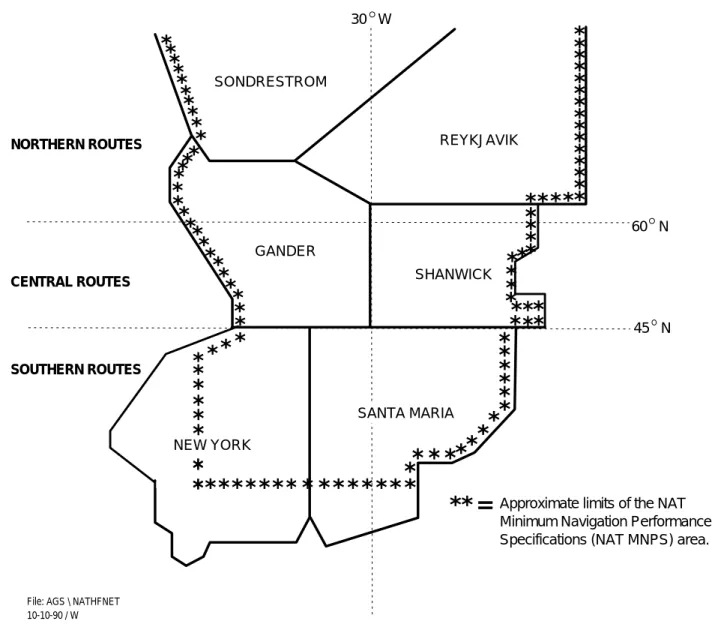
Tables D-1 and D-2 provide a guide for the operational use for North Atlantic HF radiotelephone networks. The following is a description of NAT routes for use with Table D-2:
Northern NAT Routes Generally the international air routes extending between North America and Europe, lying North of 60˚ N latitude.
Central NAT Routes Generally the international air routes extending between North America and Europe, lying between 60˚ N and 45˚ N latitude.
Southern NAT Routes Those routes that enter the New York and Santa Maria FIRs.
Table D-1. North Atlantic HF Radiotelephone Families
Aircraft Registered West of 30˚W Aircraft Registered East of 30˚W
NAT-A Southern routes NAT-A Southern routes
NAT-B Central and Northern routes NAT-C Central and Northern routes NAT-D Northern routes while flying outside
the NAT OTS
NAT-D Northern routes while flying outside the NAT OTS
NAT-E Southern routes NAT-E Southern routes
NAT-F Central routes NAT-F Central routes
Note: Aircraft registered in Australia will use NAT HF families designated for use by aircraft registered east of 30˚ W.
The use of SSB (upper sideband) is compulsory for all communications on the civil
aeronautical mobile Air/Ground high frequency channels as of February 1, 1982. See Figure D-1 for graphical presentation of NAT HF usage.
☞
North Atlantic HF SSB Families ARINC Voice Services Table D-2. North Atlantic HF Radiotelephone Networks
North Atlantic HF Radiotelephone Networks
NAT Routes Served by NAT Family Indicated
Availability of NAT HF Families Versus Hemisphere of Aircraft Registration
NAT Family A Southern NAT routes Available for use by all aircraft
NAT Family B† Northern and Central NAT routes Available for use by aircraft regis- tered in the hemisphere west of 30˚
W longitude
NAT Family C† Northern and Central NAT routes Available for use by aircraft regis- tered in the hemisphere east of 30˚ W longitude
NAT Family D† Northern NAT routes outside the NAT Organized Track System (OTS)
Available for use by all aircraft
NAT Family E‡ Southern NAT routes Available for use by all aircraft
NAT Family F† Central NAT routes Available for use by all aircraft
† NAT family B, C, D, and F not implemented at New York.
ARINC Voice Services North Atlantic HF SSB Families
** **
* **
* *
SONDRESTROM
* * * *
* *
* *
* *
* *
* *
* *
* *
*
REYKJAVIK
60 N 30 W
SHANWICK GANDER
* *
* *
* *
* *
** **
*
*
*
File: AGS \ NATHFNET 10-10-90 / W
45 N
* *
* *
* *
* *
** *
** *
* *
* *
*
NEW YORK
SANTA MARIA
* *
* *
* *
*
* *
* * * * * * * * * * * * * * * * * * * * * **
* * * * *
* *
*
NORTHERN ROUTES
CENTRAL ROUTES
SOUTHERN ROUTES
* * =
Approximate limits of the NAT Minimum Navigation Performance Specifications (NAT MNPS) area.*
Figure D-1. North Atlantic Flight Information Region Boundaries
North Atlantic HF SSB Families ARINC Voice Services
ARINC Voice Services Jeppesen Charts: E
JEPPESEN CHARTS E
The attached charts are produced and supplied by the Jeppesen-Sanderson Company and are copyright-protected. Requests for additional copies of the ARINC 1/2 (Domestic VHF/Intl VHF coverage), the ARINC 3/4 (International HF and VHF coverage), and the ARINC 5/6, 7/8, and 9 (ACARS VHF Data Link Service coverage) charts should be directed to the ARINC Air Traffic Communications Support Department at (410) 266-4430 or to ARINC Customer Services at (410) 266-4180. Requests for large numbers of each, or for a chart subscription, should be referred directly to Jeppesen.
Jeppesen has created a subscription service to provide updated charts and information on ARINC services direct to ARINC customers. The "ARINC Service" consists of an initial order setup containing all the pages depicting ARINC services coverage and the automatic
distribution of changed pages as they occur.
Currently, the initial subscription is sold by Jeppesen for $9.00 per service. Yearly renewal costs $20.00 per service per year. These prices were in effect at the time this publication was printed, and are subject to change without notice. This service can be ordered alone or added on to any Jeppesen service you may already have. It may be ordered direct from Jeppesen by calling toll free 1-800-621-JEPP (5377).
These charts depict approximate coverage of the described services; however, actual coverage may vary depending on time of day, aircraft altitude, and aircraft avionics. Specific questions or comments regarding these charts or ARINC radio coverage should be referred to the ARINC Air Traffic Communications Support Department at (410) 266-4430 or via e-mail to [email protected].
Because the coverage areas, frequencies, and other information on these charts change frequently, it is recommended that Jeppesen-Sanderson Company be contacted in reference to the chart subscription mentioned above. This will ensure current information is always available to flight crews.
Jeppesen Charts ARINC Voice Services