C H A P T E R 1 0
Public relations as planned
communication
L e a r n i n g o u t c o m e s
By the end of this chapter you should be able to:
■
understand why planning is important for public relations programmes
■
identify what research is required to underpin sound programmes
■
determine appropriate programme objectives
■
select and justify chosen strategy and tactics
■
determine required timescales and resources
■
evaluate the effectiveness of the campaign and review future direction.
S t r u c t u r e
■
Why planning is important
■
Systems context of planning
■
Approaches to the planning process
■
Analysis
■
Setting objectives
■
Identifying publics
■
Messages or content
■
Strategy and tactics
■
Timescales and resources
■
Evaluation and review
Successful public relations programmes do not just happen. They are the result of sound research, meticulous planning and careful implementation. This does not rule out the impromptu or the reactive, but these are exceptions.
Recent research among Britain’s ‘most admired companies’ (Gregory and Edwards 2004) shows that up to 70% of their communication activity is pre-planned. The ma- jority of the remaining time is spent making the most of unexpected opportunities and reacting to events such as a major media story, and some time is spent in crisis management. But once these incidents are dealt with, the planned approach is re- sumed.
Planning will not make a poorly conceived programme successful in achieving its ob- jectives, but planning makes it more likely that a programme will be well conceived in the first place. By ensuring that plans are targeted at the right people, use the right channels of communication and say the appropriate things at the right time, all within agreed timescales and budget, the foundations for success are laid.
Introduction
Within the many definitions of public relations that were discussed in Chapter 1, planned or managed communication is frequently mentioned as a defin- ing characteristic of the discipline. Planning for pub- lic relations programmes provides a framework that can stimulate thinking; it acts as a prompt for prob- lem solving and it releases creativity while ensuring it is focused and purposeful.
There are a number of very practical reasons for planning public relations activity:
■ Planning focuses effort – by eliminating unneces- sary and low-priority work.
Why planning is important
■ Planning improves effectiveness – by ensuring the planner works to achieve agreed objectives from the outset.
■ Planning encourages the long-term view – by re- quiring the planner to look to the organisation’s future needs, preparing it for change and helping it manage future risks.
■ Planning assists pro-activity – setting the agenda means planners can be proactive and ‘on the front foot’.
■ Planning reconciles conflicts – putting together a comprehensive public relations plan means that potential difficulties and conflicts have to be thought through in the planning stage.
■ Planning minimises mishaps – thinking through potential scenarios means that most eventualities
Planning public relations programmes should not be difficult but time, effort and knowledge of the planning process is required.
This chapter provides an overview of the planning process. It will introduce each of the stages involved in planning public relations programmes and examine some of the the- ories that underlie the process. Other chapters will discuss some elements of the plan- ning process in more depth (for example, Chapter 11 on research and evaluation).
These chapters and further reading will be highlighted throughout this chapter.
PICTURE 10.1 Effective public relations planning might help avert media stories like this where shoppers overwhelmed a newly opened London store. (Source:Johny Green/PA/Empics.)
S Y S T E M S C O N T E X T O F P L A N N I N G 185
can be covered and contingency plans put in place.
■ Planning demonstrates value for money – plan- ners can show they have achieved programme ob- jectives within budget and past achievements also help the planner argue for future resourcing.
So why doesn’t everyone plan everything? The fol- lowing suggests why practitioners are sometimes reluctant to plan, despite the arguments outlined above:
■ Lack of time – planning is time consuming and ongoing work cannot be suspended while it is done.
■ Plans are out of date as soon as they are written – business and particularly communication is con- ducted in an ever-changing and dynamic envi- ronment, so planning has little point.
■ Planning raises unrealistic managerial expecta- tions – too many factors that are outside the plan- ner’s control to guarantee results.
■ Plans are too rigid and stifle the impromptu and opportunistic – flexibility of response is a crucial strength of the communication function.
■ Plans are a block to creativity – the approach is formulaic and encourages formulaic activities.
■ Plans always reflect the ideal, not the real – it makes it appear that communication work can be tightly controlled and all ambiguities ‘planned out’. The reality of doing public relations work, say some practitioners, is not like that.
See Think about 10.1.
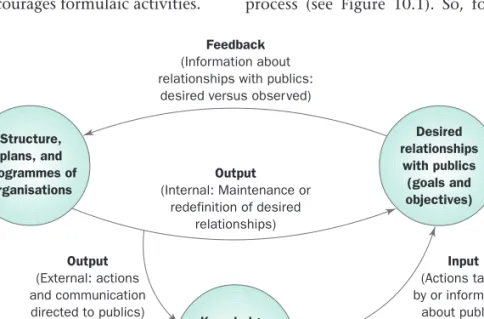
Public relations planning is located within the posi- tivist framework and maps across very well to the systems view of organisations (see Chapter 8 for more discussion of systems theory). The ‘open system’ view of an organisation is an important concept for public relations planning, because an open system assumes that the organisation is an organism or ‘living entity with boundaries, inputs, outputs, “through-puts”, and enough feedback from both the internal and external environments so that it can make appropriate adjust- ments in time to keep on living’ (McElreath 1997).
Cutlip et al. (2000) present an open systems model of public relations that clearly identifies how all these systems characteristics map on to the planning process (see Figure 10.1). So, for example, ‘input’
Systems context of planning think about 10.1 P l a n n i n g
Which argument do you find more persuasive: the arguments for planned activity or against?
Why? Would these arguments apply to planning a birthday party? Or a study project, such as a dissertation?
FIGURE 10.1 Open systems model of public relations (source:Cutlip, Scott M., Center, Allen H., Broom, Glen M., Effective Public Relations, 8th Edition, © 2000, p. 244. Reprinted by permission of Pearson Education, Inc., Upper Saddle River, NJ.)
Feedback (Information about relationships with publics:
desired versus obser ved)
Structure, plans, and programmes of
organisations
Desired relationships
with publics (goals and objectives)
Knowledge, predisposition,
and behaviour of publics Output
(External: actions and communication directed to publics)
Input (Actions taken by or information
about publics) Output
(Internal: Maintenance or redefinition of desired
relationships)
refers to actions taken by, or information about, publics. These inputs in turn are transformed into goals (aims) and objectives that underpin the desired relationships with publics. By contrast, a ‘closed sys- tem’ approach might neglect to take account of in- formation about publics and thus the planner might formulate aims and objectives in isolation.
Scope of public relations planning
Systematic planning can be applied to public relations activity over a period of several years, such as the Full Stop campaign to prevent child abuse conducted by the UK’s National Society for the Prevention of Cruelty to Children, or to short-focused campaigns, such as the launch of a new service, or even to a single activ- ity, such as a press conference.
When discussing the role of the communication planner, Windahl et al. (1992) embrace a wider inter- pretation of planning programmes or ‘campaigns’. In- formal communication, which is initiated to begin a dialogue for its own sake, is legitimate and may be
‘planned’. It will have a purpose and will involve dif- ferent publics. For example, key opinion formers may be invited by a university to a hospitality event such as an annual dinner. This occasion may not have a spe- cific planned outcome other than a belief that inter- personal communication is in itself a valuable process which helps people work together in a more coopera- tive way. This dialogue helps build relationships and a sense of community around the university.
Furthermore, the type of work that planners under- take can be extremely varied. Some planners work for large organisations on large communication projects.
For example, government communicators may work on nationwide initiatives such as the one to encour- age healthy eating in schools or voting in EU elec- tions, while those working for large corporations may work on global corporate identity initiatives. How- ever, some planners work on quite small projects, for example running an open day for a local charity or volunteering to work with local communities and ac- tivists to protest about a local road scheme.
Windahl et al. (1992) also point out that commu- nication initiatives can start at the bottom of an organisation as well as the top. For example, a small department may begin a series of sporting events to build informal communications in the team which eventually widens out into a company-wide and company-supported programme of activities.
This chapter takes the systemic approach to plan- ning, outlined earlier, as its basis. The next step there- fore is to examine some of the existing planning ap- proaches.
The planning process is ordered and enables the pub- lic relations planner to structure their approach around certain key aspects (see Figure 10.2). It is help- ful to see it as answering six basic questions:
■ What is the problem? (Researching the issue.)
■ What does the plan seek to achieve? (What are the objectives?)
■ Who should be talked to? (With which publics should a relationship be developed?)
Approaches to the planning process
FIGURE 10.2 Cutlip and colleagues’ planning model (source:Cutlip, Scott M., Center, Allen H., Broom, Glen M., Effective Public Relations, 8th Edition, © 2000. Reprinted by permission of Pearson Education, Inc., Upper Saddle River, NJ.)
‘How did we do?’
Assessment
‘What’s happening now?’
Situation analysis
Implementation
‘How and when do we do and
say it?’
Strategy
‘What should we do and say, and why?’
4 Evaluating the programme
1 Defining public relations problems
2 Planning and programming 3 Taking action and
communicating
A P P R O A C H E S T O T H E P L A N N I N G P R O C E S S 187
■ What should be said? (What is the content or message?)
■ How should the message be communicated?
(What channels should be used for dissemination?)
■ How is success to be judged? (How will the work be evaluated against the objectives?)
Marston (1979) provided one of the best known planning formulae for public relations which is en- capsulated in the mnemonic RACE – Research, Ac- tion, Communication and Evaluation. American academics Cutlip et al. (2000) articulate the public relations planning process as in Figure 10.2.
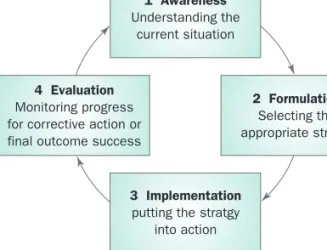
Gregory (2000) has expanded public relations plan- ning into a sequence of steps that add further detail to the process (see Figure 10.3).
All planning processes follow a basic sequence, whether they are for the strategic management of an organisation or for public relations (see Figure 10.4 and Think about 10.2). The approach advocated here is known as ‘management by objectives’ (MBO), which means:
■ setting objectives and targets
■ participation by individual managers in agreeing unit (i.e. department) objectives and criteria of performance
■ review and appraisal of results (Mullins 1989:
254).
The MBO system can be integrated into strategic- level corporate planning, at unit level (as in a public relations department) and at the individual level where there is a review of staff performance in a given role (Mullins 1989).
Gregory’s planning model in Figure 10.3 provides a sequence of activities and captures the essence of the planning approaches outlined. It will be used to examine the steps of the planning process in detail.
However, first it is important to explain the struc- ture of the first part of the diagram.
Although, ideally, the public relations practitioner would undertake analysis of the situation before de- termining objectives, in practice they are often given objectives by their managers. Such an objective might be to help overturn proposed legislation. In these cir- cumstances it is still vital that the objectives them- selves are scrutinised to see if they are appropriate. For example, an organisation may wish to resist the intro- duction of a stringent piece of environmental legisla- tion because it will be expensive to implement and thereby affect shareholder dividends. However, on in- vestigation, the public relations practitioner may dis- cover that: stakeholders are very much in favour of the legislation; competitor companies will support it;
and the company will be out of line if it persists. In this situation the public relations practitioner may recommend that the proposed campaign is aban- doned.
FIGURE 10.4 Basic business planning model
think about 10.2 P l a n n i n g p r o c e s s e s
Look at the public relations planning processes and models described so far. What are the main similarities between them?
FIGURE 10.3 Gregory’s planning model (source:Gregory 2000: 44)
1 Awareness Understanding the
current situation
2 Formulation Selecting the appropriate stratgy 4 Evaluation
Monitoring progress for corrective action or final outcome success
3 Implementation putting the stratgy
into action
Analysis Aim(s) Objectives
Publics
Content for messages
Strategy
Tactics
Timescales
Resources
Evaluation
Review
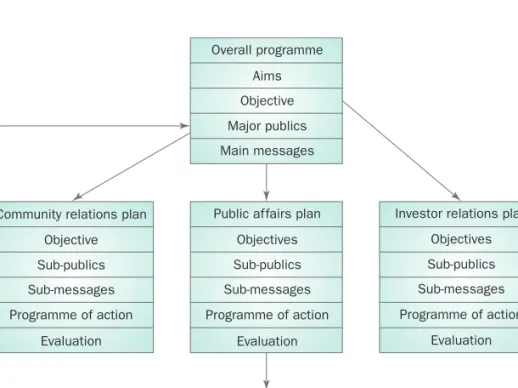
The ‘aim’ element is in a dotted box because some- times a campaign has a single, simple objective that does not need an overarching aim. If the programme is particularly large, it may be necessary to break down the whole into a series of projects that follow the same basic steps. Each project will have its own specific ob- jectives, publics and content or messages, but this needs to be incorporated into a larger plan which pro- vides a coordinating framework with overall aims, ob- jectives and the message content guidance so that the individual projects do not conflict. (See Figure 10.5.)
Two things need to be borne in mind at this stage.
First, the planning template could be seen to encour- age a very rigid and undynamic approach. Sometimes practitioners have to move very rapidly in response to unpredictable events. Of course, practitioners must respond to the unplanned. However, even in these circumstances, the template can be used as a checklist to ensure that all the essential elements have been covered. Second, the degree to which any element of the planning process is followed will vary according to the requirements of the task in hand.
For example, a full analysis of an organisation’s ex- ternal environment (see also Chapter 2 for an expla- nation of EPISTLE) will not be required to run an effective open day for families because any key issues will be relatively easy to identify. However, if a major programme is planned, such as the introduction of a new basis for licensing road vehicles, then a full analysis is certainly required, since research about lifestyles, demographics, technological advances and
environmental impacts may need to be undertaken to identify and understand the full range of issues which have to be borne in mind by the public rela- tions planner.
The rest of the chapter explores each stage of the planning process in turn.
Analysis is the first step of the planning process. The point of analysis, sometimes called ‘situation analysis’
is to identify the issues or specific problems on which to base the programme. Without identifying the key issues the programme will not have a clear rationale.
For example, if the core issue identified for action is that the organisation is seen to be unfriendly towards family carers, there is no point in aiming a recruit- ment campaign at potential employees such as women without addressing the reasons why the or- ganisation is not an employer of choice for them.
Analysing the environment
This analysis of the external and internal environment is called ‘environmental monitoring’ by Lerbinger (1972), a phase that is now generally called ‘environ- mental scanning’ in the public relations literature (e.g.
Grunig et al. 2002).
Analysis
FIGURE 10.5 Framework for multi-project public relations plans (source:adapted from Gregory 2000: 46) Overall programme
Aims Objective Major publics Main messages
Community relations plan Objective Sub-publics Sub-messages Programme of action
Evaluation
Public affairs plan Investor relations plan Objectives
Sub-publics Sub-messages Programme of action
Evaluation
Objectives Sub-publics Sub-messages Programme of action
Evaluation
Overall evaluation Review
A N A L Y S I S 189
This analysis may seem more appropriate to the identification of strategic business issues than com- munication issues. However, public relations practi- tioners need to be alert to the wider environmental issues because it is these that will force some sort of action from the organisation. Action always has communication implications. Indeed, one of the major contributions that public relations can make is to maintain an environmental scanning brief on behalf of their organisation. This ‘early warning’ of issues allows organisations to manage future risks and is a key strategic input at senior management level. In the light of these emerging issues, organisa- tions can make adjustments to their own strategy and actions to align themselves to new realities. (See also Chapter 19.)
Furthermore, issue spotting helps organisations contribute sensibly to public debate at an early stage and hence influence the outcome. Pressure groups, for example, will spot issues early to influence public debate. In one case, the intervention of environmen- tal and human rights activists at a formative stage in the debate led to the stalling of plans to build dams in disputed areas in India.
The main questions to be asked when undertaking this kind of analysis are:
■ What are the environmental factors that affect this organisation (identified from the EPISTLE analysis)?
■ Which ones are of most importance now?
■ Which will become the most important in the next four years?
From this it will be possible to derive a list of the main issues that will affect the organisation. These will differ depending on the country, the industry sector and the particular circumstances the organisa- tion operates in.
It is important to identify whether some of these is- sues are linked. For example, social and technological changes are often connected: the lifestyle of many people has been transformed by mobile phone tech- nology. As well as current issues, it is vital to identify the long-term forces for change. For example, con- cerns about obesity in developed economies will have a profound effect on the drinks, confectionary and fast food industries in the coming decade. Many organisations, from governments to financial and leisure companies, will need to respond to changing demographics that will see the average age of the population rising in many developed countries, with profound effects on the nature of health, welfare and educational provision and on the taxation system that supports them.
Having identified the broader environmental is- sues that affect the organisation and over which it
has little control, it is then necessary to look at the organisation itself and those things over which it has greater control. A classic way to undertake this internal analysis is to use a technique called SWOT.
The first two elements, strengths and weaknesses are particular to the organisation and can usually be changed by it, although all organisations are to a certain extent captive to their own history and cul- ture. However, it is in the organisation’s power to address its strengths and weaknesses. The third and fourth, opportunities and threats, are generally ex- ternal and can be derived from wider environmental analysis (see Chapter 2), but are usually related to those factors that have a direct impact on it. The four elements of SWOT can be seen as mirror seg- ments in a quadrant. An example of a SWOT analy- sis is given in Figure 10.6.
Analysing publics
Having analysed the environment and the organisa- tion and identified the key issues, it is then essential to look at the organisation’s publics and discover what their attitudes are towards the organisation it- self, to the wider issues identified by the EPISTLE (see Chapter 2) and SWOT processes or to the particular issue that management have asked the public rela- tions department to address. (See Mini case study 10.1.)
Cutlip et al. (2000) suggest that research can be in- formal or formal. Informal or exploratory research methods may involve the use of any of the following:
■ Personal contacts – these could be at public meet- ings (e.g. for shareholders or community) or trade shows.
■ Key informants – these can be experts, editors, journalists, politicians.
FIGURE 10.6 Example of SWOT analysis Strengths
Good capital reser ves Leading-edge products Loyal customer base
Good reputation for ser vice deliver y Committed employees
Weaknesses Risk averse in
investment Limited product line Ageing customer base
Bureaucratic Limited skills base Opportunities
New market oppor tunities in Russia Potential to acquire
competitors Tax breaks if offices
relocated
Threats
Potential political instability Danger of being
overstretched Loss of loyal employee
base
■ Focus groups – for example, informal discussion groups of employees, groups of consumers or a cross-section of the public. Focus groups can be more structured, however, and use an independent moderator to elicit discussion around key themes.
■ Advisory committees, panels or boards – many non-profit organisations have these to gauge re- sponses to ideas.
■ Ombudsman/woman – this is someone (usually independent) appointed by an organisation to identify and detect problems.
■ Call-in telephone lines (e.g. helplines) – these can be set up with varying degrees of success; however, they do signal that the organisation is ‘listening’.
■ Mail analysis – this involves examining letters to identify comments and criticisms.
■ Online sources – monitoring chatrooms and web- sites for rumours is an increasingly important source of intelligence.
■ Field reports – these are people such as the sales- force who can serve as useful early warning for potentially difficult situations.
Chapter 11, on research and evaluation, goes into detail about how to conduct research, including the range of formal social scientific methods that can be employed, but it is important to mention here that the analysis stage of the planning process makes use of all the available information and intelligence on which public relations programmes are based. This preparation work is vitally important in answering the first basic question, ‘What is the problem?’
(For an example of a campaign based on solid re- search, see Case study 10.1 on BT’s ‘Am I Listening?’
campaign at the end of this chapter.)
If the public relations professional discovers that a key public hold a view different from that of the or- ganisation on an issue, then there are two choices. Ei- ther the organisation must change to bring itself into line with what the public expects – for example, it may need to change its transport policy so that the local community is no longer disturbed by rogue parking. Or the organisation may wish to persuade its publics to a particular point of view. For example, it may seek to persuade people living around a chemi- cal plant that the fume emissions genuinely are harmless. If key publics are opposed because they simply do not have relevant or accurate information, that can easily be remedied. If the problem is more complex, for example, the fumes are harmless as long as filtered through specially installed chimney baf- fles, the safety baffles have to be in place before com- munication can do its job.
As this last example indicates, sometimes public relations practitioners are asked to solve problems that are not just communication problems. So the planner must analyse the situation to see if they are amenable to communication solutions. Windahl et al. (1992) say that a communication problem can be defined in one of two ways: first, the problem arises from the lack ofor the wrong sort of communica- tion. For example, it may be that a child vaccination is not being taken up because it has been publicised only to doctors, not to parents, and because it has been described by its technical name, not its popular name. Second, the problem is a communication prob- lem if it can be solved by communication alone. In this example, if parents are given the required informa- tion (lack ofcommunication problem solved) and the popular name is used (wrong sortof communication
m i n i c a s e s t u d y 1 0 . 1
Identifying stakeholders
Identifying stakeholders is often a complex business.
Figure 10.7 is a stakeholder map of the Sea Fish In- dustry Authority, a trade body based in Scotland.
The inner circle shows the priority stakeholders with the outer rings showing those with progressively less stake in the organisation.
The Sea Fish Industry Authority (Seafish), estab- lished in 1981, works across all sectors of the UK seafood industry to promote quality seafood. Its re- search and projects are aimed at raising standards, improving efficiency and sustainability and ensuring that the entire industry develops in a viable way.
Seafish is the UK’s only cross-industry seafood body working with fishermen, processors, wholesalers,
seafood farmers, fish friers, caterers, retailers and the import/export trade. It works closely with some 100 trade bodies across the UK. As an executive non- departmental public body (NDPB), sponsored by the four UK government fisheries departments and funded pri- marily by a levy on seafood landed, farmed or imported, it is accountable to all these stakeholders, as well as those who provide it with grant assistance for individual project work. Seafish must demonstrate to all these groups that its services offer good value for money.
Mission statement
Seafish works with the seafood industry to satisfy con- sumers, raise standards, improve efficiency and se- cure a sustainable future.
Sea Fish Industr y Authority
A N A L Y S I S 191
problem solved), it is likely that vaccination uptake will increase.
Often what are regarded as ‘communication prob- lems’ are a mixture of communication and other issues and the public relations practitioner must be able to separate them. For example, if the uptake of
child vaccinations were also being affected by suspi- cion about side-effects, or if they were only available at certain clinics, then there is more than a commu- nication problem. Some other measures such as inde- pendent clinical opinion or wider distribution of the vaccine may be needed to stimulate use.
FIGURE 10.7 Stakeholder map of the Sea Fish Industry Authority (Produced by Kirsty Innes MCIPR on behalf of the Sea Fish Industry Authority (Seafish))
• Enterprise bodies
• Other specialist press (e.g. compost)
• Environmental health officers
• Ex-Seafish employees
• Seafish contractors
• Seafish accountants
• Marine Accident Investigation Branch (MAIB)
• Sea Fisheries Committees of England and Wales
• Trade press and fisheries correspondents (regional and national media)
• National media
• Regional media
• Consumer magazines
• Food waiters
• Celebrity chefs
• Manufac- turers of fishing gear and on-board equipment
• Manufact- urers of food processing equipment
• Manufact- turers of equipment for fish- mongers
• Health departments in England, Scotland, Wales and Nor thern Ireland
• UK Hydrographic Office
• Food Standards Agency
• CEFAS
• Education and Skills departments in England, Scotland, Wales and Nor thern Ireland
• Wholesalers
• Processors
• Importers
• Fishermen
• Fishing vessel owners
• Exporters
• Retail (supermarkets, and independent fishmongers)
• Regional seafood development groups
• Seafish group training associations
• Seafish advisor y committees
• Depar tment for the Environment, Food and Rural Affairs (Defra)
• Scottish
Executive Environment and Rural Affairs Department (Seerad)
• Welsh Assembly Government (WAG) Fisheries Department
• Depar tment of Agriculture and Rural Development in Northern Ireland (Dard-NI)
• Food service (restaurants, contract caterers and fish and chip shops)
• Industr y trade bodies • Prime Minister
• Prime Minister’s Strategy Unit
• MPs
• MSPs
• MEPs
• Scottish Fisheries Protection Agency
• Sea Fisheries Inspectorate (England and Wales)
• Transport departments in England, Scotland, Wales and Northern Ireland
• BIM – The Irish Sea Fisheries Board
• Maritime and Coastguard Agency
• Environmental groups
• Activists
• HM Treasur y
• HM Stationer y Office
• European Commission
• European Parliament
• Scientific researchers
• Fisheries economists (EU wide)
• Improve the Sector Skills Council for the food and drinks industr y
• Maritime Skills Alliance
• Trade, Industr y and Enterprise departments in England, Scotland, Wales and Northern Ireland
• Local authorities
• Schools
• Colleges
• Universities
•Regional development agencies (non-seafood specific)
• Oil and gas industr y
• Shipbuilders
• Windfarm industr y
• Telecommunications industr y
• Por ts associa- tions Consumers
Levy payers
Seafish staff and board members Seafish
There are occasions when no amount of communi- cation will assist in solving a problem. For example, no amount of excellent communication will make citi- zens happy to have a rubbish dump sited next to them. The best that can be hoped for is limited protest.
Thus it can be seen that analysis not only identifies the issue, but also points to the precise contribution that public relations can make to its resolution.
To set realistic objectives it is necessary to know the size and nature of the communication task. Research among publics will have uncovered their knowledge, attitudes and behaviour on any particular topic, which will provide the starting point. The planner then needs to decide what movement is required, if any: a legitimate objective may be to confirm existing attitudes or actions. Objectives are usually set at one of three levels (Grunig and Hunt 1984; Cutlip et al.
2000), as shown in Table 10.1.
According to Grunig and Hunt (1984), three things should be borne in mind that will make the achieve- ment of objectives easier:
1 The level of effect or outcome should be chosen with care. If the communication planner wants to introduce a new or complex idea, it would be sensible to set cognitive objectives first, rather than hoping for conative effects from the start.
2 Choose target publics with advocacy in mind. Re- search should have identified those who already support the organisational policies or who could be easily enlisted (more on this in Chapter 11).
They can then act as advocates on behalf of the organisation.
Setting objectives
3 Organisations can change too. Sometimes minor adjustments in the organisation’s stance can elicit a major, positive response from publics.
Generally speaking it is much more difficult to get someone to behave in a certain way than it is to prompt them to thinkabout something, the notable exception being over hot issues (see Chapter 14).
Cutlip et al. (2000) warn that public relations pro- gramme objectives all too often describe the tactic in- stead of the desired outcome for a particular public.
In the ‘employee’ public example below, a tactical objective would be to issue the corporate plan. How- ever, the objective that focuses on the desired out- come for employees is ‘to ensure awareness of the new corporate plan’. This is the public relations ob- jective where the effort is focused on confirmation or change in knowledge, attitude or behaviour among those publics communicated with.
All objectives should be SMART: specific, measur- able, achievable (within the planner’s ability to de- liver) resourced and time bound. Examples of SMART objectives follow. Note that the desired out- come for each public is highlighted in bold.
Employees: Ensure every employee is aware of new corporate plan by 10 November and, three weeks later, can list three priorities for next year.
Community: Use sponsorship of 20 local junior foot- ball teams to promote more positive opinion about company among par- ents.
Corporate: Change legislation on taxation of char- ity giving within two years through in- fluencing attitudes of government officials and ministers.
Trade: Double amount of coverage in trade media in one year to overcome lack of awareness among key suppliers.
Cognitive Encouraging the target public to thinkabout something or to create awareness.
(means related to For example, local government might want the local community to be aware that thoughts, reflection, it is holding a housing information day. The whole community will not need the awareness) service, but part of local government’s reason for making them aware is so that
they know what a proactive and interested local council they have
Affective Encouraging the target public to form a particular attitude, opinion or feeling (means related to about a subject. For example, a pressure group may want moral support for or feelings, emotional against gun ownership
reaction)
Conative Encouraging the target public to behavein a certain way. For example, the local (means related to hospital may use television to ask for emergency blood donors following a major behaviour, actions or incident
change)
TABLE 10.1 Objectives set at one of three levels
I D E N T I F Y I N G P U B L I C S 193
Consumer: Increase face-to-face contact with con- sumers by 20% in 18 months to counter perception of company being remote.
Apart from setting SMART objectives, there are four prerequisites for objective setting that will ensure that they are organisationally relevant and deliver- able (Gregory 2000):
■ Ally the public relations objectives to organisational objectives. If the corporate objective is to grow the company by acquiring other companies, then pub- lic relations activity must be focused on that.
■ Ensure the objectives are public relations objec- tives. Employee satisfaction cannot be achieved through communication if the main problem is poor working conditions. The source of the prob- lem must be removed first and this is a manage- ment issue.
■ Promise what is achievable. It is better to set mod- est objectives (e.g. cognitive objective) and meet them than to over-promise (e.g. set behavioural objectives) and fail.
■ Work to priorities. This way the more important areas of the plan will be achieved. If the planner is then required to work on other things, the least important things can be removed from the plan.
Likewise, if there are budget cuts, again the least important activities can be forgone.
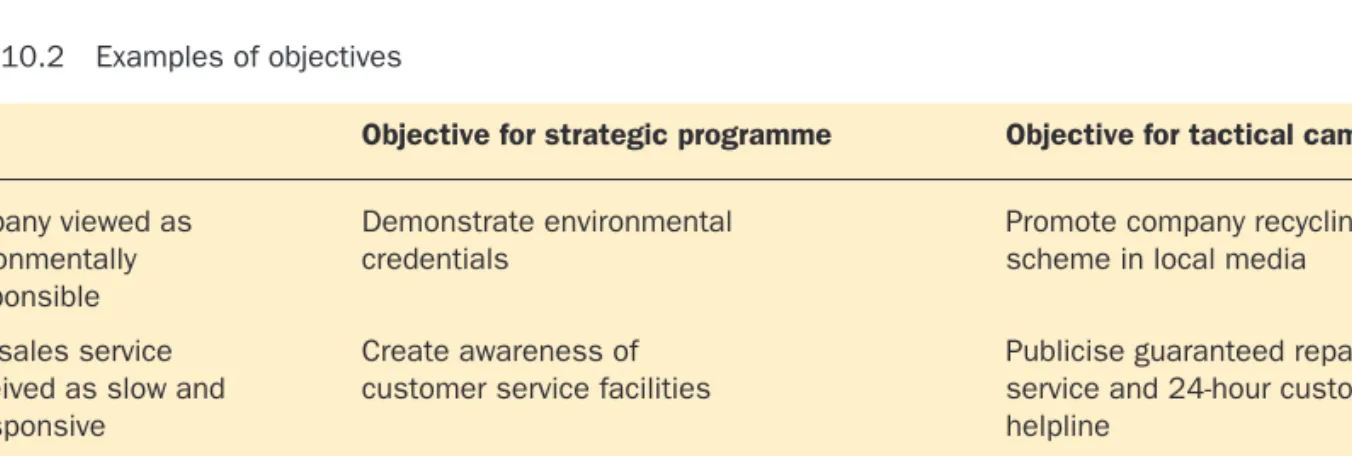
As stated earlier, programmes and campaigns can be large or small. Similarly, objectives apply to both large and small programmes and campaigns. They can also be applied in strategic or tactical pro- grammes or campaigns. The examples in Table 10.2 show how. Note how the tactical objectives do not go into detail of the specifics of the tactical approach.
Setting sound objectives is fundamental to public relations planning. They define what the outcomes of the programme should be, they support the strategy, set the agenda for action and are the benchmark
Issue Objective for strategic programme Objective for tactical campaign
Company viewed as Demonstrate environmental Promote company recycling
environmentally credentials scheme in local media
irresponsible
After-sales service Create awareness of Publicise guaranteed repair perceived as slow and customer service facilities service and 24-hour customer
unresponsive helpline
Proposed legislation Change proposed legislation Galvanise local pressure groups
will damage by lobbying government into action
environmentally sensitive areas
TABLE 10.2 Examples of objectives
Go to the Chartered Institute of Public Relations website (www.cipr.co.uk/prideaward/winners). Look at some of the award-winning entries and analyse the objectives.
Are they genuine objectives? Are they SMART?
a c t i v i t y 1 0 . 1 Evaluating objectives
against which the programme will be evaluated. Their importance cannot be overstated. (See Activity 10.1.)
The section on objectives answered the second basic question in planning programmes, ‘What does the plan seek to achieve?’ This next section answers the third, ‘Who should we talk to?’ Chapter 12 is devoted to audiences, publics and stakeholders so this section will be relatively brief.
Research for the proposed programme will have identified the key publics (see section on analysis).
Sometimes the key publics are apparent to the plan- ner. If the planned programme is to support a prod- uct launch, then existing and potential customers will be a priority. However, groups are often not homogenous. It is incorrect to assume that all- embracing groups such as the local communitycom- prise individuals who are similar or who will act in the same way. Within these groups there will be the
‘active’, ‘aware’, ‘latent’ and ‘apathetic’ publics that Grunig and Repper (1992) discuss. (Explained in Chapter 12.) They will have very different interests and concerns. It is likely that many individuals will belong to more than one stakeholding or public cate- gory too. Employees of an organisation may well be partners in a community relations campaign, or con- sume their organisation’s products or services; they may even be shareholders.
Identifying publics
There are many ways in which stakeholders and publics can be segmented and the type of campaign will determine the best way to do that. For example, if a government wants to introduce a new benefit tar- geted at lower-income families, it makes sense to seg- ment stakeholders by income and where they live. A charity wanting to start up a counselling service for refugees may wish to segment by ethnicity; a leisure company wanting to set up Saturday morning clubs for children will segment by age. (See Box 10.1.)
The practitioner has to decide the most appropriate ways to undertake the segmentation of stakeholders.
Then it is important to move from the general to the particular. Broad categories must be divided into dis- crete groups. This could be done on the basis of the communication effort required for each group or on the basis of their power and influence.
The power/interest matrix (Figure 10.8) is used in strategic planning and can be readily transferred to the communication context. It categorises stakehold- ers depending on the amount of power they have to influence others and the level of interest they may have in a particular issue. Clearly the more power and interest they have, the more likely their actions are to impact on the organisation, so the support of this group is crucial. Johnson and Scholes (2002) point out that power comes from a number of sources
including status in or outside the organisation, the ability to claim resources, (for example, investors money or internal budget) and the symbols of power that individuals have, for example use of titles.
It is possible, even desirable at times, that stake- holders in one segment should move to another. For example, powerful, institutional investors often re- side in segment C. It may be in times of crisis that the communicator will want to move them to segment D so that they can use their power and influence with others to support the organisation.
Similarly, just because a stakeholding group appears not to have much interest or power does not mean that it is not important. It may be desirable to stimulate lo- cal community groups located in segment B because they in turn are connected to more interested and pow- erful stakeholders, such as employees, in segment D.
By plotting stakeholders and publics in the power/interest grid it is possible to identify who the key blockers and facilitators of communication are likely to be and to react to this, for example, through more information or dialogue. It is also feasible to identify whether some stakeholders and publics should be repositioned (as above) and who should be maintained in their position.
It is informative to map stakeholders in a number of ways. For example, not only can current position and desired position be mapped, but a useful exercise is to map how stakeholders might move in relation to a de- veloping issue and whether or not this is desirable, pre- ventable or inevitable. Communication strategies can then be devised that accommodate these movements.
Once categorised according to a suitable method, the groups need to be prioritised and the amount of communication effort devoted to them apportioned.
Figure 10.9 shows an example of how this might be done for a luxury wallpaper manufacturer.
The number of publics that are communicated with and the depth of that communication is likely to be limited by either a financial or time budget. However, it is important that all the key ‘gatekeepers’ or leaders of active groups are identified. They may well interpret information for others, act as advocates on the organ- isation’s behalf and catalyse action. Key individuals may belong to more than one group, so public rela- tions activity needs to be coordinated to ensure that there are no conflicting objectives, messages or tactics.
The fourth basic question is, ‘What should be said?’
Traditionally, public relations people have focused on messages. Heath (2000) says this could be explained partly because many practitioners have come from a
Messages or content Ways to segment publics
■ By geographics – where they live, work
■ By demographics – age, gender, income
■ By psychographics – attitudes, opinions
■ By group membership – e.g. clubs, societies, parents
■ By overt and covert power – e.g. religious leader, information gatekeeper
■ By role in decision process – e.g. financial manager, CEO
box 10.1
FIGURE 10.8 Power/interest matrix (source:adapted from Mendelow 1991, cited in Johnson and Scholes 2002: 208)
Power
Level of interest
Low High
LowHigh
A Minimal
effor t
B Keep informed
C Keep satisfied
D Key players
M E S S A G E S O R C O N T E N T 195
FIGURE 10.9 Prioritisation of effort for luxury wallpaper manufacturer
journalistic background, where ‘getting the story’ out is seen as important. This has led to a focus on ‘message design and dissemination to achieve awareness, to in- form, to persuade – even manipulate’ (Heath 2000: 2).
There are many kinds of campaign where mes- sages are critically important, especially in public information campaigns. So, a country’s health de- partment that wants to inform the public about as- pects of health care often uses memorable messages.
Similarly, road safety messages are encapsulated in slogans such as ‘Don’t drink and drive’.
Messages are important for four main reasons:
1 Messages assist the awareness and attitude-forming process. Publics who can repeat a message they have seen or heard are demonstrating that it has been received. They are also likely to have a view on it.
2 Messages demonstrate that the communication channels have been appropriate and that the message reached the recipient.
3 Messages are essential in the evaluation process.
Messages intended for the media can be evalu- ated through media content analysis. If the same messages are picked up and repeated by the target public (e.g. through survey research), it demon- strates that the communication has been, at least in part, effective. What publics do with that as- similated message is the other half of the story.
4 Summarising an argument down to its bare essen- tials in a key message such as ‘eat five fruits and vegetables every day’ helps focus management minds and imposes discipline on woolly thinking.
However, messages have limitations. They indicate one-way communication: the originator simply checks to see if their communication has been received. If an organisation genuinely wants to enter into a dialogue with publics where the outcome will be mutually de- termined, messaging is not so appropriate. For exam- ple, if a new organisation wants to discuss with its em- ployees what its values and goals should be, dialogue is required. Where dialogue is part of the overall purpose of communication, simplistic approaches to messaging are inappropriate. (For more on the different models of communication and their purpose, see Chapter 8.)
How then can programmes that involve dialogue be evaluated if messages are one of the ways to mea- sure communication effectiveness? The obvious an- swer is: by the quality of the relationship that results from the dialogue. More on this later in the chapter.
Messaging or dialogue initiation is often underval- ued or reduced to simple statements, but it is very im- portant. It is the point of contact, providing the meaning between an organisation and its publics. It is ‘given’ by the organisation, and ‘received’ by its publics and vice versa. If messages are poorly con- ceived and the way they are conveyed poorly exe- cuted, it can be the end of the communication process. There are four steps in determining mes- sages:
1 Take existing articulated perceptions that encap- sulate the issue or problem. For example, it may be that the organisation is regarded as an old- fashioned employer.
2 Define what realistic shifts can be made in those perceptions. If working practices and policies have been completely overhauled, this needs ex- plaining.
3 Identify elements of persuasion. Work on the ba- sis of fact. For example, the organisation may have introduced a crèche and family-friendly work practices. The number of women managers may have increased by 25%; the organisation may have achieved Investors in People status and won a major training award. All these facts demonstrate
Corporate 20
Shareholders (active) 8
Shareholders (latent) 2
Investment analysts 5
Financial press (active) 5
Customers 30
Large do-it-yourself retailers 10 Specialist wholesale decorating suppliers 6
Specialist retail outlets 6
Trade press 7
Trade exhibition organisers 1
Consumers 15
Consumer press 10
TV and radio specialist programme producers 5
Suppliers 10
Raw materials
Major suppliers 6
Minor suppliers 4
Employees 15
Executives 2
Super visors 2
Shopfloor workers 4
Designers and salesforce 3
Trade union leaders 2
Pensioners 2
Community 10
Neighbours 6
Schools 4
Grouping
Percentage of communication effort
apportioned
that the organisation is not an old-fashioned em- ployer, and should form the platform for pro- gramme content. However, facts are rarely enough. People are not just rational beings, so it is important to add human emotion to these facts.
People associate more readily with other people and their experiences rather than to purely factual information. For example, providing case studies that people can relate to in a human way and which illustrate how the organisation operates as a social as well as economic unit adds warmth and depth.
4 Ensure that the message or content is deliverable and credible through public relations activity rather than via advertising or direct mail.
See Box 10.2.
The integrity of the message is affected by a range of factors that can determine whether it is taken seri- ously or not, such as:
■ format – should words or pictures be used?
■ tone – serious or light-hearted?
■ context – is it a day when there is bad news for the business or the country?
■ timing – is it controllable and if so, has the most auspicious time been chosen?
■ repetition – can the message be repeated often enough to be remembered, but not so often as to breed contempt?
Sometimes, circumstances dictate the format of the message and the medium in which it should be con- veyed. For example, stock market information has to be provided in a prescribed form and a product recall dictates that advertising is used to get the message out quickly, in the required media and in an unmedi- ated way.
Messages and content are key components of effec- tive communication campaigns. Vague content leads to confusion and wasted effort. Carefully thought- through content is vital to understanding and dia- logue – and essential to relationship building. (See Activity 10.2.)
Strategy
The fifth basic question, ‘How should the message be communicated?’ falls into two parts: strategy and tactics. The temptation for the public relations plan- ner is to move immediately to tactics because in many ways it is easier to think of a raft of ideas than it is to think about the rationale behind them. Im- plementation – where the tactics are put into action – is often the most exciting part of the planning process, and the most obviously creative. However, an underpinning strategy provides coherence and focus and is a clear driving force. It is the framework that guides the menu of activities. As Windahl et al.
(1992: 20) state, communication planning ‘should include both systematic and creative elements. Both are essential to information/ communication work’.
There is much discussion on the meaning of ‘strat- egy’. Most books on strategic planning, for example Steyn and Puth (2000), who have applied strategy specifically to communication, provide several defin- itions and this in itself indicates that there is an issue around precise definitions. Strategy is described as:
the ‘overall concept, approach or general plan’ (Cut- lip et al. 2000: 378); the coordinating theme or factor;
the guiding principle, or purpose; and ‘the big idea’, the rationale behind the programme. If an articulated strategy satisfies one or more of these elements it will be broadly satisfactory.
Strategy is dictated by, and springs from, the issues arising from the analysis of the problem and it is the foundation on which tactics are built. Tactics are
Strategy and tactics
Typical messages in corporate campaigns
‘Company X is the largest manufacturer of widget Y in China, providing 3000 new jobs in two years.’
‘Company X has provided shareholder dividends above 5% for seven years.’
‘Company X is quoted in Fortunemagazine as having a strong, forward-thinking board.’
‘Company X is committed to corporate social responsibility and has been included in the Dow Jones Sustainability Index since 2001. It sponsored the provision of 200 artificial limbs to victims of land- mines.’
box 10.2
Devise an overarching message or slogan for a ‘grass roots’ or community-led campaign aimed at stopping children dropping litter outside the school premises.
What would be a suitable sub-message for children?
For parents?
a c t i v i t y 1 0 . 2 Message design
S T R A T E G Y A N D T A C T I C S 197
the ‘events, media, and methods used to implement the strategy’ (Cutlip et al. 2000: 378). In the three ex- amples in Figure 10.10, the first shows how strategy can describe the nature of, and summarise the tacti- cal campaign for, a simple, single objective cam- paign. The second example is for a conceptual propo- sition, the third for a slogan-driven campaign encapsulating a key theme. All are equally valid.
Tactics
It is obvious that tactics should be linked to, and flow from, strategy. Indeed, having got the strategy correct, tactics should flow easily and naturally.
Strategy should guide brainstorming and be used to reject activities that do not support the strategic intent or the programme objectives. There should be a clear link between objectives, strategy and tactics.
A level of caution is required when planning the tac- tics of a programme. It is easy for the practitioner to al- low creative ideas to take over while ignoring the key aim and objectives. The aim is to get a programme that reaches the right people in sufficient numbers and that has the right level of impact to do the job required, all within acceptable costs and timescales. Sometimes that can be done with a single activity – for example, the in- ternational Live Aid concert on 13 July 1985 stimulated global awareness of starvation in Africa overnight.
More usually a raft of complementary tactics over a period of time is required. These will vary depending on the nature of the programme, so the practitioner will need to draw from a palette of tactics as appropriate. For example, if a company wants to launch new and highly visual products such as a range of expensive household accessories, it is important that tactics are selected that will show how these products look and feel. In this case, a range of tactics might include displays at exhibitions, product samples provided to journalists to encourage placement in the consumer media, CDs and websites showing the products in use, in-store demonstrations, brochures and high-quality posters.
In a different situation, for example, if the cam- paign involves lobbying over some aspect of financial legislation, quite different tactics, such as research re- ports, seminars, opinion former briefings, one-to-one meetings with members of parliament (MPs), would be more appropriate.
When designing the tactical elements of a cam- paign, two questions should be asked
1 Is the tactic appropriate? Will it reach the target publics? Will it have the right impact? Is it credi- ble and influential? Does it suit the content in terms of creative treatment and compatibility with other techniques used?
2 Is the tactic deliverable? Can it be implemented successfully? Is there sufficient budget? Are the timescales correct? Are there the right people and expertise to implement it?
Figure 10.11 (overleaf) is a sample menu of activity that can be used in campaigns. (See also Chapter 3 on the role of the practitioner and Activity 10.3.) FIGURE 10.10 Different types of strategy
Example 3 Example 2
Example 1
Media campaign, posters, competitions, bus adver ts, website, schools programme, etc.
Research repor ts, speaker platforms, information resource facility, online helpline, sponsorship of awards, etc.
Press conference, press releases, exclusives, features, competition Tactics
Encourage people to exercise
Establish organisation as thought leader Publicise new
product Objective
Drive home health policy through memorable message Position as industr y-
leading think-tank Mount media
relations campaign Strategy
Bearing in mind the content of this section, list the tac- tics you would use to promote engagement rings. Then list the tactics you would use to encourage the cus- tomers of a utility company to pay online.
Feedback
To promote engagement rings, the tactics might include, for example, special shop openings (e.g. after office hours) targeted at couples to enable people to view and try on the rings. This would be the sensory component.
Feature articles written for the local press would need to be more factual but would seek to stimulate interest in the shop openings. Photography will be an important part of the media effort. Timing, of course, would be around festive or traditionally romantic occasions such as New Year and St Valentine’s day.
a c t i v i t y 1 0 . 3 Public relations tactics
FIGURE 10.11 A selection of public relations activities Media relations
Press conference Press release Ar ticles and features One-to-one briefings Inter views
Background briefings/materials Photography
Video news releases Website
Advertising (PR led) Corporate
Product
Direct mail (PR led) Annual repor t Brochures/leaflets Customer repor ts External newsletters General literature (also multimedia material) Exhibitions
Trade and public Literature Sampling Demonstrations Multimedia Conferences Multimedia Literature Hospitality
Community relations Direct involvement Gifts in kind Sponsorship Donations Special events AGMs SGMs
Special occasions Customer relations Media relations Direct mail Adver tising Internet Exhibitions Retail outlets Sponsorship Product literature Newsletter
Internal communication Videos
Briefings Newsletters Quality guides
Compact disk interactive Email
Intranet
Corporate identity Design
Implementation Sponsorship Spor t Ar ts
Wor thy causes Lobbying
One-to-one briefings Background material Videos
Literature Group briefings Hospitality CDs
Audio cassettes Research Organisations
Public relations programmes Issues monitoring
Results monitoring
Crisis management Planning
Implementation Liaison
Internal (including counselling) External
Financial relations Annual repor t Briefing materials One-to-one briefing Media relations Hospitality Internet Extranet
Time
Time is a finite commodity and the life of a public re- lations practitioner is notoriously busy. Furthermore,
Timescales and resources
public relations often involves the cooperation of others, and getting them to observe deadlines re- quires firmness and tact.Deadlines can be externally imposed or internally driven by the organisation. Internal events may in- clude the announcement of annual results, launching a new service or the appointment of a senior execu-
T I M E S C A L E S A N D R E S O U R C E S 199
tive. External events may be major calendar dates, such as the Olympic Games, Chinese New Year or Thanksgiving.
To ensure deadlines are met, all the key elements of a project must be broken down into their individual parts and a timeline put against them. Check out Box 10.3, which contains a list of the main elements of a press facility visit.
Each of these elements will need its own action plan and timescale. Thus, preparing the visit areas may in- clude commissioning display boards with photographs and text. That in turn will mean briefing photogra- phers and printers, getting text approved by senior management and so on. It may also involve liaising with, for example, the marketing department for prod- uct literature, organising cleaners and arranging for porters to move furniture and erect the displays.
Having split the project down into its individual tasks, it is then useful to use techniques such as criti- cal path analysis (CPA) (see Figure 10.12). There are also software packages available to help with project planning tasks like this (see www.microsoft.com/
uk/office/experience). If tasks have to be done to a short timescale, time-saving measures will have to be implemented, such as employing a specialist agency to help or using existing display material.
Once the project is complete, it is vital to undertake a post-event analysis to see how the task could be done more efficiently and effectively another time. Certainly the planner should make a checklist of all the things undertaken so that it can be used for future events.
An annual activity plan allows the peaks and troughs of activity to be identified so that they can be resourced accordingly (see Figure 10.13). The times when activity is less intense can be used for reviewing or implementing other proactive plans.
From this annual planner it is clear that June will be a pressurised month, so extra help may be needed.
May, on the other hand, looks fairly quiet, so this may be an ideal time for a team event to review plans and prepare for the future.
Resources
There are three areas of resourcing that underpin pub- lic relations work; human resources, implementation costs and equipment (Gregory 2000). Having the right staff skills and competencies as well as an adequate budget are critical to success. Skilled investor relations personnel, for example, are rarer and more expensive than general media relations staff (see Chapters 16 and 24 to gain an understanding of the skills involved in these areas). Generally speaking, a single practi- tioner with a few years experience can handle a broad- ranging programme of limited depth or a focused in- depth specialism, such as internal communication.
Ideally, the organisation decides its optimum com- munication programme and resources it accordingly.
The reality is usually a compromise between the ideal and the actual budget allocated (Beard 2001). How- ever, it has to be borne in mind that public relations is a relationship-driven activity and therefore people
Checklist for a press facility visit
1 Draw up invitation list 2 Alert relevant departments 3 Select visit hosts
4 Book catering 5 Issue invitations
6 Prepare display materials 7 Write speeches
8 Prepare media packs 9 Brief visit hosts 10 Follow up invitations 11 Prepare visit areas
12 Collate final attendance list 13 Rehearse with visit hosts 14 Facilitate visit
15 Follow up box
10.3
FIGURE 10.12 Example of critical path analysis
Prepare press packs Prepare display materials
4 Nov 6 Nov 11 Nov 12 Nov 13 Nov 14 Nov 28 Nov 29 Nov 30 Nov 1 Dec 2 Dec
Draw up invite list
Aler t depts Select visit hosts
Book catering Send out invites
Brief visit hosts
Follow up invites
Prepare visit areas
Rehearsals Prepare final guest list
Facility visit
Follow up Write speeches Speeches approved
FIGURE 10.13Annual media relations plan for a supermarket chain ActivityJanuaryFebruaryMarchAprilMayJuneJulyAugustSeptemberOctoberNovemberDecember One-to-one editor briefings
Trade press × 2Consumer press × 2Trade press × 2Consumer press × 2Consumer press × 1Trade press × 1Consumer press × 2Local press Advertorials with key journals
The GrocerCosmopolitanSunday Times MagazineWomanRegional Consumer News stories (including new products) Seasonal themes Competitions Exhibitions
News story Prepared foods News story Healthy options News story Summer fruits News story Barbeque foods News storyRoot vegNews story
Xmas goods Spring promoOutdoor lifeAutumn promoWinter warmers Trolley dashHoliday bargainsPicnic hampersKids’ adventureFreezer fillerSanta’s party Ideal HomeLocal showsLocal shows
Great Yorkshire Show Local showsLocal shows Trade press × 2
T I M E S C A L E S A N D R E S O U R C E S 201
are more valuable than materials. Media relations work survives without expensive press packs. It can- not survive without people.
When considering the implementation costs of a programme, public relations practitioners have a duty to be effective and efficient. So, for example, if an in- ternal magazine is an appropriate medium, choices have to be made on the number of colours, quality of paper, frequency of publication, and so on. A full- colour, glossy, weekly magazine may be desirable, but would it be effective and efficient? On the other hand, a single-colour publication on cheap paper, issued once a quarter, may fail to make employees feel im- portant or be frequent enough to be meaningful.
There are more difficult decisions to be made re- quiring knowledge of media (see Chapter 16). Email distribution of press releases is cheap, but of variable effect. Writing and negotiating exclusives with media outlets is time intensive and expensive, but the ef- fects may be more powerful. Deciding on what is the most effective and efficient solution will depend on the public relations problem.
If budgets are restricted, it is important to think creatively about how a similar result can be obtained
at a fraction of the cost. Joint ventures with comple- mentary organisations, sponsorship and piggyback mailings (i.e. when one mailing such as an annual statement from a bank is used to include other infor- mation) should be considered. See Mini case study 10.2.
Sometimes it can be more effective and efficient to spend slightly more money. Run-ons (i.e. additional copies of a part or all of a publication) of a feature can provide a powerful promotional tool. Holding an em- ployee conference off-site may cost more, but may guarantee their attention. Posting an analyst’s brief- ing to other key shareholders may cost a little extra, but it may retain their support.
While not requiring excessive amounts of equip- ment to support their work, it is important that prac- titioners have the right technology to ensure quick and easy access to key stakeholders in a manner that is appropriate (Beard 2001).
Consultancy costs
If a public relations consultancy is hired, it is worth noting that consultancy charges vary. Consultancies
3D mummy campaign
m i n i c a s e s t u d y 1 0 . 2
Being efficient and effective
Sometimes a little lateral thought and creativity can bring additional efficiency to public relations cam- paigns. Portfolio Communications looked closely at the needs of an existing client to come up with an imagi- native and cost-effective campaign.
The 3D mummy
Bringing a 3000-year-old Egyptian mummy to life was an award winning public relations campaign by Portfolio Communications for supercomputing company SGI Sili- con Graphics.
Portfolio’s brief was to develop a campaign to popu- larise SGI’s 3D visualisation technology, used by car designers, oil engineers and pharmaceutical compa- nies to study large amounts of data in a visual, 3D for- mat. The campaign needed to appeal to a broad set of media to reach the client’s target audiences of ABC1 scientists, engineers and managers.
The campaign began by using a planning tool that contains information on all aspects of consumers’
lifestyles. This revealed an excellent match between SGI’s target audiences and their tendency to visit museums, with 42% of SGI’s AB audience having vis- ited a museum within the last 12 months. It also identified the key publications read by this audience,
enabling careful targeting of the right publications for the campaign.
Portfolio approached The British Museum to explore ideas for applying the 3D technology to ancient antiq- uities. The collaboration saw a mummy recreated in 3D, a virtual unwrapping that was not only a world first, but also resulted in very exciting 3000-year-old discoveries.
The Financial Timeswas identified as a primary tar- get publication read by both museum visitors and SGI customers. Armed with this information, Portfolio ap