7
What you will be able to do once you complete this chapter:
Learning Objectives
© Ryan McVay/Riser/Getty Images5
Understand how the span of management describes an organization.6
Describe the four basic forms of organizational structure.7
Describe the effects of corporate culture.8
Understand how committees and task forces are used.9
Explain the functions of the informalorganization and the grapevine in a business.
1
Understand what an organization is and identify its characteristics.2
Explain why job specialization is important.3
Identify the various bases for departmentalization.4
Explain how decentralization follows from delegation.Creating a Flexible
Organization
Did You Know?
A British soap maker and a Dutch margarine company merged to form Unilever, which is now the world’s third- largest manufacturer of consumer goods.
FYI
Unilever Restructures Using Mobile Technology
Unilever, formed from the merger of a British soap maker and a Dutch margarine company in 1930, has grown into a global powerhouse selling 400 brands in 150 nations. Today, the company is the world’s third-largest manufacturer of consumer goods, with more than $57 billion in annual sales and a workforce of 174,000. Among Unilever’s best-known brands are Axe (personal care), Ben & Jerry’s (ice cream), Dove (soap), Lipton (tea), Sunsilk (hair care), and Surf (laundry).
To manage operations on six continents, Unilever organizes its employees by location, prod- uct, and function. The CEO directly supervises the top executives responsible for managing three key regions: the Americas; Western Europe; and Asia, Africa, and Central and Eastern Europe. Also reporting to the CEO is the global president of foods, personal care, and home care (the company’s three main product categories). In addition, the heads of three vital functions—finance, human resources, and research and development—report directly to the CEO.
Unilever’s organizing principle is that “work can be done anywhere, anytime as long as busi- ness needs are being fully met,” according to the senior vice president of human resources and communications for the Americas. As a result, the company classifies workers according to three categories of where they work. A resident employee works mainly in a single Unilever office or facil- ity. A mobile employee works at different locations, spending some time at a company facility and some time at a customer’s facility. An off-site employee telecommutes from home or works on-site at a partner business rather than in a Unilever facility.
To direct, coordinate, and control the activities of Unilever’s highly mobile workforce, manag- ers rely on teleconferencing, Internet phone services, and other communication technologies. To encourage teamwork and accommodate the visits of mobile and off-site employees, the company is reconfiguring major facilities to enlarge areas for collaboration and reduce areas set aside for individual work. This movement toward “agile space” has saved Unilever 40 percent on office costs.
Just as important, it has enhanced the company’s overall flexibility as the workforce becomes increasingly mobile to meet the challenges of today’s global marketplace.1
inside business
T
o survive and to grow, companies such as Unilever must constantly look for ways to improve their methods of doing business. Managers at Unilever, like those at many other organizations, deliberately reorganized the company to achieve its goals and to create satisfying products that foster long-term customer relationships.When firms are organized, or reorganized, the focus is sometimes on achieving low operating costs. Other firms, such as Nike, emphasize providing high-quality products to ensure customer satisfaction. A firm’s organization influences its perfor- mance. Thus, the issue of organization is important.
We begin this chapter by examining the business organization—what it is and how it functions in today’s business environment. Next, we focus one by one on five characteristics that shape an organization’s structure. We discuss job specialization within a company, the grouping of jobs into manageable units or departments, the delegation of power from management to workers, the span of management, and establishment of a chain of command. Then we step back for an overall view of organizational structure, describe the effects of corporate culture, and focus in on how committees and task forces are used. Finally, we look at the network of social interactions—the informal organization—that operates within the formal business structure.
What Is an Organization?
We used the term organization throughout Chapter 6 without really defining it mainly because its everyday meaning is close to its business meaning. Here, how- ever, let us agree that an organization is a group of two or more people working together to achieve a common set of goals. A neighborhood dry cleaner owned and operated by a husband-and-wife team is an organization. IBM and Home Depot, which employ thousands of workers worldwide, are also organizations in the same sense. Although each corporation’s organizational structure is more complex than the dry-cleaning establishment, all must be organized to achieve their goals.
An inventor who goes into business to produce and market a new invention hires people, decides what each will do, determines who will report to whom, and so on. These activities are the essence of organizing, or creating, the organization.
One way to create this “picture” is to create an organization chart.
Developing Organization Charts
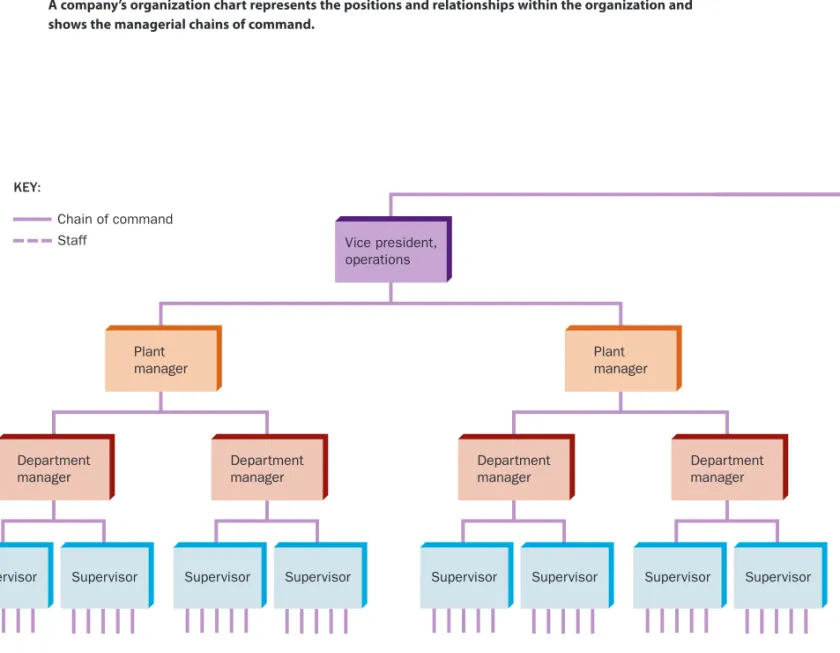
An organization chart is a diagram that represents the positions and relationships within an organization. An example of an organization chart is shown in Figure 7.1.
Each rectangle represents a particular position or person in the organization. At the top is the president, at the next level are the vice presidents. The solid vertical lines connecting the vice presidents to the president indicate that the vice presidents are in the chain of command. The chain of command is the line of authority that extends from the highest to the lowest levels of the organization. Moreover, each vice presi- dent reports directly to the president. Similarly, the plant managers, regional sales managers, and accounting department manager report to the vice presidents. The chain of command can be short or long. For example, at Royer’s Roundtop Café, an independent restaurant in Roundtop, Texas, the chain of command is very short.
Bud Royer, the owner, is responsible only to himself and can alter his hours or change his menu quickly. On the other hand, the chain of command at McDonald’s is long. Before making certain types of changes, a McDonald’s franchisee seeks per- mission from regional management, which, in turn, seeks approval from corporate headquarters.
In the chart, the connections to the directors of legal services, public affairs, and human resources are shown as broken lines; these people are not part of the direct chain of command. Instead, they hold advisory, or staff, positions. This difference will be examined later in this chapter when we discuss line-and-staff positions.
Most smaller organizations find organization charts useful. They clarify positions and report relationships for everyone in the organization, and they help managers to track growth and change in the organizational structure. However, many large organizations, such as ExxonMobil, Kellogg’s, and Procter & Gamble, do not maintain complete, detailed charts for two reasons. First, it is difficult to chart even a few dozen positions accurately, much less the thousands that characterize larger firms. Second, larger organizations are almost always changing parts of their structure. An organization chart would be outdated before it was completed.
However, organization must exist even without a chart in order for a business to be successful. Technology is helping large companies implement up-to-date orga- nization charts.
Major Considerations for Organizing a Business
When a firm is started, management must decide how to organize the firm. These decisions focus on job design, departmentalization, delegation, span of management, and chain of command. In the next several sections, we discuss major issues associ- ated with these dimensions.
1
Understand what an organization is and identify its characteristics.
organization a group of two or more people working together to achieve a common set of goals organization chart a diagram that represents the positions and relationships within an organization chain of command the line of authority that extends from the highest to the lowest levels of an organization
Job Design
In Chapter 1, we defined specialization as the separation of a manufacturing process into distinct tasks and the assignment of different tasks to different people. Here we are extending that concept to all the activities performed within an organization.
Job Specialization
Job specialization is the separation of all organizational activities into distinct tasks and the assignment of different tasks to different people. Adam Smith, the 18th-century economist whose theories gave rise to capitalism, was the first to empha- size the power of specialization in his book, The Wealth of Nations. According to Smith, the various tasks in a particular pin factory were arranged so that one worker drew the wire for the pins, another straightened the wire, a third cut it, a fourth ground the point, and a fifth attached the head. Smith claimed that ten men were able to produce 48,000 pins per day. Before specialization, they could produce only 200 pins per day because each worker had to perform all five tasks!
The Rationale for Specialization
For a number of reasons, some job specialization is necessary in every organization because the “job” of most organizations is too large for one person to handle. In a firm such as DaimlerChrysler, thousands of people are needed to manufacture
Figure 7.1 A Typical Corporate Organization Chart
A company’s organization chart represents the positions and relationships within the organization and shows the managerial chains of command.
Supervisor Supervisor Department manager
Chain of command Staff
Plant manager KEY:
Vice president, operations
Plant manager
Supervisor Supervisor Department manager
Supervisor Supervisor Department manager
Supervisor Supervisor Department manager
2
Explain why job
specialization is important.
job specialization the separation of all organizational activities into distinct tasks and the assignment of diff erent tasks to diff erent people
District manager
District manager
District manager
District manager Regional
sales manager
Regional sales manager
Supervisor Supervisor Accounting department manager Vice president,
marketing
President
Director of public affairs Director of legal services
Vice president, finance
Director of human resources
automobiles. Others are needed to sell the cars, control the firm’s finances, and so on.
Second, when a worker has to learn one specific, highly specialized task, that individual should be able to learn it very efficiently. Third, a worker repeat- ing the same job does not lose time changing from operations, as the pin workers did when producing complete pins. Fourth, the more specialized the job, the easier it is to design specialized equipment. And finally, the more specialized the job, the easier is the job training.
Alternatives to Job Specialization
Unfortunately, specialization can have negative consequences as well. The most significant draw- back is the boredom and dissatisfaction employees may feel when repeating the same job. Bored
employees may be absent from work frequently, may not put much effort into their work, and may even sabotage the company’s efforts to produce quality products.
Job specialization. This designer at Puma has a highly specialized job that includes the evaluation of proposed designs of specific types of athletic shoes.
© vario images GmbH & Co.KG/Alamy
© iStockphoto.com/Catherine Yeulet
To combat these problems, managers often turn to job rotation. Job rotation is the systematic shifting of employees from one job to another. For example, a worker may be assigned a different job every week for a four-week period and then return to the first job in the fifth week. Job rotation provides a variety of tasks so that workers are less likely to become bored and dissatisfied. Pharmaceutical company Eli Lilly, for example, uses a form of job rotation for its managers in which it gives them short-term assignments outside their field of expertise to further develop their skills.2
Two other approaches—job enlargement and job enrichment—also can provide solutions to the problems caused by job specialization. These topics, along with other methods used to motivate employees, are discussed in Chapter 11.
Departmentalization
After jobs are designed, they must be grouped together into “working units,” or departments. This process is called departmentalization. More specifically, depart- mentalization is the process of grouping jobs into manageable units. Several depart- mentalization bases are used commonly. In fact, most firms use more than one.
Today, the most common bases for organizing a business into effective departments are by function, by product, by location, and by customer.
By Function
Departmentalization by function groups jobs that relate to the same organiza- tional activity. Under this scheme, all marketing personnel are grouped together in the marketing department, all production personnel in the production department, and so on.
Most smaller and newer organizations departmentalize by function. Supervision is simplified because everyone is involved in the same activities, and coordination is easy. The disadvantages of this method of grouping jobs are that it can lead to slow decision making and that it tends to emphasize the department over the whole organization.
By Product
Departmentalization by product groups activities related to a particular good or service. This approach is used often by older and larger firms that produce and sell a variety of products. Each department handles its own marketing, production, financial management, and human resources activities.
Departmentalization by product makes decision making easier and provides for the integration of all activities associated with each product. However, it causes some duplication of specialized activities—such as finance—
from department to department. Moreover, the empha- sis is placed on the product rather than on the whole organization.
By Location
Departmentalization by location groups activities according to the defined geographic area in which they are performed. Departmental areas may range from whole countries (for international firms) to regions within countries (for national firms) to areas of several city blocks (for police departments organized into precincts). Departmentalization by location allows the organization to respond readily to the unique demands or requirements of different locations. Nevertheless, a large administrative staff and an elaborate control sys- tem may be needed to coordinate operations in many locations.
3
Identify the various bases for departmentalization.
job rotation the systematic shifting of employees from one job to another
departmentalization the process of grouping jobs into manageable units
departmentalization by function grouping jobs that relate to the same organizational activity departmentalization by
product grouping activities related to a particular product or service departmentalization by location grouping activities according to the defi ned geographic area in which they are performed
Departmentalization. These employees are co-workers in an information technology department.
By Customer
Departmentalization by customer groups activities according to the needs of vari- ous customer populations. A local Chevrolet dealership, for example, may have one sales staff to deal with individual consumers and a different sales staff to work with corporate fleet buyers. The obvious advantage of this approach is that it allows the firm to deal efficiently with unique customers or customer groups. The biggest drawback is that a larger-than-usual administrative staff is needed.
Combinations of Bases
Many organizations use more than one of these departmentalization bases.
Take a moment to examine Figure 7.2. Notice that departmentalization by customer is used to organize New-Wave Fashions, Inc., into three major divisions:
men’s, women’s, and children’s clothing. Then functional departmentalization is used to distinguish the firm’s production and marketing activities. Finally, location is used to organize the firm’s marketing efforts.
Delegation, Decentralization, and Centralization
The third major step in the organizing process is to distribute power in the organiza- tion. Delegation assigns part of a manager’s work and power to other workers. The degree of centralization or decentralization of authority is determined by the overall pattern of delegation within the organization.
Delegation of Authority
Because no manager can do everything, delegation is vital to completion of a man- ager’s work. Delegation is also important in developing the skills and abilities of subordinates. It allows those who are being groomed for higher-level positions to play increasingly important roles in decision making.
departmentalization by customer grouping activities according to the needs of various customer populations
delegation assigning part of a manager’s work and power to other workers
4
Explain how
decentralization follows from delegation.
Design Cutting Sewing Western
region
Midwestern region
Eastern region
Operations Marketing
Men’s clothing division
Women’s clothing division
Children’s clothing division President
Figure 7.2 Multibase Departmentalization for New-Wave Fashions, Inc.
Most firms use more than one basis for departmentalization to improve efficiency and to avoid overlapping positions.
© Jupiterimages/Photolibrary
Steps in Delegation
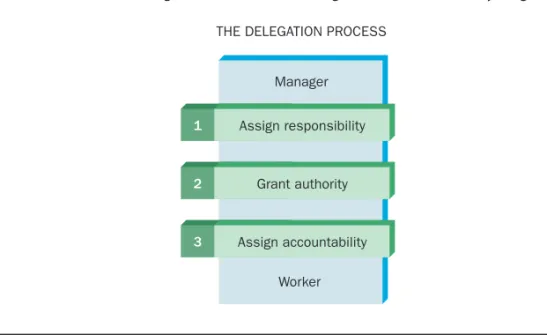
The delegation process generally involves three steps (see Figure 7.3). First, the manager must assign responsibility. Responsibility is the duty to do a job or perform a task. In most job settings, a manager simply gives the worker a job to do. Typical job assignments might range from having a worker prepare a report on the status of a new quality control program to placing the person in charge of a task force. Second, the manager must grant authority. Authority is the power, within the organization, to accomplish an assigned job or task. This might include the power to obtain specifi c information, order supplies, authorize relevant expen- ditures, or make certain decisions. Finally, the manager must create accountability.Accountability is the obligation of a worker to accomplish an assigned job or task.
Note that accountability is created, but it cannot be delegated. Suppose that you are an operations manager for Target and are responsible for performing a spe- cific task. You, in turn, delegate this task to someone else. You nonetheless remain accountable to your immediate supervisor for getting the task done properly. If the other person fails to complete the assignment, you—not the person to whom you delegated the task—will be held accountable.
Barriers to Delegation
For several reasons, manag- ers may be unwilling to delegate work. Many managers are reluctant to delegate because they want to be sure that the work gets done. Another reason for reluctance stems from the opposite situation. The manager fears that the worker will do the work well and attract the approving notice of higher-level managers. Finally, some managers do not delegate because they are so disorga- nized that they simply are not able to plan and assign work effectively.Decentralization of Authority
The pattern of delegation throughout an organization determines the extent to which that organization is decen- tralized or centralized. In a decentralized organization, management consciously attempts to spread authority widely across various organization levels. A centralized organization, on the other hand, systematically works to
responsibility the duty to do a job or perform a task
authority the power, within an organization, to accomplish an assigned job or task
accountability the obligation of a worker to accomplish an assigned job or task
decentralized organization an organization in which management consciously attempts to spread authority widely in the lower levels of the organization
centralized organization an organization that systematically works to concentrate authority at the upper levels of the organization
Figure 7.3 Steps in the Delegation Process
To be successful, a manager must learn how to delegate. No one can do everything alone.
Assign responsibility Manager THE DELEGATION PROCESS
Worker 1
Grant authority 2
Assign accountability 3
Delegation. Delegation allows subordinates to develop the skills and abilities required for higher-level positions.
concentrate authority at the upper levels. For example, many publishers of college- level textbooks are centralized organizations, with authority concentrated at the top. Large organizations may have characteristics of both decentralized and central- ized organizations.
A number of factors can influence the extent to which a firm is decentralized.
One is the external environment in which the firm operates. The more complex and unpredictable this environment, the more likely it is that top management will let lower-level managers make important decisions. After all, lower-level managers are closer to the problems. Another factor is the nature of the decision itself. The riskier or more important the decision, the greater is the tendency to centralize decision making. A third factor is the abilities of lower-level managers. If these managers do not have strong decision-making skills, top managers will be reluctant to decentralize. And, in contrast, strong lower-level decision-making skills encour- age decentralization. Finally, a firm that traditionally has practiced centralization or decentralization is likely to maintain that posture in the future.
In principle, neither decentralization nor centralization is right or wrong. What works for one organization may or may not work for another. Kmart Corporation and McDonald’s are very successful—and both practice centralization. But decen- tralization has worked very well for General Electric and Sears. Every organization must assess its own situation and then choose the level of centralization or decen- tralization that will work best.
The Span of Management
The fourth major step in organizing a business is establishing the span of management (or span of control), which is the number of workers who report
span of management (or span of control) the number of workers who report directly to one manager
5
Understand how the span of management describes an organization.
Google Changes Corporate Culture at Web Speed
Why would a highly successful business like Google deliberately change its corporate culture? One reason is to keep up with the ever- changing business environment—or, better yet, to stay one or two steps ahead.
As a long-time leader in the fast-moving world of information technology, Google knows that speed and innovation are critical to maintaining its competitive edge.
Throughout the company’s history, employees have been encouraged to come up with unconventional new ideas for catapulting Google into the future. These days, employ- ees are invited to present their best ideas in regular meetings with the company’s co-founders and top management, a change that allows for direct feedback and speedier decision making.
Another reason to change the corporate culture is to maintain the nimbleness and entrepreneurial drive of a scrappy start-up even as the company grows and matures. Because Google is now a global corporation with 20,000 employees, it is “actively trying to prevent middle-agedom,” the CEO says.
In a change to its culture, Google has increased the number of small teams working on new ideas and now allows each team con- siderable freedom and resources for its projects. In another cultural change, some teams are located hundreds or thousands of miles from Google’s California headquarters. This means teams have the opportunity to develop ideas in some detail before asking managers and colleagues for constructive criticism and assistance.
Sources: Jonathan Tombes, “Editor’s Letter: Google and Other Crazies,” Communications Technology, January 15, 2010, http://www.cable360.net/
ct/sections/columns/editorsletter/39258.html;
“Creative Tension: Google’s Corporate Culture,” The Economist, September 19, 2009, 67EU; Jonathan V.
Last, “Googling Google,” Weekly Standard, October 12, 2009, http://www.weeklystandard.com/
Content/Public/Articles/000/000/017/033pmaeg .asp; Google Corporate Culture, http://www.google .com/corporate/culture.html.
Going for SUCCESS
© Courtesy of Google, Inc.
directly to one manager. For hundreds of years, theorists have searched for an ideal span of management. When it became apparent that there is no perfect number of subordinates for a manager to supervise, they turned their attention to the general issue of whether the span should be wide or narrow. This issue is complicated because the span of management may change by department within the same organization.
Wide and Narrow Spans of Management
A wide span of management exists when a manager has a larger number of subordi- nates. A narrow span exists when the manager has only a few subordinates. Several factors determine the span that is better for a particular manager (see Figure 7.4).
Generally, the span of control may be wide when (1) the manager and the subordi- nates are very competent, (2) the organization has a well-established set of standard operating procedures, and (3) few new problems are expected to arise. The span should be narrow when (1) workers are physically located far from one another, (2) the manager has much work to do in addition to supervising workers, (3) a great deal of interaction is required between supervisor and workers, and (4) new problems arise frequently.
Organizational Height
The span of management has an obvious impact on relations between managers and workers. It has a more subtle but equally important impact on the height of the organization. Organizational height is the number of layers, or levels, of management in a firm. The span of management plays a direct role in determining the height of the organization (see Figure 7.4). If spans of management are wider, fewer levels are needed, and the organization is flat. If spans of management gen- erally are narrow, more levels are needed, and the resulting organization is tall.
organizational height the number of layers, or levels, of management in a fi rm
WIDE SPAN High level of competence in managers and workers Standard operating procedures Few new problems
•
•
•
NARROW SPAN
Physical dispersion of subordinates Manager has additional tasks High level of interaction required between manager and workers High frequency of new problems
•
•
•
•
Flat organization
Tall organization Figure 7.4 The Span of Management
Several criteria determine whether a firm uses a wide span of management, in which a number of workers report to one manager, or a narrow span, in which a manager supervises only a few workers.
In a taller organization, administrative costs are higher because more managers are needed. Communication among levels may become distorted because information has to pass up and down through more people. When companies are cutting costs, one option is to decrease organizational height in order to reduce related administrative expenses. For example, when cosmetics provider Avon experienced declining sales, the company began a series of long and extensive restructuring programs, with the first beginning in 2005 and the second beginning in 2009. The programs focused on increasing efficiency and organizational effectiveness. While the original restructuring plan saved the company approximately $200 million per year, the newer plan has saved the company an estimated $350 million per year.3 Although flat organizations avoid these problems, their managers may perform more administrative duties simply because there are fewer managers. Wide spans of management also may require managers to spend considerably more time supervis- ing and working with subordinates.
Forms of Organizational Structure
Up to this point, we have focused our attention on the major characteristics of orga- nizational structure. In many ways, this is like discussing the parts of a jigsaw puzzle one by one. It is now time to put the puzzle together. In particular, we discuss four basic forms of organizational structure: line, line-and-staff, matrix, and network.
The Line Structure
The simplest and oldest form of organizational structure is the line structure, in which the chain of command goes directly from person to person throughout the organization. Thus, a straight line could be drawn down through the levels of man- agement, from the chief executive down to the lowest level in the organization. In a small retail store, for example, an hourly employee might report to an assistant manager, who reports to a store manager, who reports to the owner.
Managers within a line structure, called line managers, make decisions and give orders to subordinates to achieve the organization’s goals. A line structure’s simplicity and clear chain of command allow line managers to make decisions
6
Describe the four basic forms of organizational structure.
line structure an organizational structure in which the chain of command goes directly from person to person throughout the organization
line manager a position in which a person makes decisions and gives orders to subordinates to achieve the organization’s goals
Career
SUCCESS
Your Green Career Path?
If you want to pursue a green career path, you have more choices and opportunities than ever before, extending up to the very top of the management ranks. The post of chief sustainability officer (CSO) is the newest C-level position in the organizational hierarchy—a green management job that reports directly to the president or chief executive officer.
AT&T, Google, Dow Chemical, DuPont, and many other busi- nesses have appointed a CSO to plan and coordinate company-wide environmental initiatives, ensure proper compliance with govern- ment regulations, and manage internal and external communi- cations about sustainability issues. Just as important, the CSO is responsible for inserting sustainability into corporate strategy and making it part of the business case for new goods and services.
Some colleges, universities, and municipalities are hiring sustain- ability officers to handle such diverse issues as switching to clean power sources, improving recycling programs, reducing waste, and minimizing the environmental impact of buildings, supplies, and operations.
Rather than isolate responsibility for sustainability in a single top- management role, companies are increasingly adding sustainability to job descriptions throughout the organization. As Levi Strauss’s vice president for social and environmental sustainability explains:
“We’re successful when sustainability gets embedded in all the roles in the company.”
Sources: Henry Fountain, “Sustainability Comes of Age,” New York Times Education Life Supplement, January 3, 2010, 20; Tiffany Hsu, “Eco-officers Are Moving into Executive Suites,”
Los Angeles Times, December 30, 2009, http://www.latimes.com/business/la-fi-green- officers30-2009dec30,0,3283781.story; Geoff Colvin, “Linda Fisher, C-Suite Strategies,” Fortune, November 23, 2009, 45ff.
quickly with direct accountability because the decision- maker only has one supervisor to report to.
The downside of a line structure, however, is that line managers are responsible for many activities, and therefore must have a wide range of knowledge about all of them. While this may not be a problem for small organizations with a lower volume of activities, in a larger organization, activities become more numerous and complex, thus making it more difficult for line managers to fully understand what they are in charge of. Therefore, line managers in a larger organization would have a hard time making an educated decision without expert advice from outside sources. As a result, line structures are not very effective in medium- or large-size organizations, but are very popular in small organizations.
The Line-and-Staff Structure
A line-and-staff structure not only utilizes the chain of command from a line structure but also provides line managers with specialists, called staff managers. There- fore, this structure works much better for medium- and large-size organizations than line management alone. Staff managers provide sup- port, advice, and expertise to line managers, thus eliminating the previous drawback of line structures. Staff managers are not part of the chain of command like line managers are, but they do have authority over their assistants (see Figure 7.5).
line-and-staff structure an organizational structure that utilizes the chain of command from a line structure in combination with the assistance of staff managers staff manager a position created to provide support, advice, and expertise within an organization
Regional sales manager
Regional sales manager
Accounting department manager Vice president,
marketing
President LINE
Director of public affairs Director of legal services
STAFF
Vice president, finance Figure 7.5 Line and Staff Managers
A line manager has direct responsibility for achieving the company’s goals and is in the direct chain of command. A staff manager supports and advises the line managers.
Line-and-staff organization structure. Ronald McDonald occupies a staff position and does not have direct authority over other employees at McDonald’s. The other individuals shown here occupy line positions and do have direct authority over some of the other McDonald’s employees.
© Feature Photo Service/McDonald’s
Both line and staff managers are needed for effective management, but the two positions differ in important ways. The basic difference is in terms of authority.
Line managers have line authority, which means that they can make decisions and issue directives relating to the organization’s goals. Staff managers seldom have this kind of authority. Instead, they usually have either advisory authority or functional authority. Advisory authority is the expectation that line managers will consult the appropriate staff manager when making decisions. Functional author- ity is stronger. Functional authority is the authority of staff managers to make decisions and issue directives about their areas of expertise. For example, a legal adviser for Nike can decide whether to retain a particular clause in a contract but not product pricing.
For a variety of reasons, conflict between line managers and staff managers is fairly common in business. Staff managers often have more formal education and sometimes are younger (and perhaps more ambitious) than line managers. Line managers may perceive staff managers as a threat to their own authority and thus may resent them. For their part, staff managers may become annoyed or angry if their expert recommendations—for example, in public relations or human resources management—are not adopted by line management.
Fortunately, there are several ways to minimize the likelihood of such conflict.
One way is to integrate line and staff managers into one team. Another is to ensure that the areas of responsibility of line and staff managers are clearly defined.
Finally, line and staff managers both can be held accountable for the results of their activities.
The Matrix Structure
When the matrix structure is used, individuals report to more than one supe- rior at the same time. The matrix structure combines vertical and horizontal lines of authority, which is why it is called a matrix structure. The matrix struc- ture occurs when product departmentalization is superimposed on a function- ally departmentalized organization. In a matrix organization, authority flows both down and across. Martha Stewart Living Omnimedia, for example, utilizes the matrix structure to combine the management of its functional departments (publishing, Internet, broadcasting, and merchandising) with its product depart- ments (food, crafts, entertaining, gardening, etc.).4 Another example of a matrix organization could be an automobile manufacturer, whose company may be divided into functional departments, such as production, sales, marketing, distri- bution, and accounting, which co-manage with product departments (the vehicle models).
To understand the structure of a matrix organization, consider the usual func- tional arrangement, with people working in departments such as engineering, finance, and marketing. Now suppose that we assign people from these departments to a special group that is working on a new project as a team—a cross-functional team.
A cross-functional team consists of individuals with varying specialties, expertise, and skills that are brought together to achieve a common task. Frequently, cross- functional teams are charged with the responsibility of developing new products.
For example, Ford Motor Company assembled a special project team to design and manufacture its global cars. The manager in charge of a team is usually called a project manager. Any individual who is working with the team reports to both the project manager and the individual’s superior in the functional department (see Figure 7.6).
Cross-functional team projects may be temporary, in which case the team is disbanded once the mission is accomplished, or they may be permanent. These teams often are empowered to make major decisions. When a cross-functional team is employed, prospective team members may receive special training because effective team work can require different skills. For cross-functional teams to be
matrix structure an organizational structure that combines vertical and horizontal lines of authority, usually by superimposing product departmentalization on a functionally departmentalized organization
cross-functional team a team of individuals with varying specialties, expertise, and skills that are brought together to achieve a common task
successful, team members must be given specific information on the job each performs. The team also must develop a sense of cohesiveness and main- tain good communications among its members.
Matrix structures offer advantages over other organizational forms. Added flexibility is prob- ably the most obvious advantage. The matrix structure also can increase productivity, raise morale, and nurture creativity and innovation. In addition, employees experience personal develop- ment through doing a variety of jobs.
The matrix structure also has disadvan- tages. Having employees report to more than one supervisor can cause confusion about who is in charge. Like committees, teams may take longer to resolve problems and issues than indi- viduals working alone. Other difficulties include personality clashes, poor communication, unde- fined individual roles, unclear responsibilities, and finding ways to reward individual and team performance simultaneously. Because more managers and support staff may be needed, a matrix structure may be more expensive to maintain.
Figure 7.6 A Matrix Structure
A matrix is usually the result of combining product departmentalization with function departmentalization. It is a complex structure in which employees have more than one supervisor.
Source: Ricky W. Griffin, Management, 10th ed. Copyright © 2011 by South-Western/Cengage Learning, Mason, OH. Adapted with permission.
Project manager
A
Vice president, engineering
Project manager
B
Project manager
C
Vice president, production
Vice president, finance
Vice president, marketing CEO
Employees
SP O TLIGHT
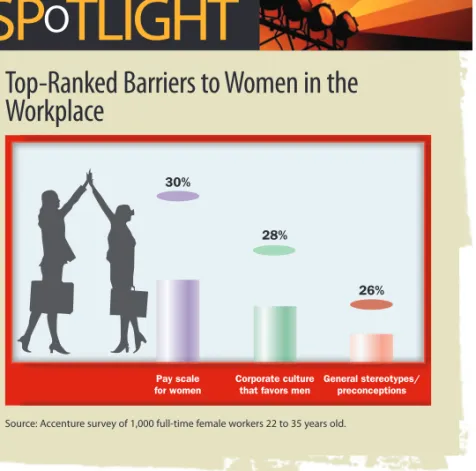
Top-Ranked Barriers to Women in the Workplace
30%
28%
26%
Pay scale for women
General stereotypes/
preconceptions Corporate culture
that favors men
Source: Accenture survey of 1,000 full-time female workers 22 to 35 years old.
The Network Structure
In a network structure (sometimes called a virtual organization), administration is the primary function performed, and other functions such as engineering, production, marketing, and finance are contracted out to other organizations.
Frequently, a network organization does not manufacture the products it sells.
This type of organization has a few permanent employees consisting of top management and hourly clerical workers. Leased facilities and equipment, as well as temporary workers, are increased or decreased as the organization’s needs change. Thus, there is rather limited formal structure associated with a network organization.
An obvious strength of a network structure is flexibility that allows the organization to adjust quickly to changes. Some of the challenges faced by managers in network-structured organizations include controlling the qual- ity of work performed by other organizations, low morale and high turnover among hourly workers, and the vulnerability associated with relying on outside contractors.
Corporate Culture
Most managers function within a corporate culture. A corporate culture is generally defined as the inner rites, rituals, heroes, and values of a firm. An organization’s cul- ture has a powerful influence on how employees think and act. It also can determine public perception of the organization.
Corporate culture generally is thought to have a very strong influence on a firm’s performance over time. Hence, it is useful to be able to assess a firm’s cor- porate culture. Common indicators include the physical setting (building, office layouts), what the company says about its corporate culture (in advertising and news releases), how the company greets guests (does it have formal or informal reception areas?), and how employees spend their time (working alone in an office or working with others).
Goffee and Jones have identified four distinct types of corporate cultures (see Figure 7.7). One is called the networked culture, characterized by a base of trust and friendship among employees, a strong commitment to the orga- nization, and an informal environment. The mercenary culture embodies the feelings of passion, energy, sense of purpose, and excitement for one’s work.
The term mercenary does not imply that employees are motivated to work only for the money, but this is part of it. In this culture, employees are very intense, focused, and determined to win. In the fragmented
culture, employees do not become friends, and they work “at” the organization, not “for” it. Employees have a high degree of autonomy, flexibility, and equality. The communal culture combines the positive traits of the networked culture and the mercenary culture —those of friendship, commit- ment, high focus on performance, and high energy.
People’s lives revolve around the product in this culture, and success by anyone in the organization is celebrated by all.5
Some experts believe that cultural change is needed when a company’s environment changes, when the industry becomes more competitive, the company’s performance is mediocre, and when the company is growing or is about to become a truly large organization. For example, top executives at Dell Computer allocated considerable time and
7
Describe the effects of corporate culture.
network structure an organiza- tional structure in which adminis- tra tion is the primary function, and most other functions are contracted out to other fi rms
corporate culture the inner rites, rituals, heroes, and values of a fi rm
Corporate culture. Food and fun are part of the corporate culture at Google.
© Sergio Dionisio/Publicity Images/Getty Images
resources to develop a strong, positive cor- porate culture aimed at increasing employee loyalty and the success of the company.
Organizations in the future will look quite different. Experts predict that tomorrow’s businesses will comprise small, task-oriented work groups, each with control over its own activities. These small groups will be coordinated through an elaborate computer network and held together by a strong cor- porate culture. Businesses operating in fast- changing industries will require leadership that supports trust and risk taking. Creating a culture of trust in an organization can lead to increases in growth, profit, productiv- ity, and job satisfaction. A culture of trust can retain the best people, inspire customer loyalty, develop new markets, and increase creativity.
Another area where corporate culture plays a vital role is the integration of two or more companies. Business leaders often cite the role of corporate cultures in the integration pro- cess as one of the primary factors affecting the success of a merger or acquisition. Experts note that corporate culture is a way of conducting business both within the company and exter- nally. If two merging companies do not address differences in corporate culture, they are set- ting themselves up for missed expectations and possibly failure.
Sustaining the Planet
GE’s Environmental Stewardship
General Electric views sustainability as essential to being a good corporate citizen. The company has woven environmental stew- ardship into the fabric of its organizational structure and made sustainability an integral part of its corporate culture. Take a look:
http://www.ge.com/citizenship/index.html.
Text not available due to copyright restrictions
Committees and Task Forces
Today, business firms use several types of committees that affect organizational structure. An ad hoc committee is created for a specific short-term purpose, such as reviewing the firm’s employee benefits plan. Once its work is finished, the ad hoc committee disbands. A standing committee is a relatively permanent committee charged with performing a recurring task. A firm might establish a budget review committee, for example, to review departmental budget requests on an ongoing basis. Finally, a task force is a committee established to investigate a major problem or pending decision. A firm contemplating a merger with another company might form a task force to assess the pros and cons of the merger.
Committees offer some advantages over individual action. Their several mem- bers are able to bring information and knowledge to the task at hand. Furthermore, committees tend to make more accurate decisions and to transmit their results through the organization more effectively. However, committee deliberations take longer than individual actions. In addition, unnecessary compromise may take place within the committee, or the opposite may occur, as one person dominates (and thus negates) the committee process.
The Informal Organization and the Grapevine
So far, we have discussed the organization as a formal structure consisting of interrelated positions. This is the organization that is shown on an organization chart. There is another kind of organization, however, that does not show up on any chart. We define this informal organization as the pattern of behavior and interaction that stems from personal rather than official relationships. Firmly embedded within every informal organization are informal groups and the notorious grapevine.
An informal group is created by the group members themselves to accomplish goals that may or may not be relevant to the organization. Workers may create an informal group to go bowling, form a union, get a particular manager fired or transferred, or meet for lunch. The group may last for several years or a few hours.
Informal groups can be powerful forces in organizations. They can restrict out- put, or they can help managers through tight spots. They can cause disagreement and conflict, or they can help to boost morale and job satisfaction. They can show new people how to contribute to the organization, or they can help people to get away with substandard performance. Clearly, managers should be aware of these informal groups. Those who make the mistake of fighting the informal organization have a major obstacle to overcome.
The grapevine is the informal communications network within an organization. It is completely separate from—and sometimes much faster than—
the organization’s formal channels of communication.
Formal communications usually follow a path that parallels the organizational chain of command.
Information can be transmitted through the grapevine in any direction—up, down, diagonally, or horizontally across the organizational structure. Subordinates may pass information to their bosses, an executive may relay something to a maintenance worker, or there may be an exchange of information between people who work in totally unrelated departments. Grapevine information may be concerned with topics ranging from the latest management decisions to gossip.
How should managers treat the grapevine? Certainly, it would be a mistake to try to eliminate it. People working together, day in and day out, are going to communicate.
8
Understand how
committees and task forces are used.
ad hoc committee a committee created for a specifi c short-term purpose
standing committee a relatively permanent committee charged with performing some recurring task
task force a committee established to investigate a major problem or pending decision
9
Explain the functions of the informal organization and the grapevine in a business.
informal organization the pattern of behavior and interaction that stems from personal rather than offi cial relationships
informal group a group created by the members themselves to accomplish goals that may or may not be relevant to an organization grapevine the informal
communications network within an organization
Informal groups. Informal groups can be a source of information and camaraderie for participants. These groups can create both challenges and benefits for an organization.
© i love images/Photolibrary
Unilever
The mission of Unilever is to “add vitality to life through meeting everyday needs for nutrition, hygiene, and personal care with brands that help people look good, feel good, and get more out of life.” Meeting customer needs on the local level requires some degree of decentralization so every- day decisions can be made quickly. At the same time, Unilever has centralized functions such as global research and development. By streamlin- ing the chain of command for its 6,000 research and development specialists, the company has improved efficiency while speeding up innovation.
Unilever uses structural flexibility to its advantage in other ways, as well. After acquir- ing Ben & Jerry’s the company created a separate board of directors to preserve the ice cream com-
pany’s unique social-responsibility values and cor- porate culture. Over the years, this structure has enabled Ben & Jerry’s to expand internationally without losing the personality that loyal custom- ers like as much as the quirky flavors.
Questions
1. In Unilever’s structure, research and develop- ment report directly to the CEO. Do you think managers in this function are considered line or staff? Explain your answer.
2. When Unilever created a separate board of directors for Ben & Jerry’s, was it acting to centralize or decentralize authority? What are the implications for decision-making at Ben &
Jerry’s?
return to inside business
Understand what an organization is and identify its characteristics.
An organization is a group of two or more people work- ing together to achieve a common set of goals. The relationships among positions within an organization can be illustrated by means of an organization chart.
Five specific characteristics—job design, departmen- talization, delegation, span of management, and chain of command—help to determine what an organization chart and the organization itself look like.
Explain why job specialization is important.
Job specialization is the separation of all the activities within an organization into smaller components and the assignment of those different components to different people. Several factors combine to make specialization a useful technique for designing jobs, but high levels of specialization may cause employee dissatisfaction and
boredom. One technique for overcoming these prob- lems is job rotation.
Identify the various bases for departmentalization.
Departmentalization is the grouping of jobs into manageable units. Typical bases for departmental- ization are by function, product, location, or cus- tomer. Because each of these bases provides particular advantages, most firms—especially larger ones—use a combination of different bases in different organiza- tional situations.
Explain how decentralization follows from delegation.
Delegation is the assigning of part of a manager’s work to other workers. It involves the following three steps:
(1) assigning responsibility, (2) granting authority, and
SUMMARY Summary
1
2
3
4
CHAPTER RE VIE W
A more rational approach is to recognize its existence. For example, managers should respond promptly and aggressively to inaccurate grapevine information to minimize the damage that such misinformation might do. Moreover, the grapevine can come in handy when managers are on the receiving end of important commu- nications from the informal organization.
In the next chapter, we apply these and other management concepts to an extremely important business function: the production of goods and services.
(3) creating accountability. A decentralized firm is one that delegates as much power as possible to people in the lower management levels. In a centralized firm, on the other hand, power is systematically retained at the upper levels.
Understand how the span of management describes an organization.
The span of management is the number of workers who report directly to a manager. Spans generally are charac- terized as wide (many workers per manager) or narrow (few workers per manager). Wide spans generally result in flat organizations (few layers of management); nar- row spans generally result in tall organizations (many layers of management).
Describe the four basic forms of organizational structure.
There are four basic forms of organizational structure.
The line structure is the oldest and most simple structure, in which the chain of command goes in a straight line from person to person down through the levels of management. The line-and-staff structure is similar to the line structure, but adds specialists called staff man- agers to assist the line managers in decision making.
The line structure works most efficiently for smaller organizations, whereas the line-and-staff structure is used by medium- and large-size organizations. The matrix structure may be visualized as product depart- mentalization superimposed on functional departmen- talization. With the matrix structure, an employee on a cross-functional team reports to both the project manager and the individual’s supervisor in a func- tional department. In an organization with a network structure, the primary function performed internally is administration, and other functions are contracted out to other firms.
Describe the effects of corporate culture.
Corporate culture has both internal and external effects on an organization. An organization’s culture can influence the way employees think and act, and it can also determine the public’s perception of the organiza- tion. Corporate culture can affect a firm’s performance over time, either negatively or positively. Creating a cul- ture of trust, for example, can lead to increased growth, profits, productivity, and job satisfaction, while retaining the best employees, inspiring customer loyalty, develop- ing new markets, and increasing creativity. In addition, when two or more companies undergo the integration process, their different or similar corporate cultures can affect the success of a merger or acquisition.
Understand how committees and task forces are used.
Committees and task forces are used to develop orga- nizational structure within an organization. An ad hoc committee is created for a specific short-term purpose, whereas a standing committee is relatively permanent.
A task force is created to investigate a major problem or pending decision.
Explain the functions of the informal
organization and the grapevine in a business.
Informal groups are created by group members to accomplish goals that may or may not be relevant to the organization, and they can be very powerful forces.
The grapevine—the informal communications network within an organization—can be used to transmit infor- mation (important or gossip) through an organization much faster than through the formal communication network. Information transmitted through the grape- vine can go in any direction across the organizational structure, skipping up or down levels of management and even across departments.
7
8
9 5
6
CHAPTER RE VIE W
organization (193) organization chart (193) chain of command (193) job specialization (194) job rotation (196)
departmentalization (196) departmentalization by
function (196) departmentalization by
product (196)
departmentalization by location (196) departmentalization by
customer (197) delegation (197) responsibility (198) authority (198) accountability (198) decentralized
organization (198)
centralized organization (198)
span of management (or span of control) (199) organizational height (200) line structure (201) line manager (201)
line-and-staff structure (202) staff manager (202) matrix structure (203)
cross-functional team (203)
network structure (205) corporate culture (205) ad hoc committee (207) standing committee (207) task force (207)
informal organization (207) informal group (207) grapevine (207) You should now be able to define and give an example relevant to each of the following terms:
Key Terms
1. In what way do organization charts create a picture of an organization?
2. What is the chain of command in an organization?
3. What determines the degree of specialization within an organization?
4. Describe how job rotation can be used to combat the problems caused by job specialization.
5. What are the major differences among the four departmentalization bases?
6. Why do most firms employ a combination of departmentalization bases?
7. What three steps are involved in delegation?
Explain each.
8. How does a firm’s top management influence its degree of centralization?
9. How is organizational height related to the span of management?
10. What are the key differences between line and staff positions?
11. Contrast line-and-staff and matrix forms of organizational structure.
12. What is corporate culture? Describe the major types.
13. Which form of organizational structure probably would lead to the strongest informal organization? Why?
14. What is the role of the informal organization?
Review Questions
1. How does the corporate culture of a local Best Buy store compare to that of a local McDonald’s?
2. Which kinds of firms probably would operate most effectively as centralized firms? As decentralized firms?
3. How do decisions concerning span of management and the use of committees affect organizational structure?
4. How might a manager go about formalizing the informal organization?
Discussion Questions
You might expect a company specializing in marketing organic teas to have a distinctive corporate culture. In the case of Numi Organic Tea, a progressive seller of premium organic and Fair Trade teas based in Oakland, California, you’d be right.
With a relatively small staff of about 50 people and a recent growth rate of 180 percent a year, Numi needs to remain nimble and responsive. Its founders, the brother-and-sister team of Ahmed and Reem Rahim, were inspired to create a tea company after Ahmed had spent some years operating tea houses in Europe while Reem studied art in the United States. Combining both their interests led to a unique firm dedicated to quality, sustainability, and community. Numi occupies offices that include a tea garden where employees often gather to relax, and it has won awards for many achievements including its unique teas, its innovative packaging, and its commitment to the environment.
Numi’s 25 different tea and flowering tea products and gift packs are sold in Whole Foods and Safeway markets, as well as in individual natural food and grocery stores throughout the United States, and in 20 other countries overseas.
The prevailing attitude in the company, which main- tains a blog and a presence on Facebook and MySpace, is a can-do, team-oriented spirit. Because it’s a small firm where everyone works hard, Numi can’t afford rapid employee turnover and the time that would be lost in recruiting, interviewing, and training. Employees are thus carefully chosen for their willingness to do whatever it takes to get the job done and to remain upbeat and posi- tive despite the occasional stress of working for a small company with customers around the world. Workers must also be able to devote long hours when necessary and share the company’s goals.
Employees in Numi’s distribution center, for instance, recently found themselves under pressure because it was tak- ing nearly two weeks to fill international orders. With a new manager and a new focus on everyone’s understanding how each job fit into the big picture, however, a sense of teamwork began to grow. Soon each employee had been trained to perform all the critical tasks in order fulfillment, so instead of working in isolation they were able to pitch in during crunch times. Their new flexibility reduced lead times for overseas orders to about five days and cut the time for domestic orders in half. Sometimes the team can ship them the same day.
Video Case 7.1
At Numi Organic Tea, Teams and Organizational Culture Are CriticalCHAPTER RE VIE W
At Numi, managers who communicate well and who are out working alongside their staff are the norm. They must also communicate well with customers and demonstrate a high level of emotional maturity. Some meet with their teams on a regular basis, to review project status against deadlines and due dates and to make changes in workload and procedures where necessary. The company offers flex- time to help employees retain a balance between their work and personal life, and when things get overwhelming at the office, there’s always the tea garden and a