The link between socioeconomic status and health outcomes is clear, but its interpretation is complex. Income is often used as an objective measure of the economic aspect of socioeconomic status. In the survey, respondents are presented with a scale, similar to the scale used when determining subjective socio-economic status.
In Model I, genotype may moderate the effect of an exposure, in this case low socioeconomic status. Manual review revealed that data on socioeconomic status were found exclusively in the unstructured free text of clinical notes, social history, and clinical communications. In this case, a false positive refers to the inaccurate identification of socioeconomic status information by the algorithm.
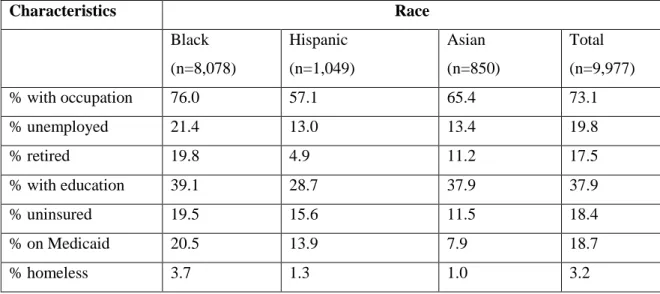
Among the total study population (N=9,977), at least one type of information on the socio-economic status of individuals was extracted. Of the total population for which socioeconomic status data (n=8,282) were collected, 1,978 individuals were unemployed, 1,742 individuals were retired, 1,839 individuals were uninsured, 1,865 were on Medicaid, and 318 were homeless at least once in their EHR (Table 3). The inconsistencies in the recording of socio-economic status data are typical of social and environmental exposure data in free clinical text65.
The sensitivities, specificities, and PPVs of the algorithms were high given the limitations of the socioeconomic status data within the current EHR.
EDUCATION INTERACTION: BLOOD PRESSURE IN BLACK ADULTS
For these reasons, it was decided to focus on the relationship between education as a measure of socioeconomic status and genetic variants that contribute to blood pressure in black individuals. Any blood pressure reading found after any of these medications were mentioned in the medication list was excluded from the blood pressure calculation. Linear regression models were used to examine the association between the genetic variants and both pre-medication systolic blood pressure and pre-medication diastolic blood pressure.
The p-value level for significance was based on the number of SNPs tested for pre-medication systolic blood pressure and pre-medication diastolic blood pressure. These differences were not statistically significant, with the exception of an association between education and diastolic blood pressure after premedication, with diastolic blood pressure after premedication increasing slightly as the level of education increases. When blood pressure measurements were examined in different age groups, an increasing trend of systolic blood pressure with age was observed (Figure 20).
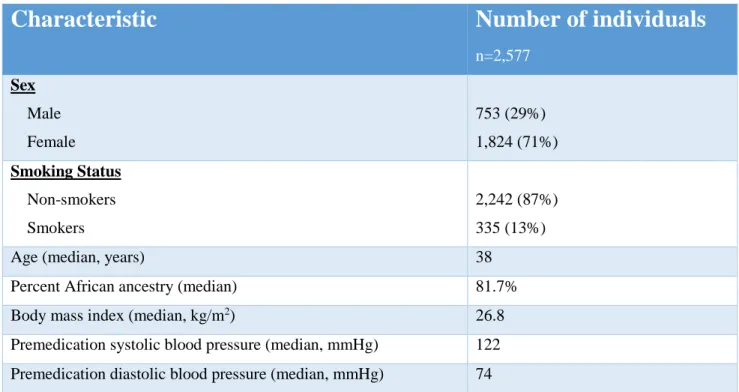
Prior to examination of genetic data, the correlation of covariates with blood pressure measurements was analyzed (Table 6). Age, sex, and body mass index were significantly correlated with both premedication systolic and diastolic blood pressure in the data set. The variation in blood pressure for those excluded from the analyzes to those included in the analyzes was similar.
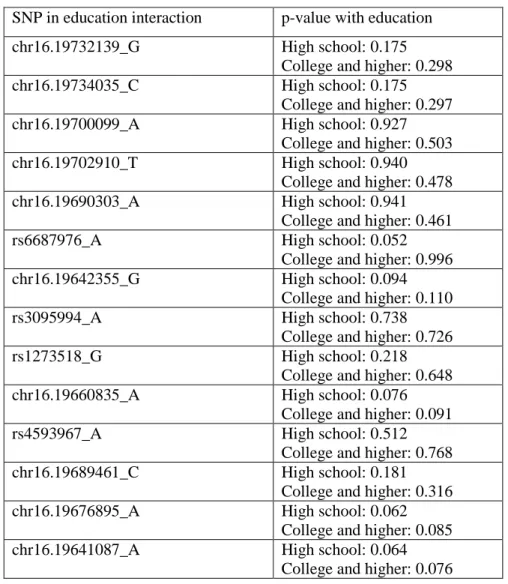
Associations between premedication systolic blood pressure or premedication diastolic blood pressure and genetic variants by Metabochip were examined, including known predictors of blood pressure (age, BMI, sex, percentage of African descent, and smoking status) in the model . SNP rs4593967, which was found to be significantly associated with systolic blood pressure, has not been previously associated with blood pressure or hypertension. Because of previous gene-x-nurture interactions associated with blood pressure in a white population, it was predicted that gene-x-nurture interactions might exist within a black population.
In addition to the limited sample size, the population in this study was also slightly different from previous populations used to examine blood pressure in a black population. Measurements of blood pressure may vary due to the calibration of instruments, the time of day that is. It is also the first analysis to include education information in a large-scale genetic study of blood pressure in a black population.
Individuals with blood pressure or body mass index values greater than three times the standard deviation of the mean were also removed. Premedication diastolic blood pressure increases until about age 60 and then decreases in older individuals within our data set.
Standard error p-value
Although there are statistically significant differences between sex, age, smoking status, body mass index, systolic blood pressure and diastolic blood pressure are the most striking. Premedication systolic blood pressure increases across age groups within individuals lacking education information. Premedication diastolic blood pressure increases across age groups within individuals lacking education information.
Summary of characteristics of SNPs associated with premedication systolic and diastolic blood pressure when education is included in the model. To investigate the effect of including socio-economic data (in the form of education) on a large-scale genetic analysis of blood pressure in a black population, three different regression models were analyzed. The first set of models examined both systolic blood pressure and diastolic blood pressure after premedication as outcomes, with age, age squared, gender, body mass index, smoking status, and percent African ancestry as covariates.
The young age of the participants resulted in a limited number of individuals developing high blood pressure and reduced variability in blood pressure measurements. Gene x education interactions were investigated without a main effect of education on the outcome, blood pressure. It was the first to examine the impact of socioeconomic data on a large-scale genetic study of blood pressure in a black population.
Association of genetic variation with systolic and diastolic blood pressure among African Americans: the Candidate Gene Association Resource study. -wide association study of extreme blood pressure identifies variants near UMOD associated with hypertension. association study identifies eight loci associated with blood pressure. A broad association study identifies six new loci that influence pulse pressure and mean arterial pressure. pathways influence blood pressure and the risk of cardiovascular disease.
A genome-wide linkage and association scan reveals novel loci for hypertension and blood pressure traits. -replication study of a genome-wide association study for hypertension and blood pressure in African Americans. -trait and multi-trait genome-wide association analyzes identify novel loci for blood pressure in populations of African origin.
Gene-age interactions in blood pressure regulation: a large-scale study with the CHARGE, Global BPgen and ICBP Consortia. Variant discovery and fine mapping of genetic loci associated with blood pressure traits in Hispanics and African Americans.