Error-Correcting Codes for Networks, Storage and Computation
Thesis by
Wael Halbawi
In Partial Fulfillment of the Requirements for the Degree of
Doctor of Philosophy
CALIFORNIA INSTITUTE OF TECHNOLOGY Pasadena, California
2017
Defended June 5, 2017
© 2017 Wael Halbawi
ORCID: 0000-0001-5951-7002 All rights reserved
To my beloved family:
my mama and baba, Alia & Iyad,
and my brother, Anas.
ACKNOWLEDGEMENTS
I would like to express my utmost gratitude and appreciation to my advisor Prof.
Babak Hassibi. Babak’s constant support has been essential for the completion of this journey. I will always remember our first meeting in early 2014; what was scheduled to be a thirty-minute meeting ended up being a two-hour discussion touching on a variety of topics – both technical and non-technical – and a soothing dose of encouragement. Thank you, Babak, for the freedom, trust and all the interesting conversations.
My sincere thanks go to my thesis committee: Prof. Shuki Bruck, Prof. Alexandros Dimakis, Dr. Dariush Divsalar and Prof. Victoria Kostina. Thank you for taking the time to provide feedback on this thesis. Special thanks are also due to Prof. P.
P. Vaidyanathan who was part of my candidacy committee.
I would also like to express my gratitude to Dr. Tracey Ho, who was my advisor when I first joined Caltech; I thank Tracey for giving me the opportunity to study at this wonderful place. The motivation and encouragement of Prof. Joseph Jean Boutros were never absent throughout my undergraduate and graduate studies. Thank you, Joseph, for the many afternoons we spent in your office discussing coding theory, art, music and other things.
During the last few years, I had the pleasure of interacting and working with incred- ibly talented people: Hongyi Yao, Iwan Duursma, Matthew Thill, Anatoly Khina, Zihan Liu, Son Hoang Dau, Navid Azizan and Fariborz Salehi. A lot of the results reported in this thesis are a direct consequence of our collaborative efforts.
The warmth and friendliness of the Hassibi Lab is solely due to its members: Wei, Matt, Kishore, Christos, Ramya, Ehsan, Navid, Toli, Philipp, Fariborz, Ahmed and Hikmet. Thank you all for maintaining a stimulating and exciting atmosphere in Moore 155. I am lucky to have shared an office first with Christos and then with Fariborz, with whom I became good friends, enjoyed many discussions and shared lots of laughs. The efforts of Shirley and Katie ensured that the group functioned smoothly; thank you for your help and patience.
International orientation is where I met my friends Alex, Carlos, Ruby, Christos and Krishna, with whom I got to discover and enjoy beautiful Pasadena. Thank you for your friendship throughout this journey. I will always cherish the fun times we spent together and will never forget our adventures in different parts of the world.
The last six years would’ve been very different without George, Noor and Sami. I will always be grateful for your friendship and everything that comes with it: good memories, lots of laughter, lengthy conversations and terrific company. My dearest friends, you have been an integral part of this journey and I cannot emphasize this strongly enough.
At the very end, I owe it all to my family: my mom Alia, my dad Iyad and my brother Anas. Your love and care, during both joyous and tough times, is the reason that I was able to complete this endeavor. Your eternal support is my strength and without it none of this would’ve been possible. I will never be able to give back what you gave me, but the least that I can do, and I hope I can do more in the future, is to dedicate my work to you.
ABSTRACT
The advent of the information age has bestowed upon us three challenges related to the way we deal with data. Firstly, there is an unprecedented demand for transmit- ting data at high rates. Secondly, the massive amounts of data being collected from various sources needs to be stored across time. Thirdly, there is a need to process the data collected and perform computations on it in order to extract meaningful information out of it. The interconnected nature of modern systems designed to perform these tasks has unraveled new difficulties when it comes to ensuring their resilience against sources of performance degradation. In the context of network communication and distributed data storage, system-level noise and adversarial er- rors have to be combated with efficient error correction schemes. In the case of distributed computation, the heterogeneous nature of computing clusters can poten- tially diminish the speedups promised by parallel algorithms, calling for schemes that mitigate the effect of slow machines and communication delay.
This thesis addresses the problem of designing efficient fault tolerance schemes for the three scenarios just described. In the network communication setting, a family of multiple-source multicast networks that employ linear network coding is considered for which capacity-achieving distributed error-correcting codes, based on classical algebraic constructions, are designed. The codes require no coordination between the source nodes and are end to end: except for the source nodes and the destination node, the operation of the network remains unchanged.
In the context of data storage,balancederror-correcting codes are constructed so that the encoding effort required is balanced out across the storage nodes. In particular, it is shown that for a fixed row weight, any cyclic Reed–Solomon code possesses a generator matrix in which the number of nonzeros is the same across the columns.
In the balanced and sparsest case, where each row of the generator matrix is a minimum distance codeword, the maximal encoding time over the storage nodes is minimized, a property that is appealing in write-intensive settings. Analogous constructions are presented for a locally recoverable code construction due to Tamo and Barg.
Lastly, the problem of mitigating stragglers in a distributed computation setup is addressed, where a function of some dataset is computed in parallel. Using Reed–
Solomon coding techniques, a scheme is proposed that allows for the recovery of the
function under consideration from the minimum number of machines possible. The only assumption made on the function is that it is additively separable, which renders the scheme useful in distributed gradient descent implementations. Furthermore, a theoretical model for the run time of the scheme is presented. When the return time of the machines is modeled probabilistically, the model can be used to optimally pick the scheme’s parameters so that the expected computation time is minimized.
The recovery is performed using an algorithm that runs in quadratic time and linear space, a notable improvement compared to state-of-the-art schemes.
The unifying theme of the three scenarios is the construction of error-correcting codes whose encoding functions adhere to certain constraints. It is shown that in many cases, these constraints can be satisfied by classical constructions. As a result, the schemes presented are deterministic, operate over small finite fields and can be decoded using efficient algorithms.
TABLE OF CONTENTS
Acknowledgements . . . iv
Abstract . . . vi
Table of Contents . . . viii
List of Illustrations . . . ix
Chapter I: Introduction . . . 1
1.1 Motivation . . . 1
1.2 Background and Literature Review . . . 4
1.3 Summary of Contributions . . . 17
Chapter II: Distributed Reed–Solomon Codes . . . 21
2.1 Introduction . . . 21
2.2 Preliminaries . . . 22
2.3 Construction . . . 25
2.4 Examples . . . 42
2.5 Discussion . . . 44
Chapter III: Distributed Gabidulin Codes . . . 47
3.1 Introduction . . . 47
3.2 Preliminaries . . . 48
3.3 Construction . . . 55
3.4 Code Construction for Networks with Two Messages . . . 57
3.5 Code Construction for Networks with Three Messages . . . 58
3.6 Discussion . . . 68
Chapter IV: Coding with Constraints: Systematic Constructions . . . 72
4.1 Introduction . . . 72
4.2 Problem Setup . . . 73
4.3 Minimum Distance . . . 75
4.4 Systematic Construction . . . 76
4.5 Minimum Distance for Systematic Linear Codes . . . 78
4.6 Example . . . 81
4.7 Discussion . . . 81
Chapter V: Balanced Reed–Solomon and Tamo–Barg Codes . . . 83
5.1 Introduction . . . 83
5.2 Preliminaries . . . 85
5.3 Balanced Reed–Solomon Codes . . . 93
5.4 Balanced Tamo–Barg Codes . . . 96
5.5 Discussion . . . 105
Chapter VI: Reed–Solomon Codes for Distributed Computation . . . 107
6.1 Introduction . . . 107
6.2 Problem Setup . . . 108
6.3 Construction . . . 112
6.4 Decoding Vectors . . . 118
6.5 Delay Model . . . 120
6.6 Numerical Results . . . 123
6.7 Discussion . . . 125
6.8 Appendix . . . 126
Chapter VII: Concluding Remarks and Future Directions . . . 131
LIST OF ILLUSTRATIONS
Number Page
1.1 The butterfly network. . . 7
1.2 Single-source and multi-source multicast networks. . . 8
1.3 A simple multi-source multicast network. . . 10
1.4 Graph representation of a code’s generator matrix. . . 14
2.1 An example of an SMAN with 3 source nodes and 10 relay nodes. . . 23
2.2 Generic form a simple multiple access network with three sources. . . 33
3.1 A schematic of a multi-source multicast network. . . 49
3.2 A rank deficient multi-source multicast network. . . 70
4.1 A bipartite graph specifying a code with encoding constraints. . . 75
4.2 Graph configuration used to prove Proposition 4.1. . . 76
6.1 Schematic representation of a parallel computing cluster . . . 109
6.2 Expected computation time in a distributed cluster with offline decoding123 6.3 Performance of distributed training of a softmax classifier . . . 125
C h a p t e r 1
INTRODUCTION
1.1 Motivation
The rate at which we are amassing data is unprecedented. Today, sources of data are ubiquitous, and interconnected in complex networks. With that arises a demand requiring us to ensure that data is communicated efficiently, stored reliably and processed robustly. Traditionally, networked solutions allow us to utilize this data in better ways but today, this has become a necessity. For these networks to scale, one would like to employ cheap and low-power devices that are potentially less reliable, while maintaining an effective and predictable overall system. The use of fault-tolerance schemes, such as error-correcting codes, in such settings is necessary to mitigate the performance degradation resulting from these devices, or from the natural consequences that accompany large-scale networked systems.
The notion of error-correcting codes was first formally conceived in late 1940s by Richard Hamming [Ham47; Ham48; Ham50] as a means of introducing redundancy into information to protect it from errors. In his seminal work [Sha48], Shannon showed that arbitrarily reliable communication at the highest possible rates is (in principle) achievable through the use of such error-correcting codes. The setting considered by Shannon is one in which a single transmitter sends a message through a noisy channel to a single receiver. This model is well studied and has found use in modern practice, which also led to the development of efficient error correction techniques throughout the second half of the twentieth century. Such techniques have also served as a basis for network management protocols in which a network of communicating nodes is viewed as a collection of point-to-point links, where data isroutedacross this network with the potential use of an error-correcting code between nodes if necessary. Such methodology is relatively simple to implement, but far from optimal. Indeed, new paradigms revolve around the basic idea that it is beneficial for the nodes in a network to operate on – or code across – the information they receive rather than simply route it.
But as with any new invention, new challenges arise when one adopts a sophisticated scheme such as the one described. Indeed, the fact that nodes code across the data packets they receive leads to catastrophic performance in the presence of errors.
As a result, it is necessary to devise new error correction techniques that are suited to these networks. Furthermore, efficient schemes are always desirable and one would hope for those that minimally affect the underlying operation of the network.
Indeed, such properties are essential for them to find place in practice.
In the context of data storage, reliable data centers, each comprising many storage nodes, are central to the operation of modern internet services such as online social networks, cloud computing services, etc. Today, it is common to utilize multiple data centers, possibly spread across geographic distances, to support a single service.
Companies resort to several techniques to prevent data loss occurring from events such as disk failures and natural disasters. Replicating information across nodes is one method that is attractive due to its simplicity and efficiency. Nonetheless, replication requires a large storage overhead in that guaranteeing a certain level of robustness requires the most redundancy; one node holds data while the rest are mere copies of it. Using error-correcting codes for data storage, however, is an attractive choice that first appeared in the mid eighties with the introduction of RAID systems1. Since then, more and more companies are relying on coding as a solution to combat data loss. In the event of disk/node failure, the lost data is reconstructed by contacting an appropriate set of surviving nodes. Key metrics involved in the design of error-correcting codes for a storage system include:
• Capacity: The amount of information that can be stored.
• Level of resilience: The number of storage nodes allowed to fail before data loss occurs.
• Read complexity: The amount of resources required to read the data stored, in the absence of node failures.
• Write complexity: The amount of resources required to encode the data and store it on the storage nodes.
• Recovery complexity: The amount of resources required to reconstruct erro- neous/erased data.
The optimization of these metrics is heavily dependent on the implementation sce- nario. For some applications, fast read speeds are essential, while in others it is
1RAID stands for Redundant Array of Inexpensive Disks. Various modes of this method exist where RAID1 employs replication while RAID2 through RAID6 employ error-correcting codes.
worth sacrificing that for an added level of protection. In another example, nodes might fail at a very low rate allowing the use of a higher capacity coding scheme capable of handling only a small number of errors. Data centers storing frequently read data, “hot data" in modern parlance, require error-correcting codes with high recovery speeds. In archival storage systems such as Amazon Glacier [Ama] and Google Coldline [Goo], one can potentially opt for codes that optimize write com- plexity thereby reducing energy consumption while ensuring that the code used offers high levels of resilience.
The third area of consideration is that of distributed computation. The growing number of computation problems involving massive datasets is rendering the use of distributed algorithms deployed on computer clusters necessary. In such setup, a job is divided into many tasks which are distributed across many machines to be performed in parallel. Frameworks such as Hadoop [Apaa] and Spark [Apab]
have facilitated the adoption of this paradigm in various domains. In principle, the expected gain from parallelizing an algorithm should scale linearly in the number of processors being used. However, there are several factors that usually prohibit this gain. Modern clusters are shared resources that can potentially serve multiple users simultaneously. In this case, the response time for a job submitted by a user heavily depends on the jobs submitted by others. This is especially prevalent in cloud computing services such as Amazon EC2, where lower-tier machines are known to have variable performance. Network congestion and background maintenance services [DB13], amongst others, also contribute to the latency observed in these clusters.
Machines that require a longer-than-expected time to respond after being assigned a task are known as stragglers, and different solutions to alleviate their effect are available. The simplest is that of initiating multiple replicas of the same task and then waiting for the first response. While seemingly simple and attractive, this solution does lead to a waste of resources. Recent methods, inspired by error-correcting codes, preprocess the tasks in a way such that a predetermined number of them are sufficient to recover the solution of problem being solved. Such preprocessing methods have to be efficient so that their utility does not end up eliminating the gains achievable from parallel processing.
In summary, the three scenarios just considered call for the design of error-correcting codes with the following properties:
• Efficient: The complexity required for implementing and using the error- correcting code should be low enough not to affect the performance of the underlying sytem, whether it is a communication network, a storage system or a cluster of computers.
• Predictable: The fault-tolerance level guaranteed by a code should be con- sistent. In particular, deterministic guarantees are often desirable in practice.
• Optimal: Error-correcting codes that optimally trade-off their design param- eters ensure the best utilization of resources.
Main Message
The three scenarios of network communication, data storage and distributed com- putation considered in this thesis are unified by the problem of constructing linear error-correcting codes with certain structure that are efficient, predictable and op- timal. In some cases, this structure arises from constraints inherent to the problem itself. For example, we will see that in the case of network error correction, the topological structure of the network translates to constraints on the encoding func- tions that define the error-correcting code. In other cases, we find that imposing a certain structure can optimize particular metrics pertinent to the code’s performance.
This will become evident in the data storage scenario, where structure can be used to speed up the encoding process and facilitate its implementation in a distributed manner. In the case of distributed computation, this structure will provide us with schemes that offer significant speedups compared to traditional parallel comput- ing. We provide explicit constructions of error-correcting codes, based on classical algebraic error-correcting codes, that enjoy efficient encoding and decoding, have deterministic guarantees on their error-correcting capabilities and are optimal given their parameters.
1.2 Background and Literature Review
This section formally introduces the problems considered in this thesis along with some mathematical preliminaries necessary for their treatment.
Error-Correcting Codes
An error-correcting code C is simply a subset of Fnq, where Fq is the finite field of q elements. The parameter n is known as the length of the code and |C| is its cardinality. If we letM={M1, . . . , M|C|}be a set of messages, one can define an error-correcting code through an encoding functionf that maps a messageMito a
codewordci ∈ C. The goal then is to conveyMi to a receiver through some noisy channel by transmittingci. Formally, one would like to find a decoding functiong such that if the receiver sees a corrupted version ofci,
y=ci+e,
it is able to reconstruct an estimate ofMivia
Mˆi =g(ci). (1.1)
Let wt(x) = |{i:xi 6= 0}| denote the Hamming weight of the vector x. This function induces a metric onFnq via
d(x,y) :=wt(x−y).
Guarantees on the code’s error correction capabilities are defined in terms of the maximum weight of anye, such that for anyMi, the estimate in (1.1) is equal to the transmitted message. This quantity is a function of what is known as the minimum distance of the code, defined as
d(C) = min
x6=y∈Cd(x,y),
where at least one of the arguments is nonzero. It follows that ifwt(e) ≤ d−1
2
, then one can recoverMi uniquely.
We consider error-correcting codes that are subspaces of Fnq. In this case, we can definek as the dimension ofC when viewed as a vector space over Fq. Here, the message setMcan be taken asFkq and one can define the functionf through the generator matrix of the codeG∈Fk×nq . A messagemis now mapped to a codeword by the relation
c=mG.
Generator matrices in which somekcolumns form an identity matrix are calledsys- tematic. These are desirable in certain applications as the message m appears explicitly in its encoding.
The minimum distance of a linear codeC reduces to d(C) = min
06=c∈Cwt(c).
A fundamental bound due to Singleton is one that relatesn, k andd(C)via d(C)≤n−k+ 1.
Codes that achieve this bound with equality are known as maximum-distance sepa- rable (MDS) and can correct the largest numbers of errors/erasures. A construction due to Reed and Solomon is one of the most famous [RS60].
Reed–Solomon Codes
We will heavily rely on Reed–Solomon codes in various parts of this thesis. For this reason, we devote this section to describing them and stating properties that are relevant to the results presented.
A Reed–Solomon code RS[n, k]is defined as the image of the set of polynomials in Fq[x] of degree less than k evaluated at n distinct elements in Fq, called the coordinates of the code. Formally, we have
RS[n, k] ={(m(α1), . . . , m(αn)) :deg(m(x))< k},
where each m(αi) is a codeword symbol and deg(m(x)) denotes the degree of m(x). With every message m = (m0, . . . , mk−1), we associate the polynomial m(x) = Pk−1
i=0 mixi, which is then evaluated at the code’s coordinates. Indeed, this mapping is linear and so the code’s generator matrix is given by
G=
1 1 · · · 1 α1 α2 · · · αn
... ... . . . ... αk−11 α2k−1 · · · αnk−1
.
A Reed–Solomon code is MDS. This is readily seen from the fact that a polynomial of degreek−1cannot have more thank−1roots and sod(RS[n, k])≥n−k+ 1. Combining this with the Singleton bound establishes the claim. For this reason, and many others, they are widely adopted in practice. Sample applications range from consumer technologies such as CDs, DVDs and Blu-ray Discs, to industry standards such as RAID6 and Digital Video Broadcasting (DVB).
More details on error-correcting codes can be obtained by consulting classical texts such as [MS77] and [McE02].
Network Error Correction
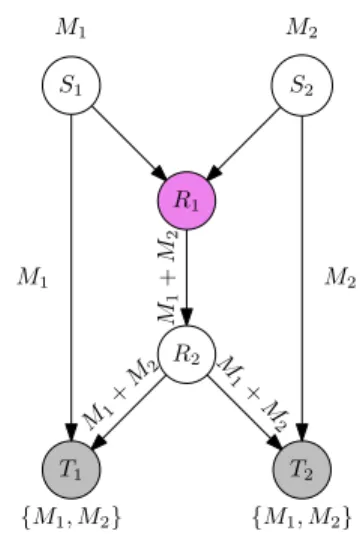
Network coding was introduced as a paradigm for operating networks in the seminal work [Ahl+00], where it was shown that traditional routing is insufficient to achieve the capacity of certain networks: the maximum throughput theoretically possible.
Their solution, termed Network Coding, allows intermediate nodes in a network to
M1 M2
M1 M2
M1 fM1; M2g M1
M
1
S1 S2
R1
R2
T1 T2
M1 M2
M1
(a) Routing: Relay node R1 has to decide whether to forward M1 or M2. In this case, only one of the two receivers will obtain both messages.
M1 M2
M1 M2
fM1; M2g fM1; M2g M1+M2
M1 +M2
M
1+ M
2
S1 S2
R1
R2
T1 T2
(b) Coding: Relay nodeR1can sum its incoming messages, which en- ables both receivers to obtainM1and M2.
Figure 1.1: The butterfly network is the canonical example for which network coding is necessary to achieve capacity. SourcesS1 and S2 carry messages M1 andM2, respectively, and each destination nodeTi is interested in receiving both messages.
Both messages are unit sized and the links in the network can carry one unit of information per time instant. The packet traversing a link is indicated by its label.
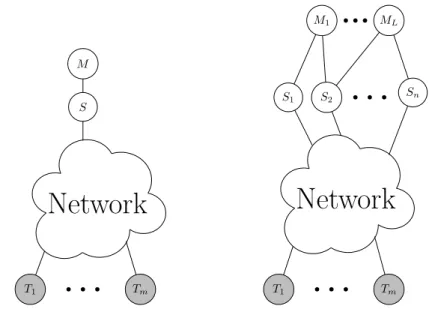
operate on the packets they receive before forwarding them to other nodes in the network. For an example, refer to Figure 1.1. From there, significant effort was dedicated to the study of multicast networks (Figure 1.2). In such a network, a single source node is interested in communicating a message to a collection of destinations.
It was shown in [LYC03] that linear network coding suffices to achieve the capacity of these networks. Since then several frameworks have been developed to construct capacity-achieving network codes and two results that stand out are those of Ho et al. [Ho+06] and Jaggi et al. [Jag+07].
The extension of the single source multicast problem to one with multiple sources was studied in [Ho+06], where it was shown that if all nodes in the network forward random linear combinations of the packets they receive, the destination nodes can recover the original set of messages with high probability. In a network with L messages, we can model each message Mi as a collection of Ri data packets organized in a matrix Mi ∈ FRqi×n, where Ri is the rate of message Mi in Fq
symbols per unit time. Due to the linearity of the network code, a receiver collects
S M
Network
T1 Tm
(a) Single-source multicast network.
S1 S2 Sn
ML
M1
T1 Tm
Network
(b) Multi-source multicast network.
Figure 1.2: In a single-source multicast network, a collection of receivers are interested in recovering the source’s single message. In the multi-source multicast setting, a collection of source nodes jointly hold a set of messages which is to be recovered at each receiver.
N packets obtained through
Y =
L
X
i=1
TiMi,
whereTi ∈FNq ×Ricaptures the aggregate effect of the network code on the message Mi.
Naturally, one is interested in scenarios where a network operates in the presence of errors resulting from faulty links or due to an adversary, say. In this case, attainable communication rates are characterized by the capacity (capacity region in the multi- source case) of the network in the presence ofzerroneous links. In the single-source multicast setting, where the messageM is of sizeRsymbols, the result is known as the network Singleton bound and was presented in [YC06] as
R ≤C−2z.
Here, the quanityC denotes the size of the min-cut2 between the source node and any receiver. The work of Dikaliotis et al. [Dik+10] characterizes the capacity region of multi-source multicast with L messages M = {M1, . . . , ML}, each of
2In graph theory, the min-cut between two subsets of vertices is the set of edges of smallest cardinality which, once removed, separates them.
rateRi, as
X
Mi∈M0
Ri ≤CM0 −2z, ∀M0 ⊆ M. (1.2)
whereCM0 is the size of min-cut that separatesM0 from any receiverTj.
Here, the network transfers the messages from sources to a destination node accord- ing to
Y =
L
X
i=1
TiMi+Z,
where the matrix Z captures the effect of the z error packets introduced into the network. By linearity of the network code, we have thatrank(Z)≤z.
The pioneering work of Kötter and Kschischang [KK08] introduced the notion of subspace coding to the realm of single-source multicast network error correction. It was noticed that by encoding the messageM in a choice of subspaceV rather than a particular basis representing it, the receiver can decodeMif the intersection between V and the rowspace ofYis large enough. Silva et al. built on top of this framework and provided constructions in [SKK08] based on Gabidulin codes [Gab85]. A Gabidulin code can be viewed as a linear subspace of matrices C ⊆ Fn×mq where the distance between two codewords is measured using the usual rank function. In particular, the distance between two codewordsC1,C2 is given by
dR(C1,C2) =rank(C1−C2).
Hence, the source node maps its message to a codeword C in a Gabidulin code of dimension R and length n, where n is the min-cut of the network, so that the receiver observes,
Y=TC+Z.
Successful decoding occurs ifdR(Y,C) ≤ z. A variety of efficient decoders for Gabidulin codes are known to exist [SK09a; WAS13; Loi06] which allows the receiver node to decode the message M efficiently. Furthermore, the construction just presented is essentially optimal in terms of the field size required. Gabidulin codes exist only whenm≥nand this requirement suffices in this setting.
The picture is a little bit less rosy in the multi-source setting. The direct application of single-source codes as proposed in [JFD09] provides a practical and distributed coding scheme but can only attain a strict subregion of (1.2). On the other hand, a carefully crafted capacity-achieving construction was developed in [Dik+10]. The construction is defined as follows: SourceSi encodes its message using a z-error
correction Gabidulin code of length ni and dimension Ri, over a finite field Fpi. Hereni =Ri+ 2z andpi =pQij=1nj for primep. It is shown that this finite field nesting technique along with a recursive decoding algorithm allows any receiver to recover all messages. Unfortunately, the exponentially growing finite field and the recursive decoding algorithm deem this construction impractical.
This gap between single-source and multi-source network error correction is ad- dressed in the first two chapters of this thesis. In particular, we aim to construct a distributed network error-correcting code that achieves the capacity of multi-source multicast networks. By distributed, we mean that the source nodes encode the message they have independently of others. By carefully selecting the encoding functions at the sources, one would want the packets obtained by the receiver to appear as
Y=TC˜ +Z,
whereC˜comes from a single-source Gabidulin code capable of correctingzerrors in the rank metric. Furthermore, one would hope for a construction whose underlying field scales slowly in CM, the min-cut of the network. In this way, the receiver, through a single use of a Gabidulin code decoder, can efficiently recover all messages.
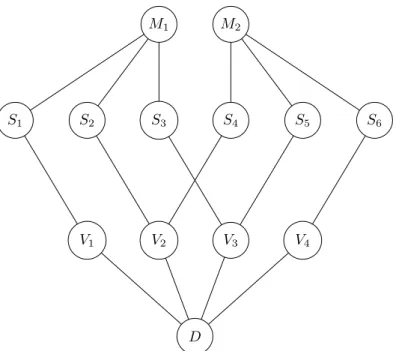
The source-message relations (as depicted by Figure 1.2b) dictate certain constraints on the encoding functions that one is allowed to use. Suppose we restrict ourselves to linear encoding functions and consider the example whereby the communication network is depicted in Figure 1.3, where the rate of eachMiisRi = 1.
M1 M2 M3
S1 S2 S3 S4 S5 S6
T
Figure 1.3: In this multi-source multicast network, each source nodeSiis connected directly to the receiverT. We assume that the rate of each messageMiisRi = 1. A distributed error-correcting code possesses a generator matrix of the following form,
G=
g1,1 g1,2 g1,3 g1,4 0 0 0 0 g2,3 g2,4 g2,5 g2,6 g3,1 g3,2 0 0 g3,5 g3,6
.
Here, we associate theithrow ofGwithMiand thejthcolumn withSj. In effect, the nodeSjencodes the messages it has access to by linearly combining them using the coefficients in the corresponding column. The destination node receives a collection of six elements ofFqof whichzare corrupted by an adversary. For the destination node to decode correctly, the variablesgi,j are carefully selected fromFqso that the code generated byGcan correctz errors.
The way we select the gi,j’s heavily affects the decoding complexity of the code, and so a careful choice is required to accomplish this and ensure optimal error correction capabilities. In chapters 2 and 3, we formalize this framework and provide constructions for certain classes of multicast networks so that efficient decoders can be used at the destination node to recover the messages.
Distributed Data Storage
The introduction of error-correction techniques to the data storage realm began when Patterson et al. invented RAID [PGK88]. In the simplest form of the scheme, known as RAID5, one usesn disks wheren−1of them carry information while the last one stores their exclusive-OR (XOR). Such scheme can tolerate any single failure.
RAID6 on the other hand, which is based on Reed–Solomon codes, employs two parity disks to tolerate any two failures. In addition to minimum distance, figures of merit by which a code’s performance is judged include encoding complexity, de- coding complexity and repair complexity. Encoding complexity measures the effort required to compute the parity symbols when the data is encoded. Furthermore, it is also of interest to measure the computation required to modify code symbols when a single data symbol is updated, known as the update complexity. Decoding complexity measures the computational effort exerted when the information stored in the storage system is to be read. Indeed, this depends on whether errors/erasures have occurred, in which case a decoder must be utilized to recover the data. Repair complexity, also commonly known today aslocality, quantifies the smallest number of code symbols from which any other code symbol can be computed.
With an eye toward constructions with low encoding complexity, Blaum and coau- thors introduced the commonly used EVENODD codes in [Bla+95] as array codes3 that can correct any two erased columns. EVENODD codes are known to have low encoding and decoding complexity; both requireO(m2)additions inFp when the codewords are in F(m−1)×mp . A generalization of EVENODD was presented
3An array code is one in which every codeword can be viewed as a matrix.
in [BBV96] to handle, under some assumptions, up to eight column erasures.
Today’s distributed storage systems also use Reed–Solomon codes, given their wider range of parameters. See [Mur+14] and [Clo] for practical examples. Even though these codes can tolerate an arbitrary number of erasures, practitioners have noticed that while storage nodes fail regularly, a small number of them fail at a time. This has led researchers to view error-correcting codes from the lens ofrepair. The first framework proposed to address this problem is that ofregenerating codes. Here, one assumes that a error-correcting code is used to encode a data filem∈Fkq, where qis a prime power, to a codewordc= (c1, . . . , cn)∈Fnq, where eachciis placed on a storage nodeSi. This leads to the natural association between the columns of the code’s generator matrix and the storage nodes. Now, suppose that a single storage node fails; a question asked is the following: What is the total amount of data that needs to be retrieved from surviving nodes to enable the repair of the failed node? In principle, one can encode the file using an MDS code and then repair a failed node by retrieving data from k other surviving nodes. In the seminal work of Dimakis et al.[DPR06], it was shown that, using certain codes, one can contact more than k nodes but download less data overall, less than the size of the whole data file in particular. This work formulated what became to be known as the storage versus repair-bandwidth trade-off, which characterizes the balance that needs to be struck between the amount of data that needs to be stored per node, versus the amount that needs to be downloaded when a repair job is invoked. Several contributions followed in [Ras+09; RSK11; Sha+12a; Sha+12b]. Due to their ubiquity, recent efforts have been dedicated to the study of repairing Reed–Solomon codes [GW15].
A parallel line of work focuses on the notionlocal repair. First formulated in [OD11]
and [Gop+12], the notion of local repair aims to address a similar problem as that of regenerating codes. However, it focuses on the following question: Given an error-correcting codeC of lengthnand dimensionk, what is the smallest numberr such that for any codeword, any code symbol can be recovered by accessingrother code symbols? Codes that address this problem are known as locally repairable codes (LRCs). Formally, an LRCC ⊂ Fnq has localityr if for eachi ∈ {1, . . . , n}, there is a subsetIi ⊂ {1, . . . , n} \i, where|Ii| ≤rsuch thatci =fi({cj :j ∈ Ii}). The coordinatesci ∪ {cj : j ∈ Ii}form what is known as a local repair group. A Singleton-type bound of the form
d≤n−k− k
r
+ 2 (1.3)
was derived for linear codes in [Gop+12] and later generalized in [PD12] to all codes4. The works [Raw+12; Sil+13] provided optimal constructions (with re- spect to (1.3)) based on Gabidulin codes, where the underlying finite field scales exponentially inn. Tamo and Papailiopoulos presented in [TPD13] a concatenated code construction whose underlying field scaled exponentially in the code dimen- sion. Tamo and Barg [TB14; TB15] presented elegant constructions, which can be viewed as subcodes of Reed–Solomon codes, over finite fields that scale linearly in n.
Once an error-correcting code for a storage system is fixed, it is preferred to have its generator matrix in systematic form. Indeed, in the absence of erasures/errors, a systematic code allows the data collector to read off the message symbols directly without any added read complexity. It is well known, though, that the parity columns in a systematic generator matrix of an MDS code are completely dense, i.e. all entries in these columns have to be nonzero. As an example, a systematic MDS code of length6and dimension4has a generator matrix of the following mask:
G=
1 0 0 0 × × 0 1 0 0 × × 0 0 1 0 × × 0 0 0 1 × ×
. (1.4)
The structure of this mask can be captured by a graph as depicted in Figure 1.4a.
While systematic codes are essential in “read" intensive applications, they do require the parity disks to exert maximal encoding effort when computing their symbols.
But what if “reads" are not very common? Can we relieve this stress from the parity nodes without sacrificing the code’s error correction capabilities? This question was first considered by Dau et al. [Dau+13] in an abstract context where the authors were interested in constructingbalancedandsparsest generator matrices for MDS codes. For an MDS code of lengthnand dimensionk, this translates to having every row be of weightn−k+ 1and every column of weight
jk(n−k+1)
n
k or
lk(n−k+1)
n
m . The authors showed that a random construction over a large field is possible with high probability. A balanced and sparse generator matrix of an MDS code is indeed suitable for distributed storage systems responsible for “cold" data [Goo; Ama; Fac].
In this setting, the data being stored is of archival nature so it’s barely read. Given this observation, one might consider employing a balanced and sparsest MDS code
4In the case of nonlinear codes, it was assumed that the code was of cardinalityqk, whereqis the order of the underlying finite field.
m1 m2 m3 m4
c1 c2 c3 c4 c5 c6
(a) Systematic Code: The two parity symbols are connected to all message symbols, as nec- essary for the code to be MDS.
m1 m2 m3
c1 c2 c3 c5 m4
c4 c6
(b) Balanced Code: Every code symbol is con- nected to the same number of message sym- bols, and vice versa.
Figure 1.4: A code’s generator matrix can be represented by a bipartite graph on the set of message symbols and the set of code symbols, where an edge betweenmiand cjimplies thatcj is (potentially) a function ofmi. The converse to this statement is also true: the absence of an edge implies thatcj cannot be a function ofmi.
in an archival storage system to balance out the encoding effort across all storage nodes. As an example, the generator matrix of an MDS code of length 6 and dimension4is given by
G=
× × × 0 0 0 0 0 0 × × × 0 × × × 0 0
× 0 0 0 × ×
,
and is represented pictorially in Figure 1.4b. It turns out that, with a careful choice of the nonzero entries, the matrix G can be made to generate a Reed–Solomon code over F7. In Chapter 5, we describe this process in detail and prove that it is always possible to construct a balanced and sparsest generator matrix for any cyclic Reed–Solomon code. Furthermore, an analogous result for Tamo–Barg codes is provided.
Distributed Computation
Mitigating the effect of straggling machines in a distributed computation setup by utilizing error-correcting codes is a relatively new concept. In comparison to replication-based techniques [WJW14; WJW15], Lee et al. showed in [Lee+16]
how substantial speed-ups can be realized by using MDS codes to performcoded computation. Formally, suppose that one is interested in computing a function of the form
f(X) :=f(x1, . . . , xN), (1.5) where thexi ∈Fpcomprise the given datasetX ={x1, . . . , xN}andFis an arbitrary field. Certain forms offfacilitate its computation in parallel. In particular, suppose
that one can find functionshandgso that
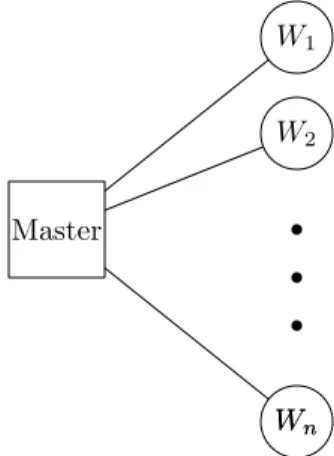
f(X) = h(g(X1), . . . , g(Xk)), (1.6) where the sets X1, . . . ,Xk form a disjoint partition ofX. To evaluatef(X)using a cluster of n machines, a taskmaster paritions X into n disjoint partitions and assigns the computation ofg(Xi)to each machineSi. The machines perform their computation in parallel and send back the results to the taskmaster, which applies the functionhon{g(Xi)}ni=1and recoversf(X). In a practical scenario, the taskmaster has to wait for all n machines to return before it can evaluate f(X). Due to the heterogeneous nature of shared computing clusters, some of then machines might experience severe delay before their results are sent back to the taskmaster [DB13].
In this case, one can utilize coding by asking the machines to compute the functions in a redundant fashion. In particular, we partition the dataset intok < npartitions and assign to each machineSithe computation of{g(Xij)}wj=1, where2 ≤w≤ k. Then, each Si sends back to the taskmaster a prescribed linear combination of the form
ci =
w
X
j=1
bi,jg(Xij).
The coefficientsbi,jare chosen in a way such that once a total offmachines indexed by l1, . . . , lf return, the task master can decode {g(Xij)}wj=1 fromcl1, . . . , clf and apply the function h to compute f(X). Suppose that the computation of interest is the multiplication of the matrixX, corresponding toX, by a vectory. For this application, the functionsf,gare
f(X) =
— xt1 — ...
— xtn —
y1
... yp
,
g(Xj) =
— xt(j−1)N/k+1 — ...
— xtjN/k —
y1
... yp
,
andh is simply the identity function. In [Lee+16], it was shown that the function f can be recovered from any k machines by choosing thebi,j as the entries of the generator matrix of an MDS code of lengthnand dimensionkoverF. Furthermore, due to the linearity of f, the scheme can be implemented in way such that the
taskmaster encodes the matrices{Xj}kj=1corresponding to{Xj}kj=1 as Ci =
k
X
j=1
bi,jXj
and providesCi toSialong with the vectory. OnceSireturnsCiy, the taskmaster can recover Xy from any k such products. The work of [DCG16] presented a scheme in which the resulting matricesCj are sparse, hence speeding up the com- putation at each machine. In this way, each machine performs a single matrix-vector multiplication compared towof them. In [LMA16a], Li et al. consider coded dis- tributed matrix multiplication in the context of a MapReduce framework, where they established a trade-off between the computational latency and the communication load of such scheme. They further proposed a coding scheme whose performance comes within a multiplicative gap of the fundamental tradeoff. In [Rei+17], coded matrix multiplication is considered in a heterogeneous setting where the machines comprising the cluster are of different capabilities. A coding scheme is proposed that achieves logarithmic (in the total number of machines) speedup when compared to other schemes.
In the context of machine learning, Tandon et al considered in [Tan+16] a distributed gradient descent scenario in the presence of stragglers. Formally, suppose one is interested in fitting a vector of parametersβ ∈ Rp to a datasetD = {(xi, yi)}Ni=1, wherexi ∈Rpandyi ∈R, subject to a loss functionLthat isseparablein data, i.e.
L(D;β) =
N
X
i=1
`(xi, yi, β),
where` is the loss function evaluated at (xi, yi). The separability of the function L in the data allows us to write its gradient with respect to β as ∇L(D;β) = PN
i=1∇`(xi, yi, β). The fitting problem can now be solved using gradient descent in a distributed fashion. In [Tan+16], a similar coding-theoretic framework was proposed for the recovery of the full gradient∇L(D;β)in the presence of stragglers.
The proposed scheme, which is based on random MDS codes overR, partitions the datasetD inton partitions and each machine is provided with a specific subset of sizew, determined by the maximum number of stragglerss to be tolerated. For a givens, their scheme achieves a theoretical lower bound onw, thereby minimizing the workload per machine. The taskmaster recovers the full gradient from the fastest f := n−smachines by inverting a matrix of orderf, with complexityO(f3). In such a setting, it is natural to assume a probabilistic model for the response time
of each machine and then choosewso that the expected time required to compute
∇L(D;β)is minimized. Toward this end, we adapt the framework of [Tan+16] and present in Chapter 6 a deterministic coding scheme, along with anO(f2)complexity decoder, that tolerates the largest number of stragglers for a fixed amount of data assigned to each machine. Furthermore, we introduce a delay model that serves as a guide for selecting the scheme’s parameters so that the expected time required to compute∇L(D, β)is minimized.
1.3 Summary of Contributions
This thesis aims to provide deterministic and efficient code constructions for three scenarios that are inherently distributed, while maintaining the highest error-correction guarantees theoretically permissible. Technically speaking, we are presented with the challenge of designing error-correcting codes whose encoding functions satisfy certain constraints. In some cases, such as network error correction, these constraints are dictated by the underlying topology, while in others, such as distributed data storage and distributed computation, designing these constraints carefully can result in desirable computational properties. A detailed outline of these contributions are presented in the sequel.
Network Error Correction
In Chapter 2, we study the problem of network error correction in the context of simple multiple access networks (SMANs). In such network, a group of source nodes collectively hold a set of messages and are directly connected, via unit-capacity relay links, to a receiver node. The network operates in the presence ofzerroneous relay links. An example of this network is given in Figure 1.3. When the number of messages isL= 3, we show that the capacity region of this network, given by (1.2), is achieved by a construction we call distributed Reed–Solomon codes. These are subcodes of classical Reed–Solomon codes whose generator matrices obey the encoding constraints imposed by the SMAN in consideration. Being subcodes of Reed–Solomon codes, they can be decoded by a variety of efficient decoders [WB86;
Mas69; GS99]. Furthermore, the finite field over which the codes operate scales linearly in the number of source nodes and so in that respect they are optimal.
In Chapter 3, we provide analogous constructions, based on Gabidulin codes, for general multiple-source multicast networks, when the number of messages isL= 3. In particular, this provides the first construction for this setting that is both capacity- achieving and efficient. The proposed scheme requires decoding complexity that is
polynomial in the network size and constant in the number of messages, compared to existing techniques where the decoding complexity was exponential in the number of messages. The code is fully distributed and is oblivious to the underlying network code; only the source nodes need to perform additional computation. The decoder at the receiver node remains unchanged and can be chosen as one of the many efficient Gabidulin code decoders [SKK08; SK09a; WAS13; Loi06].
Distributed Data Storage
In Chapter 4, we formalize the problem of coding with encoding constraints, where a given bipartite graph (see Figure 1.4) describes the feasible relations between message symbols and code symbols. A upper bound on the minimum distance of any error-correcting code that obeys the encoding constraints is presented and is shown to be achievable under certain technical conditions. We show that it is possible to achieve this bound using a carefully constructed subcode of any MDS code, and in particular Reed–Solomon codes. When the code is required to be systematic, we refine our bound and show that it is achievable, also using MDS codes.
In Chapter 5, we construct generator matrices for Reed–Solomon codes that are balanced. In this setting, we are provided with the flexibility of designing the mask of the generator matrix so that it exhibits desirable properties. In particular, for any desired row weightwwheren−k+ 1≤w≤ n−1, we show how to construct a generator matrixGfor a cyclic Reed–Solomon code of lengthn and dimensionk so that the following two properties hold:
• Every row is of weightw.
• Every column is of weightkw
n
orkw
n
.
Such matrix is called abalanced matrix. We emphasize the usefulness of such a construction by advocating a distributed storage system in which the encoding is done distributedly, i.e. every storage node in the system encodes a preallocated set of message symbols independently of the rest. Furthermore, a generator matrix of the form just described ensures that, for any fixedw, the maximal encoding time over all storage nodes is minimized. As a result, such a scheme is computationally balanced as no storage node behaves like a bottleneck. While our codes are not systematic, the update complexity is still minimal for any chosenw, i.e. updating one message symbol impacts exactlywstorage nodes. From a theoretical standpoint, it is worth
mentioning that our results generalize the setup of [Dau+13] and provide efficient constructions for it. We also present balanced Tamo–Barg codes for cyclic versions of the code, wherewcan be selected from a wide range of parameters. All of the presented constructions operate over the same finite field of the underlying codes, namelyFqwhereq ≥n, and so the computational efficiency remains intact.
Distributed Computation
In Chapter 6, we consider a cluster of n machines assigned the task of computing the gradient∇L(D;β) of a loss function Lwith respect to a parameter vector β, where the dataset D is partitioned into k disjoint sets {Di}ki=1. We construct a deterministic coding scheme, based on Reed–Solomon codes, that facilitates this computation in the presence of stragglers. Our scheme differs from others in that it is determined by a pair(w, k), wherewis the number of data partitions assigned to each machine. Given such a pair, we carefully construct a balanced matrix that prescribes the coding coefficients for each machine. For every(w, k), our scheme achieves a lower bound, due to Tandon et al. [Tan+16], on the number of machines f(w, k, n)needed for recovering∇L(D;β). An algorithm is developed to recover
∇L(D, β) in O(f2) time and, contrary to previous works, avoids computing an entire matrix inverse; our decoder is also efficient in space.
Furthermore, we propose a delay model that incorporates the decoding complexity and from there, we provide an expression in terms of w, k and n for the expected time required to compute ∇L(D;β). The expression accounts for the time spent by each machine for computation (and encoding), the delay in the response time modeled as a Pareto random variable, and the decoding time. The expression can be numerically optimized to find the minimizing w and k. Since w and k determine the fraction of data given to a machine, our setup provides a practical way to design schemes that ensure minimal response time, when the machines utilized have to adhere to a memory constraint. We supplement our theoretical findings with numerical simulations and validate the effectiveness of the proposed scheme.
C h a p t e r 2
DISTRIBUTED REED–SOLOMON CODES
2.1 Introduction
We consider the problem of error correction in multi-source multicast networks. In general, such network is one where a set of source nodes are to communicate, with the aid of a network, a set of messages to a collection of destination nodes. We restrict ourselves tosimple multiple access networks(SMAN), a family of networks which we formalize in this chapter and can capture various network error correction and key distribution scenarios. In a SMAN, a single destination node wishes to reconstruct a set of messages available at the source nodes with the aid of a single layer of relay nodes (see Figure 2.1). Each relay node can communicate with a subset of the source nodes, and is connected to the destination by a unit1 capacity link. We wish to design a distributed code that can correct arbitrary errors on up toz links that connect the relay nodes to the destination. Equivalently, one wishes to be resilient toz erroneous relay nodes. This problem has been considered previously by [YHN11] in the context of decentralized distribution of keys from a pool, where it was shown to be a special case of the general multiple-access network error- correction problem, whose capacity region was established in [Dik+10]. It also applies generally to other distributed data storage/retrieval scenarios where different nodes store different subsets of the source messages.
In this chapter, we introduce a framework for constructing a computationally efficient coding scheme, based on Reed–Solomon codes, for correcting errors in SMANs.
Specifically, the relay nodes encode the messages they have access to in a distributed fashion such that the destination node receives a set of code symbols which, when viewed as a single vector, form a codeword from a single Reed–Solomon code.
This permits the destination node to recover the desired messages efficiently using standard decoders designed for Reed–Solomon codes [Mas69; WB86]. This scheme obviates the need for encoding over successively larger nested finite fields at each source as in the prior construction of [Dik+10]. We prove that the proposed coding scheme achieves the full capacity region for such networks with up to three sources.
1We are considering an algebraic setting so a unit corresponds to the size of one element from the underlying finite field.
Related Work
The multi-source multicast problem was first introduced by Dikaliotis et al. in [Dik+10].
Under the assumption of adverserial errors, the capacity region for such networks was established, and an error correction scheme based on Gabidulin codes [Gab85].
Closer to the realm of this work, the work of [Dau+13], motivated by distributed sensor networks, introduced the notion of balanced and sparsest MDS codes. There, one is interested in construction MDS codes with generator matrices that are sparse and have balanced column weights. The work of Dau et al. in [DSY14; DSY15]
analyzes, amongst others, the problem considered in this chapter and conjecture that Reed–Solomon codes attain the capacity region of SMANs for any number of sources.
Also closely related is the work of Yan et al. in [YS11; YSZ14], in which the data exchange problem under weak security is considered. In the network considered, the nodes, each of which holds a subset of messages, communicate cooperatively, via error-free broadcast transmissions, in order to disseminate all messages subject to the presence of an eavesdropper. The existence of a secure transmission scheme is proven, using probabilistic arguments, by showing how to construct an MDS code subject to sparsity constraints, similar to the ones we consider, over an exponentially growing finite field.
2.2 Preliminaries
We begin this section by presenting a formal definition of an SMAN. Next, we show how the problem of constructing a linear error-correcting code for such a network is algebraically equivalent to building a structured generator matrix for a code capable of correcting z errors. The required structure is identified by the graph defining the SMAN. We will consider algebraic codes, Reed–Solomon codes in particular, defined overFq, the finite field ofqelements.
Simple Multiple Access Networks
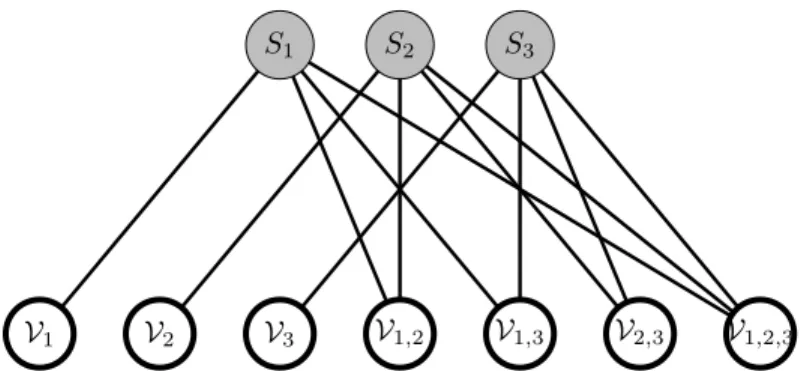
Definition 2.1. A simple multiple access network is represented by a bipartite graph G= (S,V,E), where the set of source nodes isS ={S1, . . . , Sm}, the set of relay nodes is V = {v1, . . . , vn} and the edge set is given by E. A source node Si is connected to a relay node vj, via a relay link, if and only if (i, j) ∈ E. Each Si
carries a message Mi of size ri symbols from Fq and the destination node D is interested in retrieving allMi’s by connecting to all relay nodes.
D S1 S2 S3
v2 v3 v5 v6 v7
v1 v4 v8 v9 v10
Figure 2.1: An example of an SMAN with 3 source nodes and 10 relay nodes.
An adjacency matrixAis associated with an SMAN, where the rows and columns representS andV, respectively, andAi,j = 1if and only if(i, j)∈ E. An example of an SMAN with three source nodes and ten relay nodes is given in Figure 2.1. The corresponding adjacency matrix is
A=
1 0 0 0 0 1 1 1 1 1 0 1 0 1 1 0 0 1 1 1 0 0 1 1 1 1 1 0 0 1
. (2.1)
We consider an SMAN in whichzof the links connecting the relays to the destination are erroneous. For eachS0 ⊆ S, the minimum cut capacity (min-cut) fromS0toD is denoted byCS0. From [Dik+10], the capacity regionRof an SMAN is given by cut set bounds for each subset of sources.
Theorem 2.1 (Dikaliotis et al. [Dik+10]). The capacity region of an SMAN is the set of all rate vectorsr= (r1, r2, . . . , rm)such that
X
Si∈S0
ri ≤CS0 −2z,∀S0 ⊆ S. (2.2) Furthermore, it suffices to carry out linear coding at internal network nodes, where eachvi transmits linear combinations of received symbols overFq.
It is easy to see that in a SMAN, the min-cut CS0 is given by the number of relay nodes that are connected to at least one node in S0. Formally, we have CS0 =|{vj ∈ V :∃Si ∈ S0,(i, j)∈ E}|.
Having characterized the capacity region of an SMAN, we are interested in con- structing codes that can achieve every rate vector in this region. The main result