Evaluating and controlling strategic marketing
LEARNING OBJECTIVES
By the end of this chapter you will:
n understand the importance of evaluation and controlling strategic marketing activities
n be aware of the elements of the control process and how these apply to the key areas for control in marketing
n understand the distinctions and relationships between profit control, efficiency control and strategic control in marketing
INTRODUCTION
In this chapter we assess the efficiency and effectiveness of strategic marketing efforts. The evaluation and control of marketing probably represents one of the weakest areas of marketing practice in many companies. There are a number of reasons for this. First, there is no such thing as a ‘standard’ system of control for marketing. Other functional areas of management have well established techniques and systems of control in, for example, production planning and control, financial planning and control and quality control. With the exception of annual sales and profit control, marketing theory and practice has no universally accepted system of evaluation and control procedures. Second, and perhaps related to this, there is no doubt that evaluation and control of marketing presents complex problems for the designer of control systems. For example, in large companies several marketing areas, each with different specialists, will need to be controlled. The efforts of sales managers, marketing researchers, advertising personnel, brand managers, etc., need to be closely co-ordinated if the control and evaluation process is to be successful.
Finally, and more controversially, marketing management has resisted notions of control that are widely accepted and indeed welcomed in other functional areas. This resistance has been, and still is, justified on the basis that much marketing activity does not lend itself to traditional control concerns, and indeed can detract from more ‘creative’ approaches to marketing. This argument is rejected here. Certainly, control of marketing, with its myriad of complex interrelationships, is difficult. Control of marketing presents distinct measurement problems, as we saw with, for example, the evaluation of the effectiveness of advertising. We should be careful not to over-constrain marketing management with control, but such control and evaluation of marketing effort are essential, even if it is only part of ‘good housekeeping’.
Sponsorship spend is a good example of how some areas of marketing have been difficult to evaluate and control. Few marketers have known exactly what they were getting from substantial spends in this area. To some extent, marketers have colluded in this failure to measure the effectiveness of sponsorship spending as it has enabled them to have more discretion over how much and where a major part of the promotional budget was spent. This is now changing. Sponsors are now demanding to know what they are getting for their money. Recent large sponsorship deals have involved clauses in the contract which allow the sponsor to withdraw if pre-specified promotional objectives and results are not achieved.
For this reason, a good understanding of the nature of control is needed, not only by designers of the control system, but also by those being controlled.
THE ESSENTIALS OF THE CONTROL PROCESS
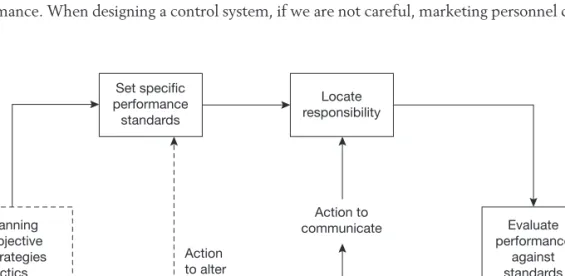
The essentials of the control process for any management function are shown in Figure 14.1.
We can see that it contains four essential elements, namely:
n setting specific performance standards;
n locating responsibility for achieving these standards;
n evaluating performance against standards;
n taking corrective action.
In addition, we can see that performance standards should stem from and reflect the objectives, strategies and tactics of the planning process. The corrective action then feeds back to, and potentially affects, the planning process itself, performance standards, and those responsible for achieving these standards.
Building on this overview of the control process, designing an effective system of control requires consideration of the following:
Information
In Chapter 12 we considered the importance and design of the marketing information system.
The control process is reliant upon timely, accurate and up-to-date information. In designing the control systems for marketing strategy, the information element should be based on establishing minimum rather than maximum information needs. This will mean improved, not reduced, performance. When designing a control system, if we are not careful, marketing personnel can spend
Evaluate performance
against standards Locate
responsibility
Action to communicate Set specific
performance standards
Action to alter plans
Action to alter performance standards
Take corrective
action Planning
• Objective
• Strategies
• Tactics
FIGURE 14.1 An overview of the control process
more time accounting for their activities than performing them. In addition, information costs money.
The control system, of which information is a part, should not cost more than the costs that would be incurred if there were no controls. Finally, information needs to be analysed and presented in a way that is understandable to those who require it.
Communication and ‘noise’ in the system
As shown in Figure 14.1, communication is essential for effective control. Managers need to be made aware of standards of performance against which their activities and those of their own subordinates are to be judged. In addition, rapid feedback of results is important so that differences between required and actual standards of performance can be corrected. Direct communication between manager and subordinates, rather than passing information down a potentially long chain of command, is preferred as this minimizes the ‘noise’ in the control system which can occur when information is distorted by having it passed down an extended scalar chain of command.
Human aspects of control
‘Control’ can be viewed negatively if individuals fear that the control process will be used not only to judge their performance, but as a basis for punishment. Another reason for this negative view is the fact that the process of collecting information for control is often seen as detracting from ‘real’
work. Salespeople, in particular, often see control in this way – they often resent having to fill in visit report forms which contain essential control information because they feel it leaves less time for selling.
To be successful, people involved and affected by the control process should be consulted in both the design and implementation stages of marketing control and need to be convinced that the purpose of control is to improve their personal levels of success and that of the company.
Subordinates need to be involved in setting and agreeing their own standards of performance, preferably through a system of management by objectives.
THE CONTROL PROCESS IN ACTION
The strategic control process should enable management to accomplish the following:
1 to allow problems, i.e. deviations from plans and budgets to be identified at an early stage on a continuous basis as the plan is being implemented;
2 to assess causes of deviations from standards of performance so corrective action can be taken;
3 to provide an input to the process of identifying and analysing opportunities and threats;
4 to provide a positive incentive to staff to improve their performance.
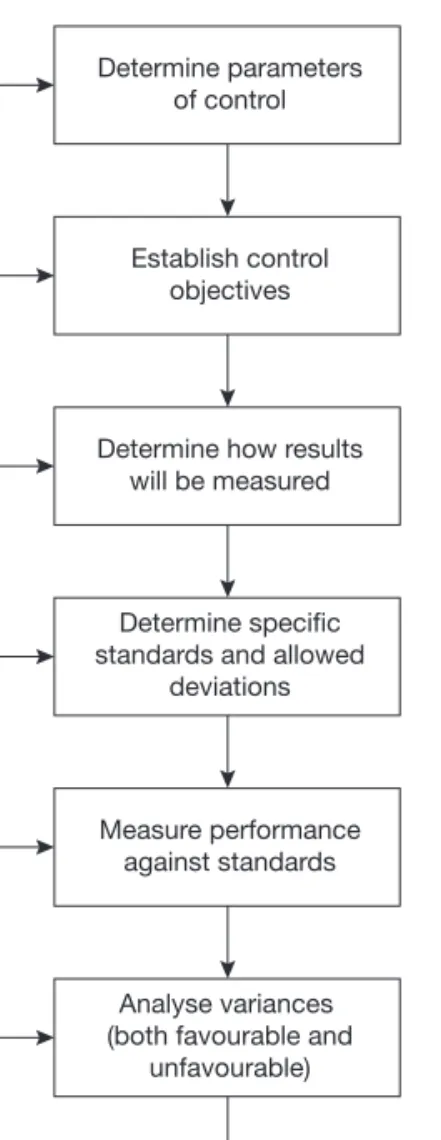
Figure 14.2 shows how the concept of a control process can be translated into action. In the context of a marketing control system, each of the steps involves the following.
Determining control parameters
Determining what to control (the parameters) is the start point of the control process. Overall, sales, costs and profits are the major parameters, but marketing control involves more than just these key areas. The company may have other key objectives which relate to, for example, social responsibility or technological reputation. In addition, each of the marketing functions will also involve objectives, and hence parameters, which will need to be controlled. The parameters of marketing control must include those for controlling the marketing objectives and strategies themselves in order to assess whether or not they are still relevant to the marketing environment.
Determine parameters of control
Establish control objectives
Determine how results will be measured
Determine specific standards and allowed
deviations
Measure performance against standards
Analyse variances (both favourable and
unfavourable)
Implement corrective action programmes
FIGURE 14.2 Steps in the control process
The objectives of control
When we have decided what to control, control objectives can be set. These will encompass functional and financial performance in addition to more qualitative objectives. If planning objectives have been clearly set, the control process can build on these. Each objective must be achieved within a given budget, so budgetary control is essential. Broad control objectives need to be broken down into sub-objectives for each area of marketing activity. Having done this we can then establish specific standards of performance, together with the degree of deviation, if any, which will be tolerated in the system.
Establishing specific standards of performance and allowed deviations
The next step in the control process is to establish specific performance standards that will need to be achieved for each area of activity if overall and sub-objectives are to be achieved. For example, to achieve a specified sales objective, a target of performance for each sales area may be required.
In turn, this may require a specific standard of performance from each of the salespeople in the region with respect to, for example, number of calls, conversion rates and order value.
Like each standard of performance, we must also try to determine what are allowable deviations for both under- and over-performance. When these allowable deviations are exceeded, then this would initiate some sort of corrective action. Such limits are useful for initiating ongoing control.
Measuring performance
Clearly, standards mean that we must measure performance against them. In addition to determining appropriate techniques of measurement we have to determine such things as frequency of measurement, e.g. daily, weekly, monthly or annually and the responsibility for measurement, i.e.
who should do it. More frequent and more detailed measurement usually means more cost. We need to be careful to ensure that the costs of measurement and the control process itself do not exceed the value of such measurements and do not overly interfere with the activities of those being measured.
Analysing results
Analysis and interpretation of results prior to taking any action is one of the most important and yet most difficult steps in the control process. Because marketing is a complex process there is potential for misinterpreting the causes of variances from standards and hence compounding the problem by taking the wrong corrective action. The system of marketing control, therefore, requires an information system which is based on disaggregative data so that variances can be broken down into their constituent causes. The system should also allow responsibilities for these variances to be pinpointed so that corrective action can be communicated. The analysis system should also allow sufficient time for detailed analysis to be made to avoid taking precipitous actions.
Taking corrective action
The final step in the control process is implementation of action programmes designed to correct any deviations from standard. There is a temptation to assume that corrective action only needs to be taken when results are less than those required or when budgets and costs are being exceeded.
In fact, both ‘negative’ (underachievement) and ‘positive’ (overachievement) deviations may require corrective action. For example, failure to spend the amount budgeted for, say, sales force expenses may indicate either that the initial sum allocated was excessive and needs to be reassessed, and/or that the sales force was not as ‘active’ as they might be. Similarly, overachievement on, say, market share or profitability may mean that overall marketing objectives in these areas need to be looked at again. This relates back to the analysis stage of the control sequence, but it shows that all significant deviations from standards should be looked at with a view to taking corrective action.
Another question which arises vis-à-vis corrective action (and indeed the whole process of control) is timing: how quickly should corrective action be implemented? This will vary according to the area of control and the nature and extent of deviations from standards. For example, a sudden fall in sales and profits will probably require immediate action. In broader terms, some elements of control will effectively be continuous; for example, the control of sales calls and expenses, which may be carried out on a monthly, weekly or even daily basis. Other areas of control will relate more to the annual planning sequence and will include sales and market share analysis. Finally, we may have control processes which relate to the totality of marketing activities and systems, i.e. a comprehensive examination of the marketing function itself within the organization. In effect, this is a marketing auditwhich is an essential part of the strategic control process.
KEY AREAS FOR CONTROL IN MARKETING
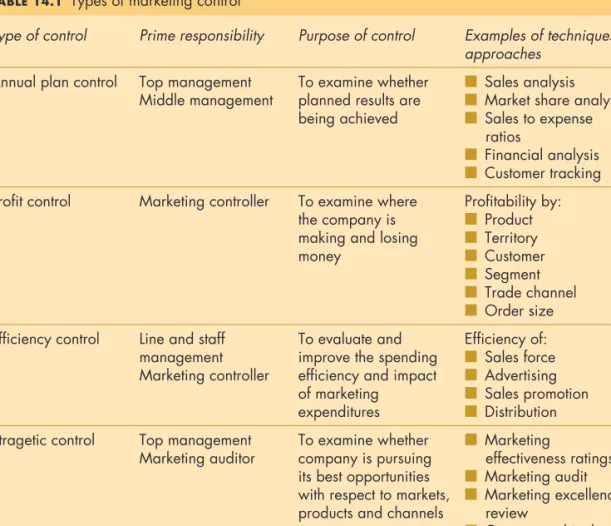
Kotler and Keller1 distinguish four types of marketing control, involving different approaches, different purposes and a different allocation of responsibilities as illustrated in Table 14.1.
Annual plan control
The purpose of annual plan control is to determine the extent to which marketing efforts over the year have been successful. Annual plan control activities are the responsibility of senior and middle management. Analysis and control will centre on measuring and evaluating sales in relation to sales goals, market share analysis, expense analysis and financial analysis.
Sales analysis
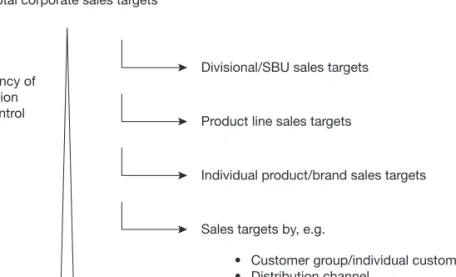
Sales performance is understandably a key indicator of marketing effectiveness, and hence an essential element of annual plan control. The marketing budget will specify objectives for sales, and according to the individual company these will be broken down into sales targets for individual parts of the business, customer groups, individual products and/or brands and ultimately individual
salespeople. In other words, sales analysis and control is likely to comprise a hierarchy of standards and control levels, each of which are interlinked, as shown in Figure 14.3.
We can see that analysis and control of sales may involve considerable time and effort. Any variance in achieving sales targets at the corporate level are ultimately a result of variances in the performance of individual salespeople. At every level of sales analysis and control, variances must be investigated with a view to determining their causes. For example, at the broadest level, variances may be due to one or a combination of volume or price. Put simply, sales revenue may be down on target because the company has not sold enough or because volume has been achieved only on the bias of price cutting. A more detailed analysis of the reasons for volume variances might, in turn, be refined to volume variances by individual members of the sales force due to, say, poor motivation or bad journey planning.
From this example, it can be seen that throughout the control process we may need to provide disaggregated control information so that broad measures of evaluation and control can be
Type of control Prime responsibility Purpose of control Examples of techniques/
approaches Annual plan control Top management To examine whether n Sales analysis
Middle management planned results are n Market share analysis being achieved n Sales to expense
ratios
n Financial analysis n Customer tracking Profit control Marketing controller To examine where Profitability by:
the company is n Product making and losing n Territory
money n Customer
n Segment n Trade channel n Order size Efficiency control Line and staff To evaluate and Efficiency of:
management improve the spending n Sales force Marketing controller efficiency and impact n Advertising
of marketing n Sales promotion expenditures n Distribution Stragetic control Top management To examine whether n Marketing
Marketing auditor company is pursuing effectiveness ratings its best opportunities n Marketing audit with respect to markets, n Marketing excellence products and channels review
n Company ethical and social responsibility review
TABLE 14.1 Types of marketing control
investigated in sufficient detail to pinpoint causes of possible variances, both favourable and unfavourable, to take the necessary corrective action.
Market share analysis
Portfolio techniques of planning are detailed in Chapter 15 and these are underpinned by the relationship between market share and cash flow and profits. In addition, in the context of marketing control, marketing objectives, both short and long term, are set for market share.
The principal reason for measuring and evaluating market share performance is because it allows a company to assess how well it is doing compared with the overall market and competition. A company might find that while sales volume has declined over the year its market share has increased.
Clearly, declining sales volume would still represent a cause for concern. Nevertheless, an increase in market share would indicate that a company is faring better than competitors in a market which has declined overall. This observation suggests a very different course of action on the part of marketing management than that suggested by a simple analysis of sales.
As the last millennium came to a close, Marks & Spencer were struggling to maintain the sales and profits they had enjoyed in previous years. Most worrying for Marks & Spencer was their fall in market share. Like most companies, the company realized that even small drops in market share can have a tremendous impact, not only on profitability but also on the market standing and image of a company. Marks & Spencer started the new millennium therefore with a determined effort to recapture lost market share. This has involved substantial restructuring of the company and the introduction of major new lines, the sale of non-M&S branded merchandise and store developments, which the company hopes will restore their standing in the market.
Total corporate sales targets
Divisional/SBU sales targets Frequency of
evaluation and control
Product line sales targets
Individual product/brand sales targets
Sales targets by, e.g.
• Customer group/individual customer
• Distribution channel
• Sales territories/sales manager
• Individual salesperson Increasing
FIGURE 14.3 The hierarchy of sales analysis and control
As with sales analysis, measurement of market share alone is not sufficient to determine the action(s) to be taken. The evaluation process requires that marketing management determines the reasons for observed levels of company market share and any significant differences and trends. On the basis of this, the marketing manager must then determine the actions required and by whom.
Results and conclusions of the evaluation of the annual marketing plan must be discussed with those responsible and a future plan of action agreed.
It is important to recognize that in interpreting market share results, several bases of measuring market share might be needed to provide useful control information for further decision making.
For example, Figures 14.4(a)–(d) show how various measures of market share for the same product might produce different pictures of the position of the product in the marketplace. The example shows four possible market share percentages for a hypothetical marketer of car tyres. Figures 14.4(a) and (b) represent this manufacturer’s percentage market share by volume and value respectively of the total UK car tyre market. We see straight away that very different pictures of market share are obtained using these different measures and they may in themselves provide insights into this company’s market position compared to competitors.
Figure 14.4(c) represents this company’s market share of the replacement (rather than original equipment) UK tyre market. Again we can see that a very different picture of market share is obtained than when using the total UK tyre market as a basis. This simply illustrates that we need to be quite
(a) Share of total market by volume
(b) Share of total market by value
(c) Share of replacement market
(d) Share of largest competitor
18% 13%
32% 30%
FIGURE 14.4 Measuring market share: the UK tyre market
clear about which ‘market’ we are talking about when we set objectives for market share and how we interpret our performance in this respect.
Figure 14.4(d) uses a measure of market share based on this company’s share relative to its largest competitor. As we shall see in Chapter 15, relative market share is a key input to many of the
‘portfolio techniques’ of strategic market planning.
Marketing expenses to sales ratios
An important element of the marketing budget is the planned expenditures on the elements of marketing activity designed to achieve budgeted levels of sales. Precisely what these elements comprise, and how they are to be grouped together for the purpose of control and evaluation, will vary from company to company, but common expense areas for marketing would include:
n sales force expenses;
n promotional expenses;
n distribution expenses;
n market research expenses.
As indicated, each of these groups of expense will comprise a series of activities, each of which may have its own budgeted expense level for the year e.g. promotional expenses may comprise:
n advertising expenses;
n sales promotion expenses;
n public relations expenses.
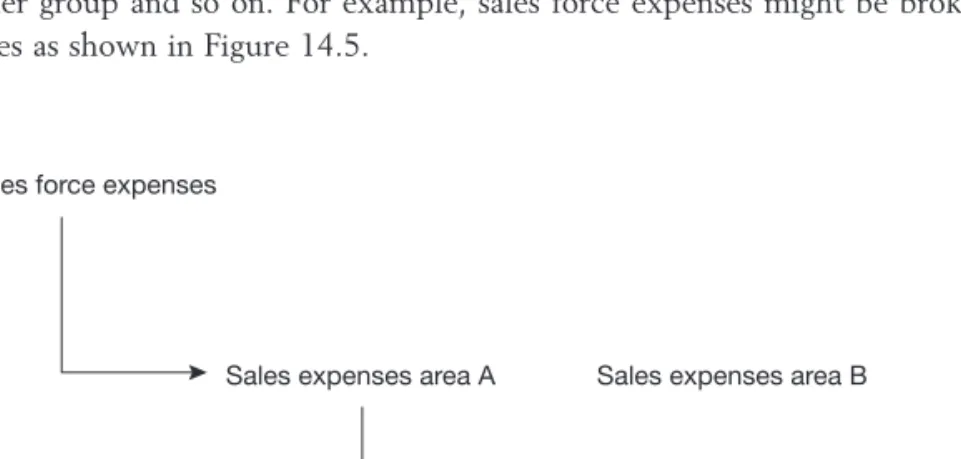
Finally, budgeted expenses for each activity may comprise expenses for each product, sales area, customer group and so on. For example, sales force expenses might be broken down into budget expenses as shown in Figure 14.5.
Total sales force expenses
Sales expenses area A
Sales expenses Product 2 Sales expenses
Product 1
Sales expenses Product 3
Sales expenses area B
FIGURE 14.5 Breaking down sales force expenses
As we have seen throughout the discussion of control, the evaluation process, in the case of marketing expenses to sales ratios, usually starts with broad measures e.g. we should first measure and control the ratio of total marketing expenses to sales. We start by determining the standards for marketing expenses to sales together with upper and lower limits between which we are prepared to allow these expenses to deviate. Ideally, total marketing expenses to sales should be evaluated on a continuous basis throughout the planning year, normally each month. Where total expenses deviate outside the control limits the reasons should be investigated and corrective action taken. At this stage the broad measure of total marketing expenses to sales will need to be broken down into the previously defined expense areas of sales, promotion, distribution, market research etc. In turn, each of the expense areas can then be further disaggregated in order to pinpoint the precise reasons for deviations from standards. If all this appears to imply a detailed and comprehensive system of marketing expenses control – it does. Provided that the costs of control do not exceed the benefits derived from it, and provided that these benefits are perceived and accepted by those being controlled, then the control system should be as detailed as possible.
Customer tracking
The control elements we have discussed in the context of the annual marketing plan involve quantitative elements of marketing control. Equally important to the control process are the more qualitative elements of marketing control, in particular customer tracking, or the assessment and evaluation of customer feedback and attitudes. Effective marketing control should include systematic and regular tracking of factors that indicate how customers feel about the company’s marketing activities and in particular should highlight any potential problems before they become serious. Examples of information and procedures which form this part of the control system include:
n consumer panel information;
n returns and complaints;
n customer surveys;
n sales force reports.
This last element, sales force reports, is a valuable source of information on customer attitudes and can highlight early signs of problems. Unfortunately, this element of reporting is often resented by salespersons who view it as a chore and a distraction from what they see as their main task of selling.
In addition, it might be regarded with some suspicion by salespeople as to how such information might be used for control purposes, so care should be taken to ensure that they understand the purpose and accept the value of providing such information.
Customer tracking can be carried out typically on a monthly basis for such matters as customer complaints, panel data and sales force reports, backed up by customer surveys on a biannual or annual basis. Although most qualitative control will relate to customers, other important publics, such as the local community, watchdog bodies and shareholders, might also usefully be included as part of the qualitative control system.
Profit control: the marketing budget
In addition to the previously discussed control elements of the annual marketing plan, organizations should be concerned with profit control. We have seen that key areas of marketing control, such as sales analysis and marketing expense analysis, are evaluated against pre-set standards for both sales and costs. These standards for sales and costs derive from the marketing budget. When we combine the notion of profit control with sales and costs we have the basis of a complete system of budgetary control for marketing.
However, when it comes to the analysis of profits in the budgetary control process, a number of complex and controversial issues arise, not only with respect to the control of profits, but also with respect to the compilation of budgets. We can illustrate these contentions by examining the essence of profitability control.
The focus of profitability control begins with the company evaluating the profitability of different marketing entities. Precisely what these entities will be will vary according to the particular company, and how its profit and cost centres are organized. In addition, the entities may also vary according to the precise purpose of the profitability analysis, but examples of marketing entities would include products, channels of distribution, customer groups and so on, with the objective of discovering where the firm is making profits or losses in various parts of its business; e.g. consider a one-product company selling to three distinct customer groups:
n Customer Group 1: industrial buyers;
n Customer Group 2: institutional buyers;
n Customer Group 3: domestic buyers.
A profitability analysis of these marketing entities (i.e. customer groups) would allow marketing management to assess the differences, if any, in profitability between these customer groups and hence the extent to which future strategies and tactics might be designed to reflect this. In order to assess the profitability of these three customer groups we need to be able to associate both costs and revenues with each of them. A simple example serves to illustrate the problems that can arise when we try to do this for this hypothetical company.
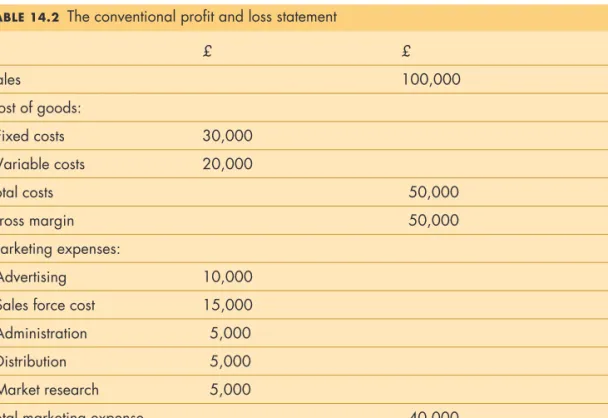
First of all, let us assume that the overall profit and loss statement for the company is as shown in Table 14.2. As mentioned earlier, if we now want to know the profitability by customer group we have to be able to associate the revenues and costs associated with each. For some elements of the overall profit and loss account, this is relatively straightforward. For example, variable costs, and some elements of marketing expenses, such as sales force costs and marketing research, may be directly attributed to each customer group. This still leaves us, however, with fixed costs and some of the marketing expenses, such as administration and elements of the promotional expenses, which must be in some way allocated to each customer group. In practice it can be difficult to identify some aspects of marketing costs. Certainly, it is possible to devise a way of allocating these remaining costs to the three customer groups, but often, and particularly with fixed costs, the allocation is arbitrary. We may end up with a ‘profitability’ analysis that is possibly misleading for evaluation and decision making with respect to marketing entities. Related to this, though perhaps more fundamental to the issue of profitability control, is the question of what constitutes an appropriate
measure of profitability for marketing entities and marketing effort. Specifically, what we are talking about is the issue of which costs to deduct from revenues for the purpose of marketing profitability control.
In the example, the net profit figure for the company requires the deduction of all costs.
Similarly, if we require a net profit figure for each of our customer groups, as we have seen, the total costs associated with each customer group must be deducted from the revenues derived from that group. For purposes of control, evaluation and decision making, perhaps a more useful and relevant measure of marketing profitability is contribution to profit rather than net profit.
Although there are some differences between the suggested approaches to using these contribution-based control mechanisms for marketing profitability, the idea is illustrated in Table 14.3 for one of our hypothetical customer groups. The controllable margin represents the contribution to profits of customer group one, taking into account only those revenues and costs that can be directly attributed to this customer group.
Clearly this is not to deny the importance of net profit to the organization, nor the fact that in the long run all costs need to be covered. However, the contribution approach to marketing budgeting and profitability control recognizes the fact that non-traceable fixed costs lie outside the control of the marketing manager and that to allocate them to marketing entities potentially distorts the picture of the true profitability of these entities, which, after all, is what we are seeking to establish. Needless to say, a distorted picture also leads to ineffective decision making.
£ £
Sales 100,000
Cost of goods:
Fixed costs 30,000
Variable costs 20,000
Total costs 50,000
Gross margin 50,000
Marketing expenses:
Advertising 10,000
Sales force cost 15,000
Administration 5,000
Distribution 5,000
Market research 5,000
Total marketing expense 40,000
Net profit 10,000
TABLE 14.2 The conventional profit and loss statement
A further broader, but inevitable, issue which the marketing contribution approach raises is whether or not net profits should be included in marketing objectives and budgets, and hence form part of the responsibilities of the marketing department. Many believe they should not, in that so many other factors affect net profits that are clearly outside the direct control of marketing. The view taken here is that the contribution method in fact offers a sounder approach to planning and controlling the profitability element of marketing.
Finally, it is important to stress that profitability control requires a carefully designed, pre- determined information and control system. In particular, the accountancy system needs to be designed to provide information on costs that can be easily translated into profit performance by the marketing entities of most relevance to the particular organization. Budgeting can be difficult, but its implementation is facilitated by the use of computer models.
Efficiency control
As the term suggests, efficiency control is concerned with ensuring that each element of the marketing mix, together with their sub-elements, is being utilized as efficiently as possible.
Examination of the efficiency of marketing activities may derive from other parts of the control system. For example, we may instigate an examination of efficiency as a result of, say, adverse profitability results for a marketing entity. However, efficiency controls should be built into the marketing planning and control systems so as to make them part of a dynamic system. As an example of how efficiency control might be applied, we can take the example of personal selling.
Personal selling can be evaluated at two levels – first, at the level of the individual salesperson, and second, as we have seen, by looking at the total selling effort. The individual salesperson will be evaluated on how well he or she has met performance targets such as:
n number of sales calls per day (number of orders);
n strike rate (number of quotations);
n average order value;
£
Minus: Variable production costs: customer group 1 _______
Manufacturing contribution: customer group 1 _______
Minus: Attributable marketing costs for customer group 1 _______
Contribution margin: customer group 1 _______
Less the non-variable costs incurred specifically for customer group 1 _______
Controllable margin: customer group 1 _______
TABLE 14.3 The contribution approach to measuring marketing profitability
n prospective success ratio;
n expense targets.
In addition to these quantitative aspects of efficiency, we should also include some qualitative aspects such as:
n sales skills;
n customer relationships;
n co-operation and attitudes.
The evaluation of total selling effort is basically derived from the sum of the contributions of all sales personnel. Evaluation of individual sales personnel and the total selling function is often viewed as a negative device for the control of salespeople, which is too narrow a view. A more comprehensive view is that the evaluation process, in addition to providing information about performance, can also be used to motivate and encourage sales personnel to plan their sales campaigns more efficiently and effectively. Hence evaluation brings considerable benefits both to the organization as a whole and to the individual salesperson.
This sort of detailed evaluation and control of marketing efficiency should be applied to each element of marketing mix activity, including advertising, sales promotion and distribution.
Strategic control
The strategic controlof marketing planning process pertains to the control of the strategic planning process itself. Two tools are available to marketing management for this process: the marketing effectiveness rating review and the marketing audit.
Control of marketing effectiveness
Control of marketing effectiveness is essentially aimed at evaluating:
n the extent to which the company is customer oriented;
n the extent to which the different functions are integrated with the marketing function, and the extent to which the marketing functions themselves are co-ordinated one with another;
n the effectiveness of the marketing information system;
n the extent to which there is a strategic perspective to marketing planning, the quality of current strategies and the efficacy of contingency planning;
n the extent to which marketing plans are communicated to lower levels, the speed of response to marketing developments and the use of marketing resources.
As we can see, control of marketing effectiveness is wide ranging, complex and requires considerable management judgement and skill. A questionnaire approach can be used, with marketing effectiveness being scored against a prepared checklist of questions. Total scores are obtained and the organization scored on a scale of marketing effectiveness ranging from poor to superior.
THE MARKETING AUDIT
Even more wide ranging than a marketing effectiveness rating is a full marketing audit. The major purpose of a marketing audit is to examine and evaluate periodically, in the light of current circumstances, the marketing objectives and policies that have been guiding the company. A marketing audit is essentially a systematic, critical and impartial review and appraisal of the total marketing operation – of the basic objectives and policies of the operation and the assumptions which underlie them, as well as of the procedures, personnel and organization employed to implement these policies and achieve the objectives.
The audit should also include a careful analysis of the company’s marketing environment.
Recommendations for improving marketing performance should be a major outcome from the audit process.
Any company carrying out an audit will be faced with two kinds of variable. First, there are variables over which the company has not direct control. These usually take the form of environmental variables. Second, there are variables over which the company has complete control that are called operational variables.
The process of auditing is usually associated with the financial side of the business and is conducted according to a defined set of accounting standards, which are well documented and easily understood. The total business, moreover, can also be audited, although this process is more complicated and demands considerable powers of judgement. A marketing audit is part of this larger audit and is concerned with the collection and analysis of information and data essential to effective problem solving. As Lancaster and Massingham2point out, the marketing audit should be concerned not only with marketing performance, but with the overall marketing philosophy in the company.
For it to be beneficial an audit should be carried out on a regular basis and the company should not wait until things start to go wrong.
Carrying out the audit
We have now come full circle in the marketing planning process. The text began by discussing the importance of analysing the environment, followed by an internal appraisal of the company itself.
We stressed the importance of both customers and competitors and can now remind ourselves of some of these factors by looking at how they form part of the marketing audit.
Auditing the environment
Three distinct elements of the environment are relevant to the marketing audit:
1 business/economic and market factors;
2 competitors;
3 customer needs and wants.
In the context of the marketing audit, we describe some of the factors that will need to be assessed under each category of environmental factors.
Business/economic and market factors
The following elements should be examined during a marketing audit:
n Demographic trends are important, since it is people who make up markets. A change in size of the population, its age distribution or its regional distribution may have implications for the type of industry the company is in.
n Markets require purchasing power as well as people. The company should audit the main economic trends. For example, high inflationary pressure may lead to a change in customer expenditure patterns, or an impending shortage of raw materials vital to the firm’s business may result in the firm increasing its costs.
n One of the most dramatic forces shaping business destiny is technology. Each new technology creates major long-run consequences. The marketer should audit changes occurring in product or process technology that can affect the company.
n Any changes in the political/legal environment should also be audited. This environment is made up of laws, government agencies and pressure groups that may influence and constrain organizations and/or individuals. There is a substantial amount of legislation regulating businesses, which protects companies from each other, protects the larger interest of society against unbridled business behaviour and protects customers from unfair business practices.
n The society that people grow up in shapes their basic beliefs, values and norms. The major cultural vales of the population are expressed in people’s relationships to themselves, others, institutions and society. Companies need to anticipate cultural shifts to identify threats, e.g.
people vary in their attitudes towards corporations, government agencies and other institutions.
Most people accept these institutions, but there may be a point when they become critical of them and less trusting. A company finding itself in such a position needs to find new ways to win back confidence, perhaps by reviewing advertising communications.
n In addition to these major forces, an examination of trends in the markets the company serves is necessary to reveal what is happening to the market size. It may be increasing or declining, with major segments behaving differently.
Competitors
As a first step in auditing its competitive environment, a company must find out who are its direct and indirect competitors, their objectives, strengths and weaknesses. The industry structure, its growth and the number of competitors in the industry help determine the degree of rivalry between the different firms. The determination of a threat of entry of new firms and the threat of substitute products provides a basis for analysing indirect and possible future competition. However, barriers such as economies of scale tend to deter new entrants. The bargaining power of suppliers refers to the ability of the industry’s raw material suppliers to demand higher prices or better terms, and the bargaining power of buyers refers to the ability of the industry’s customers to effect price reductions using their combined strength. These are important factors that can instigate competition. The interaction of these forces determines the intensity of competition within the industry, and should be audited on a regular basis.
Customer needs and wants
In Chapter 2, we emphasized that to achieve a profitable and durable penetration of a market, a company must base its marketing strategy upon a thorough understanding of customer needs and wants. It must also make itself familiar with the buying processes utilized by the customer and factors that influence customer choice. This requirement holds for all companies no matter what their products or the markets to which their efforts are directed. We should remember that industrial or organizational customers will not be buying on their own behalf, but on behalf of an organization, and will respond to a different set of circumstances from an individual. It is always the needs of the ultimate user that must be recognized and satisfied with the product/service. Monitoring of needs in an attempt to identify opportunities and any unsatisfied needs is also required.
The internal audit
The internal part of the marketing audit should be a comprehensive and detailed look at how effectively marketing is currently responding to the environment and its potential to do so in the future. The audit should encompass:
n marketing objective and strategies;
n the organizational structure for marketing, including interfaces with other functions;
n marketing systems and procedures, including those for marketing information and control;
n marketing mix elements, i.e. how effective are product, price, place and promotion?
n sales, market share and profitability analysis.
There is no definitive checklist for a marketing audit. Each company must determine for itself what constitutes the detail of an appropriate audit. However, to illustrate in more detail the scope of an audit, we give an illustrative checklist for a marketing audit.
1 Business and economic environment
Economic Inflation
Unemployment Energy prices Price volatility
Political/fiscal/legal Availability of materials, etc.
Nationalization Privatization Trade unions Taxation Duties/levies
Regulatory constraints, e.g. labelling, quality, safety
Social/cultural Demographic issues, e.g. age distribution Changes in consumer lifestyle
Environmental issues, e.g. pollution Education
Immigration/emigration Religion etc.
Technological New technology/processes Energy saving techniques New materials/substitutes New equipment
New products 2 The market
Total market Size (value/volume) Growth (value/volume) Trends (value/volume) Characteristics Developments, etc.
Products Principal products bought How they are used Where they are used Packaging
Accessories
Prices Price levels/range
Terms and conditions of sale Trade practices
Special discounts Official regulations Physical distribution Principal methods
Batch sizes
Mechanical handling Protection
Distribution channels Principal channels Purchasing patterns Geographical disposition Stocks
Turnover Incentives Purchasing ability Needs
Tastes
Profits Prices paid Communications Principal methods
Sales force Advertising Exhibitions Public relations Promotions New developments Industry practices Inter-firm comparisons
Trade associations
Trade regulations/practices Links with government Historical attitudes Image
3 Competition
Industry structure Companies in the industry Their make-up
Their market standing/reputation
Their capacity to produce, market, distribute Their diversification
Their origins and ownership New entrants
Mergers and acquisitions Bankruptcies
International links Strengths/weaknesses Industry profitability Historical data
Current performance
Relative performance of competitors Structure of operating costs
Level on investment Return on investment Pricing/volume Sources of funding 4 Internal audit
Sales Total (value/volume)
By geographical location By industry/market segment
By customer By product
Markets Market share
Profit margins Marketing procedures Organization structure Sales/marketing control data Marketing mix variables Market research
Product development Product range Product quality Unit of sale Stock levels Distribution Dealer support
Pricing/discounts/credit Packaging
Samples Exhibitions Selling Sales aids Point of sale Advertising Sales promotion Public relations After-sales service
Training and development
Systems and procedures Marketing planning system, i.e. is it effective?
Marketing objectives; are they clear and consistent with corporate objectives?
Marketing strategy; are they appropriate for objectives?
Structure, i.e. are duties and responsibilities clear?
Information, i.e. adequacy of marketing intelligence and its presentation?
Control, e.g. suitable mechanisms?
Communication, e.g. its effectiveness? In all areas?
Interfunction efficiency between functions/departments?
Profitability, e.g. regular monitoring and analysis?
Cost effectiveness, e.g. are functions/products continually reviewed in attempts to reduce excess cost?
We can see from this list that the marketing audit is far reaching and potentially complex. It encompasses not only marketing performance but also the underpinning objectives and strategies of the company. It is important to ensure that the elements of the audit match the elements of the marketing strategies that underpin it. The implication here is that the precise nature of the marketing audit and the elements contained therein should be company specific, reflecting the individual strategy of the company. We must be careful though in the application of audit ‘checklists’ which are useful but should be used with care and discretion in selecting those elements that are appropriate to a particular company and its situation.
SUMMARY
The final, but often neglected stage of strategic market planning is the control process. Not only is control important to evaluate how we have performed, but it completes the circle of planning in that it provides the feedback necessary for the start of the next planning cycle.
Control is often viewed with suspicion by those whose activities are being controlled and it needs to be implemented with some sensitivity by senior management. In particular, it is important to involve people in the setting of standards and in the process of determining and agreeing corrective action.
Every element of marketing should be controlled using both quantitative and qualitative standards for performance. The most obvious areas of control relate to the control of the annual marketing plan and include sales control, control of market share, control of expenses and customer tracking. In addition, profitability control is an essential element of marketing control, preferably using a contribution rather than net profit basis.
Control of marketing efficiency involves potentially detailed analysis of each and every element of the marketing mix. Again, although some of these are difficult to evaluate, e.g. the effectiveness of advertising spend, it is possible provided clear objectives and standards of performance, that are essential stages in the control process, are established.
The control process should stretch to the evaluation of the effectiveness of the marketing process itself in the organization. The marketing audit represents the most comprehensive process of marketing control and seeks to assess the entirety of a company’s marketing system with a view to establishing what future strategies and actions will be required to match an ever changing and turbulent marketing environment.
KEY TERMS
Noise 435
Management by objectives 435
Control parameters 436
Marketing audit 438
Customer tracking 443
Profit control 444
Efficiency control 446
Strategic control 447
REFERENCES
1 Kotler, P. and Keller, K.L. (2009), Marketing Management, 13th edn, Upper Saddle River, NJ: Prentice-Hall, p. 689.
2 Lancaster, G. and Massingham, L. (2002), Essentials of Marketing, 4th edn, Maidenhead: McGraw-Hill, pp. 373–4.
CASE STUDY
CASE STUDY QUESTION
Prepare John’s case for the types of controls he feels are necessary.
Helensgate Glass Ltd
John Heady is worried about the latest sales figures for his company. As marketing manager of Helensgate Glass Ltd, he is concerned that over a twelve month period sales have dropped by some 10 per cent.
However, more than this, he knows that he will have to present and explain these figures to the main board at the company’s annual review of results.
He knows that understandably, the dir - ectors will want answers as to why sales have dropped. After all, in the previous five years that the company has been trading, sales have increased every year. The problem is that John simply does not know why sales have dropped, nor what this means in the context of the market as a whole.
For the past two years, he has been arguing that the control and evaluation systems in the company, particularly with respect to marketing activities, have been neglected.
In arguing for more resources and effort in this area, however, the directors have always
been able to point to the fact that there was no need to put more effort into this area of evaluation and control because sales were constantly rising. John now feels caught in a trap in the sense that he is going to have to explain the reasons for a drop in sales, but without having had the support of the necessary control and evaluation techniques required to provide this information.
He is determined to use the situation to reinforce his case for improved control and evaluation techniques, including the resources necessary to implement these. At the moment, the company only has a system of profit control in operation that can be used to examine profitability by product and customer group. In addition, there is a rela - tively crude system of sales analysis. There is no market share analysis, no systems of customer tracking, no efficiency controls and no systems of strategic control in the com - pany. John is determined to make this case for implementing some of thee key areas of market ing control in the company at the forthcoming meeting.