Wiley Publishing, Inc. is not affiliated with any product or supplier mentioned in this book. We are proud of this book; please send us your comments through our online Dummies Registration form at www.dummies.com/register/.
Introduction
If you're taking a logic course, you'll find the ideas you're studying clearly explained, with plenty of examples of the kinds of problems your professor will ask you to do. You want to learn more about logic, whether you're taking a course or just curious.
Overview of Logic
Formal Sentential Logic (SL)
Proofs, Syntax, and Semantics in SLSemantics in SL
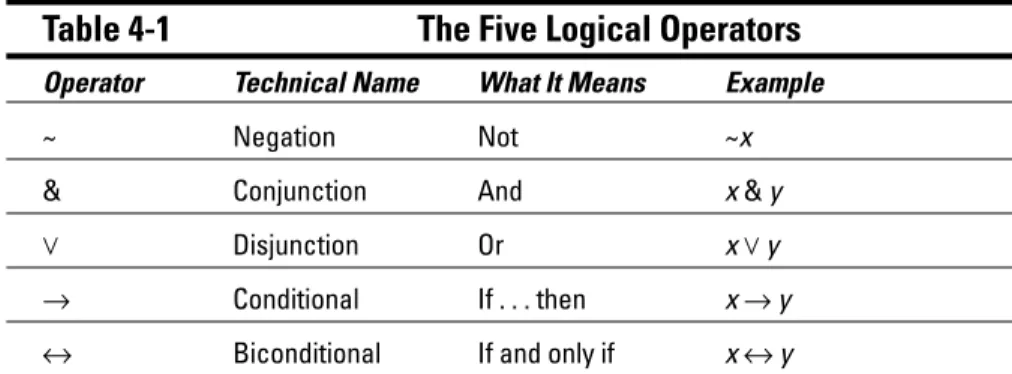
I also discuss how logical operators in SL allow you to build sentence functions that have one or more input values and an output value. From this perspective, you see how versatile SL is to express all possible sentence functions with a minimum of logical operators.
Quantifier Logic (QL)
Modern Developments in Logic
The Part of Tens
If you're taking a logic course, you might want to read Parts III and IV carefully—you might even try to reproduce the proofs in those chapters with the book closed. If you progress through Parts IV and V, you're probably ready to tackle some pretty advanced ideas.
Overview of Logic
Or maybe you're not scrambling at all and just looking for some insight to deepen your understanding. Finally, if you feel like getting started, turn to Chapter 3 for an explanation of the basic structure of logical reasoning.
What Is This Thing Called Logic?
What Is This Thing Called Logic?
For example, when you say "All horses are friendly", it means that the set of all horses is included within the set of all friendly things. According to the law of the excluded middle, no third option is possible - in other words, statements cannot be partially true or partially false.
Logical Developments from Aristotle to the Computer
Logical Developments from Aristotle to the Computer
However, by the late 19th century, mathematicians had developed formal logic—also called symbolic logic—in which computable symbols represent words and statements. The larger system, quantifier logic, also called predicate logic, contains all the rules of sentence logic, but extends them.
Just for the Sake of Argument
Just for the Sake of Argument
If the argument is valid, it is airtight, so the conclusion follows inexorably from the premises. Logic does not tell you what to do or how to act - it is not such a tool.
The science of induction
Formal Affairs
Aaron doesn't like Alma and the boat is in the bay or Cathy isn't catfishing. Either Aaron doesn't like Alma and is a boat in the bay or Cathy doesn't catch catfish. Aaron doesn't like Alma and either the boat is in the bay or Cathy isn't catfishing.
If Aaron loves Alma, the boat is not in the bay and Cathy catches catfish. It's not like if Aaron loves Alma, the boat isn't in the bay and Cathy is catching catfish.
The Value of Evaluation
The Value of Evaluation
The scope of an operator is the smallest subdeclaration that includes that operator. This shows that the scope of the → operator includes the constant P and the subexpression (Q0R), but not the constant S. This means that you cannot evaluate the → operator until you know the value of the 0 operator.
In this case, the ~ operator is outside the parentheses, so it is outside the scope of the 0 operator. First, you must evaluate the substatement Q↔R to get the value of the ↔ operator.
Parts of the whole
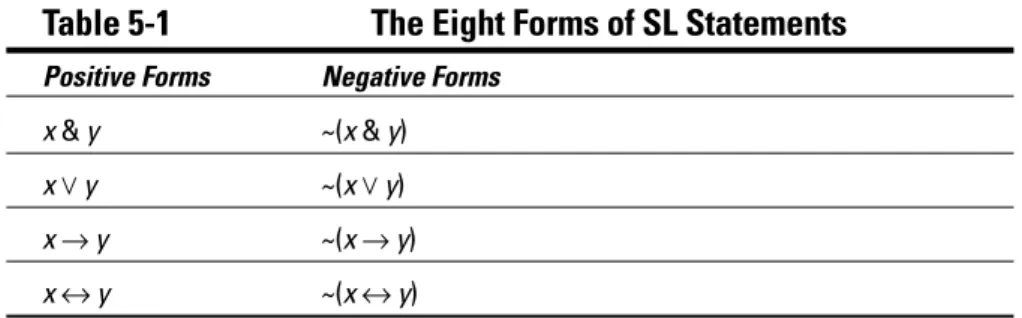
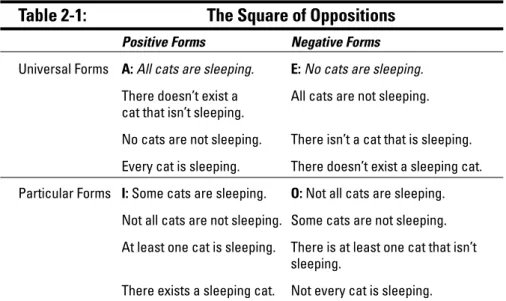
When the key operator of a statement is one of the four binary operators (&, 0, →, or ↔), its declaration form is one of the four positive forms in Table 5-1. However, when the main operator of a statement is the ~ operator, its form is one of the negative forms in Table 5-1. For now, note that each statement can only be represented by one of the eight basic statement forms.
You are less likely to make mistakes because you understand how all the parts of the statement fit together. The truth value of the main operator is the value of the entire statement, so you know that under a given interpretation the statement is true.
Turning the Tables: Evaluating Statements with Truth Tables
Set up the top row of the table with each constant on the left and the statement on the right
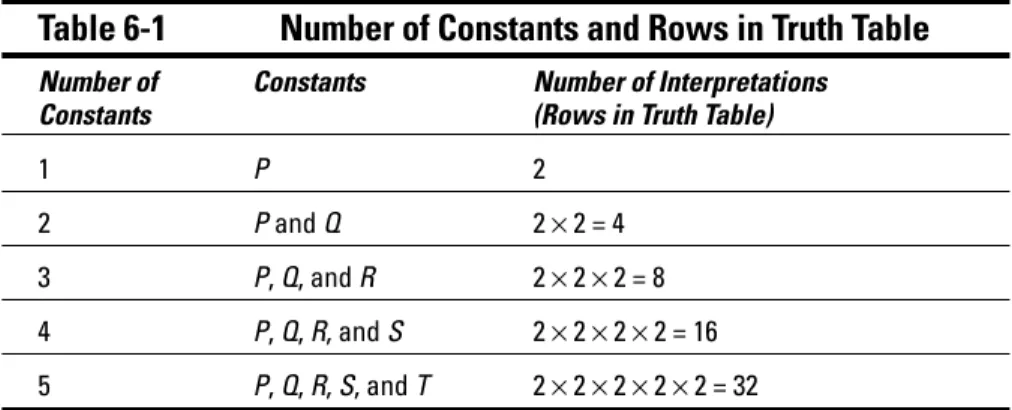
Determine the number of additional rows your table needs based on the number of constants in the statement.
Determine the number of additional rows that your table needs, based on the number of constants in the statement
Turning the Tables: Evaluating Statements with Truth Tables
- Set up the constant columns so that with every possible combination of truth values is accounted for
- Draw horizontal lines between rows, and draw vertical lines separat- ing all constants and operators in the statement
- Copy the value of each constant into the proper statement columns for those constants
- In each of the columns that has a ~-operator directly in front of a con- stant, write the corresponding negation of that constant in each row
- Starting with the innermost set of parentheses, fill in the column directly below the operator for that part of the statement
- Repeating Step 3, work your way outward from the first set of paren- theses until you’ve evaluated the main operator for the statement
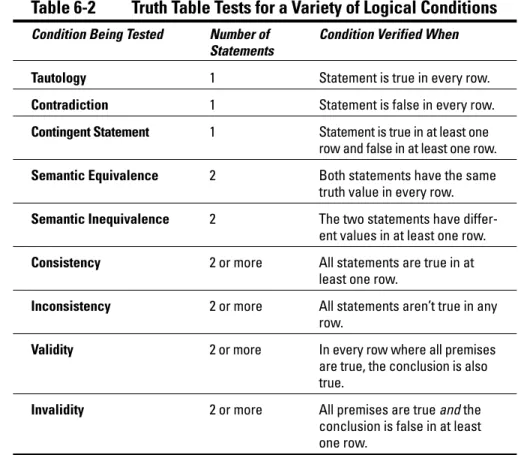
Starting with the innermost set of parentheses, fill in the column directly below the operator for that part of the statement. For example, in the section "Baby's First Truth Table" earlier in this chapter, you used a truth table to show that the statement P→(~Q→(P& ~Q)) evaluates to true in each row of the truth table. so the statement is a tautology. When every row of the truth table has at least one statement that evaluates to false, the statements are inconsistent.
As you can see, the only thing that has changed is that the main operator of the statement — the only operator outside the parentheses — is now the ~ operator. As predicted, the statement evaluates to false on every row of the table, so this is a contradiction.
Making even more connections
When you deny the conclusion of a valid argument, you get a set of inconsistent statements. It might seem a little backwards that validity and inconsistency are linked, but that's the way it shakes out.) You can also turn this set of inconsistent statements into a contradiction by connecting them with the. To turn a valid argument into a contradictory statement, connect all the premises plus the negation of the conclusion by repeated use of the & operator.
Taking the Easy Way Out
Creating Quick Tables
Taking the Easy Way Out: Creating Quick Tables
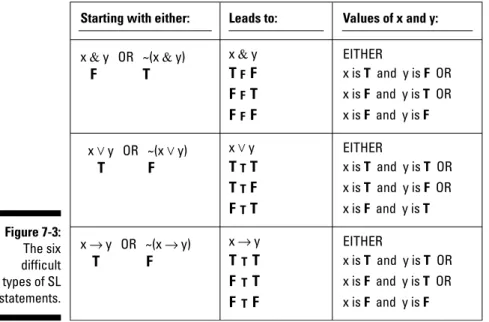
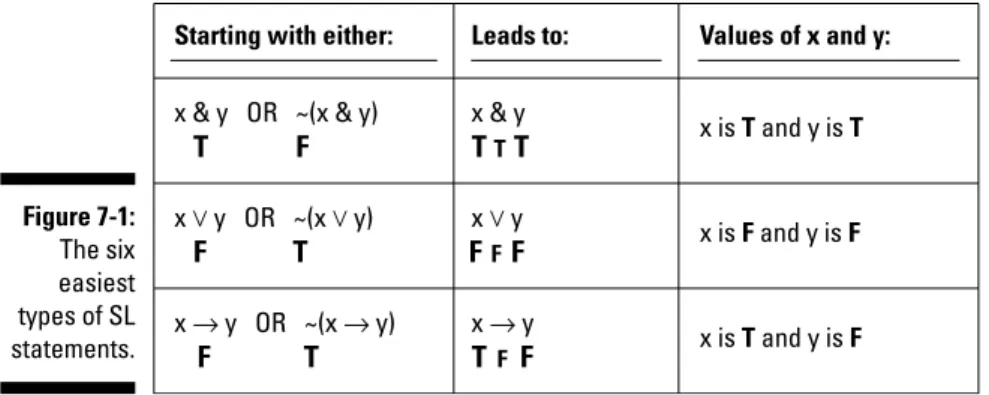
Strategic assumption: Try to show that the statement is not a tautology, so assume that the statement is false. If you find an interpretation under this assumption: The statement is not tautology - it is either a contradiction or a conditional statement. Strategic assumption: Try to show that the statement is not a contradiction, so assume that the statement is true.
If you find an interpretation under this assumption: The statement is not a contradiction - it is either a tautology or a conditional statement. Strategic assumption: Try to show that the set of statements is consistent, so assume that all the statements are true.
Truth Grows on Trees
Truth Grows on Trees
At least one branch is left open: At least one interpretation makes each statement in the trunk of the tree true. All the branches are closed: No interpretation makes every statement in the tree trunk true. At this point, a branch is closed off: Tracing from the beginning of the trunk to the end of this branch forces you to pass through both ~Pand P, which is a contradiction.
One tree using the first statement and the negation of the second statement as a trunk. The other tree uses the negation of the first statement and the second statement as a stem.
Proofs, Syntax, and Semantics in SL
In Chapter 10, I discuss the remaining ten rules of inference, which are considered the set of equivalence rules. In Chapter 12, I show you how and when to use all of these tools while discussing proof strategies. In Chapter 13, you discover why the five SL operators are sufficient to produce any logical function in SL.
In Chapter 14, I discuss a number of topics related to the syntax and semantics of SL. Here, I show you how to decide whether a string of symbols in SL is also a well-formed formula.
What Have You Got to Prove?
What Have You Got to Prove?
MP allows you to derive a new statement, Q, that you can use as part of your next step. MT uses the idea of the slippery slide in a different way than how MP uses it: it tells you, "If you know that a statement of the form x → y is true, and you also know that the ypart is false, you can conclude that the xpart is also false.” Conj is a fairly simple rule: if you have two true statements, x and y, you can conclude that the statement x & y is also true.
Look for statements that have constants in common and see if you can combine them using the rules of inference. This gives you easier explanations to work with, which you can use to build your conclusion.
The 0 rules: Addition and Disjunctive SyllogismDisjunctive Syllogism
When the conclusion of the statement argument is 0, you only need to construct one of the two substatements, and then you can use Addto tack for the others. Again, not entirely sure how you got here, but if you find a way to construct the P0S and Q0R statements, the rest follows. DS says, "If you have two options and you can eliminate one of them, you can be confident about the one you're left with."
It tells you, "If you know that x leads to y and y leads to z, then x leads to z." This means that if you can get both parts of it - ~P & ~Q and T0V - you can use Conj to get the whole thing.
Equal Opportunities: Putting Equivalence Rules to Work
Equal Opportunities: Putting Equivalence Rules to Work
Now look what you're trying to prove: Q 0R. With Impl this is the same as . So if you can find a way to write the premise using only 0 statements, you can finish the proof using just Command Assoc. You can almost always find more than one way to get where you are going within a proof.
However, if you're stuck with x0x and need to get x, Tau is the way to go. And you're in luck, because the two Equiv rules can help you with that.
Big Assumptions with Conditional and Indirect Proofs
Big Assumptions with Conditional and Indirect Proofs
You can apply equivalence rules to the conclusion of an argument to make conditional proof easier to use. So if the conclusion is a → statement, you can use conditional proof to attack it in two different ways. But the problem becomes much simpler after you find out that you can use Impl to rewrite the conclusion as.
After assuming a premise, if the new conclusion is a → statement (or can be transformed into one), you can assume another premise. But because the new conclusion is a → statement, you can draw out another AP, like this:.