
Civil society's role in combating judicial corruption in Central America 115 Katya Salazar and Jacqueline de Gramont. The Rule of Law and Judicial Corruption in China: Halfway Across the Great Wall 151 Keith Henderson.
Contributors
Acknowledgements
Special thanks to Linda Ehrichs, Contributing Editor of this volume of the Global Corruption Report. This year, Transparency International's Global Corruption Report focuses on the justice system for one simple reason: the fight against corruption depends on it.
Preface
It was also inspired by the work of many of the 100 national chapters that make up the global movement Transparency International. The GCR 2007 focuses largely on judges and judicial staff involved in the administration of justice.
Defining judicial corruption
It is difficult to overestimate the negative impact of a corrupt judiciary: it erodes the ability of the international community to tackle transnational crime and terrorism; it reduces trade, economic growth and human development; and most importantly, it denies citizens impartial settlement of disputes with neighbors or authorities. In this way, they send a direct message to the population: corruption is tolerated in this country.
Executive summary: key judicial corruption problems
The appeals process, ostensibly an important avenue for redress in cases of wrongful convictions, provides additional opportunities for judicial corruption. Even when appointments are appropriate, the effectiveness of the appeals process is impaired if the screening of requests for hearings is not transparent, or when the backlog of cases means that many years have been spent waiting to be heard.
The scope of judicial corruption
Appeals tend to favor the party with the deepest pockets, meaning that a party with limited resources but a valid appeal may not be able to pursue their case beyond the first instance.
Types of judicial corruption
Political interference in judicial processes
These safeguards go a long way in ensuring that courts, judges and their judgments are independent of outside influences. The perceived integrity of the institution is of particular importance, as it supports trust in the institution.
Bribery
In Kenya, judges were pressured to resign without being informed of the allegations against them in an anti-corruption campaign widely seen as politically expedient. It is important to remember that the formal judiciary handles only a fraction of disputes in developing countries; Traditional legal systems or state-run administrative justice processes are responsible for an estimated 90 percent of non-legal cases in many parts of the world.
Tackling judicial corruption
When defendants or litigants already have a low opinion of the fairness of judges and the judicial process, they are much more likely to resort to bribing court officials, lawyers, and judges to achieve their ends. In Central and Eastern Europe, the failure to fully take into account social context, especially in countries where informal networks allow people to circumvent formal judicial processes, has rendered some highly sophisticated changes in formal institutions virtually meaningless.
Recommendations
Code of conduct A code of judicial conduct provides a guide and measure of judicial conduct, and must be drawn up and enforced by the judiciary. The Principles of Judicial Conduct, a code for judges that has been adopted by a number of national judiciaries and was endorsed by the UN Economic and Social Council in 2006.
Comparative analysis of judicial corruption
The merits of the case and the applicable law are not paramount in corrupt judiciaries, but rather the status of the parties and the arbitrators and court staff derives from their decisions. In such countries, the existing system supports the professionalism of the judiciary and protects the judge from unwanted influence.
1 Introducing the problem
The following are seven factors that contribute to judicial corruption that can be remedied regardless of the type of legal system that exists. A respectable salary for judges and court staff at least strengthens the public perception of the judiciary as an equal branch of government.
Remedies to corruption in the judiciary
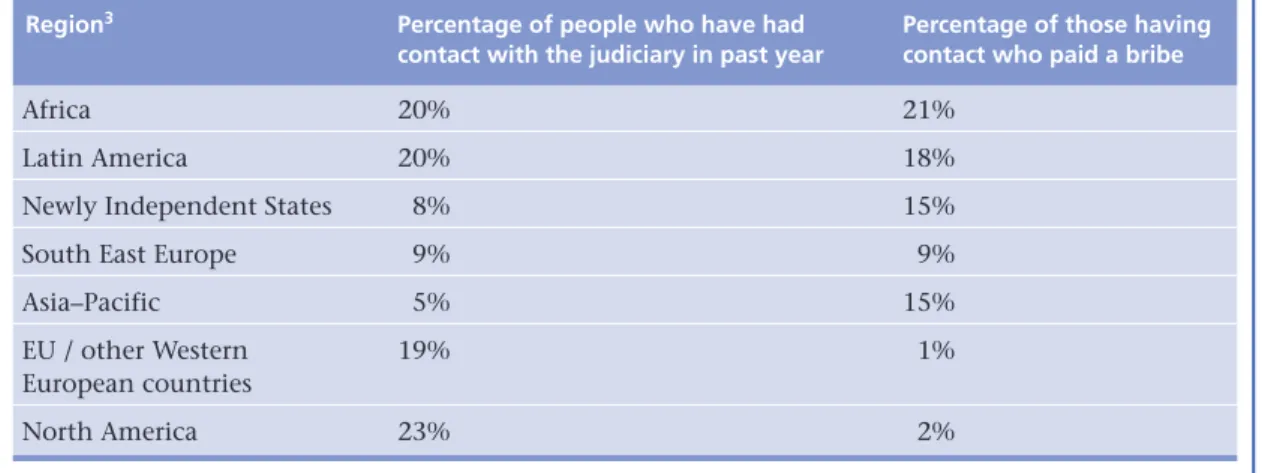
There are major differences in popular perceptions of judicial corruption between regions of the world, as Table 2 shows. Eight of the ten countries with the lowest levels of judicial corruption are European, led by Denmark, where 81 percent of respondents perceive little or no corruption in the legal system/judiciary.
Are people talking about judges, the police or court staff?
Of the 8,263 people who were recently in contact with the justice system, 991, more than one in 10, paid a bribe. In all former communist countries, 45 percent or more of the people surveyed described the justice system as corrupt.

Conclusion
The main variation by region arises in the group second most likely to be bribed. Published in the United States of America by Cambridge University Press, New York www.cambridge.org.
Contents
Part one: Comparative analysis of judicial corruption
The Professionalism of Judges: Education, Salaries, and Career Structure in Asia 48 Vincent Yang and Linda Ehrichs.
Part two: Country reports on judicial corruption
Judicial reforms in PNG require political will 263 TI Papua New Guinea, Port Moresby.
Part three: Corruption research
Judicial corruption includes any inappropriate influence on the impartiality of the judicial process by any actor within the court system. Law enforcement cannot be an effective tool against corruption unless the judiciary is independent from both the rest of the state and the private sector.
2 Independence, political interference and corruption
Andrew Hanssen, 'Independent Courts and Administrative Agencies: An Empirical Analysis of the States', Journal of Law, Economics and Organization. See Mark Ramseyer, 'The Puzzling (In)Dependence of the Courts: A Comparative Approach', Journal of Legal Studies23 (1994).
Aspects of judicial independence
States with corrupt court systems and a desire for foreign investment often consider creating "boutique" courts to satisfy this need, but they can be difficult to isolate from a corrupt environment. Indonesia, for example, set up a trade court under the auspices of the IMF that aimed to enable foreigners to avoid the corrupt regular court system.
Conditions related to the independence of the judiciary from the rest of government
Conditions primarily related to the control of corruption for a given level of political independence
At the federal level, judges are appointed by the president and confirmed by a majority of the Senate. Corruption in the judiciary can occur even when the courts are independent of the rest of the state.
Economic growth, certainty in the law and judicial independence
Feldbrugge, Russian Law: The End of the Soviet System and the Role of Law (The Hague; Martinus Nijhoff, 1993). Finally, it is the respect for the state itself, the belief in the power of the law and the power of justice.'4.
Judicial appointments
Judge Olga Kudeškina was fired from the Moscow City Court in May 2003 for "violating the rules of courtroom conduct and discrediting the judiciary" after she claimed that the state prosecutor and the court president pressured her to rule in favor of the prosecutor. in an investigation by the Ministry of the Interior. In a widely publicized letter to President Putin in March 2005, Kudeshkina said that the justice system in Moscow was "characterized by gross violations of personal rights and freedoms, disregard for Russian legislation, as well as the rules of international law," and that there was every reason to believe that the behavior the president possibly because of the patronage of some officials in Putin's administration.7.
Perceived extent of corruption
The government should resist further dilution of the judicial composition of the Judicial Qualification College. This ruling directly led to the closure of Zimbabwe's only independent daily newspaper.
3 Accountability and competence of judges
If the judiciary is accountable to an external body, there is a danger that it may undermine judicial independence. Various standards have also been prepared by NGOs, including the IBA Minimum Standards of Judicial Independence, the Draft Principles on the Judicial Independence, the Siracusa Principles prepared by the International Commission of Jurists and the International Association of Penal Law Latimer House Guidelines on Parliamentary Supremacy and judicial independence.
The Bangalore Principles
Based on international standards, raise awareness among the wider population about the issues of independence and responsibility of the judiciary and about the role of the judiciary in society. Encourage the UN General Assembly to adopt the Bangalore Principles of Judicial Conduct in their current form.
Corruption, accountability and the discipline of judges in Latin America
Civil society and policy makers should use these standards as the basis of their engagement with governments and judiciary on the issues of judicial independence and accountability. Two important external sources of judicial accountability are the role of the media (see page 108) and the role of civil society organizations (see page 115).
Argentina’s politicians strengthen their grip on the judicial council
However, it does not require the decision to be made public, for example by uploading it to the council's website, which would better serve the interests of transparency. This means that in the first years of the council's existence, 18 judges were forced to leave the judiciary, compared to only 29 judges in the many decades of the previous system.5.
Codes of conduct and ethical standards
Regarding the second argument, it is true that the explicit definition of the standards of behavior expected of judges orients and focuses them on social expectations and enables the early detection of judges whose behavior deviates from the standards. The relatively low status and pay of judges and the subordinate nature of the judiciary in the government structure are among the first causes of corruption in the judiciary.2The.
Budgets and salaries
In China, critics asked why judges should be paid more when so many cases of judicial corruption appeared in the media. China launched a comprehensive campaign to combat judicial corruption in the past decade and enacted policies to increase salaries and secure the tenure of judges.7 The 1995 Law on Judges requires the government to raise judges' salaries accordingly.
Promotions
If it is handled by senior judges or a judicial council, the outcome will depend on the independence and integrity of the judicial leadership. 14. Young judges are generally reassigned to a new appointment every few years based on assessment by the court system's administrative office, which is staffed with career judges.
Education and training
Judges in these jurisdictions enjoy a high social status, in part because of the power they exercise in making case law. In the eyes of the public, judges may not seem all that different from other civil servants.
Professional standards
Judicial training to fight corruption
There, the power of the executive was effectively obliterated, as all decisions about members of the judiciary were entrusted to the higher council of the judiciary, two-thirds of which were magistrates elected by colleagues. In both France and Italy, judicial associations elect all judicial members of the higher council.
Judicial corruption and trust
11 As perception can be influenced by the prominence in the media of the cases that have been reported. 12 For a detailed list of these guarantees, see 'Independence, effectiveness and role of the judges', Council of Europe, recommendation no.
Significant factors affecting corruption
In other words, professionally trained judges identify with their institutional role and are less prone to corruption. Furthermore, qualified judges are likely to take their fellow judges and the legal profession in general as a reference group.
Comparison of cases
The selection and further training of judges and state prosecutors is the responsibility of the Higher Judicial Council. 21 See Roger Errera, 'Recruitment, Training, Evaluation, Career and Accountability of the Judiciary in France', in Di Federico (2005), op.
Repatriation of assets and the role of local judiciaries
As highlighted below, these goals have been hampered by differences in legal approaches and the reach of relevant legislation, and by the non-mandatory nature of many UNCAC provisions. In general, a civil action is recommended when the primary purpose is immediate recovery rather than punishment of wrongdoers.
Case studies
Switzerland has returned about US$700 million to the Philippines as part of the mutual aid process. The judiciary plays a key role in each step of the criminal process in the context of confiscation of stolen property.
4 The broader justice system
The structure of institutions and the decision-making process are important factors that determine the type and level of corruption to be tackled. 4 Edgardo Buscaglia and Samuel Gonzalez Ruiz, "How to design a national strategy against organized crime and corruption in the public sector within the framework of the United Nations Convention of Palermo", in Combating Organized Crime (new.
Diagnosing justice-sector corruption
Bribe or other substantial private benefit to judge/court clerk to expedite or delay a case; bribes and/or other substantial private benefit for a judge to abuse administrative/procedural discretion. Court of Appeals Threat/Financial (eg bribes) and/or other substantial private benefit for judge to influence decisions and/or improper changes of venue Monitor judicial corruption.
Best international practices in countering justice-sector corruption
In short, the gap between the formal and informal allocation of organizational roles and tasks in the courts and prosecutorial areas is a factor related to corruption in the justice sector. The identification of these areas should focus on the links between judicial systems and other institutions of the justice sector, without neglecting the examination of factors that hinder the independence of the judiciary itself.
Conclusions
Adoption of consistent and predictable administrative (i.e. personnel and budget-related) measures based on rewards and sanctions driven by performance-based indicators, clarifying the career horizon of officials in the judicial sector. These states must further emphasize the fact that by strengthening their ability to prevent and control corruption in the justice sector, they can also remove major obstacles to socio-economic and political development.
Mexico: the traffickers’ judges
3 Office of the Attorney General, Boletín 789/05 at www.pgr.gob.mx/cmsocial/bol05/jul/b78905.htm The PGR successfully appealed the decision to free Guzmán Salazar. 5 Office of the Attorney General, Boletín 049/97 at www.pgr.gob.mx/cmsocial/bol97/ene/b0004997.htm Judge Morales was dismissed by the CFJ and prosecuted for collusion with drug traffickers.
Prosecution models and limits on independence
The Prosecutor's Office is in the executive branch, but performs some quasi-judicial decision-making functions and works most closely with the judiciary. In such cases, there is a risk that the judiciary will be seen as independent and will ally with the prosecution to the detriment of the accused.
The prosecutor’s career
Another important distinction between models is whether any agencies enjoy a monopoly on the prosecution of crime or whether there can be private prosecution (by the police, victims, NGOs or others). Private prosecution can provide a last resort of redress, which is important if political considerations discourage the prosecution from pursuing a case.
Prosecutors as watchdogs on judicial corruption
In court, a judge may not act in accordance with the law or procedure applied to the material and other evidence presented to the court. This may be the result of a deliberate distortion of the process or, more often, it may arise from the judge's own perception of events and views on how the trial should proceed or end.
Safeguards
Corruption of the process by improper benefits, provided the benefit is concealed, is usually only detectable by examining the process against the outcome it produced. We can also raise awareness of the risk and educate people in ways to avoid it.
The investigating magistrate’s loss of influence in France, and the effect on the fight against corruption
The public prosecutor's department has now been given investigative powers that compete with those of the investigating magistrate. The crux of the matter therefore remains the status of magistrates in charge of investigations.
Corporate tactics to evade justice
The Sole trial was followed by the first corporate trial of the Canadian construction company, Acres International Limited. His evidence helped the prosecution in its pursuit of the Italian corporation Impregilo, the lead corporation in the Highlands Water Enterprises Consortium (HWV).
Political obstacles placed in the prosecution’s path
Changing the identity of the company by recording it in another vehicle in the hope that the original company could not be correctly identified, charged and convicted. Yet the international community - with the exception of the EU's anti-fraud agency, OLAF10 - remained silent throughout.
The prosecution resists pressure
Judge Lehohla's ruling in the conviction of Acres reflects the emerging revulsion of the Lesotho judiciary for the offense of corporate bribery and especially for the contemptuous attitude that characterized Acres' approach to the litigation process. The independence of the judiciary and the quality of the legal profession are therefore closely linked.
Corruption involving lawyers and legal associations
In Eastern and Southern African countries, lawyers are an integral part of the concept of separation of powers because judges, especially those working at higher levels of the judiciary, are almost entirely appointed from among the judiciary. By the time the judgment was announced in 2004, inflation had reduced the value of the claim to US$33, although it remained Z$2 million in local currency.
Lawyers’ associations: weak, but gaining support
This becomes difficult when the association's governing council or disciplinary committee is directly elected by the members. Their governments have not fully accepted that self-regulatory law associations are part of the process that promotes democracy and good governance, and is a prerequisite for an effective fight against corruption.12
Recommendations to the profession and lawyers’ associations
In Botswana, Namibia, South Africa, Tanzania, Zambia and Zimbabwe, law associations require a clean audit certificate for trust funds before practicing certificates can be renewed. Law associations may impose a minimum mandatory continuing legal education requirement for members as a condition for renewal of the practice license.
Broader reforms to fight corruption in the legal profession
Legislation establishing statutory bar associations in Malawi, Namibia, South Africa, Zambia and Zimbabwe allows them to define methods for testing compliance with ethical conduct. 21 For example, the Ethiopian Women Lawyers' Association (EWLA), the Federation of Kenya Women Lawyers (FIDA Kenya), Federation of Uganda Women Lawyers (FIDA Uganda), Tanzania Women Lawyers' Association (TAWLA) and the Zanzibar Female Lawyers' Association (ZAFELA ).
The context of legal culture
In Asia and Africa, as Stephen Golub describes, NGOs work with paralegals to raise awareness of corruption in extrajudicial justice systems, which an estimated 90 percent of the developing world uses to resolve their disputes. Celestine Nyamu-Musembi examines the gendered dimensions of judicial corruption and argues that the currency of corruption is not always monetary.
5 Courts, culture and corruption
To illustrate this, a group of Italian judges in the early 1990s were strong enough to expose a nationwide scandal and bring down a corrupt political regime. Despite the scale of their achievement in the mani pulite (clean hands) campaign, it was actually carried out by only 5 percent of Italy's roughly 7,000 judges and therefore meant little about the judiciary as a whole.
Legal culture
This did not stop many other judges from collaborating with politicians and big business in illegal activities. In 1998 alone, 203 judges in Italy were under investigation for corruption, abuse of power and ties to the mafia.2 (See 'Culture and corruption in Italy', page 107.) Although the institutional independence of Italian judges cannot be underestimated, because it does the judiciary, one of Italy's least corrupt institutions, the above outline of how the Italian judiciary has dealt with corruption shows that institutional independence has not successfully immunized judges from infection by the surrounding culture of cooperation and exchange of favors.
Life as a judge
Ironically, this untouchable exclusivity does not mean that British judges enjoy the unconditional trust of the public. By contrast, in the continental tradition, legal codes were instituted at the behest of the sovereign to keep society in order.
Legal culture of the general public
In the conditions prevailing in those societies, judges must be fully integrated into the legal culture of the general public if they are to survive. The level of tolerance is one of the most powerful forces that prevent or assist corruption.
Conclusions and policy considerations
These were not trivial accusations, but according to the public of Trinidad and Tobago, they mattered less than the political and ethnic divisions in the country. The frequent penetration of the legal process by influence seekers does not necessarily distort the outcome in all cases.
Culture and corruption in Italy
Photos of the lawyer and the former chief justice on holiday together were then posted online. It is reinforced by the right to participate in governance under Article 21 of the Universal Declaration.
Evaluation of institutional control mechanisms
The perception of the judiciary as corrupt and politicized in most Central American countries, with the exception of Costa Rica, led to new initiatives from outside the government to participate more directly in judicial reform. While NGOs previously focused on seeking protection for victims of human rights violations, they now view the judiciary as a public service, subject to public scrutiny and pressure to improve accountability, impartiality and transparency.2 More recently, civil society has new wave of legal aid has been launched. Monitoring and accountability initiatives directly aimed at combating corruption in response to the failure of institutional mechanisms to address unethical behavior in the judiciary.
In-depth review of controversial cases
US$600,000 was withdrawn by an individual representing the defendants, with signed consent from members of the Supreme Court. Despite media coverage, formal charges against the judges were hampered by 'procedural obstacles' and by the Supreme Court's monopoly on initiating judicial investigations.6 However, case reviews often lead to a negative response.
Systematic review of guidelines for judicial performance
Case studies alone cannot lead to the adoption of reforms, but they are important tools that civil society coalitions can use to achieve change, as Alianza did in Panama. Although Probidado's initiative did not bring the desired response, it was valuable for obtaining and disseminating information about a case of national interest.
Judicial observatories
Public surveys
Civil society groups have taken on new control and oversight roles over the judiciary in Central America. This has led to reluctance among judicial institutions to work with civil society in many countries.
Introduction
Finally, promoting an in-depth and coherent discussion within civil society on the scope, causes and impact of judicial corruption, and the exchange of information on initiatives to combat it, will help develop new ways for civil society to can strengthen confidence in the judiciary. system. Do all cases of non-administration or bias in the administration of justice deserve the label 'corrupt'?
Gender relations shape the currency of corruption
Is it corruption when the 'private gain' is self-gratification, or the actualization of a deep-seated prejudice against women having certain rights. Are there cases where it is strategically important to label bias – whether based on gender, ethnicity, religion or other sectarianism – as corruption?
Corruption in the justice system affects men and women differently
- Stigma reinforces corruption
- Gender bias sustains systemic inertia in responding to corrupt practices whose impact falls exclusively or predominantly on women
- Minor’ system failures amplify existing inequalities in accessing justice
- Lack of clear regulation of the interface between formal and informal institutions exposes women and children to disproportionate risk of corrupt practices
The Kenyan Bribe Payers Index shows that avoiding law enforcement is the most common reason for paying bribes, i.e. human trafficking was a non-issue for the Russian government and by some politicians and law enforcement officials for much of the years ninety was denied.
Gender relations shape networks and opportunities for corruption
Considering gender disparities in staff underlines the fact that gender dynamics shape opportunities to be involved in corrupt networks. For example, access-to-justice strategies may need to provide resources in the short term so that disadvantaged groups can bypass local forums if they are so dominated by close-knit corrupt networks that such groups can never expect a fair result.
Conclusion and recommendations
Beyond the courts
The TI definition of corruption, 'abuse of entrusted power for personal gain', can be applied in the context of NJJS. However, it can be difficult to distinguish where personal bias ends and personal gain begins, especially in customary legal systems.
Administrative law systems in the Philippines
Conventional dispute resolution forums, such as informal village panels, resolve land, family and other disputes independently of the state. When it comes to corruption, perhaps the most important piece of ALG's software pie is their involvement with administrative law.
Shalish and Bangladeshi NGOs
When this happened in the 1990s under President Fidel Ramos, they were able to revamp regulations, procedures and personnel in reformatory ways. In the context of shalish, human rights and gender issues are often intertwined with abuse of entrusted power (as in favoritism by shalish panelists) for personal gain.
Legal pluralism and Timap for Justice in Sierra Leone 16
A combination of meetings, letters, threats of legal action and other pressure on both the NGOs and contractors resulted in the delivery of the promised aid. In the words of one of the NGO's co-founders: 'Although it has no legal authority, the project has shown that sometimes this is simply the color of the law.
6 Lessons learned about fighting judicial corruption
Incoming elected regimes often replaced much of the bench, without regard to constitutional or due process, and sometimes with judges selected for their partisan leanings. The explicit and implicit means have had an impact and in several countries appear to have significantly reduced some of the most serious forms of corruption.
Argentina and Brazil
Brazil leaves such matters in the hands of higher courts, as governed – unlike Argentina – by national law. While practices in Argentine provinces resemble those in Brazil, gubernatorial selection of high court judges reduces their control over the lower bench.
Dominican Republic and Paraguay