386
Money
and Banking
15
A Tale of Two Worlds in Banking
O nce upon a time, in an economic climate far, far away, banking was a steady, quiet, money-making industry regarded by some as, well, rather mundane or even boring.
Nothing is further removed from the turbulent and con- troversial world of banking today.
Banking’s external environments—especially eco- nomic, global, and political-legal—are significantly demanding and challenging, starting with the largest national banking systems, and continuing on down to the smallest community banks. Following the global economic meltdown of 2008, the U.S. Federal Reserve Bank and European Central Bank, for example, have taken ambitious steps to staunch the damage at thou- sands of banks in their jurisdictions. Individual banks, both large and small, are redefining the products they offer, changing sources of revenue to compete and survive, and otherwise addressing obligations to the communities they serve.
Governments are relying on banks as instruments of national policy for eco- nomic stability, using diverse responses for different conditions. We see, for example, while central banks in China and India are raising key interest rates, those in the euro zone and the U.S. are holding rates at near-historic lows, because remedies for stagnant economies differ from cures for those that are booming. Countries with severe downturns, high unemployment, and increas- ing national debt—the U.S., Portugal, Greece, Ireland, and Spain among
After reading this chapter, you should be able to:
1
Define money and identify the different forms that it takes in the nation’s money supply.2
Describe the different kinds of financial institutions that compose the U.S. financial system and explain the services they offer.3
Explain how financial institutions create money and describe the means by which they are regulated.4
Discuss the functions of the Federal Reserve System and describe the tools that it uses to control the money supply.5
Identify three important ways in which the money and banking system is changing.6
Discuss some of the institutions and activities in international banking and finance.WhAT’s in iT for Me?
Dealing in matters of money is vastly more com- plicated than counting the cash and coins in your pocket, especially when technology and globalization come into play. At its core are questions about where money comes from, how national economies depend on it, and the public’s trust in its value. This chapter will give you a solid understanding of the different forms of money and how its supply is created and controlled by different kinds of financial institutions and government regulations.
others—use low interest rates and financial bail- outs to stimulate borrowing and create jobs.
Meanwhile, banks in China and India are increasing lending rates to make borrowing more expensive for businesses and consumers. The goal is to slow down rapid economic expansion and reduce fears of runaway inflation. At the same time, Japan’s economy—broken by a terrible earthquake and tsunami—needs lower interest rates for easier borrowing to rebuild the devastated economy.
1Countries with massive debt face double-trou- ble for recovery: The first is difficulty borrowing outside money for economic recovery, although some have received emergency financing from the International Monetary Fund. Second, when national debt increases, the value of its currency falls on foreign exchange markets, its money then buys less than before, so each of its citizens suffers lower real wealth.
2Our story continues on page 406.
Jeffrey Blackler/Alamy
MyBizLab
Where you see MyBizLab in this chapter, go to www.mybizlab.com for additional activities on the topic being discussed.What is Money?
When someone asks you how much money you have, do you count the dollar bills and coins in your pockets? Do you include your checking and savings accounts?
What about stocks and bonds? Do you count your car? Taken together, the value of all these combined is your personal wealth. Not all of it, however, is “money.” This section considers more precisely what money is and does.
The Characteristics of Money
Modern money generally takes the form of stamped metal or printed paper issued by governments. Theoretically, however, just about anything portable, divisible, dura- ble, and stable can serve as money. To appreciate these qualities, imagine using some- thing that lacks them—for example, a 1,000-pound cow used as a unit of exchange in ancient agrarian economies.
• Portability. Try lugging 1,000 pounds of cow from shop to shop. In contrast, mod- ern currency is light and easy to handle.
• Divisibility. How would you divide your cow if you wanted to buy a hat, a book, and a radio from three different stores? Is a pound of head worth as much as a pound of leg? Modern currency is easily divisible into smaller parts with fixed values—for example, a dollar for ten dimes.
• Durability. Your cow will lose value every day (and eventually die). Modern cur- rency, however, neither dies nor spoils, and if it wears out, it can be replaced. It is also hard to counterfeit—certainly harder than cattle breeding.
• Stability. If cows were in short supply, you might be able to make quite a deal for yourself. In the middle of an abundant cow year, however, the market would be flooded with cows, so their value would fall. The value of our paper money also fluctuates, but it is considerably more stable and predictable.
The Functions of Money
Imagine a successful cow rancher who needs a new fence. In a barter economy—one in which goods are exchanged directly for one another—he or she would have to find someone who is willing to exchange a fence for a cow (or parts of it). If no fence maker wants a cow, the rancher must find someone else—for example, a wagon maker—who does want a cow. Then, the rancher must hope that the fence maker will Gain hands-on experience
through an interactive, real-world scenario. This chapter’s simulation entitled Adapting to the economic environment is located at www.mybizlab.com.
MyBizLab
Cattle are not portable, divisible, durable, or stable, making them an unsuitable medium of exchange in the modern monetized economy.
Define money and identify the different forms that it takes in the nation’s money supply.
© Thinkstock images/Getty images
Currency (Cash) government-issued paper money and metal coins
M-1 measure of the money supply that includes only the most liquid (spendable) forms of money
Money object that is portable, divisible, durable, and stable, and that serves as a medium of exchange, a store of value, and a measure of worth
trade for a new wagon. In a money economy, the rancher would sell his or her cow, receive money, and exchange the money for such goods as a new fence.
Money serves three functions:
1 It is a medium of exchange. Like the rancher “trading” money for a new fence, money is used to buy and sell things. With- out money, we would be bogged down in a system of barter.
2 It is a store of value. Pity the rancher whose cow gets sick on Monday and who wants to buy some clothes on the following saturday, by which time the cow may have died and lost its value. in the form of currency, how- ever, money can be used for future purchases and “stores” value.
3 It is a measure of worth. Money lets us measure the relative values of goods and services. it acts as a measure of worth because all products can be valued and ac- counted for in terms of money. For example, the concepts of $1,000 worth of clothes or
$500 in labor costs have universal meaning.
M-1: The Spendable Money Supply
For money to serve its basic functions, both buyers and sellers must agree on its value, which depends in part on its supply—how much money is in circulation.
When the money supply is high, the value of money drops. When it is low, that value increases.
Unfortunately, there is no single agreed-upon measure of the supply of money.
The oldest and most basic measure, M-1, counts only the most liquid, or spendable, forms of money—cash, checks, and checking accounts.
• Paper money and metal coins are currency (cash) issued by the government and widely used for small exchanges. Law requires creditors to accept it in payment of debts.
• A check is essentially an order instructing a bank to pay a given sum to a payee.
Checks are usually, but not always, accepted because they are valuable only to specified payees and can be exchanged for cash.
• Checking accounts, or demand deposits, are money because their funds may be withdrawn at any time on demand.
These are all noninterest-bearing or low–interest-bearing forms of money. As of January 2011, M-1 in the United States totaled $1.85 trillion.4
Instead of using a modern monetary system, traders like Muhammed Essa in Quetta, Pakistan, transfer funds through handshakes and code words.
The ancient system is called hawala, which means “trust” in Arabic. The worldwide hawala system, though illegal in most countries, moves billions of dollars past regulators annually and is alleged to be the system of choice for terrorists because it leaves no paper trail. 3
Check demand deposit order instructing a bank to pay a given sum to a specified payee
Checking Account (Demand Deposit) bank account funds, owned by the depositor, that may be withdrawn at any time by check or cash
Ton Koene/Picture contact BV/Alamy
M-2: M-1 Plus the Convertible Money Supply
M-2, a second measure of the money supply, is often used for economic planning by businesses and government agencies. M-2 includes everything in M-1 plus other forms of money that are not quite as liquid—short-term investments that are easily converted to spendable forms—including time deposits, money market mutual funds, and savings accounts. Totaling $8.84 trillion in January 2011, M-2 accounts for most of the nation’s money supply.5 It measures the store of monetary value available for financial transactions by individuals and small businesses. As this overall level increases, more money is available for consumer purchases and business invest- ments. When the supply is tightened, less money is available; financial transactions, spending, and business activity slow down.
Unlike demand deposits, time deposits, such as certificates of deposit (CDs), have a fixed term, are intended to be held to maturity, cannot be transferred by check, and pay higher interest rates than checking accounts. Time deposits in M-2 include only accounts of less than $100,000 that can be redeemed on demand, with penalties for early withdrawal.
With money market mutual funds, investment companies buy a collection of short- term, low-risk financial securities. Ownership of and profits (or losses) from the sale of these securities are shared among the fund’s investors.
Figure 15.1 shows how M-1 and M-2 have grown since 1979. For many years, M-1 was the traditional measure of liquid money. Because it was closely related to gross domestic product, it served as a reliable predictor of the nation’s real money supply. This situation changed in the early 1980s, with the introduction of new types of investments and the easier transfer of money among investment funds to gain higher interest returns. As a result, M-2 today is regarded as a more reliable measure than M-1.
Credit Cards and Debit Cards: Plastic Money? The use of credit and debit cards has become so widespread that many people refer to them as “plastic money.”
Credit cards, however, are not money and, accordingly, are not included in M-1 or M-2 when measuring the nation’s money supply. Why? Because spending with a credit card creates a debt, but does not move money until later when the debt is paid by cash or check. Debit card transactions, in contrast, transfer money immediately from the consumer’s bank account, so they affect the money supply the same way as spending with a check or cash, and are included in M-1.6
While consumers enjoy the convenience of credit cards, they also are finding that irresponsible use of the cards can be hazardous to your financial health. A discussion on managing the use of credit cards is presented in Appendix III: Managing Your Personal Finances.
The U.s. financial system
Many forms of money depend on the existence of financial institutions that provide money-related services to both individuals and businesses. Just how important are these financial institutions, how do they work, and what are some of the services that they offer? The sections that follow explain their role as creators of money and discuss the regulation of the U.S. banking system.
Financial Institutions
The main function of financial institutions is to ease the flow of money from users with surpluses to those with deficits by attracting funds into checking and savings accounts. Incoming funds will be loaned to individuals and businesses and perhaps invested in government securities. U.S. consumers have access to more than 90,000 U.S. branches and offices of commercial banks, savings institutions, credit unions, and various nondeposit institutions.
Describe the different kinds of financial institutions that compose the U.s. financial system and explain the services they offer.
Money Market Mutual Fund fund of short- term, low-risk financial securities purchased with the pooled assets of investor-owners
Time Deposit bank funds that have a fixed term of time to maturity and cannot be withdrawn earlier or transferred by check M-2 measure of the money supply that includes all the components of M-1 plus the forms of money that can be easily converted into spendable forms
1979 1984 1989 1994 1999 2004 2009 2014
7.87.6 7.47.2 7.06.8 6.66.4 6.26.0 5.85.6 5.45.2 5.04.8 4.64.4 4.24.0 3.83.6 3.43.2 3.02.8 2.62.4 2.22.0 1.81.6 1.41.2 1.00.8 0.60.4 0.20
Money Supply (in trillions)
Year
In the 1980s, M-2 began growing at a much faster rate than M-1.
Why? Mainly because new types of investments and investment funds, many offering higher-interest returns, were introduced at this time. M-2 is now the more reliable indicator of the country’s economic status.
M-1
M-2 8.0
8.28.4 8.68.8
9.0 Figure 15.1 Money Supply
Growth
Source: “Money stock measures,”
Federal Reserve, at http//www .federalreserve.gov/releases/h6/, accessed 4/16/2011.
Commercial Banks Federally insured commercial banks accept deposits, make loans, earn profits, and pay interest and dividends. Some 6,400 commercial banks range from the very largest institutions in New York, such as Citigroup, Bank of America, and JPMorgan Chase, to tiny banks dotting the rural landscape. Bank lia- bilities—holdings owed to others—include checking accounts and savings accounts.
U.S. banks hold assets totaling more than $12 trillion, consisting of a wide variety of loans to individuals, businesses, and governments.7
Savings Institutions Savings institutions include mutual savings banks and sav- ings and loan associations. They are also called thrift institutions because they were established decades ago to promote the idea of savings among the general population.
Commercial Bank company that accepts deposits that it uses to make loans, earn profits, pay interest to depositors, and pay dividends to owners
Savings and Loan Associations Like commercial banks, savings and loan associa- tions (S&Ls) accept deposits, make loans, and are owned by investors. Most S&Ls were created to encourage savings habits and provide financing for homes; they did not offer check services. Today they have ventured into a variety of other loans and services.
Mutual Savings Banks In a mutual savings bank, all depositors are considered owners of the bank. All profits are divided proportionately among depositors, who re- ceive dividends. More than 700 U.S. mutual savings banks attract most of their funds in the form of savings deposits, and funds are loaned out in the form of mortgages.
Credit Unions A credit union is a nonprofit, cooperative financial institution owned and run by its members. Its purpose is to promote thrift—careful management of one’s money or resources—and to provide members with a safe place to save and borrow at reasonable rates. Members pool their funds to make loans to one another. Each credit union decides whom it will serve, such as a group of employees, people in a particular community, or members of an association. Many universities, for example, have credit unions, as does the U.S. Navy, among the nation’s nearly 8,000 credit unions.
Nondeposit Institutions A variety of other organizations take in money, pro- vide interest or other services, and make loans. Unlike commercial banks, these non- deposit institutions use inflowing funds for purposes other than earning interest for depositors. Four of the most important are pension funds, insurance companies, finance companies, and securities investment dealers.
1 A pension fund is a pool of funds that is managed to provide retirement income for its members. Public pension funds in the u.s. include social security and the nearly $3 trillion in retirement programs for state and local government employ- ees. Private pension funds, operated by employers, unions, and other private groups, cover about 43 million people and have total assets of $13 trillion, down from $15 trillion before the recent recession.8
2 Insurance companies accumulate money from premiums charged for coverage.
They invest these funds in stocks, real estate, and other assets. earnings pay for insured losses, such as death benefits, automobile damage, and healthcare ex- penses.
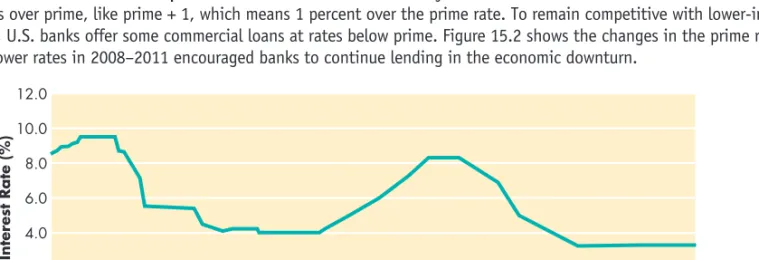
The Prime RateEvery bank receives a major portion of its income from interest paid on loans by borrowers. As long as terms and conditions are clearly revealed to borrowers, banks may set their own interest rates, within limits set by each state. Traditionally, banks only offered the lowest rate, or prime rate, to their most creditworthy commercial customers. Most commercial loans are set at markups over prime, like prime + 1, which means 1 percent over the prime rate. To remain competitive with lower-interest foreign banks, U.S. banks offer some commercial loans at rates below prime. Figure 15.2 shows the changes in the prime rate since 2000. Lower rates in 2008–2011 encouraged banks to continue lending in the economic downturn.
2000 2001 2002 2003 2004 2005Year2006 2007 2008 2009 2010 2011 12.0
10.0 8.0 6.0 4.0 2.0 0
Interest Rate (%)
Figure 15.2 The Prime Rate
Source: http://www.federalreserve.gov/releases/h15/data/annual/h15_prime_na.txt.
Pension Fund nondeposit pool of funds managed to provide retirement income for its members
Credit Union nonprofit, cooperative financial institution owned and run by its members, usually employees of a particular organization Mutual Savings Bank financial institution whose depositors are owners sharing in its profits
Savings and Loan Association (S&L) financial institution accepting deposits and making loans primarily for home mortgages
3 Finance companies specialize in making loans to businesses and consumers.
HFc Beneficial, for example, offers mortgage refinancing and personal loans.
commercial finance companies lend to businesses needing capital or long-term funds. consumer finance companies devote most of their resources to providing small noncommercial loans to individuals.
4 Securities investment dealers (brokers), such as Merrill Lynch and A. G. edwards inc., buy and sell stocks and bonds for client investors. They also invest in securities—they buy stocks and bonds for their own accounts in hopes of resell- ing them later at a profit. These companies hold large sums of money for transfer between buyers and sellers. (We discuss the activities of brokers and investment banking more fully in chapter 16.)
The Growth of Financial Services
The finance business today is highly competitive. No longer is it enough for com- mercial banks to accept deposits and make loans. Most, for example, also offer bank- issued credit and debit cards, safe-deposit boxes, ATMs, electronic money transfer, and foreign currency exchange. In addition, many offer pension, trust, international, and brokerage services and financial advice.
Pension and Trust Services Individual retirement accounts (IRAs) are tax-deferred pension funds that wage earners and their spouses can set up to supplement other retirement funds. Advantages and drawbacks to various kinds of IRAs—traditional, Roth, and education—are discussed in Appendix III.
Many commercial banks offer trust services—the management of funds left in the bank’s trust. In return for a fee, the trust department will perform such tasks as making your monthly bill payments and managing your investment portfolio. Trust departments also manage the estates of deceased persons.
International Services Suppose a U.S. company wants to buy a product from a Chinese supplier. For a fee, it can use one or more of three services offered by its bank:
1 currency exchange: it can exchange u.s. dollars for chinese yuan to pay the supplier.
2 Letters of Credit: it can pay its bank to issue a letter of credit—a promise by the bank to pay the chinese firm a certain amount if specified conditions are met.
3 Banker’s Acceptances: it can pay its bank to draw up a banker’s acceptance, which promises that the bank will pay some specified amount at a future date.
A banker’s acceptance requires payment by a particular date. Letters of credit are payable only after certain conditions are met. The Chinese supplier, for exam- ple, may not be paid until shipping documents prove that the merchandise has been shipped from China.
Prime Rate interest rate available to a bank’s most creditworthy customers
Insurance Company nondeposit institution that invests funds collected as premiums charged for insurance coverage
Finance Company nondeposit institution that specializes in making loans to businesses and consumers
Securities Investment Dealer (Broker) financial institution that buys and sells stocks and bonds both for investors and for its own accounts
Individual Retirement Account (IRA) tax- deferred pension fund that wage earners set up to supplement retirement funds
Trust Services management by a bank of an estate, investments, or other assets on behalf of an individual
Letter of Credit bank promise, issued for a buy- er, to pay a designated firm a certain amount of money if specified conditions are met Banker’s Acceptance bank promise, issued for a buyer, to pay a designated firm a specified amount at a future date
MAnAging in TUrBUlenT TiMes
Getting Serious with Credit Standards
While banks try to avoid drowning in bad loans, borrowers and lenders alike are questioning how the banks got into the current financial mess. Many observers blame subprime mortgage lend- ing. Unlike prime mortgages, subprime loans are made to high- risk borrowers—those with bad credit histories, excessive debt, inadequate income, or other indicators that they will not repay the lender. In return for riskier loans, borrowers pay higher inter- est rates. As the housing market tumbled, delinquencies skyrock- eted on millions of subprime loans. Whereas about 6 percent of mortgage loans were uncollectable from 2000 to 2005, thereafter delinquencies increased, nearing 30 percent by 2008, and on into 2010. Lenders extended too much credit to weak borrowers.9
Reports indicate that the subprime crisis can be traced to overly relaxed credit standards. One study found that many loan applications listed fraudulent information. Some borrowers, tak- ing advantage of lax lending practices to live beyond their means, lied about their income and assets in order to secure loans. Other misinformation can be attributed to mortgage brokers eager to get otherwise unqualified borrowers approved for loans. Some lenders went so far as to have a relative pose as a borrower’s fake employer and falsify W-2 forms to gain approval. These problems were compounded further by those within the banking and fi- nance system who knew that rampant fraud was occurring but looked the other way, as long as profits kept rolling in.10
Now stuck with uncollectable loans, unsellable foreclosed properties, and big financial losses, the industry is tightening
credit standards and lending practices. Federal bank examiners, for example, are insisting that loan officers use greater caution and judgment to identify credit-worthy borrowers and avoid weak loans. Lenders are switching to independent real estate appraisers who have no direct contact with loan officers, to get accurate rather than inflated property appraisals. Along with requiring bigger down payments, lenders are requiring higher minimum credit scores. Lenders are also reducing limits on credit card balances. With a dire lesson learned, it appears that tighter standards are here for the foreseeable future.11
MyBizLab
DnY59/istockphoto.com
Financial Advice and Brokerage Services Many banks, both large and small, help their customers manage their money. Depending on the customer’s situation, the bank, in its role as financial advisor, may recommend different investment op- portunities. The recommended mix might include CDs, mutual funds, stocks, and bonds. Many banks also serve as securities intermediaries, using their own stockbro- kers to buy and sell securities and their own facilities to hold them.
Electronic Funds Transfer Electronic funds transfer (EFT) provides for payments and collections by transferring financial information electronically. Consumers using debit cards instead of writing personal checks enjoy EFT’s convenience and speed at the checkout. In addition, EFT systems provide automatic payroll deposit, ATM trans- actions, bill payment, and automatic funds transfer. Such systems can help a business- person close an important business deal by transferring money from San Francisco to Miami within a few seconds. The U.S. Treasury reports that it costs $1.03 to issue a check payment, but only $0.105 to issue an EFT payment. The U.S. Social Security system expects savings of over $1 billion during the next decade by phasing out paper check payments by 2013, and instead using paperless payments for federal benefits.12 Automated Teller Machines Automated teller machines (ATMs) allow customers to withdraw money, make deposits, transfer funds between accounts, and access infor- mation on their accounts. About 420,000 machines are located in U.S. bank build- ings and other locations.13 Increasingly, ATMs have become multilingual global fixtures. As Figure 15.3 shows, among the world’s more than 2 million ATMs, most are located outside the United States, and many U.S. banks offer international ATM services. China is expected to become the world’s largest ATM market by 2015.
Automated Teller Machine (ATM) electronic machine that allows bank customers to conduct account-related activities 24 hours a day, 7 days a week
Electronic Funds Transfer (EFT) communica- tion of fund-transfer information over wire, cable, or microwave
financial institutions Create Money and Are regulated
Financial institutions provide a special service to the economy: They create money.
They don’t print bills and mint coins, but by taking in deposits and making loans, they expand the money supply.
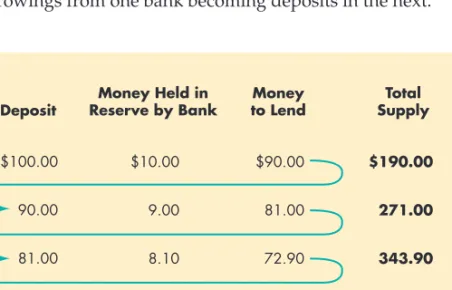
As Figure 15.4 shows, the money supply expands because banks are allowed to loan out most (although not all) of the money they take in from deposits. If you deposit $100 in your bank and banks are allowed to loan out 90 percent of all their deposits, then your bank will hold $10 in reserve and loan $90 of your money to bor- rowers. (You still have $100 on deposit.) Meanwhile, a borrower—or the people paid by the borrower—will deposit the $90 loan money in a bank (or banks). The bank will then have another $81 (90 percent of $90) available for new loans. The banks, therefore, have turned your original $100 into $271 ($100 + $90 + $81). The chain con- tinues, with borrowings from one bank becoming deposits in the next.
North America Asia
Western Europe Latin America Other
26%
20%
11%
11%
32%
Figure 15.3 Global Dispersion of ATMs
Deposit Money Held in
Reserve by Bank Money
to Lend Total Supply
$100.00 $10.00 $90.00 $190.00
90.00 9.00 81.00 271.00
81.00 8.10 72.90 343.90
72.90 7.29 65.61 409.51
65.61 6.56 59.05 468.56
Figure 15.4 How Banks Create Money
explain how financial institutions create money and describe the means by which they are regulated.
Regulation of the Banking System
Because commercial banks are essential to the creation of money, the government regulates them to ensure a sound and competitive financial system. Federal and state agencies regulate banks to ensure that the failure of some will not cause the public to lose faith in the banking system itself.
Federal Deposit Insurance Corporation The Federal Deposit Insurance Corpo- ration (FDIC) supervises banks and insures deposits in banks and thrift institutions.
The FDIC is a government agency, created by President Franklin D. Roosevelt to restore public confidence in banks during the Depression era. More than 99 percent of the nation’s commercial banks and savings institutions pay fees for membership in the FDIC. In return, the FDIC guarantees the safety of all accounts—checking, savings, and certificates of deposit (CDs)—of every account owner up to the current maximum of $250,000. If a bank collapses, the FDIC promises to pay each depositor for losses up to $250,000 per account. A person with more money can establish ac- counts in more than one bank to protect sums in excess of $250,000. (A handful of the nation’s 6,400 commercial banks are insured by states rather than by the FDIC.) To ensure against multiple bank failures, the FDIC maintains the right to examine the activities and accounts of all member banks.
The Role of the FDIC in Bank Failures What happens with banks that fail, such as the nearly 300 U.S. banks that failed in slow- down years 2009–2010? The FDIC becomes responsible for disposing of failed banks. One option is to sell them to other banks that are then responsible for the liabilities of the failed banks. Alternatively, the FDIC can seize the assets of the failed banks and undertake two activities: (1) Pay insurance to depositors and (2) dispose of the banks’ assets and settle their debts, all at the lowest cost to the FDIC’s insurance deposit fund. The resulting net gain (or loss) is put into (or paid from) the insur- ance deposit fund. As the recession of 2007–
2009 deepened, this fund had dwindled to $13 billion in 2009, down from $45 billion in 2008, before recovering to $18 billion in 2010. With more bank closures expected, the FDIC was raising assessments against member banks to restore the fund’s reserves.14
The federal reserve system
Perched atop the U.S. financial system and regulating many aspects of its opera- tion is the Federal Reserve System (the Fed), the nation’s central bank, established by Congress in 1913. This section describes the structure of the Fed, its functions, and the tools it uses to control the nation’s money supply.
The Structure of the Fed
The Fed consists of a board of governors, a group of reserve banks, and mem- ber banks. As originally established by the Federal Reserve Act of 1913, the system consisted of 12 relatively autonomous banks and a seven-member com- mittee whose powers were limited to coordinating the activities of those banks.
By the 1930s, however, both the structure and function of the Fed had changed dramatically.
Devout Muslims can’t pay or receive interest—a fact that tends to compli- cate banking operations. Because money has to work in order to earn a return, institutions like the Shamil Bank in Bahrain invest deposits directly in such ventures as real estate and pay back profit shares rather than interest.
nikolai ignatiev/PhotoLibrary
Discuss the functions of the federal reserve system and describe the tools that it uses to control the money supply.
Federal Reserve System (The Fed) central bank of the United States, which acts as the government’s bank, serves member commer- cial banks, and controls the nation’s money supply
Federal Deposit Insurance Corporation (FDIC) federal agency that guarantees the safety of deposits up to $250,000 in the financial institutions that it insures
The Board of Governors The Fed’s board of governors consists of seven mem- bers appointed by the U.S. President for overlapping terms of 14 years. The chair of the board serves on major economic advisory committees and works actively with the administration to formulate economic policy. The board plays a large role in control- ling the money supply. It alone determines the reserve requirements, within statutory limits, for depository institutions. It also works with other members of the Fed to set discount rates and handle the Fed’s sale and purchase of government securities.
Reserve Banks The Fed consists of 12 districts, as shown in Figure 15.5. Each Federal Reserve Bank holds reserve deposits from and sets the discount rate for com- mercial banks in its geographic region. Reserve Banks also play a major role in the nation’s check-clearing process.
Open Market Committee The Federal Open Market Committee is responsi- ble for formulating the Fed’s monetary policies to promote economic stability and growth by managing the nation’s money supply. Its members include the Board of Governors, the president of the Federal Reserve Bank of New York, and the presi- dents of four other Reserve Banks, who serve on a rotating basis.
Member Banks All nationally chartered commercial banks and some state-char- tered banks are members of the Fed. The accounts of all member bank depositors are automatically covered by the FDIC.
Other Depository Institutions Although many state-chartered banks, credit unions, and S&Ls do not belong to the Fed, they are subject to its regulations, pay deposit insurance premiums, and are covered by the FDIC or the National Credit Union Administration (NCUA).
Alaska and Hawaii are part of the San Francisco District
12
10
11
8
6 5 9
7 4 3
2 1
Dallas Kansas City
Richmond Board of Governors Philadelphia
New York Boston Cleveland
San Francisco
Minneapolis
Chicago
St. Louis
Atlanta
Figure 15.5 The Twelve Federal Reserve Districts
Source: http://www.federalreserve.gov/otherfrb.htm
The Functions of the Fed
In addition to chartering national banks, the Fed serves as the federal government’s bank and the “bankers’ bank,” regulating a number of banking activities. Most importantly, it controls the money supply.
The Government’s Bank The Fed produces the nation’s paper currency and de- cides how many bills to produce and destroy. It also lends money to the government by buying bonds issued by the Treasury Department to help finance the national deficit.
The Bankers’ Bank Individual banks that need money can borrow from the Fed and pay interest on the loans. In addition, the Fed provides storage for commercial banks, which are required to keep funds on reserve at a Federal Reserve Bank.
Controlling the Money Supply The Fed is responsible for the conduct of U.S.
monetary policy—the management of the nation’s economic growth by managing the money supply and interest rates. By controlling these two factors, the Fed influences the ability and willingness of banks throughout the country to loan money.
Inflation Management As defined in Chapter 1, inflation is a period of widespread price increases throughout an economic system. It occurs if the money supply grows too large. Demand for goods and services increases, and the prices of everything rise. To reduce China’s inflationary conditions in 2010–2011, for example, banking officials decreased the money supply, hoping to slow that nation’s economic growth.
In contrast, deflation occurs when the supply of goods outpaces the supply of money, so demand for goods and services falls. Decreasing prices lead businesses to cut out- put, and unemployment rises. The Fed, with its goal of economic stability, uses the money supply to avoid extreme inflation or deflation. Because commercial banks are the main creators of money, much of the Fed’s management of the money supply takes the form of regulating the supply of money through commercial banks.
The Tools of the Fed
According to the Fed’s original charter, its primary duties were to supervise banking and to manage the nation’s currency. The duties of the Fed have evolved to include an emphasis on the broad economic goals as discussed in Chapter 1, especially growth and stability. The Fed’s role in controlling the nation’s money supply stems from its role in setting policies to help reach these goals. To control the money sup- ply, the Fed uses reserve requirements, interest rate controls, and open-market operations.
Reserve Requirements The reserve requirement is the percentage of its depos- its that a bank must hold, in cash or on deposit, with a Federal Reserve Bank. High requirements mean that banks have less money to lend and the money supply is re- duced. Conversely, low requirements permit the supply to expand. Because the Fed sets requirements for all depository institutions, it can adjust them to make changes to the overall supply of money in the economy.
Check Clearing The Fed also clears checks for commercial banks to ensure that cash is deducted from the check writer’s bank account and deposited into the check receiver’s account. With electronic payments, however, the number of paper checks processed is falling, with 9.5 billion cleared by the Fed in 2008, down from a peak of 60 billion in 2000. Consumers prefer the convenience of debit and credit cards and electronic trans- actions such as direct deposits and online payments. Even with paper checks, however, the clearing is faster because banks now send the Fed some 60 million electronic images daily to be processed (instead of shipping the checks). As a result, the Fed now has just one full-service check-processing site, instead of the 45 locations needed as recently as 2003.15
creatas/jupiterimages
Discount Rate interest rate at which member banks can borrow money from the Fed
Reserve Requirement percentage of its deposits that a bank must hold in cash or on deposit with the Fed
Monetary Policy management of the nation’s economic growth by managing the money supply and interest rates
Interest Rate Controls As the bankers’ bank, the Fed loans money to banks. The interest rate on these loans is known as the discount rate. If the Fed wants to reduce the money supply, it increases the discount rate, making it more expensive for banks to borrow money and less attractive for them to loan it. Conversely, low rates encour- age borrowing and lending and expand the money supply.
More familiar to consumers, the federal funds rate (or key rate) reflects the rate at which commercial banks lend reserves to each other, usually overnight. While the Fed can’t actually control this rate, which is determined by the supply and demand of bank reserves, it can control the supply of those reserves to create the desired rate. By instructing its bond traders to buy fewer government bonds, the supply of reserves was decreased, resulting in a series of key rate increases—from a then- historic low of 1 percent in 2004 up to 5.25 percent in 2006—to slow a booming U.S.
economy. The Fed then reversed its policy as the economy lost momentum, cutting the target rate gradually down to a then-record low, 0.25 percent in 2008 to boost the economy during the recession, and then to 0.00–0.25 percent to encourage the 2011 recovery.16
Open-Market Operations Open-market operations refer to the Fed’s sale and purchase of securities (usually U.S. Treasury notes and short-term bonds) in the open market, as directed by the Fed’s Open-Market Committee. Open-market operations are particularly effective because they act quickly and predictably on the money sup- ply. The Fed buys securities from a commercial dealer, whose bank account is cred- ited for the transaction, thus giving that bank more money to lend, so this transaction expands the money supply.
The opposite happens when the Fed sells securities. Selling treasury securities to investors allows the U.S. government to raise money and contract the money sup- ply. These securities may include Treasury bills (T-bills), T-notes, and T-bonds with maturity dates ranging from short-term (a few weeks) to long-term (up to 30 years).
Treasury securities are highly liquid because they are actively traded on national securities markets, and traditionally have been considered a risk-free investment because they are backed by the U.S. government.
Fed Uses Massive Bond Purchases to Stem Recession In 2009, the Fed launched its most aggressive buying of long-term Treasury bonds in history—$300 billion—to fight the recession. The purchases were intended to push up market prices for Treasuries and thereby drive down interest rates. As long-term Treasury rates fell, other interest rates soon followed, including rates for home mortgages, business loans, and consumer loans. Overall lower interest rates were expected to encourage more widespread bor- rowing and lending to get the economy moving. However, continuing weakness led to the Fed’s 2010–2011 ground-breaking move in launching a further $600 billion pur- chase of Treasury debt. While some claim the move is essential for economic recovery, critics fear it may stimulate destructive spiraling inflation17
The Changing Money and Banking system
The U.S. money and banking systems continue to change today. Government emer- gency intervention aims to stabilize a troubled financial system. Enforcement of anti- terrorism regulations deters criminal misuse of the financial system. And with
Federal Funds Rate (Key Rate) interest rate at which commercial banks lend reserves to each other, usually overnight
Open-Market Operations the Fed’s sale and purchase of securities in the open market identify three important ways in which the money and banking system is changing.
the expansion of banking services, electronic technologies affect how you obtain money and how much interest you pay for it.
Government Intervention for Stabilizing the U.S. Financial System
The financial world was shaken with the 2008 collapse of Lehman Brothers, the lead- ing U.S. investment bank. Lehman’s bankruptcy was soon followed by the threat of another giant’s demise, as Bear Stearns teetered and then was bought by JPMorgan Chase. But JPMorgan Chase’s purchase of Bear Stearns became possible only when the Federal Reserve stepped forward with $26 billion to guarantee potential losses on Bear Stearns’s assets. With a goal of stabilizing the fractured financial system, the govern- ment continues its unprecedented infusion of funding for U.S. financial institutions.
Government Emergency Investment By mid-2009, the Fed’s investments reached nearly $300 billion, mostly in lending programs to commercial banks. Banks used the loans to get rid of bad mortgages and other hard-to-sell assets, thereby gaining cash for lending to bank customers. Another source of funds, the Troubled Asset Relief Program (TARP), a temporary program under the U.S. Treasury, was included in the government’s bailout efforts. TARP support included $15 billion to auto- financing companies at risk of failure and $235 billion in direct investments to some 600 banks to encourage lending. Other government sources provided over
$130 billion to rescue Freddie Mac and Fannie Mae, two government-sponsored en- terprises on the verge of financial failure. Freddie Mac and Fannie Mae (also known as FM2) buy home mortgages from the original lenders—for example, from banks—
and hold them or resell them. In 2008, FM2 held 80 percent of U.S. home mortgages, many of which turned bad in the collapsed housing market, and many more that continue to default today. As a result, critics are questioning whether the govern- ment should be involved in the mortgage loan business.18
Assurances of Repayment In return for its investments, the government imposes various kinds of assurances. The Fed’s loans to banks, for example, are secured by the banks’ assets. That is, the Fed holds some of the banks’ assets, such as commercial loans, residential mortgages, and asset-backed securities as collateral until the banks repay the Fed. In return for TARP funds, the U.S. Treasury holds preferred stock (dividend- paying ownership shares) of the banks. The Treasury also holds warrants—which give the right to buy shares of the banks’ stock in the future at a preset price. In addition to creating the government’s precedent-setting part ownership, TARP also imposes strict- er executive compensation requirements. In the bailout of Freddie Mac and Fannie Mae, both firms were taken over by the Federal Housing Finance Agency (FHFA) because the failure of either would severely damage global financial markets along with the U.S.
economy. FHFA took full control over the two firms’ assets and operations.19
Anti-Crime and Anti-Terrorism Regulations
Enforcement of anti-terrorism regulations deters criminal misuse of the financial system.
Under provisions of the Bank Secrecy Act (BSA), the U.S. Department of the Treasury imposed a $24 million fine on the New York branch of a Jordan-based Arab Bank for failing to implement required monitoring and record-keeping methods to deter fund- ing of crimes. The enforcement of BSA regulations includes tracking and reporting on suspicious transactions, such as a sudden increase in wire transfers or cash transactions exceeding $10,000, to cut off funding of criminal and terrorist activities.20
Banks are subject to prosecution when they fail to maintain systems for identify- ing and reporting suspicious activities that indicate possible drug transactions and money laundering. In violation of the BSA, a Miami, Florida, bank agreed to pay a
$55 million penalty to the U.S. government following charges that it did not oper- ate an effective anti-money laundering program. A Puerto Rico bank was assessed a $21 million penalty for not filing suspicious activity reports when repeated cash deposits were made into one account, often in paper bags in small denominations, totaling $20 million. A California bank was cited for not maintaining an effective
anti-money laundering program when proceeds from cocaine sales were transferred from Mexico for deposit into accounts at the bank.21
The USA PATRIOT Act, passed in 2001 and designed to reduce terrorism risks, requires banks to better know the customer’s true identity by obtaining and verifying their name, address, date of birth, and Social Security (or tax identification) number.
They must also implement a customer identification program (CIP) to verify identities, keep records of customer activities, and compare identities of new customers with government terrorist lists. Enforcement resides with examiners from the Department of the Treasury.
The Impact of Electronic Technologies
Banks are among the most enthusiastic adopters of technology to improve efficiency and customer service. In addition to EFT systems and mobile devices, banks offer access via telephone, TV, and Internet banking, which allow customers to make around-the- clock transactions. Each business day, trillions of dollars exist in and among banks and other financial institutions in purely electronic form. Each day, the Fed’s Fedwire funds transfer system—the world’s largest electronic payments system—processes about $4 trillion in transactions for some 8,900 financial institutions.
Automated Clearing House (ACH) Network ACH is an electronic funds transfer system that provides interbank clearing of electronic payments for the na- tion’s financial institutions. The ACH network allows businesses, government, and consumers to choose an electronic-over-paper alternative for payments (instead of written checks); the system is green, safe, and efficient.
ACH payments include:
• Internet-initiated debit and credit payments by businesses and consumers
• B2B electronic payments
• Direct deposit of payroll, Social Security benefits, and tax refunds
• Federal, state, and local tax payments
• E-checks
• Direct payment of consumer bills: mortgages, loans, utility bills, and insurance premiums
• E-commerce payments
In 2009, the ACH system processed some 19 billion payments that were initiated or received by customers at 15,000 U.S. businesses and financial institutions. Those payments totaled more than $30 trillion. With the federal government’s use of ACH, each direct deposit that replaces a check saves $0.925. With more than 1 billion direct deposits for 2009, the federal savings was more than $1 trillion.
The ACH system is governed by NACHA—The Electronic Payments Association—
which administers and enforces the association’s strict NACHA Operating Rules for sound risk management practices. Although NACHA was formed within the American Bankers Association, it later became an independent not-for-profit asso- ciation that launched the Accredited ACH Professional program and established the system’s operating rules.22
Check 21: Making the Paper Check Go Away The Check Clearing for the 21st Century Act (Check 21), which became federal law in 2004, allows a receiving bank to make an electronic image of a paper check and electronically send the image to the paying bank for instant payment instead of waiting days for the paper check to wind its way back to the sender. More banks are adopting check image processing (Check 21) and benefitting from its speed and cost efficiency: less paper handling, reduced reliance on physical transportation, faster collection times, and elimination of expen- sive float. Today, almost 99 percent of the items processed by the Fed are images in- stead of in paper form. The days of writing a check, mailing it, and having several days to put money in the account to cover it are numbered, due to faster check clearing.23
enTrepreneUrship AnD neW VenTUres
Cultivating a Social Side for Community Banking
While the U.S. banking system struggles in a distressed econ- omy, smaller community banks are confronted with vigorous challenges from larger banks that stretch across state lines, competing for local consumers and commercial customers.
State-chartered Fidelity Bank, serving Central Massachusetts, is an example. With headquarters in Leominster (population 41,000) and full-service facilities in five nearby towns, Fi- delity’s primary competitive advantage is its commitment to long-term community relationships developed since being es- tablished in 1888.
Unlike many smaller banks across the nation, Fidelity ex- perienced a relatively successful year, remaining financially sound through the challenging 2009 economic environment.
Consumer and business deposit accounts increased, a record number of first mortgage loans were issued, many borrow- ers refinanced their homes at lower interest rates to reduce monthly payments, and the bank’s commercial lending opera- tion gained recognition by the Small Business Administration for offering new business loan products, with faster and more effective approval processes. By streamlining its services, cus- tomers can use mobile banking—“like carrying a branch bank in your pocket”—for “anywhere/anytime” access to their ac- counts, and text-messaging provides quick information on ac- count balances.24
Fidelity’s newest initiative, launched in 2011, is a social media program for strengthening customer and community re- lationships. It aims for broader exposure of the bank’s brand through a visible and widespread presence in the social me- dia. The focal resource is a publicly accessible blog, available at Fidelity’s website, designed to encourage communications among customers, bank employees, and the local communi- ties-at large. Its content is then broadcast outward in digital space via connectivity with social media including Twitter, YouTube, LinkedIn, and Facebook. Aided by social media specialists—Digital Brand Expressions—Fidelity’s upgraded media reach involves increasing the bank’s listings in major search engines, expanding key-word links from other websites,
and utilizing podcasts for competitive advantage. The program enables monitoring of how Fidelity is being talked about in the social media, frequencies of messages, and then taking steps to guide employees toward more effective communicat- ing with constituents. Measurements of frequencies for social network mentions and types of message content can then be compared to changes in product acceptance—savings, loans, investments, and insurance—among consumers and business customers. The results will enable the bank to determine the success of its social media program in terms of profitability and customer satisfaction. 25
MyBizLab
Blink Credit Card “Blink” technology uses a computer chip that sends radio-fre- quency signals in place of the magnetic strips that have been embedded in credit cards for the past 30 years. The “contactless” payment system lets consumers wave the card in front of a merchant’s terminal, at a gas pump or in a department store, without waiting to swipe and sign. Radio-frequency identification, while new to credit cards, is familiar on toll roads with electronic passes that allow drivers to avoid waiting in line to pay.
Debit Cards Unlike credit cards, debit cards do not increase the funds at an indi- vidual’s disposal but allow users only to transfer money between accounts to make retail purchases. Debit cards are used more than credit cards as payment for U.S.
consumer transactions. However, the risk of financial loss is greater for debit cards.
Paul Rapson/Alamy
Smart Card credit-card-sized plastic card with an embedded computer chip that can be programmed with electronic money Point-of-Sale (POS) Terminal electronic device
that transfers funds from the customer’s bank account to pay for retail purchases Debit Card plastic card that allows an individual to transfer money between accounts
Federal law limits the credit card user’s liability to $50 for stolen or fraudulent use.
Protection against debit card losses can be higher—ranging up to $500—depending on how quickly the lost card is reported. 26
Many stores use point-of-sale (POS) terminals to communicate relevant purchase information with a customer’s bank. A customer inserts a card, and the bank auto- matically transfers funds from the customer’s account to the store’s account.
Smart Cards A smart card has an embedded computer chip that can be pro- grammed with “electronic money.” Also known as electronic purses or stored-value cards, smart cards have existed for more than a decade. They are most popular in gas- pump payments, followed by prepaid phone service, ATMs, self-operated checkouts, vending machines, and automated banking services.27
international Banking and finance
Electronic technologies permit nearly instantaneous financial transactions around the globe. These business exchanges—the prices asked and paid—are affected by val- ues of the currencies among the various nations involved in the transactions. Once agreements are reached, the international payments process that moves money between buyers and sell- ers on different continents is not subject to any worldwide policy system beyond loosely structured agreements among countries.
Currency Values and Exchange Rates
Euros, pesos, dollars, and yen—money comes in all sizes and stripes. With today’s global activities, travelers, shop- pers, investors, and businesses often rely on banks to con- vert their dollars into other currencies. When it comes to choosing one currency over others, the best choice changes from day to day. Why? Because every currency’s value changes, reflecting global supply and demand—what trad- ers are willing to pay—for one currency relative to others.
One index for the value of the U.S. dollar, for example, is the average of its foreign exchange values against the cur- rencies of a large group of major U.S. trading partners. The resulting exchange rate—the value of one currency com- pared to the value of another—reveals how much of one currency must be exchanged for another. At any one time, then, some currencies are “strong”—selling at a higher price and worth more—while others are “weak.” Rates of exchange among currencies are published daily in financial media around the world, and at online foreign currency exchange (forex) markets.28
Exchange Rate the value of one currency compared to the value of another
Citizens of the Republic of Belarus, along with visitors from other countries, rely on information about current exchange rates between the Belarusian ruble (Br) and currencies of other countries. The BelarusBank is a local provider of currency exchange services.
Tatyana Zenkovich/Photoshot
Discuss some of the insti- tutions and activities in international banking and finance.
Strong Currency or Weak: Which Is Better? Most people would prefer a
“strong” currency, right? Well, not so fast. It depends on how it will be used. Using money for international activities, such as taking a vacation, for example, is one of those “good news–bad news” situations.
Consider the euro, at times up as much as 83 percent against the U.S. dollar since 2002. As a citizen in one of the 23 euro-area countries—for example, France—you chose wisely in delaying that U.S. vacation until 2011. Each euro in 2011 paid for about $1.45 of the trip, but it would have covered only $0.87 in 2002. That’s the good news: The stronger euro means more purchasing power against the weaker dol- lar. It’s bad news, though, for French innkeepers because Americans go elsewhere to avoid expensive European travel—it takes $1.45 for €1 of vacation cost, up from
$0.83 nine years earlier. Simply put, that $0.83 cup of coffee at a French sidewalk café in 2002 now costs you $1.45. In this example of the U.S. dollar to euro, your purchas- ing power has declined as the dollar has weakened against the euro.
The stronger euro has proven to be a stumbling block for Europe’s economy, espe- cially for industries that export to non-euro countries with weaker currencies. Prices (in U.S. dollars) had to be increased, for example, on German-made Mercedes and BMW auto exports to the United States to cover the higher euro-based manufactur- ing costs, causing weaker U.S. demand and sales. While the weaker dollar has hurt many European firms that export products to the U.S., others have gained by increas- ing their U.S. investments. When DaimlerChrysler, for example, produces Mercedes M-class autos in Alabama, it pays in weaker dollars for manufacturing them, exports cars to Europe, and sells in euros for windfall profits. On balance, however, many euro-based firms have faced sagging sales, with slower revenue growth due to a strong euro.
Bank Policies Influence Currency Values In managing the money supply and interest rates, the Fed strongly influences the dollar’s strength against other curren- cies. The European Central Bank (ECB) has the same role in the euro zone. The rais- ing of interest rates tends to increase an economic system’s currency value, whereas lowering the rate has the opposite effect. Europe’s economic recovery is slower than desired when the euro is strong because euro-zone companies are less competitive against global counterparts. Even so, the European Central Bank (ECB) refuses to weaken the euro by cutting interest rates. With lower rates, the supply of euros would increase, and the price of euros would fall—stimulating Europe’s economy.
But, the ECB fears, it would also stimulate too much inflation.
In contrast, the U.S. Federal Reserve continues with low interest rate policies to stimulate the ailing economy, and in doing so contributes to weakening the dollar.
The weaker dollar makes U.S. goods cheaper and more attractive on the world’s markets, thus increasing U.S. export sales. At the same time, the weaker dollar makes foreign imports more expensive, so U.S. consumers can afford fewer imported prod- ucts, many of which are available only from foreign manufacturers. Some must-have commodities, too, such as petroleum, are priced worldwide in U.S. dollars, so as the dollar’s value falls, the price of oil increases because it takes more of those weaker U.S. dollars to buy each barrel.29 We see, then, some of the ways that banking and banking policies significantly influence currency values.
The International Payments Process
Financial settlements between buyers and sellers in different countries are simpli- fied through services provided by banks. For example, payments from U.S. buyers start at a local bank that converts them from dollars into the seller’s currency—for example, into euros to be sent to a seller in Greece. At the same time, payments and currency conversions from separate transactions also are flowing between Greek businesses and U.S. sellers in the other direction.
If trade between the two countries is in balance—if money inflows and outflows are equal for both countries—then money does not actually have to flow between the two countries. If inflows and outflows are not in balance at the U.S. bank (or at the Greek
International Monetary Fund (IMF) UN agency consisting of about 150 nations that have combined resources to promote stable exchange rates, provide temporary short- term loans, and serve other purposes World Bank UN agency that provides a
limited scope of financial services, such as funding improvements in underdeveloped countries
bank), then a flow of money—either to Greece or to the United States—is made to cover the difference.
International Bank Structure
There is no worldwide banking system comparable, in terms of policy making and regulatory power, to the system of any industrialized nation. Worldwide banking stability relies on a loose structure of agreements among individual countries or groups of countries.
Two United Nations agencies, the World Bank and the International Monetary Fund, help to finance international trade. Unlike true banks, the World Bank (techni- cally, the International Bank for Reconstruction and Development) provides only a very limited scope of services. For instance, it funds national improvements by making loans to build roads, schools, power plants, and hospitals. The resulting improvements eventually enable borrowing countries to increase productive capac- ity and international trade.
Another U.N. agency, the International Monetary Fund (IMF), is a group of some 150 nations that have combined resources for the following purposes:
• To promote the stability of exchange rates
• To provide temporary, short-term loans to member countries
• To encourage members to cooperate on international monetary issues
• To encourage development of a system for international payments
The IMF makes loans to nations suffering from temporary negative trade bal- ances. By making it possible for these countries to continue buying products from other countries, the IMF facilitates international trade. However, some nations have declined IMF funds rather than accept the economic changes that the IMF demands.
For example, some developing countries reject the IMF’s requirement that they cut back social programs and spending in order to bring inflation under control.
Continued from page 387
shakeups Bring a Wakeup Call to Banking
The failure of Crescent Bank and Trust in Jasper, Georgia, will cost the FDIC more than $240 million and that’s just one example among the 157 U.S. bank failures in 2010, after another 140 closures in 2009, the highest since 1992.30 The nation’s remain- ing 6,400 lenders, too, are shaken by the housing market collapse. As uncollectable loans increase, banks are left with unsellable foreclosed properties, and housing val- ues are continuing to fall.
Along with industry giants, hundreds of smaller U.S. banks face additional losses of billions on commercial loans for office buildings, shopp